
About TNTET 2027 Exam Series
📖 Table of Contents
- TNTET 2027 at a glance
- What TNTET is, and what it is not
- The 2025 cycle, from notification to result
- Who can apply
- The fee, and the outdated Rs 500 figure
- TNTET Paper 1: five sections of 30 marks
- TNTET Paper 2: the 60 mark section decides it
- Qualifying marks: the G.O. 23 change
- No negative marking, and what it means for strategy
- The special TNTET 2026, and why fresh candidates cannot apply
- Syllabus: state board books are the base
- A 90 day plan that follows the marks
- Five mistakes that cost candidates the certificate
- How this guide was put together
- Sources
TNTET 2027: Complete Exam Guide
The Tamil Nadu Teacher Eligibility Test is an eligibility test, not a recruitment exam. Clearing it gives a candidate a lifetime certificate to teach Classes 1 to 8 in Tamil Nadu schools. It does not give a job.
Teaching posts are filled through separate Teachers Recruitment Board notifications, and a TNTET pass is the entry ticket for those. The last cycle open to fresh candidates was TNTET 2025, under Notification No. 03/2025 dated 11 August 2025. TNTET Paper 1 was held on 15 November 2025 and TNTET Paper 2 on 16 November 2025.
The result was published on 30 January 2026. As of early November 2026, the board has not announced the next regular TNTET for fresh candidates. This TNTET 2027 guide works from the 2025 cycle, because that is the document the next open notification will most likely follow.
Two facts confuse first time candidates more than any others. The first is the fee. It is Rs 600 per paper for general candidates and Rs 300 per paper for SC, SC (Arunthathiyar), ST and differently abled candidates, and Paper I and Paper II need separate applications and separate fees.
The second is the pass mark. It changed after the exam, when Government Order Ms No. 23 of 28 January 2026 lowered the qualifying marks for the 2025 result. General candidates need 60 percent, BC, BC (Muslim), MBC and DNC need 50 percent, and SC, SC (Arunthathiyar) and ST need 40 percent.
Older pages that still print 55 percent for reserved categories are out of date.
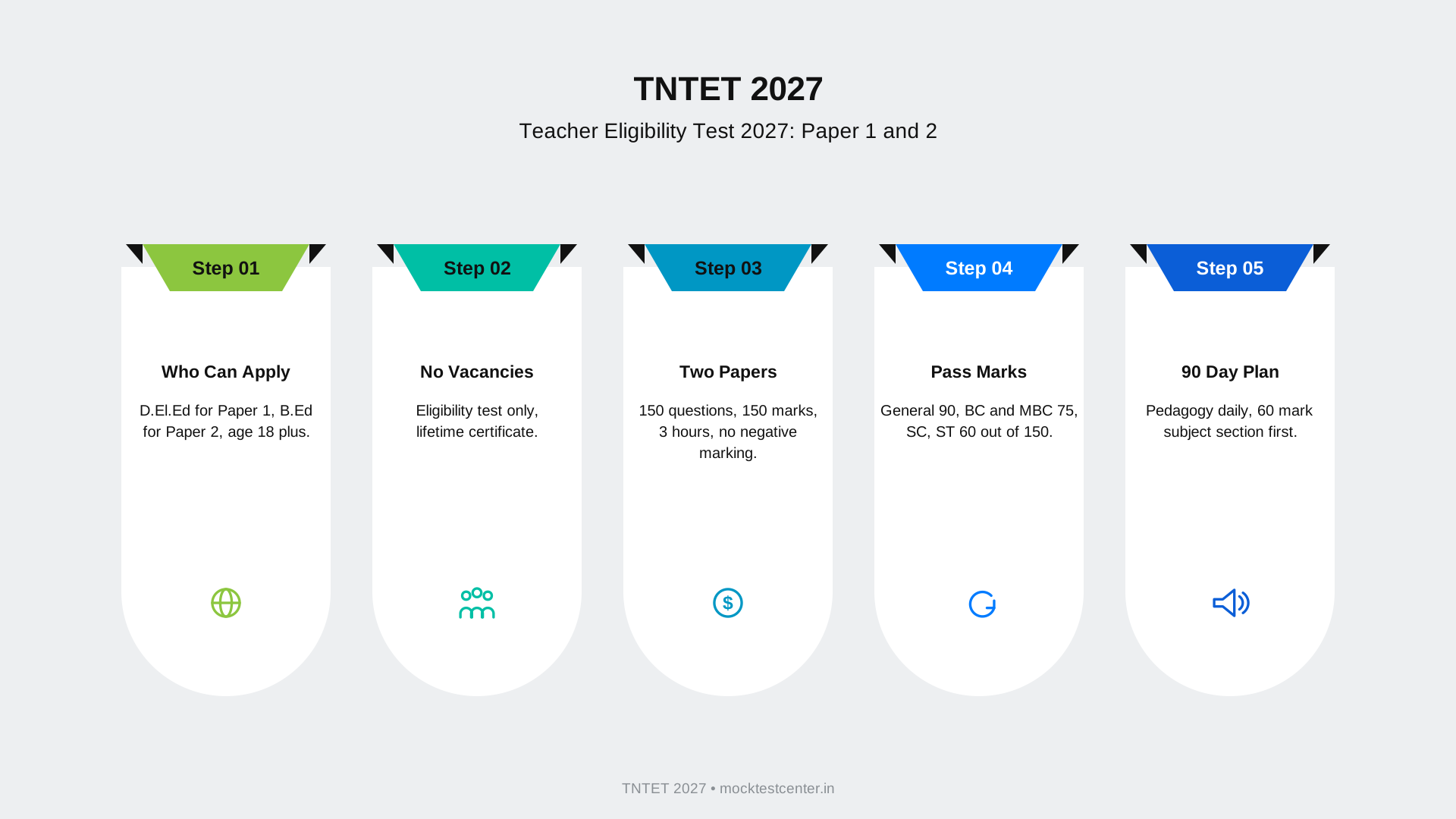
The test itself is straightforward in shape. Both papers have 150 objective questions for 150 marks, answered on an OMR sheet in three hours, with one mark per question and no negative marking. Paper I is for Classes 1 to 5, and Paper II is for Classes 6 to 8. A candidate who is eligible for both levels can write both papers, and many do, because the Child Development and Pedagogy section is common to both.
TNTET 2027 at a glance
| Detail | TNTET 2025, the live cycle |
|---|---|
| Conducting body | Teachers Recruitment Board (TRB), Tamil Nadu |
| Test type | Eligibility test, no vacancies, no job on clearing |
| Notification | No. 03/2025, 11 August 2025 |
| Application window | 11 August to 10 September 2025 |
| Exam dates | Paper I 15 November 2025, Paper II 16 November 2025 |
| Exam mode | Offline, OMR based, 10 AM to 1 PM each paper |
| Questions and marks | 150 MCQs per paper, 150 marks, 3 hours, 1 mark each |
| Negative marking | None |
| Application fee | Rs 600 per paper, Rs 300 for SC, SC (A), ST and PwD, per paper |
| Qualifying marks | General 60 percent, BC and MBC 50 percent, SC, SC (A) and ST 40 percent |
| Result | 30 January 2026, under G.O. (Ms) No. 23 of 28 January 2026 |
| Certificate validity | Lifetime |
| Age | Minimum 18 years as on 1 July 2025, no upper age limit |
| Official website | trb.tn.gov.in |
What TNTET is, and what it is not
TNTET exists because of the Right of Children to Free and Compulsory Education Act 2009 and the NCTE rules under it. Passing the test is the basic eligibility to teach Classes 1 to 8. The Teachers Recruitment Board has conducted the test since 2012, and the pattern has stayed broadly stable across cycles: two papers, 150 questions each, OMR sheets, no negative marking.
The certificate is the point. A Tamil Nadu government order of August 2021 made the TNTET certificate valid for life. It was earlier valid for seven years. A candidate who clears the test once does not need to clear it again, and the certificate stays valid for every later teacher recruitment the candidate applies to.
The posts come later, through separate notifications. Secondary Grade Teacher posts generally match Paper I, and Graduate Teacher and BT Assistant posts generally match Paper II. Each of those recruitments has its own exam, its own vacancies and its own pay scale.
A TNTET pass is necessary for them, and it is not sufficient on its own. Candidates who treat the TET certificate as a job offer will be disappointed. Candidates who treat it as a licence they must hold before the real competition starts will plan correctly.
The test also has no interview and no merit list. The result shows each candidate as Qualified or Not Qualified, based on the final answer key. There is no ranking, no cut off that moves with competition, and no waiting list. The qualifying mark is fixed by government order for each category, and a candidate either reaches it or does not.
The 2025 cycle, from notification to result
Notification No. 03/2025 came out on 11 August 2025. Applications opened the same day and were first due to close on 8 September 2025.
The last date was later extended to 10 September 2025 at 5 PM, and the fee payment last date moved with it. The edit window ran from 9 to 11 September 2025.
The exam dates moved once. The notification first listed Paper I for 1 November 2025 and Paper II for 2 November 2025, marked tentative. A board notice of 14 August 2025 revised them to 15 November and 16 November 2025.
Paper I ran on 15 November and Paper II on 16 November, each in a single morning shift from 10 AM to 1 PM, with extra time to 2 PM for PwD candidates. Hall tickets were released on 3 November 2025, and the tentative answer key came out on 25 November 2025.
The result came with a change to the pass marks. G.O. (Ms) No. 23, dated 28 January 2026, lowered the qualifying marks, and the result was published with a board notice dated 30 January 2026.
One tracker prints 31 January 2026 as the result date, but the board notice is dated 30 January 2026, and this guide uses 30 January.
A later order, G.O. (Ms) No. 46 of 25 February 2026, set the PwD pass mark at 40 percent, and the PwD results followed on 26 February 2026.
About 92,412 candidates appeared for Paper I and about 3,31,923 appeared for Paper II, according to tracker reports of the result. The Paper II figure is more than three times the Paper I figure, which fits the shape of teacher training in the state: far more graduates hold a B.Ed than a D.El.Ed. Both numbers are reported figures, not board published totals, and the upload check may confirm them against the board result notice.
Who can apply
Eligibility depends on the paper, and each route has its own percentage condition. Read the full table in the notification for your cycle, because the summary below cannot cover every route.
For Paper I, the main route is Higher Secondary with at least 50 percent marks plus a two year Diploma in Elementary Education. The percentage drops to 45 percent under the NCTE 2002 norms route. Other routes are a four year B.El.Ed with at least 50 percent in Higher Secondary, a two year Diploma in Education in Special Education, graduation with a two year Diploma in Elementary Education, and graduation with at least 50 percent plus a B.Ed.
For Paper II, the main route is graduation with at least 50 percent plus a B.Ed. Reserved categories, meaning SC, ST, BC, MBC, DNC and persons with disabilities, can qualify with 45 percent in graduation under NCTE norms. Other routes are graduation with a two year Diploma in Elementary Education, Higher Secondary with 50 percent plus a four year B.El.Ed or a four year B.A.Ed or B.Sc.Ed, and graduation or post graduation with at least 50 percent plus a B.Ed in Special Education.
Candidates in the final year of D.El.Ed, B.El.Ed or B.Ed may also appear. The TET certificate is issued only after they pass the course and submit proof to the board. That rule lets final year students sit the exam without waiting a year, and it also means a final year candidate who fails the course holds no certificate even with a TET pass.
The age rule is simple. For TNTET 2025, candidates had to be at least 18 years old as on 1 July 2025, and there was no upper age limit. A 40 year old graduate with a B.Ed can sit the test on the same terms as a 22 year old. The special sessions for working teachers set no age limit either, because they are open only to serving teachers.
The fee, and the outdated Rs 500 figure
The fee is Rs 600 per paper for general and other categories, and Rs 300 per paper for SC, SC (Arunthathiyar), ST and differently abled candidates. Paper I and Paper II need separate applications and separate fees, so a candidate who writes both papers pays twice. The fee is paid online only, through net banking, a credit card or a debit card, and it is not refundable.
Several older pages still print Rs 500 for general candidates and Rs 250 for reserved candidates. That was the fee in earlier cycles, and it is out of date for 2025. The Rs 600 and Rs 300 figures are confirmed by Shiksha, Jagran Josh, Adda247, CareerPower and the 2026 cycle guides, all quoting the 2025 notification. This guide uses Rs 600 and Rs 300, and flags the Rs 500 figure as an old cycle figure that some trackers never updated.
The practical point is about budgeting for both papers. A general candidate who writes both papers pays Rs 1,200 in fees, and a reserved candidate pays Rs 600. That is a small sum next to a teaching career, but a candidate who budgets for one paper and then decides to add the second needs to know the second fee is a fresh payment, not an add on.
TNTET Paper 1: five sections of 30 marks
Paper I is for teaching Classes 1 to 5. It has five sections, each with 30 questions for 30 marks, and the total is 150 questions for 150 marks in three hours.
| Section | Questions | Marks |
|---|---|---|
| Child Development and Pedagogy, ages 6 to 11 | 30 | 30 |
| Language I, Tamil, Telugu, Malayalam, Kannada or Urdu | 30 | 30 |
| Language II, English | 30 | 30 |
| Mathematics | 30 | 30 |
| Environmental Studies | 30 | 30 |
| Total | 150 | 150 |
Child Development and Pedagogy covers growth and development, learning theories, constructivism, intelligence, motivation, personality, assessment, guidance, pitched at the 6 to 11 age group. Language I tests comprehension, grammar, vocabulary, literature, language teaching methods in the chosen regional language. Language II tests reading comprehension, grammar, vocabulary, listening, speaking skills, the teaching of English.
Mathematics covers numbers, operations, fractions, measurement, geometry, data handling, the teaching of mathematics. Environmental Studies covers family, food, water, plants, animals, health, environment, Tamil Nadu geography basics.
The five equal sections make Paper I a balanced paper. No section can be ignored, because each one is a fifth of the total. A candidate who scores 25 out of 30 in four sections and 10 out of 30 in the fifth still lands at 110, which clears the general pass mark of 90 with room to spare.
The risk is a candidate who scores well in three sections and collapses in two. Balance beats brilliance here.
TNTET Paper 2: the 60 mark section decides it
Paper II is for teaching Classes 6 to 8. It has four sections, and the total is again 150 questions for 150 marks in three hours. The difference from Paper I is the subject section, which carries 60 marks instead of 30.
| Section | Questions | Marks |
|---|---|---|
| Child Development and Pedagogy, ages 11 to 14 | 30 | 30 |
| Language I | 30 | 30 |
| Language II, English | 30 | 30 |
| Mathematics and Science, or Social Science | 60 | 60 |
| Total | 150 | 150 |
The subject section is a choice. A candidate picks Mathematics and Science or Social Science, and the choice should follow the subject the candidate studied and intends to teach. Mathematics and Science covers the number system, algebra, geometry, measurement, physics, chemistry, life science basics.
Social Science covers history, geography, civics, economics. The section is 40 percent of the paper, so it needs the largest share of preparation time. A candidate who treats it as one section among four will underprepare for the part that decides the result.
Child Development and Pedagogy appears in both papers, with the age group shifting from 6 to 11 in Paper I to 11 to 14 in Paper II. A candidate who writes both papers gets double value from pedagogy preparation, and the two language sections are also common in shape. That is why many candidates write both papers in the same cycle. The extra fee buys a second certificate with preparation that largely overlaps.
Qualifying marks: the G.O. 23 change
The qualifying marks for the 2025 result were set by G.O. (Ms) No. 23, dated 28 January 2026.
| Category | Qualifying percent | Marks out of 150 |
|---|---|---|
| General | 60 percent | 90 |
| BC, BC (Muslim), MBC and DNC | 50 percent | 75 |
| SC, SC (Arunthathiyar) and ST | 40 percent | 60 |
| Persons with disabilities | 50 percent in 2025, 40 percent from February 2026 | 75, then 60 |
The change matters because the notification itself printed different figures. Before G.O. 23, reserved categories needed 55 percent, which is 82 marks, and ST candidates had a one time concession of 60 marks for the 2025 test only.
G.O. 23 replaced those figures with the 60, 50 and 40 percent scale, and applied the new scale to the 2025 result.
A candidate who scored 80 marks in 2025 and belonged to a BC category failed under the notification figures and passed under G.O. 23. That is a real difference, and it is why the result notice and the government order matter more than the notification for the pass mark.
Two cautions follow. The next notification may print yet another pass mark scale, and a new government order may change it again after the exam. Candidates should check the pass mark in the result notice for their own cycle, not in a guide written for an earlier one.
The second caution is about the PwD figure. The 40 percent PwD mark comes from a February 2026 order reported by trackers, and the upload check should confirm it against the board notice before the page goes live.
No negative marking, and what it means for strategy
Neither paper has negative marking. Each question carries one mark, and a wrong answer costs nothing. The strategy follows from that single fact: attempt every question.
A blank answer can only cost marks, and a guess has a one in four chance of earning a mark for free. There is no penalty to manage, no negative mark to fear, and no reason to leave a question blank.
The absence of negative marking also changes how a candidate should use the last 15 minutes. In a paper with negative marking, the last minutes go to checking doubtful answers. In TNTET, the last minutes go to answering the questions that were skipped, even by elimination.
A candidate who finishes with 20 questions unanswered has thrown away 20 marks of free chances. The OMR sheet makes this easy to miss, because a skipped question looks the same as an answered one from the outside. Count the marked bubbles before the sheet goes in.
The special TNTET 2026, and why fresh candidates cannot apply
The last two years have been unusual for TNTET, and a fresh candidate who reads only headlines can easily apply for the wrong test. In September 2025, the Supreme Court ruled that in service teachers of Classes 1 to 8 must clear the Teacher Eligibility Test. The board then ran special TNTET sessions for working teachers only.
The first special session ran under Notification No. 01/2026, dated 13 February 2026. Paper I was held on 4 July 2026 and Paper II on 5 July 2026.
About 59,535 teachers wrote Paper I and about 1,60,929 wrote Paper II. The results, with the final answer key, were published on 12 October 2026.
The second special session runs under Notification No. 02/2026, dated 26 October 2026. Applications ran from 27 October to 19 November 2026, and the exam is tentatively scheduled for 20 December 2026, with Paper II in the forenoon and Paper I in the afternoon. Only working Secondary Grade Teachers, BT Assistants, BRTEs, equivalent cadre teachers and IEDSS special education teachers appointed on or before 1 September 2025 can apply, and only if they serve in government, government aided or recognised unaided schools in Tamil Nadu.
Fresh B.Ed and D.El.Ed candidates cannot apply for the special sessions. The next regular TNTET open to fresh candidates has not been announced as of early November 2026. The special sessions use the same papers, so preparation stays the same. The application is different.
A fresh candidate who applies for the December 2026 session will find the application rejected, because the eligibility check is built into the form.
Syllabus: state board books are the base
The board frames the syllabus around the Tamil Nadu school curriculum for the classes each paper covers. Questions can test understanding a little beyond textbook level, so state board textbooks are the natural base. A candidate who works through the relevant Tamil Nadu textbooks class by class, and makes short notes while doing it, covers most of the content sections.
For Paper I, the content sections are Mathematics and Environmental Studies, and the language sections need daily practice in comprehension and grammar. For Paper II, the content section is the 60 mark subject paper, and it needs the deepest work. Pedagogy is the section that rewards concept clarity over memorising, and it is the section where a candidate who understands learning theories scores steadily while a candidate who memorised definitions scores in patches.
Language I deserves a note of its own. The choices are Tamil, Telugu, Malayalam, Kannada, Urdu, and the candidate picks one. Most Tamil Nadu candidates pick Tamil, and the Tamil section tests comprehension, grammar, vocabulary, literature, teaching methods.
A candidate who studied Tamil only up to Class 10 and has not read Tamil grammar since should not assume the section is easy. It is set at a level that tests formal grammar, and formal grammar fades fast without practice.
A 90 day plan that follows the marks
Ninety days is enough for TNTET if the plan follows the marks table. Pedagogy is common to both papers, so it takes a daily slot from day one. The subject section in Paper II carries 60 marks, so it takes the largest share of study time for Paper II candidates.
The language sections need daily practice rather than weekend blocks. Comprehension and grammar improve with frequency.
Days 1 to 30 build the base. Pedagogy gets one hour a day, working through learning theories and child development in order. The subject section gets two hours a day for Paper II candidates. Mathematics and Environmental Studies get two hours a day for Paper I candidates.
Language I and Language II get 30 minutes each a day, with one comprehension passage and ten grammar questions in each slot. State board textbooks supply the content, and short notes capture it.
Days 31 to 60 add test conditions. One full paper a week, 150 questions in three hours on an OMR style sheet, marked the same day. The analysis matters more than the score.
Every wrong answer gets a note: was it a knowledge gap, a reading error, or a guess that failed? Knowledge gaps go back into the notes. Reading errors get a slower reading habit.
Guesses stay guesses, because there is no penalty for them.
Days 61 to 90 are revision and simulation. Two full papers a week, with the gaps spent only on the topics the papers exposed. Pedagogy revision covers the theories that confuse candidates most, such as the difference between constructivism and behaviourism in classroom practice. The last week includes a full mock of the exam day: three hours, 150 questions, no phone, no breaks, the OMR sheet filled in pencil first and then in pen as the board requires.
Mock tests earn their place because TNTET is a three hour paper with 150 questions, which leaves 72 seconds per question. That sounds generous until the comprehension passages and the 60 mark subject section arrive. A candidate who has never sat a timed 150 question paper will spend the first half hour learning the pace inside the real exam. That is a lesson best learned at home, with a clock and a printed OMR sheet.
Five mistakes that cost candidates the certificate
The first mistake is choosing the wrong paper. Paper I is for Classes 1 to 5 and Paper II is for Classes 6 to 8, and the eligibility routes differ. A B.Ed graduate who applies for Paper I without a D.El.Ed may find the application rejected, and a D.El.Ed holder who applies only for Paper II misses the primary level entirely. Read the eligibility table for your own qualification before you pay.
The second mistake is treating TNTET as a job. It is an eligibility test, and the certificate opens the door to teacher recruitments that run separately. A candidate who clears TNTET and then waits for a posting will wait a long time. The next step after the certificate is the Secondary Grade Teacher or Graduate Teacher recruitment, and those have their own exams and dates.
The third mistake is underpreparing the 60 mark subject section in Paper II. It is 40 percent of the paper, and candidates who spread their time evenly across four sections give it a quarter of their effort for 40 percent of the marks. The subject section deserves the largest share of the plan, and the other three sections share the rest.
The fourth mistake is paying for one paper and assuming it covers both. Paper I and Paper II need separate applications and separate fees. A candidate who registers for Paper I and walks into the Paper II hall will not be on the list. Register for both if you are eligible for both, and pay both fees.
The fifth mistake is trusting an old pass mark. The 55 percent figure for reserved categories was correct before G.O. 23, and it is wrong now.
A candidate who aims for 82 marks because an old page said so may stop studying 8 marks short of the 90 mark general pass line. Aim for 100 marks in practice, and the pass line takes care of itself.
How this guide was put together
Every date and fee and mark and rule in this guide comes from Notification No. 03/2025 and the board notices that followed it, as reported by trackers that quote them. The official notification PDF sits on trb.tn.gov.in, and the board site was not reachable from the machine that built this page, so the notification was read through the trackers that reproduce it. The most complete of those are the Testkart TN TET guide and the Shanmugam IAS Academy TNTET guide, both updated in November 2026, which work from the official TRB notices, the Tamil Nadu School Education Department government orders and the NCTE rules.
Three disagreements between trackers are worth naming. The fee is the first. Chegg and GetMyUni print Rs 500 for general candidates and Rs 250 for reserved candidates, which was the fee in earlier cycles.
Shiksha, Jagran Josh, Adda247, CareerPower and Testkart all print Rs 600 and Rs 300 for the 2025 notification, as do the 2026 cycle guides. This guide uses Rs 600 and Rs 300.
The result date is the second. Adda247 prints 31 January 2026. Testkart and the Shanmugam guide print 30 January 2026, citing the board notice dated 30 January 2026. This guide uses 30 January 2026.
The third is the Paper II section split in one older tracker, which lists Language I twice and omits the pedagogy section. The section table in this guide follows the Testkart and Shanmugam pattern, which matches the notification.
One more caution belongs here. The applicant numbers, about 92,412 for Paper I and about 3,31,923 for Paper II, are tracker reported figures from the result, and the board site was not reachable to confirm them against the result notice. The PwD pass mark of 40 percent from the February 2026 order is also tracker reported. The upload check should confirm both against the official board notices before the page goes live.
The next regular TNTET has no announced date. The special session on 20 December 2026 is for working teachers only, and it is not the next open cycle. Fresh candidates should prepare on the 2025 pattern and watch trb.tn.gov.in for the notification, because the board gives about a month between the notification and the last date to apply.
A candidate who starts after the notification has four weeks to cover a 150 question paper. A candidate who starts now has the whole season.
Sources
TRB Notification No. 03/2025, 11 August 2025, and TRB result notice dated 30 January 2026, on trb.tn.gov.in.
G.O. (Ms) No. 23, School Education Department, 28 January 2026.
Testkart TN TET guide, updated November 2026.
Shanmugam IAS Academy TNTET guide, updated 3 November 2026. Shiksha TNTET 2025 page. Jagran Josh TNTET 2025 page.
Adda247 TNTET result and application form pages. CareerPower TNTET Notification 2025 page.
The Times of India report on the TNTET 2025 revised schedule, September 2025.
The Telegraph India report on the TNTET 2025 schedule and timings, November 2025.







