
About TNPSC Combined Technical Services 2027 Exam Series
📖 Table of Contents
- TNPSC Combined Technical Services 2027 at a glance
- The 76 posts, post by post
- Who can apply, and the age rule
- Paper I and Paper II, and the Tamil gate
- The negative marking question, stated plainly
- Fee, One Time Registration and the form
- What happens after the written exam
- The six subject papers in this notification
- The other three 2025 notifications, and why they matter
- How this exam differs from the TNPSC Group exams
- A 90 day plan that fits this paper
- Five mistakes that cost candidates their place
- Sources
TNPSC Combined Technical Services 2027: Complete Exam Guide
The Tamil Nadu Public Service Commission, known as TNPSC, opened Notification No. 19/2025 on 22 December 2025 for 76 posts in the Combined Technical Services Examination (Interview Posts) II. The TNPSC Combined Technical Services 2027 cycle builds on that notification, and the written exam for it is set for 7 and 8 March 2026. Applications run from 22 December 2025 to 20 January 2026, with a correction window from 24 to 26 January 2026.
That notification is the latest in a family of four. TNPSC ran three Combined Technical Services notifications in 2025 before it. Interview Posts I, Notification Number 08/2025, carried 330 posts with the exam held from 20 to 23 July 2025.
Non Interview Posts, Notification Number 09/2025, carried 615 posts across 47 post types with the exam held from 4 to 10 August 2025.
The Diploma and ITI Level notification, Advertisement Number 10/2025, carried 1,910 posts, with applications closing on 2 July 2025. The Interview Posts II notification is the newest of the four, and it is the anchor for this guide.
The exam itself is a technical recruitment, not a general one. Each post has its own subject paper, and the subject paper carries 300 of the 450 written marks. A candidate who holds a degree in agriculture competes for agriculture posts.
A candidate who holds a law degree competes for legal posts. A candidate who holds an engineering degree competes for engineering posts. The general studies paper is common, but it is the smaller half of the contest.
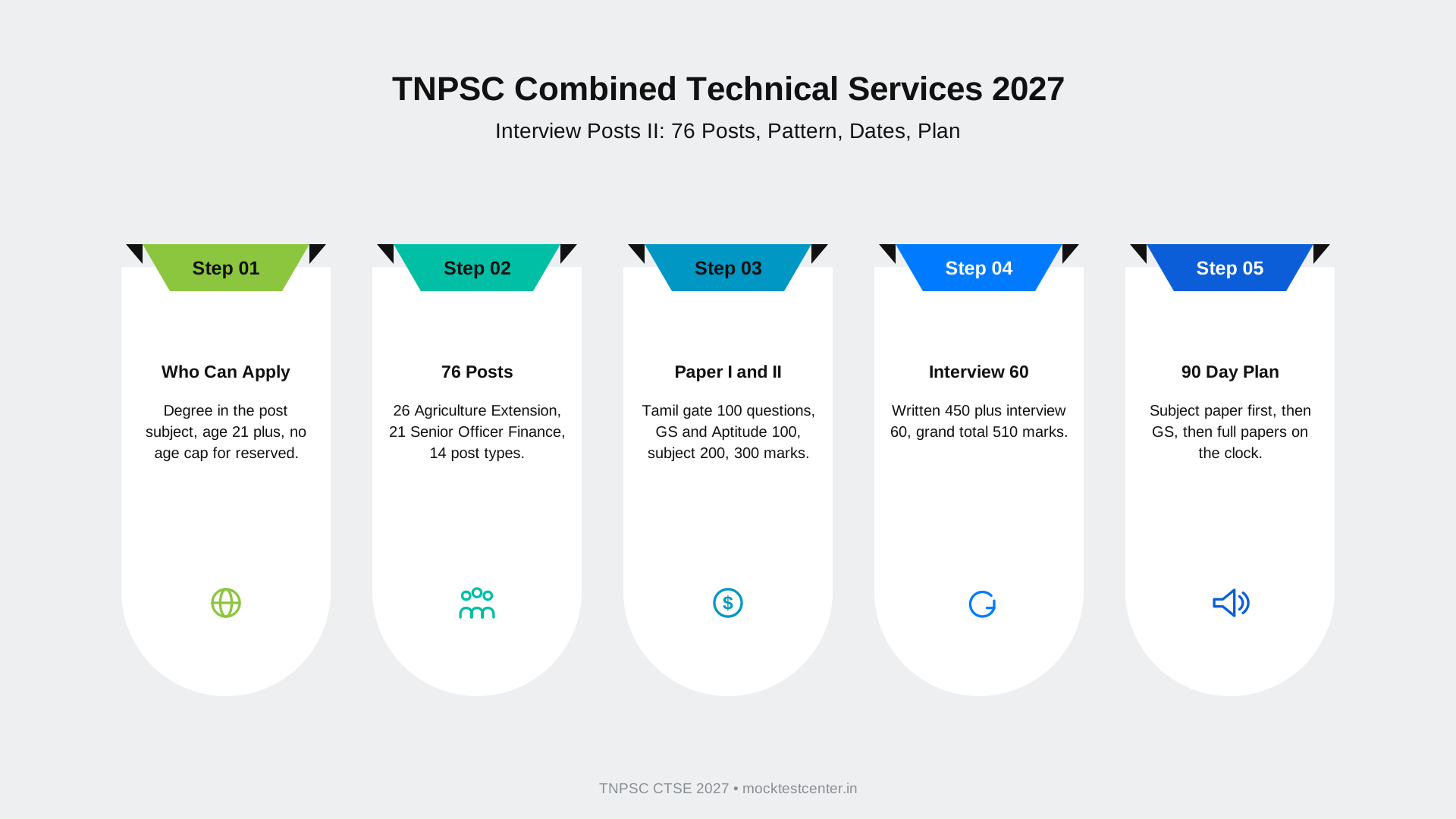
The 76 posts in this notification sit across 14 post types in state departments and public sector corporations. The largest blocks are Assistant Director of Agriculture (Extension) with 26 posts and Senior Officer (Finance) with 21 posts. Together those two posts hold 47 of the 76 seats. The remaining 29 seats spread across accounts posts, legal posts, management posts and engineering posts, most of them with a single vacancy each.
TNPSC Combined Technical Services 2027 at a glance
| Detail | TNPSC Combined Technical Services 2027, the live cycle |
|---|---|
| Conducting body | Tamil Nadu Public Service Commission, Chennai |
| Notification | Notification No. 19/2025, Advertisement No. 728, dated 22 December 2025 |
| Examination | Combined Technical Services Examination (Interview Posts) II |
| Posts | 76, across 14 post types |
| Application window | 22 December 2025 to 20 January 2026, till 11.59 pm, online only |
| Correction window | 24 January to 26 January 2026 |
| Written exam | 7 and 8 March 2026 |
| Written total | 450 marks, Paper I Parts B and C plus Paper II |
| Interview | 60 marks, grand total 510 marks |
| Exam fee | Rs 200, plus One Time Registration Rs 150 |
| Age as on 1 July 2025 | Minimum 21 years for all posts |
| Negative marking | Not stated in the notification, trackers disagree, see the section below |
| Official websites | tnpsc.gov.in and tnpscexams.in |
Read the table as the skeleton and the rest of this TNPSC Combined Technical Services 2027 guide as the flesh. The dates belong to the Interview Posts II notification. The pattern is shared across the 2025 Combined Technical Services notifications, with the interview added only for the interview posts.
The 76 posts, post by post
Assistant Director of Agriculture (Extension) takes 26 posts in the Agriculture Department, at Level 22 of the pay matrix. Senior Officer (Finance) takes 21 posts in the Tamil Nadu Industrial Investment Corporation, also at Level 22. Those two posts are the only ones with a large block of seats, and they are the posts most candidates in this notification will target.
Accounts Officer Class III takes 8 posts in the Treasuries and Accounts Department, at Level 23. Assistant Manager (Accounts) takes 9 posts across the State Express Transport Corporation, the Metropolitan Transport Corporation and the Tamil Nadu State Transport Corporations. Assistant Manager (Legal) takes 3 posts in the Tamil Nadu State Transport Corporation, Coimbatore.
The single post entries fill the rest of the list. Senior Accounts Officer takes 1 post in the Chennai Metropolitan Water Supply and Sewerage Board. Manager Grade III (Finance) takes 1 post in the Tamil Nadu Industrial Investment Corporation, at Level 23.
Senior Officer (Legal) takes 1 post in the same corporation. Manager (Mechanical) takes 1 post in Tamil Nadu Cements Corporation, at Level 26, the highest pay level in this notification.
Manager (Marketing) takes 1 post in the same corporation. Deputy Manager (Electrical) takes 1 post at Level 25. Deputy Manager (Mechanical) takes 1 post.
Deputy Manager (Materials) takes 1 post. Assistant Manager (Materials) takes 1 post at Level 22.
| Post | Post code | Posts | Pay level |
|---|---|---|---|
| Assistant Director of Agriculture (Extension) | 3202 | 26 | 22 |
| Senior Officer (Finance) | 3302 | 21 | 22 |
| Assistant Manager (Accounts) | 3335 | 9 | See note |
| Accounts Officer Class III | 2093 | 8 | 23 |
| Assistant Manager (Legal) | 3259 | 3 | See note |
| Senior Accounts Officer | 3535 | 1 | See note |
| Manager Grade III (Finance) | 3301 | 1 | 23 |
| Senior Officer (Legal) | 3312 | 1 | See note |
| Manager (Mechanical) | 3390 | 1 | 26 |
| Manager (Marketing) | 3394 | 1 | See note |
| Deputy Manager (Electrical) | 3396 | 1 | 25 |
| Deputy Manager (Mechanical) | 3395 | 1 | See note |
| Deputy Manager (Materials) | 3400 | 1 | See note |
| Assistant Manager (Materials) | 3401 | 1 | 22 |
| Total | 76 |
One figure in the table needs a note. Some trackers list Assistant Manager (Accounts) as 8 posts and some as 10 posts, while the notification total is 76. The distribution in the notification adds to 9 for that post across the eight transport units.
That is the figure that makes the total come to 76. This guide uses 9, and the upload check should confirm it against the notification table.
The pay levels run from Level 22 to Level 26. The table shows the level only where the notification text states it clearly. The rows marked See note carry a level in the notification table that the extracted text does not show cleanly, so the upload check should confirm those levels from the notification before publishing them.
Who can apply, and the age rule
Every candidate must have completed 21 years of age as on 1 July 2025. That is the only age rule that applies to every post. The maximum age depends on the post and the category, and the notification prints it post by post.
For candidates not belonging to the Scheduled Castes, Scheduled Castes Arunthathiyar, Scheduled Tribes, Most Backward Classes and Denotified Communities, Backward Classes and Backward Class Muslims, the maximum age is 34 years for Assistant Director of Agriculture (Extension) and 32 years for Senior Officer (Finance) and for Accounts Officer Class III. For Accounts Officer Class III, a person in regular service under the Government of Tamil Nadu gets 37 years. The notification table is hard to read for the remaining posts, and this guide does not guess their maximum ages. The upload check should read the age table in the notification before publishing any figure for those posts.
For candidates from the Scheduled Castes, Scheduled Castes Arunthathiyar, Scheduled Tribes, Most Backward Classes and Denotified Communities and Backward Classes including Backward Class Muslims, there is no maximum age limit for any of the 14 posts. No maximum age limit means the candidate should not have completed 60 years of age as on 1 July 2025, or at the time of selection or appointment.
The education rule is post specific, and it is the first filter. Assistant Director of Agriculture (Extension) needs an MSc in Agricultural Extension or Agricultural Economics. The finance posts need a CA or ICWA qualification, or a degree in commerce with the professional qualification the post demands. The engineering posts need a BE or BTech in the relevant branch.
The legal posts need a law degree. A candidate must choose only the subject paper in which the candidate holds the educational qualification, or an equivalent qualification. A candidate who picks a subject paper without the matching degree will fail at certificate verification, even after clearing the written test.
The notification also bars a claim after the application is submitted. A candidate who applies for a post without the qualification cannot add it later, and a candidate who picks the wrong subject paper cannot change it after the correction window closes on 26 January 2026.
Paper I and Paper II, and the Tamil gate
The written exam has two objective papers, and both are computer based. Paper I runs for 3 hours and Paper II runs for 3 hours, and they are held on 7 and 8 March 2026. The two papers test different things, and they count differently, so a candidate should understand the split before opening a book.
Paper I has three parts. Part A is the Tamil Eligibility Test, set at SSLC standard, with 100 questions for 150 marks. Part B is General Studies, set at degree standard, with 75 questions.
Part C is Aptitude and Mental Ability, set at SSLC standard, with 25 questions. Parts B and C together carry 100 questions for 150 marks.
Paper II is the subject paper, with 200 questions for 300 marks in 3 hours. The subject depends on the post, and the standard is degree or postgraduate degree level. The merit total is 450 marks, made of Parts B and C of Paper I plus Paper II. The Tamil test marks do not count for ranking.
| Paper | Part | Questions | Marks | Duration | Counts for rank |
|---|---|---|---|---|---|
| Paper I | A, Tamil Eligibility Test, SSLC | 100 | 150 | 3 hours, with Parts B and C | No, qualifying only |
| Paper I | B, General Studies, degree | 75 | 150, with Part C | 3 hours, with Parts A and C | Yes |
| Paper I | C, Aptitude and Mental Ability, SSLC | 25 | 150, with Part B | 3 hours, with Parts A and B | Yes |
| Paper II | Subject paper, degree or PG degree | 200 | 300 | 3 hours | Yes |
| Interview | Interview posts only | 60 | Yes | ||
| Total | Written plus interview | 510 |
The Tamil test is a gate, and it works the same way it works in the other TNPSC exams. A candidate must score 40 percent in Part A, which is 60 marks out of 150, or Parts B and C of Paper I and Paper II will not be evaluated at all. The rule is written into the notification in plain words. Differently abled candidates can claim exemption from Part A by furnishing the disability certificate in the format in Annexure II of the notification, and they must make that claim in the online application itself.
The minimum qualifying marks for the merit total are 135 marks for candidates from the Scheduled Castes, Scheduled Castes Arunthathiyar, Scheduled Tribes, Most Backward Classes and Denotified Communities and Backward Classes including Backward Class Muslims. Other candidates need 180 marks. Those figures come from the scheme of examination, where the notification prints 135 and 180 against the 450 mark merit total. A candidate below the line does not reach the interview, whatever the subject score.
Appearance in Paper I and Paper II and the interview is compulsory. A candidate who misses any of the three is not considered for selection, even with qualifying marks in the papers taken. The interview carries 60 marks, and the grand total of 510 marks decides the final merit list.
The notification also sets a tie rule. When marks are equal, the candidate who submitted the application earlier, as determined from the application number, is placed above in the merit list.
The negative marking question, stated plainly
This is the one point in this guide where the sources disagree, and the disagreement is worth stating in full rather than smoothing over. The scheme of examination in Notification No. 19/2025 states no penalty for a wrong answer anywhere in its text. Testbook states that there is no negative marking in the Combined Technical Services examination, and that no marks are deducted for unattempted answers.
Two other trackers state the opposite. FreeJobAlert and MyNaukriAlert both list negative marking of one third of a mark for each wrong answer in the Combined Technical Services exam. A candidate who reads those pages will prepare for a penalty that the notification does not mention.
The safest reading is this. The notification is the authority, and it sets no penalty, so a candidate should not plan around a one third deduction. But the notification annexures carry the detailed OMR and CBT instructions, and a candidate should read the annexure for the cycle the candidate sits, because TNPSC has used different marking rules in different exams. This guide flags the conflict openly, and the upload check should confirm the marking rule against the notification annexure before publishing a firm statement either way.
Fee, One Time Registration and the form
The examination fee is Rs 200, paid at the time of submitting the online application, unless the candidate claims exemption. Candidates in the special categories can claim exemption from the fee under the rules in Annexure II of the notification. The fee is paid online through net banking, credit card, debit card or UPI, on or before the last date of submission of the online application.
Before the fee comes the One Time Registration. Every candidate must register first on the One Time Registration platform on the Commission website, paying Rs 150 as the registration fee. A successful registration is valid for five years from the date of registration.
The registration only stores the candidate details. The candidate files a separate online application for every examination.
The registration asks for the SSLC register number and certificate number with the month and year of passing, the medium of instruction and the name of the board. A wrong detail here follows the candidate into every later application, because the registration details fill in automatically. Linking the Aadhaar number with the One Time Registration is mandatory. The Aadhaar details are used only for identification, and the candidate gives consent in the registration itself.
The application itself runs on tnpscexams.in. The candidate logs in with the registration user ID and password and checks the registration details before filling the details for this examination. The photograph must be taken on or after the date of the notification, in colour, passport size, against a white background, in a photo studio, showing both ears and part of the neck, with the name of the candidate and the date of photography printed at the bottom. The photograph is 4.5 cm high and 3.5 cm wide, and the face takes 3.0 cm of the height while the name and date take 1.5 cm.
The correction window runs from 24 January to 26 January 2026. During those three days the candidate can edit the details in the online application. After the last date of the correction window, no modification is allowed. A candidate who has to pay a fee based on the edited details must pay it online, while a candidate who has already paid the fee need not pay again.
What happens after the written exam
The Commission publishes the written examination results, the list of candidates admitted for onscreen certificate verification and the dates for the interview and counselling after physical certificate verification on the TNPSC website. No individual communication is sent by post. Candidates are told by SMS and email on the registered mobile number and email ID, so a dead email ID or a changed number can cost a candidate the call.
The stages run in order. The written exam comes first, then onscreen certificate verification, then physical certificate verification, then the interview and counselling. The interview carries 60 marks.
The final selection follows the merit list of 510 marks with the rule of reservation. The Commission warns candidates against touts and agents who promise selection through unfair means, and states that all recruitment is purely merit based.
Candidates who need help can contact the Commission on the toll free number 1800 419 0958 on working days between 10.00 am and 5.45 pm. Queries on One Time Registration and online applications go to helpdesk@tnpscexams.in, and other communication goes to grievance.tnpsc@tn.gov.in. Communications sent by post go to the Secretary, Tamil Nadu Public Service Commission, TNPSC Road, V.O.C. Nagar, Park Town, Chennai 600003.
The six subject papers in this notification
The subject paper is the heart of this exam, and each post maps to one subject paper with its own code and standard. Agriculture carries code 492 at postgraduate degree standard, in English. Business Administration carries code 385 at postgraduate degree standard in Tamil and English. Electrical and Electronics Engineering carries code 400 at degree standard, in English.
Financial and Cost Accountancy carries code 434 at final standard, in English. Law carries code 414 at degree standard in Tamil and English. Mechanical Production and Manufacturing Engineering carries code 399 at degree standard in Tamil and English.
| Post | Subject paper | Code | Standard | Language |
|---|---|---|---|---|
| Assistant Director of Agriculture (Extension) | Agriculture | 492 | PG degree | English |
| Manager (Marketing) | Business Administration | 385 | PG degree | Tamil and English |
| Deputy Manager (Electrical) | Electrical and Electronics Engineering | 400 | Degree | English |
| Accounts and finance posts | Financial and Cost Accountancy | 434 | Final | English |
| Legal posts | Law | 414 | Degree | Tamil and English |
| Mechanical and materials posts | Mechanical, Production and Manufacturing Engineering | 399 | Degree | Tamil and English |
The syllabus for the written examination sits in Annexure III of the notification. The unit wise distribution of questions in the syllabus is only indicative, and the Commission reserves the right to increase or decrease the number of questions in each unit if needed. A candidate should study the whole syllabus rather than betting on the printed unit weights.
The subject paper decides the rank because it carries 300 of the 450 written marks. A candidate who scores 220 out of 300 in the subject and average marks in General Studies beats a candidate who scores 160 in the subject and full marks in General Studies. That arithmetic shapes the whole preparation.
The subject comes first and General Studies second. The Tamil test is cleared early and then set aside.
The other three 2025 notifications, and why they matter
A candidate who misses Interview Posts II still has the other cycles to learn from, and the pattern is the same across them. Interview Posts I, Notification Number 08/2025, carried 330 posts with the exam held from 20 to 23 July 2025. Non Interview Posts, Notification Number 09/2025 under Advertisement Number 711, carried 615 posts across 47 post types, with applications from 27 May to 25 June 2025 and the exam held from 4 to 10 August 2025. The Diploma and ITI Level notification, Advertisement Number 10/2025, carried 1,910 posts, with applications closing on 2 July 2025.
The Non Interview notification is the largest of the family, and it shows what the exam looks like at scale. Its biggest post was Assistant Engineer (Agricultural Engineering) with 116 posts, and its 615 seats spread across departments such as Agricultural Engineering and Public Works and Highways. The Diploma and ITI Level notification is larger still, with 1,910 posts for diploma and ITI holders, including Junior Training Officers and Junior Tradesmen and Junior Engineers.
All four notifications share the same Paper I and Paper II scheme. Paper I carries the Tamil gate with the General Studies and Aptitude sections. Paper II carries the subject paper, and the merit total is 450 marks.
The difference is the end of the process. The interview posts add a 60 mark interview and a grand total of 510. The non interview and diploma level posts end with the written exam and document verification, with no interview at all.
That shared scheme is good news for a candidate. A mock test built for one Combined Technical Services notification works for the others, because the papers are the same shape. A candidate who prepared for the Non Interview exam in August 2025 can sit the Interview Posts II exam in March 2026 with the same preparation, changing only the subject paper if the post changes.
How this exam differs from the TNPSC Group exams
Candidates often confuse the Combined Technical Services Examination with the Group exams, and the confusion costs time. The Group exams test general ability across the board, and every candidate sits the same papers. The Combined Technical Services Examination tests one subject in depth, and the subject paper is different for each post family. A Group 2 candidate and a Combined Technical Services candidate may both study General Studies, but only the technical candidate sits a 200 question subject paper worth 300 marks.
The second difference is the Tamil test. In the Group exams the Tamil paper is a large scoring section. In the Combined Technical Services Examination the Tamil test is a qualifying gate of 150 marks that does not count for rank. A candidate who treats it as a scoring paper wastes study time that belongs to the subject paper.
The third difference is the interview. Group 1 and Group 2 carry interviews at the end of a long mains process. The Combined Technical Services interview posts carry a short 60 mark interview after a single written stage. The non interview posts carry no interview at all, which makes them the most direct route into Tamil Nadu government service for a technical graduate.
A 90 day plan that fits this paper
The plan below assumes a candidate who holds the degree for the post and can give four hours a day. A candidate with less time should cut the General Studies reading first and protect the subject hours, because the subject carries 300 marks.
Days 1 to 10 belong to the Tamil test and the syllabus map. Clear the Tamil eligibility syllabus in the first three days, using SSLC level Tamil material. Then take two timed tests of 100 questions.
Then map the subject syllabus unit by unit against the previous year papers, marking the units that produced the most questions. That map becomes the study plan for the next ten weeks.
Days 11 to 45 belong to the subject paper, two units a week, with a short test at the end of each unit. The test should be 50 questions in 45 minutes, taken from the unit just finished. A candidate who scores below 60 percent on a unit test repeats the unit before moving on, because a weak unit in the subject section costs more than a weak unit anywhere else.
Days 46 to 60 belong to General Studies and Aptitude. Read the degree level General Studies syllabus, and take one 100 question Paper I test every third day. The Aptitude section is 25 questions at SSLC level, and it rewards practice more than reading, so a daily set of 25 questions works better than a weekly block.
Days 61 to 75 belong to full papers. Take one full Paper II of 200 questions every second day, in 3 hours, on the clock. Score it the same day.
Spend the next day only on the questions that went wrong. The target by the end of this block is a steady subject score above 200 out of 300, not a single lucky paper.
Days 76 to 90 belong to revision and the Tamil test again. Revise the weak units from the unit tests and take one more Tamil test. Take two final full Paper I papers in the last week.
The day before the exam is for rest and for checking the hall ticket, the exam centre and the documents. No new topic in the last three days, because a new topic learned late pushes out a known topic at the worst moment.
Five mistakes that cost candidates their place
The first mistake is picking the wrong subject paper. The notification allows only the subject paper in which the candidate holds the qualification. A candidate who picks a subject without the matching degree will fail at certificate verification, even after clearing the written test.
The second mistake is ignoring the Tamil test. It is 100 questions and 150 marks, and it gates the whole paper. A candidate who cannot score 60 marks in SSLC level Tamil should not be surprised when Paper II is never evaluated.
The third mistake is treating the One Time Registration as a formality. A wrong SSLC register number or a wrong board name in the registration follows the candidate into every application. Check the registration before filing the application, because the application pulls the registration details in automatically.
The fourth mistake is missing the correction window. The window runs for three days only, from 24 to 26 January 2026. A candidate who finds an error on 27 January has no way to fix it, and the Commission states plainly that no modification is allowed after the window closes.
The fifth mistake is treating the qualifying marks as the target. One hundred and eighty marks is the minimum for other category candidates, not the score that wins a post. In a post with a single vacancy, the last selected candidate scores far above 180. The target should be the highest score the candidate can reach, and the mock test scores should climb week by week toward it.
The TNPSC Combined Technical Services 2027 exam rewards a candidate who knows one technical subject well and files a clean application on time. The 76 posts in Interview Posts II are the newest chance, and the three earlier 2025 notifications show the exam will keep coming back. The candidates who start now will be the ones who walk into the hall ready.
Sources
Tamil Nadu Public Service Commission, Notification 19/2025, Advertisement 728, Combined Technical Services Examination (Interview Posts) II, dated 22 December 2025, on the TNPSC website. India Exam Alert, TNPSC CTS Recruitment 2025-26 Notification Out, 76 interview posts. Mathrubhumi English, TNPSC Combined Technical Services recruitment, Notification 19/2025, 76 vacancies with the exam on 7 and 8 March 2026. Government Daily Jobs, TNPSC CTSE Recruitment 2025 for 615 Non Interview Vacancies, Notification Number 09/2025.
Veranda Race, TNPSC Combined Technical Services (Non Interview), Notification Number 09/2025, Advertisement Number 711. Testbook, TNPSC Combined Technical Services Syllabus and Exam Pattern, qualifying marks 135 and 180, no negative marking stated.
FreeJobAlert, TNPSC CTS Syllabus 2026, one third negative marking stated. Govt Job Guru, TNPSC CTS Diploma and ITI Level Recruitment 2025, Advertisement Number 10/2025, 1,910 vacancies.







