
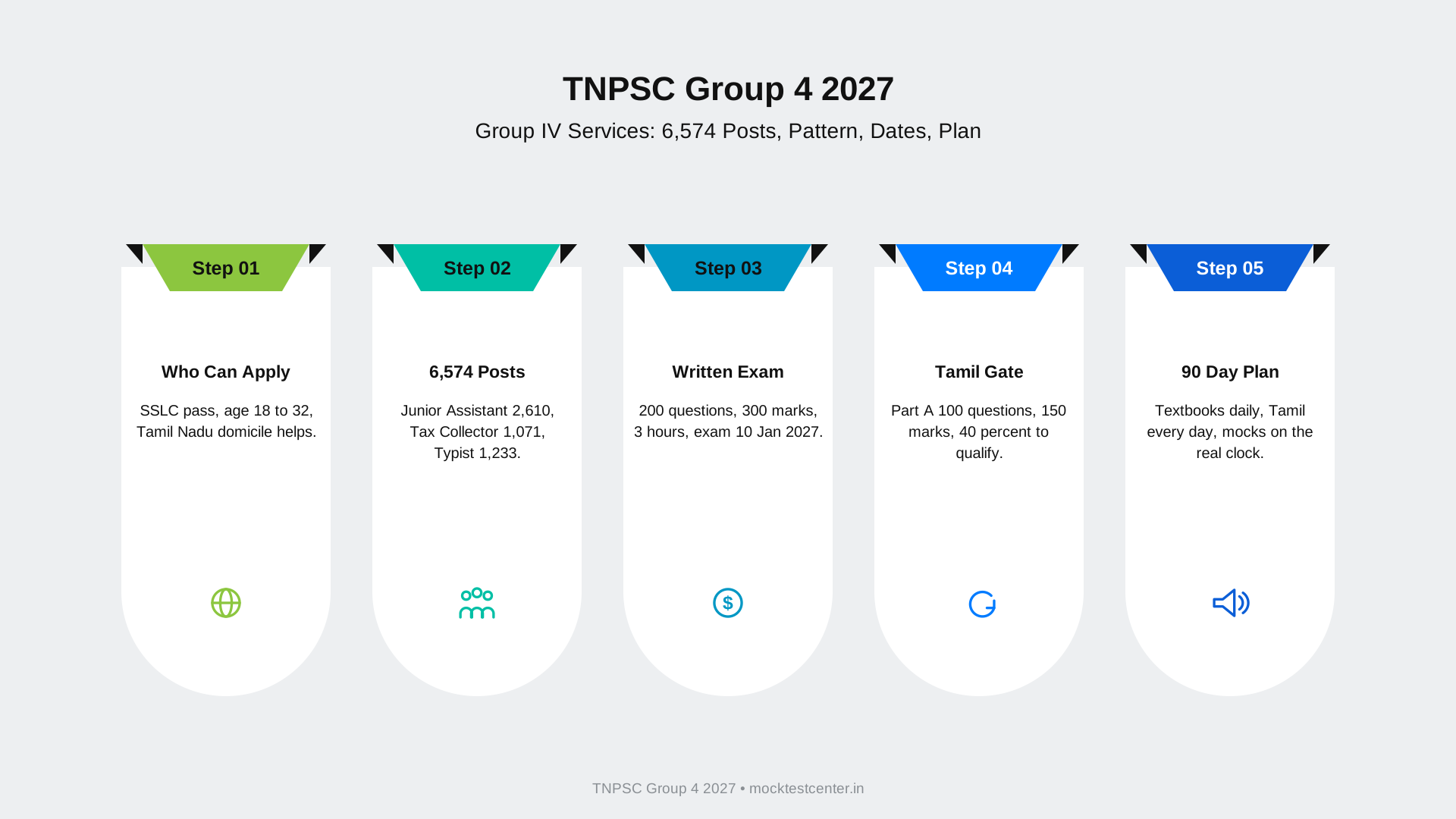
About TNPSC Group 4 2027 Exam Series
📖 Table of Contents
- TNPSC Group 4 2027 at a glance
- 6,574 posts: where the seats sit in the new cycle
- The 2025 cycle: what actually happened
- Who can apply for TNPSC Group 4 2027
- The paper: 200 questions, 300 marks, three hours
- What Part A tests, and why it decides the paper
- General Studies: the 75 questions that separate the list
- The Aptitude and Mental Ability Test: 25 questions, 50 marks
- Fee, application and the correction window
- Minimum marks, cut off and the 40 percent gate
- Salary, posting and the working life
- A 90 day plan for the 10 January 2027 paper
- Mistakes that cost candidates their place
- Sources
TNPSC Group 4 2027: Complete Exam Guide
The Tamil Nadu Public Service Commission has opened the next TNPSC Group 4 recruitment for 6,574 posts, and the written examination is fixed for 10 January 2027. This TNPSC Group 4 2027 guide works from the new notification, Notification Number 11 of 2026, and from the finished 2025 cycle that came just before it, so every date and figure here belongs to a real advertisement, not to a guess about the next one.
The examination itself has not changed shape. One paper, 200 questions, 300 marks, three hours, answered on an OMR sheet. No interview follows it. The marks in that single paper decide who gets called for certificate verification and counselling, and the order of the merit list decides which post a candidate gets.
That simplicity is the reason the examination draws lakhs of candidates. A Class 10 pass is enough for most of the posts. The fee is Rs 100 plus a one time registration fee of Rs 150. The posts sit in district offices, courts, municipal bodies and corporations across Tamil Nadu, and they carry the security of a state government job with a pensionable career path.
The new cycle is also the biggest Group 4 drive in recent years. The 2025 cycle offered 3,935 posts. The 2024 cycle offered 6,244 posts. The 2026 notification offers 6,574 posts across 46 post entries, and the largest share goes to Junior Assistant posts, followed by Tax Collector and Typist posts. A candidate who missed the 2025 examination, or who fell short in its merit list, gets a fresh chance with more seats than the last two cycles combined in practical terms.
One caution belongs at the top. Several popular guides still print the 2025 figures as if they were the current ones, and at least one prints the 2024 vacancy total of 6,244 against the 2025 notification. This guide separates the cycles clearly. Where a tracker disagrees with another tracker, the disagreement is stated in the text instead of being smoothed over.
TNPSC Group 4 2027 at a glance
| Detail | TNPSC Group 4, the live cycle |
|---|---|
| Conducting body | Tamil Nadu Public Service Commission |
| Examination | Combined Civil Services Examination IV, Group IV Services |
| Notification | Notification Number 11 of 2026, Advertisement Number 747, dated 6 October 2026 |
| Posts | 6,574 tentative vacancies across 46 post entries |
| Application window | 6 October to 5 November 2026, to 11.59 pm |
| Correction window | 9 to 11 November 2026 |
| Written examination | 10 January 2027, 9.30 am to 12.30 pm |
| Paper | One OMR paper, 200 questions, 300 marks, 3 hours |
| Minimum qualifying marks | 90 out of 300 for selection, for all communities |
| Part A gate | 40 percent in Part A, that is 60 out of 150, for Parts B and C to be evaluated |
| Examination fee | Rs 100, plus one time registration fee of Rs 150 valid for 5 years |
| Education | SSLC pass for most posts, Higher Secondary for some posts |
| Age limit | 18 to 32 years for general category candidates as on 1 July 2026, with relaxations for reserved categories |
| Selection | Written examination, certificate verification, counselling |
| Official website | tnpsc.gov.in |
Read the table as the skeleton and the rest of this guide as the flesh. The dates belong to Notification Number 11 of 2026. The pattern, the fee and the minimum marks carry the same shape as the 2025 cycle, and any change the Commission prints later will appear on tnpsc.gov.in first.
6,574 posts: where the seats sit in the new cycle
The 2026 notification lists 6,574 tentative vacancies across 46 post entries. Tentative is the Commission's own word, and it matters. The count can be revised before counselling, as departments confirm their final vacancy position. Candidates should treat 6,574 as the notified figure and watch for an addendum if the Commission revises it.
Junior Assistant posts take the largest share. Junior Assistant (Non-Security) under the Tamil Nadu Ministerial Service alone accounts for 2,610 posts. A further 252 Junior Assistant (Non-Security) posts sit in the Judicial Ministerial Service. Junior Assistant (Accounts) under the Tamil Nadu Power Distribution Corporation Limited accounts for 422 posts. Taken together, the Junior Assistant family is close to half of the whole recruitment.
Tax Collector is the surprise entry in this cycle, with 1,071 posts. Typist posts total 1,233 across the services, with 856 under the Ministerial, Legislative Assembly Secretariat and Secretariat services and 377 under the Judicial Ministerial Service. Village Administrative Officer, the post most candidates ask about first, has 291 posts. Steno Typist Grade III has 354 posts across the two services. Bill Collector has 59 posts, Revenue Assistant has 96 posts, and Executive Officer Grade IV has 46 posts.
| Post | Post code | Vacancies in Notification 11 of 2026 |
|---|---|---|
| Village Administrative Officer | 2025 | 291 |
| Junior Assistant (Non-Security), Ministerial Service | 2600 | 2,610 |
| Junior Assistant (Non-Security), Judicial Ministerial Service | 4600 | 252 |
| Junior Assistant (Security) | 2400 | 28 |
| Junior Assistant (Accounts) | 3848 | 422 |
| Tax Collector | 3854 | 1,071 |
| Typist, various services | 2200 | 856 |
| Typist, Judicial Ministerial Service | 4200 | 377 |
| Steno Typist Grade III | 2300 | 209 |
| Steno Typist Grade III, Judicial Ministerial Service | 4300 | 145 |
| Bill Collector Grade I | 2500 | 59 |
| Revenue Assistant | 3843 | 96 |
| Executive Officer Grade IV | 1655 | 46 |
| Forest Watcher | 3319 | 40 |
| Forest Guard with Driving Licence | 3318 | 1 |
The table above lists the large entries. The notification covers 46 post entries in all, and the smaller entries include Junior Inspector of Co-operative Societies with 84 posts, Record Clerk, Senior Laboratory Assistant with 23 posts, Junior Administrative Assistant, Junior Assistant cum Typist, Telephone Operator and other corporation posts. The full post wise list sits in the notification PDF on tnpsc.gov.in, and a candidate should read the entry for the exact post code applied for, because the service, the department and the pay level change with the code.
Forest posts deserve a separate note. Forest Guard with Driving Licence has exactly one post in this cycle, and Forest Watcher has 40 posts. These posts carry physical standards and an endurance test that the clerical posts do not. A candidate who applies for a forest post without checking the physical standards risks clearing the written paper and failing at the next stage.
The post codes are not decoration. Two posts can share a name and differ in service, department and pay. Junior Assistant under post code 2600 sits in the Ministerial Service, while the same title under post code 3848 sits in the power distribution corporation as Junior Assistant (Accounts). The application form asks for post preferences by code, and the counselling allotment follows those codes.
The 2025 cycle: what actually happened
The cycle before this one ran under Notification Number 07 of 2025, dated 25 April 2025. It offered 3,935 posts. Applications ran from 25 April to 24 May 2025. The correction window ran from 29 to 31 May 2025. The examination was held on 12 July 2025 from 9.30 am to 12.30 pm in a single shift across Tamil Nadu. The tentative answer key came out on 21 July 2025, and the result was declared on 22 October 2025.
About 13.89 lakh candidates appeared for the 2025 examination, according to JagranJosh. That figure gives the scale of the competition. For 3,935 posts, roughly 353 candidates appeared for every post. The 2026 cycle offers more posts, but the applicant count will likely stay in the same range, so the ratio will improve without becoming easy.
The 2025 post split shows how the Commission builds these recruitments. Village Administrative Officer had 215 posts. Junior Assistant (Non-Security) under the Ministerial and Judicial Ministerial services had 1,621 posts. Typist under the main code had 1,099 posts, and Steno Typist Grade III had 335 posts under its main code. Junior Revenue Inspector had 239 posts. Assistant in the Pollution Control Board had 54 posts. Forest Guard had 62 posts, Forest Guard with Driving Licence had 35, Forest Watcher had 71, and Forest Watcher (Tribal Youth) had 24.
Two traps sit in the 2025 record, and both still circulate in guides. The first is the examination date. A few guides print 13 July 2025 as the examination date. The Indian Express, The Times of India, The Economic Times, Careers360 and JagranJosh all record 12 July 2025, and the result reports repeat 12 July 2025 as the date the examination was held. This guide uses 12 July 2025 and treats 13 July as a tracker error.
The second trap is the vacancy total. One guide prints 6,244 vacancies against the 2025 notification. That figure belongs to the 2024 cycle, whose examination was held on 9 June 2024. The 2025 notification total is 3,935, and the post wise table in the notification adds to 3,935. A candidate who plans from 6,244 for the 2025 cycle is reading the wrong year.
The 2024 cycle is worth one line for context. Its examination was held on 9 June 2024 for 6,244 posts, and its result came out on 28 October 2024. The Commission has run this examination every year, and the gap between examination and result has stayed close to three months in both cycles.
Who can apply for TNPSC Group 4 2027
The education rule is a pass, not a percentage. For most posts, the minimum qualification is a pass in SSLC, the Class 10 examination, from a recognised board. Village Administrative Officer requires the minimum general educational qualification, and several guides describe that as a Higher Secondary pass. Junior Assistant and Typist posts list SSLC as the minimum in the notification tables, while some specialised posts in the 46 entries require a degree from a recognised university.
The qualification cut off date matters as much as the qualification itself. In the 2025 notification, candidates had to hold the required qualification on or before the last date of application, and one tracker records an educational qualification cut off of 2 January 2026 for a later stage. The safe rule is simple. Hold the certificate before applying, and do not apply on the strength of a result that has not been declared.
Typist and Steno Typist candidates carry an extra condition. A Typist must have passed the Government Technical Examination in Typewriting, by Higher or Senior Grade in Tamil and English, or by Higher or Senior Grade in one language and Lower or Junior Grade in the other, and must have passed the Certificate Course in Computer on Office Automation conducted by the Directorate of Technical Education. A Steno Typist needs the shorthand qualification for the grade applied for. These conditions are checked at certificate verification, not at the application stage, so a candidate who applies without them and clears the paper will still be turned away.
The age limit is calculated as on 1 July of the notification year, so 1 July 2026 for the live cycle. For general category candidates, the window runs from 18 years at the minimum to 32 years at the maximum for most posts. Village Administrative Officer, Forest Guard, Forest Guard with Driving Licence, Forest Watcher and Forest Watcher (Tribal Youth) carry a minimum age of 21 years.
| Category, other posts | Minimum age | Maximum age as on 1 July |
|---|---|---|
| Others, that is candidates not belonging to SC, SC(A), ST, MBC and DC, BC and BCM | 18 years | 32 years |
| SC, SC(A), ST and Destitute Widows of all castes | 18 years | 37 years |
| MBC and DC, BC and BCM | 18 years | 34 years |
| Category, Village Administrative Officer | Minimum age | Maximum age as on 1 July |
|---|---|---|
| Others | 21 years | 32 years |
| SC, SC(A), ST, MBC and DC, BC and BCM, and Destitute Widows of all castes | 21 years | 42 years |
The two tables above follow the 2025 notification as reported by Careers360, and they match the structure the Commission has used for years. One flag belongs here. A guide to the 2026 notification reports a different upper age for the general category, 30 years instead of 32, with 32 for BC and MBC and 35 for SC and ST. That set of figures does not match the 2025 notification, and the official PDF for Notification Number 11 of 2026 was not read directly in this build. The upload check must read the age table from the 2026 notification itself before publishing, because the age table is the one figure candidates cannot afford to get wrong.
No upper age limit applies in practice for reserved category candidates who have studied above the minimum qualification in some cases, and ex-servicemen, persons with disabilities and destitute widows carry their own relaxations under the Commission rules. The notification prints the full relaxation table, and a candidate with a relaxation claim should read that table rather than trust a summary.
A candidate from another state can apply against unreserved vacancies. Reservation and age relaxation benefits belong to candidates of Tamil Nadu. The community certificate, the nativity certificate and the educational certificates must be valid on the last date of application.
The paper: 200 questions, 300 marks, three hours
The TNPSC Group 4 2027 paper is a single objective paper answered on an OMR sheet. It carries 200 questions for 300 marks, and the time allowed is three hours. There is no second paper and no interview. The whole selection rests on this one sitting, which is why the examination rewards steady accuracy more than speed alone.
The paper divides into three parts. Part A is the Tamil Eligibility cum Scoring Test, set at SSLC standard, with 100 questions for 150 marks. Part B is General Studies with 75 questions. Part C is the Aptitude and Mental Ability Test with 25 questions. Parts B and C together carry 150 marks, so each question in those parts carries 2 marks, while each question in Part A carries 1.5 marks.
| Part | Subject | Standard | Questions | Marks |
|---|---|---|---|---|
| Part A | Tamil Eligibility cum Scoring Test | SSLC | 100 | 150 |
| Part B | General Studies | Degree standard in the 2025 cycle | 75 | 100 |
| Part C | Aptitude and Mental Ability Test | SSLC | 25 | 50 |
| Total | One paper | 200 | 300 |
One line in the table above needs a flag. The 2025 cycle set General Studies at degree standard, while a guide to the 2026 cycle describes the whole paper as set at SSLC standard. The two statements conflict, and the official syllabus for Notification Number 11 of 2026 was not read directly in this build. Candidates should prepare General Studies to degree standard, because that is the harder of the two readings, and the upload check should confirm the standard from the 2026 notification.
The examination is held offline, in a single shift from 9.30 am to 12.30 pm. The medium is Tamil and English, and the question paper is bilingual. A candidate chooses General Tamil or General English for Part A at the application stage, and that choice fixes the language of Part A for the examination.
Negative marking is the question every candidate asks first. No negative marking rule was found in the tracker reports of either the 2025 or the 2026 notification. One guide to the 2026 cycle states plainly that Notification Number 11 of 2026 carries no negative marking rule in its text. The absence of a printed rule proves nothing about the paper itself, because the instructions on the question paper and the OMR sheet govern the sitting. A candidate should read the instructions printed on the question paper before marking the first answer, and should not assume a penalty exists or that it does not.
The OMR sheet itself is part of the examination. Answers marked outside the circles, answers marked with a pen where a pencil or ballpoint is specified, and sheets with more than one answer to a question can be rejected by the scanner. The Commission prints the marking instructions on the hall ticket and on the question paper. A mock test on a real OMR sheet, under the real three hour clock, is the cheapest insurance against losing marks to the sheet instead of to the questions.
What Part A tests, and why it decides the paper
Part A carries half the marks in the paper, 150 out of 300, and it carries a gate that no other part carries. A candidate must score at least 40 percent in Part A, that is 60 marks out of 150, for Parts B and C to be evaluated at all. A candidate who scores 59 in Part A and full marks in the other parts still fails, because the other parts are never evaluated.
That gate shapes preparation. Tamil carries half the marks in the paper and holds the key to the other half. Candidates who read Tamil at home and treat it as a subject they can pick up in the last month are the ones who discover the gate too late.
The Part A syllabus runs across Tamil language and literature at SSLC standard. It covers grammar, including word formation, sentence structure, punctuation and the standard rules of written Tamil. It covers vocabulary, synonyms, antonyms and the correct use of words. It covers literature, with questions from the prescribed Tamil texts, the lives of Tamil poets and writers, and the standard anthologies used in the state syllabus. It covers comprehension, with passages that test whether a candidate can read a paragraph and answer from it rather than from memory.
The General English option follows the same shape in English. It covers grammar, vocabulary, comprehension and the standard literature prescribed for the paper. A candidate should choose the language in which reading is faster and more accurate, not the language that feels more prestigious. The marks are the same either way, and the gate is the same either way.
General Studies: the 75 questions that separate the list
General Studies carries 75 questions, and in a paper where most serious candidates clear the Part A gate, these 75 questions decide the merit order. The syllabus divides into units, and the Commission has kept the unit structure stable across cycles.
General Science takes questions from physics, chemistry and biology at the level of the state school syllabus, with an emphasis on everyday science, health, environment and the scientific temper behind public policy. Geography of India covers physical features, rivers, climate, soils, agriculture and the geography of Tamil Nadu in particular.
History and Culture of India covers the freedom movement, the social reform movements, Tamil history and the cultural heritage of the state. Indian Polity covers the Constitution, the federal structure, the state government, local bodies and the rights and duties of citizens. Indian Economy covers planning, agriculture, industry, banking and the Tamil Nadu economy.
Indian National Movement covers the stages of the freedom struggle, the leaders and the events that shaped it. Current events cover national and state developments, government schemes, awards, sports and science. The Aptitude and Mental Ability section covers numerical problems, reasoning, data interpretation and logical puzzles.
Tamil Nadu specific content runs through the whole General Studies paper. Questions on the history of the Tamil country, the Sangam literature, the temple towns, the rivers of the state, the districts and their headquarters, and the welfare schemes of the Tamil Nadu government appear every year. A candidate who prepares only from a national level general knowledge book will lose these questions, and these questions are the ones that separate a candidate from Chennai from a candidate who studied the same national book in another state.
The best preparation material is the Tamil Nadu state board textbooks from Class 6 to Class 12, read in full rather than skimmed for facts. The Commission draws its questions from the state syllabus, and the textbooks are the source the paper setters use. A candidate who has read the textbooks can answer a question even when the exact fact was not memorised, because the context is familiar.
The Aptitude and Mental Ability Test: 25 questions, 50 marks
Part C carries 25 questions for 50 marks, which makes each question worth 2 marks, the highest value per question in the paper after Part A. The syllabus is set at SSLC standard, and it covers simplification, percentage, ratio and proportion, simple and compound interest, area and volume, time and work, and data interpretation from tables and graphs. It covers logical reasoning, including number series, letter series, coding and decoding, odd one out, analogy, and direction sense.
The section rewards practice more than study. A candidate who solves twenty problems a day for three months will answer these questions faster than a candidate who reads the formulae the night before the examination. Speed matters here because the paper is three hours for 200 questions, which leaves 54 seconds per question on average, and the aptitude questions are the ones where a candidate either knows the method at once or loses minutes working it out.
A practical point about order. Many candidates answer the paper in the order it is printed, Part A first, then General Studies, then aptitude. That order works if the candidate is strong in Tamil. A candidate who is slow in Tamil should consider answering the aptitude section first, while the mind is fresh, and returning to Tamil with the remaining time. The OMR sheet does not record the order of answering, only the answers.
Fee, application and the correction window
The fee structure has two parts. The one time registration fee is Rs 150, valid for five years, and it is mandatory for a new applicant. The examination fee is Rs 100. Both are paid online through net banking, credit card or debit card on the TNPSC portal.
Exemption from the examination fee applies to Scheduled Castes, Scheduled Tribes, persons with disabilities, ex-servicemen and destitute widows, among others named in the notification. The exemption covers the examination fee, not the one time registration fee, and the claim must be supported by the relevant certificate at verification.
Applications are filed online only, through tnpsc.gov.in and the Commission's application portal. The 2026 window opened on 6 October 2026 and closed on 5 November 2026 at 11.59 pm. One tracker reports that Addendum Number 11B of 2026 extended the last date to 8 November 2026. The two dates conflict in the tracker record, and the original date of 5 November 2026 is the one printed in the first reports of the notification. Candidates should treat the earlier date as the deadline and treat any extension as a bonus, never as a plan.
The correction window for the 2026 cycle ran from 9 to 11 November 2026. The window allows correction of details in the submitted form, and it closes before the hall tickets are issued. A candidate who finds a mistake in the name, the date of birth or the community after the window closes has no route to fix it before the examination.
The application steps are the same each year. Register on the one time registration portal and pay Rs 150 if not already registered. Fill the Group 4 application with personal details, education, post preferences by code and the choice of General Tamil or General English for Part A. Upload the photograph and signature in the specified size and format. Pay the examination fee of Rs 100 unless exempt. Submit the form and keep a copy of the submitted application and the payment receipt. The hall ticket is issued about ten days before the examination and is downloaded from the Commission website.
Minimum marks, cut off and the 40 percent gate
Two numbers govern selection. The first is the minimum qualifying mark for selection, which is 90 marks out of 300, for all communities. A candidate who scores below 90 cannot be selected, whatever the vacancy position. The second is the Part A gate of 40 percent, 60 marks out of 150, without which Parts B and C are not evaluated.
The cut off is a different number from the minimum qualifying mark. The cut off is the mark of the last candidate called for counselling in each community and post, and it changes every year with the difficulty of the paper, the number of applicants and the number of posts. The 2025 cut off figures are published with the result, and a candidate should read them community wise rather than as a single number, because the cut off for the general category and for the reserved categories differ by a wide margin.
The counselling that follows the result is where the post is actually won. Candidates are called in merit order, and each candidate chooses from the posts still available at that point in the order. A candidate with a higher rank takes the post of first choice. A candidate with a lower rank takes what remains. That is why the difference of five marks can change a posting from a Junior Assistant post in Chennai to a Forest Watcher post in a remote district.
Certificate verification comes before the final appointment. The Commission checks the educational certificates, the community certificate, the nativity certificate, the typewriting and shorthand certificates for Typist and Steno Typist posts, and the physical standards for forest posts. A candidate whose certificates do not match the application is removed from the list, and the seat passes to the next candidate in merit order.
Salary, posting and the working life
The pay levels follow the Tamil Nadu pay matrix. Village Administrative Officer, Junior Assistant and Typist sit at Level 8, with a pay scale of Rs 19,500 to Rs 71,900 a month, plus allowances. Steno Typist Grade III sits at Level 10, with a higher scale. Field Assistant sits at Level 6. Forest Guard sits at Level 5, and Forest Watcher at Level 3. The exact scale for each post code is printed in the notification table, and the allowance structure follows the state government rules in force at appointment.
A Village Administrative Officer works in a revenue village, keeps the village accounts, issues certificates, maintains land records and assists the Tahsildar. A Junior Assistant works in a government office, handling files, correspondence and the daily work of the section. A Typist handles the typing and computer work of the office. A Bill Collector collects taxes and fees for the local body. A Steno Typist takes dictation and types it for senior officers.
The working life differs sharply by post. A Junior Assistant in the Secretariat works office hours in Chennai. A Village Administrative Officer lives in or near the village of posting and deals with the public every day. A Forest Watcher works in the forest ranges and walks the beats. The counselling choice should weigh the posting life, not only the pay scale, because the pay difference between the clerical posts is small and the daily life difference is large.
Promotion follows the state service rules. A Junior Assistant can rise to Assistant, then to Superintendent, and further with service and departmental examinations. A Village Administrative Officer can rise to Revenue Inspector and beyond. The Group 4 examination is an entry gate, and the career after it depends on service, departmental tests and seniority.
A 90 day plan for the 10 January 2027 paper
Ninety days is enough for this paper if the days are used in order. The first thirty days belong to the textbooks. Read the Tamil Nadu state board books from Class 6 to Class 12 for science, social science and Tamil, and make short notes in the margin of each chapter. Solve twenty aptitude problems a day from the start, because aptitude is a habit, not a chapter.
The next thirty days belong to practice. Take one full mock test every week on an OMR sheet, under the three hour clock, and mark it the same day. Spend the day after each mock on the questions that went wrong, and read the textbook chapter behind each wrong answer. Start the Tamil literature revision in this phase, because literature questions reward repeated reading of the same texts.
The last thirty days belong to revision and speed. Take two mocks a week. Revise the notes instead of reading new books. Practise the OMR sheet until marking an answer takes seconds, not thought. In the final week, revise the current events of the last twelve months, the Tamil Nadu schemes, the state budget figures and the national awards. Sleep properly in the last three days. A tired candidate loses more marks than an underprepared one.
One rule runs through all ninety days. Study Tamil every day, even if only for an hour. Part A is half the paper and the gate to the other half, and it is the section most candidates leave to the end. An hour a day for ninety days beats a week of panic at the end.
Mistakes that cost candidates their place
The first mistake is reading the wrong cycle. Guides that mix the 2024, 2025 and 2026 figures are common, and a candidate who prepares from the 2025 vacancy total for the 2027 examination is planning from a smaller recruitment than the real one. Check the notification number on every page read. Notification Number 11 of 2026 is the live cycle. Notification Number 07 of 2025 is the finished one.
The second mistake is ignoring the Part A gate. Candidates who score well in General Studies and fail Part A by a few marks never see their General Studies marks evaluated. The gate is printed in the notification in plain language, and it is the single most overlooked rule in this examination.
The third mistake is choosing the wrong language for Part A. A candidate who reads Tamil slowly and chooses General Tamil because it feels expected will lose marks in the largest section of the paper. Choose the language of faster reading.
The fourth mistake is leaving the typewriting certificate to the last minute. Typist and Steno Typist posts require the Government Technical Examination pass and the computer course certificate at verification. A candidate who clears the paper without them loses the post.
The fifth mistake is trusting a tracker table that fails its own addition. The 2025 record carries at least one guide that prints the 2024 vacancy total against the 2025 notification, and at least one that prints the wrong examination date. The official website, tnpsc.gov.in, is the only source that settles a date or a number. Read it before the examination, and read it again before counselling.
The TNPSC Group 4 2027 examination is a fair paper. One sitting, no interview, a published syllabus and a published answer key. The candidate who reads the textbooks, practises on the real clock and respects the Part A gate has a genuine chance at one of the 6,574 posts. The work starts with the notification on tnpsc.gov.in and ends in the examination hall on 10 January 2027.
Sources
Tamil Nadu Public Service Commission, tnpsc.gov.in, Notification Number 11 of 2026 and Notification Number 07 of 2025, Group IV Services.
Moneycontrol, 7 October 2026, on Notification Number 11 of 2026, 6,574 vacancies, application window and examination date of 10 January 2027. The Times of India, October 2026, on the 2026 notification, the correction window of 9 to 11 November 2026 and the post wise vacancy table. Testbook, on Notification Number 11 of 2026, Advertisement Number 747 and the 46 post entries.
JagranJosh, on the 2025 cycle, the examination of 12 July 2025, the result of 22 October 2025 and about 13.89 lakh candidates appearing. Shiksha, on the 2025 post wise vacancy table, Village Administrative Officer 215, Junior Assistant 1,621 and Typist 1,099. Careers360, on the 2025 important dates, the fee of Rs 100 and the one time registration fee of Rs 150, and the age tables as on 1 July. The Indian Express, The Times of India and The Economic Times, on the 2025 result of 22 October 2025 and the examination date of 12 July 2025.
Government Daily Jobs, on the 2025 age limits, the minimum qualifying mark of 90 and the fee structure. Professor Academy, on the 2025 vacancy split and the examination pattern. Arivark, on the 2026 scheme, the Part A gate of 40 percent and the minimum qualifying mark of 90. TNPSC Test, on Notification Number 11 of 2026, the last date extension to 8 November 2026 under Addendum Number 11B of 2026 and the examination date of 10 January 2027.







