
About Tamil Nadu Police Sub Inspector 2027 Exam Series
📖 Table of Contents
- Tamil Nadu Police Sub Inspector 2027 at a glance
- The 2025 cycle, from notification to result
- Who can apply
- Vacancies, and the 53 shortfall posts
- The Tamil test that ends candidacies quietly
- The Main written exam: 70 marks that decide the list
- Physical measurement: the tape decides first
- The endurance test: one run, no excuses
- The physical efficiency test: 15 marks, three events, stars
- Viva voce and special marks
- Fee and pay
- What the addendum changed, and why it still matters
- The next cycle: what the planner says
- A 90 day plan that respects the marks table
- Five mistakes that cost candidates the post
- How this guide was put together
- Sources
Tamil Nadu Police Sub Inspector 2027: Complete Exam Guide
The Tamil Nadu Uniformed Services Recruitment Board advertised 1,299 Sub Inspector posts in its 2025 cycle, and the written exam for that cycle was held on 21 December 2025. The result came out on 27 January 2026, and the board then said it would revise it because of a software error in the departmental quota list. No fresh Sub Inspector notification has appeared since.
The board annual planner puts the next direct Sub Inspector recruitment in June 2027, with a women only Taluk recruitment in December 2026 and a technical Sub Inspector recruitment in February 2027. This Tamil Nadu Police Sub Inspector 2027 guide, the TNUSRB SI 2027 guide, works from the 2025 notification, because that is the document the next cycle will most likely follow.
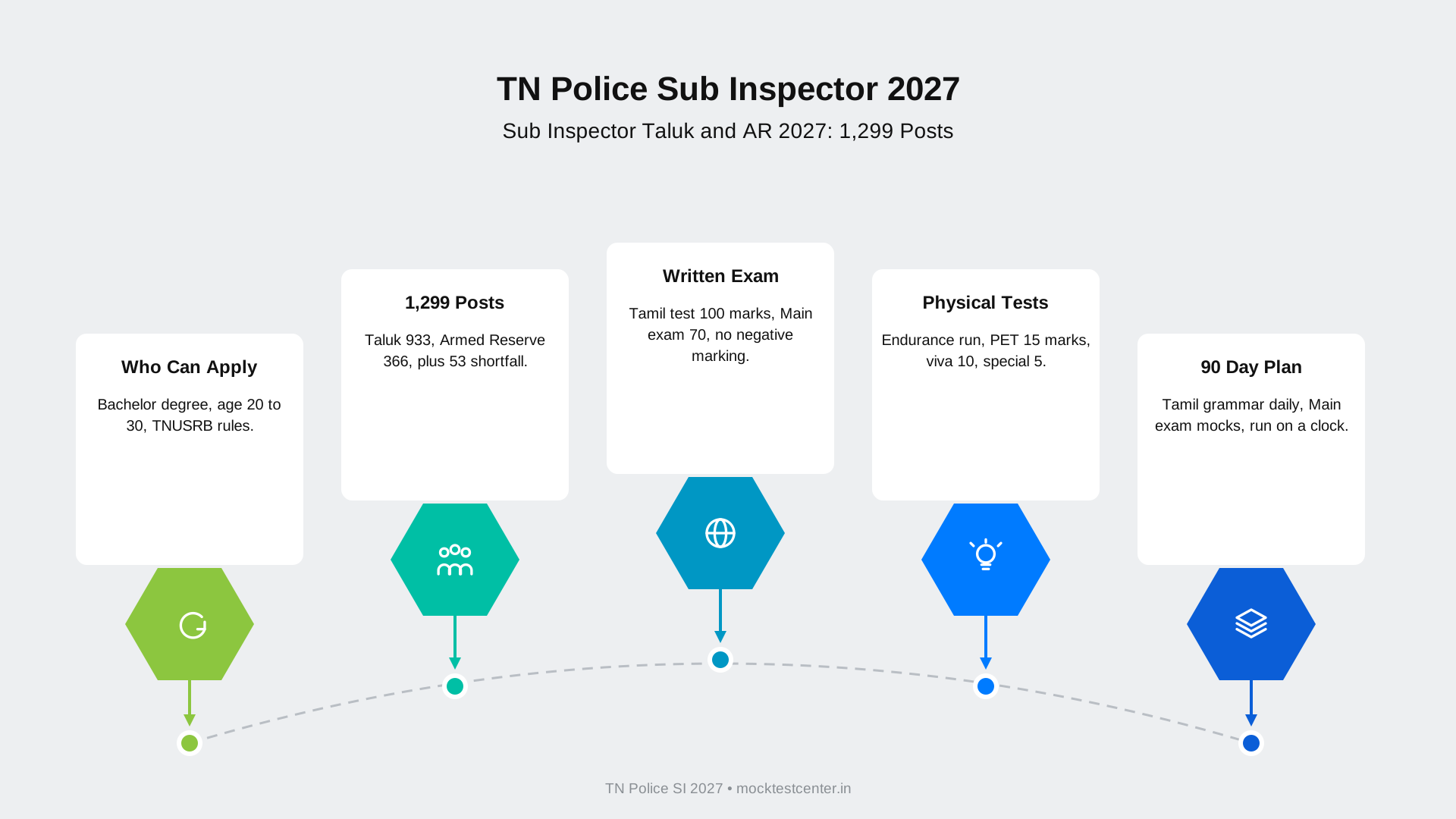
One fact shapes everything else about this exam. The written test decides 70 marks out of the final 100. The physical efficiency test adds 15 marks, the viva voce adds 10, and special marks add 5.
A candidate preparing for TNUSRB SI 2027 who treats the physical tests as the main event has the maths backwards. The running track matters, but the answer sheet matters more.
The 2025 cycle also teaches a lesson about dates. The board first announced the written exam for 28 and 29 June 2025. Then the date moved to 21 November 2025.
Then it moved again, to 21 December 2025, when both papers were held on a single day. Candidates who booked travel around the first date had to change plans twice. The dates in this guide are the ones that actually happened, and the next cycle deserves the same caution.
Check the board website before you book anything.
Tamil Nadu Police Sub Inspector 2027 at a glance
| Detail | Tamil Nadu Police SI 2025, the live cycle |
|---|---|
| Conducting body | Tamil Nadu Uniformed Services Recruitment Board (TNUSRB) |
| Posts | 1,299: Taluk 933 plus Armed Reserve 366, with 53 shortfall vacancies extra |
| Notification | No. 01/2025, 4 April 2025 |
| Addendum | No. 1A/2025, 31 October 2025, common written exam for open and departmental candidates |
| Application window | 7 April to 10 May 2025 |
| Written exam | 21 December 2025, Main exam in the forenoon, Tamil test in the afternoon |
| Written result | 27 January 2026, 1:5 ratio, revision announced |
| Application fee | Rs 500, Rs 1,000 for a departmental candidate who applied under both quotas |
| Education | Bachelor degree from a recognised university, held on or before 4 April 2025 |
| Age limit | 20 to under 30 years as on 1 July 2025, relaxations by category |
| Tamil test | 100 questions, 100 marks, 100 minutes, 40 percent to pass, qualifying only |
| Main written exam | 140 questions, 70 marks, 2.5 hours, 35 percent to pass, no negative marking stated |
| Physical tests | Measurement test, endurance test, physical efficiency test of 15 marks |
| Viva voce and special marks | 10 marks plus up to 5 marks |
| Pay | Rs 36,900 to Rs 1,16,600 a month |
| Official website | tnusrb.tn.gov.in |
The 2025 cycle, from notification to result
Notification No. 01/2025 came out on 4 April 2025. It covered Sub Inspectors of Police in the Taluk and the Armed Reserve, men and women, plus transgender candidates. Tamil Nadu Special Police personnel were not given separate posts in this notification.
They could apply under the departmental quota, which reserves 20 percent of the posts for serving police personnel.
Applications opened on 7 April 2025 and were first due to close on 3 May. The board extended the last date to 10 May 2025, and the correction window ran from 4 to 13 May, later extended to 15 May. Departmental candidates got a separate edit window from 9 to 30 October 2025, and all candidates got another edit window from 7 to 10 November 2025. That second window came after the addendum changed the exam itself.
The addendum matters more than most candidates realise. Addendum No. 1A/2025, dated 31 October 2025, followed a Supreme Court order and two Home Department government orders. Before it, departmental candidates sat a separate 85 mark paper and skipped the physical efficiency test.
After it, every candidate took the same written exam, the same endurance test and the same physical efficiency test. Departmental candidates stayed exempt only from the physical measurement test. The addendum also changed the marks table for everyone, and the selection total became 100 marks for all candidates.
Hall tickets came out in early December 2025. The press release on hall tickets was dated 3 December 2025. The exam ran on 21 December 2025 at 46 centres.
The Main Written Examination ran in the forenoon and the Tamil Language Eligibility Test ran in the afternoon, which is the reverse of the order in the original notification. Preliminary answer keys appeared on 26 December 2025, with representations accepted till 6 pm on 2 January 2026.
The written result, at a ratio of one post to five candidates, was published on 27 January 2026. Then the board reported a software error. Some candidates who had switched from the open quota to the departmental quota were wrongly placed in the open list, and the board said a revised 1:5 result would be published.
As of early November 2026, the board site did not yet list a revised result or call letters for certificate verification and physical tests. That is the position this guide is written from. If you cleared the written exam, watch the board website for the revised list rather than assuming the January list is final.
Who can apply
The education rule is stricter than it looks at first glance. A candidate needs a bachelor degree from a university recognised by the UGC or the government, held on or before 4 April 2025. The degree must follow one of the accepted patterns: SSLC plus Higher Secondary plus degree, or SSLC plus diploma plus degree, or SSLC plus a two year ITI course plus degree. A degree from an open or distance university counts only if it followed one of these patterns.
Two details catch people out. Candidates who passed Class 10 without studying Class 9, or Class 12 without studying Class 11, are not eligible. The board checks the pattern, not just the degree certificate. If your schooling skipped a year, read the notification wording for your own case before you apply.
The age rule uses 1 July 2025 as the cut off date. A candidate must be at least 20 years old and under 30 years old on that date, which means born between 2 July 1995 and 1 July 2005. The upper limit rises by category.
It is 32 years for BC, BC (Muslim), MBC and DNC candidates. It is 35 years for SC, SC (Arunthathiyar), ST and transgender candidates. It is 37 years for destitute widows.
It is 47 years for ex-servicemen, ex-CAPF personnel discharged within three years of the notification, and serving military personnel retiring within a year. The 20 percent departmental quota carries a 47 year limit as on 1 July 2024, a year earlier than the open quota cut off.
There is no separate age rule for women in the open quota. Women apply under the same 20 to 30 window, with the same category relaxations. The women only Taluk recruitment planned for December 2026 will carry its own notification, and its age rule may differ. Do not assume it will copy the 2025 figures.
Vacancies, and the 53 shortfall posts
The 1,299 posts split into two forces. The Taluk police took 933 posts, 654 for men and 279 for women. The Armed Reserve took 366 posts, 255 for men and 111 for women.
Men took 909 posts in total and women took 390. The split is clean, and every tracker that quotes the notification agrees on it.
On top of the 1,299, the notification added 53 shortfall vacancies for Sub Inspector (Taluk). Ten went to Scheduled Caste candidates: seven men, three women. Forty three went to Scheduled Tribe candidates: 30 men, 13 women.
No departmental, sports, wards or PSTM quota applies to these 53 posts. They exist because earlier cycles left these community posts unfilled, and the board carried them forward.
Communal reservation runs through the 200 point roster. OC takes 31 percent. BC takes 26.5 percent.
BC (Muslim) takes 3.5 percent. MBC and DNC take 20 percent. SC takes 15 percent.
SC (Arunthathiyar) takes 3 percent. ST takes 1 percent. If eligible women are not available in any category, the women vacancies go to men of the same community.
That rule keeps the community split intact even when the gender split cannot be filled.
The Tamil test that ends candidacies quietly
Part I of the written exam is the Tamil Language Eligibility Test. It has 100 objective questions for 100 marks, and 100 minutes to answer them. A candidate needs 40 marks to pass.
The marks stay outside the selection total. Fail this paper, and the Main Written Examination answer sheet is never evaluated.
That last sentence deserves a second read. A candidate can score well in general knowledge and psychology and still go home because the Tamil paper fell short. The board sets the Tamil syllabus from the Tamil Nadu State Board curriculum up to Class 10.
Part A covers Tamil grammar: letters, words, general grammar, meaning and prosody, plus figures of speech and language skills such as splitting and joining words, antonyms, spotting the odd word, error correction, plus Tamil equivalents of English words. Part B covers literature. Part C covers Tamil scholars and their service to Tamil.
Candidates who studied in Tamil medium through school usually clear this paper without much extra work. Candidates who studied in English medium and speak Tamil at home often find the grammar section harder than they expect. The questions test formal grammar, not spoken fluency. A month of practice with Class 10 Tamil grammar, done before the Main exam preparation peaks, is the cheapest insurance in this whole recruitment.
The Main written exam: 70 marks that decide the list
Part II is the Main Written Examination. It has 140 questions for 70 marks, and each question carries half a mark. The duration is two and a half hours.
A candidate needs 25 marks, which is 35 percent, to qualify. The notification and the syllabus do not mention any negative marking, so a wrong answer costs nothing except the half mark it could have earned.
Part A is General Knowledge, 80 questions for 40 marks. The topics are General Science, History, Geography, Economics, Indian Polity, Chemistry, Biology, Diet, Nutrition, Environmental Science, Physics, Current Affairs. The list is wide, and it rewards steady reading over last minute cramming. Current affairs sits inside a general knowledge paper, not as a separate section, so a candidate who reads only static subjects leaves marks on the table.
Part B is the Psychology Test, 60 questions for 30 marks. The topics are Logical Analysis, Numerical Analysis, Communication Skills in Tamil and English, Information Handling Ability and Mental Ability, with inductive reasoning and deductive reasoning both tested. This section is where the half mark per question bites.
Sixty questions at half a mark each means a careless stretch of ten wrong answers costs five marks out of a 70 mark paper. That is a large share of the whole selection.
The qualifying mark of 35 percent is only the floor. The real cut off is set by competition, and five candidates per post go forward to certificate verification and the physical measurement test. A candidate tied at the cut off is also called, so the ratio can run past 1:5.
The written exam is the gate, and it is also the largest single block of the final total. Treat it that way.
Physical measurement: the tape decides first
After the written result, five candidates per post are called for certificate verification and the Physical Measurement Test. The height rule depends on community. Men from OC, BC, BC (Muslim), MBC and DNC need 170 cm.
Men from SC, SC (Arunthathiyar) and ST need 167 cm. Women from OC, BC, BC (Muslim), MBC and DNC need 159 cm. Women from SC, SC (Arunthathiyar) and ST need 157 cm.
Men also need a chest of at least 81 cm, with at least 5 cm expansion on full inspiration. Measurements are rounded to the nearest 0.5 cm, so 169.8 cm counts as 170.0 cm and 169.7 cm counts as 169.5 cm. That rounding rule has saved candidates who measure a fraction short, and it has also ended the hopes of candidates who measure a fraction shorter still.
Height or chest certificates from hospitals or other agencies are not accepted. A candidate can appeal to the sub-committee chairperson for re-measurement, and that appeal is the only route if the first reading goes against you.
Ex-servicemen, serving military personnel retiring within a year, ex-CAPF personnel and departmental quota candidates do not take the physical measurement test. Everyone else does, and there is no appeal beyond the re-measurement at the centre.
The endurance test: one run, no excuses
The Endurance Test is qualifying only, but it is pass or fail in the bluntest sense. Men run 1,500 metres in 7 minutes or less. Women run 400 metres in 2 minutes 30 seconds or less.
Ex-servicemen, ex-CAPF personnel and serving military personnel retiring within a year run 1,500 metres in 8 minutes or less. Departmental candidates run under the open candidate norms since the addendum, which is a change from the old rules.
Only candidates who pass the endurance test go on to the physical efficiency test. The board accepts no excuse for illness or injury at the centre. A candidate who arrives with a sprained ankle faces the same clock as everyone else. Train the run early, and keep training it through the written exam period, because the physical tests follow the written result and there is little time to build running fitness from zero.
The physical efficiency test: 15 marks, three events, stars
The Physical Efficiency Test carries 15 marks, and it is the only physical stage that adds to the final total. Each candidate takes three events. Each event scores 0, 2 or 5 marks, which the board calls zero, one or two stars.
Skipping an event disqualifies the candidate, but a zero in an event still leaves the candidate in the test. That distinction matters. A candidate who cannot climb the rope should still attempt it, because a zero in one event leaves the other two events live.
Men take rope climbing, a jump, a run. Rope climbing uses hands only, and climbing with the legs or body scores zero. Five metres to under six metres earns one star, and six metres and above earns two stars.
The jump is a long jump or a high jump. In the long jump, 3.80 metres to under 4.50 metres earns one star, and 4.50 metres and more earns two stars. In the high jump, 1.20 metres to under 1.40 metres earns one star, and 1.40 metres and more earns two stars.
The run is 100 metres or 400 metres. In the 100 metre run, 15.00 seconds or less but over 13.50 seconds earns one star, and 13.50 seconds and less earns two stars. In the 400 metre run, 80.00 seconds or less but over 70.00 seconds earns one star, and 70.00 seconds and less earns two stars.
Women take a long jump, a throw, a run. In the long jump, 3.0 metres to under 3.75 metres earns one star, and 3.75 metres and more earns two stars. The throw is a shot put of 4 kg or a cricket ball throw.
In the shot put, 4.25 metres to under 5.50 metres earns one star, and 5.50 metres and more earns two stars. In the cricket ball throw, 17 metres to under 24 metres earns one star, and 24 metres and more earns two stars. The run is 100 metres or 200 metres.
In the 100 metre run, 17.50 seconds or less but over 15.50 seconds earns one star, and 15.50 seconds and less earns two stars. In the 200 metre run, 38.00 seconds or less but over 33.00 seconds earns one star, and 33.00 seconds and less earns two stars.
Rope climbing and the jump get two attempts each, with the better one counted. The run gets one attempt. For women, the long jump and the throw get two attempts each, and the run gets one.
The practical point is simple. Two stars in all three events means the full 15 marks. One star in all three means 6 marks.
The gap between a trained candidate and an untrained one is nine marks out of a 100 mark total, which is often larger than the gap between two neighbours on the written merit list.
Viva voce and special marks
Candidates are called for the viva voce at twice the number of notified vacancies, plus anyone tied at the cut off. The viva voce carries 10 marks. Special marks add up to 5 marks, awarded at the viva voce stage.
The full selection total is 100 marks: the Main Written Examination 70, the Physical Efficiency Test 15, the viva voce 10, special marks 5. The Tamil test sits outside the total. It qualifies a candidate and then disappears from the maths.
Special marks come from NCC and NSS, plus sports. NCC gives up to 2 marks. An A certificate gives half a mark, a B certificate gives 1 mark, and a C certificate, Under Officer rank or Best Cadet at the All India level gives 2 marks.
NSS gives up to 1 mark. National programme participation or regular activities give half a mark each, and best volunteer at state or national level, or best NSS cadet at the Republic Day Parade, gives 1 mark. Sports and games give up to 2 marks across 16 approved games, including basketball, football, hockey, volleyball, handball, kabaddi, wrestling, boxing, gymnastics, judo, weightlifting, swimming, athletics, equestrian, rifle shooting, silambam.
Since the addendum, departmental candidates earn special marks on the same basis as open candidates. They no longer get marks for National Police Duty Meet certificates. A candidate with an NCC C certificate and a state level sports certificate walks into the viva voce with 4 of the 5 special marks already in hand. That is not a small edge in a 100 mark total.
Fee and pay
The examination fee is Rs 500 for open or departmental quota candidates. A departmental candidate who applied under both quotas paid Rs 1,000. Payment was online only.
One tracker prints a Rs 100 fee for reserved candidates, which differs from the Rs 500 fee in the notification based record. This guide uses Rs 500. The upload check should confirm the fee table against the official notification before the page goes live.
The scale of pay in the notification is Rs 36,900 to Rs 1,16,600 a month. That is the pay band for a Sub Inspector in the Tamil Nadu Police Subordinate Service, before allowances. It is a graduate level post with a uniform, and the pay is the reason the competition runs into lakhs of applicants for 1,299 posts.
What the addendum changed, and why it still matters
Many pages list the addendum as a date. It deserves more than that, because it changed who competes with whom. Before 31 October 2025, departmental candidates sat a different paper.
Their written exam was worth 85 marks, it included police subjects, and they skipped the physical efficiency test entirely. Open candidates sat a 70 mark paper and took the physical test for 15 marks. Two different exams fed one merit list, and the board had to balance them.
The Supreme Court order behind the addendum ended that split. After it, every candidate took the same two papers, the same endurance test and the same physical efficiency test. The only remaining difference is the physical measurement test, from which departmental candidates stay exempt.
The software error in the January 2026 result came from this very change. Candidates who switched from the open quota to the departmental quota after the government order of 18 August 2025 were wrongly left out of the departmental list and counted under the open quota. The board caught it and promised a revised result.
For the next cycle, the lesson is plain. The common exam is now the settled pattern, and a candidate preparing for 2027 should expect the same structure: Tamil test, Main exam, endurance, physical efficiency, viva voce and special marks, all under one set of rules. If a future notification changes the structure again, it will say so in print. Do not prepare for the old split exam.
The next cycle: what the planner says
The TNUSRB Annual Planner for 2026-27 was published on the board website on 2 September 2026, with an earlier version on 9 July 2026. It lists tentative notification months, not dates. Grade II Police Constables (Women) and Sub Inspectors of Police (Women) in the Taluk are both listed for December 2026.
Common Recruitment and Sub Inspectors (Technical) are listed for February 2027. Band Police Constables are listed for March 2027. Direct recruitment of Sub Inspectors of Police is listed for June 2027.
Three points need care here. The December 2026 women only recruitments are for female candidates alone. The February 2027 technical Sub Inspector recruitment is a separate post with its own qualifications, and it is not the Taluk and Armed Reserve recruitment this guide covers.
The June 2027 direct recruitment is the one that matches the 2025 cycle, and it is the date that matters most for a general candidate. All of these months are tentative, and the board can move them. The planner is a planning document, not a notification.
No SI 2026 notification has been issued. Trackers that promise a 2026 notification in May 2026 were writing before the planner came out, and the planner supersedes them. A candidate who waits for a 2026 notification is waiting for a train that the board has not scheduled.
A 90 day plan that respects the marks table
Ninety days is enough if the plan follows the marks. The Main exam carries 70 of the final 100, so it takes the largest share of study time. The Tamil test carries no marks but can end a candidacy, so it takes a fixed daily slot that never gets skipped.
The physical tests carry 15 marks and need the body ready on a date the board chooses. Running and the three PET events take a fixed weekly slot from day one.
Days 1 to 30 build the base. General knowledge gets two hours a day, split between a Tamil Nadu state board book and a current affairs note. The psychology section gets one hour a day, spent on reasoning and numerical practice in short timed sets.
Tamil grammar gets 45 minutes a day, working through Class 10 grammar topics in order. Running gets 30 minutes on five days a week, building from a slow 1,500 metre jog to timed intervals. Rope climbing, long jump, sprint work get one session a week each, so the body learns the movements before speed matters.
Days 31 to 60 add test conditions. One full Main exam paper a week, 140 questions in two and a half hours, marked the same day. One Tamil test a week, 100 questions in 100 minutes, with the 40 mark line treated as a fail line.
General knowledge revision shifts to short notes and previous year questions. The psychology section shifts to speed, because half a mark per question rewards accuracy under time pressure. Running moves to the exact test distance at the exact target pace, and the PET events move to measured attempts with the star thresholds in view.
Days 61 to 90 are revision and simulation. Two full papers a week, with the gaps between them spent only on the topics the papers exposed. Tamil grammar revision covers the error correction and odd word questions that cost marks in a hurry.
The physical sessions taper in the last ten days so the candidate arrives fresh, not tired. The last week includes a full mock of the whole day: Main exam in the morning, Tamil test in the afternoon, exactly as 21 December 2025 ran.
Mock tests earn their place in this plan because the Main exam is a speed test as much as a knowledge test. One hundred and forty questions in 150 minutes leaves about a minute per question, and the half mark each means a guessed answer is worth taking when the notification sets no penalty. A candidate who has never sat a timed 140 question paper will spend the first 30 minutes learning the pace inside the real exam. That is a lesson best learned at home.
Five mistakes that cost candidates the post
The first mistake is ignoring the Tamil test. It is qualifying only, so candidates push it to the last week. Then a grammar section they have not revised since school costs them the whole recruitment. Forty marks out of 100 is a reachable bar, and the board sets it on purpose.
The second mistake is treating the psychology section as a soft 30 marks. Sixty questions at half a mark each look small next to 80 general knowledge questions. The section still carries 30 of the 70 written marks, and it tests reasoning and numerical skill that improves only with timed practice. A candidate who reads theory without solving timed sets will find the section slower than expected.
The third mistake is starting physical training after the written result. The board calls five candidates per post for the physical stages, and the gap between the result and the physical tests is short. A candidate who can run 1,500 metres in 7 minutes needs weeks of base work, not days. The endurance test is pass or fail, and a fail ends the recruitment at the last stage.
The fourth mistake is skipping a PET event. The rule is clear: skipping an event disqualifies the candidate, while a zero in an event still leaves the candidate in the test. A candidate who cannot climb the rope should still stand under it and try. The attempt keeps the other two events alive, and the other two events can still earn 10 marks.
The fifth mistake is applying with the wrong degree pattern. The board checks the schooling pattern behind the degree, and candidates who skipped Class 9 or Class 11 are not eligible even with a valid degree. Check the pattern rule against your own certificates before you pay the fee. The fee is not refundable, and an ineligible application wastes a cycle.
How this guide was put together
Every date and post count and mark and standard in this guide comes from the 2025 notification as reported by the board own documents and by trackers that quote them. The official notification PDF sits on tnusrb.tn.gov.in, and the board site was not reachable from the machine that built this page, so the notification was read through the trackers that reproduce it in full. The most complete of those is the ExamDetail guide to the 2025 cycle.
It works from Notification No. 01/2025, Addendum No. 1A/2025, the 2025 syllabus, the preliminary answer keys and the 27 January 2026 result notice.
Two trackers disagree with the record used here, and the disagreements are worth naming. One tracker still lists the written exam for 28 and 29 June 2025, which was the first announced date before the board moved it twice. Another lists a 21 November 2025 exam date, which was the second announced date before the final move to 21 December 2025.
A third tracker prints a Rs 100 fee for reserved candidates, a figure that differs from the Rs 500 fee in the notification based record. This guide uses 21 December 2025 and Rs 500, and the upload check should confirm both against the official notification.
One more caution belongs here. The physical efficiency star thresholds and the special marks table come from the notification as quoted by trackers. The board site was not reachable to read the PDF directly, so the upload check should confirm the PET thresholds and the special marks table against the official notification before the page goes live. The written exam pattern, the vacancy split, the age table and the fee are the figures with the widest agreement across sources, and they are the ones this guide leans on hardest.
The next TNUSRB SI 2027 notification is expected in June 2027, and the women only Taluk notification is expected in December 2026. Both are tentative. Between now and then, the 2025 pattern is the best map a candidate has.
Study the Tamil grammar, practise the psychology section under time, run the 1,500 metres on a clock, and keep the board website open. The candidates who clear this exam are usually the ones who started before the notification, not after it.
Sources
TNUSRB Notification No. 01/2025, 4 April 2025, and Addendum No. 1A/2025, 31 October 2025, on tnusrb.tn.gov.in. TNUSRB Annual Planner 2026-27 on tnusrb.tn.gov.in.
ExamDetail guide to TNUSRB SI 2025, compiled from the notification, the addendum, the 2025 syllabus, the preliminary answer keys and the 27 January 2026 result notice.
Shanmugam IAS Academy TNUSRB SI guide, updated 3 November 2026. Adda247 TNUSRB SI Notification 2026 page. Chegg India TNUSRB 2025 page.
ExamDays TNUSRB SI Notification 2025 page. The Economic Times hall ticket report, November 2025.







