
About Punjab PCS 2027 Exam Series
📖 Table of Contents
- Punjab PCS 2027 at a glance
- The 2025 cycle is the map for 2027
- The ten posts and what each officer does
- Who can apply
- Punjab PCS exam pattern, prelims first
- The mains papers, where the selection is made
- The interview and the final merit
- Fee and how to apply
- What the five year gap tells you about the 2027 cycle
- A preparation plan that fits the real paper
- Mistakes that cost candidates a year
- Where to check next
- Sources
Punjab PCS 2027: Complete Exam Guide
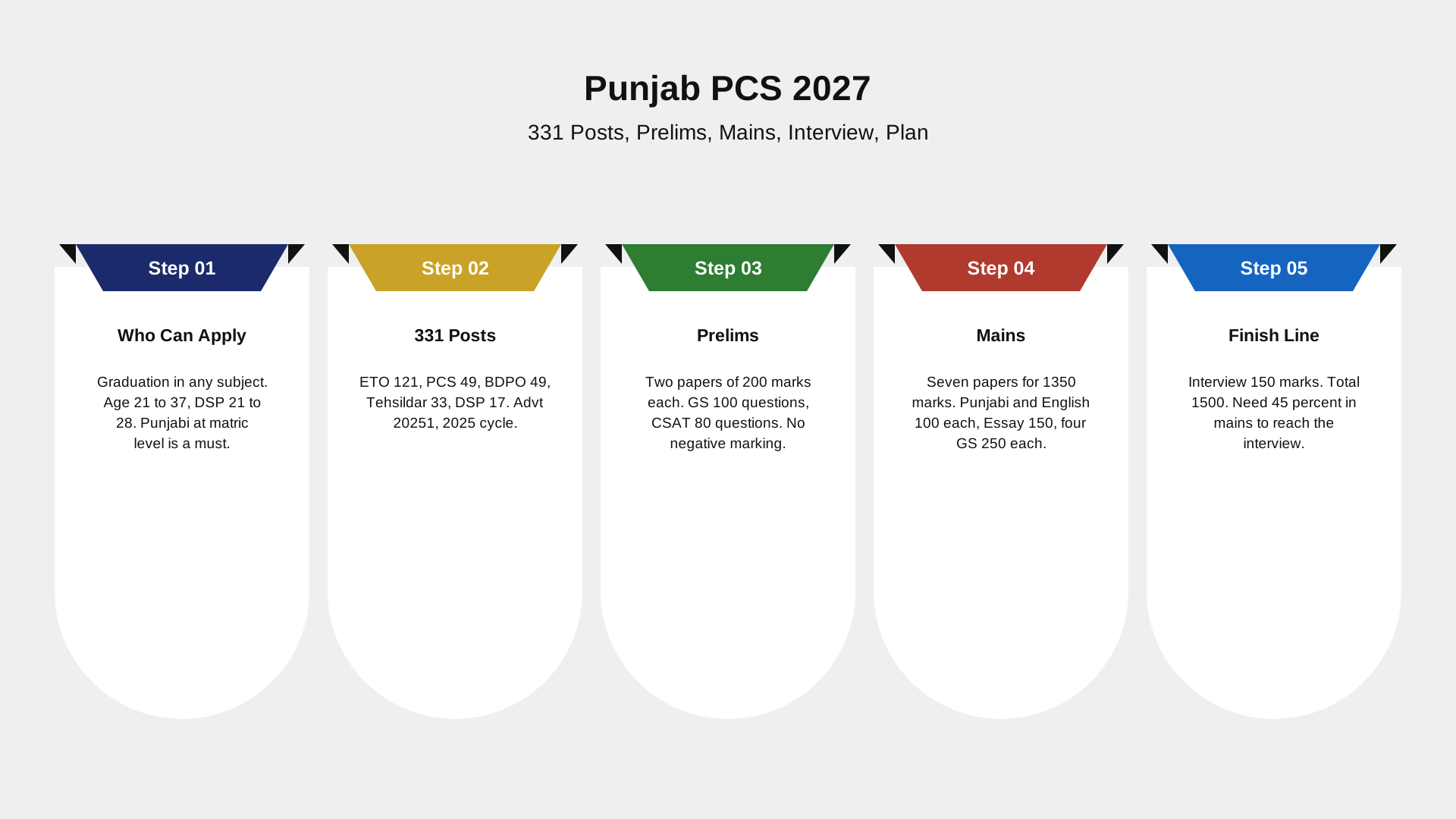
The Punjab PCS 2027 cycle is the one Punjab graduates wait years for, and the wait is the first fact to understand. The Punjab Public Service Commission, known as PPSC, did not hold a Punjab State Civil Services Combined Competitive Examination between 2020 and 2025. When the 2025 notification finally appeared on 2 January 2025, it carried 322 posts across ten services, and a later addendum raised the count to 331. The 2027 cycle has no notification yet as of 21 November 2026, so this guide anchors on the 2025 cycle, the freshest complete map of the exam, and marks every 2027 figure as not yet announced.
That five year gap matters more than any single date in the notification. It means the 2025 prelims, held on 7 December 2025, drew candidates who had been preparing since college, working graduates who had waited through their twenties, and first timers who had only months to get ready. The paper did not care which group you belonged to. It rewarded the same things it always has: steady command of Punjab and India, clear writing in two languages, and the patience to sit through a long selection process that runs from prelims to mains to interview.
This guide covers the exam as it actually runs. The ten posts and what each officer does, the age and education rules including the Punjabi language condition that removes more candidates than any other rule, the prelims and mains patterns with exact marks, the fee for each category, and a preparation plan built around the real weight of each paper. Where the 2025 notice changed during the cycle, this guide says so. Where a figure comes from a tracker rather than the Commission, this guide says that too.
Punjab PCS 2027 at a glance
| Detail | Punjab PCS 2027, as last run in the 2025 cycle |
|---|---|
| Conducting body | Punjab Public Service Commission (PPSC), Patiala |
| Exam | Punjab State Civil Services Combined Competitive Examination (PSCSCCE) |
| Last cycle | 2025, Advertisement Number 20251 dated 3 January 2025 |
| Posts in last cycle | 322 at notification, raised to 331 by an addendum dated 3 September 2025 |
| 2027 notification | Not published as of 21 November 2026 |
| Services | Ten services, from Punjab Civil Service (Executive Branch) to Deputy Superintendent of Jails |
| Education | Bachelor degree in any discipline, plus Punjabi at matriculation level |
| Age limit | 21 to 37 years as on 1 January of the application year; 21 to 28 years for Deputy Superintendent of Police |
| Fee in last cycle | Rs 1500 for general category, Rs 750 for SC and ST and Backward Classes of Punjab, Rs 500 for ex-servicemen, EWS and persons with disabilities of Punjab |
| Prelims | Two papers of 200 marks each, General Studies and CSAT, no negative marking |
| Mains | Seven compulsory papers for 1350 marks, plus interview of 150 marks |
| Grand total | 1500 marks |
| Official website | ppsc.gov.in |
The 2025 cycle is the map for 2027
The 2025 notification, Advertisement Number 20251, was published on 2 January 2025 and opened online applications the next day. The window ran from 3 January to 31 January 2025, with the fee payable till 11:59 PM on the last day. The Indian Express reported on the notification in January 2025 and noted that the last PCS examination in Punjab had been held in 2020, which explains the size of the applicant rush that followed.
The prelims date moved twice before it settled. The first public notice spoke of April 2025, then the Commission fixed 26 October 2025, and finally the exam was held on 7 December 2025 in two shifts. Candidates who had planned their revision around April had to hold their peak for eight more months. That is worth remembering for 2027. PPSC dates shift, and the candidate who keeps a steady weekly routine through a postponement beats the candidate who sprints for a date that moves.
On 3 September 2025 the Commission issued an addendum that raised the vacancy count from 322 to 331. Nine posts were added after a fresh requisition from the Department of Personnel: three more Punjab Civil Service (Executive Branch) posts, taking that service from 46 to 49, and six more Tehsildar posts, taking that service from 27 to 33. Every other post stayed the same. The addendum is a useful reminder that the vacancy table in a notification is not final until the selection ends.
One tracker site lists the 2025 total as 332 posts. That figure does not match the notification or the addendum, both of which give 322 at the start and 331 after the addendum. This guide uses 331. The mains stage of the 2025 cycle opened its own online application form from 26 February to 8 March 2026, according to tracker reports. The mains examination date itself has not been verified from an official source, so this guide does not print one.
The ten posts and what each officer does
The combined examination fills ten services in a single merit list, and the post you get depends on your rank and your preference order. The largest share by far goes to Excise and Taxation Officers, with 121 posts in the 2025 cycle. That single service accounts for more than a third of all vacancies, which is why the cut off for the exam often turns on how many candidates put ETO high in their preference list.
| Post | Posts in the 2025 cycle |
|---|---|
| Punjab Civil Service (Executive Branch) | 46, raised to 49 |
| Deputy Superintendent of Police | 17 |
| Tehsildar | 27, raised to 33 |
| Excise and Taxation Officer | 121 |
| Food and Civil Supply Officer | 13 |
| Block Development and Panchayat Officer | 49 |
| Assistant Registrar, Cooperative Societies | 21 |
| Labour-cum-Conciliation Officer | 3 |
| Employment Generation, Skill Development and Training Officer | 12 |
| Deputy Superintendent of Jails Grade 2 and District Probation Officer | 13 |
| Total | 322, raised to 331 |
The Punjab Civil Service (Executive Branch) is the post most candidates name first. PCS officers work as Sub Divisional Magistrates and in district administration, handling revenue, law and order support, elections and development work at the subdivision level. It is the service with the clearest path to senior district posts, and it takes the highest ranks.
Deputy Superintendent of Police is the second most sought after post, and it carries the tightest age rule in the whole examination: 21 to 28 years, against 21 to 37 for the other services. A candidate who is 29 can still sit for PCS, Tehsildar and the rest, but the DSP door has closed. The physical standards for DSP are also stricter than for the other services, and the Commission checks them at the medical stage.
Tehsildars run the revenue administration of a tehsil, which in Punjab means land records, mutations, recovery work and the daily interface between the state and the farmer. The post suits candidates who know Punjab revenue vocabulary, because the work itself runs on jamabandi, girdawari, fard and mutation, words that also turn up in the mains papers on Punjab history and society.
Excise and Taxation Officers work on state tax collection, excise duty and the enforcement side of trade and liquor regulation. The 121 posts make it the most reachable of the ten services for a candidate in the middle of the merit list, and the work is office based with field inspection duties. Food and Civil Supply Officers handle the public distribution system, ration depots and procurement support, work that touches every village in the state. Block Development and Panchayat Officers run development schemes at the block level and work directly with panchayats, which makes the post a good fit for candidates who like field work and village level administration.
The remaining services are smaller but no less real. Assistant Registrars look after cooperative societies, a sector that runs deep in Punjab agriculture. Labour-cum-Conciliation Officers handle industrial disputes and labour welfare. Employment Generation, Skill Development and Training Officers work on job schemes and training programmes. Deputy Superintendents of Jails and District Probation Officers work in prisons and probation, posts that need a steady temperament more than any other quality in the list.
Who can apply
The education rule is simple on paper and strict in practice. A candidate needs a bachelor degree in any discipline from a recognised university. Final year students could appear for the prelims in the 2025 cycle, but they had to produce proof of passing the degree before the mains examination. A candidate who clears prelims and then fails the final year degree loses the candidature, which is a hard outcome to carry after a year of preparation.
The Punjabi condition is the rule that removes the most candidates, and it catches outsiders more than anyone else. No candidate could appear for the prelims unless they had passed matriculation with Punjabi as one of the compulsory or elective subjects, or an equivalent examination in Punjabi. The Commission issued a public notice in January 2025 clarifying that candidates who had not yet passed matriculation with Punjabi but intended to appear for it could choose Yes against the Punjabi column in the form. Their eligibility stayed conditional on passing that examination one day before the prelims date. Passing Punjabi at matriculation level is a mandatory condition for government jobs in Punjab, and it applies to this examination without exception.
The age rule in the 2025 cycle was 21 to 37 years as on 1 January 2025, the year in which the last date for applications fell. The upper limit could be relaxed to 42 years for Scheduled Castes and Backward Classes of Punjab, except for the Punjab Police Service and the Punjab Prisons Service. Punjab government employees and staff of its boards, corporations, commissions and authorities, and all state and central government employees, could get relaxation up to 45 years. For Deputy Superintendent of Police, the age window was 21 to 28 years. Candidates should read the relaxation table in the new notice with care, because the relaxation differs by service and a wrong assumption about age is the most common reason a form gets rejected after the exam.
Indian citizenship is required, and the domicile rules for reservation follow Punjab government instructions. Reservation benefits go to candidates with Punjab domicile, and the category certificates must match the format the Commission asks for. A certificate in the wrong format, or one issued after the cut off date, can cost a candidate the seat even after clearing the interview.
Punjab PCS exam pattern, prelims first
The Punjab PCS exam runs in three stages: prelims, mains and interview. Prelims is a screening test only. Its marks do not count toward the final merit list. A candidate who tops prelims and then scores poorly in mains finishes behind a candidate who scraped through prelims and wrote strong mains papers. That single fact should shape how you divide your time. Prelims needs enough preparation to clear the cut off with comfort. Mains needs the bulk of your year.
The prelims examination has two papers of 200 marks each, both objective type with multiple choice questions. Paper 1 is General Studies, with 100 questions of 2 marks each, to be finished in two hours. Paper 2 is the Civil Service Aptitude Test, known as CSAT, with 80 questions of 2.5 marks each, also in two hours. Persons with disability get an extra 40 minutes for each paper.
| Paper | Subject | Questions | Marks each | Total marks | Duration |
|---|---|---|---|---|---|
| Paper 1 | General Studies | 100 | 2 | 200 | 2 hours |
| Paper 2 | Civil Service Aptitude Test (CSAT) | 80 | 2.5 | 200 | 2 hours |
Two features of the prelims pattern set Punjab PCS apart from most state civil service examinations. First, there is no negative marking in either paper. A wrong answer costs nothing, so a candidate should attempt every question and use intelligent guessing on the ones they are unsure about. Second, the CSAT paper is qualifying in nature. A candidate must score at least 40 percent in CSAT, and the prelims merit list rests on Paper 1 alone. The CSAT paper can end a candidature, but it cannot improve a rank. That asymmetry decides how to prepare: CSAT needs enough practice to cross 40 percent safely, and every extra hour after that belongs to General Studies.
Both papers are bilingual, printed in English in Roman script and Punjabi in Gurmukhi script, except for questions that test language proficiency itself. The 2025 prelims were held on 7 December 2025 in two shifts on the same day, and the question papers were answered on OMR sheets with a blue or black ballpoint pen. Candidates who clear prelims are called for mains in a ratio fixed by the Commission, and only their Paper 1 score decides who gets called.
The mains papers, where the selection is made
The mains examination has seven compulsory papers. Two are language papers at 10+2 standard: Punjabi in Gurmukhi script for 100 marks, and English for 100 marks. Then comes the Essay paper for 150 marks, and four General Studies papers of 250 marks each. The written mains total is 1350 marks. The interview carries 150 marks, taking the grand total to 1500.
| Paper | Subject | Maximum marks | Duration |
|---|---|---|---|
| Paper 1 | Punjabi, compulsory, in Gurmukhi script, 10+2 standard | 100 | 3 hours |
| Paper 2 | English, compulsory, 10+2 standard | 100 | 3 hours |
| Paper 3 | Essay | 150 | 3 hours |
| Paper 4 | General Studies Paper 1: History, Geography and Society | 250 | 3 hours |
| Paper 5 | General Studies Paper 2: Indian Constitution, Polity and Governance | 250 | 3 hours |
| Paper 6 | General Studies Paper 3: Economy, Statistics and Security | 250 | 3 hours |
| Paper 7 | General Studies Paper 4: Science and Technology, Environment, and Problem Solving and Decision Making | 250 | 3 hours |
| Interview | Personality test | 150 | As scheduled |
| Total | Mains written plus interview | 1500 |
The language papers look easy and punish overconfidence. Both are set at 10+2 standard, which means a graduate who has not written Punjabi or English formally for years can lose marks on grammar, precis, translation and comprehension. Punjabi is the paper where Punjab domicile candidates hold a natural edge, and it is also the paper where a candidate who grew up speaking Punjabi at home but never wrote it formally can be surprised. Practice in Gurmukhi script, not just spoken Punjabi, is what the paper tests.
The Essay paper, at 150 marks, rewards candidates who can build an argument in clean prose. Two or three essays are usually asked, and the topics run across social, economic, philosophical and Punjab specific themes. The examiner reads for structure, clarity and evidence, not for long words. A candidate who writes short paragraphs, states a position early and supports it with two or three facts from Punjab or India scores better than one who fills pages with general statements.
General Studies Paper 1 covers history, geography and society, with a heavy Punjab component. Punjab history from the Sikh Gurus through Maharaja Ranjit Singh to the freedom movement, the geography of the state and its rivers and agriculture, and the social structure of Punjab villages and towns all feature here. General Studies Paper 2 covers the Indian Constitution, polity and governance, including the working of the Punjab state government, panchayati raj and the rights framework. General Studies Paper 3 covers the economy, statistics and security, where Punjab agriculture, the state's fiscal position and national economic policy meet. General Studies Paper 4 covers science and technology, environment, and problem solving and decision making, including ethics in public life.
One caution belongs here. The titles of the four General Studies papers above follow the Commission's published pattern, but the exact syllabus wording for each paper is set out in the official syllabus document on ppsc.gov.in. Candidates should read that document, not a coaching summary, before they plan their mains preparation. The pattern has been stable, but the syllabus detail is what decides which books to buy.
The interview and the final merit
No candidate can appear for the interview unless they score at least 45 percent in the aggregate of the mains papers, with 40 percent for candidates belonging to Scheduled Castes and Scheduled Tribes, and at least 25 percent marks in each paper. That rule has a sharp edge: a candidate who scores brilliantly in three papers and falls below 25 percent in one paper does not reach the interview at all. The language papers, which candidates often ignore, are the usual place where this happens.
The interview carries 150 marks out of the 1500 total, which is 10 percent of the final merit. It is a personality test, not a fourth written paper. The board asks about the candidate's background, their district, their optional interests, Punjab affairs and current events, and their reasons for wanting the service. A candidate who knows their own district, its crops, its industry, its history and its current problems, answers with more confidence than one who has memorised national facts and nothing local. The board also tests composure. A candidate who says they do not know an answer, plainly and without panic, scores better than one who invents one.
The final merit list is prepared from the mains written total plus the interview. Prelims marks play no part. That is why the preparation calendar for this exam should be read backwards from mains. A candidate who spends a year on prelims facts and two months on mains writing has the order wrong. The written mains papers need months of answer writing practice, and that practice should start long before the prelims result arrives.
Fee and how to apply
The fee structure in the 2025 cycle had two parts: online application charges of Rs 500 for every candidate, plus an examination fee that varied by category. Ex-servicemen, Economically Weaker Sections, persons with disabilities and lineal descendants of ex-servicemen of Punjab paid no examination fee, so their total was Rs 500. Scheduled Castes and Scheduled Tribes of all states and Backward Classes of Punjab paid Rs 250 as examination fee, taking their total to Rs 750. All other categories paid Rs 1000 as examination fee, taking their total to Rs 1500.
| Category | Application charges | Examination fee | Total |
|---|---|---|---|
| Ex-servicemen, EWS, persons with disabilities and lineal descendants of ex-servicemen of Punjab | Rs 500 | Nil | Rs 500 |
| Scheduled Castes and Scheduled Tribes of all states, Backward Classes of Punjab | Rs 500 | Rs 250 | Rs 750 |
| All other categories | Rs 500 | Rs 1000 | Rs 1500 |
Applications are submitted online on ppsc.gov.in, and the fee is paid online before the closing time. In the 2025 cycle the last date to apply and the last date to pay the fee were the same day, 31 January 2025 at 11:59 PM. Candidates should not leave the form to the last evening. The portal slows down, payment gateways fail, and a form that is half filled at midnight is a form that does not exist. Fill the form early, check the Punjabi column twice, and keep the payment receipt and the application printout until the selection ends.
The mains stage has its own application form. In the 2025 cycle, candidates who cleared prelims had to fill a separate mains application form, open from 26 February to 8 March 2026 according to tracker reports. That second form is easy to miss, because candidates assume the prelims form covers the whole examination. It does not. Watch the Commission website after the prelims result, and treat the mains form as a fresh deadline.
What the five year gap tells you about the 2027 cycle
The gap between the 2020 examination and the 2025 notification is the most important background fact for a 2027 candidate. PPSC does not run this examination every year on a fixed calendar. It runs it when the government sends a requisition, and the requisition depends on vacancies, budgets and administrative decisions that a candidate cannot control. The 2025 cycle filled 331 posts after a five year wait. Whether the 2027 cycle comes quickly or after another long pause depends on the same process.
That uncertainty cuts two ways. A candidate who waits for the notification before starting preparation will be months behind when it arrives. A candidate who starts now, on the 2025 pattern, will be ready whenever the notice lands, and the preparation itself stays useful for other Punjab examinations. The PCS syllabus overlaps heavily with the PSSSB Clerk and Patwari papers, the Punjab Police papers and the cooperative bank examination. General Studies, Punjab history, Punjabi language and reasoning appear in all of them. Time spent on PCS preparation is rarely wasted, even if the PCS notice takes its time.
The 2025 cycle also shows how a large vacancy count changes the competition. With 331 posts, the largest share went to Excise and Taxation Officers, and the cut off for the last selected candidate sat lower than it would have with 100 posts. A 2027 cycle with a similar count would again favour the well prepared middle of the field. A small cycle, like the 78 post Naib Tehsildar recruitment of 2022, favours only the top ranks. Candidates cannot control the vacancy count, so the only useful response is to prepare as if the count will be small and be pleasantly surprised if it is large.
A preparation plan that fits the real paper
The plan below assumes twelve months, which is the honest minimum for a candidate starting from a general degree with no prior civil service preparation. A candidate who has already attempted the exam can compress it. A candidate with six months should not panic, but should cut the reading list rather than the answer writing.
Months one to three belong to the base. Read Punjab history from the Sikh Gurus to 1947, Indian history from the freedom movement to independence, the Indian Constitution with its parts and schedules, and the geography of India and Punjab with maps. Keep a notebook of Punjab facts: the five rivers, the districts and their headquarters, the main crops and their seasons, the major industries of Ludhiana, Jalandhar, Amritsar and Mohali, and the state's population and literacy figures from the latest census. These facts return in prelims, in mains and in the interview, so learning them once pays three times.
Months four to six belong to prelims depth and the start of mains writing. Finish the standard books for polity, economy and modern history, and add a daily newspaper habit. The newspaper matters more for this exam than for most, because the General Studies paper in prelims carries a strong current affairs share, and the mains papers reward candidates who can connect a news event to a syllabus topic. From month four onward, write one essay a week and two mains answers a week. Short answers at first, timed from the start. The habit of writing under time pressure is a separate skill from knowing the material, and it cannot be built in the last month.
Months seven to nine belong to prelims revision and mock tests. Take a full prelims mock every week, Paper 1 and Paper 2 together, in the same order and timing as the real exam. Review every wrong answer and every guessed answer, and keep a list of weak topics. CSAT needs its own weekly practice: comprehension, reasoning, basic numeracy and decision making. The target is a safe margin above 40 percent, so that a hard CSAT paper cannot end the attempt.
Months ten to twelve belong to mains. Shift the balance to answer writing: four to six answers a day, one essay a week, and weekly revision of the language papers. Punjabi and English need two hours a week each, no more, but they need it every week. A candidate who writes Punjabi only in the last fortnight will find the Gurmukhi script slower than expected. In the final month, solve the previous prelims paper from the 2025 cycle under exam conditions, and read the Commission's syllabus document once more, line by line, checking that every topic has notes.
Two subjects deserve special attention because candidates underrate them. The first is Punjab specific content. The prelims General Studies paper asks about Punjab history, culture, geography and current affairs in a proportion that no national examination matches. A candidate who knows Indian history well and Punjab history poorly will lose marks that their competitors gain. The second is statistics and data. The mains General Studies papers expect candidates to quote figures for Punjab agriculture, industry, health and education, and a candidate who can cite the right number in the right answer stands out. Keep a small data sheet and update it every month from government releases.
Mistakes that cost candidates a year
The first mistake is treating prelims as the whole examination. Prelims only screens candidates for mains. Candidates who spend eleven months on prelims facts and one month on mains writing usually clear the screening and then fail at the written papers. The mains papers need months of writing practice, and that practice should run alongside prelims preparation from the middle of the plan onward.
The second mistake is ignoring the language papers. Punjabi and English together carry 200 marks, more than the interview. A candidate who scores 25 percent in Punjabi and 80 percent everywhere else still misses the interview, because the rules demand at least 25 percent in each paper. Two hours a week on each language, from the start, removes that risk entirely.
The third mistake is the Punjabi matriculation condition. Candidates from outside Punjab, and Punjab candidates who studied in boards that did not include Punjabi, sometimes discover the rule only after filling the form. Check the condition before you start preparing, not after. If you need to pass the Punjabi examination, register for it early, because its date may fall close to the prelims date.
The fourth mistake is trusting tracker dates. The prelims date for the 2025 cycle was first reported as April 2025, then fixed for 26 October 2025, and finally held on 7 December 2025. Candidates who built their revision around the April date had to rebuild it twice. Follow ppsc.gov.in for dates, and treat every other date as a rumour until the Commission confirms it.
The fifth mistake is applying for the wrong post preferences. The preference order in the mains form decides which service you get at your rank. A candidate who ranks Deputy Superintendent of Police first without checking the age and physical standards, or who ranks a service they do not want above one they do, can spend a career in the wrong post. Read what each service does, talk to officers if you can, and rank by the work, not by the prestige of the name.
Where to check next
Three places matter for this examination, and only three. The PPSC website at ppsc.gov.in carries the notification, the syllabus, the admit card and the result. The Department of Personnel of the Government of Punjab issues the requisition that decides the vacancy count, and its letters surface in the Commission's addendums. The Punjab government gazette carries the service rules that govern age, reservation and appointment. Everything else is a copy, and copies introduce errors, like the 332 post figure that still circulates for a cycle that advertised 322 and closed at 331.
When the 2027 notification lands, read four things before you pay the fee: the post table, the cut off date for age, the fee for your category, and the examination pattern. If the pattern differs from the one in this guide, this page will be updated and the mock tests rebuilt to match. Until then, the work is the same. Punjab history every day, polity and economy alongside it, Punjabi and English every week, an essay every week, and a mock test every week. The 331 posts of the 2025 cycle show what this examination can offer after a long wait, and the candidate who treats the waiting time as preparation time is the one who benefits when the notice finally appears.
Sources
Punjab Public Service Commission, Advertisement Number 20251 dated 3 January 2025, Punjab State Civil Services Combined Competitive Examination 2025, on ppsc.gov.in, 322 posts with applications from 3 January to 31 January 2025. Punjab Public Service Commission, Addendum dated 3 September 2025, vacancies raised from 322 to 331, Punjab Civil Service (Executive Branch) from 46 to 49 and Tehsildar from 27 to 33. Adda247, Punjab PCS Notification 2025 Out for 322 vacancies, vacancy table, age limit 21 to 37 years, fee table with totals of Rs 500, Rs 750 and Rs 1500. Drishti IAS, Punjab PCS Exam Pattern, prelims Paper 1 General Studies 100 questions for 200 marks and Paper 2 CSAT 80 questions for 200 marks, no negative marking, CSAT qualifying at 40 percent, mains seven compulsory papers for 1350 marks and interview of 150 marks. StudyIQ, Punjab PCS Question Paper 2025, prelims held on 7 December 2025 in two shifts, OMR based, no negative marking. PW Live, Punjab PCS Syllabus 2025, prelims 400 marks, mains 1350 marks, interview 150 marks. Indian Express, January 2025, PPSC notification for 322 posts, last PCS examination held in 2020, Punjabi at matriculation a mandatory condition, age relaxation to 42 years for Scheduled Castes and Backward Classes of Punjab and to 45 years for government employees. Testbook, Punjab PCS mains online application form open from 26 February to 8 March 2026. The IAS Hub, Punjab PCS Exam 2025, prelims first fixed for 26 October 2025 and rescheduled to 7 December 2025.







