About Punjab Police Constable 2027 Exam Series
📖 Table of Contents
- Punjab Police Constable 2027 at a glance
- Three cycles, three different vacancy pictures
- Who can apply for Punjab Police Constable
- Punjab Police Constable exam pattern: two papers, one that counts
- Paper I, section by section
- Paper II Punjabi: the paper that ends selections quietly
- No negative marking changes how you play Paper I
- The physical tests: one chance at the race
- What a constable earns and where the department posts you
- The fee, and what it is made of
- A 120 day plan that fits the real pattern
- Mistakes that cost candidates a year
- Sources
Punjab Police Constable 2027: Complete Exam Guide
The Punjab Police Constable 2027 cycle has a solid base to stand on, because the last recruitment is fresh and fully documented. Advertisement No. 01 of 2026, published on 6 March 2026, offered 3,298 constable posts in the District Police Cadre and the Armed Police Cadre. Applications ran from 10 March to 30 March 2026, and a public notice dated 16 June 2026 said the computer based test would be held from 1 July 2026 onwards. As of 21 November 2026, Punjab Police has published no advertisement for a 2027 cycle on punjabpolice.gov.in, so this guide anchors on the 2026 advertisement and says plainly wherever a figure comes from that cycle.
That matters more than it sounds. Punjab Police Constable recruitment changes its numbers every cycle. The 2024 advertisement offered 1,746 posts, the 2025 advertisement also offered 1,746 posts, and the 2026 advertisement nearly doubled the total to 3,298. The split between the two cadres moved each time as well. A candidate who prepares from a random website that mixes the three cycles will walk into the exam with the wrong post count, the wrong fee and possibly the wrong idea about which cadre to pick. This guide keeps the cycles apart.
The post itself is the entry level uniformed job in Punjab Police. A constable does the daily work of policing: beat duty, patrolling, guard duty, traffic control, assistance at police stations, and support to investigation teams. District cadre constables work in the districts, and Armed cadre constables work in the armed battalions. The two cadres do not transfer into each other. Section 4(b) of the Punjab Police Act, 2007 bars transfer from one cadre to another, so the preference a candidate gives in the application form stays with them for their whole career. That one choice deserves more thought than most candidates give it.
The entry ticket is simple on paper. A candidate needs a 10+2 pass from a recognised board or university, an age of 18 to 28 years as on 1 January 2026, and a Matriculation pass with Punjabi as a compulsory or elective subject. The Punjabi condition is the one that catches outsiders. It is a separate requirement from the written test, and it must already be met before the cut off date. No amount of preparation for the written paper can fix a missing Punjabi qualification at Matric level.
Punjab Police Constable 2027 at a glance
| Detail | Punjab Police Constable 2027, anchored on the last cycle |
|---|---|
| Conducting body | Punjab Police, through its recruitment board, on punjabpolice.gov.in |
| Post | Constable, District Police Cadre and Armed Police Cadre |
| Last advertisement | Advertisement No. 01 of 2026, published 6 March 2026 |
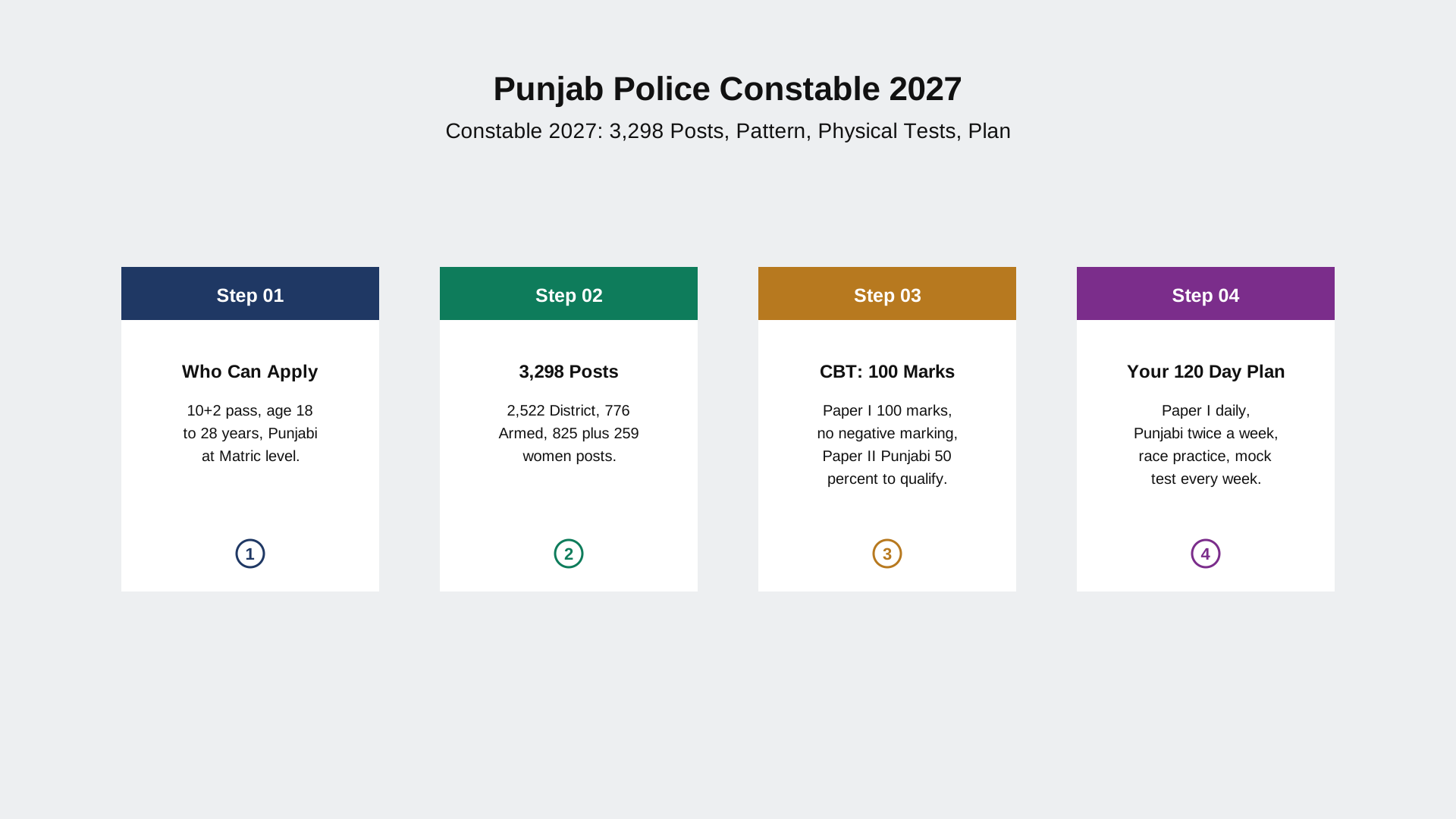
| Posts in last cycle | 3,298 in total: 2,522 District Cadre and 776 Armed Cadre, excluding sports quota posts |
| Women posts in last cycle | 825 in District Cadre and 259 in Armed Cadre, out of the category totals |
| Applications in last cycle | 10 March 2026, 7 pm, to 30 March 2026, 11.55 pm |
| Computer test in last cycle | From 1 July 2026 onwards, per the public notice of 16 June 2026 |
| Advertisement for 2027 cycle | Not published as of 21 November 2026 |
| Education | 10+2 or equivalent; Matriculation for ex-servicemen |
| Age limit | 18 to 28 years as on 1 January 2026 in the last cycle, with relaxation to 33 years for SC and Backward Class candidates of Punjab |
| Punjabi rule | Matriculation with Punjabi as a compulsory or elective subject, on or before 1 January 2026 |
| Fee in last cycle | Rs 1,200 for General, Rs 700 for SC, ST, Backward Classes of Punjab and EWS, Rs 500 for ex-servicemen of Punjab and their lineal descendants |
| Written test | Paper I, 100 questions for 100 marks in 2 hours, decides merit; Paper II, 50 questions for 50 marks in 1 hour, Punjabi, qualifying only |
| Negative marking | None in either paper |
| Physical tests | Physical Screening Test and Physical Measurement Test, both qualifying only |
| Pay in last cycle | Rs 19,900 a month for the first three years from joining |
| Selection | Computer based test, then physical tests, then document scrutiny, then medical examination |
| Official website | punjabpolice.gov.in, with the recruitment portal for applications and results |
Three cycles, three different vacancy pictures
The 2026 advertisement is the one to prepare from, but the two cycles before it explain why the numbers move. In 2024, Advertisement No. 01 of 2024, published on 29 February 2024, offered 1,746 posts: 970 in the District Cadre, with 317 reserved for women, and 776 in the Armed Cadre, with 253 reserved for women. Applications ran from 14 March to 4 April 2024. In 2025, Advertisement No. 1 of 2025 offered 1,746 posts again, but the split had shifted: 1,261 in the District Cadre, with 410 reserved for women, and 485 in the Armed Cadre, with 157 reserved for women. The notification came out on 12 February 2025, applications ran from 21 February to 13 March 2025, and the computer test started from 2 May 2025 onwards. Document verification for that cycle ran from 28 November to 5 December 2025.
Then came 2026. The total jumped to 3,298, with 2,522 District Cadre posts and 776 Armed Cadre posts. The Armed Cadre figure is identical to 2024, while the District Cadre figure more than doubled from the 2025 number. Women hold 825 of the District Cadre posts and 259 of the Armed Cadre posts in 2026. Sports quota posts sit outside all these totals in every cycle and the board fills them separately, so a candidate should not add them in.
Two lessons follow. First, the District Cadre is where the growth has been, and it is also where the competition is spread across 15 district preferences. In the 2026 cycle, District Cadre candidates gave 15 district preferences, the board allotted districts on merit and availability, and the government kept a selected candidate out of their home district under Punjab Government instructions of 21 May 2020. Second, the advertisement itself warns that the government or Punjab Police may increase or decrease the numbers at any time before the recruitment is complete. The 3,298 figure is the advertised figure, not a promise carved in stone.
For the 2027 cycle, no such advertisement exists yet. The pattern of the last three years suggests a new notice in the first months of the year, but that is a pattern, not a date. This guide prints no 2027 application date, because Punjab Police has published none. Candidates who see a 2027 date on a tracker site should ask for the advertisement number behind it. If there is no advertisement number, there is no date.
Who can apply for Punjab Police Constable
The age rule in the 2026 advertisement is 18 to 28 years as on 1 January 2026. SC and Backward Class candidates who are residents of Punjab get relaxation up to 33 years. Serving regular employees of the Punjab Government, another state government or the Central Government also get relaxation up to 33 years. Ex-servicemen resident in Punjab may deduct their Armed Forces service from their actual age, and they qualify if the resulting age is not more than three years above the maximum. The cut off date decides everything here. A candidate who turns 29 on 31 December 2025 is inside the limit, and a candidate who turns 29 on 2 January 2026 is outside it, because the board counts the age as on 1 January 2026.
Education is a 10+2 pass or its equivalent from a recognised board or university, and the qualification must be held on or before 1 January 2026. For ex-servicemen the minimum is Matriculation. There is no requirement of a degree, no requirement of a diploma, and no stream restriction. A science student and an arts student sit the same paper, and the board builds the paper for that. The syllabus leans on school level maths, reasoning and language, not on any one stream.
The Punjabi condition deserves its own paragraph, because it ends more applications than any other rule. Every candidate must have passed Matriculation with Punjabi as a compulsory or elective subject, or an equivalent Punjabi examination specified by the Punjab Government, on or before 1 January 2026. This is separate from the Punjabi questions inside Paper I and separate from Paper II. A candidate from another state who studied Hindi or English at Matric level and never took Punjabi cannot clear this condition, however well they score in the written test. The advertisement also makes it a nationality rule with a sharp edge: a citizen of India who has obtained citizenship, permanent residency or a green card of another country is not eligible.
Examiners check height at the physical measurement test, not at the application stage, but a candidate should know the numbers before paying the fee. The minimum height is 5 feet 7 inches, or 170.2 cm, for men and 5 feet 2 inches, or 157.5 cm, for women, for both cadres. The board treats transgender candidates at par with female candidates for the physical screening test and the physical measurement test. There is no separate height relaxation for any category in the 2026 advertisement.
Punjab Police Constable exam pattern: two papers, one that counts
Stage I is the computer based test, and it has two papers. Paper I has 100 questions carrying 1 mark each, with 2 hours to finish them, and it decides the merit. Paper II is a mandatory qualifying test of Punjabi language at Matriculation standard. It has 50 questions carrying 1 mark each, takes 1 hour, and needs 50 percent after normalisation. Its marks are not counted for merit. A candidate who scores 90 in Paper I and 24 in Paper II is out, while a candidate who scores 45 in Paper I and 25 in Paper II goes through to the physical tests. That is the shape of this exam, and it punishes anyone who treats Paper II as an afterthought.
There is no negative marking in either paper. Section 7.1 of the 2026 advertisement states this plainly. That single fact changes how a candidate should play the paper, and this guide returns to it below. The computer test runs in several shifts, so the board normalises scores using the mean and standard deviation method set out in Section 7.2 of the advertisement. Normalisation matters because a hard shift and an easy shift should not decide a career. The minimum marks in Paper I after normalisation are 40 percent for general and other categories and 35 percent for SC, BC, EWS and ex-servicemen candidates. Paper II needs 50 percent for everyone.
The board uploads the answer key after the last computer test session, with 48 hours for objections at Rs 50 per objection, refunded if the objection is upheld. That is a small detail with a real use. A candidate who remembers a doubtful question should check the key when it appears, because a single upheld objection can move a candidate across the shortlist line.
| Paper | Questions | Marks | Time | Role |
|---|---|---|---|---|
| Paper I | 100 | 100, 1 mark each | 2 hours | Decides merit |
| Paper II, Punjabi language, Matric standard | 50 | 50, 1 mark each | 1 hour | Qualifying, 50 percent needed |
| Total | 150 | 150 | 3 hours | No negative marking in either paper |
Paper I, section by section
Paper I splits into six sections, and the split tells a candidate where the marks live. General Awareness carries 35 questions, the largest block. Quantitative Aptitude and Numerical Skills carries 20. Mental Ability and Logical Reasoning carries 20. English Language Skills carries 10. Punjabi Language Skills carries 10. Digital Literacy and Awareness carries 5. The total is 100, and every question carries the same single mark, so a General Awareness question and a Digital Literacy question are worth exactly the same. Time is the only thing that differs between them.
General Awareness covers the Constitution and its features, Central and State legislature, executive and judicial institutions and local government, history, geography, culture and economy of Punjab, health and nutrition, and current affairs. Punjab carries real weight inside this block. A candidate who knows national current affairs but cannot name the rivers of Punjab, the districts and their crops, or the main events of Punjab history will drop marks in the biggest section of the paper. The 2026 advertisement lists Punjab history, geography, culture and economy as part of this section, and that is a direct instruction about where to study.
Quantitative Aptitude covers simplification, average, decimals and fractions, ratio and proportion, percentages, profit and loss, simple interest, and time and work. The level is school maths, and the questions reward speed more than depth. A candidate who can do a percentage question in 40 seconds has an edge over a candidate who needs two minutes, because the paper gives 120 seconds per question on average across the whole of Paper I, and the reasoning section will eat into that average.
Mental Ability and Logical Reasoning covers number and letter series, sequencing, statements and conclusions, pattern completion, order and ranking, direction and distances, and relationship problems. This is the section where practice shows fastest. The patterns repeat, the question types stay limited, and a candidate who has worked through a few hundred of them will recognise the shape of a question before reading it fully.
English Language Skills, 10 questions, covers reading comprehension, Punjabi to English translation, sentence rearrangement and correction, error spotting, fill in the blanks, spelling correction, and vocabulary including synonyms, antonyms and one word substitution. The translation item is the distinctive part. A candidate who can move a sentence from Punjabi to English cleanly has an advantage that a general English grammar book will not give.
Punjabi Language Skills, also 10 questions inside Paper I, covers correct and incorrect usage, synonyms and antonyms, proverbs and idioms, English to Punjabi translation, one word substitution, and an unseen passage. Put together with Paper II, Punjabi accounts for 60 of the 150 questions in Stage I. That is 40 percent of the written stage in a language test of one kind or another, which is why this guide keeps returning to it. Digital Literacy, the last 5 questions, covers computer fundamentals, MS Office including Word and PowerPoint, internet and web search, email, and basic mobile phone concepts. Five questions is small, but five marks is five marks in a paper where one mark gaps decide the merit list.
Paper II Punjabi: the paper that ends selections quietly
Paper II is a 50 question test of Punjabi language at Matriculation standard, written in Gurmukhi, covering grammar, vocabulary, idioms, translation and comprehension. It takes one hour. It needs 50 percent after normalisation, which means 25 marks in raw terms, and its marks do not count for merit. The trap is psychological. Candidates spend months on Paper I, because Paper I decides the rank, and then they treat Paper II as a formality. The advertisement does not treat it as a formality. Failing Paper II disqualifies a candidate whatever the Paper I score.
The standard is Matriculation level, which sounds easy to a native Punjabi speaker. The language feels familiar, but the questions test grammar rules, correct usage and idioms that many fluent speakers never learned formally. A person can speak Punjabi every day and still miss a question on the correct form of a word or the meaning of a proverb. The fix is small and regular. Two Punjabi sessions a week, built around a Matric level Punjabi grammar book and past questions, is enough to hold the 50 percent line. What fails candidates is neglect of the subject, not its difficulty.
There is a second Punjabi layer that candidates from Punjab sometimes miss. The Matriculation Punjabi condition for eligibility and the Paper II test are two different gates. Passing Paper II does not cure a missing Matriculation Punjabi qualification, and holding the Matriculation qualification does not pass Paper II. A candidate has to clear both gates, and each gate needs different preparation.
No negative marking changes how you play Paper I
Most police exams in India punish wrong answers. This one does not. With no negative marking, a blank answer and a wrong answer score the same, which is zero, while a guessed answer has a one in four chance of scoring a mark. The maths is plain. A candidate who attempts all 100 questions and gets 60 right scores 60. A candidate who attempts only the 60 they are sure of and leaves 40 blank also scores 60, and has thrown away the chance of picking up extra marks from the 40. In this exam, leaving a question blank is never the better play.
Guessing wildly on every question wastes time. The better play is precise. Answer the questions you know first, mark the ones you can narrow to two options, and in the last 15 minutes go back and answer everything that is left. A guess between two options has a one in two chance, which is a good bet when the downside is zero. A pure guess between four options is still a free chance at a mark. The only real cost of guessing is time, and doing it last manages that cost.
Time is the real constraint in Paper I. Two hours for 100 questions is 72 seconds per question on average, but the sections do not take equal time. General Awareness questions are mostly recall, and a prepared candidate clears most of them in under a minute. Reasoning questions can take two minutes each without the candidate noticing. The plan that works is to take the quick sections first, bank those marks, and then give reasoning and maths the long stretch they need. A candidate who starts with reasoning and gets stuck on three hard questions in a row has lost the time that would have bought ten easy marks elsewhere.
The minimum marks line also shapes the plan. After normalisation, a general category candidate needs 40 percent in Paper I to reach Stage II, and a SC, BC, EWS or ex-serviceman candidate needs 35 percent. Those are the floors, not the targets. The board draws the merit list from Paper I marks alone, and draws the shortlist for the physical tests on Paper I merit after reservation. A candidate who aims at 40 percent will reach Stage II and then lose the cadre of their choice to a candidate who aimed at 70. The floor gets a candidate through the door. The score decides which district they serve in.
The physical tests: one chance at the race
Stage II has two parts, both qualifying only. The Physical Screening Test checks fitness through events, and the Physical Measurement Test checks height. Neither adds marks. A candidate has to clear both, and has to clear every event inside the screening test. Failing any one event disqualifies the candidate. The events run in a fixed order: running first, then long jump, then high jump, then height measurement. That order matters, because the race comes when the candidate is fresh, and the jumps come after it.
For male candidates, including ex-servicemen below 35 years of age as on 1 January 2026, the race is 1,600 metres in 6 minutes 30 seconds, with only one chance. The long jump is 3.80 metres, with three chances. The high jump is 1.10 metres, with three chances. For female candidates, including ex-servicewomen below 35, the race is 800 metres in 4 minutes 30 seconds, with one chance. The long jump is 3.00 metres, with three chances. The high jump is 0.95 metres, with three chances. The race is the event that ends most physical attempts, because it gives a single chance and the clock does not forgive a slow start.
Ex-servicemen above 35 years of age as on 1 January 2026 have a different set of events. Male ex-servicemen in that group do a 1,400 metre walk and run in 12 minutes, with one chance, and 10 full squats within 3 minutes, with one chance. Female ex-servicemen above 35 do an 800 metre run in 6 minutes, with one chance. The advertisement also notes that examiners may carry out random dope testing, and refusing to give a sample disqualifies the candidate. Pregnant candidates may apply on the portal, before their scheduled date and with a government hospital medical report, to postpone the screening and measurement tests.
Examiners measure height last, and the standard is the same as the eligibility rule: 5 feet 7 inches, or 170.2 cm, for men and 5 feet 2 inches, or 157.5 cm, for women. A candidate who clears the race and both jumps and then fails the height check is out, which is why a candidate should measure their height at home long before the physical test date. There is no appeal against a tape measure.
No candidate can compress physical preparation into the gap between the written result and the physical test date. The race needs weeks of steady running, and the jumps need technique as much as strength. A candidate who starts running only after clearing the written test is already late. The sensible plan is to run three or four times a week from the first month of preparation, so that the physical test is a formality by the time the written result arrives.
| Candidate | Race | Long jump | High jump |
|---|---|---|---|
| Male, including ex-servicemen below 35 | 1,600 m in 6 min 30 sec, one chance | 3.80 m, three chances | 1.10 m, three chances |
| Female, including ex-servicewomen below 35 | 800 m in 4 min 30 sec, one chance | 3.00 m, three chances | 0.95 m, three chances |
| Ex-serviceman male, above 35 | 1,400 m walk and run in 12 min, one chance | 10 full squats in 3 min, one chance | Not applicable |
| Ex-serviceman female, above 35 | 800 m run in 6 min, one chance | Not applicable | Not applicable |
What a constable earns and where the department posts you
The 2026 advertisement gives the pay scale of a constable as Rs 19,900, with a minimum pay of Rs 19,900 a month admissible for three years from the date of joining. That figure comes from the Punjab Government notification of 29 December 2020 and the Punjab Police (First Amendment) Rules, 2025. The three year period is the probation period, and the pay is the minimum admissible during it. Allowances sit on top of the basic figure as per government rules, and the full pay scale rises after probation. Candidates who see a larger salary figure on a tracker site should check whether it is the basic pay, the gross pay with allowances, or a guess. The advertisement figure is Rs 19,900 a month for the first three years.
Posting is wider than most candidates expect. The department can post recruits anywhere in Punjab, in India, or abroad, and the cadre preference given in the form decides the cadre for the whole career. The board allots districts to District Cadre constables on merit and availability, and a selected candidate stays out of their home district. That rule exists to keep a constable from policing their own village, and it means a candidate should be ready to live and work in a district they did not choose.
After the physical tests comes document scrutiny, Stage III. Officers check certificates, category, Punjabi qualification and domicile papers. After that, a medical examination, including a substance abuse test, and character and antecedent verification follow. A candidate with a clean written score and a clean physical test can still lose the post at this stage if a certificate is missing or a document does not match the form. The fix is to keep every original certificate ready from the day a candidate files the application, not from the day the scrutiny letter arrives.
The fee, and what it is made of
The 2026 fee is split into an application fee and an examination fee, and the split explains why different categories pay different totals. General candidates pay Rs 550 as application fee and Rs 650 as examination fee, a total of Rs 1,200. SC and ST candidates of all states, Backward Classes of Punjab and EWS candidates pay Rs 550 as application fee and Rs 150 as examination fee, a total of Rs 700. Ex-servicemen of Punjab and their lineal descendants pay Rs 500 as application fee and no examination fee, a total of Rs 500. Transgender candidates pay according to their reservation category. Payment is online only, and the board does not refund the fee.
The 2025 cycle charged the same headline totals: Rs 1,200 for general, OBC and EWS candidates, Rs 700 for SC and ST, and Rs 500 for ex-servicemen of Punjab and their lineal descendants. The headline totals have been stable across the two cycles, which makes Rs 1,200 the working figure for a general candidate planning for 2027, while the category split in the new advertisement is the figure that will actually apply. A candidate should never pay a fee through any link except the official recruitment portal. punjabpolice.gov.in publishes the portal address, and the application link for each cycle is a fresh address.
A 120 day plan that fits the real pattern
The pattern sets the plan. Paper I is 100 marks, Paper II is a 50 percent gate, and the physical tests need a fit body. A 120 day plan can cover all three if a candidate uses the weeks in the right order. The first 30 days belong to the base. General Awareness takes one hour a day, with Punjab history, geography and culture first, then the Constitution and current affairs. Maths and reasoning take one hour a day between them, built on practice sets rather than theory. Punjabi gets 30 minutes a day from the first week, not the last, because Paper II is a gate that needs steady work. Running gets three sessions a week from day one.
Days 31 to 80 are for depth and speed. General Awareness moves to revision and current affairs of the last six months. Maths and reasoning move to timed sets of 20 questions, with the time per question tracked. English and Punjabi translation take one session each per week, because translation is the skill that most candidates leave to chance. Digital Literacy takes one session a week, which is enough for 5 questions. Take a full mock test in the real pattern, 100 questions in 2 hours followed by a 50 question Punjabi paper in 1 hour, every week from day 45 onwards, and review every wrong answer the same day.
Days 81 to 120 are for the finish. Mock tests move to twice a week. General Awareness revision narrows to Punjab facts and the last three months of current affairs. Test the race at full distance once a week, and practise the jumps at a ground with a proper pit. The last week belongs to revision of the mistake notebook, one final full mock test, and rest before the exam day. A candidate who follows this shape arrives at the exam with the syllabus covered, the Punjabi gate held, and the body ready for the race.
The mock tests on this site follow the 2026 pattern: Paper I of 100 questions in 2 hours with no negative marking, and Paper II of 50 Punjabi questions in 1 hour with a 50 percent qualifying line. Practising in that exact shape matters, because the exam rewards candidates who have already sat through the three hour sitting several times before the real day.
Mistakes that cost candidates a year
The first mistake is the Punjabi condition. Candidates from outside Punjab apply, pay the fee, clear the written test and then fail document scrutiny because they never passed Matriculation with Punjabi. Every advertisement prints the condition, and it is still the most common reason for a late rejection. A candidate who does not hold it should not apply, and a candidate who is unsure should check the Matric certificate before paying anything.
The second mistake is the cadre preference. Candidates pick the District Cadre because it has more posts, without thinking about what district policing means, or they pick the Armed Cadre because a relative served in it. No one can change the preference after selection, and the Punjab Police Act bars transfer between cadres. Fifteen district preferences in the District Cadre is a real choice, and a candidate should make it with the family and with the knowledge that the home district stays out of the allotment.
The third mistake is leaving questions blank. With no negative marking, a blank answer is a wasted chance. The habit comes from other exams where a wrong answer costs marks, and a candidate has to unlearn it for this one. Every question should carry an answer by the end of the two hours.
The fourth mistake is ignoring Paper II until the last week. Fifty percent in Punjabi at Matric standard is a low bar for a prepared candidate and a high bar for one who has not opened a Punjabi book in years. Two sessions a week from the start removes the risk entirely.
The fifth mistake is starting physical training late. The race gives one chance, and the clock gives 6 minutes 30 seconds for men and 4 minutes 30 seconds for women. A candidate who can run the distance in the required time in practice will clear it on the day. A candidate who has never timed a full distance run will discover the truth on the ground, in front of the examiners, with no second chance.
Sources
Punjab Police Advertisement No. 01 of 2026, published 6 March 2026, on punjabpolice.gov.in, as reproduced in full by ExamDetail, including the vacancy tables, the fee table, the pattern in Sections 7.1 and 7.2, the physical standards and the pay scale. Punjab Police public notice dated 16 June 2026, announcing the computer based test from 1 July 2026 onwards. Punjab Police Constable Recruitment 2025, Advertisement No. 1 of 2025, notification 12 February 2025, applications 21 February to 13 March 2025, computer test from 2 May 2025 onwards, as reported by ExamNotify, IndGovtJobs and Rojgar Pedia. Punjab Police Constable Recruitment 2024, Advertisement No. 01 of 2024, published 29 February 2024, applications 14 March to 4 April 2024, as reproduced by MPCareer and Government Daily Jobs. Punjab Police Constable syllabus and exam pattern, as set out by Examsyllabushub and House of Aspirants from the official notifications. Punjab Police Act, 2007, Section 4(b), on cadre transfer, as cited in the 2026 advertisement.