About Punjab Police SI 2027 Exam Series
📖 Table of Contents
- Punjab Police SI 2027 at a glance
- Two SI cycles, and why they look so different
- Who can apply for Punjab Police SI
- Punjab Police Sub Inspector exam pattern: three papers, and only two count for merit
- Negative marking: the 1 mark that punishes guessing
- Paper III Punjabi and the 50 percent line
- The physical tests: a slower race than constable, nearly the same jumps
- Pay, probation and posting
- The fee question this guide could not settle
- What the ASI news means for graduates
- SI and constable, side by side
- A 150 day plan that fits the real pattern
- Mistakes that cost candidates a year
- Sources
Punjab Police SI 2027: Complete Exam Guide
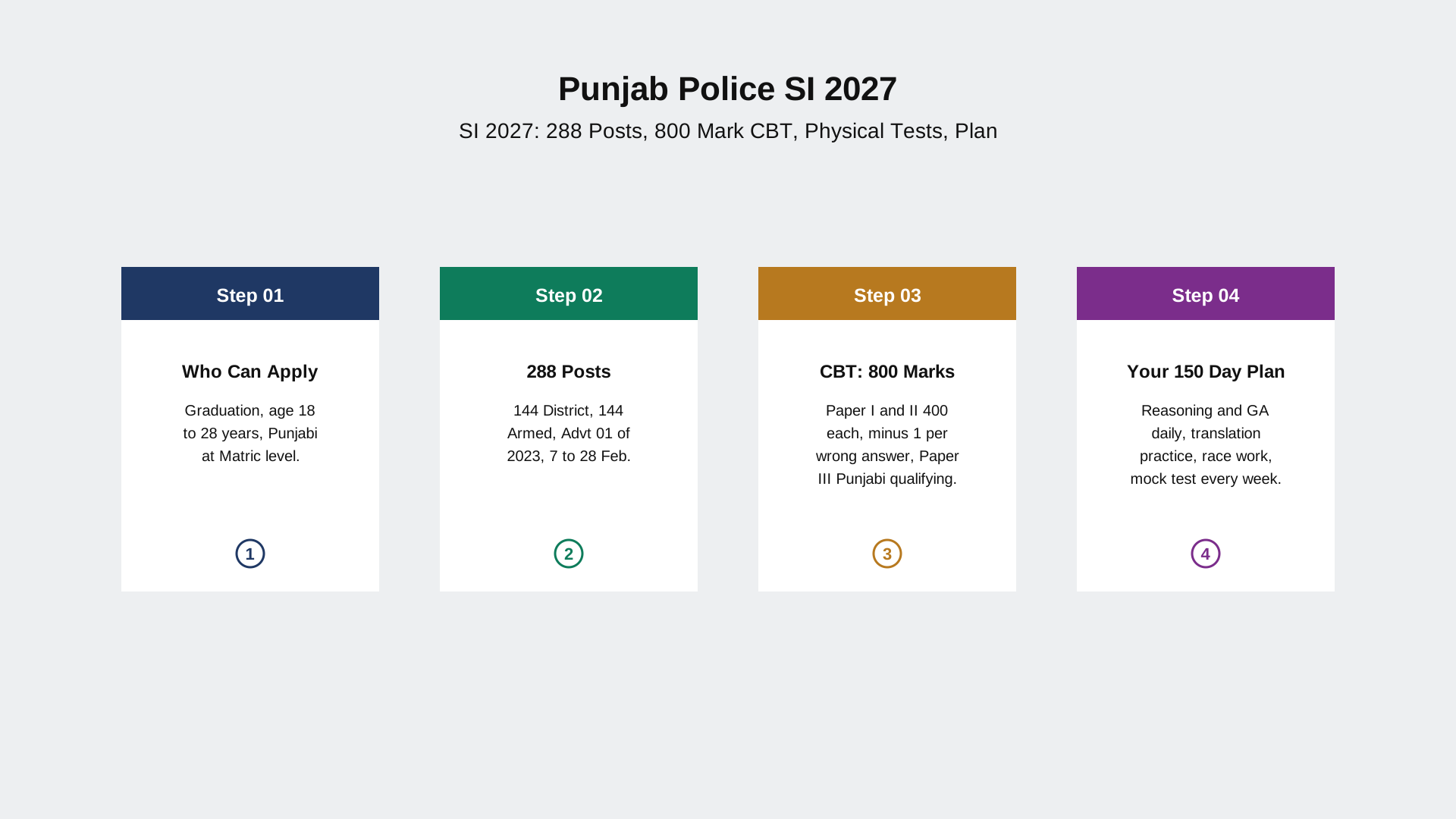
The Punjab Police SI 2027 cycle starts from a clear fact. The last Sub Inspector recruitment came through Advertisement No. 01 of 2023, published on 31 January 2023, and it offered 288 posts: 144 in the District Police Cadre and 144 in the Armed Police Cadre. Applications ran from 7 to 28 February 2023. As of 21 November 2026, Punjab Police has published no newer SI notification. That gap of nearly four years is the first thing a candidate has to understand, because it changes how to read every tracker site that promises a 2027 date.
A Sub Inspector is the graduate entry officer rank in Punjab Police. An SI leads a police station team, supervises constables, records first information reports, investigates cases, manages a beat and answers to an Inspector. It is a different job from a constable, and the exam reflects that. The written test carries 800 marks across two papers, each question carries 4 marks, and each wrong answer costs 1 mark. A constable candidate can attempt every question without fear, because the constable paper has no negative marking. An SI candidate who does the same will bleed marks on every guess.
The entry ticket is a graduation degree from a recognised university, an age of 18 to 28 years as on 1 January 2023 in the last cycle, and Matriculation with Punjabi as a compulsory or elective subject. The height standard matches the constable standard: 5 feet 7 inches for men and 5 feet 2 inches for women. The pay in the 2023 notification was Rs 35,400 a month for the first three years from joining. Three years of probation apply, as they do for constables.
One warning belongs at the top. Several tracker sites label the old 560 post SI cycle as a 2026 recruitment with application dates in August 2025. That cycle belongs to 2022, not 2026, and its exam was scrapped after reports of cheating. This guide separates the 2022 cycle, the 2023 cycle and the 2027 outlook, and it names the source for each figure. A candidate who mixes the cycles will prepare for the wrong paper.
Punjab Police SI 2027 at a glance
| Detail | Punjab Police SI 2027, anchored on the last cycle |
|---|---|
| Conducting body | Punjab Police, through its recruitment board, on punjabpolice.gov.in |
| Post | Sub Inspector, District Police Cadre and Armed Police Cadre |
| Last advertisement | Advertisement No. 01 of 2023, published 31 January 2023 |
| Posts in last cycle | 288 in total: 144 District Police Cadre and 144 Armed Police Cadre, excluding sports quota posts |
| Applications in last cycle | 7 February to 28 February 2023 |
| Advertisement for 2027 cycle | Not published as of 21 November 2026 |
| Education | Graduation from a recognised university, completed on or before 1 January 2023 in the last cycle |
| Age limit | 18 to 28 years as on 1 January 2023 in the last cycle, with relaxation up to 33 years for SC and BC candidates of Punjab |
| Punjabi rule | Matriculation with Punjabi as a compulsory or elective subject |
| Fee in last cycle | Not verified from the official 2023 notification copy; a tracker lists Rs 1,600 total for general candidates, see the fee section |
| Written test | Paper I, 100 questions for 400 marks in 2 hours; Paper II, 100 questions for 400 marks in 2 hours; Paper III, 50 Punjabi questions for 50 marks in 1 hour, qualifying only |
| Negative marking | 1 mark cut for each wrong answer in Paper I and Paper II; no negative marking in Paper III |
| Minimum marks | 40 percent in each of Paper I and Paper II separately for general candidates, 35 percent for SC, BC, EWS and ex-servicemen; 50 percent in Paper III |
| Physical tests | Physical Measurement Test and Physical Screening Test, both qualifying only |
| Pay in last cycle | Rs 35,400 a month for the first three years from joining |
| Selection | Computer based test, then physical tests, then document scrutiny; merit from Paper I and Paper II combined after normalisation |
| Official website | punjabpolice.gov.in, with the recruitment portal for applications and results |
Two SI cycles, and why they look so different
The 2022 cycle was the big one. Punjab Police advertised 560 Sub Inspector posts across four cadres: 87 in the District Police Cadre, 97 in the Armed Police Cadre, 87 as Intelligence Officers in the Intelligence Cadre, and 289 in the Investigation Cadre. Of the 560, 378 were for men and 182 for women. The Tribune reported on 2 August 2022 that about 1.11 lakh candidates had applied, nearly 200 times the number of vacancies. The common computer based tests ran from 17 to 24 August 2022 at centres across the state.
That cycle then collapsed. Punjab Police scrapped the examination after reports of cheating and malpractices, on the directions of Chief Minister Charanjit Singh Channi and Deputy Chief Minister Sukhjinder Singh Randhawa. The recruitment board had recommended scrapping the tests, and the department said dates for a fresh examination would follow soon. The 560 post cycle is the reason some tracker pages still show a five stage selection process with a drug test and a personal interview. Those stages belonged to the 2022 notification, not to the 2023 one.
The 2023 cycle was smaller and cleaner. Advertisement No. 01 of 2023 offered 288 posts in only two cadres, District Police and Armed Police, 144 each. Sports quota posts sat outside the total and the department filled them separately. Applications ran from 7 to 28 February 2023. The selection process had three stages: a computer based test with three papers, physical measurement and physical screening tests, and document scrutiny. No interview appeared in the 2023 notification, and the board made no waiting list.
The contrast between the two cycles teaches a practical lesson. The 2022 cycle offered four cadres and an Intelligence Officer post for graduates who wanted desk and analysis work. The 2023 cycle offered only the two uniformed cadres. A candidate who wants the Intelligence or Investigation cadre has to wait for a notification that includes those cadres, because the 2023 pattern cannot create them. The 2027 outlook depends on which cadres the next notification opens.
Who can apply for Punjab Police SI
Graduation is the core requirement. A candidate needs a graduation degree from a recognised university, completed on or before 1 January of the recruitment year, which was 1 January 2023 in the last cycle. The degree can come from any stream. Arts, commerce, science and engineering graduates all sit the same papers, and the syllabus rewards general awareness, reasoning and language rather than any one subject. A candidate in the final year of graduation who has not yet received the degree by the cut off date cannot apply.
The age rule in the 2023 notification is 18 to 28 years as on 1 January 2023. SC and BC candidates of Punjab get relaxation up to 5 years, taking the upper limit to 33 years. Serving government employees get the same relaxation up to 33 years. Ex-servicemen deduct their service period from their actual age as per the rules. The cut off date decides everything, as it does in the constable recruitment. A candidate who turns 29 a week before the cut off date is out, and a candidate who turns 29 a week after it is in.
The Punjabi condition matches the constable rule. Every candidate needs Matriculation with Punjabi as a compulsory or elective subject, or an equivalent Punjabi examination specified by the Punjab Government. This condition ends applications from candidates who studied in other states without Punjabi at Matric level, however strong their graduation degree is. The 2023 notification also requires Indian citizenship, and the constable rule about foreign citizenship, permanent residency or a green card applies in the same spirit to police recruitment in Punjab.
Height is 5 feet 7 inches, or 170.2 cm, for men and 5 feet 2 inches, or 157.5 cm, for women, for both cadres in the 2023 notification. The standard is identical to the constable standard, which means a candidate who clears the height check for constable clears it for SI as well. The physical events differ, and the next sections cover them.
Punjab Police Sub Inspector exam pattern: three papers, and only two count for merit
The 2023 computer based test has three papers, and the three papers do very different jobs. Paper I has 100 questions, each carrying 4 marks, for a total of 400 marks, in 2 hours. Paper II has 100 questions, each carrying 4 marks, for a total of 400 marks, in 2 hours. Paper III has 50 questions, each carrying 1 mark, for a total of 50 marks, in 1 hour, and it is a qualifying test of Punjabi language at Matriculation standard. The board makes the merit list from the combined marks of Paper I and Paper II after normalisation. Paper III, the physical measurement test and the physical screening test are qualifying only.
Paper I splits into three sections. General Awareness carries 50 questions, Quantitative Aptitude and Numerical Skills carries 30, and Punjabi Language Skills carries 20. The General Awareness section is half the paper, which is 200 of the 400 marks. It covers the Indian Constitution and its features, Central and State legislature, executive and local government, judicial institutions, history and culture of India and Punjab, science and technology, Indian economy, geography and environment, national and international current affairs including current legal developments, and diversity, ethics and vulnerable sections of society. A candidate who wants a high Paper I score has to win this section first.
Quantitative Aptitude in Paper I covers numbers and their relations, simplification, decimals and fractions, ratio and proportion, percentage, average including mean, median and mode, profit and loss, simple and compound interest, time and work, mensuration, speed, time and distance, and equations. The level is school and graduation level maths, and the questions reward a candidate who can work fast without a calculator. Punjabi Language Skills in Paper I covers sentence completion and structuring, error detection, vocabulary including synonyms, antonyms and one word substitution, comprehension, English to Punjabi translation, precis, and fill in the blanks. Translation appears in both directions across the two papers, which is a deliberate design choice by the board.
Paper II splits into three sections as well. Logical and Analytical Reasoning and Data Interpretation carries 50 questions, Digital Literacy and Computer Awareness carries 30, and English Language Skills carries 20. Reasoning and data interpretation covers statements and conclusions, number and letter series, sequencing, missing numbers, pattern completion, order and ranking, direction and distances, relationship problems, data sufficiency, puzzles, classification and analogy, calendars, coding and decoding, verbal, non verbal and legal reasoning, and data interpretation from graphs, charts, tables and spreadsheets. It is the largest single block in Paper II, and it is also the block where practice shows fastest.
Digital Literacy and Computer Awareness, 30 questions for 120 marks, is the section most candidates underprepare. It covers computer fundamentals, operating systems, hardware, MS Office including Word, Excel and PowerPoint, internet and the web, social media, search engines, VoIP, mobile phones, instant messaging apps, and basics of encryption and cyber security. A graduate who uses a computer daily still needs to study this syllabus, because the questions test terms and concepts, not daily use. English Language Skills in Paper II covers sentence completion and structuring, error detection, vocabulary, comprehension, Punjabi to English translation, precis, and fill in the blanks. Together, the two translation directions carry 80 marks in Paper I and 80 marks in Paper II, which makes translation practice one of the highest value habits in this exam.
| Paper | Questions | Marks | Time | Sections |
|---|---|---|---|---|
| Paper I | 100 | 400, 4 marks each | 2 hours | General Awareness 50, Quantitative Aptitude 30, Punjabi 20 |
| Paper II | 100 | 400, 4 marks each | 2 hours | Reasoning and Data Interpretation 50, Digital Literacy 30, English 20 |
| Paper III, Punjabi, Matric standard | 50 | 50, 1 mark each | 1 hour | Qualifying only, 50 percent needed |
| Total | 250 | 850 | 5 hours | Merit from Paper I and Paper II combined, 800 marks |
Negative marking: the 1 mark that punishes guessing
Each wrong answer in Paper I or Paper II costs 1 mark, which is 25 percent of the 4 marks a question carries. Paper III has no negative marking. The arithmetic of guessing follows from that. A blind guess between four options has a one in four chance of gaining 4 marks and a three in four chance of losing 1 mark. On average, a blind guess gains 1 mark and loses 0.75 marks, which nets 0.25 marks per guess. That looks like a small gain, but the average hides the risk. A candidate who guesses on 20 questions can easily lose 15 marks in a bad run, and 15 marks in an 800 mark merit list can cost a rank of hundreds of places.
The practical rule comes from a candidate who cleared the exam with rank 2 and a score of 713 out of 800, as reported by House of Aspirants. That candidate attempted a question only after cutting it down to two options. A guess between two options has a one in two chance of gaining 4 marks and a one in two chance of losing 1 mark, which nets 1.5 marks on average. The rule is simple to state and hard to follow under time pressure: answer what you know, attempt what you can narrow to two options, and leave the rest alone.
The minimum marks rule adds a second constraint. After normalisation, a candidate needs 40 percent in each of Paper I and Paper II separately, which is 160 marks out of 400 in each paper, for general and other categories. SC, BC, EWS and ex-servicemen candidates need 35 percent in each paper, which is 140 marks out of 400. A brilliant Paper I cannot rescue a weak Paper II, because the minimum applies to each paper separately. A candidate who scores 300 in Paper I and 150 in Paper II is out, while a candidate who scores 200 in each paper goes through. Balance between the two papers matters as much as the total.
Normalisation applies because the computer test runs in several shifts. The board normalises scores so that a hard shift and an easy shift do not decide the merit list. Ties break in a fixed order: the older candidate ranks higher, then the candidate with the higher Paper I score, then the candidate with higher qualifications. The board makes no waiting list in the 2023 cycle, so a candidate who misses the cut off by one mark has no second chance from the same list.
Paper III Punjabi and the 50 percent line
Paper III is a 50 question test of Punjabi language at Matriculation standard, with 1 mark per question, 1 hour on the clock, and a 50 percent qualifying line. Its marks do not count for merit, and it has no negative marking. The same trap that catches constable candidates catches SI candidates here. A graduate who has not studied Punjabi formally since school can speak the language fluently and still miss questions on grammar, correct usage and idioms. The fix is the same as for the constable paper: two Punjabi sessions a week from the first month, built around a Matric level Punjabi grammar book.
The Punjabi load across the whole SI test is heavy. Paper I carries 20 Punjabi questions for 80 marks. Paper III carries 50 Punjabi questions for 50 marks. Together, Punjabi accounts for 70 of the 250 questions in the written stage, plus the Matriculation Punjabi condition for eligibility. A candidate who treats Punjabi as a minor subject is fighting the design of the exam. The board has made Punjabi a gate at three separate points: eligibility, Paper I marks, and the Paper III qualifying line.
The physical tests: a slower race than constable, nearly the same jumps
Stage II has two parts, both qualifying only. The Physical Measurement Test checks height, and the Physical Screening Test checks fitness through events. Neither adds marks. A candidate has to clear every event for their category, because failing any one event ends the selection. The 2023 physical standards differ from the constable standards in one useful way: the SI race allows more time.
For men, the race is 1,600 metres in 7 minutes, with one chance. The long jump is 3.65 metres, with three chances. The high jump is 1.10 metres, with three chances. For women, the race is 800 metres in 5 minutes, with one chance. The long jump is 2.75 metres, with three chances. The high jump is 0.90 metres, with three chances. Compare that with the constable race: 6 minutes 30 seconds for men and 4 minutes 30 seconds for women, over the same distances. The SI race gives a man 30 extra seconds and a woman 30 extra seconds, while the long jump asks a man for 15 cm less and a woman for 25 cm less than the constable standard. The high jump standard is the same for men and 5 cm lower for women.
Ex-servicemen above 35 years of age have a different set of events. Male ex-servicemen in that group do a 1,400 metre walk and run in 12 minutes, with one chance, and 10 full squats in 3 minutes, with one chance. The race still gives only one chance, whatever the category. That single chance is the reason physical training has to start with the written preparation, not after the written result. A candidate who can run 1,600 metres in 7 minutes in practice will clear the race on the day. A candidate who has never timed a full distance run will learn the truth on the ground, with no second attempt.
Height is 5 feet 7 inches for men and 5 feet 2 inches for women, the same standard as the constable test. A candidate should measure height at home long before the physical test date, because the tape gives no second opinion. After the physical tests comes document scrutiny, Stage III. Officers check graduation certificates, category certificates, the Punjabi qualification and domicile papers. A missing certificate at this stage costs the same as a failed paper: the whole selection.
| Candidate | Race | Long jump | High jump |
|---|---|---|---|
| Male | 1,600 m in 7 min, one chance | 3.65 m, three chances | 1.10 m, three chances |
| Female | 800 m in 5 min, one chance | 2.75 m, three chances | 0.90 m, three chances |
| Ex-serviceman male, above 35 | 1,400 m walk and run in 12 min, one chance | 10 full squats in 3 min, one chance | Not applicable |
Pay, probation and posting
The 2023 notification fixes the pay of a Sub Inspector at Rs 35,400 a month, with a minimum pay of Rs 35,400 a month admissible for three years from the date of joining. That figure comes from the Punjab Government notification of 29 December 2020. Tracker sites place the post at Level 6 of the Punjab pay matrix, with a scale of Rs 35,400 to Rs 1,12,400, and the 2023 notification figure is the starting point of that scale. The three year period is the probation period, and the cabinet decision that sets a three year probation for all fresh appointees in Punjab applies here as well. Allowances sit on top of the basic figure as per government rules, and the full pay scale rises after probation.
Posting can take an SI anywhere in Punjab, in India or abroad, and the cadre preference in the application form decides the cadre. Transfer from one cadre to another is barred under Section 4(b) of the Punjab Police Act, 2007, so the choice between District Police and Armed Police at the time of application lasts for the whole career. District Police SIs work in police stations, investigation and district policing. Armed Police SIs work in the armed battalions. The daily work differs, the promotion path differs, and the posting pattern differs. A candidate should make the choice with those differences in mind, not by counting which cadre has more posts.
The SI post also carries a supervisory load that the constable post does not. An SI signs case papers, supervises constables and head constables, and answers for the work of a team. The written test reflects that load: 50 questions of reasoning and data interpretation in Paper II, 30 questions of digital literacy, and a General Awareness section that includes current legal developments, diversity, ethics and vulnerable sections of society. The board tests judgement, not just recall.
The fee question this guide could not settle
Every honest guide has a gap, and the SI fee is the gap in this one. The copy of the 2023 official notification that this guide could read, a 16 page PDF hosted on Google Drive and reproduced by tracker sites, states the pay scale, the pattern and the physical standards, but the fee table in the material available to this guide did not give a clean figure that two sources agreed on. The tracker site PW lists a fee of Rs 1,600 in total for general candidates, split as Rs 800 application fee and Rs 800 examination fee. That split matches the structure of the constable fee in the 2026 advertisement, where the total also splits into an application fee and an examination fee.
Other tracker pages disagree. The GovtJobOnline page for the 560 post cycle lists Rs 800 for general candidates and Rs 200 for SC, ST, EWS and BC candidates in one paragraph, and then says the application fee for all candidates is Rs 700 in the next paragraph. A page that contradicts itself on the fee cannot settle it. The 2022 cycle and the 2023 cycle may also have charged different fees, which would explain part of the disagreement. This guide does not print a fee as fact when the sources conflict. A candidate should read the fee table in the new notification before paying, and should pay only through the official recruitment portal on punjabpolice.gov.in.
The uncertainty is worth stating plainly, because the fee is the one figure a candidate has to act on before the exam. The working expectation, based on the PW tracker figure and the constable fee structure, is a total near Rs 1,600 for a general candidate, with lower totals for reserved categories and ex-servicemen. That is an expectation, not a verified figure, and the new notification will settle it.
What the ASI news means for graduates
While the SI notification has not come, Punjab has moved on a neighbouring rank. In August 2026, Punjab notified the Punjab Police (Second Amendment) Rules, 2026, which provide for direct recruitment of Assistant Sub Inspectors. The DGP has spoken in the media of about 300 to 350 ASI posts, and the exact number will appear in the official notification. No ASI notification has come out yet, and no ASI pattern has been published. The expected pattern is a written test and physical tests on the same lines as the SI pattern, but that is an expectation, not an official pattern.
For a graduate, the practical meaning is simple. The SI pattern on this page is the best preparation for the ASI recruitment as well, because the eligibility is the same shape: graduation, Matriculation level Punjabi, and an age of 18 to 28 years. A graduate who prepares for SI now is preparing for whichever of the two notifications comes first. A graduate who waits for the ASI notification before starting to study will start months behind candidates who prepared on the SI pattern.
The ASI development also explains part of the SI gap. The department has been filling graduate level posts through the constable and head constable routes while the ASI rules took shape. The 2026 constable advertisement offered 3,298 posts, and the head constable investigation cadre has had its own recruitment. The SI rank has waited longest, and the wait is the reason this guide anchors on 2023 rather than pretending a 2027 notification exists.
SI and constable, side by side
Candidates often ask whether to aim for SI or constable, and the answer depends on qualification and time. A 10+2 pass candidate cannot apply for SI, so constable is the only door. A graduate can apply for both, and the choice is about the size of the test. The constable written test is 100 marks with no negative marking, and the merit list comes from Paper I alone. The SI written test is 800 marks across two papers with negative marking, and the merit list comes from both papers combined. The SI test needs more months of preparation, and it rewards a candidate who can hold two papers at 40 percent each rather than one paper at a high score.
The physical tests favour the SI candidate slightly. The race allows 30 extra seconds, and the long jump asks for less distance. The pay favours the SI candidate clearly: Rs 35,400 a month against Rs 19,900 a month for the first three years. The job favours the SI candidate in responsibility, and the constable candidate in numbers: 3,298 constable posts in the 2026 cycle against 288 SI posts in the 2023 cycle. A graduate who wants the best chance of a uniformed job in the next cycle should apply for both when both notifications are open, and prepare for the SI pattern, because the SI pattern covers the constable syllabus and adds the depth the SI papers demand.
One confusion to clear up: the Punjab Public Service Commission of Pakistan also advertises Sub Inspector posts, 300 of them in 2025, at BPS-14, with a fee of Rs 600 and an age limit of 20 to 25 years. That is a different country, a different commission and a different exam. Its figures have no place in the Indian Punjab Police SI preparation, and tracker sites that mix the two have caused real confusion. This guide covers the Indian Punjab Police only, recruited by Punjab Police on punjabpolice.gov.in.
A 150 day plan that fits the real pattern
The SI pattern sets the plan, and the pattern has two heavy papers. A 150 day plan can cover both if the weeks respect the weight of each section. The first 45 days belong to the base. General Awareness gets 90 minutes a day, with the Constitution, Punjab history and culture, and current affairs first. Reasoning gets one hour a day, built on practice sets rather than theory. Quantitative Aptitude gets 45 minutes a day. Digital Literacy gets 30 minutes a day from the first week, because 30 questions for 120 marks is too large to leave for the end. Punjabi gets 30 minutes a day, split between Paper I Punjabi, translation practice and Paper III grammar. Running gets three sessions a week from day one.
Days 46 to 105 are for depth and speed. General Awareness moves to revision and current affairs of the last six months, including current legal developments, which the syllabus names directly. Reasoning moves to timed sets of 50 questions, with data interpretation sets twice a week. Maths moves to timed sets with the time per question tracked. Translation gets one passage each way every day, because the two translation directions carry 160 marks across the two papers. A full mock test in the real pattern, Paper I of 100 questions in 2 hours and Paper II of 100 questions in 2 hours, should be taken every week from day 60 onwards, with the Paper III Punjabi paper added in the same sitting, and every wrong answer reviewed the same day.
Days 106 to 150 are for the finish. Mock tests move to twice a week, with at least two full sittings that include all three papers in one day, so the body learns the five hour stretch. Revision narrows to the mistake notebook, Punjab facts, and the last three months of current affairs. The race is tested at full distance once a week, and the jumps are practised at a ground with a proper pit. The last week is for revision and rest, not for new topics. A candidate who follows this shape arrives at the exam with both papers balanced, the Punjabi gate held, and the body ready for the race.
The mock tests on this site follow the 2023 pattern: Paper I and Paper II of 100 questions each for 400 marks each, with 1 mark cut for each wrong answer, and Paper III of 50 Punjabi questions with a 50 percent qualifying line. Practising in that exact shape matters, because the exam rewards candidates who have already sat through the five hour sitting several times before the real day.
Mistakes that cost candidates a year
The first mistake is the Punjabi condition. Graduates from other states apply, pay the fee, clear the written test and then fail document scrutiny because they never passed Matriculation with Punjabi. The condition is printed in every advertisement, and it is still the most common reason for a late rejection. A candidate who does not hold it should not apply, and a candidate who is unsure should check the Matric certificate before paying anything.
The second mistake is guessing in Paper I and Paper II. The habit comes from the constable paper, where a wrong answer costs nothing, and from school exams where attempting everything is rewarded. In the SI papers, a wrong answer costs 1 mark. A candidate who guesses on 20 questions in each paper can lose 30 marks or more across the two papers, which is the difference between selection and rejection in an 800 mark merit list.
The third mistake is an unbalanced pair of papers. A candidate who loves General Awareness and neglects Paper II will score 300 in Paper I and fall below 160 in Paper II, and the 40 percent rule in each paper separately will end the selection. Both papers need 40 percent, so both papers need study time every week.
The fourth mistake is ignoring Paper III until the last week. Fifty percent in Punjabi at Matric standard is a low bar for a prepared candidate and a high bar for one who has not opened a Punjabi book in years. Two sessions a week from the start removes the risk entirely.
The fifth mistake is the cadre preference. Candidates pick a cadre by counting posts, without thinking about what district policing and armed battalion work mean day to day. The preference cannot change after selection, and the Punjab Police Act bars transfer between cadres. A graduate should choose the cadre whose work they want to do for a career, not the cadre with the larger number.
The sixth mistake is trusting a tracker date. Sites that label the 2022 cycle as 2026, sites that mix the Pakistan PPSC SI with the Indian Punjab Police SI, and sites that print a 2027 application date with no advertisement number have all misled candidates in this recruitment. The only date that counts is the one in an advertisement on punjabpolice.gov.in, with an advertisement number attached.
Sources
Punjab Police Advertisement No. 01 of 2023, published 31 January 2023, a 16 page notification hosted on Google Drive and reproduced by House of Aspirants, including the vacancy split, the pay scale of Rs 35,400, the three paper pattern, the minimum marks and the physical standards. House of Aspirants, Punjab Police SI and ASI 2027 syllabus and exam pattern, published 2 October 2026, which states that the latest SI recruitment was notified on 31 January 2023 and no newer SI notification has come out yet, and which reports the August 2026 Punjab Police (Second Amendment) Rules, 2026 for direct ASI recruitment. The Tribune, 1.11 lakh apply for 560 SI posts in Punjab, 2 August 2022. Zee News, Punjab Police scraps exams to fill 560 posts of sub-inspectors, on the common computer based tests held from 17 to 24 August 2022 and the scrapping on the directions of Chief Minister Charanjit Singh Channi and Deputy Chief Minister Sukhjinder Singh Randhawa. The Print, 2,500 posts in police dept to be filled up soon, says Punjab CM Mann, 6 October 2022, on the 560 SI posts across investigation, intelligence, district and armed police cadres. GovtJobOnline, Punjab Police Sub Inspector SI Recruitment Exam Notification 2026, 560 posts, which reproduces the 2022 cycle figures with 2025 application dates and contradicts itself on the fee, and is used here only as a record of the confusion. PW Live, Punjab Police SI Notification 2025, on the 2023 vacancy split of 144 District and 144 Armed posts and the tracker fee figure of Rs 1,600 total for general candidates. Testbook, Punjab Police SI Salary 2024, on the pay of Rs 35,400 a month and the three year probation period. Punjab Police Act, 2007, Section 4(b), on cadre transfer, as cited in the 2023 notification.