About OPSC OCS 2027 Exam Series
📖 Table of Contents
- OPSC OCS 2027 at a glance
- 465 posts, and where the extra 151 came from
- Who can apply for OPSC OCS 2027
- No attempt limit any more
- Prelims: two papers, one qualifying
- Mains: nine papers across five days
- The interview, and the final 2,000 marks
- What each Mains paper tests
- How the 2025 cycle actually ran
- What the 2024 cycle tells OPSC OCS 2027 aspirants
- A 12 month plan that fits the real calendar
- Five mistakes that cost OCS candidates marks
- Sources
OPSC OCS 2027: Complete Exam Guide
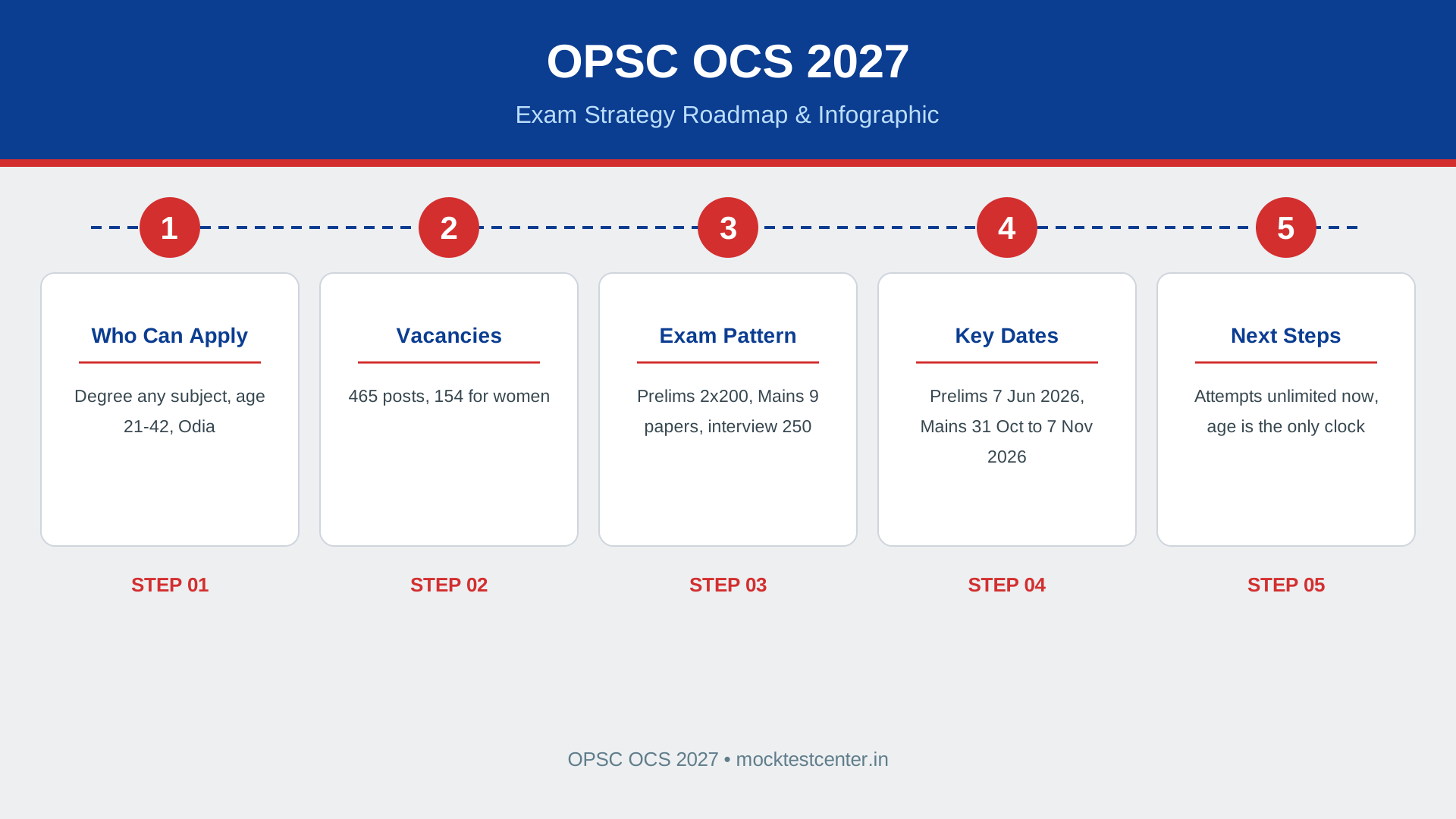
The Odisha Public Service Commission runs the Odisha Civil Services Examination, known as OPSC OCS, to fill Group A and Group B posts in the Odisha government. The live cycle is OCS 2025, advertised as Advt. No. 05 of 2025-26 for 465 posts.
Its Prelims took place on 7 June 2026, its Mains ran from 31 October to 7 November 2026, and the interview stage comes next. No fresh OCS notification has appeared yet, so this guide works from the 2025 cycle and shows how the next one will run.
That matters because OCS follows the same shape every year. Prelims screens. Mains decides. The interview adds the last 250 marks.
The 2025 cycle also changed two things that shape every plan from here on. The vacancy count jumped from 314 to 465 within days of the notification, and the Odisha Cabinet removed the attempt limit in November 2026. Both changes sit at the centre of this OPSC OCS 2027 guide.
OPSC OCS 2027 at a glance
| Detail | OPSC OCS 2025, the live cycle |
|---|---|
| Conducting body | Odisha Public Service Commission, Cuttack |
| Advertisement | Advt. No. 05 of 2025-26, dated 31 December 2025 |
| Posts | 465 Group A and Group B posts, 154 reserved for women |
| Application window | 20 January to 12 March 2026 |
| Application fee | Rs 700, exempt for SC, ST, PwD candidates |
| Age limit | 21 to 42 years as on 1 January 2025 |
| Attempts | Unlimited for all categories since 9 November 2026 |
| Prelims | 7 June 2026, two papers of 200 marks each |
| Prelims result | 10 July 2026, 5,690 candidates qualified |
| Mains | 31 October to 7 November 2026, nine papers |
| Interview | 250 marks, after the Mains result |
| Final total | 2,000 marks, Mains 1,750 plus interview 250 |
| Official website | opsc.gov.in |
Read the table as the skeleton and the rest of this OPSC OCS 2027 guide as the flesh. The dates belong to the 2025 cycle. The pattern, the age rule and the fee structure carry over to the next advertisement unless OPSC changes them in print.
465 posts, and where the extra 151 came from
OPSC first notified 314 posts on 31 December 2025, with 104 of them reserved for women. Three days later, the 1st Addendum of 3 January 2026 added 151 posts and took the total to 465, with 154 reserved for women.
Candidates who applied in the first week of the OPSC OCS 2027 cycle applied for a smaller exam than the one they ended up writing. That is worth remembering when the next notification lands. OPSC has added posts after the first advertisement before, and the count in the first notice is not always the final count.
The 151 added posts came from four services. The Odisha Revenue Service took the largest share with 113 posts.
The Odisha Welfare Service added 16, the Odisha Administrative Service added 14, and the Odisha Transport Service added 8. Revenue dominates the added list, and that shapes the competition. Revenue posts draw candidates who want field postings in the districts, and they also draw the largest share of serious aspirants.
The original 314 posts spread across seven services. The Odisha Taxation and Accounts Service held the largest block with 176 posts. The Odisha Labour Service followed with 98. The Odisha Police Service had 12, the Odisha Skill Development and Employment Service had 10, the Odisha Tourism Service had 8, the Odisha Excise Service had 6, and the Odisha Co-operative Service had 4.
| Service | Posts in the first notice | Posts added |
|---|---|---|
| Odisha Taxation and Accounts Service | 176 | 0 |
| Odisha Revenue Service | 0 | 113 |
| Odisha Labour Service | 98 | 0 |
| Odisha Administrative Service | 0 | 14 |
| Odisha Welfare Service | 0 | 16 |
| Odisha Police Service | 12 | 0 |
| Odisha Skill Development and Employment Service | 10 | 0 |
| Odisha Transport Service | 0 | 8 |
| Odisha Tourism Service | 8 | 0 |
| Odisha Excise Service | 6 | 0 |
| Odisha Co-operative Service | 4 | 0 |
| Total | 314 | 151 |
One detail in that table deserves a second look. The Odisha Administrative Service, the most sought after service in the exam, had zero posts in the first notice and 14 after the addendum.
A candidate who judged the exam by its first notice would have missed the OAS opening entirely. The lesson is plain. Read the addenda, not just the first advertisement.
Women hold 154 of the 465 posts as horizontal reservation. The first notice reserved 104 for women, and the addendum added 50 more. Reservation for SC, ST, SEBC, PwD, ex-servicemen, sportspersons follows the state rules in the notification, with the detailed split in Appendix A of the advertisement.
Who can apply for OPSC OCS 2027
A candidate needs a bachelor degree in any discipline from a recognised university. Any discipline qualifies. The degree subject gains weight later, when the candidate picks an optional subject for Mains, because a degree subject makes one optional paper far easier than a new subject would.
Every candidate also needs knowledge of Odia. OPSC requires the ability to read, write, speak Odia, and candidates prove it through Odia as a subject in their school or college examinations. The Mains even tests Odia as a full qualifying paper, so a candidate who cannot write Odia at matriculation standard has no route through this exam. Treat Odia as a real subject from the first month of preparation, not as a formality to handle later.
The age window runs from 21 to 42 years as on 1 January 2025 for the 2025 cycle. The lower limit of 21 is firm for every category.
The upper limit of 42 applies to general candidates, and the notification grants five years of relaxation to SC, ST, SEBC, women, ex-servicemen candidates. Persons with disabilities get ten years. That takes the effective upper limit to 47 for most relaxed categories and 52 for PwD candidates.
| Category | Upper age limit as on 1 January 2025 |
|---|---|
| General | 42 years |
| SC, ST, SEBC, women, ex-servicemen | 47 years |
| Persons with disabilities | 52 years |
Nationality follows the usual state service rule. A candidate must be a citizen of India. The notification also sets conditions on government servants who apply, and it bars candidates who have been debarred by OPSC or any other public service commission. Read those clauses in the advertisement before applying, because a missed clause can end a candidature after the exam.
No attempt limit any more
Until November 2026, OCS capped attempts by category. General candidates could appear six times, SEBC candidates nine times. SC and ST candidates faced no cap. That rule shaped how older aspirants planned their years, and it pushed many candidates to skip a cycle to save an attempt for a better prepared year.
The Odisha Cabinet ended that system on 9 November 2026. It approved an amendment to the Odisha Civil Services (Combined Competitive Recruitment Examination) Rules, 1991. It removed the attempt limit for every category.
Candidates can now appear as many times as they wish, as long as they meet the age limit and the other eligibility conditions. Chief Minister Mohan Charan Majhi had promised the change in his Independence Day speech, and the Cabinet approval gave it legal effect.
The old limits still matter for one reason. Guides written before November 2026 quote six attempts for general candidates and nine for SEBC candidates, and those guides still rank high in search results. A candidate who reads them without checking the date will plan around a limit that no longer exists. The current rule is unlimited attempts within the age window, and the age window is now the only real clock.
That change cuts both ways. A candidate can keep trying until 42, or 47 with relaxation, without counting attempts. But every extra cycle also means another year of competition against fresh graduates. The sensible use of the new rule is to treat the first two attempts as the serious ones and treat later attempts as backup, not as a reason to delay preparation.
Prelims: two papers, one qualifying
Prelims is a screening test. Its marks do not count in the final merit list. Its only job is to cut the field down to the candidates who write Mains. In the 2025 cycle, 5,690 candidates cleared that cut from a much larger field of applicants, and 1,905 of them were women.
The Prelims has two objective papers, each worth 200 marks and each two hours long. Paper I tests General Studies.
Paper II tests aptitude, the CSAT paper, and it is qualifying only. A candidate must score at least 33 percent in Paper II to stay in the race, and the Paper II score itself adds nothing to the ranking. The merit for the Prelims cut comes from Paper I alone.
OPSC held the 2025 Prelims on 7 June 2026. Paper I ran in the morning from 10 AM to 12 noon, and Paper II ran in the afternoon from 1:30 PM to 3:30 PM.
The result came out on 10 July 2026, just over a month later. That gap is short, and it punishes candidates who wait for the result before starting Mains preparation. The 5,690 who qualified had about fifteen weeks between the Prelims result and the first Mains paper.
| Prelims paper | Marks | Duration | Role |
|---|---|---|---|
| Paper I, General Studies | 200 | 2 hours | Decides the Mains shortlist |
| Paper II, CSAT aptitude | 200 | 2 hours | Qualifying, 33 percent minimum |
Negative marking runs at one third of the marks for each wrong answer in Prelims. A wrong answer on a two mark question costs two thirds of a mark. That rate rewards accuracy over guessing, and it punishes the habit of answering every question. Candidates who attempt 90 questions with 70 right score far better than candidates who attempt all 100 with 65 right and 35 wrong.
The General Studies syllabus covers current events of national and international importance. It also covers history of India, the Indian national movement, Indian geography, world geography, Indian polity, governance, economic and social development, environmental ecology, climate change, general science. Odisha specific content runs through all of it. The history of Odisha, its geography, its art, its culture, its current affairs appear in the paper every year, and candidates who study only national material leave those marks behind.
CSAT covers comprehension, interpersonal skills, communication, logical reasoning, analytical ability, decision making, problem solving, general mental ability, basic numeracy, data interpretation. The numeracy stays at Class 10 level. The trap in CSAT is complacency. Candidates who spend all their time on General Studies and treat CSAT as easy sometimes fall below the 33 percent line and exit the exam in the first stage.
Mains: nine papers across five days
Mains is the exam that decides the result. It has nine descriptive papers, and every paper carries 250 marks.
Two papers in Part I test language and only qualify. Seven papers in Part II count for merit. The interview adds 250 marks on top, and the final merit list runs out of 2,000 marks.
Part I holds the Odia Language paper and the English Language paper. Each is worth 250 marks, and each needs a minimum of 25 percent to qualify. The Odia paper tests comprehension of given passages, precis writing, usage, vocabulary, short essays, translation from English to Odia and back.
The English paper tests comprehension, precis writing, usage, vocabulary, short essays. Candidates who clear the 25 percent line in both papers move on. Candidates who miss it in either paper exit, whatever their scores in the merit papers.
Part II holds seven papers of 250 marks each. The Essay paper opens the merit section.
General Studies I through IV follow. Then come Optional Subject Paper I and Paper II, both on the same day. The seven merit papers total 1,750 marks, and the interview adds the last 250.
| Mains paper | Marks | Counts for merit |
|---|---|---|
| Odia Language, Part I | 250 | No, qualifying, 25 percent minimum |
| English Language, Part I | 250 | No, qualifying, 25 percent minimum |
| Essay | 250 | Yes |
| General Studies I | 250 | Yes |
| General Studies II | 250 | Yes |
| General Studies III | 250 | Yes |
| General Studies IV | 250 | Yes |
| Optional Subject Paper I | 250 | Yes |
| Optional Subject Paper II | 250 | Yes |
| Personality Test, interview | 250 | Yes |
| Final total | 2,000 | Mains 1,750 plus interview 250 |
OPSC first published the Mains programme in Notice No. 4888/PSC on 29 August 2026. The programme ran from 29 October to 7 November 2026, with papers on five days.
Then Cyclone Arnab moved toward the Odisha coast, and OPSC revised two of the five days in a notice dated 26 October 2026. The language papers moved from 29 October to 31 October, and the Essay paper moved from 30 October to 5 November. The General Studies papers on 2 and 4 November stayed put, and the optional papers on 7 November stayed put. The Mains as actually held ran from 31 October to 7 November 2026.
| Date, as held | Morning, 9 AM to 12 noon | Afternoon, 2 PM to 5 PM |
|---|---|---|
| 31 October 2026, Saturday | Odia Language | English Language |
| 2 November 2026, Monday | General Studies I | General Studies II |
| 4 November 2026, Wednesday | General Studies III | General Studies IV |
| 5 November 2026, Thursday | Essay | No paper |
| 7 November 2026, Saturday | Optional Subject Paper I | Optional Subject Paper II |
Each Mains paper runs for three hours. Two papers a day means six hours of writing on the double paper days, with a two hour break between sessions.
That schedule tests stamina as much as knowledge. Candidates who have never written two full papers in a day discover the cost in the second session, when handwriting slows and arguments thin out. Answer writing practice under timed conditions is the only fix, and it needs to start months before Mains, not weeks.
The interview, and the final 2,000 marks
The Personality Test carries 250 marks, one eighth of the final total. OPSC calls candidates for interview in order of their Mains merit, and the board tests leadership, administrative aptitude, mental alertness, moral integrity. The interview tests how a candidate thinks when a question has no single right answer. Memory alone earns little there.
Two hundred and fifty marks can move a candidate many ranks in either direction. A strong Mains score with a weak interview still clears the list in most cases, but the service allocation at the top depends on small margins. The difference between the Odisha Administrative Service and the next service on the list can come down to ten marks, and the interview supplies a quarter of the total swing available after Mains.
Preparation for the interview starts with the detailed application form. The board reads it before the candidate walks in, and its questions follow the form. Home district, degree subject, work experience, hobbies, the optional subject all become question material. A candidate who writes a hobby on the form should expect questions on it, and a candidate who cannot discuss their own district should not be surprised when the board notices.
What each Mains paper tests
General Studies I covers Indian heritage and culture. It also covers Odisha heritage and culture, plus the history and geography of the world and society. Odisha content carries real weight here. The temples, the dance forms, the tribal cultures, the maritime history, the freedom movement in Odisha all appear, and candidates who know them in detail score where others write generic answers.
General Studies II covers governance, the Constitution, polity, social justice, inter-state relations. This is the paper where current policy meets static theory. Questions on the structure of the Constitution sit beside questions on live governance issues, and answers need both the article number and the argument about how it works in practice.
General Studies III covers the economy, science, technology, the environment, internal security. Odisha's economy runs through it. Mining, agriculture, industry, disaster management, the coastal economy all matter, and the paper rewards candidates who can connect a national scheme to its Odisha outcome.
General Studies IV covers ethics, integrity, aptitude, with case studies. This paper has no syllabus to memorise in the usual sense. It tests judgment. Candidates answer case studies about conflicts of interest, public pressure, administrative dilemmas, and the marking rewards clear reasoning and a stated course of action over safe generalities.
The Essay paper asks for two essays, and it rewards structure more than vocabulary. A clear opening, a developed argument with examples, and a firm close beats ornate language every time. Candidates should practise writing essays on Odisha themes as well as national themes, because the paper has asked about both.
The optional subject is the highest value choice in the whole exam. Two papers of 250 marks each make 500 marks, a quarter of the final total, and the optional papers are the only place where a candidate can outscore the field by a wide margin.
The notification lists the approved optional subjects, and a candidate picks one subject for both papers. The best choice is usually the graduation subject, or a subject the candidate has already studied in depth. A new subject chosen for its reputation costs months and rarely pays back.
How the 2025 cycle actually ran
The 2025 cycle moved fast once it started, and its dates show how little slack OPSC leaves between stages. The notification came on 31 December 2025.
The addendum followed on 3 January 2026. Applications opened on 20 January 2026. The first last date was 27 February 2026, and two extensions pushed it to 12 March 2026, with the 3rd Addendum of 5 March 2026 fixing the final date at 5 PM.
| Event | Date |
|---|---|
| Notification, Advt. No. 05 of 2025-26 | 31 December 2025 |
| 1st Addendum, posts 314 to 465 | 3 January 2026 |
| Applications open | 20 January 2026 |
| First last date | 27 February 2026 |
| Final last date after extensions | 12 March 2026, 5 PM |
| Prelims | 7 June 2026 |
| Prelims result | 10 July 2026 |
| Mains programme notice | 29 August 2026 |
| Mains, as held | 31 October to 7 November 2026 |
| Interview | After the Mains result |
Two features of that timeline deserve attention. First, the gap between the last date and Prelims was under three months, from 12 March to 7 June. A candidate who started serious preparation only after applying had less than twelve weeks.
Second, the gap between the Prelims result and Mains was under four months, from 10 July to 31 October. Mains preparation cannot start after the Prelims result. It has to run alongside Prelims preparation, or the candidate arrives at Mains underprepared.
The fee tells its own story. Candidates other than SC, ST, PwD pay Rs 700 online. SC, ST, PwD candidates pay nothing.
OPSC refunds the fee to candidates who actually appear in both papers of the Preliminary Examination. That refund rule is unusual, and it rewards candidates who show up. It does not reward candidates who pay and skip the exam.
What the 2024 cycle tells OPSC OCS 2027 aspirants
The previous cycle, OCS 2024, notified 200 posts on 31 December 2024. The 2025 cycle notified 314 posts on the same date a year later, then raised the count to 465. The jump from 200 to 465 across two cycles is large, and it reflects a government clearing backlogs in several services at once. The Taxation and Accounts Service alone took 176 posts in the 2025 cycle, and the Revenue Service took 113 more through the addendum.
That pattern will not repeat forever. Backlog clearances come in waves, and a future cycle could return to a smaller count. Candidates should treat 465 as the high water mark of a clearing wave, not as the new normal. The safer assumption for the next cycle is a count closer to the recent average, with the same services appearing in smaller numbers.
One more pattern holds across both cycles. OPSC notifies OCS in the last week of December. The 2024 notification came on 31 December 2024, and the 2025 notification came on 31 December 2025. A candidate planning for the next cycle should watch the OPSC website through December and keep documents ready, because the application window opens within weeks of the notification.
A 12 month plan that fits the real calendar
Start with the optional subject and General Studies together, not one after the other. The optional papers carry 500 marks, and they need the longest runway. Six months of steady optional study beats three months of cramming, and the optional subject also feeds the Essay paper and the General Studies papers. A candidate with a strong optional subject writes better essays and better GS answers.
Give Odia and English a fixed slot every week from the start. The qualifying papers need only 25 percent each, and that low bar tricks candidates into ignoring them. The 25 percent line is a floor, not a target, and candidates who write Odia rarely can fall below it. Two hours a week on Odia writing and one hour on English precis keeps both papers safe without eating into GS time.
Build Prelims preparation around Paper I, with CSAT as a weekly check. Solve one CSAT paper every week from month three onward, and track the score against the 33 percent line. If the score sits below 50 percent, add a second weekly paper. CSAT failure ends the attempt in June, and no Mains score can undo it.
Write one full Mains answer every day from month five onward. Start with one question a day, then move to two, then to a full three hour paper every weekend. The goal is not volume for its own sake. The goal is to reach Mains with hands and mind trained for six hours of writing a day, because the double paper days demand exactly that.
Take mock tests on the real calendar. Sit a full Prelims mock on a Sunday morning, Paper I at 10 AM and Paper II at 1:30 PM, with the real gap between them.
Sit a full Mains mock on the same weekday pattern as the real timetable. Mock tests taken at random hours build knowledge. Mock tests taken on the real clock build exam temperament.
Keep the last six weeks before Prelims for revision and previous papers. Read the OPSC question papers from the last five years, and note which topics repeat. Odisha history, Odisha geography, the state budget, central schemes in Odisha, major rivers, districts recur. Previous papers are the closest thing to a syllabus that OPSC publishes, and they repay close reading.
Five mistakes that cost OCS candidates marks
The first mistake is treating Prelims as the whole exam. Candidates spend a year on objective questions and then discover that Mains needs descriptive writing they have never practised. Start answer writing in the first month, even before the syllabus feels complete. Short answers written early beat long answers started late.
The second mistake is picking an optional subject by reputation. A subject with a reputation for high scores still needs 500 marks of writing, and a candidate who dislikes the subject will not sustain the study it needs. Pick the subject you can study for a year without losing interest, and check its overlap with General Studies before committing.
The third mistake is ignoring the Odia qualifying paper. It needs 25 percent, and candidates who write Odia only in school assume they will clear it. School Odia and exam Odia differ. Precis writing, translation, essay writing in Odia need practice, and the paper is the only one that can end an attempt on a language technicality.
The fourth mistake is guessing in Prelims. Negative marking at one third per wrong answer turns wild guessing into a losing strategy.
Attempt questions you can narrow to two options, and leave the rest. A blank answer costs nothing. A wrong answer costs marks you earned elsewhere.
The fifth mistake is waiting for the result before preparing for the next stage. The 2025 cycle gave fifteen weeks between the Prelims result and Mains, and under three months between the last date and Prelims. Every stage rewards candidates who prepare for the next one while writing the current one. The calendar is the exam, and the candidates who respect it are the ones who finish it.
Sources
Odisha Public Service Commission, opsc.gov.in, Advt. No. 05 of 2025-26 and the OCS 2025 notices
Times of India, 10 November 2026, Cabinet approves unlimited attempts for OCS
Moneycontrol, 10 November 2026, Odisha removes OCS attempt limits for all categories
Drishti IAS: OCS 2025 dates, syllabus, pattern, strategy
Drishti IAS: OPSC exam pattern, Prelims, Mains marks scheme
StudyIQ: OPSC OCS Prelims Result 2026, 5,690 candidates qualify for Mains
PW Live: OPSC OCS 2025 Mains exam schedule, Notice No. 4888/PSC
Times of India, October 2026: OCS Mains dates revised after Cyclone Arnab
NitiExam: OPSC OCS 2025, addendum, fee, vacancy detail