
About OTET 2027 Exam Series
📖 Table of Contents
- OTET 2027 in numbers
- Three OTET exams in one year, and which one this guide follows
- Who can apply for Paper I
- Who can apply for Paper II
- OTET 2027 exam pattern: Paper I
- OTET 2027 exam pattern: Paper II
- The 90 mark bar, and what the certificate is worth
- Fee and how to apply
- What the syllabus actually asks
- A 90 day plan for the next cycle
- What the certificate gives you, and what it does not
- Sources
OTET 2027: Complete Exam Guide
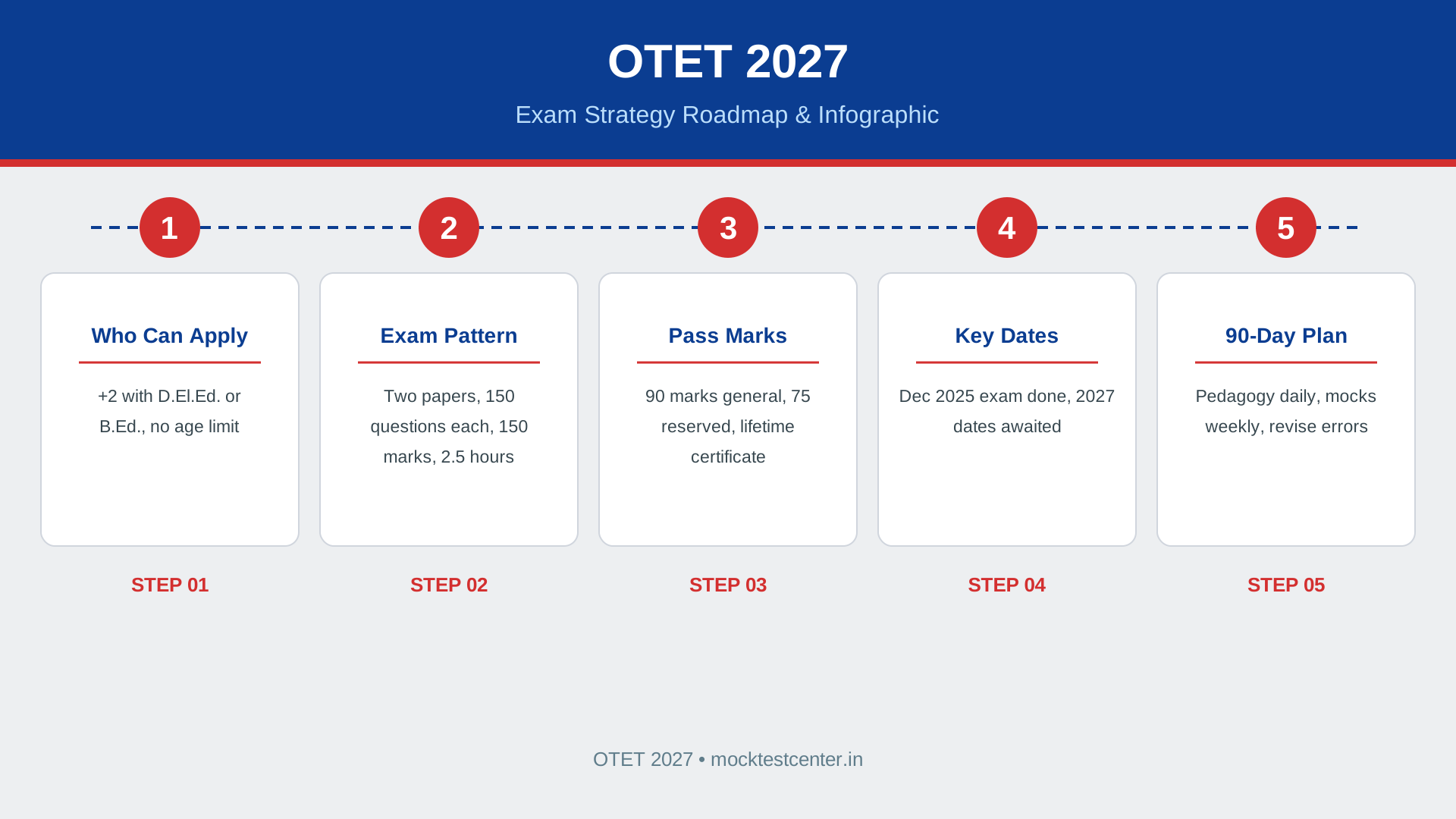
OTET 2027 is the next round of the Odisha Teacher Eligibility Test, run by the Board of Secondary Education (BSE) Odisha from Cuttack. The last full cycle ran on 17 December 2025, with Paper I in the morning and Paper II in the afternoon, and the next notification had not been issued when this guide was written. Each paper carries 150 multiple choice questions for 150 marks in 2 hours 30 minutes, with no negative marking. General category candidates need 90 marks to pass, and SC, ST, SEBC and PwD candidates need 75. The certificate stays valid for life under a 2023 Government of Odisha resolution. This guide covers the December 2025 cycle in full, the two other OTET exams that ran in 2025, the eligibility routes for each paper, the pattern, the fee, the syllabus and a 90 day plan for the next cycle.
OTET is a qualifying test, not a recruitment exam. Passing it makes you eligible to apply for teacher posts in Odisha government schools, government aided schools and recognised private schools. It does not give you a job by itself. Recruitment happens through separate notifications from the School and Mass Education Department and the recruiting agencies, and those notifications set their own age limits, vacancy counts and selection rules. The OTET score can carry weightage in a later recruitment if the government decides so, and that decision changes from one recruitment to the next. So the right way to treat OTET is as a gate you must clear once, and then keep your certificate safe while you watch for teacher recruitment notices.
OTET 2027 in numbers
| Item | Detail |
|---|---|
| Conducting body | Board of Secondary Education (BSE), Odisha, Cuttack |
| Exam name | Odisha Teacher Eligibility Test (OTET) |
| Last full cycle | Notified 11 November 2025, short notification No. 2006; exam 17 December 2025 |
| Papers | Paper I for Classes I to V; Paper II for Classes VI to VIII; a candidate may sit one or both |
| Questions and marks | 150 questions, 150 marks per paper, 1 mark per question |
| Duration | 2 hours 30 minutes per paper |
| Mode | Offline, pen and paper, OMR sheet |
| Negative marking | None |
| Pass marks | 60 percent (90 marks) general; 50 percent (75 marks) SC, ST, SEBC and PwD |
| Certificate validity | Lifetime, under Resolution No. 11787 dated 15 May 2023 |
| Age limit | No age limit for sitting OTET; recruitment notices set their own limits |
| Fee, December 2025 cycle | Rs 600 for most candidates; Rs 400 for SC and ST candidates, per the short notification |
| Official portal | bseodisha.ac.in |
Three OTET exams in one year, and which one this guide follows
Anyone who searches for OTET 2025 dates will find three different sets of dates, and they all look right because they all belong to real exams. The confusion is honest, and it has a cause. In 2025 the Board ran a Special OTET for in-service teachers, then a regular OTET in December, and the regular OTET that should have run earlier in the year was cancelled after a paper leak allegation. Sorting these out matters, because the syllabus and pattern are the same across them but the dates, the fee and the result figures are not.
The Special OTET came first. The Board notified it on 9 May 2025, took applications from 9 to 22 May 2025, issued admit cards on 17 September 2025 and held the exam on 27 September 2025. It was meant only for teachers already working in recognised schools in Odisha. The answer key came out on 10 October 2025 and the result on 15 November 2025. The numbers were large: 75,403 candidates applied across the two papers, 72,413 qualified, and 48,153 cleared both papers, an overall pass rate of 66.50 percent. Paper I was the harder paper to clear, with 12,988 of 27,533 candidates qualifying, a pass rate of 47.17 percent. Paper II was far easier to clear, with 35,165 of 44,840 qualifying, a pass rate of 78.35 percent. Digital certificates were downloadable from 15 November 2025 to 15 January 2026. One tracker report says the regular OTET planned for earlier in 2025 was cancelled after allegations of a question paper leak, and the Special OTET was the Board's answer for in-service teachers caught by that cancellation.
The regular OTET followed a month after the Special OTET result. The Board issued short notification No. 2006 on 11 November 2025. Applications ran from 12 to 25 November 2025, with the fee payable till 26 November 2025 at 11:45 PM. Admit cards came out on 10 December 2025, a week before the exam. The exam was held on 17 December 2025 in two sittings, Paper I from 9:00 AM to 11:30 AM and Paper II from 2:00 PM to 4:30 PM, offline on OMR sheets. This is the main cycle this guide is built on. It was open to all eligible candidates, not only in-service teachers, and it is the cycle a fresh candidate should study when preparing for OTET 2027.
There is one more date to know. After the December 2025 exam, the Board ran the next OTET on 5 July 2026, rescheduled from 28 June 2026, with the result declared on 2 September 2026, according to a tracker report. That makes July 2026 the most recent completed cycle. The 2027 notification had not been released when this guide was written. Treat the December 2025 dates as the pattern for the next cycle, and check the BSE Odisha portal for the 2027 notification rather than trusting any coaching site calendar.
Who can apply for Paper I
Paper I is for teaching Classes I to V, the primary stage. The Board accepts several qualification routes, and they all rest on the same idea: a school leaving qualification plus a recognised elementary teacher training qualification. The routes below follow the Board's framework and the December 2025 notification as reported. Check the notification for your cycle before you apply, because the Board can add or drop a route.
| Route | What you need |
|---|---|
| 1 | Higher Secondary (+2) with at least 50 percent marks, plus a 2 year Diploma in Elementary Education (D.El.Ed. or CT) |
| 2 | Higher Secondary with at least 45 percent marks, plus a 2 year Diploma in Elementary Education under the NCTE Recognition Norms and Procedure Regulations, 2002 |
| 3 | Higher Secondary with at least 50 percent marks, plus a 4 year Bachelor of Elementary Education (B.El.Ed.) |
| 4 | Higher Secondary with at least 50 percent marks, plus a 2 year Diploma in Education (Special Education) |
| 5 | Graduation in any subject, plus a 2 year Diploma in Elementary Education |
| 6 | Graduation with at least 50 percent marks, plus a B.Ed. |
| 7 | Post-graduation with at least 55 percent marks, plus a 3 year integrated B.Ed.-M.Ed. |
Two points in that table catch people out. First, a B.Ed. alone does not qualify you for Paper I unless you also hold a graduation degree with at least 50 percent marks, which is route 6. A B.Ed. holder with a graduation score below 50 percent cannot use route 6, and should check whether any other route fits. Second, the 45 percent route exists only for D.El.Ed. done under the NCTE 2002 norms. If your diploma came through another route, the 50 percent bar applies. Keep your mark sheets ready before you start the form, because the portal asks for the exact percentages.
There is no age limit for OTET. The Board sets no minimum or maximum age for sitting the test. Age limits appear later, in teacher recruitment notifications, and they differ by post and category. So a candidate of any age can sit OTET, but the same candidate may still face an age bar when a recruitment notice comes out. That is a recruitment rule, not an OTET rule, and it is worth knowing before you plan around the certificate.
Who can apply for Paper II
Paper II is for teaching Classes VI to VIII, the upper primary stage. It asks for a graduation degree plus teacher training, and the routes are wider than Paper I because B.Ed. is the main training qualification here.
| Route | What you need |
|---|---|
| 1 | Graduation in any subject, plus a 2 year Diploma in Elementary Education |
| 2 | Graduation with at least 50 percent marks, plus a 1 year B.Ed. |
| 3 | Graduation with at least 45 percent marks, plus a 1 year B.Ed. under the NCTE Recognition Norms and Procedure Regulations |
| 4 | Higher Secondary with at least 50 percent marks, plus a 4 year B.El.Ed. |
| 5 | Higher Secondary with at least 50 percent marks, plus a 4 year B.A./B.Sc.Ed. or B.A.Ed./B.Sc.Ed. |
| 6 | Graduation with at least 50 percent marks, plus a 1 year B.Ed. (Special Education) |
A candidate who wants to teach both stages should sit both papers. The December 2025 cycle allowed that, with Paper I in the morning and Paper II in the afternoon on the same day, and the fee covered the choice. In the Special OTET result, 48,153 candidates cleared both papers out of 75,403 applicants, which shows how common the both-papers attempt is. If you are eligible for both, sitting both costs one day and doubles the posts you can later apply for. The only reason to sit one paper is that you are eligible for one stage only.
One more check before you apply: your training qualification must come from an NCTE recognised institution. The Board's framework is built on NCTE norms, and a diploma or degree from an unrecognised institution will not count even if the marks are high. If you trained outside Odisha, confirm the recognition status of your institution on the NCTE portal before you pay the fee, because the fee is not refunded.
OTET 2027 exam pattern: Paper I
Paper I has five sections of 30 questions each. Every question carries 1 mark, every question has four options with one correct answer, and there is no negative marking. The paper runs 2 hours 30 minutes. In each subject area other than Child Development and Pedagogy, 20 questions come from content and 10 from pedagogy. That split is the key to preparation: a third of each subject section tests how you would teach the topic, not whether you know it. The questions follow the state prescribed syllabus for Classes I to V, but the difficulty and the linkages can reach up to the secondary stage.
| Section | Questions | Marks |
|---|---|---|
| Child Development and Pedagogy | 30 | 30 |
| Language I (Odia, Urdu, Hindi, Telugu or Bengali) | 30 | 30 |
| Language II (English) | 30 | 30 |
| Mathematics | 30 | 30 |
| Environmental Studies | 30 | 30 |
| Total | 150 | 150 |
Language I is the language you choose from Odia, Urdu, Hindi, Telugu and Bengali. Most candidates pick Odia. Language II is English for everyone. The medium of the paper in non-language subjects is bilingual, English and Odia. That helps candidates who studied in Odia medium, because the same question appears in both languages and you can switch to the version you read faster. Use that in the exam hall: if a question in English looks tangled, read the Odia version before you guess.
Child Development and Pedagogy is the section where first-time candidates lose the most marks. It is worth 30 marks, the same as every other section, but it has no content half to lean on. All 30 questions test pedagogy, child development, learning theories and classroom practice. Candidates who spend all their time on Mathematics and Environmental Studies and leave pedagogy to the last week usually find this section deciding whether they cross 90 marks. Give it a fixed slot every day from the start.
OTET 2027 exam pattern: Paper II
Paper II has three compulsory sections of 30 questions each, plus one optional section of 60 questions. You pick the optional section that matches the subject you want to teach. The total is again 150 questions for 150 marks in 2 hours 30 minutes, with no negative marking. The 20 content and 10 pedagogy split applies in each subject area, and the questions follow the syllabus for Classes VI to VIII, with difficulty and linkages that can reach up to the senior secondary or higher secondary stage.
| Section | Questions | Marks |
|---|---|---|
| Child Development and Pedagogy | 30 | 30 |
| Language I (Odia, Urdu, Hindi, Telugu or Bengali) | 30 | 30 |
| Language II (English) | 30 | 30 |
| Optional A: Mathematics and Science (30 Mathematics, 30 Science) | 60 | 60 |
| Optional B: Social Studies (30 History and Political Science, 30 Geography) | 60 | 60 |
| Total | 150 | 150 |
The optional section is 40 percent of the paper, so it decides your score more than any other part. Pick it on the basis of your graduation subjects, not on a guess about which optional is easier. A science graduate who picks Social Studies to dodge Mathematics will spend the whole preparation fighting unfamiliar content, and the Special OTET result hints at the cost: Paper II overall had a 78.35 percent pass rate, far higher than Paper I, which suggests candidates who pick the optional that matches their background clear the paper comfortably. Your graduation degree already tells you which optional to take. Trust it.
Both papers are set in the same way, and both use OMR sheets. Fill the OMR carefully, because a wrongly darkened circle costs a mark that no appeal can recover. The Board releases the OMR sheet after the result, as it did for the Special OTET, so you can check your own responses against the final answer key. Keep your admit card and registration number safe after the exam, because you need them to download the OMR sheet and the scorecard.
The 90 mark bar, and what the certificate is worth
The pass rule is simple and strict. A general category candidate who scores 60 percent or more, that is 90 marks out of 150, is treated as TET pass. A candidate from SC, ST, SEBC or PwD categories who scores 50 percent or more, that is 75 marks out of 150, is treated as TET pass. There is no sectional cut off. A weak section cannot fail you if the total clears the bar, and a strong section cannot save you if the total falls short. That changes how you should plan the paper: a section you find hard is worth attempting fully, because every correct answer anywhere counts the same toward the total.
One tracker page lists the reserved category bar as 55 percent, or 83 marks. That figure conflicts with the Board's framework and with every other tracker, including the Special OTET result reports that state 50 percent and 75 marks for SC, ST, OBC and SEBC candidates. This guide follows the 50 percent figure. If a later notification changes the bar, the notification wins, and this guide will need an update.
The certificate itself is the most valuable part of passing. Under Resolution No. 11787 dated 15 May 2023, issued by the School and Mass Education Department of the Government of Odisha, the OTET qualifying certificate and mark sheet remain valid for life. The resolution replaced the old seven year validity, and it applies with retrospective effect from 4 June 2012, the date the OTET guidelines came into force. It follows the National Council for Teacher Education decision of June 2021, which extended TET certificate validity to lifetime with retrospective effect from 2011. Older guides still quote seven years. They are out of date.
Lifetime validity does not mean lifetime appointment. The certificate stays valid, but every recruitment still sets its own conditions: age limits, subject requirements, and the weightage given to the OTET score. The weightage of OTET scores in recruitment is decided by the state government from time to time. Some recruitments give the TET score a fixed weightage, others treat it only as an eligibility gate. Read the recruitment notification, not the OTET notification, to find out which applies to the post you want.
Fee and how to apply
For the December 2025 cycle, the fee reported from the short notification was Rs 600 for most candidates and Rs 400 for SC and ST candidates. That figure comes from a tracker report quoting short notification No. 2006. Older guides list different figures, Rs 500 for one paper and Rs 800 for both papers for general and OBC candidates, and Rs 300 for one paper and Rs 500 for both for SC and ST candidates, and those figures belong to earlier cycles. The December 2025 short notification figures are the ones to trust for the last cycle, and the fee for the 2027 cycle will be fixed only in its own notification. Pay the fee online through the Board portal, and do not pay through any agent or third party link.
Applications run online only, through the Board portal at bseodisha.ac.in. The December 2025 window was short, 12 to 25 November 2025, with the fee payable till 26 November 2025 at 11:45 PM. That is 14 days from notification to the last date, and the Board gave one extra day for the fee. Expect a similar short window for the next cycle. Keep these documents ready before the portal opens: your Higher Secondary and graduation mark sheets, your D.El.Ed. or B.Ed. certificate, your caste or PwD certificate if you claim a concession, a recent photograph and signature in the size the portal asks for, and a mobile number you can receive OTPs on. The admit card is downloaded from the same portal, using your registration number and mobile number or password, and you must carry a printout plus a valid photo ID to the centre.
The admit card for the December 2025 cycle came out on 10 December 2025, seven days before the exam. Check every detail on it the day you download it: your name, your photograph, the paper or papers you applied for, the exam centre and the reporting time. If anything is wrong, contact the Board at once. The admit card also carries the exam day instructions, and the centre will not let you in without it.
What the syllabus actually asks
The OTET syllabus was prepared by the Teacher Education and SCERT, Odisha, under NCTE guidelines, and the Board has used the same syllabus structure since 2012. The syllabus for each paper lists units under every section, and the exam draws from those units. The Board publishes the detailed syllabus on its portal. Download it and use it as your checklist, because coaching material often adds topics the Board never tests.
Child Development and Pedagogy covers how children grow and learn at the primary or upper primary stage, theories of learning, the role of the teacher, assessment, and inclusive education. Language I tests comprehension, grammar and pedagogy of the language you chose. Language II tests English comprehension, grammar and pedagogy. Mathematics in Paper I covers the Class I to V syllabus: numbers, operations, shapes, measurement and data handling, with pedagogy questions on how to teach each topic. Environmental Studies covers family, food, shelter, water, travel, things we make and do, and the natural world, again with pedagogy questions attached.
Paper II keeps the same compulsory sections and adds depth in the optional section. Mathematics and Science covers Class VI to VIII mathematics and science, and Social Studies covers history, political science and geography at the same level. The difficulty can reach the senior secondary stage, so a Paper II candidate should revise Class IX and X science and social science as backup, not as the main study. The main study stays the Class VI to VIII syllabus, because that is where most questions come from.
Choosing Language I deserves a decision of its own. Odia is the natural choice for most candidates, because it is the medium of instruction in most Odisha schools and the language most candidates read fastest. But the right choice is the language you can read and answer in without translating in your head. A candidate who studied in an Urdu medium school should pick Urdu, even if Odia is the common choice. The marks are the same, the questions test the same skills, and the only thing that differs is the script you read. Pick the language that costs you the least time per question, because time is the one resource you cannot get back in a 150 question paper.
Two study habits pay off more than any book list. First, solve previous OTET papers and the Special OTET paper of 27 September 2025 if you can get it, because the Board repeats question styles even when it changes the questions. Second, practise the pedagogy half of each section separately. Content questions reward revision; pedagogy questions reward thinking about how a child learns, and they are the third of each section that most candidates ignore.
A 90 day plan for the next cycle
The December 2025 cycle gave candidates about five weeks from notification to exam, which is too short to start from zero. The plan below assumes 90 days and two to three hours a day, and it fits either paper. If you sit both papers, add one hour a day for the second optional section.
Days 1 to 30: cover the syllabus once. Read Child Development and Pedagogy daily, because it is 30 marks in both papers and the section most candidates neglect. Finish Language I and Language II grammar and comprehension in the first month too, since language scores are the most stable part of the paper. Do Mathematics or your optional subject on alternate days. End each week with 50 questions from the topics you covered.
Days 31 to 60: switch to practice. Solve one full paper a week under timed conditions, 2 hours 30 minutes, no breaks, OMR style answering on paper. Review every wrong answer the same day and note whether it was a content gap or a pedagogy gap. Content gaps go back into your notes; pedagogy gaps go into a separate list of teaching situations to revise. By day 60 you should know your weak section by its score, not by a feeling.
Days 61 to 90: revise and sharpen. Re-solve your error list, not fresh material. Take two more full papers, one at day 70 and one at day 84, and spend the last six days on light revision only: pedagogy notes, language rules, formulas and the OMR habit of darkening circles cleanly. Do not start a new book in the last week. The candidates who clear 90 marks are usually the ones who revised what they already knew, not the ones who read one more chapter.
Mock tests deserve a word of caution. A mock test helps only if it follows the Board pattern: 150 questions, the same section split, no negative marking, and the same 90 mark bar. Many free mocks online use other states patterns, add negative marking, or test Class IX and X content for Paper I. Those mocks teach you the wrong exam. Use mocks that state the OTET pattern on the cover, and score them against 90 marks for general category and 75 for reserved categories, so you learn what clearing the bar feels like before the real paper.
One practical note for the exam day: both papers run on the same day in the December pattern, Paper I at 9:00 AM and Paper II at 2:00 PM. If you sit both, the gap between papers is two and a half hours. Carry food and water, rest instead of cramming new topics in the gap, and reach the centre early for the second paper. A tired afternoon paper is where both-papers candidates lose marks they had already earned in the morning.
What the certificate gives you, and what it does not
Passing OTET gives you a lifetime eligibility certificate and nothing else. It does not give you a post, a posting, or a place in any merit list. Teacher recruitment in Odisha runs through separate notifications, and those notifications decide the vacancies, the age limits, the subject combinations and the weightage of your OTET score. Your certificate stays valid while you wait, and you can use it in any recruitment that asks for OTET as long as you meet that recruitment's other conditions.
That is also why the December 2025 cycle matters even though its exam is over. The pattern, the pass bar and the certificate rule are stable across cycles, and they are what you prepare for. The dates and the fee change each time. Watch the BSE Odisha portal for the 2027 notification, keep your training certificates and mark sheets in order, and start the 90 day plan before the notification comes out. A 14 day application window rewards the candidate who is already ready.
Sources
Board of Secondary Education, Odisha, official portal, bseodisha.ac.in. Short notification No. 2006 dated 11 November 2025, applications 12 to 25 November 2025, fee till 26 November 2025, exam 17 December 2025, admit card 10 December 2025, as reported by Shiksha, Testbook, Adda247 and the Telegraph. Special OTET 2025 dates and result figures, notification 9 May 2025, exam 27 September 2025, result 15 November 2025, 75,403 applicants, 72,413 qualified, 66.50 percent pass rate, as reported by Shiksha, Moneycontrol and the Free Press Journal. OTET pattern, 150 questions, 150 marks, 2 hours 30 minutes, no negative marking, 60 percent and 50 percent pass marks, eligibility routes and syllabus structure, from the Board's OTET framework and syllabus as reproduced by JagranJosh, Prepp, RankRacer and Vidyabharati. OTET certificate lifetime validity, Resolution No. 11787 dated 15 May 2023 of the School and Mass Education Department, Government of Odisha, published on forest.odisha.gov.in, following the NCTE lifetime validity decision of June 2021 reported by the Press Information Bureau on 3 June 2021. OTET 2026 cycle, exam 5 July 2026, result 2 September 2026, as reported by CampusLoop. Fee figures for the December 2025 cycle, Rs 600 and Rs 400, as reported by MTimes quoting the short notification; older fee figures from CareerIndia and Odisha Government Job Alert.







