About OSSC CGL 2027 Exam Series
📖 Table of Contents
- Two CGL cycles, and why trackers confuse them
- OSSC CGL 2027 in numbers
- Post wise vacancies: the full 1,576
- Who can apply
- Exam pattern: Preliminary, Mains, skill tests, verification
- Syllabus: what to study, and at what level
- What each post actually does
- Cut offs from 2024, and a target score for 2027
- A 90 day plan that fits this exam
- How to apply without a rejected form
- What to check before the next notification
- Sources
OSSC CGL 2027: Complete Exam Guide
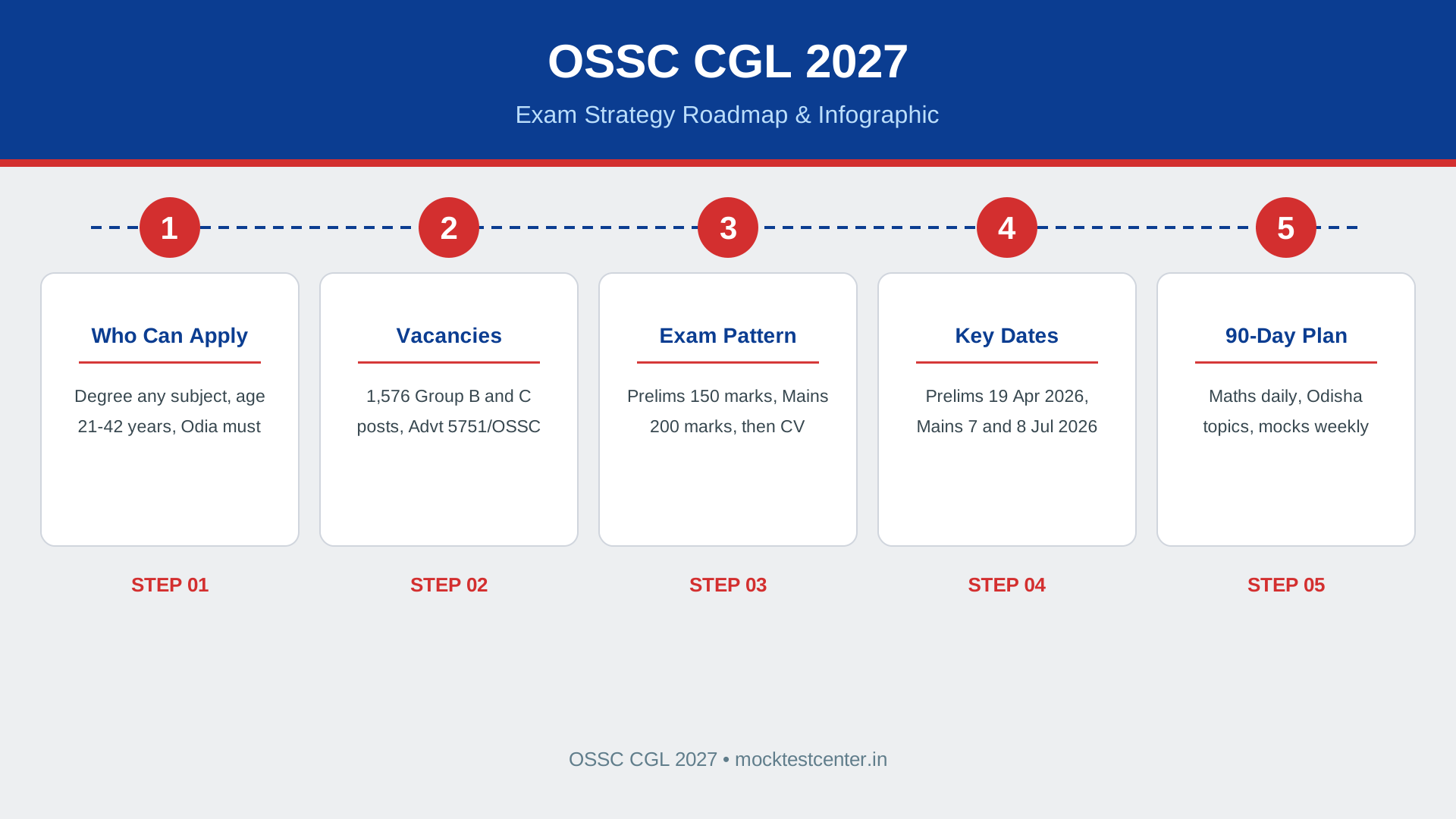
OSSC CGL 2027 is the next Combined Graduate Level Recruitment Examination from the Odisha Staff Selection Commission. The latest completed cycle, CGLRE 2025, advertised 1,576 Group B and Group C posts under Advertisement Number 5751/OSSC, dated 12 December 2025. Applications ran from 19 December 2025, the Preliminary exam took place on 19 April 2026, the Main Written Examination ran on 7 and 8 July 2026, and certificate verification reached its third phase in October 2026. That cycle now gives 2027 aspirants the clearest picture of what OSSC asks, how it marks, and where the seats sit.
One warning belongs at the top. Trackers mix up two different CGL cycles, and the mix up changes the vacancy count, the dates, and the age limit. This guide separates them in full, in the next section, so you never prepare from the wrong advertisement. Every number below comes from the 5751/OSSC advertisement as reported by multiple trackers that quote it, or from OSSC notices reported after the exam. The official OSSC site returned a redirect on a direct check during preparation, so no fact here rests on a fresh direct read of ossc.gov.in. Check the advertisement itself on ossc.gov.in before you apply.
Two CGL cycles, and why trackers confuse them
CGLRE 2024 came first. OSSC issued Advertisement Number 1249/OSSC on 15 March 2024 for 586 Group B and Group C posts. Registration ran from 5 April to 5 May 2024. The Preliminary exam took place on 20 October 2024. OSSC released the result on 14 November 2024 and shortlisted 3,016 candidates for the Main Written Examination. The Mains followed in February and March 2025, with the General Studies paper held on 30 March 2025 as per the official paper record, and OSSC released final marks in November 2025.
CGLRE 2025 is a separate and much larger cycle. OSSC issued Advertisement Number 5751/OSSC on 12 December 2025 for 1,576 posts. Registration opened on 19 December 2025. The Preliminary exam took place on 19 April 2026. The Mathematics test and Computer Skill Test took place on 7 July 2026, and the two Main papers took place on 8 July 2026. Certificate verification ran in phases, and Phase 3 ran from 22 to 28 October 2026 under Notice Number 3838/OSSC dated 13 October 2026.
Trackers cause the confusion in two ways. Some pages label the 586 post 1249/OSSC cycle as CGL 2025, because its exam stages ran through 2025. Other pages print a Preliminary date of 13 April 2025 and a result date of 23 April 2025 for that same 586 post cycle. Those dates do not match the OSSC calendar record, which places the Computer Skill Test and certificate verification of the 1249/OSSC cycle in April 2025, after a Preliminary exam in October 2024. Treat any page that pairs 586 posts with an April 2025 Preliminary exam as wrong on at least one of those two facts.
The age limit also differs between the cycles. CGLRE 2025 sets the age at 21 to 42 years as on 1 January 2025. Pages on the older cycle quote 21 to 38 years. If you copy the older figure into your 2027 preparation, you will misjudge your own eligibility by four years. Always match the age limit to the advertisement number, not to the year in the page title.
OSSC CGL 2027 in numbers
The table below packs the whole CGLRE 2025 cycle into one place. Use it as your reference sheet, then read the sections after it for the detail behind each row.
| Detail | CGLRE 2025 |
|---|---|
| Conducting body | Odisha Staff Selection Commission |
| Exam name | Combined Graduate Level Recruitment Examination 2025 |
| Advertisement number | 5751/OSSC, dated 12 December 2025 |
| Total posts | 1,576 Group B and Group C posts |
| Registration | 19 December 2025 to 18 January 2026, later extended to 28 January 2026 |
| Form submission | By 21 January 2026, later extended to 31 January 2026 |
| Age limit | 21 to 42 years as on 1 January 2025 |
| Qualification | Bachelor degree in any subject, plus basic computer knowledge |
| Odia requirement | Read, write and speak Odia, with a school level Odia pass |
| Fee | Rs 500 for General and SEBC, no fee for SC, ST and PwD |
| Preliminary exam | 19 April 2026, 150 questions, 150 marks, 150 minutes |
| Main exam | 7 and 8 July 2026, two papers of 100 marks each |
| Selection | Preliminary, Main Written Examination, certificate verification |
| Group B pay | Level 9, Rs 35,400 to Rs 1,12,400 |
| Group C pay | Level 4, Rs 19,900 to Rs 63,200 |
Women hold a large share of these posts. Trackers that quote the advertisement put the women quota at 504 of the 1,576 posts. That share runs through the category wise tables in the advertisement, post by post, and it matters for cut offs. The women cut off in the 2024 cycle ran about 10 marks below the open cut off in most categories, and the same pattern should hold in 2025.
Post wise vacancies: the full 1,576
The vacancy table below sums to exactly 1,576. That check matters, because the most copied tracker table does not sum. Several trackers print Junior Assistant as 1,137 posts and Junior Clerk as 255 posts alongside the other posts, and those two lines alone push the total to 1,974. That table is wrong. The advertisement splits Junior Assistant across departments, and the department wise split adds to 739. Add the 255 Junior Clerk posts and the other posts, and the total lands on 1,576.
| Post | Group | Posts |
|---|---|---|
| Assistant CT and GST Officer | B | 54 |
| Sub divisional Financial Service and Savings Officer | B | 5 |
| Inspector of Supplies | B | 41 |
| Inspector of Co operative Societies | B | 52 |
| Gram Panchayat Development Officer | B | 58 |
| Junior Correctional Officer | B | 7 |
| Estate Supervisor | B | 1 |
| Block Social Security Officer | B | 146 |
| Auditor of Co operative Societies | B | 57 |
| Common Cadre Auditor | B | 69 |
| Local Fund Auditor | B | 75 |
| Auditor, various departments | B | 17 |
| Junior Assistant, Heads of Departments | C | 316 |
| Junior Assistant, District Offices, Water Resources | C | 374 |
| Junior Assistant, Fisheries | C | 49 |
| Junior Clerk, field offices | C | 255 |
| Total | 1,576 |
Two notes on this table. First, one tracker prints Junior Assistant in Heads of Departments as 364 instead of 316. That version sums to 1,624, so it cannot stand with the other figures. The 316 figure comes from the tracker whose full table sums exactly to 1,576 with the Estate Supervisor post included. Second, the advertisement covers 48 post entries across departments, because Junior Assistant and Auditor posts split by department. The 16 rows above group those entries by post name, which is how most candidates actually choose.
Junior Assistant dominates the cycle. The three Junior Assistant rows add to 739 posts, which is about 47 percent of the total. Junior Clerk adds 255 more. Together the two clerical posts make 994 of the 1,576 seats, close to two in three. A graduate who wants a Group C seat should treat Junior Assistant as the main target and Junior Clerk as the second target, not the other way round.
Block Social Security Officer is the largest single Group B post at 146 seats. It sits in the Social Security and Empowerment of Persons with Disabilities Department, and it handles social security schemes at block level. Assistant CT and GST Officer, at 54 seats, draws the most attention per seat because it sits in the tax department and carries field inspection work. Inspector of Supplies, at 41 seats, and Inspector of Co operative Societies, at 52 seats, both carry field work across districts.
Who can apply
OSSC asks for a Bachelor degree in any subject from a recognised university. The subject of your degree does not matter for most posts. Commerce graduates get no extra marks, and arts graduates lose nothing. What matters is the degree itself, plus the two extra conditions below.
Basic computer knowledge is a must for every post. The advertisement describes it as knowledge of the internet, email, word processing, data analysis and presentation. Some posts ask for more. OSSC issued a clarification after the advertisement for auditor and Common Cadre Auditor posts, asking for computer proficiency such as PGDCA, NIELIT O Level, OS CIT from OKCL, or another recognised computer course. If you aim for an auditor post, finish a recognised computer course before you apply, and keep the certificate ready.
Odia is the second must. You need the ability to read, write and speak Odia, and you need one of the school level proofs. The advertisement accepts a Middle School pass with Odia as a language subject, or an HSC pass with Odia as the medium of examination in a non language subject, or a pass in Odia in Class 7 or above, or a pass in the Odia test of Middle School standard run by the School and Mass Education Department. Candidates from outside Odisha fail here more often than on any other rule. A degree and a good mock score mean nothing if the Odia proof is missing.
The age window runs from 21 to 42 years as on 1 January 2025. OSSC gives five years of relaxation to SC, ST, SEBC and women candidates, and ten years to PwD candidates. That takes the upper limit to 47 for the first group and 52 for PwD candidates. Ex servicemen get relaxation as per government rules. Check your age against 1 January 2025, not against the date you fill the form. A candidate who turns 43 in March 2025 still qualifies if the birth date falls after 1 January 1983, because the cut off date freezes the count.
The fee is Rs 500 for General and SEBC candidates, and no fee for SC, ST and PwD candidates. OSSC refunds the Rs 500 to candidates who appear in the examination. That refund rule changes the cost of a careless application. You lose nothing but time if you apply and sit for the exam, but you lose the fee if you apply and stay away. Pay online only, through the OSSC portal, and keep the payment receipt with the application printout.
Exam pattern: Preliminary, Mains, skill tests, verification
OSSC runs the selection in three stages. The Preliminary exam screens candidates. The Main Written Examination decides merit. Certificate verification checks documents for the candidates who clear the Mains. There is no interview in CGL. That fact shapes preparation. You do not need to polish interview answers. You need to score in two written papers.
The Preliminary exam carries 150 questions for 150 marks in 150 minutes. Each question carries one mark. Each wrong answer costs 0.25 marks. The questions sit at Class 10 level. OSSC shortlists candidates for the Mains at about five times the vacancies, category wise. Preliminary marks do not count in the final merit list. Treat the Preliminary as a gate, not as a score to protect. Clear it with a margin, then forget the score.
| Preliminary section | Questions | Marks |
|---|---|---|
| Arithmetic and Data Interpretation | Part of 150 | Part of 150 |
| Logical Reasoning and Analytical Ability, General Mental Ability | Part of 150 | Part of 150 |
| Current Events of national and international importance | Part of 150 | Part of 150 |
| Computer and Internet Awareness | Part of 150 | Part of 150 |
| Odisha Geography, Heritage and Culture | Part of 150 | Part of 150 |
| Total | 150 | 150 |
OSSC does not publish a fixed question count per section in the Preliminary. Trackers that print 50 questions each for General Studies, Quantitative Aptitude and Reasoning are guessing a split that the advertisement never gives. The advertisement lists six subject areas and a total of 150 questions. Prepare all six areas, and do not trust a section wise count from any tracker.
The Main Written Examination carries 200 marks in two papers of 100 marks each. Paper 1 covers Language, Odia and English. Paper 2 covers General Studies. Each paper runs for two and a half hours in the original scheme, though the July 2026 schedule ran Paper 1 for two hours and Paper 2 for one and a half hours. Both papers mix multiple choice and short answer questions. Each wrong answer costs 0.25 marks. Merit for certificate verification comes from these two papers alone.
| Main paper | Subject | Marks | Duration |
|---|---|---|---|
| Paper 1 | Language, Odia and English | 100 | 2 hours in July 2026 |
| Paper 2 | General Studies | 100 | 1.5 hours in July 2026 |
| Total | 200 |
Two extra tests apply to some posts. Auditor posts face a Mathematics test of 100 marks in two hours, and candidates need 50 percent to qualify. The Computer Skill Test applies to Auditor, Inspector of Supplies, Estate Supervisor, Block Social Security Officer, Junior Assistant and Junior Clerk posts. It carries 50 marks in one hour, and candidates need 50 percent to qualify. Neither test adds marks to merit. Both can still end a candidature. A candidate who tops the Mains and fails the Computer Skill Test loses the post. No scribe is allowed in the Computer Skill Test, so PwD candidates must plan for that rule.
Minimum qualifying marks in the written stages run at 35 percent for General candidates and 30 percent for SEBC, SC, ST and PwD candidates, as reported by trackers that quote the advertisement. Clearing the qualifying mark does not guarantee a call for verification. OSSC calls about 1.5 times the vacancies, post wise and category wise, for certificate verification. The call depends on the Mains merit list and the post preferences you filled in the form.
Syllabus: what to study, and at what level
The Preliminary syllabus sits at Class 10 level, and that level is the whole point. OSSC does not ask graduate level maths in the Preliminary. It asks Class 10 arithmetic, done fast and without error. The arithmetic list covers number systems, simplification, decimals and fractions, HCF and LCM, percentage, ratio and proportion, profit and loss, average, discount, simple and compound interest, mensuration, time and work, time and distance, and tables and graphs. Data interpretation adds charts, graphs, tables and data sufficiency. Speed matters more than depth here. A candidate who finishes the arithmetic section in 40 minutes with 90 percent accuracy beats a candidate who knows harder maths but finishes half the paper.
Logical reasoning covers verbal and non verbal reasoning, similarities and differences, space visualisation, problem solving, analysis, judgment, decision making, visual memory, discrimination, observation, relationships, concepts, arithmetical reasoning, verbal and figure classification, and arithmetical number series. Practice this section in timed sets of 20 questions. Reasoning rewards pattern recognition, and pattern recognition only comes from volume.
Current events cover national and international importance, Indian history, polity, constitution, sports, art and culture, Indian geography, economics, everyday science, scientific research, and national and international organisations. Read a daily current affairs source and make a one line note for each item. The note should carry the fact and the date. Revision from those notes in the last two weeks beats rereading a monthly magazine.
Odisha specific topics carry real weight in this exam, and the 2025 syllabus revision raised their share. The list covers Odisha geography, Odisha heritage and culture, Odisha history, Odisha economy, and Odisha art forms. Most all India test series underweight Odisha topics. Fix that gap yourself. Study the Odisha state board books for history and geography, and read the Odisha budget summary each year. The budget gives you Odisha economy, schemes, and numbers in one document.
Computer awareness covers Microsoft Office, Word, PowerPoint, Excel, keyboard shortcuts, data transmission and networking, computer viruses, operating systems, input and output devices, and hardware and software. This section is short, and it is also the easiest place to lose marks through overconfidence. Candidates who use computers daily still miss shortcut keys and file extension questions. Spend one hour a week on computer awareness from the start, not in the last week.
The Mains syllabus splits by paper. Paper 1, Language, covers Odia comprehension at Class 10 level, English comprehension at Plus Two level, and grammar, usage and vocabulary in both languages at Class 10 level. It also covers precis writing and unseen passages in both languages. Paper 2, General Studies, runs at Plus Two level and covers the Indian Constitution, the Indian economy, the Odisha economy and budget, Indian and world geography, history of India, history of Odisha, arts and culture with special reference to Odisha, and general issues of environment and climate change.
English in Paper 1 deserves a separate note. The grammar list covers nouns, pronouns, articles, prepositions, verbs, tenses, modals, active and passive voice, subject verb agreement, direct and indirect speech, conjunctions and question tags. Vocabulary covers one word substitution, idioms, antonyms and synonyms. Odia grammar covers sabda, barna, bachana, karaka, bivakti, biseshan, biseshya, karma and abaya, plus rudi, pratisabda and biparita sabda. Candidates who studied in Odia medium schools hold an edge in Paper 1, and English medium candidates need to close that gap early with daily Odia reading.
What each post actually does
A post name tells you little about the work. The work decides whether you will like the job for the next thirty years, so read this section before you fill post preferences. OSSC asks for preferences in the form, and the merit list assigns posts by preference and rank. A wrong preference order can place you in a post you never wanted, with no easy way out.
Assistant CT and GST Officer works in the Commissionerate of Commercial Taxes and Goods and Services Tax. The officer handles tax assessment, inspection of dealers, and enforcement work in the field. It suits candidates who like field work and direct dealing with traders. It also brings transfer across districts and a workload that rises sharply near filing deadlines.
Inspector of Supplies works in the food supplies system. The inspector monitors fair price shops, checks stocks, and handles complaints about the public distribution system. The work is field heavy and public facing. Candidates from rural blocks often find this post familiar, because they have seen the supply system from the user side.
Block Social Security Officer works at block level in the Social Security and Empowerment of Persons with Disabilities Department. The officer handles pensions and social security schemes for elderly people, widows, and persons with disabilities. It is the largest Group B post in this cycle, and it suits candidates who want steady block level work with direct public contact.
Gram Panchayat Development Officer works in the Panchayati Raj system at gram panchayat level. The officer handles development schemes, panchayat records, and coordination with block offices. It is a Group B post with village level posting, and it suits candidates who want to work close to the ground. It does not suit candidates who want a district headquarters posting.
Auditor posts sit in several departments, and the work differs by department. An Auditor of Co operative Societies audits cooperative societies. A Common Cadre Auditor audits government accounts. A Local Fund Auditor audits local bodies. The common thread is account work, and the common demand is a computer course certificate. Candidates who dislike number work should avoid auditor preferences, even though the posts carry Level 9 pay.
Junior Assistant and Junior Clerk form the clerical backbone of the state government. Junior Assistants work in heads of departments, district offices, and field offices. They handle files, correspondence, data entry, and record keeping. Junior Clerks work in field offices under the Engineer in Chief, Rural Works, and similar offices. The work is office based, the hours are regular, and the promotion path runs through senior assistant grades. Most graduates who want a stable office job should put these two posts at the top of their preference list.
Pay follows the Odisha Revised Scales of Pay Rules 2017. Group B posts sit in Level 9, with a pay range of Rs 35,400 to Rs 1,12,400. Group C posts sit in Level 4, with a pay range of Rs 19,900 to Rs 63,200. Gross pay adds dearness allowance, house rent allowance, and other allowances, and it varies by posting place. Do not trust any gross pay figure from a tracker. Trackers estimate gross pay from different allowance rates, and the estimates differ by thousands of rupees. The advertisement gives basic pay only, and this guide does the same.
Cut offs from 2024, and a target score for 2027
OSSC published cut offs with the CGLRE 2024 Preliminary result. The figures below come from the result report, and they give the only honest baseline for a target score.
| Category | Preliminary cut off, 2024 |
|---|---|
| UR | 105 |
| UR, women | 95 |
| SEBC | 103.25 |
| SEBC, women | 92.75 |
| SC | 85.75 |
| SC, women | 74.25 |
| ST | 67 |
| ST, women | 62.5 |
| Ex servicemen | 81.5 |
| Sportsperson | 41.5 |
Two cautions apply. First, one widely shared report puts the shortlist at 2,763 candidates, while the OSSC result notice and other reports put it at 3,016. The 2,763 figure matches the CGLRE 2023 shortlist, and it seems to have crossed over into 2024 reports. This guide uses 3,016, which matches the result notice title. Second, the 2024 cycle had 586 posts, while the 2025 cycle had 1,576. A larger vacancy count pulls cut offs down, because OSSC shortlists about five times the vacancies. A UR candidate who scores 105 in a 1,576 post cycle sits safer than a UR candidate who scored 105 in a 586 post cycle.
For 2027 preparation, set a working target of 115 out of 150 in the Preliminary for UR candidates, and 105 for SEBC, with lower targets by the same 2024 gaps for SC and ST. These are working targets, not official figures. They build in a margin above the 2024 cut offs and allow for a tougher paper. In the Mains, aim for 130 out of 200. The Mains decides the post, so the Preliminary target only buys entry. The Mains target buys the post.
Negative marking shapes the target. Each wrong answer costs 0.25 marks, so four wrong answers erase one right answer. In the Preliminary, that rule punishes blind guessing. A candidate who attempts 140 questions with 100 right and 40 wrong scores 90. A candidate who attempts 120 questions with 105 right and 15 wrong scores 101.25. Attempt fewer questions, and attempt only the ones you can defend. Leave the rest blank.
A 90 day plan that fits this exam
Ninety days is enough for this exam if you already hold a degree and a basic grip on Class 10 maths. It is not enough if you start from zero in both Odia and English. The plan below assumes three hours a day, six days a week, with one day for revision and a full mock test.
Days 1 to 30 build the base. Spend the first hour on arithmetic and data interpretation, the second hour on reasoning, and the third hour on Odia and English language work. Add 30 minutes of current affairs reading at night, with one line notes. Cover the full Preliminary syllabus once in these 30 days, and finish with a mock test every Sunday. Do not touch Mains level General Studies yet. The Preliminary gate comes first.
Days 31 to 60 shift the balance. Keep one hour for arithmetic and reasoning revision, and give two hours to General Studies and Odisha topics. Start Mains Paper 1 language practice in this phase, with one Odia passage and one English passage each day, plus precis writing twice a week. Take two mock tests a week now, one Preliminary and one Mains Paper 2. Review every wrong answer the same day. A mock test without review wastes the test.
Days 61 to 90 run on mocks and revision. Take a full Preliminary mock every alternate day, and a Mains mock twice a week. Spend the remaining time on weak areas the mocks expose, not on new topics. In the last ten days, stop learning new material. Revise notes, formulas, Odisha facts, and current affairs from the last six months. Sleep properly in the last three days. A tired candidate loses more marks to silly errors than to hard questions.
Computer Skill Test practice belongs in the plan from day 31, not after the Mains. Spend 30 minutes twice a week on MS Word formatting, Excel formulas, and PowerPoint basics. The test needs 50 percent to qualify, and candidates who never practice fail it after clearing the Mains. That failure is the most avoidable loss in this whole recruitment.
How to apply without a rejected form
Apply only on ossc.gov.in. OSSC accepts no offline form and no form through any other site. Register first with your name, mobile number and email, then log in with the credentials OSSC generates. Fill the detailed form, upload a recent colour photograph, signature, and thumb impression in JPG or JPEG format, and upload certificates as the form asks. Pay the fee online, submit before the last date, and take a printout of the confirmation page.
Three form errors cause most rejections. The first is a wrong Odia proof. Upload the correct certificate, and check that the name on it matches the name on your degree. The second is a photograph that breaks the size or background rule. Use a recent photo with a light background, face clear, no cap and no sunglasses. The third is a late submission after the server slows down. OSSC extended the 2025 dates once, from 18 January to 28 January for registration and from 21 January to 31 January for submission. Do not count on an extension in 2027. Submit at least three days before the last date.
Keep four documents ready before you start the form. Your degree certificate and mark sheets, your Odia proof, your caste or PwD certificate if you claim relaxation, and your computer course certificate if you aim for an auditor post. OSSC checks originals at certificate verification, and a missing original at that stage ends the process after you have cleared two exams. Check the originals now, not in the verification week.
What to check before the next notification
OSSC has not issued the CGL 2027 advertisement yet. The 2025 cycle gives the pattern, but the next advertisement can change the vacancy count, the age cut off date, and the post list. Watch ossc.gov.in for the advertisement, and read it in full when it lands. Pay special attention to three items. The advertisement number and date, which tell you which cycle you are reading. The vacancy table, which you should add up yourself. And the Odia and computer conditions, which change between cycles more often than candidates expect.
Start preparation now, with the 2025 syllabus and the 2024 cut offs in this guide. The syllabus changes slowly, and the pattern has stayed stable across the last two cycles. A candidate who starts now and follows the 90 day plan in the last stretch will face the next notification with the syllabus already covered, and will only need to adjust to the new vacancy table and dates.
Sources
OSSC Combined Graduate Level Recruitment Examination 2025, Advertisement Number 5751/OSSC dated 12 December 2025, as reported by IndGovtJobs and Adda247, both quoting the advertisement. OSSC CGLRE 2024, Advertisement Number 1249/OSSC dated 15 March 2024, Preliminary exam 20 October 2024, result 14 November 2024, as reported by CareerPower, Scroll and PW Live. OSSC CGL Mains July 2026 schedule and certificate verification Notice Number 3838/OSSC dated 13 October 2026, as reported by Adda247 and GovtJobsAlert. OSSC CGL syllabus and exam pattern, Annexure C of the advertisement, as reported by Sikhyasetu, CareerPower and Prepp. Official site: ossc.gov.in