About OSSTET 2027 Exam Series
📖 Table of Contents
- OSSTET 2027 in numbers
- The 45 percent bar that most coaching sites get wrong
- Paper I or Paper II: which one is yours
- Eligibility: the Odia rule comes first
- Eligibility: Category I, education teachers
- Eligibility: Category II, physical education teachers
- OSSTET 2027 exam pattern: Paper I
- OSSTET 2027 exam pattern: Paper II
- Fee and how to apply
- What the certificate is worth
- The 2024 cycle, and what it tells you
- A 90 day plan for the next cycle
- Sources
OSSTET 2027: Complete Exam Guide
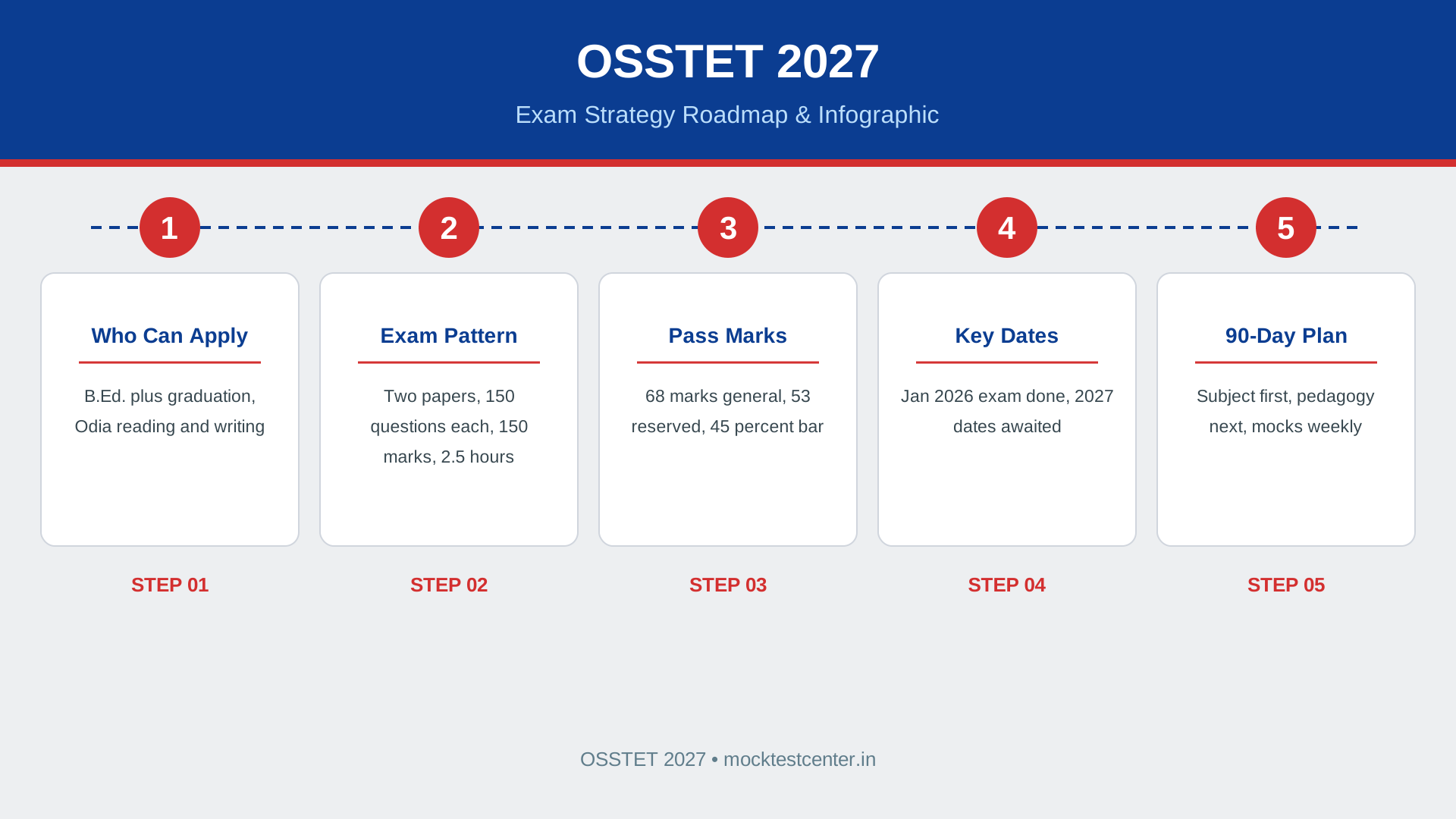
OSSTET 2027 is the next round of the Odisha Secondary School Teacher Eligibility Test, run by the Board of Secondary Education (BSE) Odisha. The last full cycle was notified on 5 December 2025, with applications from 6 to 17 December 2025, extended to 20 December 2025, and the exam held on 20 January 2026 in two sittings on the same day. Paper I is for education teachers and Paper II is for physical education teachers. Each paper carries 150 multiple choice questions for 150 marks in 2 hours 30 minutes, with no negative marking. The pass mark is 45 percent, or 68 marks, for general category candidates, and 35 percent, or 53 marks, for SC, ST, PH and SEBC candidates. That bar is lower than most coaching sites claim, and this guide explains why, using the Board's own guidelines. This guide covers the January 2026 cycle in full, the eligibility rules, the pattern, the fee, the certificate, the 2024 cycle and a 90 day plan for the next round.
OSSTET is the eligibility test for secondary school teaching in Odisha. Passing it is a must for appointment as a teacher in government and aided secondary schools in the state. It is not a recruitment exam. It gives you no post and no place in a merit list. Recruitment happens separately, and the recruiting agency decides the vacancies, the age limits and the weightage of your OSSTET score. The certificate stays valid till you reach the upper age limit set for teacher recruitment, which is a different rule from the lifetime certificate that OTET carries. Know that difference before you plan.
OSSTET 2027 in numbers
| Item | Detail |
|---|---|
| Conducting body | Board of Secondary Education (BSE), Odisha, Cuttack |
| Exam name | Odisha Secondary School Teacher Eligibility Test (OSSTET) |
| Last full cycle | Notified 5 December 2025; exam 20 January 2026 |
| Papers | Paper I for Category I education teachers; Paper II for Category II physical education teachers |
| Questions and marks | 150 questions, 150 marks per paper, 1 mark per question |
| Duration | 2 hours 30 minutes per paper |
| Mode | Offline, pen and paper, OMR sheet |
| Negative marking | None |
| Pass marks | 45 percent (68 marks) general; 35 percent (53 marks) reserved categories (SC, ST, PH, SEBC) |
| Certificate validity | Till the upper age limit set for teacher recruitment |
| Attempts | No restriction on the number of attempts |
| Fee, January 2026 cycle | Rs 900 general, Rs 600 SC and ST, as reported from the notification; some trackers list Rs 600 and Rs 400 |
| Official portal | bseodisha.ac.in |
The 45 percent bar that most coaching sites get wrong
Search for the OSSTET pass mark and you will find two different answers. Many coaching sites say 60 percent for general category and 50 percent for reserved categories. That is the OTET pass mark, not the OSSTET pass mark, and the sites that print it have mixed up the two tests. The Board's own Guidelines for Conduct of OSSTET 2025, published on the Board portal, state the rule in plain words: the minimum pass mark in each paper is 45 percent, which is 68 marks out of 150, and for reserved category candidates (SC, ST, PH and SEBC) it is 35 percent, which is 53 marks out of 150. The 2024 result reports confirm it. Hindustan Times, Careers360 and the Telegraph all reported the same figures when the OSSTET 2024 result came out on 28 March 2025: 45 percent for general category, 35 percent for SC, ST, PH and SEBC.
The difference matters more than it looks. At a 60 percent bar, a candidate needs 90 marks. At the real 45 percent bar, the same candidate needs 68. That is 22 marks of difference, which is the whole of the Odia section plus a little more. A candidate who studies to a 90 mark target will still pass, but a candidate who gives up because 90 looks out of reach may be giving up on a paper they could have cleared at 68. The lower bar is not a gift. The paper is 150 questions in 150 minutes, and the subject section alone is 60 marks of graduation level content. But the bar is 45 percent, and your plan should be built on the real number.
There is no sectional cut off. The 45 percent applies to the total of the paper, not to each section. A weak Odia section cannot fail you if the total clears 68 marks, and a strong subject section cannot save you if the total falls short. That shapes exam strategy: attempt every question, because there is no negative marking, and spend your time where the marks are thickest. The subject section is 60 marks and the pedagogy section is 50 marks. Together they are 110 of the 150 marks. Those two sections decide your result.
One more number from a tracker needs a warning. A niche Odisha tracker page tells candidates they need 68 of 150, which matches the official 45 percent, but the same page also carries a table that says 60 percent and 50 percent in another place. Read the Board guidelines, not the tracker table, when the two disagree. The guidelines are the document the Board itself published, and the result reports from 2024 back them up.
Paper I or Paper II: which one is yours
OSSTET has two papers, and you do not choose between them freely. Your qualification decides your paper. Category I is education teachers: Trained Graduate Teachers in Science and Arts, Hindi teachers and Classical teachers in Sanskrit, Urdu and Telugu. Those candidates sit Paper I. Category II is physical education teachers. Those candidates sit Paper II. In the January 2026 cycle, Paper I ran in the morning from 9:00 AM to 11:30 AM and Paper II ran in the afternoon from 2:00 PM to 4:30 PM on 20 January 2026, the same day. A candidate who qualifies for both categories would sit both papers, but that is rare, because the training qualifications for the two categories are different.
Paper I covers five kinds of teacher. TGT Arts covers social studies teachers. TGT Science covers two streams, PCM (Physics, Chemistry, Mathematics) and CBZ (Chemistry, Botany, Zoology). Hindi Teacher covers Hindi language teachers. Classical Teacher covers Sanskrit, Urdu and Telugu language teachers. Each stream has its own subject section in the paper, but the Odia, English and pedagogy sections are common to all Paper I candidates.
Paper II is only for physical education teachers. Its subject section tests physical education, and its pedagogy section is the same Child Development, Pedagogy, School Management and Evaluation section that Paper I carries. If you hold a C.P.Ed., D.P.Ed., B.P.Ed. or M.P.Ed., Paper II is your paper. If you hold a B.Ed. and a graduation degree, Paper I is your paper. Do not apply for the wrong paper, because the Board will not move you to the other one after the form is submitted.
Eligibility: the Odia rule comes first
Before the degrees and the percentages, OSSTET has a rule that surprises candidates from outside Odisha. You must be a citizen of India, and you must be able to read and write in Odia. The Board's guidelines accept any one of these as proof: you passed the HSC examination of the Board of Secondary Education, Odisha, or an equivalent examination of another state board or a central board such as CBSE or ICSE, with Odia as a language subject, first, second or third language; or you passed the +2 or Higher Secondary examination of the Council of Higher Secondary Education, Odisha, with Odia as an examinable subject; or you passed the Odia examination of the HSC or 10th standard single subject examination conducted by BSE Odisha.
Language teachers get a narrower route. If you want to be a Hindi teacher or a Classical teacher in Sanskrit, Telugu or Urdu, passing the Odia examination of the 7th or 8th standard conducted by BSE Odisha is also accepted. That matters for candidates who studied outside Odisha and never took Odia at the HSC or +2 stage. Check which of these routes fits you before you apply, because the portal will ask for the proof and a missing Odia qualification is the most common reason for a rejected form.
Final year trainees can apply. The guidelines say candidates who are in the process of acquiring the training qualification, that is, in the final year of the training course or appearing or having appeared in the training examination with the result not yet published, as on the date of the advertisement, are also eligible, provided they meet all other conditions. So a B.Ed. final year student can sit OSSTET. Keep the proof of enrolment ready, and remember that the training qualification must be complete before appointment, even though it need not be complete before the test.
Eligibility: Category I, education teachers
Category I needs a graduation degree with 50 percent marks in aggregate, or 45 percent for SC, ST, PH and SEBC candidates, plus a recognised training qualification. The degree must include two school subjects as honours, elective, pass, optional or compulsory subjects, from the list in Annexure I of the guidelines. The training qualification must come from an NCTE recognised institution.
| Stream | Academic qualification | Training qualification |
|---|---|---|
| TGT Arts | Bachelor degree in Arts, Commerce or Shastri (Sanskrit) with two school subjects, 50 percent marks (45 percent for SC, ST, PH, SEBC) | B.Ed. or 3 year integrated B.Ed.-M.Ed.; or 4 year integrated B.A.B.Ed. with two school subjects, 50 percent (45 percent reserved) |
| TGT Science (PCM) | Bachelor degree in Science, B.Tech. or B.E. with two school subjects, 50 percent (45 percent reserved) | B.Ed. or 3 year integrated B.Ed.-M.Ed.; or 4 year integrated B.Sc.B.Ed. with two school subjects, 50 percent (45 percent reserved) |
| TGT Science (CBZ) | Bachelor degree in Science, B.Tech. or B.E. with two school subjects, 50 percent (45 percent reserved) | B.Ed. or 3 year integrated B.Ed.-M.Ed.; or 4 year integrated B.Sc.B.Ed. with two school subjects, 50 percent (45 percent reserved) |
| Hindi Teacher | Bachelor degree with Hindi as honours, elective, optional or pass subject, 50 percent (45 percent reserved); or bachelor degree, 50 percent (45 percent reserved), with Rastrabhasa Ratna, Shastri (Hindi) or Snataka acquired by June 2005 | Hindi Sikshyan Parangat from Kendriya Hindi Sansthan, Agra; or B.H.Ed.; or B.Ed. in Hindi; or B.Ed. from an NCTE recognised institution |
| Classical Teacher (Sanskrit) | Bachelor degree with Sanskrit as honours, elective, optional or pass subject, 50 percent (45 percent reserved); or Shastri (Sanskrit), 50 percent (45 percent reserved) | Sikshya Shastri (Sanskrit) or B.Ed. from an NCTE recognised institution |
| Classical Teacher (Urdu) | Alim with 50 percent (45 percent for PH); or B.A. (Persian) with 50 percent (45 percent for PH) | B.Ed. or Urdu B.Ed. from an NCTE recognised institution |
| Classical Teacher (Telugu) | Bachelor degree in Arts with Telugu as a subject, 50 percent (45 percent reserved) | Telugu B.Ed. from an NCTE recognised institution |
The two school subjects rule is the detail that trips up TGT applicants. Your degree must contain two subjects from the Board's school subject list, not just one. A B.Sc. with only Physics and no second school subject will not meet the rule, even with high marks. Check Annexure I of the guidelines against your degree mark sheet before you apply. For TGT Science PCM, the two subjects come from Physics, Chemistry and Mathematics. For TGT Science CBZ, they come from Chemistry, Botany and Zoology. For TGT Arts, they come from the arts school subjects, which include Odia, English, History and Political Science, Geography and Economics.
Eligibility: Category II, physical education teachers
Category II is simpler. You need +2 or an equivalent examination from a recognised institution, plus C.P.Ed., D.P.Ed., B.P.Ed. or M.P.Ed. from a recognised board or university. There is no graduation degree requirement for Paper II, and no percentage bar is stated for the +2 stage in the guidelines. The training qualification is the heart of it, and it must come from a recognised institution. A candidate with a B.P.Ed. and no B.Ed. sits Paper II, not Paper I, and a candidate with a B.Ed. and no physical education training sits Paper I, not Paper II.
OSSTET 2027 exam pattern: Paper I
Paper I has four sections. Section I is Language I, Odia, 20 questions for 20 marks, compulsory for all categories. Section II is Language II, English, 20 questions for 20 marks, also compulsory. Section III is the subject section, 60 questions for 60 marks, and it changes with your stream. Section IV is Child Development, Pedagogy, School Management and Evaluation, 50 questions for 50 marks. The total is 150 questions for 150 marks in 2 hours 30 minutes. All questions are multiple choice with four options and one correct answer, each carrying 1 mark, and there is no negative marking.
| Section | Subject area | Questions | Marks |
|---|---|---|---|
| I | Language I, Odia | 20 | 20 |
| II | Language II, English | 20 | 20 |
| III | Stream subject: TGT Arts, TGT Science PCM, TGT Science CBZ, Hindi, Sanskrit, Telugu or Urdu | 60 | 60 |
| IV | Child Development, Pedagogy, School Management and Evaluation | 50 | 50 |
| Total | 150 | 150 |
The subject section splits by stream. For TGT Arts, the 60 marks cover Odia, English, History and Political Science, and Geography and Economics, 15 marks each. For TGT Science PCM, the 60 marks split evenly across Mathematics, Physics and Chemistry, 20 marks each. For TGT Science CBZ, they split evenly across Chemistry, Botany and Zoology, 20 marks each. For Hindi, Sanskrit, Telugu and Urdu teachers, the full 60 marks are in that language. The questions in Section III for TGT Arts and TGT Science are in English. The questions for Classical and Hindi teachers are in the respective languages and scripts. Section IV is in English for all categories.
The Odia section deserves attention even though it is only 20 marks. It tests comprehension through an unseen prose passage of about 150 words with 5 objective questions, plus grammar: Sandhi, Samasa, antonyms and synonyms, correction of common errors, idioms and phrases, Taddhita and Krudanta, and language usage such as identification of parts of speech and transformation of sentences. A candidate who grew up speaking Odia but never studied its grammar will lose marks here. Twenty marks is the gap between 48 and 68 for a candidate near the bar, so do not treat Odia as free marks.
OSSTET 2027 exam pattern: Paper II
Paper II follows the same frame with a different subject section. Section I is Odia, 20 marks. Section II is English, 20 marks. Section III is Physical Education, 60 marks. Section IV is Child Development, Pedagogy, School Management and Evaluation, 50 marks. The total is again 150 questions for 150 marks in 2 hours 30 minutes, with no negative marking. Section III for Paper II is set in English, and Section IV is in English too.
| Section | Subject area | Questions | Marks |
|---|---|---|---|
| I | Language I, Odia | 20 | 20 |
| II | Language II, English | 20 | 20 |
| III | Physical Education | 60 | 60 |
| IV | Child Development, Pedagogy, School Management and Evaluation | 50 | 50 |
| Total | 150 | 150 |
Section IV is in English for all categories, and it is the section where a prepared candidate can pull ahead. It covers child development and pedagogy, with school management and evaluation alongside. Fifty marks is a third of the paper. Candidates who revise only their subject and ignore pedagogy are leaving a third of the paper to chance. The subject section is 60 marks, pedagogy is 50, and the two languages together are 40. That is the shape of the paper, and your timetable should match it.
Both papers are offline on OMR sheets. The Board allots centres anywhere in the state, and the guidelines warn that the centre may not be allotted as per your permanent or correspondence district, unlike previous examinations. Plan travel the day before if your centre is far, and do not assume you will get a centre in your home district. Keep your admit card and registration number safe after the exam, because the Board releases the final answer key and the OMR sheet after the result, and you need your login details to download them.
Fee and how to apply
The fee for the January 2026 cycle is reported differently by different trackers, and the conflict is worth stating plainly. JagranJosh, reporting from the notification, lists Rs 900 for general category candidates and Rs 600 for SC and ST candidates. Other trackers list Rs 600 for general, SEBC and OBC candidates and Rs 400 for SC and ST candidates, figures that match older OSSTET cycles. This guide uses the JagranJosh figures for the January 2026 cycle, because that report quotes the notification table, and flags the older figures as the likely source of the confusion. The fee is paid online only and is not refunded in any circumstances. Check the fee table in your own cycle's notification before you pay, because the fee is the one figure the Board revises most often.
Applications run online only through the Board portal at bseodisha.ac.in. For the January 2026 cycle, the window opened on 6 December 2025 and was first set to close on 17 December 2025. The Board then extended the last date to 20 December 2025, giving candidates three extra days. That extension is a reminder to apply early: the portal slows down on the last day, and an extension is never certain. Keep your graduation and B.Ed. mark sheets, your Odia proof, your caste or PH certificate if you claim a concession, a photograph and signature, and a mobile number for OTPs ready before the window opens. After you submit, take a printout of the acknowledgement receipt and keep it till the result.
Admit cards for the January 2026 cycle were available from 10 January 2026, ten days before the exam. Download yours the day it appears and check the name, photograph, paper, centre and timings. The admit card is a must at the centre, along with a valid photo ID. If any detail is wrong, contact the Board at once, because corrections take time and the centre will go by what the admit card says.
What the certificate is worth
The OSSTET certificate follows a different rule from the OTET certificate, and confusing the two is the most common mistake candidates make about this exam. The OTET certificate is valid for life. The OSSTET certificate is not. Clause 9 of the Board guidelines says the OSSTET pass certificate shall remain valid till the candidate reaches the upper age limit prescribed for recruitment of teachers, under the rules or executive instructions of the Government from time to time. In plain words, your certificate stays valid while you are still young enough to be recruited as a teacher. Once you cross the upper age limit for recruitment, the certificate stops being usable, even though you passed the test. One tracker page says the OSSTET certificate is valid for lifetime. That is wrong, and it contradicts the Board guidelines.
There is no restriction on the number of attempts. Clause 10 of the guidelines says so directly. You can sit OSSTET as many times as you like, and you can sit it again to improve your score. That matters because the weightage of OSSTET scores in recruitment may be decided by the Government from time to time, under clause 11. If a future recruitment gives weightage to the OSSTET score, a higher score could help your rank, and a second attempt could be worth it. If the recruitment treats OSSTET only as an eligibility gate, the score does not matter once you have passed. Read the recruitment notification to find out which rule applies.
Qualifying OSSTET gives you no right to a job. Clause 12 of the guidelines says qualifying would not confer a right on any person for recruitment or employment in any government or government aided school, and it may be treated as one of the essential eligibility criteria for appointment. The recruiting agency decides eligibility for recruitment on the basis of all the conditions the Government prescribes. So the certificate is a door pass, not a job offer. Keep it safe, and watch for teacher recruitment notices from the School and Mass Education Department.
The 2024 cycle, and what it tells you
The previous cycle before January 2026 was OSSTET 2024, and its dates show how the Board's calendar moves. The notification came out on 14 November 2024, applications opened on 19 November 2024, and the exam was held on 17 January 2025 in two shifts for about 50,587 candidates. The result came out on 28 March 2025, along with the final answer key and the OMR sheets. The final answer key covered Arts, CBZ, Hindi, Paper II, PCM, Sanskrit, Telugu and Urdu. The 2024 cycle ran from notification to result in about four and a half months.
Compare that with the January 2026 cycle: notification 5 December 2025, exam 20 January 2026, about six weeks from notification to exam. The Board's calendar is not fixed to a month. The guidelines say OSSTET shall be conducted once in a year or as decided by the Government as per need. Some years it comes in November, some years in December, and the exam has fallen in January in both the 2024 and 2025 cycles. Do not plan around a fixed month. Plan around the pattern, and check the portal from November onward.
There is one more cycle to know about. After the January 2026 exam, the Board notified the next OSSTET in late July and early August 2026, extended registration twice in August, and held the exam on 30 September 2026, with the answer key and a challenge window on 10 October 2026, according to tracker reports. That makes September 2026 the most recent completed cycle. The 2027 notification had not been released when this guide was written. Treat the January 2026 cycle as the pattern, and check the BSE Odisha portal for the 2027 dates.
A 90 day plan for the next cycle
The January 2026 cycle gave candidates about six weeks from notification to exam. That is enough to revise, not enough to learn. The plan below assumes 90 days and two to three hours a day, and it follows the marks: subject first, pedagogy second, languages third.
Days 1 to 30: cover the subject section once. For TGT Arts, that means Odia, English, History and Political Science, and Geography and Economics at 15 marks each. For TGT Science, it means your three subjects at 20 marks each. For language teachers, it means your language at 60 marks. For PET candidates, it means physical education at 60 marks. Study from your graduation notes and the Class VI to X textbooks, because the subject questions sit at that level. End each week with 60 subject questions under timed conditions.
Days 31 to 60: add pedagogy and the languages. Section IV is 50 marks, so give it a fixed hour every day: child development and learning theories, plus school management and evaluation. Revise Odia grammar in short daily bursts, Sandhi, Samasa, synonyms and antonyms, error correction, idioms, and the unseen passage habit of reading once and answering from the passage, not from memory. Take one full paper a week, 150 questions in 150 minutes, and review every wrong answer the same day.
Days 61 to 90: revise and sharpen. Re-solve your error list instead of starting new material. Take two more full papers, one at day 70 and one at day 84. Spend the last six days on light revision: pedagogy notes, Odia grammar rules, subject formulas and the OMR habit. Since there is no negative marking, practise the habit of attempting every question, and keep a simple rule for the last ten minutes: no question left blank, no circle left half darkened.
One practical note for the exam day: both papers run on the same day in the January pattern, Paper I at 9:00 AM and Paper II at 2:00 PM. If you sit both, the gap is two and a half hours. Carry food and water, rest instead of cramming, and reach the centre early for the second paper. A tired afternoon paper is where candidates lose marks they had already earned in the morning.
Sources
Board of Secondary Education, Odisha, Guidelines for Conduct of Odisha Secondary School Teacher Eligibility Test OSSTET 2025, published on onlineapp.bseodisha.ac.in, read in full: eligibility, Odia requirement, two papers, 2 hours 30 minutes, four sections, no negative marking, qualifying marks 45 percent (68 of 150) and 35 percent (53 of 150) for SC, ST, PH and SEBC, certificate validity till the upper age limit for recruitment, no restriction on attempts, weightage decided by Government, once a year or as decided by Government. Board of Secondary Education, Odisha, official portal, bseodisha.ac.in. OSSTET 2025 cycle dates, notification 5 December 2025, applications 6 to 17 December 2025, extended to 20 December 2025, exam 20 January 2026, admit card 10 January 2026, as reported by JagranJosh, Adda247, AimIndia and Odisha TV. OSSTET 2024 cycle, notification 14 November 2024, exam 17 January 2025, about 50,587 candidates, result 28 March 2025, final answer key and OMR sheets, as reported by Hindustan Times, Careers360, the Telegraph and Notopedia. OSSTET 2025 result April 2026 and OSSTET 2026 cycle, exam 30 September 2026, answer key 10 October 2026, as reported by Odiapedia and Testbook. Fee figures for the January 2026 cycle, Rs 900 and Rs 600, as reported by JagranJosh; older fee figures Rs 600 and Rs 400 from AimIndia and CTET. Pattern section splits, Odia 20, English 20, subject 60, pedagogy 50, as reported by Testbook and Adda247, matching the Board guidelines.