
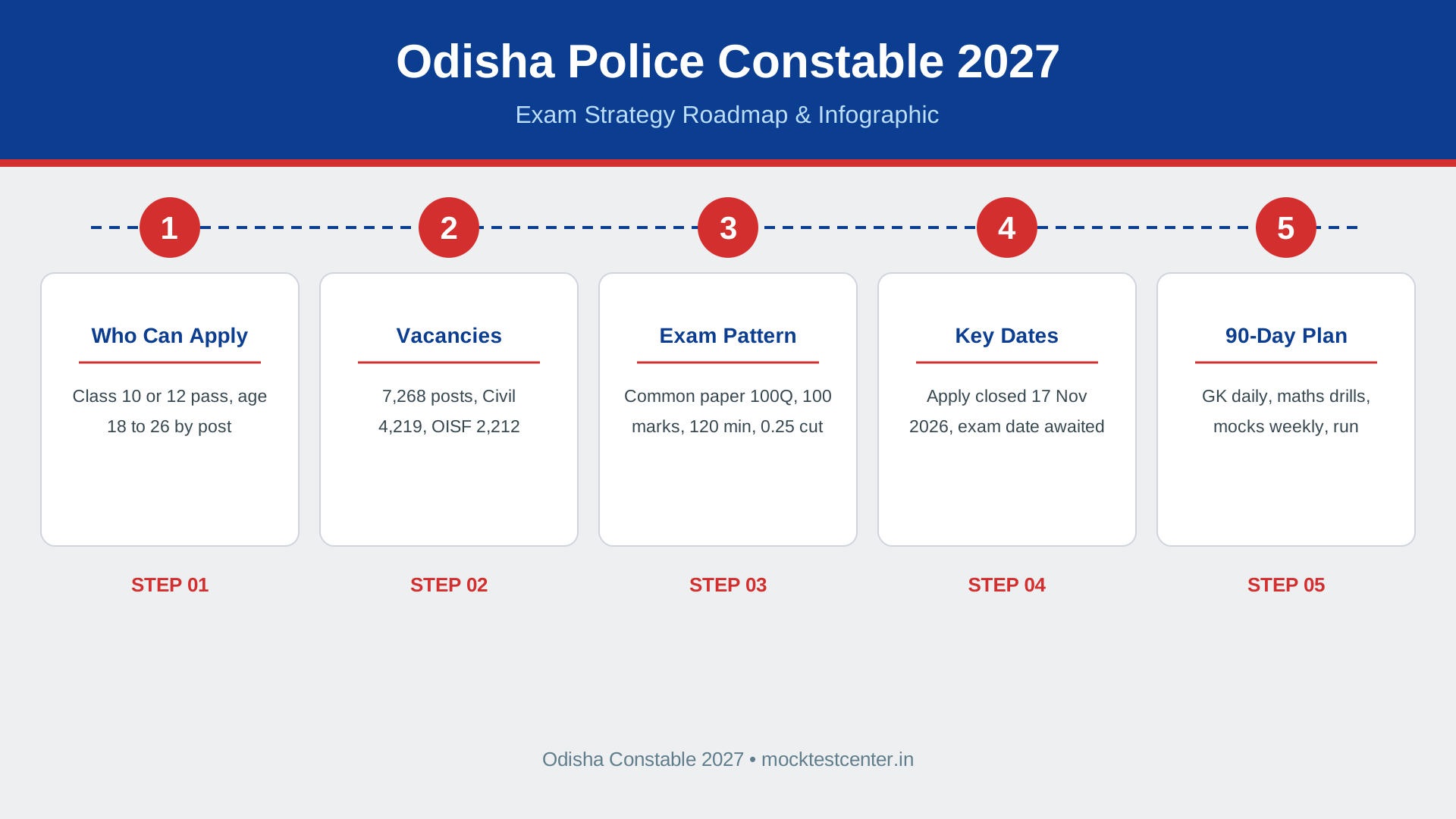
About Odisha Police Constable 2027 Exam Series
📖 Table of Contents
- Odisha Police Constable 2027 in numbers
- Why this cycle looks different from every earlier constable drive
- The seven posts, and which one fits you
- Dates, fee and the extension that changed the deadline twice
- The pattern, in full: what the written papers actually test
- Physical standards and the efficiency test that ends candidatures
- Pay, posting and what the job actually pays
- What happened in the last constable cycle
- A 90 day plan built around the real paper
- Mistakes that cost candidates this drive
- Sources
Odisha Police Constable 2027: Complete Exam Guide
Odisha Police Constable 2027 is a live recruitment with 7,268 posts and a closed application window. The Odisha Uniformed Services Staff Selection Commission released Advertisement No. 01-CRE-2026/OUSSSC on 23 October 2026 for the Combined Uniformed Services (Below Graduate Level) Examination 2026. Applications ran from 23 October to 17 November 2026, after an extension from the first last date of 12 November. The fee deadline moved with it, to 18 November 2026. The written exam date has not been announced yet. One common written paper sits at the centre of this recruitment, and it feeds seven different posts, from Civil Constable with 4,219 posts to Traffic Constable with just 4.
That single exam structure is the first thing to grasp. You do not apply for seven separate exams. You file one form, pick your post preferences, sit one common paper of 100 questions for 100 marks in 120 minutes, and then the posts split apart. Constable (Communication) adds a special paper. Driver posts add a driving paper. Everyone who clears the written stage faces the same physical measurement and physical efficiency tests. Merit comes from written marks plus small bonus marks for NCC certificates and driving licences. The physical tests only qualify you. They add no marks.
This guide covers the post wise vacancies, the age and education rules for each post, the full pattern with negative marking, the physical standards, the pay, what happened in the last constable cycle, and a 90 day plan built around the real paper. Every fact here comes from the 01-CRE-2026 notification as reported by the Times of India, the Indian Express, Moneycontrol and other trackers that quote the notification, because the official OUSSSC site could not be reached directly while this package was prepared. Where trackers disagree, this guide says so instead of picking one version quietly.
Odisha Police Constable 2027 in numbers
| Item | Detail |
|---|---|
| Conducting body | Odisha Uniformed Services Staff Selection Commission (OUSSSC), Bhubaneswar |
| Exam name | Combined Uniformed Services (Below Graduate Level) Examination 2026 |
| Advertisement | No. 01-CRE-2026/OUSSSC, dated 23 October 2026 |
| Total posts | 7,268 across seven posts |
| Biggest post | Constable (Civil), 4,219 posts |
| Second biggest post | Constable OISF, 2,212 posts |
| Women reserved posts | 1,819 posts across four posts |
| Apply window | 23 October to 17 November 2026, 10 PM, extended from 12 November |
| Fee last date | 18 November 2026, 10 PM, extended from 13 November |
| Fee | Rs 500 for UR and SEBC, nil for SC and ST, refunded if you appear for the written exam |
| Written exam date | To be announced by OUSSSC |
| Age counted on | 1 January 2026 |
| Official portal | ousssc.odisha.gov.in |
Why this cycle looks different from every earlier constable drive
Odisha used to run police constable recruitment through the State Selection Board of Odisha Police, and later through the Odisha Police Recruitment Board. This cycle runs through a new body. The Home Department created the Odisha Uniformed Services Staff Selection Commission to run uniformed recruitment in one place, and the 7,268 post drive is its first big constable examination. The same transfer moved the stalled 933 post Sub Inspector recruitment from the Odisha Police Recruitment Board to OUSSSC. If you applied for Odisha Police posts in earlier years, the name on the admit card has changed. The posts have not.
The second change matters more for preparation. Earlier constable drives often covered one cadre at a time, such as Sepoys for battalions. This one bundles seven posts into a single examination with one common paper. That bundling helps you if you qualify for more than one post, because one preparation covers all of them. It hurts you if you prepare for only one post and ignore the special paper that post needs. A Constable (Communication) candidate who masters the common paper and skips Physics and Computer Science loses 300 marks. A Driver PMT candidate who skips the 50 mark driving paper gives away a third of the written score for that post.
The third change is scale. The 2024 Sepoy drive started at 1,360 posts and grew to 2,080 after the government added 720 posts mid window. This drive starts at 7,268. Civil Constable alone, at 4,219 posts, is more than double the whole 2024 drive. OISF adds 2,212 more. Big numbers pull in big crowds, so the written paper will decide almost everything. About seven times the vacancies in each category go to the physical stage, which means roughly 50,000 candidates will clear the written stage across all posts. The physical tests then remove people who fail a run or a jump. They do not reorder the merit list.
The seven posts, and which one fits you
Start with the vacancy table, because the post you pick shapes the age limit, the education you need, and the extra paper you sit.
| Post | Posts | Education | Age on 1 January 2026 |
|---|---|---|---|
| Constable (Civil) | 4,219 | Class 12 pass | 18 to 26 |
| Constable OISF | 2,212 | Class 10 pass | 18 to 23 |
| Constable (Communication) | 300 | Class 12 Science or 3 year engineering diploma | 18 to 23 |
| Firefighter | 317 | Class 12 pass | 18 to 25 |
| Driver PMT | 154 | Class 10 pass plus driving licence | 18 to 23 |
| Firefighting Driver | 62 | Class 12 pass plus driving licence | 18 to 25 |
| Traffic Constable | 4 | Class 12 pass | 21 to 32 |
| Total | 7,268 |
Civil Constable is the district cadre post. You choose one police district when you apply, and the employment exchange registration for that district matters. The notification asks for registration with the employment exchange of the district you apply for. OISF is the Odisha Industrial Security Force, a battalion cadre post. You rank the first, second, third and fourth battalions in order of preference. The remaining posts are state cadre. That distinction decides where you serve. District cadre keeps you in one district. Battalion cadre moves you with the battalion. State cadre posts you anywhere in Odisha.
Education splits the field cleanly. Class 10 pass opens OISF and Driver PMT. Class 12 pass opens Civil Constable, Firefighter, Firefighting Driver and Traffic Constable. Communication needs Class 12 Science with Physics, Chemistry and one of Mathematics, Electronics, Statistics, Computer Science or IT, or a three year engineering diploma. The Science requirement cuts the Communication field down hard, which is why 300 posts there can be a better bet than 4,219 Civil posts for a Science student. Fewer people qualify, so the competition per post drops even though the post count looks small.
Age splits the field a second time. Civil Constable takes you from 18 to 26. Communication, OISF and Driver PMT stop at 23. Firefighter and Firefighting Driver stop at 25. Traffic Constable is the odd one out: 21 to 32, the widest upper limit in the whole drive, for just 4 posts. A 27 year old graduate cannot apply for Civil Constable but can apply for Traffic Constable, and that is the kind of detail that decides whether a form gets filed at all. Relaxation adds five years for SC, ST, SEBC and women candidates, three years for ex-Agniveers, and service linked relaxation for ex-servicemen. A 28 year old SC candidate still fits Civil Constable after relaxation, where a 28 year old general candidate does not.
Women get 1,819 reserved posts inside the total. Civil Constable reserves 1,393 for women, Communication 99, OISF 326, and Traffic Constable 1. That adds to 1,819. Women and transgender candidates can apply for every post except Firefighter, Firefighting Driver and Driver PMT. Those three posts are closed to women in this notification. Every candidate must be able to read and write Odia. That rule sounds small and it ends candidatures every cycle, because candidates who studied outside Odisha assume a Class 12 certificate is enough. It is not, without Odia.
Category splits inside Civil Constable show where the posts sit: UR 2,805, SC 588, ST 741 and SEBC 85. OISF splits as UR 1,119, SC 342, ST 508 and SEBC 243. Communication splits as UR 165, SC 41, ST 68 and SEBC 26. Special quotas sit inside these totals for ex-servicemen, sportspersons and ex-Agniveers, and for Group D police employees and Home Guards in the Civil and Communication posts. The notification gives 10 percent in each district for Group D employees and Home Guards in Civil Constable. Check your own category column before you judge your chances, because the UR column and the ST column are different races.
Dates, fee and the extension that changed the deadline twice
The notification came out on 23 October 2026 and applications opened the same day at 5 PM. The first last date was 12 November 2026 at 10 PM, with fee payment to 13 November at 10 PM. OUSSSC then extended both. Commission notice No. 871/OUSSSC dated 11 November 2026 moved the application last date to 17 November 2026 at 10 PM and the fee last date to 18 November 2026 at 10 PM, and said no further extension would be granted. The notice also gave a one time opportunity to modify a submitted form. That is the version of the dates this guide uses, because it quotes the commission notice number and date.
One tracker page and a video description claim the fee deadline moved again, to 20 November 2026. No commission notice number backs that claim in the material found for this package, and the 17 and 18 November dates rest on notice No. 871. Treat 20 November as an unverified tracker claim. The application window is now closed in any case, so the dates matter for the record and for the next cycle, rather than for filing a form today.
The fee is Rs 500 for UR, SEBC and female candidates, and nil for SC and ST candidates. Payment runs online only, through net banking, credit card, debit card or UPI. The Rs 500 comes back to you if you actually appear for the written examination. That refund rule is unusual and it matters. It removes the cost barrier for a candidate who sits the exam, and it punishes no shows only by keeping their fee. If you paid and you appear, you get the money back. If you paid and you stay home, you lose Rs 500 and your chance.
No exam date has been announced. Trackers that quote a December 2026 or January 2027 written exam date label it tentative, and no commission notice in the material found for this package fixes a date. The admit card usually comes about a week before the exam, and the commission will decide the mode, OMR or computer based, and announce it with the date. Plan as if the exam lands in the next two to three months, and check the OUSSSC portal for the date instead of trusting a tracker headline.
The pattern, in full: what the written papers actually test
Selection in the OUSSSC Constable recruitment runs in four stages. Stage one is the written examination. Stage two is physical measurement and physical efficiency, plus a driving test where it applies. Stage three is medical examination by a medical board. Stage four is certificate and document verification. The written stage decides your rank. The physical stage only decides whether you continue. The medical stage and document check remove candidates who fail them. There is no interview anywhere in this process.
The common written paper covers all seven posts. It has 100 multiple choice questions for 100 marks, in 120 minutes, at Class 10 standard. One mark per correct answer. A wrong answer costs 0.25 marks. A blank answer costs nothing. The subjects are Odia language, English language, General Knowledge, Quantitative Aptitude and Reasoning, and Basic Computer Literacy. Questions come in Odia and English, except the language sections, which use their own language. The notification gives no subject wise question count in the material quoted by trackers, so this guide gives no subject wise split. Any page that prints exact counts per subject for this paper is guessing, or it is copying an older exam.
Two special papers sit on top of the common paper. Constable (Communication) candidates sit a special paper in Physics and Computer Science at Class 12 Science standard: 100 questions, 300 marks, 120 minutes, three marks per correct answer and 0.75 cut per wrong answer. Firefighting Driver and Driver PMT candidates sit a driver paper: 50 questions, 50 marks, 60 minutes, one mark per correct answer and 0.25 cut per wrong answer, covering vehicle knowledge and maintenance, traffic signals, road safety and rules. Communication candidates therefore face a 400 mark written total. Driver candidates face 150. Everyone else faces 100, plus bonus marks.
Negative marking is real in this exam, and the numbers above come from the notification as quoted by three independent tracker pages that reproduce the scheme in the same figures. The common paper cuts 0.25 per wrong answer. The Communication paper cuts 0.75. The driver paper cuts 0.25. That changes how you attempt the paper. A blind guess on a one mark question needs better than a one in four chance to pay off, because three wrong answers wipe out one right answer. On the Communication paper the maths is the same in proportion: three wrong answers wipe out one right answer at three marks each. Guess only when you can remove at least one option with confidence. Leave the rest blank.
Bonus marks add a small but real edge. An NCC A certificate adds 1 mark, B adds 2, C adds 3. A valid LMV driving licence adds 3 marks and an HMV licence adds 5, for Civil Constable, OISF, Driver PMT and Firefighting Driver, if you pass the driving test. These marks go into the final merit. Three marks from an NCC C certificate is three questions on the common paper. Five marks from an HMV licence is five questions. In a recruitment with 7,268 posts and lakhs of applicants, five marks can move you past hundreds of candidates. If you hold a licence or a certificate, claim it properly in the form and carry the original to verification.
Merit follows the written marks plus bonus marks, post by post. Civil Constable and OISF count the common paper plus NCC plus driving marks. Communication counts the common paper plus the special paper plus NCC. Firefighter and Traffic Constable count the common paper plus NCC. Firefighting Driver and Driver PMT count the common paper plus the driver paper plus NCC plus driving marks. Physical tests add nothing to this total. About seven times the vacancies in each category go forward to the physical stage on written merit. There is no reserve list and no waiting list, so a candidate who clears the written stage and then fails the physical stage is out, and nobody moves up to take that place.
The qualifying marks for the written stage are not stated in the tracker material found for this package, and this guide states none. Do not trust a page that prints a cut off for this cycle. No cut off exists until OUSSSC publishes the result. Work instead with a target: aim for 75 or more out of 100 on the common paper before negative marking, because the physical shortlist at seven times vacancies will sit well above the pass line in a drive this large.
Physical standards and the efficiency test that ends candidatures
Physical measurement comes first. Men from UR and SEBC need 168 cm height, 55 kg weight, and a chest of 79 cm unexpanded and 84 cm expanded. Men from SC and ST need 163 cm, 50 kg, and a chest of 76 cm unexpanded and 81 cm expanded. Women from UR and SEBC need 158 cm and 47.5 kg. Women from SC and ST need 153 cm and 45 kg. Chest measurement applies to men only. These are the standards quoted across tracker pages for this notification, and they match the standards Odisha Police has used for years. Measure yourself with a tape before the exam, because a candidate who fails measurement never gets to run.
The physical efficiency test is qualifying only, and every event must be passed. Fail one event and you are out, whatever your written score. Men run 1.6 km in 7 minutes. Women run 1.6 km in 9 minutes. Men long jump 3.66 metres in three attempts. Women long jump 2.75 metres in three attempts. Men put the shot 4 metres with a 7.26 kg shot in three attempts. Women put the shot 3 metres with a 4 kg shot in three attempts. Firefighter and Firefighting Driver candidates also swim 100 metres in 8 minutes, and Firefighter candidates face rope climbing of 6 metres in three attempts and load carrying of a 63 kg sand bag for 100 metres in 60 seconds, as reported by tracker pages quoting the notification. Ex-Agniveers are exempt from the physical efficiency test.
One tracker page puts the men shot put at 4.3 metres instead of 4 metres. The 4 metre figure appears in the Testbook pattern page and in the SarkariJob notification summary, so this guide uses 4 metres and flags the 4.3 metre figure as a conflict. The difference is small on paper and large on the ground, so train for 4.5 metres and remove the argument.
Train for the physical test from week one, not after the written result. The written result and the physical test can land close together, and a candidate who starts running only after the result has no time to build the 1.6 km pace. Seven minutes for 1.6 km is about 4 minutes 22 seconds per kilometre, a steady run rather than a sprint, but it still beats most candidates who never train. Nine minutes for women is about 5 minutes 37 seconds per kilometre. Run three times a week, add one long jump session and one shot put session, and practise the swim now if you applied for Firefighter. A written score of 85 means nothing if you stop at 1.2 km.
Pay, posting and what the job actually pays
Constable posts sit in the Odisha Revised Scales of Pay 2017 matrix. Level 5 pays Rs 21,700 to Rs 69,100 a month as basic pay. Level 4 pays Rs 19,900 to Rs 63,200 a month as basic pay. Dearness allowance, house rent allowance and other allowances sit on top of basic pay, and the in hand figure lands higher than basic. Trackers that print a single in hand figure are estimating, because dearness allowance moves and house rent allowance depends on posting. This guide prints basic pay only, because basic pay is the figure the notification fixes.
Which posts sit in which level is one place where trackers disagree, and the disagreement is worth naming. Two tracker summaries agree that Civil Constable, Communication and OISF sit in Level 5, and that Firefighter, Firefighting Driver and Traffic Constable sit in Level 4. They disagree on Driver PMT: one puts it in Level 5, the other in Level 4. A third page assigns the levels differently again. This guide follows the two page agreement for the six posts named above and flags Driver PMT as unresolved. The upload pre check should confirm the Driver PMT level against the notification itself. All seven posts are Group C posts.
Civil Constable serves in a police district, in police stations and district police work. OISF guards industrial installations. Communication works on police wireless and signals. Firefighter and Firefighting Driver serve in fire stations under the Fire and Emergency Services. Driver PMT drives police vehicles. Traffic Constable works traffic duties. The job is a uniformed field job with shifts, night duty and physical work, and the pay reflects a Group C starting post with a long service ladder. A constable who serves well can rise through head constable, assistant sub inspector and beyond, through departmental examinations and seniority, over a full career.
What happened in the last constable cycle
The last big Odisha Police constable drive before this one was the Sepoy and Constable recruitment of 2024, run by the State Selection Board of Odisha Police. The detailed advertisement came out on 22 September 2024, with applications from 23 September to 13 October 2024, for 1,360 Sepoy and Constable posts in OSAP, IR, SIR and SS battalions. Candidates needed Class 10 pass, age 18 to 23 as on 1 January 2024, and Odia as a subject. The pay was Level 5, Rs 21,700 to Rs 69,100. Women, transgender candidates and persons with benchmark disabilities could not apply for those battalion posts, which is a sharp contrast with the 2026 drive, where women hold 1,819 reserved posts.
The 2024 drive then grew. The board extended the last date to 30 October 2024, and the government sanctioned 720 more posts in the battalions, taking the total from 1,360 to 2,080. The correction window ran from 1 to 7 November 2024. That growth is the pattern to remember: Odisha Police constable numbers move after the first advertisement, and they move upward. The 2026 drive already starts at 7,268, so further growth is possible but nobody should count on it.
The 2024 selection ran through a computer based test, physical measurement and physical efficiency, and medical examination. Its physical test used the same shape as the 2026 one: 1.6 km run, long jump and shot put, with 8 minutes for men in that cycle against 7 minutes in 2026. Candidates who prepared for 2024 and missed out carry one advantage into 2026: they know the physical test. They carry one disadvantage too: the 2026 common paper is at Class 10 standard with Odia, English, General Knowledge, Quantitative Aptitude and Reasoning, and Basic Computer Literacy, and the 2024 paper was a different paper for a different post. Old preparation helps. It does not transfer whole.
An older cycle is worth one line for context. In June 2021 the Odisha Police Recruitment Board notified 477 Sub Inspector posts and 244 Constable (Communication) posts together, with the communication constable paper as a separate technical recruitment. That 2021 Communication drive is the ancestor of the Communication post in the 2026 bundle. The lesson from both old cycles is the same: Odisha Police changes the recruiting body and the bundling often, and the notification in front of you is the only document that counts.
A 90 day plan built around the real paper
No exam date is fixed, so this plan assumes about 90 days from the close of applications and works in three 30 day blocks. If OUSSSC announces a date, shift the blocks to fit the date. The plan assumes two to three hours a day, six days a week, with one rest day for revision and a mock test.
Days 1 to 30 build the base. Spend the first hour on General Knowledge, with Odisha first: districts, rivers, history, art and culture, government schemes, and current affairs from the last year, then India and the world. Spend the second hour on Quantitative Aptitude and Reasoning, alternating days, from Class 10 level: arithmetic, percentages, ratio, time and work, simple interest, number series, coding, blood relations, direction sense and seating. Spend the third hour on Odia and English language, alternating days: grammar, vocabulary, comprehension, and Odia spelling and usage. Add 30 minutes of Basic Computer Literacy three days a week: hardware, operating systems, MS Office basics, internet and email. Run three times a week from day one, 20 minutes building to the 1.6 km pace.
Days 31 to 60 turn the base into exam practice. Take one full common paper mock every week, 100 questions in 120 minutes, with 0.25 negative marking applied when you score it. Review every wrong answer the same day and write the rule you missed in one line. Keep the subject study going, but shift the balance toward your weakest subject, measured by mock scores rather than by feeling. Communication candidates add Physics and Computer Science in this block, one hour a day, from Class 12 Science level. Driver candidates add vehicle knowledge and traffic rules, 30 minutes a day. Increase running to four times a week and add long jump and shot put practice twice a week.
Days 61 to 90 are revision and speed. Stop learning new topics in the last two weeks. Revise the one line rule book you built from mock mistakes. Take two mocks a week, then three in the final week, always timed at 120 minutes. Practise the attempt order: answer the questions you know first, mark the ones you can solve with effort, and leave the blind guesses blank. Negative marking rewards discipline more than courage. In the last week, cut running to light jogging, sleep properly, and keep documents ready: admit card, photo identity, NCC certificate and driving licence originals, caste and residence certificates, and employment exchange registration where it applies.
Books need no long list. Use Class 10 Odisha board books for Odia, English, mathematics and science foundations, Lucent or an equivalent general knowledge book for the static part, a daily newspaper for current affairs, and a standard reasoning and aptitude book for practice. Previous year papers from the 2024 Sepoy drive and the 2021 Communication drive help with the physical test pattern and the question style, but they are not the 2026 paper. OUSSSC Constable mock tests on this site, matched to the 100 question 120 minute format with 0.25 negative marking, are the closest practice to the real paper.
Mistakes that cost candidates this drive
The first mistake is the post preference. Civil Constable asks for one district, OISF asks for a battalion order, and both choices lock in at the form stage. Candidates who pick a district because a friend picked it, without checking the category wise posts in that district, throw away their best chance. The second mistake is the age date. Age counts on 1 January 2026, not on the application date and not on the exam date. A candidate who turns 27 in February 2026 is still 26 on 1 January 2026 and still fits Civil Constable. A candidate who turns 27 in December 2025 does not.
The third mistake is Odia. The notification asks for the ability to read and write Odia, and document verification will test that claim. Candidates who studied in English medium outside Odisha should check their certificates now, not at verification. The fourth mistake is the special paper. Communication and driver candidates who prepare only for the common paper walk into the exam hall with a third of their marks unprepared. The fifth mistake is the physical test, covered above: candidates treat it as a formality and fail a run they could have passed with eight weeks of training.
The sixth mistake is guessing. With 0.25 cut per wrong answer, a candidate who attempts all 100 questions with 60 sure answers and 40 guesses at one in four odds scores about 60 plus 10 minus 7.5, which is 62.5. The same candidate leaving the 40 blank scores 60. The guesses add 2.5 marks and a lot of risk. Guessing pays only when you can remove options. The seventh mistake is the fee refund: candidates who pay and then skip the exam lose Rs 500 for nothing. Appear, even if preparation feels thin, because the fee comes back and the experience carries into the next cycle.
Sources
Advertisement No. 01-CRE-2026/OUSSSC dated 23 October 2026, Combined Uniformed Services (Below Graduate Level) Examination 2026, as reported by the Times of India, the Indian Express, Moneycontrol and the Telegraph, all quoting the notification for vacancies, dates, age, education, fee and selection stages. Extension notice No. 871/OUSSSC dated 11 November 2026, moving the last dates to 17 and 18 November 2026, as reported by NaukriHelp, SarkariJob, RojgarPulse and GovtJobsAlert. Pattern, negative marking, bonus marks, physical standards and pay as quoted from the notification by Testbook, SikhyaSetu, SarkariJob and IndGovtJobs. Women reservation of 1,819 posts with the post wise split as reported by CareerPower. The 2024 Sepoy drive, 1,360 posts growing to 2,080, as reported by the Times of India Education Times and Moneycontrol. The 2021 OPRB drive, 477 SI posts and 244 Constable (Communication) posts, as reported by Scroll and NDTV. The OUSSSC portal is the official source for the notification, the admit card and the exam date, and the Odisha Police portal carries police recruitment notices. Both official sites returned no response to direct requests while this package was prepared, so the facts above rest on the tracker and press reports named here, and the upload pre check should confirm the pattern, the pay levels and the physical standards against the notification PDF itself.







