About OPSC ASO 2027 Exam Series
📖 Table of Contents
- OPSC ASO 2027 in numbers
- What changed since the last ASO cycle
- Who can apply for OPSC ASO 2027
- The 340 posts, category by category
- How the exam actually works
- Syllabus paper by paper
- Fee, refund and how to apply
- Pay and what an ASO does
- The last cycle, in full
- A 58 day plan to 17 January
- Three mistakes that cost marks
- Sources
OPSC ASO 2027: Complete Exam Guide
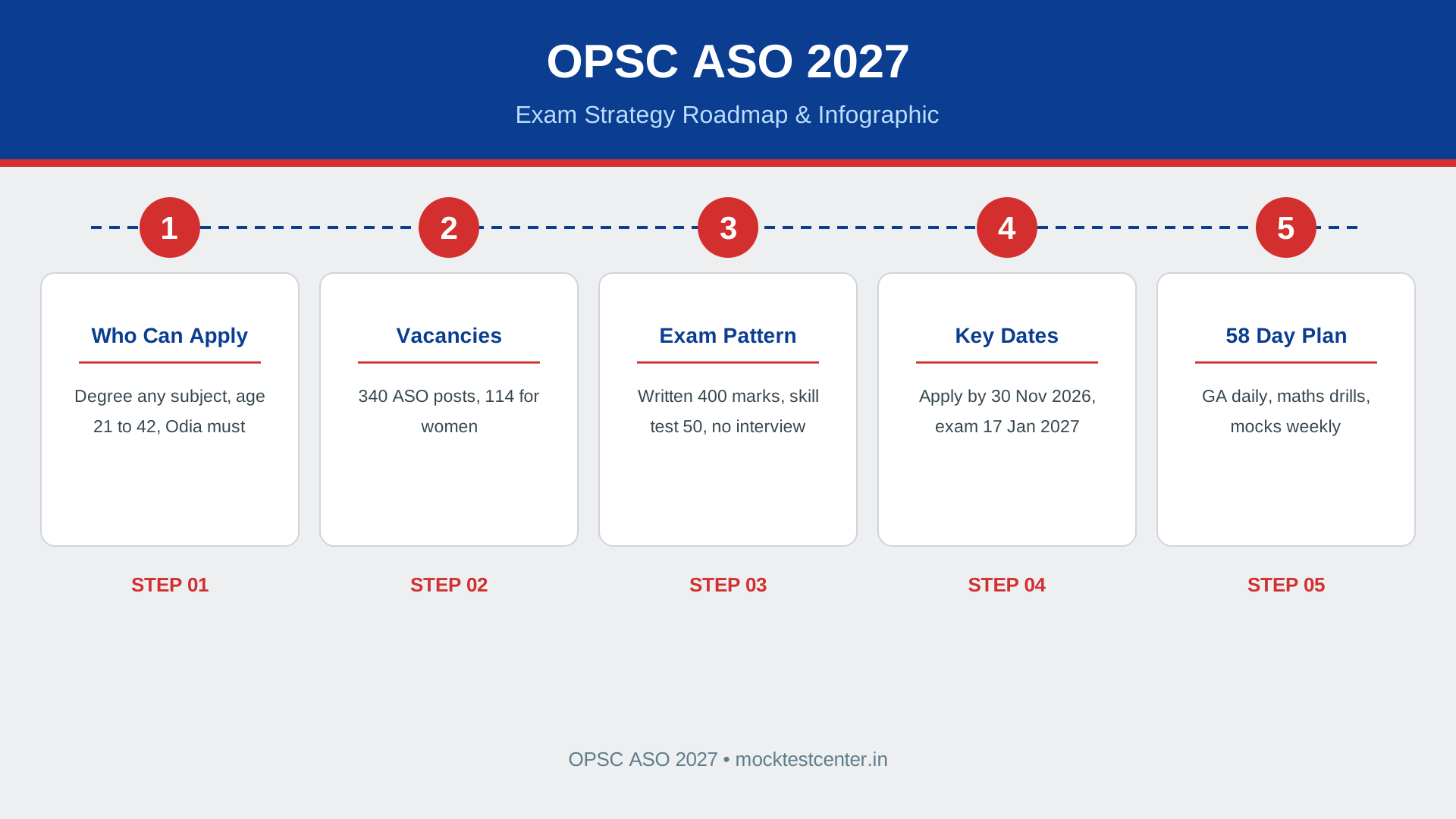
OPSC ASO 2027 is a live recruitment with a fixed exam date. The Odisha Public Service Commission issued Advertisement No. 15 of 2026-27 on 5 November 2026 for 340 Assistant Section Officer posts in the Odisha Secretariat Service Cadre under the Home Department. Applications run from 9 November to 30 November 2026, and the written examination is tentatively set for 17 January 2027. Selection has two stages and no interview: a 400 mark written examination of three papers, then a 50 mark Computer Skill Test that you must pass. Final merit comes from the written examination alone. If you hold a degree and you can read, write and speak Odia, this is a direct route into the Odisha Secretariat, and the window to apply is 22 days.
Three facts make this cycle different from the last one. The upper age limit is now 42 years, up from 32 years in the 2021-22 cycle, so a whole group of candidates who had aged out are back in the race. The post count is 340, less than half the 796 posts of the last cycle, so the contest per post will be sharper. And the examination fee of Rs 700 is refunded to every candidate who actually appears in the written examination, which removes the usual cost barrier for serious applicants. This guide covers the posts, the pattern, the syllabus, the age limits, the fee, the pay and a plan that fits the 58 days between now and the exam.
OPSC ASO 2027 in numbers
| Item | Detail |
|---|---|
| Conducting body | Odisha Public Service Commission (OPSC), Cuttack |
| Post | Assistant Section Officer (Group B), Odisha Secretariat Service Cadre, Home Department |
| Current notification | Advertisement No. 15 of 2026-27, dated 5 November 2026 |
| Posts in the current cycle | 340, with 114 reserved for women |
| Application window | 9 November 2026 to 30 November 2026, up to 5:00 PM, online only |
| Written examination date | 17 January 2027, tentative, a Sunday |
| Age counted on | 1 January 2026, 21 to 42 years |
| Fee | Rs 700 for UR and SEBC, exempt for SC, ST and PwD, refunded if you appear in the written examination |
| Selection | Written examination of 400 marks plus a 50 mark qualifying Computer Skill Test, no interview |
| Pay | Level 9, Rs 35,400 to Rs 1,12,400, under the Odisha Revised Scales of Pay Rules, 2017 |
| Previous cycle | Advertisement No. 26 of 2021-22, 796 posts, written examination 27 August 2022, final result 30 December 2023 |
The date that matters most is 17 January 2027. OPSC calls it tentative, and the Commission will notify the detailed schedule and centres later, but a tentative date from the notification is still a date you can plan around. From 20 November 2026, when this guide was written, you have 58 days to the examination. That is short enough that every study day counts and long enough that a candidate starting from scratch in the language papers can still get ready, provided the plan is honest about where the marks are.
The application window is the other date to respect. The link for registration and submission was to be made available from 9 November 2026, and the last date for submission and fee payment is 30 November 2026 at 5:00 PM. One news report put the start date at 11 November 2026, but the Commission's own statement quoted in the press said the link would be live from 9 November, and two trackers that reproduce the notification in full give 9 November. Apply early in the window rather than testing which date is right, because the portal slows down in the last two days of every OPSC recruitment.
What changed since the last ASO cycle
The last ASO recruitment ran on Advertisement No. 26 of 2021-22, published on 31 December 2021 for 796 posts. Applications ran from 20 January to 19 February 2022, with 25 February 2022 as the last date for the registered application. The written examination was first fixed for 21 August 2022, postponed because of floods, and finally held on 27 August 2022. About 1,48,888 candidates appeared. The result came on 7 November 2022, 1,104 candidates were called for document verification and the skill test, the Computer Skill Test was held on 4 December 2022, and the final result on 30 December 2023 recommended 787 candidates. Appointment orders for 716 candidates followed on 8 February 2024, with an orientation programme on 9 February 2024.
That cycle did not end cleanly. The Orissa High Court scrapped the merit list prepared by OPSC and ordered a fresh merit list within two months, on the basis of marks obtained in the written examination and under the Odisha Secretariat Service Rules, 2016. In July 2025 the court rejected review petitions against that order, and later directed OPSC to notify the fresh merit list within six weeks. The litigation is a warning, not a reason to stay away. It shows that the merit list in this exam is built on written examination marks, and that the rules behind the list are enforced. Read the notification for this cycle in full before you apply, and keep a copy of your submitted form.
The biggest change in the 2026 cycle is the age limit. The 2021-22 cycle allowed candidates aged 21 to 32 years on 1 January 2021. The 2026 cycle allows 21 to 42 years on 1 January 2026. Ten extra years at the top end is rare in any state recruitment, and it changes the competition. Candidates in their thirties who had given up on this post are eligible again, and many of them have been preparing for other OPSC examinations in the meantime. The post count moved the other way, from 796 to 340, so the field is older, more experienced and fighting for fewer seats. Treat the examination as a contest against prepared candidates, not against fresh graduates alone.
The pay scale is unchanged at Level 9, Rs 35,400 to Rs 1,12,400. The examination pattern is unchanged too: three written papers for 400 marks, a practical skill test for 50 marks, negative marking of 0.25 per wrong answer, and no interview. What the Commission changed is who may sit the examination and how many seats are on offer. Both changes push in the same direction, towards a tougher cut off than the last cycle.
Who can apply for OPSC ASO 2027
Eligibility has four parts, and all four must be met on the dates the notification fixes. Miss one and the application fails at document verification, even if you clear the written examination. Check each part against your own records before you pay the fee.
A bachelor degree in any discipline from a recognised university qualifies you, or an equivalent qualification recognised by the government. There is no subject condition and no minimum percentage in the notification. A degree in any subject is enough, which is why this examination draws candidates from arts, science, commerce and engineering in the same hall. Your degree must be complete, not merely pursued, and the university must be recognised.
You must have adequate knowledge of computer applications, as specified in the recruitment schedule. In practice this means you should be able to work with Windows and MS Office before the skill test, because the skill test is practical and there is no theory paper to hide behind. The notification does not ask for a computer certificate by name in the summaries that reproduce it, but the skill test itself is the proof the Commission wants. If you have never used Excel, start now, because the skill test is where otherwise strong candidates fail.
You must be able to speak, read and write Odia. The notification gives four ways to prove it. You passed the Middle School examination with Odia as a language subject, or you passed the Matriculation or equivalent examination with Odia as the medium of examination in a non-language subject, or you passed Odia as a language subject in the final examination of Class VII or above, or you passed an Odia test at Middle English School standard conducted by the School and Mass Education Department. Most Odisha candidates meet one of these through their school record. If you studied outside Odisha, check your certificates now, because this is the eligibility condition that catches outstation candidates most often.
You must be a citizen of India. The notification also fixes the age window precisely. You must have been born not earlier than 2 January 1984 and not later than 1 January 2005, which is the same as saying 21 to 42 years on 1 January 2026. Age relaxation applies on top of this. SC, ST and SEBC candidates get five years more, women candidates get five years more, and ex-servicemen get five years more. Persons with disabilities with a permanent disability of 40 percent or more get ten years more, and PwD candidates who also belong to SC, ST or SEBC get a cumulative relaxation of 15 years. If you qualify under more than one head, you get only one benefit, whichever helps you most, except for that cumulative PwD provision. Work out your own upper limit from your category and your date of birth, and do not guess it.
The 340 posts, category by category
| Category | Posts | Women |
|---|---|---|
| Unreserved (UR) | 144 | 48 |
| Socially and Educationally Backward Classes (SEBC) | 38 | 13 |
| Scheduled Castes (SC) | 81 | 27 |
| Scheduled Tribes (ST) | 77 | 26 |
| Total | 340 | 114 |
One post in three is reserved for women, 114 of 340. That is a large share, and it applies inside each category, so women candidates compete in their own category pool as well as in the open pool. The notification also provides horizontal reservation inside the category totals: 25 posts for persons with disabilities, 19 posts for ex-servicemen and 3 posts for sportspersons. The Commission adjusts these against the respective social category vacancies, not added on top, so the total stays at 340.
The category split tells you where the pressure sits. UR has 144 posts, the largest block, and it will draw the largest number of applicants. SC has 81 posts and ST has 77, both sizeable, while SEBC has only 38. A small category does not mean an easy category, because the number of applicants per post is what sets the cut off, and the Commission does not publish applicant counts by category before the examination. Apply in the category you belong to, with the certificate ready, and ignore any claim about which category is easiest, because nobody outside the Commission has the numbers to prove it.
All 340 posts are in the Odisha Secretariat Service Cadre under the Home Department. An ASO works in the Secretariat at Bhubaneswar, handling files, correspondence, noting and drafting under the supervision of section officers and under secretaries. It is desk work with a clear promotion line, and it is the reason this post draws graduates who want a stable government job in the state capital rather than field postings in the districts. The posting is the Secretariat, so plan for Bhubaneswar if you are selected.
How the exam actually works
Selection runs in two stages. The written examination comes first, and the Computer Skill Test follows for candidates shortlisted on written marks. There is no interview at any stage, and the notification does not mention one. Some trackers list an interview for this examination, but that is wrong for this cycle. The Commission states the selection plainly: a written examination and a skill test. OPSC prepares the final merit list from the aggregate marks in the written examination, among candidates who qualify the skill test.
| Paper | Subject | Marks | Questions | Duration |
|---|---|---|---|---|
| Paper I | General Awareness | 100 | 100 | 1 hour 30 minutes |
| Paper II | Test of Reasoning and Mental Ability (50) and Mathematics at 10th standard level (50) | 100 | 100 | 1 hour 30 minutes |
| Paper III | Language: English (100) and Odia (100) | 200 | 200 | 2 hours |
| Total written | Three papers | 400 | 400 | 5 hours |
| Paper IV | Skill Test in Computer Application, practical | 50 | 5 tasks | 1 hour |
Every written question is objective type with multiple choices, except the skill test, which is practical. Each wrong answer costs 0.25 marks. With 400 questions on the paper, blind guessing is a losing habit, because four wrong guesses erase one correct answer. The right habit is to attempt what you know, mark what you can narrow to two options, and leave the rest. Candidates who treat negative marking as a detail lose 10 to 15 marks in a paper where the cut off may be decided by two marks.
The written papers also have minimum qualifying marks, and you must clear them in each paper to be shortlisted for the skill test. The minimum is 35 percent for UR and SEBC candidates, 30 percent for SC and ST candidates, and 28 percent for candidates with disabilities. That works out to 35 marks in a 100 mark paper for UR and SEBC candidates, and 70 marks in the 200 mark language paper. These are floors, not targets. Clearing the floor gets you into the shortlist pool, but the shortlist itself is drawn on aggregate marks, so a candidate who only just clears each paper will not rank high enough to be called for the skill test.
The Computer Skill Test carries 50 marks and lasts one hour. It is a practical test of computer applications, and you must secure at least 40 percent, which is 20 marks, to qualify. The marks do not count in the final merit. That makes the skill test a pass or fail gate, and it is the gate that ends the run of candidates who spent five months on General Awareness and five minutes on Excel. Shortlisting for the skill test follows the written examination result, and the final merit list is then drawn from the written aggregate of those who pass the skill test.
Ties in the final merit are settled in two steps. The candidate with higher marks in General Awareness, Paper I, ranks higher. If the Paper I marks are also equal, the older candidate ranks higher. Both rules favour the candidate who took Paper I seriously, which is another reason to give General Awareness its full share of preparation time rather than treating it as a general knowledge paper you can wing on the day.
Syllabus paper by paper
Paper I, General Awareness, covers current national and international events, the history of British rule in India and the freedom struggle, the Indian Constitution, the salient features of world physical geography and the physical geography of India and Odisha, governance with transparency, accountability, e-governance and the role of civil services in democracy, and the Indian economy, including planning, growth, development, employment, poverty alleviation, resource mobilisation and inflation. It also covers defence and the Indian armed forces, scientific inventions and the use of science in everyday life, environment, ecology, biodiversity and climate change, and important national and international institutions, organisations and forums, with their structure and mandate. The Odisha part of the geography and the current events part of the paper are where prepared candidates pull ahead, because both reward reading that is specific to the state and to the last twelve months.
Paper II has two halves of 50 marks each. The reasoning and mental ability half covers number series and alphabet series, direction sense, coding and decoding, number ranking, arithmetic reasoning, age calculation problems, non-verbal series, mirror images, cubes and dice, grouping identical figures and embedded figures. The mathematics half is set at 10th standard level and covers arithmetic, algebra, mensuration in two and three dimensions, and statistics and probability. This paper is the most scoreable of the three for a candidate who practises daily, because the question types repeat and the answers are exact. It is also the paper where careless errors hurt most, because each wrong answer costs a quarter mark and the questions look easy.
Paper III is the language paper, and at 200 marks it is half the written examination. The English half tests grammar, including verbs, prepositions, adverbs, subject-verb agreement, error correction and recognition, tenses, fill in the blanks with articles, vocabulary with synonyms and antonyms, comprehension and sentence rearrangement. The Odia half tests Odia grammar, vocabulary, comprehension and related language topics as detailed in Appendix I of the notification. Many candidates treat the language paper as a formality and then discover that it decides their rank. Two hundred marks is too large a block to leave to chance, and Odia in particular rewards a candidate who reads the language daily rather than one who revises it in the last week.
Paper IV, the Computer Skill Test, is practical work on Windows, MS Office applications including Word, Excel and PowerPoint, MS Access and the use of internet services. The test has five tasks in one hour, so speed matters as much as accuracy. A candidate who can format a document, build a small spreadsheet with formulas, make a short presentation and run a simple database query without hunting through menus will finish comfortably. A candidate who has to think about where each command sits will run out of time. Practise the tasks on a real computer, not by reading about them, because the test measures what your hands can do.
Fee, refund and how to apply
The examination fee is Rs 700 for candidates other than SC, ST and PwD. SC, ST and PwD candidates are exempted from the fee. The fee is paid online at the time of application, and the last date for fee payment is 30 November 2026 at 5:00 PM, the same as the last date for the application itself.
The refund rule is worth knowing before you pay. The Commission refunds the fee only if you actually appear in the written examination. The refund goes to the original payment mode after the examination is over, and candidates must give valid bank account details in the application form for cases where the refund to the original payment mode fails. The practical meaning is simple: pay the fee, sit the examination, and the money comes back. Skip the examination and the fee stays with the Commission. Exempt candidates pay nothing and get nothing back, which is fair enough.
Apply online only, through the OPSC website. The steps are registration, filling the form, uploading documents and paying the fee. On registration you get a Permanent Public Service Account Number, or PPSAN, and you should note it down and keep it safe, because it is your identity on the portal for this and later recruitments. Log in with your credentials, fill the form with your personal details, educational qualification, category information and other details, and check every entry before you submit. Do not submit more than one application through multiple PPSAN accounts, because the notification warns against it.
Upload a scanned image of your latest passport-size photograph, your full signature and your left-hand thumb impression in the prescribed format. Check that each image is clear and identifiable, because a blurred thumb impression or a cropped photograph is the kind of small defect that creates trouble at document verification. Pay the fee through the available online payment modes, review all the information once more, submit the form, and download and keep a copy of the finally submitted application. Keep your documents ready for verification, including your degree certificate, your Odia language proof, your caste or category certificate if you claim relaxation or reservation, and your disability certificate if that applies.
Pay and what an ASO does
Selected candidates get Level 9 of the Odisha Revised Scales of Pay Rules, 2017, with a starting basic pay of Rs 35,400 and a scale running to Rs 1,12,400. Dearness allowance and other allowances sanctioned by the state government from time to time are paid on top of basic pay. The exact take-home pay depends on the dearness allowance rate in force at the time of joining and on the place of posting, so no single monthly figure in a guide can be exact. What is fixed is the scale, and Level 9 is a respectable Group B entry scale in the state government.
The job itself is Secretariat work. An Assistant Section Officer handles files, correspondence, noting and drafting in a department of the Odisha Secretariat, working under a section officer. The work is paper based and rule based: a file comes in, you put up a note with the facts and the rule, the note moves up, and a decision comes back. It suits candidates who are careful with language and comfortable with procedure. Promotion runs up the Secretariat line, and the post is a standard entry point for graduates who want a career inside the state government rather than a transferable field job.
Compare this with the other OPSC examinations before you commit your preparation time. The Odisha Civil Services examination leads to administrative posts with field postings and a longer selection process. The ASO examination is shorter, has no interview, and leads to one cadre in one place. If you want the Secretariat and you want a result in months rather than years, the ASO examination is the better fit. If you want district administration, look elsewhere.
The last cycle, in full
The 2021-22 cycle is the best guide to how this examination behaves, because the pattern is unchanged. The notification came on 31 December 2021 for 796 posts: UR 447 with 149 women, SEBC 62 with 21 women, SC 109 with 36 women, ST 178 with 59 women, and 265 women in all. The age limit then was 21 to 32 years on 1 January 2021. Applications ran from 20 January to 19 February 2022, and the last date for the registered application was 25 February 2022. A corrigendum on 20 January 2022 fixed the upper age relaxation, so even the last cycle had its share of corrections.
OPSC first fixed the written examination for 21 August 2022, then postponed it because of floods in the state. The Commission rescheduled it to 27 August 2022, and about 1,48,888 candidates appeared. That is roughly 187 candidates for every post. OPSC declared the result on 7 November 2022, and 1,104 candidates qualified for document verification and the skill test. The Computer Skill Test followed on 4 December 2022. The final result on 30 December 2023 recommended 787 candidates against 796 posts, and the government issued appointment orders for 716 candidates on 8 February 2024.
Two lessons follow from those numbers. First, the written examination is the whole contest, because only 1,104 of 1,48,888 candidates reached the skill test, which is less than one in a hundred. Second, the timeline from notification to appointment took more than two years, from December 2021 to February 2024, and the court case stretched it further. The 2026 cycle has a faster start, with the examination fixed about ten weeks after the notification, but do not assume the result will be quick. Plan for a long wait after the examination, and do not stop preparing for other examinations while you wait.
A 58 day plan to 17 January
From 20 November 2026 to the examination on 17 January 2027 is 58 days, or eight weeks and two days. That is enough for a focused plan if you already have a degree-level general awareness base and you can read Odia. It is not enough to start from zero in three papers at once, so the plan below assumes you pick your weakest paper first and protect your strongest paper from neglect.
Weeks one and two are for the base. Cover the full Paper I syllabus once, with daily current events from the last twelve months and a separate notebook for Odisha geography, history and government schemes. Do Paper II daily in short sets, 30 reasoning questions and 20 mathematics questions, and mark every error. Read Odia for 30 minutes a day and English grammar for 30 minutes a day. End each week with one full Paper I mock of 100 questions in 90 minutes.
Weeks three to five are for depth. Move to previous year questions from the 2022 cycle and to topic-wise tests. Paper I gets two hours a day, with Constitution, economy and environment on rotation. Paper II gets one hour a day, with the focus on the question types you get wrong most often. Paper III gets one hour a day, split between English and Odia, with comprehension passages every alternate day. Start the computer practice in week three: one hour, three times a week, on Word, Excel and PowerPoint, working through real tasks rather than reading menus.
Weeks six and seven are for mocks. Sit one full written examination each week, all three papers in one day, in the same order and with the same gaps as the real examination. Score each paper separately and track the qualifying floor as well as the total, because a candidate can clear the total and still fail a paper floor. Revise only the topics where the mocks show losses. In the last three days, stop learning new material, revise your notes, practise one computer task set a day, and keep your admit card, photo identity proof and stationery ready.
One warning about the plan. The examination date is tentative, and OPSC can move it. The last cycle moved its written examination by six days because of floods. If the date moves, the plan stretches, it does not collapse. Keep the weekly rhythm and add a revision week. Do not stop studying because the date looks uncertain, and do not burn out by studying twelve hours a day in week one.
Three mistakes that cost marks
The first mistake is guessing through Paper I. With 100 questions and a quarter mark penalty, a candidate who guesses 40 questions and gets 10 right loses 7.5 marks net on the guesses alone. Attempt the questions you know, attempt the ones you can narrow to two options, and leave the rest blank. A blank answer costs nothing, and nothing is the best price for a question you do not know.
The second mistake is ignoring the skill test until the written result comes out. The skill test is qualifying, but qualifying still means passing, and the gap between the written result and the skill test in the last cycle was less than a month. Candidates who started computer practice only after the written result had four weeks to learn five applications. Start the practice now, one hour three times a week, and the skill test becomes a formality.
The third mistake is treating Paper III as a language paper you can pass on general ability. It is 200 marks, half the written examination, and it has a qualifying floor of 70 marks for UR and SEBC candidates. A candidate who scores well in Paper I and Paper II and then scores 60 in Paper III fails the floor and goes home. Give the language paper the same daily time as the other papers, and test yourself on it under time pressure, because two hours for 200 questions leaves 36 seconds per question.
Sources
Advertisement No. 15 of 2026-27, Odisha Public Service Commission, dated 5 November 2026, as reproduced in full by PW Live and by Argus News, and reported by Sambad English on 5 November 2026. OPSC ASO syllabus and examination pattern as reproduced from Appendix I of the notification by PW Live, Adda247 and Vanik. Advertisement No. 26 of 2021-22 and the examination timeline for the 2022 cycle, from the OPSC examination archive as compiled by Works Odisha, and the Orissa High Court orders on the ASO merit list as reported by Sambad English. The official OPSC website is opsc.gov.in, and candidates should check the notification there before applying.