
About NABARD Grade A IT 2027 Exam Series
📖 Table of Contents
- Ten posts, one wrong paper, and a lost year
- What the IT post actually is
- The 2025-26 cycle in numbers
- The vacancy swing nobody warns you about
- Who can apply: the degree list that decides everything
- Age: the cutoff date three sources cannot agree on
- Phase 1: the same paper as everyone else, a different cutoff
- Phase 2 Paper 1: English, typed, 100 marks
- Phase 2 Paper 2: the IT paper, and why it decides the rank
- Psychometric test and interview: 50 marks that still matter
- The cutoffs that break the usual logic
- Salary and what an IT officer does at NABARD
- The fee, and the 850 rupee figure that keeps appearing
- A six month plan built around the IT paper
- Five mistakes IT candidates keep making
- How to apply, and what to check first
- Sources
NABARD Grade A IT 2027
Ten posts, one wrong paper, and a lost year
NABARD Grade A IT 2027 is the Assistant Manager post in the Computer and Information Technology discipline of the Rural Development Banking Service. The 2025-26 cycle offered 10 IT posts out of 91 Grade A posts. Phase 1 is the same paper every Grade A candidate sits. Phase 2 is where the IT discipline splits away. Paper 2 for IT candidates tests computer science and information technology, and it replaces the Economic and Social Issues and Agriculture and Rural Development paper that General discipline candidates sit. A candidate who spends six months on agriculture and rural development for Paper 2 walks into the wrong exam.
That single fact shapes this whole page. Everything else here follows from it. The eligibility list is a degree list, and a general degree does not open this door. The cutoffs look strange until you see them discipline by discipline. Phase 1 cutoffs for IT sit far below the General cutoffs, and Phase 2 cutoffs for IT sit above them. The vacancy count swings hard from year to year, from 40 posts in 2023 down to 10 in the 2025-26 cycle. And no notification for the next cycle has been released as of 23 November 2026, so every date below comes from the 2025-26 cycle and every 2027 figure waits on the new advertisement.
One more correction belongs right at the top. There is no NABARD Grade B IT post. The task title for this page once carried Grade B beside Grade A, and the two do not belong together. Direct recruitment to Manager in Grade B last ran in 2021, in the General discipline only, and no Grade B notification had been released as of September 2026. This page covers Grade A IT only. A computer science graduate who wants NABARD applies through Grade A.
What the IT post actually is
NABARD is the National Bank for Agriculture and Rural Development. It was set up on 12 July 1982 under the NABARD Act 1981. It is fully owned by the Government of India and works under the Department of Financial Services in the Ministry of Finance. Its work covers refinance to banks, supervision of cooperative banks and regional rural banks, rural infrastructure funds, watershed work, financial inclusion and development schemes for farmers and rural enterprises. The Grade A IT officer works inside that institution, on its technology side.
The post is Assistant Manager in Grade A, in the Rural Development Banking Service, or RDBS, in the Computer and Information Technology discipline. NABARD runs a Department of Information Technology at its head office, and the transfer policy names it among the specialised head office departments where officers build longer tenures. The advertisement itself does not publish a day to day job chart for the IT discipline, so this page does not invent one. The work sits with the bank technology functions: systems, data, networks and security. A candidate who likes building and running technology systems will find the work itself interesting. A candidate who only wants any bank job and has no interest in technology will find the Phase 2 paper hard to fake, because it tests the subject for 100 marks.
The exam is conducted by the Institute of Banking Personnel Selection, or IBPS, on behalf of NABARD. That matters for a candidate, because the online test interface and the admit card process follow the IBPS pattern. A candidate who has taken an IBPS exam will find the NABARD test familiar. The application goes in online only, through the Career Notices page on nabard.org.
The 2025-26 cycle in numbers
Advertisement 05/Grade A/2025-26 is the last full cycle. The short advertisement came on 4 November 2025. The detailed notification followed on 8 November 2025. Applications ran from 8 to 30 November 2025. Phase 1 was held on 20 December 2025. Phase 2 was held on 25 January 2026. The final result came in May 2026, as per secondary reporting. The whole cycle, from notification to Phase 2, took under three months, which is fast for a government recruitment.
The advertisement offered 91 posts in all. RDBS had 85, Legal Service had 2, and Protocol and Security Service had 4. Inside RDBS, the General discipline had 48 posts, and the Computer and Information Technology discipline had 10. The IT share of the whole recruitment was just over one in ten posts. Ten posts also means the Phase 2 shortlist is small. NABARD shortlists up to 25 candidates per vacancy for Phase 2, so at most 250 IT candidates went through to Phase 2 from the whole country.
| Item | 2025-26 cycle |
|---|---|
| Advertisement | 05/Grade A/2025-26 |
| Short advertisement | 4 Nov 2025 |
| Detailed notification | 8 Nov 2025 |
| Applications | 8 to 30 Nov 2025 |
| Total posts | 91 |
| RDBS posts | 85 (General 48, Computer and IT 10) |
| Legal posts | 2 |
| Protocol and Security posts | 4 |
| Phase 1 | 20 Dec 2025 |
| Phase 2 | 25 Jan 2026 |
| Final result | May 2026 |
The vacancy swing nobody warns you about
IT vacancies at NABARD jump around from year to year. The discipline had 15 posts in 2021, 25 in 2022, 40 in 2023, 16 in 2024 and 10 in the 2025-26 cycle. The 2023 figure was four times the 2025-26 figure. A candidate who plans on 40 posts because a 2023 video said so will misread the competition completely.
The swing matters more than it looks, because the shortlist and the cutoff both hang on the vacancy count. With 10 posts, 250 candidates reach Phase 2 at most. With 40 posts, that number was 1,000. Fewer posts also mean the Phase 2 cutoff climbs, and the 2025-26 numbers show exactly that. The Phase 2 cutoff for IT in the unreserved category reached 147.75 out of 200 in the 2025-26 cycle, the highest of the recent years. Treat any vacancy figure for the next cycle as unknown until the advertisement prints it. The trend says the number can move either way.
| Cycle | IT posts | Total Grade A posts |
|---|---|---|
| 2021 | 15 | Not stated here |
| 2022 | 25 | Not stated here |
| 2023 | 40 | 150 |
| 2024 | 16 | 102 |
| 2025-26 | 10 | 91 |
The 2025-26 IT posts split by category as 4 unreserved, 2 scheduled caste, 1 scheduled tribe, 2 other backward classes and 1 economically weaker section. That split comes from the vacancy table in the advertisement as reported by three secondary sources. One secondary source prints the scheduled caste and scheduled tribe figures the other way round, 1 and 2. The majority reporting agrees on 2 and 1, and this page follows the majority while flagging the difference in the package notes. Check the advertisement table itself when you apply, because one post in the wrong column changes the category cutoff you chase.
Who can apply: the degree list that decides everything
Eligibility for the IT discipline is a degree list, and the list is narrow on purpose. A Bachelor degree in any subject, which opens the General discipline, does not open this one. The degree has to sit in the fields the advertisement names.
Three routes lead in. The first route is a four year Bachelor Engineering or Technology degree in Computer Science, Computer Engineering, Computer Applications, Information Technology, Electronics, Electronics and Telecommunications, Electronics and Communication, Data Science, or Artificial Intelligence and Machine Learning, with 60 percent marks in aggregate. Scheduled caste, scheduled tribe and PwBD candidates need 55 percent. The second route is a post graduate degree in the same fields, with 55 percent marks, or 50 percent for scheduled caste, scheduled tribe and PwBD candidates. The third route is a graduation with 60 percent marks, or 55 percent for scheduled caste, scheduled tribe and PwBD candidates, plus a pass in the DOEACC B Level course. DOEACC is the Department of Electronics and Accreditation of Computer Courses, and its B Level is a recognised computer qualification.
Two details in that list catch people out. Data Science and Artificial Intelligence and Machine Learning appear as named fields, so a degree in those subjects counts directly. Electronics degrees count too, including Electronics and Communication and Electronics and Telecommunications, which surprises candidates who assume only computer science counts. Check the exact degree name on your certificate against the advertisement list before you pay the fee. A degree with a close name and a different official title can still fail the document check.
One application covers one post and one discipline only. A candidate cannot apply for General and IT in the same cycle, and the choice cannot be changed later. That rule forces a real decision. An IT graduate who also qualifies for General has to pick. General had 48 posts in the 2025-26 cycle against 10 for IT, so General looks bigger. But the General Phase 2 paper tests Economic and Social Issues and Agriculture and Rural Development, while the IT Phase 2 paper tests the candidate own subject. A strong computer science graduate often scores higher in the IT paper than in an agriculture paper, even with fewer posts. Compare the two papers, not just the two vacancy counts, before you choose.
Final year students should read the advertisement with care. Secondary reporting of the 2025-26 cycle says final year students were not eligible and the graduation result had to be declared before the notification date. That point was not checked against the official advertisement text in this pass, so it sits flagged in the package notes. Do not apply on a hope. Read the eligibility date line in the new advertisement first.
Age: the cutoff date three sources cannot agree on
Age for the IT discipline is 21 to 30 years on the cutoff date fixed in the advertisement. Relaxation follows the usual pattern. Other backward classes candidates get three years, which takes the upper limit to 33. Scheduled caste and scheduled tribe candidates get five years, which takes it to 35. Persons with benchmark disabilities get ten years, which takes it to 40. Read the advertisement for the full list, because the exact relaxations and the combinations are fixed there.
The 2025-26 cutoff date itself is a mess in secondary reporting, and this page says so plainly instead of picking one version and hiding the rest. One source puts the cutoff at 1 November 2025, with a birth window of 2 November 1995 to 1 November 2004. A second source puts it at 1 July 2025. A third gives a birth window of 2 September 1995 to 1 September 2004, which points to a 1 September 2025 cutoff. The three cannot all be right. The 1 November 2025 date also appears as the cutoff for all eligibility criteria in one detailed report of the advertisement, which gives it weight, but weight is not proof. A candidate near either edge of the age window must check the advertisement itself when it comes out. A wrong guess here can end an application before it starts.
The cutoff date moves with each cycle in any case. The 2024 cycle used 1 July 2024. The 2025-26 cycle used a later date under at least one reporting. Do not carry a date from an old cycle into a new application. The advertisement prints the date. Use that one.
Phase 1: the same paper as everyone else, a different cutoff
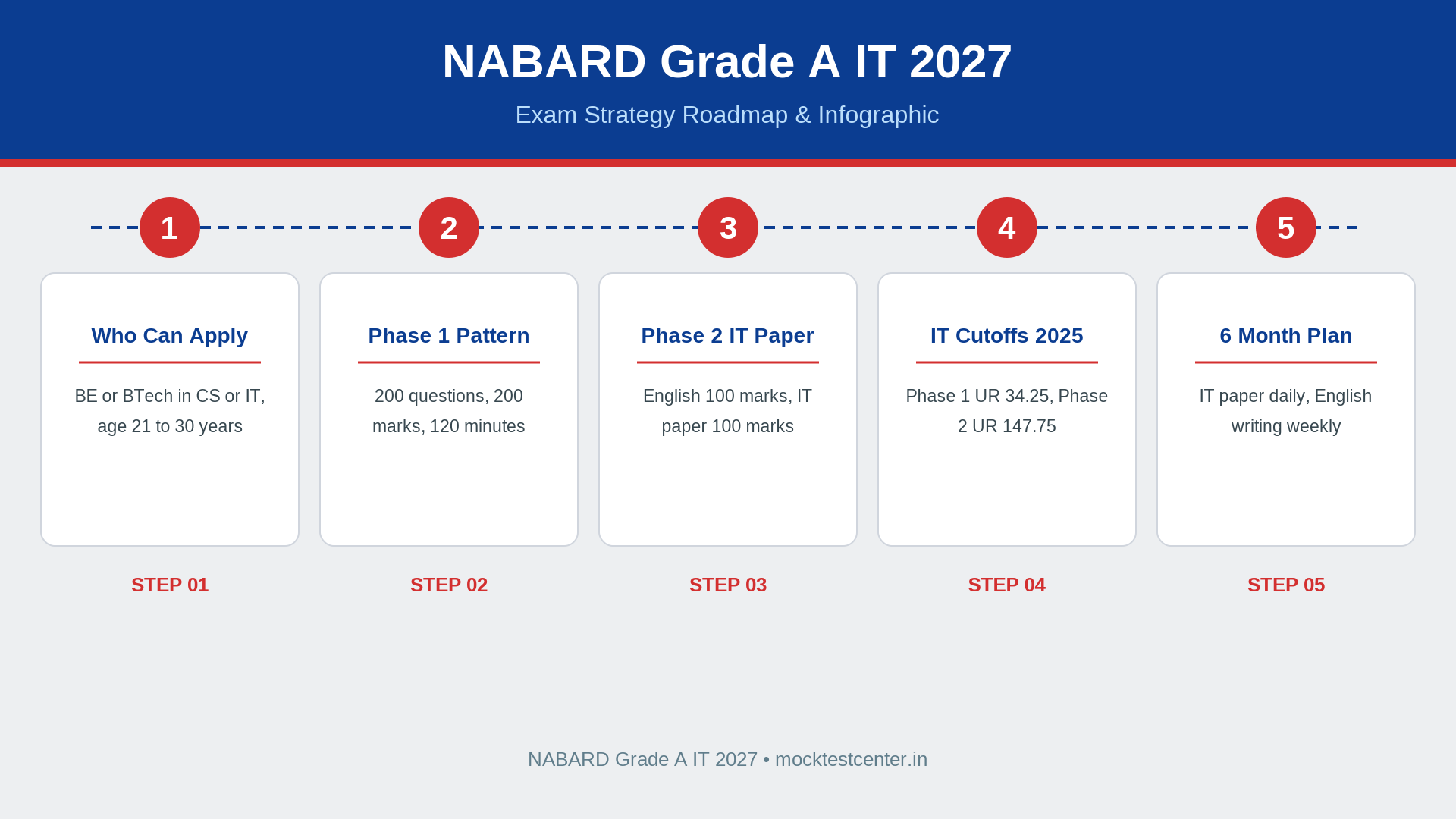
Phase 1 is one online objective test of 200 questions for 200 marks in 120 minutes, with a composite time for all tests together. Every Grade A candidate sits the same Phase 1, whatever the discipline. The paper splits into a qualifying section of 100 marks and a merit section of 100 marks. Only the merit section counts toward shortlisting for Phase 2. The qualifying section needs a pass in each test and nothing more.
The merit section has three tests. General Awareness carries 20 marks. Economic and Social Issues carries 40 marks. Agriculture and Rural Development carries 40 marks. The three together make 100 marks, and the shortlist for Phase 2 is drawn on this total alone, discipline wise, up to 25 candidates per vacancy. For IT, with 10 posts, that means at most 250 candidates go through. The rest go home, whatever their qualifying section score was.
That structure tells an IT candidate where to spend Phase 1 time. Economic and Social Issues and Agriculture and Rural Development together carry 80 of the 100 merit marks. General Awareness carries 20. A candidate who masters the two 40 mark subjects and treats General Awareness as a secondary subject will score higher than a candidate who splits time evenly across all three. The qualifying section needs a pass, so it should not eat the hours that the merit section needs.
The qualifying section has five tests for 100 marks. Test of Reasoning carries 20 marks. English Language carries 30 marks. Computer Knowledge carries 20 marks. Quantitative Aptitude carries 20 marks. Decision Making carries 10 marks. Each test has its own cutoff, and a candidate must clear each one. A zero in any test ends the attempt, whatever the merit section score is.
Computer Knowledge deserves a special note here, because IT candidates misread it. It carries 20 marks in the qualifying section, and it tests basics: hardware, software, networks, internet, MS Office and security. It is not the Phase 2 IT paper. A computer science graduate who treats it as a free 20 marks and never revises it can still fall below its sectional cutoff. Give it a weekly slot from the start, like every other qualifying test. The other qualifying tests follow the standard bank exam pattern. Reasoning covers puzzles, seating, syllogisms, coding, series and data sufficiency. English covers reading comprehension, cloze, error spotting and vocabulary. Quant covers arithmetic, data interpretation and number series. Decision Making presents situations and asks for the best course of action, and it carries only 10 marks, so do not let it eat a week of preparation.
There is no sectional timing in Phase 1. The 120 minutes are composite across all eight tests. That gives a candidate control over time, and it also gives a candidate rope. Decide your time split before the exam and stick to it. A candidate who spends 60 minutes on the qualifying section will have 60 minutes left for 100 merit marks, and that is not enough.
Negative marking is one fourth of the marks assigned to the question, which is 0.25 marks per wrong answer in the objective tests of Phase 1 and Phase 2. Unanswered questions carry no penalty. The cutoff in each test and in the merit total is fixed by NABARD after the exam, and it changes every year with the paper and the pool.
Phase 2 Paper 1: English, typed, 100 marks
Phase 2 has two papers, and Paper 1 is the same for every discipline. It is General English, descriptive, 100 marks in 90 minutes. The answers are typed on a keyboard. The paper has three parts: an essay, a precis of 120 to 180 words, and a letter or a comprehension of 200 to 220 words. The essay carries the most weight, so practice writing essays on rural and economic topics, and on technology topics too, since an IT candidate may get either.
Typing speed matters here, because a slow typist will leave marks on the table even with good ideas. Many IT candidates type fast already, and that is a real edge in this paper. It is also an edge that fades fast if the candidate never practises writing under time pressure. Typing code all day is not the same as typing a structured essay in 90 minutes. Write one essay a week, typed, from the second month of preparation onward. Get it checked. A mock that nobody checks is only half a mock.
Paper 1 carries the same weight as Paper 2 in Phase 2, 100 marks each. Candidates who treat English as an afterthought lose the easiest marks in the whole exam. The precis has a strict word band, 120 to 180 words, and the letter or comprehension has its own band, 200 to 220 words. Practise inside those bands until the length feels natural. An answer that runs long loses marks. An answer that runs short loses marks too.
Phase 2 Paper 2: the IT paper, and why it decides the rank
Paper 2 is where the IT discipline becomes a different exam. For the General discipline, Paper 2 tests Economic and Social Issues and Agriculture and Rural Development. For IT candidates, Paper 2 is a stream specific paper in Computer and Information Technology. It carries 100 marks in 120 minutes, split into an objective part and a descriptive part. The objective part has 30 questions for 50 marks in 30 minutes. The descriptive part shows six questions, of which you attempt four, for 50 marks in 90 minutes. Two descriptive questions carry 15 marks each and two carry 10 marks each. Descriptive answers are typed, in English or Hindi.
That split changes how you prepare. Half the paper rewards speed and recall in 30 minutes. The other half rewards structured writing in 90 minutes. A candidate who only solves objective questions will walk into the descriptive half unprepared. A candidate who only reads theory will run out of time in the objective half. Both halves need separate practice, and the descriptive half needs typed practice, because the real answers are typed.
The NABARD Grade A IT syllabus sits in a NABARD document titled Syllabus for the Written Examination for the Post of Assistant Manager in Grade A, Computer and Information Technology. The syllabus lists 20 topics, and it says plainly that the list is illustrative and not exhaustive, and that questions can be asked on current developments in the subject even where the topics do not name them. The 20 topics are the spine of the paper. Learn them in full before you chase anything else.
The list starts with the foundations. Introduction to Software. Computer Fundamentals. Data Structure, File Structure and programming through C, C++, Java and Python. Elements of Systems Analysis and Design. Numerical and Statistical Computing. Those five topics cover how software is built, how data is organised, and how a program moves from an idea to a working system. Data structures and programming carry the most weight in practice, because they appear in both the objective questions and the descriptive questions. A candidate who can write a sorting routine and explain its cost will score in both halves.
The next group covers the machine and the network. Data Communication and Networks. Computer Architecture and Network Architecture. Object Oriented Systems. Database Management Systems including RDBMS. Software Engineering. Operating Systems. Management Information Systems. This is the core of a computer science degree, and it is where a degree holder should score highest. Networks and operating systems reward candidates who understand how the layers fit together, not candidates who memorised definitions. Database questions reward candidates who can write a query and explain normalisation, not candidates who only know the full form of SQL.
The last group covers the newer subjects, and it is where the paper has moved in recent years. Internet of Things, or IoT, and Mobile Computing. Design and Analysis of Algorithms. Basics of AI, ML and natural language processing. Cyber Security. Big Data Analytics. Data Modelling and Analytics. Concept of data visualisation using reporting tools. Data warehousing with analytical capabilities and virtual data management. API usage for cross user interaction and data exchange. These topics sit beside the core subjects in the official list, and a candidate who skips them leaves marks on the table.
Two warnings belong with that list. The syllabus is illustrative, so a question can step outside it. Current developments count, and the document says so. A candidate who only revises a five year old book will miss questions on recent changes in the field. And the descriptive half asks for answers, not ticks. A descriptive question on database design or cyber security wants a structured answer: the concept, the application, one concrete example, and a closing line that answers the question asked. An answer that only lists facts scores in the middle. Practise one descriptive answer a week from the start, on a real topic from the list, under time pressure.
The gap between the IT paper and the General paper is the whole reason this page exists. Competitor pages for the IT exam often repeat the vacancy and eligibility lines and then paste the General Phase 2 pattern as if it applied to IT candidates. It does not. The IT candidate never sits an ESI and ARD paper in Phase 2. The IT candidate sits a computer science paper. Check any source that tells you otherwise against the official syllabus document. If a coaching page gives you an agriculture heavy Phase 2 plan for the IT discipline, that page is wrong for you.
Psychometric test and interview: 50 marks that still matter
Phase 3 is a psychometric test. It is mandatory, it runs for 90 minutes, and it carries no marks. It gives the interview panel a view of the candidate, and it informs the interview rather than adding to the total. Do not skip it and do not treat it as a formality. Answer it plainly and consistently, because inconsistent answers stand out.
The interview carries 50 marks. Candidates are shortlisted for it at up to three per vacancy, on the basis of Phase 2 marks. With 10 IT posts, at most 30 candidates reach the interview. The panel asks about your background, your degree, technology subjects, NABARD itself, the economy and current affairs. An IT graduate should expect subject questions. A computer science graduate who cannot explain a database or a network in plain words will struggle here, whatever the written score was.
The final merit adds Phase 2 marks out of 200 and interview marks out of 50, which makes 250 marks in all. Phase 1 marks play no part. A candidate who scraped through Phase 1 can still top the final list with a strong Phase 2 and interview. A candidate who topped Phase 1 and relaxes in Phase 2 will not.
The cutoffs that break the usual logic
Cutoffs for the IT discipline look wrong until you read them beside the General cutoffs. In Phase 1, the IT cutoff sits far below the General cutoff. In Phase 2, the IT cutoff sits above it. Both facts are true at once, and both come from the same cause: the two disciplines draw different pools of candidates, and the papers that decide the rank are different papers.
Phase 1 cutoffs use the merit section only, out of 100 marks, for the unreserved category. The IT figures run like this: 34.25 in the 2025-26 cycle, 23 in 2024, 11.50 in 2023, 14.50 in 2022 and 26.25 in 2021. The General figures for the same years run 54.50, 47, 46, 41.75 and 53.50. The gap is wide every year. In 2023, an IT candidate needed 11.50 out of 100 in the merit section to reach Phase 2, while a General candidate needed 46. The cause is simple. The IT pool scores lower on the merit section, which tests agriculture and rural development and economic and social issues, subjects that sit far from a computer science degree. The sectional cutoffs still apply, so a low overall cutoff does not save a candidate who fails one test.
Phase 2 tells the opposite story. The Phase 2 cutoff is out of 200 marks, for the unreserved category. The IT figures run 147.75 in the 2025-26 cycle, 119.25 in 2024 and 113.50 in 2023. The General figures for the same years run 135.25, 126.75 and 128.50. In the 2025-26 cycle, the IT cutoff stood 12.50 marks above the General cutoff. In 2023 and 2024 it stood below it. The swing follows the vacancy count. Ten posts in the 2025-26 cycle pushed the IT cutoff up hard. Forty posts in 2023 pulled it down.
| Cycle | Phase 1 IT UR (out of 100) | Phase 1 General UR (out of 100) | Phase 2 IT UR (out of 200) | Phase 2 General UR (out of 200) |
|---|---|---|---|---|
| 2025-26 | 34.25 | 54.50 | 147.75 | 135.25 |
| 2024 | 23 | 47 | 119.25 | 126.75 |
| 2023 | 11.50 | 46 | 113.50 | 128.50 |
| 2022 | 14.50 | 41.75 | Not stated here | Not stated here |
| 2021 | 26.25 | 53.50 | Not stated here | Not stated here |
Category cutoffs for the 2025-26 Phase 2 paper show the same pattern inside the discipline. The IT cutoffs were 131 for scheduled caste, 124 for scheduled tribe, 136.75 for other backward classes, 133.75 for economically weaker section and 147.75 for unreserved. The final select list cutoff for IT in 2023 was 160 for the unreserved category, as reported by two secondary sources. Final cutoffs for other years were not verified consistently enough to print here, and the package notes flag that gap. Cutoffs come from NABARD official cutoff notices as reported by secondary sources, and they change every year with the paper and the pool. Use them to set a target, not as a promise. A safe target for the next cycle is well above the last cutoff, because the vacancy count can fall again.
One more number from the 2025-26 cycle helps set that target. The group norms for Paper 1 and Paper 2 show how high the bar sat for IT candidates. For the unreserved and economically weaker section categories, the Paper 1 descriptive norm was 60 out of 100, the Paper 2 objective norm was 43 out of 50, and the Paper 2 descriptive norm was 17.75 out of 50. Those are the marks a candidate had to clear in each paper group to stay in the race. The descriptive half of Paper 2 looks low at 17.75, and that tells you something useful: most candidates score poorly on typed descriptive IT answers. A candidate who practises descriptive writing properly gains ground fast, because the field is weak there.
Salary and what an IT officer does at NABARD
Pay for the IT discipline is the same as for every Grade A officer, because the post is the same grade. The starting basic pay is 44,500 rupees a month. The pay scale runs 44500-2500(4)-54500-2850(7)-74450-EB-2850(4)-85850-3300(1)-89150, over 17 years. The gross monthly salary is about 1,00,000 rupees, as per the 2025-26 cycle reporting. That figure moves with dearness allowance, so treat it as a snapshot. Some pages quote a range of 95,000 to 1,05,000 rupees. The basic pay figure is the one that stays fixed.
On top of basic pay, officers get dearness allowance, local compensatory allowance, house rent allowance, grade allowance and other admissible perks. Perks include official accommodation where available, medical benefits, leave fare concession, loans at concessional rates, fuel reimbursement and the National Pension System. The full list sits in the advertisement under service conditions, and it is worth reading once, because the perks are part of why this post draws so many applications for 10 seats.
The posting can be in a regional office or the head office in Mumbai. The IT work sits with the bank technology functions, and NABARD runs a Department of Information Technology at head office. This page does not invent a detailed job chart, because the advertisement does not publish one. What the syllabus does show is the shape of the work: databases, networks, operating systems, software engineering, cyber security, data analytics and application interfaces. Those are the subjects NABARD tests, and they are a fair guide to the subjects the job uses. A candidate who joins for the salary alone and has no interest in those subjects will find both the exam and the job hard going.
The fee, and the 850 rupee figure that keeps appearing
The 2025-26 fee was 800 rupees for General, other backward classes and economically weaker section candidates, which was 650 rupees application fee plus 150 rupees intimation charges, and 150 rupees for scheduled caste, scheduled tribe and PwBD candidates. That is the majority reporting across secondary sources. One secondary source prints 850 rupees plus GST for the General category, which conflicts with the majority reporting. The main Grade A package flags the same conflict. This page uses 800 and 150, and flags the difference here and in the package notes. Check the new advertisement before you pay, because the fee is fixed there and nowhere else.
Pay only through the official application portal on the NABARD website. The application window in the 2025-26 cycle was 22 days, from 8 to 30 November 2025. That is enough time if your documents are ready, and it is short if they are not. Keep a graduation certificate, mark sheets, a photo, a signature scan and a valid identity proof ready before the window opens.
A six month plan built around the IT paper
Month one and two build the base. Give two hours a day to the Phase 1 merit subjects, Economic and Social Issues and Agriculture and Rural Development, and one hour to the qualifying section subjects. Finish the standard books for reasoning, quant and English. Start the IT paper with one topic a day from the official syllabus list, beginning with data structures and databases. Read the newspaper daily and make short notes on agriculture, rural and economic news. Do not touch mock tests yet, except one diagnostic test to see where you stand.
Month three and four add Phase 2. Keep one hour a day on Phase 1 revision and add two hours on the IT paper in depth. Work through networks, operating systems, software engineering and cyber security in these months, because they carry the most marks and need the most practice. Start writing one descriptive IT answer a week, typed, on a real topic from the syllabus. Start writing one English essay a week, typed. Take one full Phase 1 mock test every week and analyse every wrong answer the same day. The analysis matters more than the score, because the same error repeated ten times is ten lost marks.
Month five and six turn to exam shape. Take two full Phase 1 mocks a week with full analysis. Write one full Paper 2 every two weeks, objective and descriptive together, in the real time limits: 30 minutes for the objective half and 90 minutes for the descriptive half. Revise the IT syllabus list topic by topic and close the gaps the mocks expose. In the last two weeks, revise notes only and take one mock every three days. A candidate who keeps learning new topics in the last week arrives tired. A candidate who revises arrives ready.
One rule runs through all six months. The IT paper gets daily time from day one. Candidates who leave it until after Phase 1 fail Phase 2, because Phase 1 and Phase 2 sat five weeks apart in the 2025-26 cycle. Five weeks cannot build a computer science paper from zero. The merit section gets the morning. The IT paper gets the evening. Both get fed every day.
Five mistakes IT candidates keep making
The first mistake is preparing the wrong Paper 2. Candidates download a General discipline plan, study Economic and Social Issues and Agriculture and Rural Development for months, and then find a computer science paper in front of them. The fix is simple. Read the syllabus document for the Computer and Information Technology discipline before you buy a single book. If a book covers agriculture, it is the wrong book for your Paper 2.
The second mistake is ignoring the qualifying section. The five tests need a pass each, and a zero in any one ends the attempt. IT candidates fail here most often in English and Decision Making, the two tests furthest from their degree. Give each test a weekly slot from the start. Decision Making is only 10 marks, so keep its share of time small, yet never leave it at zero.
The third mistake is reading current affairs without notes. Current affairs feel easy to read and hard to recall, and the gap between reading and recalling is where marks go missing. The merit section is half agriculture and rural development, a subject most IT graduates never studied. Make short notes, revise them weekly, and test yourself from them. A notebook that you never revise is the same as a book you never read.
The fourth mistake is applying for the wrong discipline. One application covers one post and one discipline only, and the choice cannot be changed later. An IT graduate should compare the General discipline with the IT discipline before applying, because the Phase 2 paper and the competition differ. General had more posts. IT had a paper in your own subject. Pick the discipline where your degree and your preparation line up, not the one with the most posts.
The fifth mistake is trusting a date for the next cycle from a random website. No dates for the next cycle have been announced as of 23 November 2026. Any site that gives a fixed date today is guessing. The only dates that matter are the ones on nabard.org, on the Career Notices page. Check that page once a week, and start preparation now. The syllabus is stable, the pattern is stable, and the books are the same. A candidate who starts on the day of the notice is months behind a candidate who started today.
How to apply, and what to check first
Read the advertisement the day it comes out, and check four things before you pay. First, the cutoff date for age and the percentage rule for your degree and discipline. Second, the number of posts in the IT discipline and your category. Third, the fee for your category. Fourth, the exam dates and the last date to apply. Keep your documents ready before the window opens. A graduation certificate, mark sheets, a photo, a signature scan and a valid identity proof cover most of it.
A mock test works only if you take it like the real exam. Sit for the full 120 minutes for Phase 1 with no pauses and no phone. Mark answers the way you will in the exam. After the test, spend at least an hour on analysis. Note the questions you got wrong, the questions you guessed right, and the questions you left. The guessed right answers are as dangerous as the wrong ones, because a guess that works once will be repeated.
Track your score section by section, and split the merit section from the qualifying section. If Economic and Social Issues is low, your economics reading needs work. If Agriculture and Rural Development is low, your agriculture reading needs work. If General Awareness is low, your newspaper habit needs work. If a qualifying test is low, your pass is at risk, and that test needs a daily slot. Two good tests a week with full analysis beat ten tests taken in a rush.
Many NABARD candidates also prepare for other regulator exams, and the overlap is real. The Phase 1 base helps across them, and the IT paper is unique to NABARD. Your NABARD Grade A IT 2027 preparation should keep the IT paper at the centre from the first week, because that paper is where this discipline is won or lost. See NABARD Grade A 2027, NABARD Grade B 2027, RBI Grade B 2027, RBI Grade B DEPR 2027, SEBI Grade A 2027, SIDBI Grade A 2027, IFSCA Grade A 2027, IRDAI Assistant Manager 2027, PFRDA Grade A 2027 and FSSAI Technical Officer 2027 on this site. Start with the IT paper today, because the notice will come when it comes and your preparation should not wait for it.
Sources
NABARD official site, Career Notices on nabard.org: advertisement 05/Grade A/2025-26; syllabus for the written examination for Assistant Manager in Grade A, Computer and Information Technology; Phase 1 information handout for Assistant Manager in Grade A. Oliveboard pages on the NABARD Grade A IT notification and previous year cutoffs. ixambee page on NABARD Grade A IT. Testbook, BankersAdda and AmbitiousBaba vacancy and eligibility tables for the 2025-26 cycle. Adda247 and PracticeMock cutoff pages for 2023, 2024 and the 2025-26 cycle. Sreedhar CCE page on the NABARD Grade B notification status as of September 2026.







