About PFRDA Grade A 2027 Exam Series
📖 Table of Contents
- What this exam is
- Two live cycles: 2025 and 2026
- Streams and vacancies
- Who can apply
- Salary and perks: the 2026 pay revision
- Phase 1: the screening test
- Phase 2: where the merit is made
- The interview
- Important dates
- How to apply
- Syllabus: the pension sector
- Syllabus: the General stream
- A preparation plan that fits this exam
- Mistakes that cost candidates this exam
- PFRDA and the other regulators
- Other regulatory exams on this site
- Where to start this week
PFRDA Grade A 2027
What this exam is
PFRDA Grade A is the recruitment exam for Officer Grade A, or Assistant Manager, at the Pension Fund Regulatory and Development Authority. PFRDA regulates the National Pension System, or NPS, and the pension funds that manage retirement savings in India. An Assistant Manager at PFRDA works on pension regulation, fund supervision, and the rules that protect the retirement money of crores of subscribers.
This exam has one feature no other regulatory exam on this site has. It has run twice in two years with two very different pay scales. The 2025 cycle paid a starting basic of 44,500 rupees a month. The 2026 cycle, announced on 3 September 2026, pays a starting basic of 62,500 rupees a month, with gross emoluments of about 2,05,000 rupees a month. That is a jump of roughly 30 percent in gross pay in a single year, and it has moved PFRDA from the middle of the regulatory pay table to the top, next to SEBI.
The 2026 cycle is already in motion. Applications ran from 3 to 24 September 2026, Phase 1 was held on 15 October 2026, the Phase 1 result came on 4 November 2026, and Phase 2 is set for 20 November 2026. The 2027 cycle does not exist yet, and it will follow only when PFRDA announces it. Everything on this page about dates, vacancies and pattern comes from the 2025 and 2026 cycles, and the 2026 cycle is the one to prepare from, because it is the latest notice. Check pfrda.org.in for the next notice.
Two live cycles: 2025 and 2026
Most exams on this site have one recent cycle to learn from. PFRDA has two, and comparing them tells you how the exam is changing. The 2025 cycle ran under Advertisement No. 01/2025, dated 29 June 2025. It offered 40 posts across eight streams, took applications from 2 July to 6 August 2025, held Phase 1 on 6 September 2025 and Phase 2 on 6 October 2025.
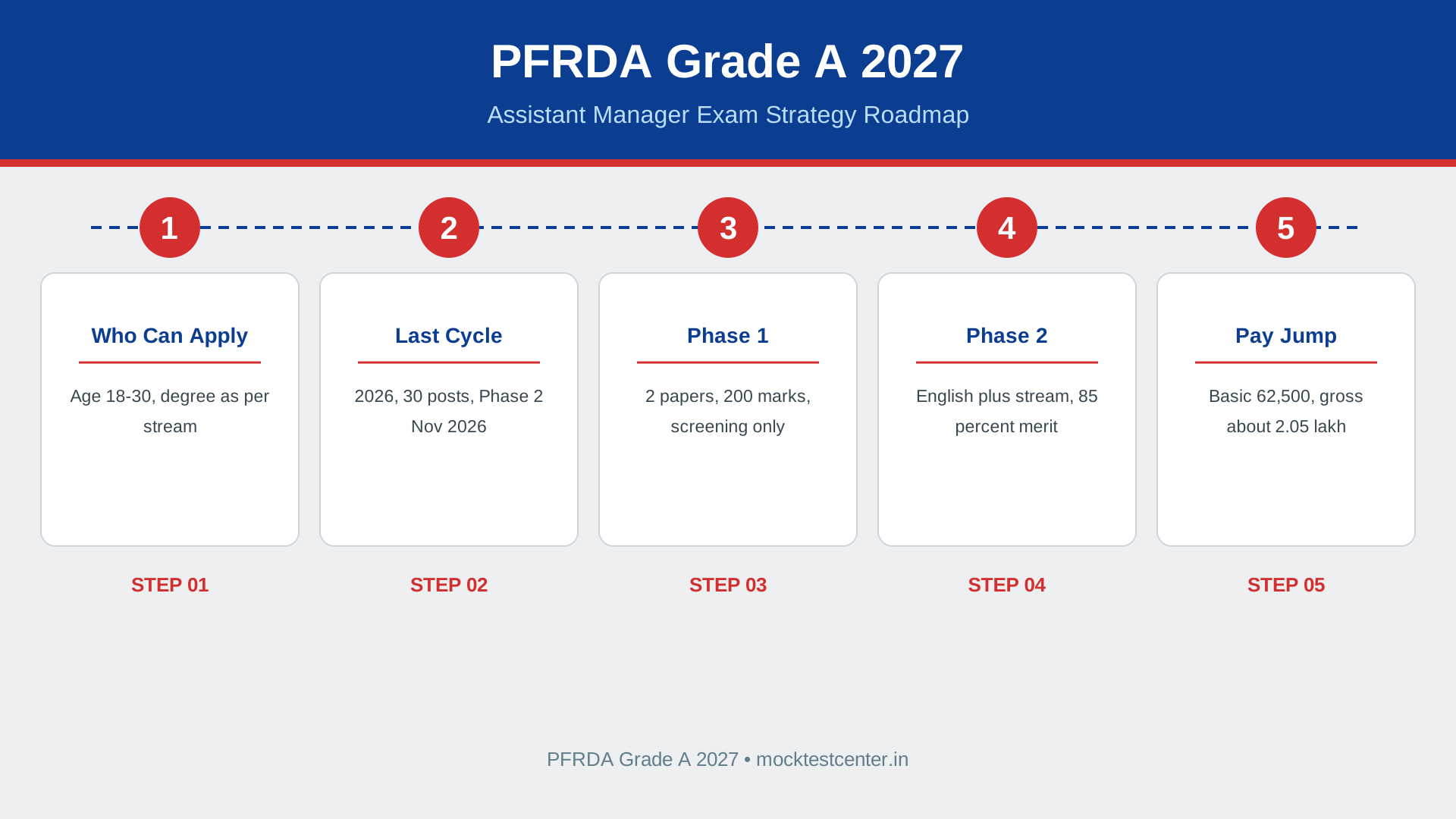
The 2026 cycle ran under Advertisement No. 03/2026, dated 3 September 2026. It offered 30 posts across four streams, took applications from 3 to 24 September 2026, held Phase 1 on 15 October 2026, published the Phase 1 result on 4 November 2026, and set Phase 2 for 20 November 2026, with the admit card out on 12 November 2026.
Three changes stand out. First, the vacancies fell from 40 to 30, and the streams fell from eight to four. Finance and Accounts, Information Technology, Legal, Research (Economics), and Research (Statistics) all disappeared as separate streams in 2026, leaving General, Research, Actuary and Official Language. Second, the application window shrank from 36 days to 22 days. Third, the pay rose sharply. A candidate who prepared from the 2025 notice alone would have studied the wrong stream list and the wrong salary. Always prepare from the latest notice.
One tracker reports that 5,559 candidates were shortlisted from Phase 1 in the 2026 cycle. That figure comes from a single source and was not confirmed against the official result notice in this pass, so treat it as indicative. Even so, it shows the scale. Thirty posts drew enough applicants to leave more than five thousand candidates standing after the first screen.
| Item | 2025 cycle | 2026 cycle |
|---|---|---|
| Advertisement | 01/2025, 29 June 2025 | 03/2026, 3 September 2026 |
| Vacancies | 40 | 30 |
| Streams | 8 | 4 |
| Applications | 2 July to 6 August 2025 | 3 to 24 September 2026 |
| Phase 1 exam | 6 September 2025 | 15 October 2026 |
| Phase 2 exam | 6 October 2025 | 20 November 2026 |
| Starting basic pay | 44,500 rupees | 62,500 rupees |
| Gross per month | About 1,57,000 rupees | About 2,05,000 rupees |
Streams and vacancies
The 2026 cycle has four streams, and the General stream carries almost the whole recruitment. General has 25 of the 30 posts. Research has 2, Actuary has 2, and Official Language, or Rajbhasha, has 1. That single Rajbhasha post went to the OBC category, which tells you how narrow the specialist streams are. A Rajbhasha candidate in 2026 is fighting for one seat in one category.
The category split inside the General stream in 2026 was 9 Unreserved, 7 OBC, 4 SC, 2 ST and 3 EWS, adding to 25. Research had 1 Unreserved and 1 SC. Actuary had 2 Unreserved. The total across all streams was 12 Unreserved, 8 OBC, 5 SC, 2 ST and 3 EWS, adding to 30. Two PwBD posts sit inside the General 25 on a horizontal basis, one for blindness and low vision and one for deaf and hard of hearing.
The 2025 cycle was wider. It had 40 posts across eight streams, with General at 28, and the rest spread across Finance and Accounts, Information Technology, Research (Economics), Research (Statistics), Actuary, Legal and Official Language. The General split in 2025 was 10 Unreserved, 8 OBC, 4 SC, 2 ST and 4 EWS. The total split was 16 Unreserved, 11 OBC, 6 SC, 3 ST and 4 EWS.
Pick your stream by your degree, not by the vacancy count. The General stream has the most posts, but it also has the most applicants. Actuary has 2 posts, but only qualified actuaries can apply, so the real competition is far smaller than the number suggests. The same logic holds for Research and Rajbhasha. A narrow stream with a matching degree beats a wide stream with a mismatched one.
Who can apply
The age rule changed between the two cycles, and the change matters. In 2025, the rule was a maximum of 30 years as on 31 July 2025, which meant candidates had to be born on or after 1 August 1995. No minimum age was stated. In 2026, the rule became 18 to 30 years as on 31 July 2026, which meant candidates had to be born between 1 August 1996 and 31 July 2008, both dates included. The 2026 notice added an explicit lower limit of 18, which the 2025 notice did not carry.
Age relaxation runs as per government rules: 5 years for SC and ST, 3 years for OBC (Non-Creamy Layer), 10 years for PwBD, with the relaxations combining for PwBD candidates from reserved categories, and 5 years for ex-servicemen. The 2026 notice spells out the combined limits, such as 18 to 40 years for General PwBD and 18 to 45 years for SC and ST PwBD. Read the relaxation table in the new notice for your own category, because the combined figures are easy to get wrong.
The education rule depends on the stream. For General, you need a Master degree in any discipline, or a Bachelor degree in Law or Engineering, or a professional qualification such as ACA or FCA from ICAI, ACS or FCS from ICSI, ACMA or FCMA from ICMAI, or CFA from the CFA Institute. For Finance and Accounts, in the 2025 cycle, you needed graduation plus one of those professional qualifications. The Research, Actuary, IT, Legal and Official Language streams each need the matching specialist qualification. The cut off date for the qualification was 31 July 2025 in the 2025 cycle and 31 July 2026 in the 2026 cycle, with the 2026 notice giving 21 July 2026 as the date for one part of the eligibility check. Read the exact dates in the new notice, because the cut off decides whether a final year result counts.
Only Indian citizens can apply. One tracker states that a candidate could apply for a maximum of two streams in the 2025 cycle, with separate applications and fees for each stream. That rule comes from a single source and was not confirmed against the official notice in this pass, so check it in the new notification before you apply twice.
Salary and perks: the 2026 pay revision
The pay revision is the biggest story in this exam, and it deserves a full section. In 2025, the pay scale was 44,500 to 89,150 over 17 years, with increments of 2,500 rupees four times to 54,500, then 2,850 rupees seven times to 74,450, then an efficiency bar, then 2,850 rupees four times to 85,850, then one increment of 3,300 rupees to 89,150. The gross at the minimum of the scale was about 1,57,000 rupees a month, including PFRDA contribution to NPS, Grade Allowance, Special Allowance, Dearness Allowance, Local Allowance, Family Allowance, and housing allowance.
In 2026, the pay scale became 62,500 to 1,26,100 over 17 years: 62,500, then increments of 3,600 rupees four times to 76,900, then 4,050 rupees seven times to 1,05,250, then an efficiency bar, then 4,050 rupees four times to 1,21,450, then one increment of 4,650 rupees to 1,26,100. That is the same scale SEBI pays, rupee for rupee. The gross at the minimum of the scale is now about 2,05,000 rupees a month.
The jump is about 48,000 rupees a month in gross pay, or roughly 30 percent, in a single year. No other regulator on this site has revised pay that fast. Candidates who skipped PFRDA in 2025 because the pay lagged behind SEBI should look again. At 2,05,000 rupees a month, PFRDA now pays more than SEBI at entry, because SEBI gross sits at about 1,84,000 rupees without accommodation.
Officers also get Leave Fare Concession, medical expenses for hospitalisation and otherwise, personal accident insurance, eye refraction and spectacles, education allowance, knowledge updation allowance, a briefcase, conveyance, house cleaning allowance, and a staff furnishing scheme for buying computers. The posting is largely at New Delhi, at the PFRDA head office, though the authority has regional presence too. Probation and service conditions follow the PFRDA rules in the notification.
Phase 1: the screening test
Phase 1 is an online screening examination of two papers, worth 200 marks in total. The marks from this screen stay out of the final merit list. The screen only decides who goes to Phase 2. That single fact should shape your whole preparation. Phase 1 needs a pass, not a top score.
Paper 1 is common to all streams. It has 80 questions for 100 marks in 60 minutes. The four sections carry 25 marks each: English Language, Quantitative Aptitude, Reasoning, and General Awareness including the financial sector. The 2025 sources list the order as English, Quant, Reasoning and General Awareness, which is the same four sections SEBI tests, in a different order.
Paper 2 is stream specific. It has 50 questions for 100 marks in 40 minutes. For the General stream, it covers commerce, accountancy, management, finance, costing, company law, economics, and the pension sector. The pension sector is the part that makes this paper different from SEBI. A SEBI candidate who reuses General stream notes for PFRDA will find pension questions they never studied.
Negative marking is one fourth of a mark per wrong answer in both papers of Phase 1. Separate and aggregate cut offs apply, which means you must clear the cut off in each paper and in the total. A strong Paper 1 cannot rescue a failed Paper 2. Time is tight in both papers, with 45 seconds per question in Paper 1 and 48 seconds per question in Paper 2. Practise with a clock from the first mock test.
Phase 2: where the merit is made
Phase 2 is the mains, and it carries 85 percent of the final merit. The interview carries the other 15 percent. Phase 1 marks play no part at all. If you remember one line from this page, make it that one. Candidates who spend six months polishing Phase 1 and two weeks on Phase 2 have the priorities backwards.
Phase 2 has two papers of 100 marks each. Paper 1 is English, descriptive, to test drafting skills: three questions, 100 marks, 60 minutes. It covers essay, precis and comprehension. Paper 2 is the stream paper: 50 MCQs for 100 marks in 40 minutes. Negative marking of one fourth applies to Paper 2. Paper 1 is evaluated only if the candidate clears the minimum marks in Paper 2, so a weak stream paper can waste a good English score.
The 2025 sources disagree on one detail of Paper 1. One tracker puts the descriptive English paper at 60 marks, while the others put it at 100 marks with three questions. The 100 mark figure matches the Phase 2 structure of two papers of 100 marks each, and it is used on this page. The 60 mark figure is flagged in the notes as a conflict. Either way, the paper tests drafting, which is a working skill at PFRDA, where officers write notes, orders and circulars.
The stream paper in Phase 2 repeats the Phase 1 stream syllabus at a deeper level. For General, that means commerce, accountancy, management, finance, costing, company law, economics and the pension sector. The pension sector questions are the ones that separate PFRDA candidates from SEBI candidates. Know the NPS structure, the role of pension fund managers, the role of the central recordkeeping agency, and the annuity market. The notice lists the pension sector in the syllabus, and the paper follows the notice.
The interview
The interview is the third and last stage. Only candidates who qualify in Phase 2 are called, and the candidate can choose Hindi or English as the medium. The interview carries 15 percent of the final merit, and the final merit is Phase 2 at 85 percent plus the interview at 15 percent.
The interview tests personality, communication, subject knowledge, and awareness of the pension sector. The panel will ask about your stream subject and about pensions. A General stream candidate should be able to explain what NPS is, who regulates it, how a pension fund works, and why pension reform matters in a country with a young workforce and a growing retired population. A candidate who follows pension news for six months before the interview will sound different from one who starts a week before.
The interview also tests your own background. The panel has your application form in front of it, and it will start there. Prepare your education, your work history, and your reasons for choosing PFRDA. A candidate who can explain why pensions, and not banking or the market, will do better than a candidate who gives a generic answer about a government job.
Important dates
These are the 2025 and 2026 dates, the only real dates this page can give. The 2025 cycle ran under Advertisement No. 01/2025, dated 29 June 2025. Applications ran from 2 July to 6 August 2025. Phase 1 was held on 6 September 2025 and Phase 2 on 6 October 2025. The 2026 cycle ran under Advertisement No. 03/2026, dated 3 September 2026. Applications ran from 3 to 24 September 2026. Phase 1 was held on 15 October 2026, the Phase 1 result came on 4 November 2026, the Phase 2 admit card came on 12 November 2026, and Phase 2 is set for 20 November 2026.
Notice the rhythm. Both cycles gave about five weeks between the notification and the end of applications, and about five weeks between the end of applications and Phase 1. A future cycle will probably follow a similar rhythm, with about ten weeks from notification to Phase 1. That gives you a rough planning horizon, but it is not a promise. PFRDA did not recruit every year before 2025. The 2021, 2022 and 2025 cycles show gaps, and the back to back 2025 and 2026 cycles are new.
Do not trust any site that lists 2027 dates today. There is no 2027 notification, no 2027 application window, and no 2027 exam date. Any date you see for 2027 is a guess. Check pfrda.org.in and nothing else for dates.
| Event | 2025 cycle | 2026 cycle | 2027 cycle |
|---|---|---|---|
| Advertisement | 01/2025, 29 June 2025 | 03/2026, 3 September 2026 | Not released |
| Applications | 2 July to 6 August 2025 | 3 to 24 September 2026 | Not announced |
| Phase 1 exam | 6 September 2025 | 15 October 2026 | Not announced |
| Phase 1 result | Not verified | 4 November 2026 | Not announced |
| Phase 2 exam | 6 October 2025 | 20 November 2026 | Not announced |
How to apply
In 2026, applications ran online only, through the careers section on pfrda.org.in. Candidates registered, filled the form, uploaded a photograph and signature, and paid the fee online. The window ran from 3 to 24 September 2026, which is 22 days. The 2025 window ran from 2 July to 6 August 2025, which is 36 days. The shorter window in 2026 caught some candidates out, so apply early when the next notice comes.
The fee in 2025 and 2026 was 1,000 rupees, inclusive of GST, for Unreserved, OBC and EWS candidates. There was no fee for SC, ST, PwBD, ex-servicemen and women candidates. The fee was non refundable, and it had to be paid online by debit card, credit card, net banking, IMPS or mobile wallet. A new cycle will set a new fee, so check it before you pay.
Keep your documents ready before the window opens. You will need your degree certificates and mark sheets, your caste or PwBD certificate if you claim relaxation, and a photo and signature in the sizes the notice asks for. Apply early in the window. The site slows down on the last two days of every PFRDA cycle, and a failed payment on the last day is a common way to lose an exam.
Syllabus: the pension sector
The pension sector is the subject that makes PFRDA different from every other regulatory exam, and it is the subject most candidates neglect. The General stream syllabus lists commerce, accountancy, management, finance, costing, company law, economics, and the pension sector. The last item is the one that decides the paper, because every candidate studies the first seven and few study the eighth.
Start with the structure. PFRDA regulates the National Pension System. Under NPS, subscribers contribute during their working life, pension fund managers invest the money, a central recordkeeping agency keeps the accounts, and at retirement the subscriber takes part of the corpus as a lump sum and buys an annuity with the rest. Know each player and what it does. Know the difference between Tier 1 and Tier 2 accounts. Know who can join NPS and who cannot.
Then read the rules. PFRDA issues regulations on pension fund managers, on investment, on grievance handling, and on the exit and withdrawal rules. Skip memorising regulation numbers. Learn what the rules say and why they exist. The paper asks about the working of the system, not about the numbering of the regulations.
Read the PFRDA annual report. It is free, it is official, and it gives you the language the paper uses. The report sets out subscriber numbers, fund performance, and the issues PFRDA is working on. A candidate who reads the latest annual report can answer questions that a candidate who only reads a guidebook cannot, because the paper often follows the report.
Syllabus: the General stream
The General stream paper covers commerce, accountancy, management, finance, costing, company law, economics and the pension sector. That is a wide field, and candidates from non commerce backgrounds find it the hardest part of the exam. A post graduate in history or science can clear Phase 1, then hit a wall in the stream paper.
Start with the basics and build in order. Learn how a company account is read, what a balance sheet shows, how costing works, and what the Companies Act says about directors, meetings and audit. Then move to finance: time value of money, capital budgeting, working capital, and the capital market. Then economics: growth, inflation, fiscal and monetary policy, and the financial sector. The pension sector sits on top of all of it, so read the PFRDA material as you go.
The General Awareness section of Phase 1 also leans towards the financial sector. Questions on the financial sector are set at an easy to moderate level, but they still need regular reading. Follow the RBI monetary policy, the Union Budget, and PFRDA press releases. A candidate who reads one financial newspaper daily will cover most of this section without extra effort.
A preparation plan that fits this exam
PFRDA preparation has a clear order, and the order is set by the weight of the papers. Phase 2 carries the merit, and inside Phase 2 the stream paper carries the same weight as English. So the stream paper and the pension sector come first, descriptive English second, and Phase 1 third. Candidates who reverse that order spend their best months on the paper that counts least.
Months one and two are for the stream subject and the pension sector. A General stream candidate should cover commerce and accountancy first, then finance and company law, then economics, then the pension sector. Read the PFRDA annual report in these two months, while you have time to absorb it. Study two to three hours a day, and make short notes as you go. Notes you write yourself are worth more than notes you download.
Months three and four are for English and for Phase 1. Start writing one essay a week, typed, in 45 minutes, on a pension or economic topic. Practise precis writing, which most candidates never do until the exam hall. Alongside that, revise reasoning, quant and English for Phase 1, and read a financial newspaper daily. Take one Phase 1 mock test every two weeks.
Months five and six are for tests. Take one full Phase 2 mock test every week, with the descriptive paper typed under time pressure. Analyse every wrong answer in the stream paper. In the last month, take two Phase 1 mock tests a week as well, because Phase 1 is a speed test and speed needs recent practice. Stop learning new topics in the last week. Revise your notes and your error list instead.
One habit matters more than any book. Follow pension news. Read PFRDA press releases, read one story a day about NPS or retirement savings, and note the numbers involved. The interview panel will ask about pensions, and a candidate who follows the sector sounds like a future officer. A candidate who does not sounds like a student.
Mistakes that cost candidates this exam
The first mistake is preparing from the 2025 notice when the 2026 notice is live. The streams changed, the vacancies changed, the window shrank, and the pay jumped. A candidate who studied Finance and Accounts from the 2025 stream list wasted weeks on a stream that did not exist in 2026. Always prepare from the latest notice.
The second mistake is treating Phase 1 as the exam. It is a screen, not the merit. Candidates who score high in Phase 1 and low in Phase 2 lose to candidates who score just enough in Phase 1 and high in Phase 2. Put your hours where the marks are.
The third mistake is ignoring the pension sector. It is listed in the syllabus, it is the core of PFRDA work, and it is the subject most candidates skip. A few weeks on NPS structure and PFRDA regulations can move your stream paper score by a margin that decides the final list.
The fourth mistake is ignoring descriptive English. It carries 100 marks in Phase 2, the same as the stream paper, and it is the paper most candidates never practise. An essay written once a week for six months is worth more than a month of reading about essay writing. Type your practice, because the exam is typed.
The fifth mistake is waiting for the notification to start. PFRDA gave 22 days to apply in 2026 and about five weeks from the end of applications to Phase 1. That is not enough to build a stream subject from scratch. Start now, while the notice is still absent. If the notice never comes this year, your preparation still helps in SEBI, RBI and every other regulatory exam.
PFRDA and the other regulators
PFRDA now pays the most at entry of any regulator on this site, at about 2,05,000 rupees a month gross, ahead of SEBI at about 1,84,000 rupees. That changes the calculation for every candidate who picks a regulator by pay. But pay is not the only factor. SEBI has 110 posts in its last cycle against PFRDA 30, so SEBI gives you more seats to aim at. RBI Grade B carries a wider mandate and a larger organisation. NABARD Grade B suits candidates with three years of rural banking experience.
The exam shapes overlap heavily. PFRDA, SEBI and RBI all use Phase 1, Phase 2 and an interview, with Phase 2 and the interview deciding the merit in the same 85 and 15 split. A candidate who prepares for PFRDA will find the general sections of SEBI and RBI familiar, and the stream papers overlap in commerce, finance and economics. The smart move is to prepare for two regulators at once, not five. Pick PFRDA and one more, and let the overlap do the work.
Other regulatory exams on this site
PFRDA Grade A is one of eleven regulatory exams covered on this site. If the age limit or the stream rule shuts you out here, another regulator may fit you better. See RBI Grade B 2027, RBI Grade B DEPR 2027, NABARD Grade A 2027, NABARD Grade B 2027, SEBI Grade A 2027, IRDAI Assistant Manager 2027, SIDBI Grade A 2027, IFSCA Grade A 2027, FSSAI Technical Officer 2027 and FSSAI Assistant 2027 on this site. SEBI Grade A is the closest match to this exam in pattern and pay, and RBI Grade B is the closest match in prestige.
Where to start this week
Start with three small steps. First, check your age and your degree against the 2026 rules, and write down whether you qualify today and in which stream. Second, open pfrda.org.in, go to the careers page, and read the 2026 advertisement for yourself, so you know what the latest notice actually says. Third, read one PFRDA press release and write a 200 word summary of it by hand. That is enough to begin. The exam rewards candidates who start early and stay steady, and with 30 seats on offer, steady is the only way in.