
About SEBI Grade A 2027 Exam Series
📖 Table of Contents
- What this exam is
- The 2025 cycle in numbers
- Streams and vacancies
- Who can apply
- Salary and perks
- Phase 1: the screening test
- Phase 2: where the merit is made
- The interview
- Cut offs: what the 2025 cycle tells us
- Syllabus: the General stream
- Syllabus: the specialist streams
- Important dates
- How to apply
- A preparation plan that fits this exam
- Mistakes that cost candidates this exam
- SEBI and the other regulators
- Other regulatory exams on this site
- Where to start this week
SEBI Grade A 2027
What this exam is
SEBI Grade A is the recruitment exam for Officer Grade A, or Assistant Manager, at the Securities and Exchange Board of India. SEBI regulates the securities market in India. It protects investors, it registers and regulates stock exchanges, brokers, mutual funds and listed companies, and it acts when the market breaks its own rules. An Assistant Manager at SEBI works inside that mandate from the first day.
The post pays the most of any regulatory exam on this site. The starting basic is 62,500 rupees a month, and the gross at Mumbai runs to about 1,84,000 rupees a month without official accommodation. That figure is from the 2025 notification, and it is the reason this exam draws applications from engineers, lawyers, chartered accountants and post graduates in the same pool.
The latest cycle is the 2025 cycle, and it is already complete. The detailed notification came on 30 October 2025, Phase 1 ran on 10 January 2026, Phase 2 ran on 21 February 2026, interviews ran in May and June 2026, and SEBI published the final list of selected candidates on 23 June 2026. There is no 2026 notification as of November 2026, and no 2027 notification either. Everything on this page about dates, vacancies and pattern comes from the 2025 cycle, and the 2027 cycle will follow only when SEBI announces it. Check sebi.gov.in for the next notice.
The 2025 cycle in numbers
The 2025 cycle opened with a short intimation notice on 8 October 2025, then the detailed notification on 30 October 2025. Applications ran from 30 October to 28 November 2025. That gave candidates 30 days to apply, which is a normal window for SEBI, neither generous nor tight.
The vacancy figure needs a straight answer, because the sources disagree. Most trackers, including the ones that quote the notification stream by stream, say 110 posts. The stream break up adds to 110 exactly: General 56, Legal 20, Information Technology 22, Research 4, Official Language 3, Engineering (Electrical) 2, and Engineering (Civil) 3. A few sites say 135 posts, but none of them shows a stream break up that adds to 135. This page uses 110, because the break up is checkable and it adds up. The 135 figure is flagged in the notes as a conflict. If you see 135 on another site, ask it for the stream table.
One tracker reports 86,588 applicants for the 2025 cycle. That figure comes from a single source and was not confirmed against a SEBI document in this pass, so treat it as indicative. Even if the exact number is off, the shape is right. SEBI Grade A draws tens of thousands of applicants for about a hundred seats, and the General stream carries most of that crowd.
Phase 1 was held on 10 January 2026 and Phase 2 on 21 February 2026. Interview call letters went out on 17 April 2026, and the final result came on 23 June 2026. The whole cycle took about eight months from notification to final list. A future cycle will probably take a similar length of time.
Streams and vacancies
SEBI recruits by stream, and your stream decides your syllabus, your Paper 2, and your competition. The General stream is the big one, with 56 of the 110 posts in 2025. It takes post graduates from any discipline, plus law and engineering graduates and professional accountants, so it draws the widest crowd. The Legal stream had 20 posts, the IT stream 22, Research 4, Official Language 3, and the two engineering streams 2 and 3.
Pick your stream by your degree, not by the vacancy count. The General stream has the most posts, but it also has the most applicants, and its Paper 2 covers commerce, accountancy, management, finance, costing, company law and economics. A law graduate will do better in the Legal stream with 20 posts than in General with 56, because the Legal Paper 2 tests what a law graduate already knows. The same logic holds for IT graduates and engineers.
You can apply for more than one stream in some cycles, but each stream needs a separate application and a separate fee. Read the notice on this point before you pay twice. The 2025 sources do not agree on the exact rule, so this page will not state it as a fact. Check the new notification when it comes.
The category split inside each stream is given in the notification. For the General stream in 2025, the split was 23 Unreserved, 14 OBC, 10 SC, 4 ST and 5 EWS, adding to 56. The total across all streams was 48 Unreserved, 24 OBC, 20 SC, 8 ST and 9 EWS, adding to 110. Read your own row in the new notice. The total tells you very little about your own chances.
| Stream | Posts in 2025 | Who it fits |
|---|---|---|
| General | 56 | Post graduates, law and engineering graduates, CA, CFA, CS, CMA |
| Legal | 20 | Law graduates |
| Information Technology | 22 | IT and computer graduates |
| Research | 4 | Economics, finance and statistics post graduates |
| Official Language | 3 | Hindi language post graduates |
| Engineering (Electrical) | 2 | Electrical engineering graduates |
| Engineering (Civil) | 3 | Civil engineering graduates |
| Total | 110 | Seven streams |
Who can apply
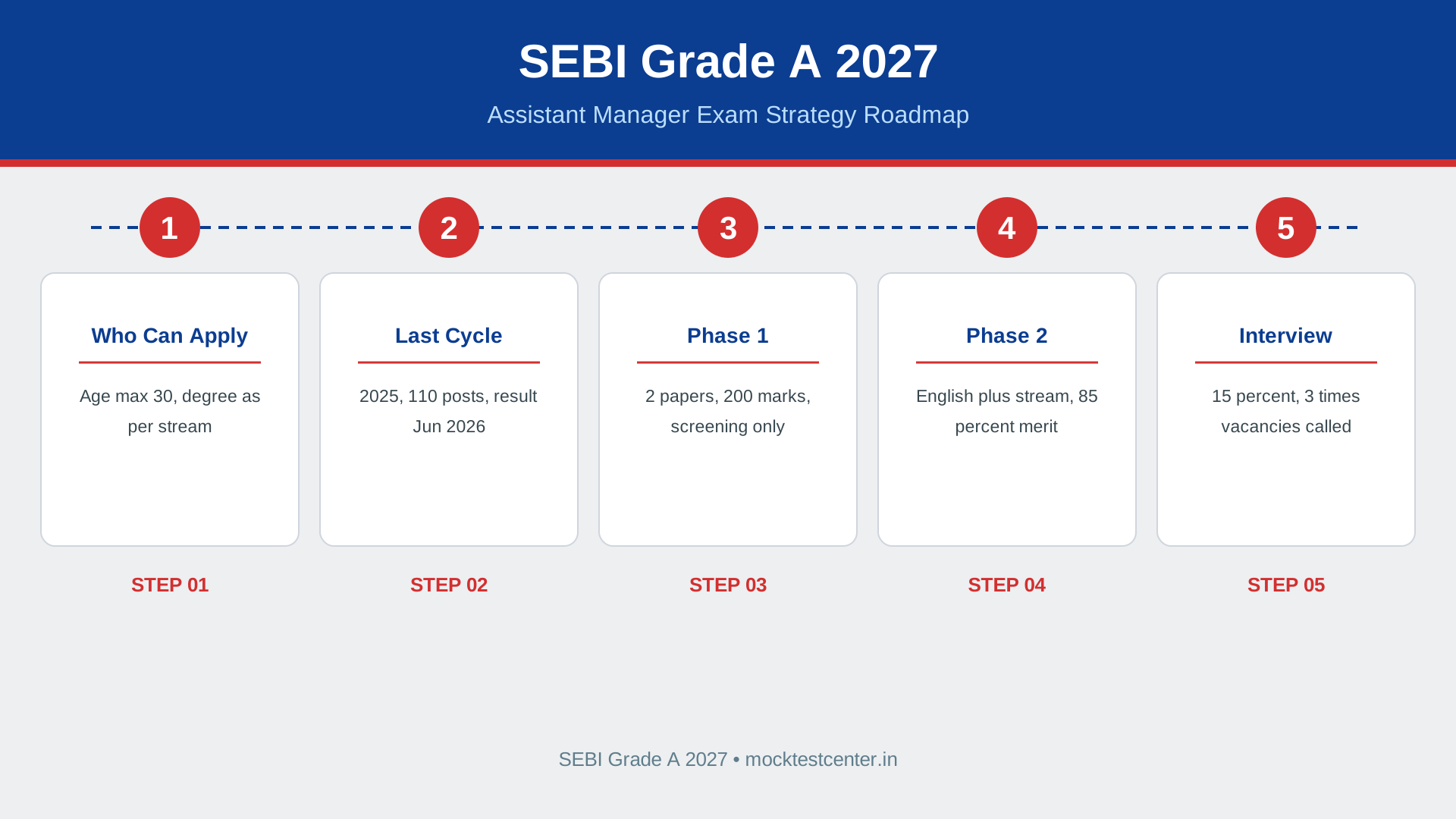
The age rule is simple and strict. You must not have exceeded 30 years of age on the cut off date fixed in the notification. In the 2025 cycle the cut off was 30 September 2025, which meant candidates had to be born on or after 1 October 1995. There is no minimum age stated in the 2025 sources, only the upper limit of 30. Age relaxation runs as per government rules: 3 years for OBC (Non-Creamy Layer), 5 years for SC and ST, and 10 years for PwBD candidates.
The education rule depends on the stream, and the General stream is the most flexible. For General, you need a Master degree or a post graduate diploma of at least two years in any discipline, or a Bachelor degree in Law or Engineering, or a professional qualification such as CA, CFA, CS or Cost Accountant. No minimum percentage is prescribed for the General stream, which is unusual among regulators and worth knowing.
The Research stream needs a Master degree or a post graduate diploma of at least two years in Economics, Commerce, Business Administration, Econometrics, Finance, Statistics, Data Science, or a closely related discipline. The Legal stream needs a Bachelor degree in Law. The IT and engineering streams need the matching engineering degree. The Official Language stream needs the Hindi language qualification the notification prescribes. Read the exact qualification line for your stream in the new notice, because a near match does not count.
Only Indian citizens can apply. Your qualifying degree must be complete by the cut off date in the notification. Candidates in their final year should read the notice with care, because SEBI sets the result date rule in the advertisement itself.
Salary and perks
The pay is the headline of this exam, and the 2025 notification revised it upward by a large step. The starting basic pay is 62,500 rupees a month, up from 44,500 rupees in the earlier cycle. That is a rise of about 40 percent, and it moved SEBI to the top of the regulatory pay table.
The pay scale runs from 62,500 to 1,26,100 over 17 years: 62,500, then increments of 3,600 rupees four times to 76,900, then increments of 4,050 rupees seven times to 1,05,250, then an efficiency bar, then increments of 4,050 rupees four times to 1,21,450, then one increment of 4,650 rupees to 1,26,100. The increments are fixed, so your pay path is predictable for the first 17 years.
The gross monthly emoluments at Mumbai, at the minimum of the scale, are about 1,84,000 rupees without accommodation and about 1,43,000 rupees with SEBI accommodation. The gross includes SEBI contribution to the National Pension System, Dearness Allowance, Grade Allowance, Special Allowance, Local Allowance, Family Allowance, and other allowances. The annual cost to company works out to roughly 22 to 24 lakh rupees, according to one tracker.
Officers also get Leave Fare Concession, medical expenses, a learning and knowledge allowance, conveyance, and a subsidised lunch facility. Probation lasts two years. The posting is largely at Mumbai, at SEBI Bhavan in Bandra Kurla Complex, though SEBI has regional offices too. Candidates who want a posting in their home state should know that Mumbai is where most of the work sits.
Phase 1: the screening test
Phase 1 is an online screening examination of two papers, worth 200 marks in total. Its marks do not count in the final merit. It only decides who goes to Phase 2. That single fact should shape your whole preparation. Phase 1 needs a pass, not a top score.
Paper 1 is common to all streams. It has 80 questions for 100 marks in 60 minutes. The four sections carry 25 marks each: General Awareness, including some questions on the financial sector, English Language, Quantitative Aptitude, and Reasoning Ability. The cut off for Paper 1 is 30 percent.
Paper 2 is stream specific. It has 50 questions for 100 marks in 40 minutes. The cut off for Paper 2 is 40 percent, and the aggregate cut off across both papers is 40 percent. Negative marking is one fourth of a mark per wrong answer. That means a wrong answer in Paper 2 costs more than a wrong answer in Paper 1, because each Paper 2 question carries 2 marks.
Time is the real test in Phase 1. Paper 1 gives you 45 seconds per question on average, and Paper 2 gives you 48 seconds per question. Candidates who practise untimed study fail here even when they know the material. Take every mock test with a clock running, and learn to leave a question after 45 seconds if it is not moving.
| Phase 1 paper | Questions | Marks | Time | Cut off |
|---|---|---|---|---|
| Paper 1 (common) | 80 | 100 | 60 min | 30 percent |
| Paper 2 (stream) | 50 | 100 | 40 min | 40 percent |
| Total | 130 | 200 | 100 min | 40 percent aggregate |
Phase 2: where the merit is made
Phase 2 is the mains, and it carries 85 percent of the final merit. The interview carries the other 15 percent. Phase 1 marks play no part at all. If you remember one line from this page, make it that one. Candidates who spend six months polishing Phase 1 and two weeks on Phase 2 have the priorities backwards.
Phase 2 has two papers of 100 marks each. Paper 1 is Descriptive English, common to all streams: an essay, a precis, and comprehension, in 60 minutes. Its cut off is 30 percent, and it carries one third of the Phase 2 weight. Paper 2 is the stream paper, worth 100 marks with a 40 percent cut off, and it carries two thirds of the Phase 2 weight. The aggregate cut off for Phase 2 is 50 percent.
The General stream Paper 2 is a set of MCQs on commerce, accountancy, management, finance, costing, company law and economics, in 90 minutes. The Legal stream Paper 2 mixes MCQs with descriptive questions. The IT stream Paper 2 includes a coding test. The Research stream Paper 2 is practical in nature. The exact format differs by stream, so read the paper pattern for your stream in the notification instead of borrowing another stream plan.
Negative marking of one fourth applies to the MCQs in Phase 2. The descriptive parts have no negative marking. Paper 1 of Phase 2 is evaluated only for candidates who clear the Paper 2 cut off in some cycles, so a weak stream paper can waste a good English score. The order of evaluation matters, and the notice states it. Read it.
One source in this pass gave a different final weight, Phase 2 at 80 percent and the interview at 20 percent. That figure comes from a single tracker, and it conflicts with the official advertisement, which states 85 percent for Phase 2 and 15 percent for the interview, a split confirmed by several trackers that quote the advertisement page directly. This page uses 85 and 15, and flags the 80 and 20 figure as an error in that one tracker.
The interview
About three candidates per vacancy are called for the interview, in order of Phase 2 merit. For 110 posts, that meant roughly 330 candidates reached the interview stage in the 2025 cycle. The interview carries 15 percent of the final merit, and the candidate can choose Hindi or English as the medium.
Inside that 15 percent, the split is worth knowing. The interview itself carries 11.25 marks, and relevant post qualification work experience carries up to 3.75 marks. But the experience marks apply only to the Legal and Engineering (Electrical) streams, not to every stream. General stream candidates get the full 15 from the interview alone. Candidates in Legal and Electrical should bring proof of relevant experience, because 3.75 marks is a large margin in a final list where the cut offs sit close together.
The interview tests domain knowledge, securities market awareness, current affairs, communication, and personality. The panel will ask about your stream subject and about the market. A General stream candidate should be able to talk about a recent SEBI order, a market event, and the basics of the Companies Act. A Legal candidate should know the SEBI Act and the securities laws. A candidate who follows the market for six months before the interview will sound different from one who starts a week before.
The final merit list comes from Phase 2 at 85 percent and the interview at 15 percent. SEBI published the final list of selected candidates for the 2025 cycle on 23 June 2026, and the cut off figures reported for that cycle are set out in the next section.
Cut offs: what the 2025 cycle tells us
SEBI sets minimum percentages for each paper, and then the actual cut offs move with the competition. The minimums are fixed: 30 percent in Phase 1 Paper 1, 40 percent in Phase 1 Paper 2, 40 percent aggregate in Phase 1, then 30 percent in Phase 2 Paper 1, 40 percent in Phase 2 Paper 2, and 50 percent aggregate in Phase 2. Those are floors, not targets. Clearing a floor only keeps you in the race.
The reported cut offs for the 2025-26 cycle, for the General category in the General stream, were 66.50 out of 100 in Phase 2 and 70.285 out of 100 in the final merit. Those figures come from a single tracker that compiled them from SEBI published result documents, and they were not checked against the official result PDF in this pass, so treat them as indicative. Even so, they tell a useful story. The gap between the Phase 2 cut off and the final cut off is only about 3.8 marks, which means interview scores clustered tightly. A strong interview helps, but it rarely rescues a weak Phase 2.
The lesson is plain. Phase 2 decides the result. The interview moves it by a few marks. Put your hours into the stream paper, because it carries two thirds of Phase 2, and into descriptive English, because it carries the other third. A candidate who scores 75 in Phase 2 and average in the interview beats a candidate who scores 65 in Phase 2 and shines in the interview.
Syllabus: the General stream
The General stream Paper 2 covers commerce, accountancy, management, finance, costing, company law and economics. That is a wide field, and candidates from non commerce backgrounds find it the hardest part of the exam. A post graduate in history or science can clear Phase 1, then hit a wall in the General Paper 2.
Start with the basics and build in order. Learn how a company account is read, what a balance sheet shows, how costing works, and what the Companies Act says about directors, meetings and audit. Then move to finance: time value of money, capital budgeting, working capital, and the capital market. Then economics: growth, inflation, fiscal and monetary policy, and the financial sector. The securities market sits on top of all of it, so read SEBI own material on the market as you go.
The General Awareness section of Phase 1 also leans towards the financial sector. Questions on the financial sector are set at an easy to moderate level, but they still need regular reading. Follow the RBI monetary policy, the Union Budget, and SEBI own press releases. A candidate who reads one financial newspaper daily will cover most of this section without extra effort.
Syllabus: the specialist streams
The Legal stream Paper 2 tests the laws that SEBI works with. The SEBI Act 1992 is the base, then the Securities Contracts (Regulation) Act, the Depositories Act, and the Companies Act. Add the securities market regulations, insider trading, takeover rules, and the case law that shapes them. A law graduate who has read these Acts will find the paper familiar. A law graduate who only read constitutional law will not.
The IT stream Paper 2 tests computer science and information technology, and it includes a coding test in Phase 2. The syllabus covers data structures, databases, operating systems, networking, and software engineering, plus the technology of the securities market. Practise coding under time pressure, because the coding test is the part IT candidates most often underprepare.
The Research stream Paper 2 is practical. It tests economics, statistics, econometrics and finance through data and problems, not through definitions. A candidate with a strong statistics base has an edge here. The Official Language stream tests Hindi language, translation, and official language policy. The engineering streams test the core subjects of electrical or civil engineering, plus the role of engineers in a market regulator, which is mostly about infrastructure, systems and project appraisal.
Whichever stream you pick, read the detailed syllabus in the notification. The notification is the only syllabus that counts, and coaching sites summarise it with errors. The 2025 notification ran to many pages, and its syllabus section is the document your preparation should follow.
Important dates
These are the 2025 cycle dates, the only real dates this page can give. The short intimation came on 8 October 2025. The detailed notification came on 30 October 2025. Applications ran from 30 October to 28 November 2025. Phase 1 was held on 10 January 2026. Phase 2 was held on 21 February 2026. Interview call letters went out on 17 April 2026, interviews ran in May and June 2026, and the final list of selected candidates was published on 23 June 2026.
There is no 2026 notification as of November 2026. One tracker notes that a SEBI reply to a Right to Information query in January 2026 confirmed that no new Grade A cycle had been initiated at that point. That is a single sourced claim, but it fits the silence on the careers page. SEBI does not recruit for Grade A every year, so a gap year is normal.
Do not trust any site that lists 2027 dates today. There is no 2027 notification, no 2027 application window, and no 2027 exam date. Any date you see for 2027 is a guess. Check sebi.gov.in and nothing else for dates.
| Event | 2025 cycle | 2027 cycle |
|---|---|---|
| Short intimation | 8 October 2025 | Not released |
| Detailed notification | 30 October 2025 | Not released |
| Applications | 30 October to 28 November 2025 | Not announced |
| Phase 1 exam | 10 January 2026 | Not announced |
| Phase 2 exam | 21 February 2026 | Not announced |
| Final result | 23 June 2026 | Not announced |
How to apply
In 2025, applications ran online only, through the careers section on sebi.gov.in. Candidates registered, filled the form, uploaded a photograph and signature, and paid the fee online. The window ran from 30 October to 28 November 2025.
The fee in 2025 was 1,000 rupees plus 18 percent GST for Unreserved, OBC and EWS candidates, as application fee plus intimation charges. For SC, ST and PwBD candidates it was 100 rupees plus 18 percent GST, as intimation charges only. The fee was non refundable, and it had to be paid online. A new cycle will set a new fee, so check it before you pay.
Keep your documents ready before the window opens. You will need your degree certificates and mark sheets, your caste or PwBD certificate if you claim relaxation, proof of relevant experience if you are in the Legal or Electrical stream, and a photo and signature in the sizes the notice asks for. Apply early in the window. The site slows down on the last two days of every SEBI cycle, and a failed payment on the last day is a common way to lose an exam.
A preparation plan that fits this exam
SEBI preparation has a clear order, and the order is set by the weight of the papers. Phase 2 carries the merit, and inside Phase 2 the stream paper carries two thirds. So the stream paper comes first, descriptive English second, and Phase 1 third. Candidates who reverse that order spend their best months on the paper that counts least.
Months one and two are for the stream subject. A General stream candidate should cover commerce and accountancy first, then finance and company law, then economics. A Legal candidate should read the SEBI Act and the securities laws in full. An IT candidate should revise core computer science and start coding practice. Study two to three hours a day, and make short notes as you go. Notes you write yourself are worth more than notes you download.
Months three and four are for English and for Phase 1. Start writing one essay a week, typed, in 45 minutes, on a market or economic topic. Practise precis writing, which most candidates never do until the exam hall. Alongside that, revise reasoning, quant and English for Phase 1, and read a financial newspaper daily. Take one Phase 1 mock test every two weeks.
Months five and six are for tests. Take one full Phase 2 mock test every week, with the descriptive paper typed under time pressure. Analyse every wrong answer in the stream paper. In the last month, take two Phase 1 mock tests a week as well, because Phase 1 is a speed test and speed needs recent practice. Stop learning new topics in the last week. Revise your notes and your error list instead.
One habit matters more than any book. Follow the market. Read SEBI press releases, read one market story a day, and note the names of the regulations involved. The interview panel will ask about the market, and a candidate who follows it sounds like a future officer. A candidate who does not sounds like a student.
Mistakes that cost candidates this exam
The first mistake is treating Phase 1 as the exam. It is a screen, not the merit. Candidates who score 150 in Phase 1 and 55 in Phase 2 lose to candidates who score 110 in Phase 1 and 70 in Phase 2. Put your hours where the marks are.
The second mistake is picking the General stream for the wrong reason. General has the most posts, but it also has the most applicants, and its Paper 2 tests commerce subjects that many post graduates have never studied. A law graduate in the Legal stream or an engineer in the IT stream faces a smaller crowd and a paper built for their degree. Pick the stream that fits your degree.
The third mistake is ignoring descriptive English. It carries one third of Phase 2, and it is the paper most candidates never practise. An essay written once a week for six months is worth more than a month of reading about essay writing. Type your practice, because the exam is typed.
The fourth mistake is guessing wildly in Paper 2 of Phase 1. Each question there carries 2 marks, so a wrong answer costs half a mark. Guess only when you can eliminate two options. Leave the rest.
The fifth mistake is waiting for the notification to start. SEBI does not recruit every year, and when the notice comes, the window to Phase 1 is about ten weeks. Ten weeks is not enough to build a stream subject from scratch. Start now, while the notice is still absent. If the notice never comes this year, your preparation still helps in RBI, PFRDA and every other regulatory exam.
SEBI and the other regulators
SEBI pays the most, but it is not the only regulator worth your time. RBI Grade B carries the same prestige and a wider mandate, and its ESI and ARD papers overlap with the reading a SEBI General candidate does. PFRDA Grade A pays nearly as well after its 2026 pay revision, and its exam shape is almost the same as SEBI, with Phase 1, Phase 2 and an interview in the same 85 and 15 split. NABARD Grade B suits candidates with three years of rural banking experience. IRDAI, SIDBI, IFSCA and FSSAI each run their own Grade A exams, and a candidate who prepares for SEBI will find the general sections of those exams familiar.
The smart move is to prepare for two regulators at once, not five. Pick SEBI and one more, and let the overlap do the work. Five exams at once means five syllabuses, five patterns, and no depth in any of them. Two exams, prepared well, beat five exams prepared thinly.
Other regulatory exams on this site
SEBI Grade A is one of eleven regulatory exams covered on this site. If the age limit or the stream rule shuts you out here, another regulator may fit you better. See RBI Grade B 2027, RBI Grade B DEPR 2027, NABARD Grade A 2027, NABARD Grade B 2027, PFRDA Grade A 2027, IRDAI Assistant Manager 2027, SIDBI Grade A 2027, IFSCA Grade A 2027, FSSAI Technical Officer 2027 and FSSAI Assistant 2027 on this site. PFRDA Grade A is the closest match to this exam in pattern and pay, and RBI Grade B is the closest match in prestige.
Where to start this week
Start with three small steps. First, check your age against the 2025 cut off rule, and write down whether you qualify today and in which stream. Second, open sebi.gov.in, go to the careers page, and confirm for yourself that no Grade A notice is live. Third, read one SEBI press release and one market story today, and write a 200 word summary of each by hand. That is enough to begin. The exam rewards candidates who start early and stay steady, and with 110 seats on offer, steady is the only way in.







