
About RBI Grade B DEPR 2027 Exam Series
📖 Table of Contents
- What DEPR means
- The 2025 cycle, step by step
- Who can apply for DEPR
- How DEPR selection differs from General
- Phase 1: two papers, 200 marks
- Phase 2: two descriptive papers, 200 marks
- The interview, and how the final list is made
- What the job looks like after selection
- The syllabus, paper by paper
- Why DEPR is harder than it looks
- A six-month plan for an economics graduate
- Books and sources that actually help
- Mistakes that cost DEPR candidates a year
- The DEPR papers and the General papers, side by side
- How to use mock tests
- What to check on the day the notice comes out
RBI Grade B DEPR 2027
What DEPR means
DEPR stands for the Department of Economic and Policy Research. It is the research arm of the Reserve Bank of India. Officers in the DEPR stream do economic research, analyse data, write reports and feed policy work. They do not do the same job as General stream officers. A General stream officer rotates across departments. A DEPR officer works on economics, and the whole selection is built around that one fact.
The 2025 notification, advertisement RBISB/DA/03/2025-26, offered 17 DEPR posts out of 120 Grade B posts. The 2026 notification, advertisement RBISB/DA/01/2026-27 dated 29 April 2026, offered 10 DEPR posts out of 60. The DEPR intake is small, and it stays small. Seventeen posts in a good year is the scale you are competing at. Plan for that.
The pay is the same as the General stream. Starting basic pay is 78,450 rupees a month in the scale 78450-4050(9)-114900-EB-4050(2)-123000-4650(4)-141600. The 2026 advertisement puts initial gross emoluments at about 1,54,936 rupees a month without house rent allowance. Older pages quote 1,50,374 rupees and a few quote 1,16,000 rupees. Those figures come from earlier dearness allowance rates, so they no longer match the current advertisement. The basic pay figure is the one that stays fixed.
No notification for the 2027 cycle has been released as of 19 November 2026. One coaching site expects the 2027 notice around February 2027, citing the RBI annual calendar. That is an expectation, not a fact, and this page gives no 2027 dates. Everything dated below comes from the 2025 and 2026 cycles.
The 2025 cycle, step by step
The 2025 DEPR cycle ran on the same advertisement as the General stream. The detailed notification came on 10 September 2025. Applications ran from 10 to 30 September 2025, closing at 6 pm on the last day. Candidates applied separately for each stream on the RBI opportunities portal, and DEPR needed its own application even if the same candidate also applied for General.
Phase 1 for DEPR and DSIM was held on 19 October 2025. Phase 2 for DEPR and DSIM was held on 7 December 2025. The General stream sat Phase 1 on 18 October 2025 and Phase 2 on 6 December 2025, so the specialist streams ran a day later in each phase. The Phase 1 result for 2025 was declared on 14 November 2025, as per secondary reporting.
For the 2026 cycle, the notification came on 29 April 2026 with 10 DEPR posts. Applications ran from 29 April to 20 May 2026. One secondary source puts the DEPR Phase 1 exam on 13 June 2026. The Phase 2 date for the 2026 cycle was not verified in this pass, so it is left out rather than guessed.
| Item | 2025 cycle | 2026 cycle |
|---|---|---|
| Advertisement | RBISB/DA/03/2025-26 | RBISB/DA/01/2026-27 |
| Notification | 10 Sep 2025 | 29 Apr 2026 |
| Applications | 10 to 30 Sep 2025 | 29 Apr to 20 May 2026 |
| DEPR posts | 17 | 10 |
| Total Grade B posts | 120 | 60 |
| Phase 1 | 19 Oct 2025 | 13 Jun 2026 [S] |
| Phase 2 | 7 Dec 2025 | Not verified in this pass |
Applications go in online only, through opportunities.rbi.org.in. The main RBI site is rbi.org.in. The detailed advertisement, the information handout and the admit card all live on the opportunities portal.
Who can apply for DEPR
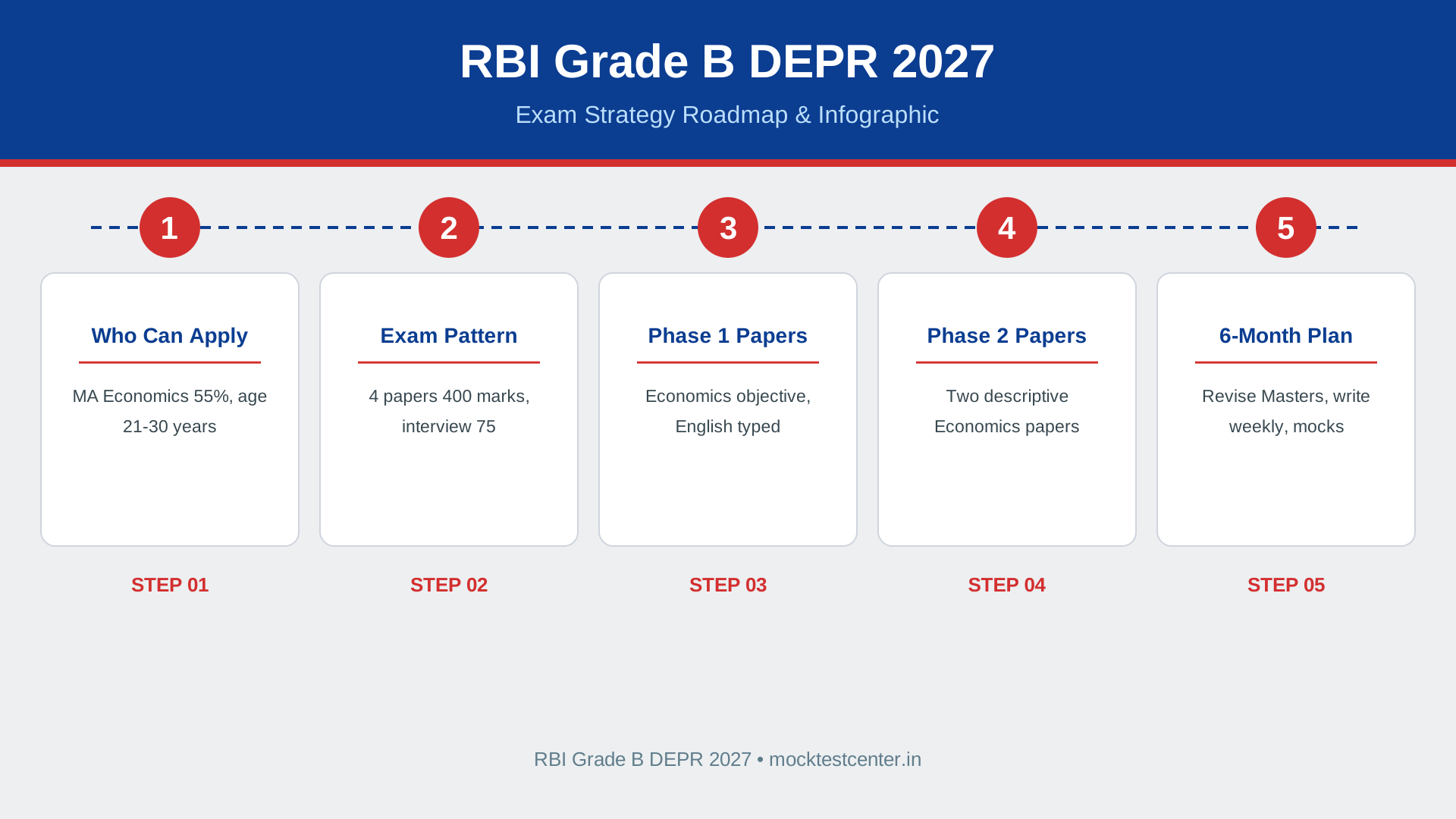
DEPR needs a post-graduation in economics or finance. The advertisement asks for a Master degree in Economics, Econometrics, Quantitative Economics, Mathematical Economics, Finance or a related field, with at least 55 percent marks. SC, ST and PwBD candidates need 50 percent. An MBA or PGDM in Finance with 55 percent also qualifies. The degree must come from a recognised university, and at least half of the courses, including electives, must be in economics or finance.
A plain graduation in economics falls short of the bar. That surprises many candidates, and it surprises them late. The bar is a Master degree, and the 55 percent bar sits on top of it. A candidate with a graduation in economics and a Master degree in another subject should check the advertisement line by line, because the Master degree subject is what counts.
A PhD in economics or finance is listed as desirable, not essential. Research or teaching experience in economics, and publications in standard journals, are also listed as desirable. Desirable means the panel may ask about it at the interview, and it may help there. It does not add marks to the written papers.
Age is 21 to 30 years on the reference date fixed in the advertisement. For the 2025 cycle the reference date was 1 September 2025. For the 2026 cycle the reference date was 1 April 2026, which meant candidates born between 2 April 1996 and 1 April 2005. One secondary source prints 1 September 2026 as the 2026 reference date. That conflicts with the advertisement date used by the other sources, so check the notice itself when you apply.
Relaxation follows the usual central government pattern. SC and ST candidates get five years. OBC candidates in the non-creamy layer get three years. Persons with benchmark disabilities get ten years. Ex-servicemen get five years. An MPhil in economics gives two extra years, which takes the upper limit to 32. A PhD in economics gives four extra years, which takes it to 34. Research or teaching experience in economics can give up to three more years, and the relaxations do not stack without limit, so read the advertisement for the exact combination.
How DEPR selection differs from General
DEPR selection has four written papers and an interview. Phase 1 has two papers of 100 marks each. Phase 2 has two papers of 100 marks each. The interview carries 75 marks. The written papers total 400 marks, and the whole selection totals 475 marks. Every written paper counts toward the final list, which is different from the General stream, where Phase 1 is only qualifying.
That difference changes the preparation completely. In the General stream, a candidate can scrape through Phase 1 and still win in Phase 2. In DEPR, a weak Phase 1 paper stays in the total. There is no stage you can afford to treat as a formality. Every paper needs a score, not just a pass.
Earlier cycles had only one paper in Phase 1 for DEPR. From 2025, each phase has two papers. That is four written papers where there used to be fewer, and the English paper in Phase 1 is now a full 100 marks of the total. A candidate who prepares only economics and ignores English is giving away a fifth of the selection.
There is also a separate application for each stream. A candidate can apply for General and DEPR both, but the applications are separate, the fees are separate, and the exams are on different days. The attempt limit for the General stream, six Phase 1 appearances for General and EWS candidates, is a General stream rule. Check the DEPR advertisement for whether any similar limit applies to DEPR in your cycle.
Phase 1: two papers, 200 marks
Phase 1 Paper 1 is Economics, objective type, 100 marks in 120 minutes. The questions are multiple choice, set at the level of a Master degree examination in economics from a Central University. The paper covers eight areas: microeconomics, macroeconomics, international economics, theories of growth and development, public finance, environmental economics, quantitative methods, and current developments in the Indian economy.
Phase 1 Paper 2 is English, descriptive, 100 marks, with answers typed on a keyboard. The paper tests writing skills, expression and understanding of the topic. Most sources put it at 120 minutes. One secondary source puts it at 90 minutes. The two figures conflict, so check the information handout for your cycle rather than trusting either number. The paper is English only, and the typing is on a computer.
The objective Economics paper carries negative marking of one fourth of a mark per wrong answer. The descriptive English paper carries no negative marking. Both papers count toward the final merit, so the English paper is not a qualifying paper. A candidate who scores 85 in Economics and 55 in English has 140 out of 200. A candidate who scores 75 in each has 150. Balance beats a single strong paper.
Cutoffs apply to each paper and to the total. RBI fixes them after the exam, and they change every year with the paper and the pool. No cutoff figure for the 2027 cycle exists. Anyone who gives you one in advance is guessing.
Phase 2: two descriptive papers, 200 marks
Phase 2 Paper 1 is Economics, descriptive, 100 marks. It covers microeconomics and macroeconomics with equal weight. The question paper is shown on a computer and the answers are written on paper. Most sources put the duration at 120 minutes. One secondary source prints 180 minutes for a Phase 2 paper. The two figures conflict, so check the handout for your cycle.
Phase 2 Paper 2 is Economics, descriptive, 100 marks. It covers quantitative methods and the Indian economy with equal weight. The format is the same: questions on a computer, answers on paper. The quantitative half tests mathematical and statistical methods, econometrics and, in the newer syllabus, basics of artificial intelligence and machine learning. The Indian economy half tests fiscal and monetary policy, banking and the financial sector, inflation, the external sector and sectoral and social developments.
Descriptive answers in Phase 2 need a different skill from objective questions. A good answer states the concept, applies it to the question, uses one fact or number, and closes with a line that answers the question asked. An answer that only lists theory scores in the middle. An answer that only gives opinion scores lower. The panel that marks these papers reads hundreds of scripts, and a clear structure stands out fast.
Handwriting matters in Phase 2, because the answers are written on paper. A candidate who has typed everything for a year will find the hand slow and the answer short. Write at least one full paper by hand every week in the last three months. Time it. A paper that is half finished is half the marks, whatever the ideas in it.
The interview, and how the final list is made
The interview carries 75 marks. Candidates are shortlisted for it on the aggregate of the four written papers. The interview panel asks about your Master degree subject, your dissertation if you wrote one, your view of the Indian economy, monetary policy, and current economic events. A candidate with a PhD or research experience should expect questions on that work. A candidate with a finance background should expect questions on financial markets.
The final list adds all four written papers and the interview, out of 475 marks. That is 400 written plus 75 interview. There is no separate weightage formula beyond that addition. A strong Phase 2 can lift a middling Phase 1, but it cannot erase it, because Phase 1 marks stay in the total.
Documents matter at this stage. Keep your Master degree certificate and mark sheets, your graduation documents, your caste certificate if applicable, your disability certificate if applicable, and your identity proof ready well before the interview. A missing certificate has ended selections that the exam did not.
What the job looks like after selection
DEPR officers work in the Department of Economic and Policy Research at RBI. The work is research and analysis: studying the economy, building data, writing reports, and supporting monetary policy and other policy work. The department publishes the RBI Bulletin, the Report on Currency and Finance, the Handbook of Statistics on the Indian Economy and other regular publications. Officers contribute to that work.
The job suits a candidate who likes economics as a subject, not just as an exam. Reading papers, working with data, and writing clearly are daily tasks. A candidate who cleared the exam by memorising notes and dislikes research will find the job itself hard. The selection tests the same skills the job needs, and that is not an accident.
Postings are in RBI offices, mainly Mumbai, where the department sits. Transfers are possible, as in the rest of RBI. The starting pay matches the General stream, and the allowances match too. The difference between the streams is the work, not the pay.
The syllabus, paper by paper
Phase 1 Paper 1 covers microeconomics first: consumer demand, production, market structures and pricing, distribution and welfare economics. Then macroeconomics: employment, output and inflation, monetary economics, the ISLM model and schools of economic thought. Then international economics: theories of trade, balance of payments and exchange rate models. Then growth and development: classical and neo-classical approaches to growth and the main theories of development.
The same paper also covers public finance: taxation, public expenditure and public debt management. Environmental economics follows: green GDP, environmental valuation and policy instruments. Quantitative methods cover mathematical and statistical methods for economics and ordinary least squares regression. Current developments in the Indian economy close the list, and that part changes every year with the news.
Phase 2 Paper 1 goes deeper into microeconomics and macroeconomics. Microeconomics adds consumer theory, utility analysis, consumer surplus, indifference curves, price income and substitution effects, and game theory. Macroeconomics adds national income measurement, theories of employment, money and banking, inflation and economic growth. The standard is a Master degree examination, so the questions expect derivations and diagrams where they fit, not only definitions.
Phase 2 Paper 2 splits between quantitative methods and the Indian economy. Quantitative methods add econometrics, time series, and the basics of artificial intelligence and machine learning as applied to economics. The Indian economy half covers fiscal policy, monetary policy, the banking and financial sector, inflation, the external sector, agriculture, industry, services and social sector developments. A candidate who follows the Economic Survey and the Union Budget each year will find this half familiar.
Why DEPR is harder than it looks
Seventeen posts is a small number, and the applicant pool is not small. Every economics post-graduate in the country who wants a government job looks at this exam, along with the Indian Economic Service and the university circuit. The competition is narrow but deep. A candidate is not competing against lakhs of general graduates. A candidate is competing against a few thousand economics specialists, and many of them are very good at economics.
The second difficulty is the syllabus level. The papers are set at Master degree standard, and the descriptive papers ask for analysis, not recall. A candidate who scored well in a Master degree by memorising answers will find Phase 2 hard, because the questions ask for an argument. The fix is to practice writing answers to real questions, not to keep re-reading textbooks.
The third difficulty is the English paper. Economics students often neglect it, and it is 100 marks out of 475, which is more than a fifth of the selection. A weak English paper can cost a candidate the final list even with strong economics papers. Give English one hour a week from the start. That is enough to keep it from dragging the total down.
The fourth difficulty is the small margin for error. With 17 posts, the cutoff for the interview list is high, and the difference between the last selected candidate and the first rejected one is often a handful of marks. That is why handwriting speed, typing speed, and time management in the exam hall matter as much as knowledge. Marks leak out of a paper through unfinished answers, and unfinished answers are a preparation failure, not a knowledge failure.
A six-month plan for an economics graduate
Month one and two rebuild the base. Revise microeconomics and macroeconomics from your Master degree notes and one standard textbook each. Add one hour a day of current economic news, with short notes. Start writing one descriptive answer a week, on a real past question, by hand. Do not touch mock tests yet, except one diagnostic paper to see where you stand.
Month three and four add the rest of the syllabus. Cover international economics, public finance, growth and development, environmental economics and quantitative methods. Start econometrics revision with solved problems, not only theory. Keep writing one descriptive answer a week, and add one English essay a week, typed, on an economic topic.
Month five is for mock tests and revision. Take one full Phase 1 Economics paper a week under time pressure. Write one full Phase 2 paper every two weeks by hand. Revise your short notes daily. Cut out any new book in this month. A new source in month five only adds confusion.
Month six is for the final push. Take a paper every three days, then one every two days in the last two weeks. Revise your error notes and your short notes only. In the last week, solve past papers and read the last six months of economic news from your own notes. Sleep properly in the last three days.
Books and sources that actually help
For microeconomics and macroeconomics, use the textbooks from your Master degree. A standard Indian economy book covers the Indian economy half of Phase 2 Paper 2. The Economic Survey and the Union Budget documents are primary sources, and they are free. Read the Survey chapters on growth, fiscal policy, monetary policy, banking, agriculture, industry and the external sector. That reading alone covers a large part of the current developments section.
For quantitative methods, use a standard econometrics textbook and solve problems by hand. Theory without solved problems will not survive a descriptive paper. For English, practice is the only book. Write essays on economic topics, get them checked, and rewrite the weak ones. A candidate who writes ten essays and gets them checked will beat a candidate who reads ten books on essay writing.
For current developments, follow the RBI Bulletin, RBI monetary policy statements, and the websites of the Ministry of Finance and the National Statistical Office. These are primary sources. Coaching summaries are useful for revision, but they sometimes get numbers wrong, so check any number you plan to use in an answer against the primary source.
Mistakes that cost DEPR candidates a year
The first mistake is preparing for DEPR like a General stream exam. The General stream has a qualifying Phase 1 and a generalist syllabus. DEPR has four papers that all count and a Master level economics syllabus. A candidate who studies general awareness and reasoning for DEPR is preparing for the wrong exam.
The second mistake is ignoring the English paper. It is 100 marks, and it is the paper most economics candidates score lowest in. One hour a week from the start is enough to keep it respectable. Zero hours is enough to lose the final list.
The third mistake is writing the first handwritten answer in the exam hall. Phase 2 answers are written on paper, and handwriting speed is a real constraint. Write by hand every week for three months before the exam. Your hand will thank you on the day.
The fourth mistake is applying with the wrong degree. A graduation in economics does not qualify. A Master degree in an unrelated subject does not qualify. Read the eligibility line in the advertisement before you pay the fee. The 2025 fee was 850 rupees plus 18 percent GST for General, OBC and EWS candidates, and 100 rupees plus 18 percent GST for SC, ST and PwBD candidates. The 2026 fee was the same. The 2027 fee will be in the new advertisement.
The fifth mistake is trusting a 2027 date from a random website. No 2027 dates have been announced. Any site that gives a fixed 2027 exam date today is guessing. The only dates that matter are the ones on rbi.org.in and the opportunities portal.
The DEPR papers and the General papers, side by side
Candidates often ask whether they should apply for General and DEPR both. The answer depends on time, because the two exams need different preparation. The General stream Phase 1 tests general awareness, reasoning, English and quant in one 200 mark paper. The DEPR Phase 1 tests economics and English in two 100 mark papers. A candidate who prepares for both is preparing for two different Phase 1 exams, and the only shared part is English.
Phase 2 splits further. The General stream Phase 2 has ESI, English and Finance and Management, all with an objective half and a descriptive half. The DEPR Phase 2 has two descriptive economics papers and nothing else. The economics in DEPR Phase 2 is deeper than the economics in the General ESI paper, and it is set at Master degree standard. A candidate who has done a Master degree in economics will find DEPR Phase 2 familiar and General ESI easy. A candidate without that background will find DEPR Phase 2 hard and General ESI manageable.
The interview differs too. A DEPR interview goes deep into economics, while a General interview ranges across banking, the economy and the candidate background. A candidate who applies for both should prepare two interview scripts, not one.
Applying for both is sensible if you hold the DEPR qualification and you have time for both syllabuses. It is not sensible if the second application takes time away from the first. One strong attempt beats two half prepared ones. Decide by counting the hours you have each week, then check whether both syllabuses fit in those hours. If they do not fit, pick the stream where your background is stronger, and give it everything.
How to use mock tests
A mock test works only if you take it like the real exam. Sit for the full paper with no pauses and no phone. For the objective Economics paper, mark answers the way you will in the exam. For the descriptive papers, write by hand on paper, timed. After the test, spend at least an hour on analysis. Note the questions you got wrong, the concepts you missed, and the answers you left unfinished.
Track your score paper by paper. If the objective paper is low, your revision needs work. If the descriptive papers are low, your writing needs work. If the English paper is low, your practice needs work. Two good papers a month with full analysis beat ten papers taken in a rush.
For the descriptive papers, get your answers checked by someone who knows economics. A mock that nobody checks is only half a mock. The checker should mark the structure, the use of facts, and the answer to the question asked, not only the content.
Many DEPR candidates also prepare for other regulator and economics exams, and the overlap is real. The economics base helps across them. See RBI Grade B 2027, NABARD Grade A 2027, NABARD Grade B 2027, SEBI Grade A 2027, PFRDA Grade A 2027, IRDAI Assistant Manager 2027, SIDBI Grade A 2027, IFSCA Grade A 2027, FSSAI Technical Officer 2027 and FSSAI Assistant 2027 on this site.
What to check on the day the notice comes out
Read the advertisement the day it comes out, and check four things before you pay. First, the eligibility line for your Master degree subject and percentage. Second, the reference date for age. Third, the number of DEPR posts and the category split. Fourth, the fee for your category, including GST, and the last date to apply.
Keep your documents ready before the window opens. A Master degree certificate, mark sheets for all semesters, a photo, a signature scan and a valid identity proof cover most of it. The application window in 2025 was 20 days and in 2026 it was 22 days. That is enough time if your documents are ready, and it is short if they are not.
Start preparation now, even though the 2027 notice is not out. The syllabus is stable, the pattern is stable, and the books are the same. A candidate who starts on the day of the notice is months behind a candidate who started today. The notice will come when it comes. Your preparation should not wait for it.







