
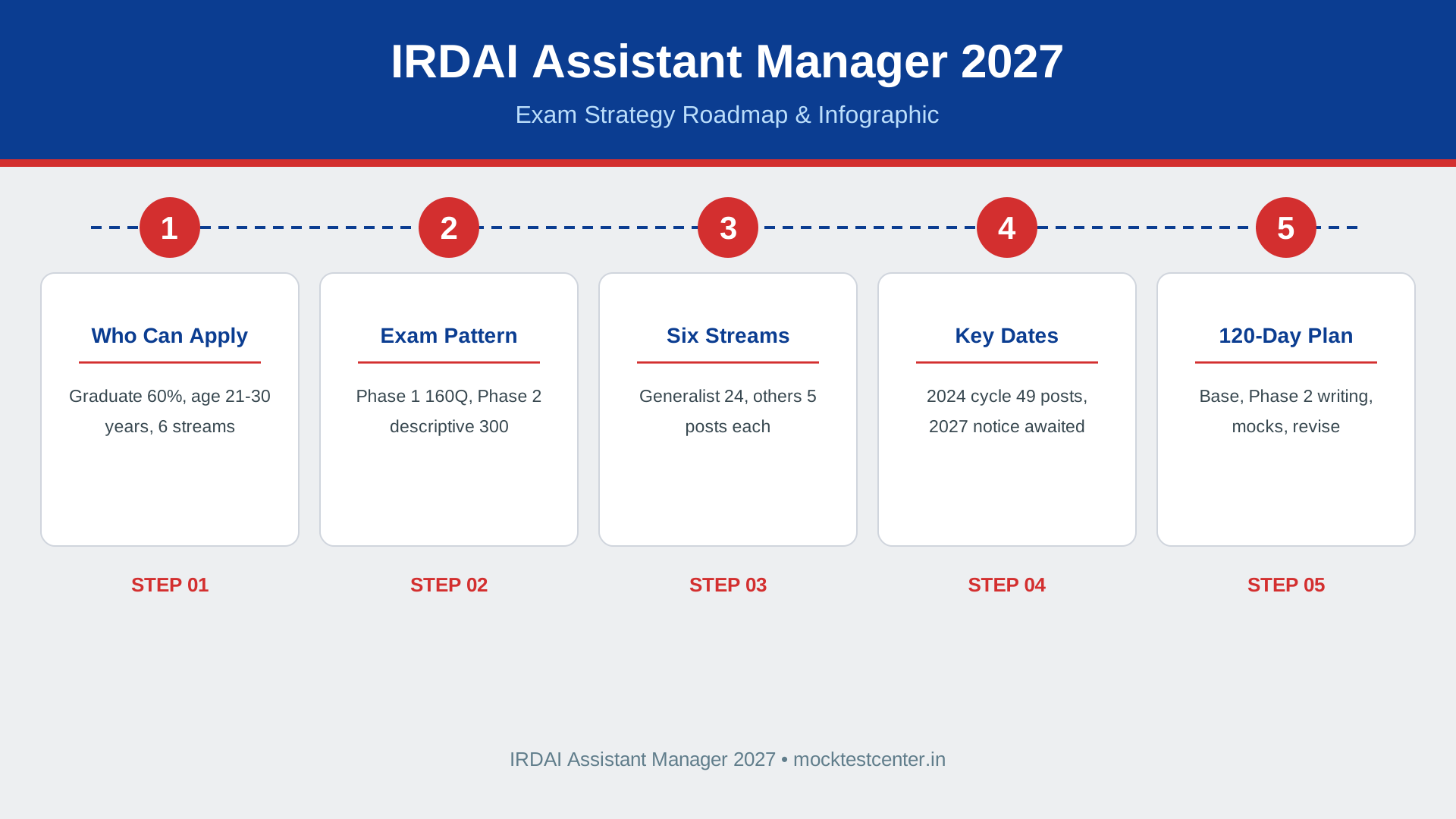
About IRDAI Assistant Manager 2027 Exam Series
📖 Table of Contents
- The one fact to know before you start
- What IRDAI does, and what an Assistant Manager actually does
- The 2024 cycle in full
- Who can apply: the six streams in detail
- Age limit and relaxations
- Fee, pay and allowances
- How selection works: three phases
- Phase 1 in detail
- Phase 2 in detail: three descriptive papers
- Interview and final merit
- Syllabus: what to study for each paper
- How to apply when the notice comes
- A 120 day plan that fits this exam
- Mistakes that cost marks in Phase 1
- Cut offs: what no site can tell you yet
- Other regulator exams on this site
- What to check first
IRDAI Assistant Manager 2027
The one fact to know before you start
No IRDAI Assistant Manager notification for 2025 or 2026 had been released as of November 2026. The latest full cycle is 2024, and that cycle is the only solid ground this page stands on. Everything about pattern, fee, age and pay below comes from that 2024 notification, and the page says so wherever a number comes from. The 2027 cycle has no dates, no vacancy figure and no fee yet, and any site that prints one today is guessing.
That does not mean the exam is dead. In August 2024 the IRDAI Authority approved annual recruitment of 40 Assistant Managers a year for 2025, 2026 and 2027, to lift the sanctioned entry grade strength from 105 to 225 by the end of 2027. The plan exists in the minutes of the 126th Authority meeting, held on 2 August 2024. The notifications have not followed yet. So the smart move is to prepare on the 2024 pattern and watch irdai.gov.in for the notice, not to wait for the notice before opening a book.
IRDAI Assistant Manager is a small exam. The 2024 cycle offered 49 posts. Compare that with banking exams that offer thousands, and you see the shape of the fight at once. Few seats, a descriptive second phase that most banking aspirants never face, and an interview that carries real weight. This page walks through all of it, with the numbers as they were in 2024, and with the gaps marked plainly where the record runs out.
What IRDAI does, and what an Assistant Manager actually does
IRDAI is the Insurance Regulatory and Development Authority of India, the regulator for insurance in India. Parliament set it up under the IRDA Act in 1999. It licenses insurers, frames rules for policies and solvency, protects policyholders, and watches the money that sits behind every claim. Its head office is in Hyderabad.
An Assistant Manager here is an entry grade officer, the same rank as Grade A in RBI or SEBI. The work depends on the stream you join. A Generalist officer reads files, drafts notes, handles complaints and works across departments. A Law officer drafts show cause notices and reads regulations line by line. A Finance officer looks at insurer accounts and solvency margins. An Actuarial officer works with mortality tables and pricing assumptions. An IT officer works on the regulator's own systems and data. A Research officer pulls economic data together and writes briefs. Nobody hands you this detail in the notification, and the notification is the only document that binds, so treat the job description above as a plain reading of the six streams rather than a promise of a posting.
New officers go through induction training of four months at the Hyderabad head office, as per the 2024 cycle reporting. You should expect a posting anywhere in India after that, since the notification asks for willingness to work anywhere in India, and it asks for working knowledge of Hindi and English and knowledge of computer operations.
The 2024 cycle in full
The 2024 notification carried the number HR/Recruitment/Aug/2024 and came out on 21 August 2024. Applications ran from 21 August to 20 September 2024, and the fee had to be paid by the same last date, 20 September 2024. The advertisement offered 49 Assistant Manager posts across six streams.
Generalist took the largest share, 24 posts. Actuarial, Finance, Law, Information Technology and Research took five posts each. Category wise, the 49 posts split into 21 unreserved, 4 EWS, 12 OBC, 8 SC and 4 ST posts, with three PwBD posts on a horizontal basis. You apply to exactly one stream, and you cannot switch streams after you apply, so the choice of stream is the first real decision in this exam.
| Stream | Posts in 2024 | Who it fits |
|---|---|---|
| Generalist | 24 | Any graduate with 60 percent marks |
| Actuarial | 5 | Graduate with IAI papers passed |
| Finance | 5 | Graduate with CA, CMA, CS or CFA |
| Law | 5 | LLB graduate with 60 percent marks |
| Information Technology | 5 | BE or BTech, MCA or PG in computers or IT |
| Research | 5 | Postgraduate in economics or statistics |
Two points in that table deserve a pause. First, Generalist holds almost half the seats, so most candidates will fight there, and the Generalist cut off will run higher than the small streams. Second, the specialist streams ask for professional papers on top of a degree, which keeps their applicant pool small. If you hold a CA or an LLB, the specialist route may give you a shorter queue than the Generalist crowd, and that is worth weighing before you apply.
Who can apply: the six streams in detail
Generalist asks for the least on paper and the most in competition. You need a bachelor degree in any discipline with at least 60 percent marks. SC, ST and PwBD candidates get a five percent relaxation, so 55 percent marks will do for them. Any stream of graduation counts, which is why this stream draws the largest crowd.
Actuarial asks for graduation with at least 60 percent marks and a pass in seven papers of the Institute of Actuaries of India examination, as per the 2019 curriculum. One tracker page says nine papers in its pay section, and another says seven in its eligibility section. The 2024 notification's eligibility rule is seven papers, and this page uses seven. If you are counting papers, read the fresh notification when it comes, since the paper count is the kind of detail a new advertisement can change.
Finance asks for graduation with at least 60 percent marks and a professional qualification: ACA, AICWA, ACS or CFA. The order of those letters matters less than the fact itself. If you hold one of them, you belong in this stream, and you should not waste the advantage by applying as a Generalist.
Law asks for a bachelor degree in Law with at least 60 percent marks. IT asks for a BE or BTech in Electrical, Electronics, Electronics and Communication, IT, Computer Science or Software Engineering with 60 percent marks, or an MCA with 60 percent marks, or a bachelor degree plus a two year postgraduate course in Computers or IT with 60 percent marks. Research asks for a master degree or a two year postgraduate diploma in Economics, Econometrics, Quantitative Economics, Mathematical Economics, Integrated Economics, Statistics, Mathematical Statistics or Applied Statistics and Informatics, with 60 percent marks.
Every stream also asks for Indian citizenship, knowledge of computer operations, working knowledge of Hindi and English, and willingness to work anywhere in India. The result of your qualifying degree must be declared on or before the last date of application in the cycle you apply for. That last rule catches people who apply in their final year on hope, so check your result date before you pay the fee.
Age limit and relaxations
The age limit in the 2024 cycle was 21 to 30 years as on 20 September 2024, the last date of application. Candidates had to be born between 20 September 1994 and 20 September 2003, both days included. The next notification will carry its own cut off date, and the window will shift with it, so do not carry the 1994 to 2003 window into the 2027 cycle.
Relaxation follows Government of India rules. SC and ST candidates get five years. OBC candidates in the non creamy layer get three years. PwBD candidates get ten years. Ex servicemen and commissioned officers get five years. If you claim relaxation, keep the certificate ready in the exact format the notification asks for, since a wrong format at document verification costs the same as a failed exam.
There is no limit on the number of attempts stated in the notification, as long as you sit inside the age window. That sounds generous until you count the years. A candidate who starts at 21 gets about ten cycles in theory, but IRDAI does not notify every year, and the 2025 and 2026 cycles never came. Treat each notification as if it may be the last one for a while, because recent history says it might be.
Fee, pay and allowances
The 2024 fee was 750 rupees for General, OBC and EWS candidates, and 100 rupees for SC, ST and PwBD candidates. The fee covers the examination fee and intimation charges for the first group, and intimation charges only for the second group. You pay online only, through debit card, credit card, net banking or UPI, and the fee does not come back if you change your mind.
Pay is where two sources disagree, and this page will not hide the gap. Several reports of the 2024 notification put the starting basic pay at 44,500 rupees a month, in the scale 44,500 to 89,150 rupees over 17 years, with initial monthly gross emoluments of about 1,46,000 rupees. One exam tracker page, updated in November 2026, puts the basic pay at 28,150 rupees a month, in the scale 28,150 to 55,600 rupees, with gross of about 81,000 rupees a month. The 44,500 figure appears in multiple independent reports that quote the notification directly, and this page uses it as the working figure. The 28,150 figure may belong to an older scale or a data error, and it stays flagged here until the next notification settles it.
On top of basic pay, the 2024 cycle offered dearness allowance, house rent allowance, qualification allowance, city compensatory allowance, grade allowance and other perks as approved from time to time. Actuarial candidates with nine IAI papers passed were reported to draw a qualification allowance of 15,000 rupees a month, and accounts professionals holding ACA, AICWA or ACS were reported to draw 3,500 rupees a month. Both allowance figures come from tracker pages, not from the notification text this pass retrieved, so treat them as reported rather than confirmed. Even on the lower pay reading, this is a strong salary for a graduate job. On the higher reading, it is one of the best paid regulator jobs in India.
How selection works: three phases
Selection runs in three phases, and the first one does not count in the final merit. Phase 1 is an online objective test. It only shortlists candidates for Phase 2, and its marks vanish the moment you qualify. Phase 2 is a descriptive written examination of three papers, and it carries the merit. Phase 3 is an interview. The final selection rests on Phase 2 and the interview, in the ratio of 85 to 15. That ratio is the single most important number in this exam, and every hour of preparation should bend toward it.
Think about what that ratio does to strategy. A candidate who tops Phase 1 by a wide margin gains nothing from the extra marks. A candidate who scrapes through Phase 1 and writes strong descriptive papers in Phase 2 can still finish at the top of the final list. So Phase 1 deserves enough work to clear it safely, with sectional cut offs in mind, and Phase 2 deserves the bulk of your time, because Phase 2 is where the job is won.
Phase 2 is held as a descriptive examination at centres in Hyderabad, Mumbai, Kolkata and Delhi, as per the 2024 cycle reporting. That detail matters for planning, since you may need to travel to one of these four cities for the mains, and you should keep that in mind when you pick your Phase 1 centre.
Phase 1 in detail
Phase 1 is an online objective paper of 160 questions for 160 marks, to be finished in 90 minutes. Four sections of 40 questions each make up the paper: Reasoning, English Language, Quantitative Aptitude and General Awareness. Each question carries one mark. Each wrong answer costs a quarter mark. The paper is bilingual in English and Hindi, except for the English Language section, which is in English only.
Phase 1 is qualifying only, but it still has sectional and overall cut offs. A strong total cannot save you if one section falls below its cut off, so you cannot leave a weak section to chance. Reasoning and Quant reward daily practice more than reading, and General Awareness in this exam leans toward insurance, banking and the economy, not just the news of the week.
| Phase 1 section | Questions | Marks |
|---|---|---|
| Reasoning | 40 | 40 |
| English Language | 40 | 40 |
| Quantitative Aptitude | 40 | 40 |
| General Awareness | 40 | 40 |
| Total | 160 | 160 in 90 minutes |
Ninety minutes for 160 questions gives you about 34 seconds a question. That pace decides the paper more than knowledge does. You need to answer the easy questions fast, mark the hard ones for a second pass, and leave the hopeless ones alone, since a quarter mark penalty on a guess is a slow bleed across 160 questions. Mock tests help here more than anywhere else, because the skill is speed under a clock, and speed only comes from timed practice.
Phase 2 in detail: three descriptive papers
Phase 2 is a descriptive examination of three papers, each worth 100 marks and each given 60 minutes, so 300 marks in 180 minutes. You write answers on answer sheets, with the questions shown on screen. Paper 1 is English, a descriptive paper. Paper 2 is Economic and Social Issues impacting Insurance. Paper 3 is Insurance and Management. All three papers are bilingual in English and Hindi, except for the English paper, which is in English only.
That shape is unusual, and it is what makes this exam different from a bank PO exam. Most banking exams end with objective papers and an interview. IRDAI asks you to write. It asks you to write an essay, a precis and a comprehension in Paper 1, and it asks you to write reasoned answers about the economy and insurance in Papers 2 and 3. Candidates who only practise multiple choice questions walk into Phase 2 unprepared, and the 85 percent weight of this phase punishes that gap hard.
One caution belongs here. The paper titles above come from the Generalist stream reporting of the 2024 cycle. Specialist streams may face stream specific papers in place of some of these, and this pass did not verify the exact Paper 2 and Paper 3 titles for Actuarial, Finance, Law, IT and Research streams against the notification text. If you apply in a specialist stream, read the paper scheme for your stream in the fresh notification before you plan your study, and do not assume the Generalist papers apply to you word for word.
Interview and final merit
Candidates who clear Phase 2 face an interview, the third phase. The interview carries 50 marks. The final merit list rests on Phase 2 and the interview, with Phase 2 carrying 85 percent weight and the interview carrying 15 percent weight. Phase 1 marks play no part in the final list. So the interview can move you up or down the list, but it cannot rescue a weak Phase 2, and a strong Phase 2 can survive an average interview.
The interview panel will probe what the papers could not. Expect questions on why insurance regulation interests you, what IRDAI does, how insurance works in India, and what is happening in the economy. If you come from a specialist stream, expect questions on your own subject, since the panel will test the professional knowledge you claimed on your form. Read the IRDAI annual report and a few recent IRDAI circulars before the interview, and read them like a person who will work there, not like a student revising a chapter.
After the interview, IRDAI publishes the final merit list. Selected candidates join as Assistant Managers and go through induction training of four months at the Hyderabad head office. The 2024 cycle's later stages ran into 2025 and 2026, with Phase 1 marks published well after the exam, which tells you something useful about pace. This regulator moves slowly, and patience is part of the process.
Syllabus: what to study for each paper
Phase 1 syllabus splits four ways. Reasoning covers puzzles, seating, coding, blood relations, direction sense, series and syllogisms, the standard set. English covers reading comprehension, grammar, vocabulary and error spotting. Quantitative Aptitude covers arithmetic, number systems, percentage, ratio, average, profit and loss, simple and compound interest, and data interpretation. General Awareness covers current affairs with a tilt toward banking, insurance and the economy, plus static awareness of the insurance sector.
Phase 2 Paper 1, English descriptive, tests essay writing, precis writing and comprehension. You need to write clean, plain English under time pressure, and you need to practise writing by hand, since the answers go on paper, not on a keyboard. Most candidates lose marks here not because their English is poor, but because they never practised writing a full essay in 60 minutes with a clock running.
Paper 2, Economic and Social Issues impacting Insurance, covers the Indian economy, growth, inflation, banking, financial inclusion, government schemes, social security, and the link between economic change and insurance demand. Paper 3, Insurance and Management, covers insurance principles, types of insurance, the IRDA Act, IRDAI functions, solvency, reinsurance, and basic management ideas. Read the IRDAI website for the regulator's own words on these topics, since the examiner will frame questions from the same source material. The official site is irdai.gov.in, and it is the only source that counts when a fact is in dispute.
For the specialist streams, the syllabus runs deeper into your own subject. Actuarial candidates should revise mortality, annuities and reserving. Finance candidates should revise accounting standards, financial statements and solvency margins. Law candidates should revise the IRDA Act, the Insurance Act of 1938, and contract law. IT candidates should revise databases, networks and security basics. Research candidates should revise econometrics and Indian economic data. The notification carries the full syllabus for each stream, and this page does not reproduce it in full, because a wrong syllabus is worse than a short one.
How to apply when the notice comes
Applications go online through the IBPS portal link that IRDAI publishes with the notification. In 2024 the link ran on ibpsonline.ibps.in. You register with a valid email and mobile number, fill personal details, pick your stream, upload a photo, signature, left thumb impression and handwritten declaration, and pay the fee online. Keep a printout of the submitted form, since the registration number and password are your keys to the admit card later.
Check the notification for the document list before you start, and keep your degree certificate, mark sheets, caste or EWS certificate, PwBD certificate and photo ID ready in scanned form. The photo and signature have fixed size limits in the notification, and a rejected upload at the last hour has ended many applications. Apply early in the window, not on the last day, because the portal slows down when thousands of candidates log in at once.
Watch for the notice in the Careers or Vacancies section of irdai.gov.in. Do not trust a Telegram channel or a coaching site that claims a date before the official site shows it. The 2025 and 2026 cycles never arrived, and the rumours about them arrived many times, so the official site is the only clock that matters.
A 120 day plan that fits this exam
Days 1 to 30 belong to the base. Give two hours a day to Quant and Reasoning, one hour to English, and one hour to General Awareness with an insurance tilt. Read the newspaper daily, and keep a small notebook for insurance news, IRDAI circulars and economic data. Start writing one short essay a week from day one, because descriptive writing is a slow skill and it cannot be built in the last month.
Days 31 to 60 add Phase 2 to the routine. Keep the Phase 1 practice going, but give two hours a day to Economics and Insurance. Read the IRDAI annual report in small pieces, one chapter a week, and make notes in your own words. Take one full Phase 1 mock test every week, under the 90 minute clock, and spend an hour after each test on the questions you got wrong. Write one essay and one precis every week, and get them read by someone who writes well.
Days 61 to 90 shift the weight toward Phase 2. Take a Phase 1 mock every three days now, and write descriptive answers daily, even short ones. Revise your economics and insurance notes twice. Practise precis writing, since it is the paper where candidates lose the most marks for the least reason, by writing too much or by copying the passage instead of shrinking it.
Days 91 to 120 are for revision and testing. Take a mock test every two days, and in the last week take one every day. Revise your short notes daily. Stop reading new books in the last ten days, and solve only past papers and your error notes. The night before Phase 1, sleep. A tired mind answers 160 questions slower than a rested one, and the clock does not forgive it.
Mistakes that cost marks in Phase 1
The first mistake is treating Phase 1 like a bank clerk prelims paper. The sections look the same, but the sectional cut offs and the insurance tilt in General Awareness change the game. Candidates who score well in Reasoning and Quant but ignore insurance current affairs can clear the total and still fail a section.
The second mistake is guessing too much. A quarter mark penalty on every wrong answer adds up across 160 questions, and random guesses on 20 questions will cost you about five marks, which is often the gap between selection and rejection in a 49 post exam. Guess only when you can remove two options with confidence, and leave the rest.
The third mistake is starting Phase 2 preparation after Phase 1. The gap between the two phases is short, and descriptive writing cannot be learned in a few weeks. If you wait for the Phase 1 result before you start writing essays, you will walk into Phase 2 with unpractised hands. Start writing in the first month, and keep it going even while Phase 1 practice fills your days.
The fourth mistake is picking the wrong stream. A CA who applies as a Generalist throws away a small pool advantage. A graduate with no professional paper who applies in a specialist stream gets rejected at the form stage. Read the eligibility rules for your own degree before you apply, and pick the stream where your papers put you in the smallest crowd.
Cut offs: what no site can tell you yet
No verified cut off marks for the 2024 cycle were found in this pass, and this page gives no cut off figures. Any site that prints an exact IRDAI cut off for the next cycle is inventing it, and you should treat that number as decoration. Cut offs move with the number of posts, the number of candidates and the difficulty of the paper, and a 49 post exam with a descriptive second phase will set cut offs that look nothing like a bank exam with 5,000 posts.
What you can do instead is aim high in Phase 2, since Phase 2 decides the final list, and aim safe in Phase 1, since Phase 1 only asks you to qualify. A Phase 1 score comfortably above the qualifying line, with no section near its cut off, is the right target. A Phase 2 score that would top a mock test list is the right ambition. Everything else is noise.
Other regulator exams on this site
IRDAI is one of several regulator exams, and many candidates prepare for two or three of them together, since the syllabuses overlap on economics, finance and descriptive English. See RBI Grade B 2027, RBI Grade B DEPR 2027, NABARD Grade A 2027, NABARD Grade B 2027, SEBI Grade A 2027, PFRDA Grade A 2027, SIDBI Grade A 2027, IFSCA Grade A 2027, FSSAI Technical Officer 2027 and FSSAI Assistant 2027 on this site.
What to check first
Open irdai.gov.in and look at the Vacancies section once a week until the notice appears. Start Phase 1 practice now, start descriptive writing this week, and pick your stream on the basis of your degree and professional papers, not on the size of the vacancy list. The 2024 pattern is your map, the Authority's 40 a year plan is your reason to hope, and the next notification is the only date that counts.







