About FSSAI Technical Officer 2027 Exam Series
📖 Table of Contents
- 125 posts last time, and a paper that rewards food science first
- What a Technical Officer actually does
- Who can apply, in plain words
- The 2021 cycle, date by date
- Vacancies and the category split
- Pay, level and what the salary means
- CBT Stage 1, the full pattern
- CBT Stage 2, a different kind of paper
- The syllabus, section by section
- What has happened since 2021
- How Technical Officer differs from CFSO and Assistant
- Cut off, and why no number is printed here
- Books and sources that match this paper
- A 90 day plan that fits the two stages
- How to use mock tests for this exam
- Mistakes that cost Technical Officer candidates
- Documents and the application, as it ran in 2021
- Other regulatory exams on this site
- What to check first when the next notice comes
FSSAI Technical Officer 2027
125 posts last time, and a paper that rewards food science first
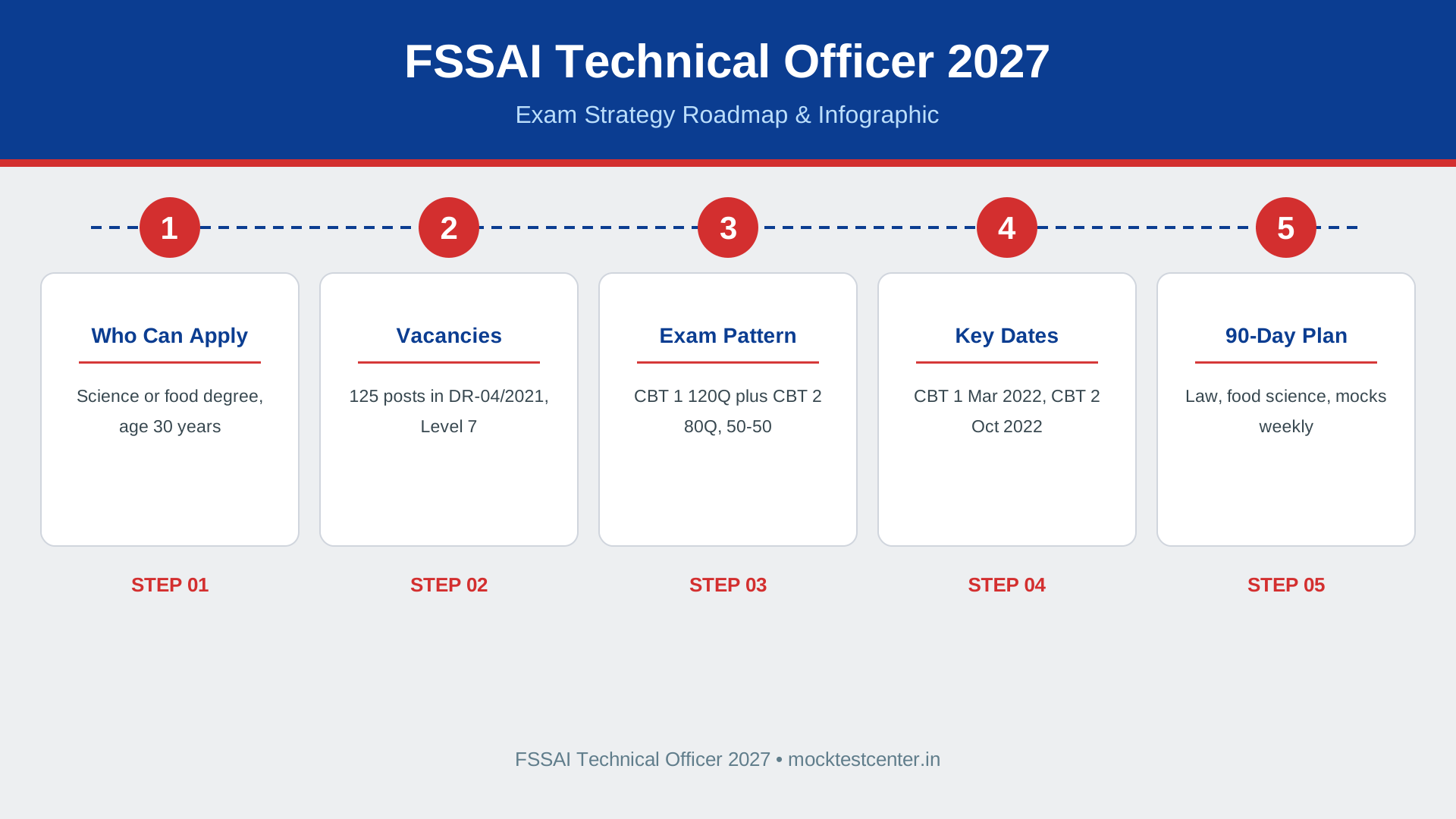
The last direct recruitment for FSSAI Technical Officer gave 125 posts. That number comes from Advertisement DR-04/2021, dated 30 September 2021. The same advertisement covered 233 posts in all, and Technical Officer was the largest single post in it. No new direct recruitment notice for Technical Officer has appeared since that cycle, so anyone who calls a 2027 date or a 2027 vacancy number today is guessing. This page works from the 2021 notice and the two computer based tests that followed it, and it says plainly where the record ends.
FSSAI means the Food Safety and Standards Authority of India. It is a statutory body under the Ministry of Health and Family Welfare. Parliament created it under the Food Safety and Standards Act, 2006, to lay down science based standards for food and to regulate manufacture, storage, distribution, sale and import, so that people get safe and wholesome food. A Technical Officer sits inside that work. The post sits between field inspection and desk work, with lab knowledge, law knowledge and file work in one job.
The 2027 tag on this page is a preparation tag. It tells you this is the next cycle to prepare for, not a cycle that has been announced. If you start now, you start from the last real pattern, and that pattern is clear enough to plan on. The first test checked general aptitude and functional knowledge in one sitting. The second test checked subject depth with a paper that mixed single correct answers, multiple correct answers, fill in the blanks and comprehension. Both tests counted equally in the final merit list, 50 percent each.
What a Technical Officer actually does
FSSAI work starts with standards. Someone has to write the standard for a food product, check it against Indian law and Codex practice, and then see that labs and officers can apply it. Technical Officers help with that chain. They work on standards, on food safety management systems, on lab related work and on the files that move between headquarters, regional offices and state food authorities.
The job also touches enforcement from the technical side. When a sample fails a test or a product label breaks a rule, the question is often technical before it is legal. What does the standard say, what did the lab find, and does the finding match the rule as written? A Technical Officer is the person who can read the lab report and the regulation in the same hour and tell a senior officer where the two meet.
Postings are across India, at headquarters in New Delhi and at regional offices and labs. That matters for preparation, because the exam does not ask for one state syllabus. It asks for national law, international food law, food chemistry, microbiology and processing, all in one paper. A candidate who knows only food technology and skips the law section loses 20 questions in the first test alone.
One more point shapes the whole preparation. FSSAI is a small regulator next to a body like the Staff Selection Commission, and its recruitment comes in bursts, not every year. The 2021 cycle took months from notice to final test. The first test ran in March 2022 and the second test ran in October 2022. A candidate who waits for the notice to start reading food law will be a year behind the candidate who started with the Act and the regulations.
Who can apply, in plain words
The 2021 notice gave three routes into the post, and a candidate needed only one of them. The first route was a master degree in a listed subject. The list was long, and it covered Chemistry, Biochemistry, Food Technology, Food Science and Technology, Food and Nutrition, Edible Oil Technology, Microbiology, Dairy Technology, Agricultural or Horticultural Sciences, Industrial Microbiology, Toxicology, Public Health, Life Science, Biotechnology, Fruit and Vegetable Technology, and Food Safety and Quality Assurance.
The second route was a post graduate diploma of at least one year in Food Safety, Food Science, Food Processing, Quality Assurance in the food sector, Dietetic and Public Health, Nutrition, Dairy Science, Bakery Science or Post Harvest Technology, from a government recognised university or institute. Candidates on this route also needed one of the listed subjects at bachelor degree level, and the notice named a wider set at that level, adding Medicine, Veterinary Sciences, Fisheries and Animal Sciences.
The third route was a BE or BTech in Food Technology, Dairy Technology, Biotechnology, Oil Technology, Food Process Engineering, Food Processing Technology, Fruit and Vegetable Technology or Food Safety and Quality Assurance, or a bachelor degree of at least four years in Medicine, Veterinary Sciences, Fisheries or Animal Sciences. A GATE score, or a CSIR or ICAR National Eligibility Test qualification, was listed as desirable, not as a must. Desirable means it can help, but it does not block a candidate who lacks it.
The age limit on the closing date of application was 30 years. Age relaxation followed central government rules for SC, ST, OBC, persons with benchmark disability, ex-servicemen and other groups named in the notice. Only Indian citizens could apply. Candidates who applied for more than one post in the same advertisement had to state a priority for joining, and the priority given in the form was final.
The 2021 cycle, date by date
Advertisement DR-04/2021 came on 30 September 2021. The online link opened on 13 October 2021, after an earlier plan to open on 8 October, and the last date for online application was 12 November 2021, extended from 7 November 2021. The cut off date for eligibility and qualification was also 12 November 2021. Admit cards for the first computer based test were made available on 28 December 2021.
The first test ran on 28, 29, 30 and 31 March 2022, on revised dates. The second test for Technical Officer ran on 1 October 2022, after a postponement from the 23 and 24 September 2022 dates first announced. Some trackers still show 24 September 2022 for Technical Officer, and that is the postponed date, not the date the test was finally held. The final result followed the second test and document verification, and no interview stage was listed for Technical Officer in the scheme of examination for DR-04/2021.
The fee in 2021 was 1,500 rupees for General and OBC candidates, made of a 1,000 rupee application fee and 500 rupees of intimation charges. SC, ST, EWS, women, ex-servicemen and persons with benchmark disability paid 500 rupees, as intimation charges only, with no application fee. Bank and transaction charges, if any, were extra, and the fee once paid was not refunded. A candidate paid separately for each post applied for.
Two other advertisements ran beside DR-04/2021, and that is where the total vacancy number gets muddled on many sites. DR-04/2021 itself covered 233 posts. Adding the posts from the other two advertisements of that season takes the total to 254. This page uses 233 for the DR-04/2021 cycle and 125 for Technical Officer, because those are the numbers in the DR-04/2021 notice itself.
| Event | DR-04/2021 |
|---|---|
| Advertisement date | 30 September 2021 |
| Online applications open | 13 October 2021 |
| Last date to apply | 12 November 2021 |
| Technical Officer posts | 125 |
| Total posts in DR-04/2021 | 233 |
| CBT Stage 1 | 28 to 31 March 2022 |
| CBT Stage 2, Technical Officer | 1 October 2022 |
| Fee, General and OBC | 1500 rupees |
| Fee, SC, ST, EWS, women, ex-servicemen, PwBD | 500 rupees |
Vacancies and the category split
Technical Officer had 125 posts in DR-04/2021. The split was 50 for Unreserved, 33 for OBC Non Creamy Layer, 19 for SC, 10 for ST and 13 for EWS. That split is worth a look, because it shows where the competition sat. Half the posts were unreserved in the broad sense, since EWS is a separate vertical, and the OBC share was the largest reserved block. A candidate who only watches the total number misses this shape, and the shape decides how many marks you need in your own category.
The rest of the DR-04/2021 posts put Technical Officer in context. Central Food Safety Officer had 37 posts, Assistant had 33, Personal Assistant had 19, Food Analyst had 4, Assistant Manager IT had 4, Assistant Manager in two other streams had 2 each, Hindi Translator had 1, IT Assistant had 3 and Junior Assistant Grade 1 had 3. Technical Officer alone was more than half the advertisement. That is why it draws the most applicants, and why its paper sets the tone for the whole cycle.
There is no vacancy number for a 2027 cycle, because no 2027 notice exists. Any site that gives a 2027 vacancy figure for Technical Officer today is inventing it. Read the 125 figure as a guide to scale. FSSAI recruits in the tens or low hundreds for one post, and a small change in posts moves the cut off by a visible margin.
Pay, level and what the salary means
Technical Officer sits in Pay Level 7 of the pay matrix, with a basic pay range of 44,900 rupees to 1,42,400 rupees under the 7th Central Pay Commission. Allowances under central government rules sit on top of basic pay, and the amount varies with the place of posting. That is the whole salary fact that can be stated from the notice and the pay matrix. Gross and in hand figures float around on coaching sites, and they differ by thousands of rupees, because dearness allowance changes and house rent allowance depends on the city. Treat any single in hand number as an estimate, not a promise.
Level 7 matters for another reason. It puts Technical Officer above the Level 6 posts in the same advertisement, such as Assistant, and below the Level 10 and above posts such as Assistant Director. A graduate who joins as Technical Officer joins at a level where the work is technical from day one, and the pay reflects that. It also means the exam can afford to be hard on subject knowledge, because the post pays for it.
Promotion follows FSSAI service rules, and this page gives no promotion timeline, because no verified timeline was found in this pass. Do not plan a career on a coaching site claim that a Technical Officer becomes an Assistant Director in a fixed number of years. The notice gives the entry level, and the service rules give the path, and both should be read from the official source when the next notice comes.
CBT Stage 1, the full pattern
The first test was a single computer based test of 180 minutes, with 120 multiple choice questions. Each right answer gave 4 marks, each wrong answer took away 1 mark, and the total was 480 marks. The paper had two parts. Part A was General Aptitude and Computer Literacy, with 40 questions. Part B was Functional Knowledge, with 80 questions.
Part A split into four subjects of 10 questions each: General Intelligence, General Awareness, English Language Comprehension, and Computer Literacy. That is the part most science graduates underrate. It is only one third of the paper, but it is the part where a food technology graduate and a chemistry graduate stand on equal ground, and where careless marks leak. Computer Literacy in this paper meant regular office work on computers, MS Office including Word, Excel and PowerPoint, Google Docs, email, digital signature and common social media handles. It was not a programming test.
Part B split into Indian and International Food Laws with 20 questions, FSSAI Role Functions and Initiatives with 20 questions, and a 40 question block that covered Principles of Food Preservation Processing and Packaging, Principles and Basics of Food Chemistry and their role in Human Nutrition, and Food Microbiology with General Principles of Food Hygiene. Some trackers split Part B as 25 and 25 and 30, or as 20, 20 and 40 with different labels, and that split has caused confusion. The split used here, 20 plus 20 plus 40, follows the Oliveboard reading of the DR-04/2021 scheme, and the package notes flag the other reading, so a reader can check it against the official PDF.
Shortlisting for the second test ran at 1 to 20, which means 20 candidates per post moved to Stage 2 on the basis of Stage 1 marks. With 125 posts, that meant about 2,500 candidates reached Stage 2. That ratio is generous next to many exams, and it changes how you should play Stage 1. You do not need a perfect paper to reach Stage 2. You need a paper with no weak section, because a zero in food law or a zero in microbiology costs more than a few missed reasoning questions.
| Stage 1 section | Questions | Marks |
|---|---|---|
| General Intelligence | 10 | 40 |
| General Awareness | 10 | 40 |
| English Language Comprehension | 10 | 40 |
| Computer Literacy | 10 | 40 |
| Indian and International Food Laws | 20 | 80 |
| FSSAI Role, Functions, Initiatives | 20 | 80 |
| Preservation, Food Chemistry, Nutrition, Microbiology, Hygiene | 40 | 160 |
| Total | 120 | 480 |
CBT Stage 2, a different kind of paper
The second test used a different design from the first test, and candidates who treated it as more of the same paid for it. The FSSAI notice of 31 May 2022, as amended on 9 September 2022, set the Stage 2 scheme for Technical Officer, Central Food Safety Officer, Assistant Manager IT and Assistant Manager under DR-04/2021. Duration was 180 minutes, the total was 80 questions for 240 marks, and the difficulty mix was stated as 20 percent easy, 30 percent medium and 50 percent hard.
Section 1 had 30 single correct option questions, each worth 2 marks, with zero marks if no option was chosen. Section 2 had 20 multiple correct option questions, each worth 4 marks, with partial marks under the amended scheme, so a candidate who picked some right options and no wrong ones could still score part marks. Section 3 was fill in the blanks, Section 4 covered other objective types, and Section 5 was comprehension, with 10 questions at 2 marks each. The full section by section mark table is given in the official notice, and this page does not reproduce a section count it could not verify in full, because the fill in the blanks and Section 4 counts were reported differently across trackers.
That mix is the point. Stage 2 tested whether a candidate could pick all the right options, not just one, and whether they could answer without options to lean on. A candidate who only practises single correct MCQs will find Section 2 strange, because guessing hurts more there and half knowledge can still earn part marks if it is clean half knowledge. Practise multiple correct questions separately, and learn to leave an option out when you are not sure it belongs.
Stage 1 and Stage 2 each carried 50 percent weight in the final merit list. That equal split is rare, and it means Stage 1 does not fade away once you clear it. A strong Stage 1 score stays with you to the end, and a weak Stage 1 score cannot be fully fixed by a good Stage 2 alone. Candidates who treat Stage 1 as a mere qualifying screen misread the scheme.
The syllabus, section by section
General Intelligence in Part A covered verbal and non verbal reasoning: analogies, similarities and differences, space visualisation, problem solving, analysis, judgement, decision making, visual memory, discriminating observations, relationship concepts, arithmetical reasoning, verbal and figure classification, and arithmetical number series. It is the standard reasoning set, and it rewards daily practice more than theory.
General Awareness tested the environment around the candidate and its application to society, with current events and matters of everyday observation, and questions on India and neighbouring countries, with history, culture, geography, economic scene, general polity including the Indian Constitution, sports and scientific research. The questions were pitched so that they did not need a special study of any one discipline, which is another way of saying breadth beats depth here.
English Language Comprehension tested vocabulary, grammar and comprehension, with one word substitution, synonyms and antonyms, spelling errors, spotting errors in sentences, nouns, pronouns, adjectives, verbs, prepositions, conjunctions, use of a, an and the, idioms and phrases, and parts of speech. Computer Literacy tested MS Office, Google Docs, email, digital signature and common social media handles, at the level of regular office work.
Food law, the first Part B block, started with the Food Safety and Standards Act of India, 2006, its provisions, definitions and different sections, and its implementation, then FSS Rules and Regulations, then an overview of other national bodies such as APEDA, BIS, EIC, MPEDA and the Spice Board, then international food control systems, Codex Alimentarius Commission history, members, standard setting and advisory mechanisms such as JECFA, JEMRA and JMPR, WTO agreements on SPS and TBT, and important national and international accreditation bodies. This is the section where rote reading fails, because the questions test whether you know how the system fits together, not whether you can recite one section number.
The FSSAI block covered the genesis and evolution of FSSAI, the structure and functions of the Food Authority, systems and processes in standards, enforcement, laboratory ecosystem, imports and third party audit, promoting safe and wholesome food through Eat Right India, food fortification, SNF, Clean Street Food Hub, RUCO and other social and behaviour change initiatives, training and capacity building, and the role of State Food Authorities. Read this block from FSSAI material first, because coaching notes compress it into slogans and the exam asks for the system behind the slogan.
Preservation, processing and packaging covered food processing operations and principles, good manufacturing practices, preservation methods and their principles including novel and emerging methods, and packaging methods and principles including novel packaging materials and techniques. Food chemistry and nutrition covered structure and functions of macro and micronutrients, their role in human nutrition, food additives and their technological functions, anti nutritional factors and their removal, enzymes as food processing aids, nutraceuticals and functional foods, food contaminants and adulterants and their effects on human health, food allergens and allergenicity, and diet in alleviating health risks, especially non communicable diseases.
Microbiology and hygiene covered general principles of food microbiology, foodborne pathogens, sources of microorganisms in the food chain such as raw materials, water, air and equipment, microbiological quality of foods, microbial spoilage and foodborne diseases, techniques in the microbiological examination of foods, beneficial microorganisms in food processing and human nutrition, and food safety management systems including traceability and recall, sanitation, HACCP, and good practices such as GMP, GAP, GHP, GLP and BAP. Food analysis and testing, which the Stage 2 syllabus adds in depth, covered field and lab sampling with statistical tools, classical methods of food analysis, modern analytical techniques including mass spectrometry and molecular techniques, and quality assurance and quality control in food analysis and testing.
What has happened since 2021
Since the 2021 cycle, FSSAI has not run a fresh direct recruitment for Technical Officer that this pass could verify. That silence is itself a fact a candidate should know, because it explains why so many pages online carry invented 2024, 2025 and 2026 dates for this post. Some of those pages recycle the 2021 pattern under a new year label. Others mix the deputation circulars with direct recruitment and present the mix as a fresh notice.
The one real 2025 development was a deputation circular, DEP-01/2025, for Group A and B posts. It covered 33 posts in all, including Director, Joint Director, Manager and Assistant, with applications online from 15 April to 30 April 2025 and hard copy by 15 May 2025, later extended in some reports to 7 May 2025 for online submission. The maximum age for that circular was 56 years, which is the giveaway that it was deputation, not direct recruitment for fresh graduates. It is not a Technical Officer direct recruitment notice, and it should not be quoted as one.
Another set of pages claims a 2025 Assistant recruitment of 15,000 plus posts, with applications from 23 January to 23 February 2025. No official FSSAI notice supports that number, and the 2025 deputation circular above, with 33 posts, is the only 2025 FSSAI recruitment this pass could verify from credible reports. The 15,000 figure is treated in the package notes as not verified, and this article does not use it as a fact. If a 2027 direct recruitment notice appears, it will appear on fssai.gov.in under Jobs at FSSAI, and that page is the only place to trust for dates, posts and fee.
How Technical Officer differs from CFSO and Assistant
Three posts in the same advertisement get mixed up, and the mix costs candidates marks, because each post has a different paper. Technical Officer and Central Food Safety Officer share the same Stage 1 pattern and the same 50 plus 50 weight, and both sit in Pay Level 7. The difference is in the job and in the degree list. CFSO needs a degree in Food Technology, Dairy Technology, Biotechnology, Oil Technology, Agricultural Science, Veterinary Sciences, Biochemistry, Microbiology, a master degree in Chemistry, a degree in medicine, or an equivalent qualification notified by the central government. Technical Officer takes a wider set, including the post graduate diploma route and the BE and BTech route, and its Stage 2 syllabus leans harder on food science depth.
Assistant is a different exam. It is a single computer based test, with 120 questions in 180 minutes, 4 marks for a right answer and minus 1 for a wrong answer, and 100 percent weight on that one test. Its paper is General Intelligence 20, Quantitative Aptitude 20, English Language 10, General Awareness 20, Computer Literacy 25, and FSSAI Role Functions and Initiatives 25. Any bachelor degree qualifies, and the age limit was also 30 in 2021. A science graduate who can clear Technical Officer Stage 1 will find Assistant paper easier on subject depth, but the Assistant paper has more maths and more computer questions, so it is not a free win.
Food Analyst is the outlier. It had a written test plus an interview, with 85 percent weight on the written test and 15 percent on the interview, and it needed a master degree plus three years of experience in food analysis. That post needs three years of experience, so a candidate who has just finished a degree should not use it as a backup plan.
Cut off, and why no number is printed here
No cut off figure is printed in this article, because no cut off figure for Technical Officer in DR-04/2021 was verified from an official source in this pass. Trackers publish category wise tables, and some of those tables disagree with each other by wide margins. One widely copied table lists numbers that look like Stage 1 scores out of 480, but the table gives no category labels that can be checked, and no official PDF was fetched to confirm it.
The honest guidance is structural, not numerical. Stage 1 shortlisted at 1 to 20, so the Stage 1 cut off sat at the score of the 2,500th candidate in the merit order, and that score moves with the paper. Stage 2 then re-ranked those 2,500 candidates on a 240 mark paper with a hard mix, and the final merit took half from each stage. A candidate who aims for 70 percent in Stage 1 and treats Stage 2 as the real test is planning on the shape of the scheme, not on a borrowed number.
Do not trust any site that gives a 2027 cut off today. A cut off is a result, not a forecast. It can only be known after a test is held, and it depends on the paper, the posts and the candidates who sat for it.
Books and sources that match this paper
Start with the Act and the regulations themselves. The Food Safety and Standards Act, 2006, with its definitions and sections, and the FSS Rules and Regulations, are the base text for 20 questions in Stage 1 and for much of Stage 2. Read them in the official text, not in a summary, and make notes section by section. Then read FSSAI material on its own work: the genesis and structure of the Authority, standards, enforcement, lab ecosystem, imports, third party audit, Eat Right India, food fortification, RUCO and Clean Street Food Hub. The FSSAI site carries this material, and it is the source the paper draws from.
For food science, use a standard food technology text for preservation, processing and packaging, a food chemistry text for macro and micronutrients, additives, contaminants and allergens, and a food microbiology text for pathogens, spoilage, examination techniques and HACCP. One good book per subject, read fully, beats a shelf of guides read in part. For the general part, use a standard reasoning book, a daily newspaper for current affairs, and a basic English grammar book. Computer Literacy needs hands on practice in Word, Excel and PowerPoint, not a theory book.
Past papers matter more here than in most exams, because Stage 2 is unusual. Solve the Stage 1 paper from March 2022 and the Stage 2 paper from October 2022 if you can get them from a reliable source, and solve them under time. For Stage 2, practise multiple correct questions as a separate skill, and mark every question where you picked a wrong option along with a right one, because that is where partial marks are won and lost.
A 90 day plan that fits the two stages
Days 1 to 30 are for the base. Give two hours a day to food science, one hour to food law and FSSAI, and one hour to reasoning, English and computers. Read the Act in small parts, one part a day, and write one line per section in your own words. Finish one food science chapter a day, and solve 30 questions a day across the general subjects. Do not touch Stage 2 multiple correct questions yet, because you need the subject base first.
Days 31 to 60 are for depth and testing. Take one full Stage 1 mock test every week, in 180 minutes, with no pauses. Spend an hour after each test on analysis, and note every wrong answer with the correct rule or fact. Start Stage 2 practice now, with 20 multiple correct questions a week, and learn to score them with partial marks in mind. Revise food law twice in this block, because it is the section most candidates forget first.
Days 61 to 90 are for revision and more testing. Take a full mock test every three days, and in the last two weeks take one every two days. Revise short notes daily, and in the last week solve only past papers and your error notes. Keep one day a week for current affairs, because General Awareness rewards a steady habit, not a last week rush.
How to use mock tests for this exam
A mock test for Technical Officer has to copy two papers, not one. Take Stage 1 mocks in 180 minutes, with 120 questions, and score them at plus 4 and minus 1. Take Stage 2 mocks with the mixed question types, and score multiple correct questions with partial marks, so you learn the cost of a wrong option. A mock that only gives single correct questions is only half a mock for this post.
After each test, spend an hour on analysis. Note the questions you got wrong, and note the questions you guessed. Track your score in each block separately: Part A, food law, FSSAI, and the food science block. If your food science score is low, go back to the textbook, not to more mocks. If your law score is low, go back to the Act. Two or three good tests a week, with full analysis, beat ten tests taken in a rush.
One more habit helps. Keep a separate notebook for Stage 2, with one page per topic, and write the facts that Stage 2 asks for in short lines: a pathogen and its food, a preservative method and its principle, a packaging material and its use, a section of the Act and what it does. Stage 2 rewards recall that is organised, not recall that is scattered.
Mistakes that cost Technical Officer candidates
The first mistake is to prepare for a food technology exam and skip the law. Food law is 20 questions in Stage 1, and the FSSAI block is 20 more, so 40 of 120 questions are law and institution, not science. A candidate who scores well in science and blanks on law starts Stage 2 from behind.
The second mistake is to treat Stage 1 as qualifying only. It carries 50 percent of the final merit, so a weak Stage 1 score follows you to the end. The third mistake is to practise only single correct MCQs and then meet multiple correct questions in Stage 2 for the first time. The fourth mistake is to trust a 2027 date or vacancy number from a tracker and plan around it. The fifth mistake is to pay a fee or fill a form on any site other than the official FSSAI site, because the notice, the link and the fee all come from there.
The sixth mistake is quieter, and it is about the degree list. Candidates with a post graduate diploma often assume they are not eligible, and candidates with a BE or BTech in a related branch often assume they are eligible, without checking the branch list. Read the three routes in the notice against your own degree, branch by branch, before you start. A month of study on an ineligible degree is a month lost.
Documents and the application, as it ran in 2021
Applications in 2021 were online only, through the FSSAI site, under Jobs at FSSAI. No other mode of submission was accepted. Candidates needed a degree certificate or provisional certificate, marksheets, a category certificate if claiming reservation, a disability certificate if applicable, a photo and a signature in the sizes the form asked for, and a payment method for the fee. The fee was paid online, and the form asked for a priority order if the candidate applied for more than one post.
Keep the same list ready for the next cycle, and add one item: a printout or saved copy of the submitted form and the fee receipt. FSSAI notices have changed dates mid cycle before, with the last date moving from 7 November to 12 November 2021, and the test dates moving twice. A saved copy of your own form is the one record that does not move.
Age and qualification were counted as on the closing date of application, 12 November 2021 in that cycle. That rule matters, because a degree completed after the closing date did not count, even if it was completed before the test. Check the closing date rule in the next notice with the same care, because it decides eligibility, not the test date.
Other regulatory exams on this site
FSSAI is one regulator among many, and a candidate who prepares for it often prepares for a second regulator at the same time. The general aptitude part overlaps, and the habit of reading a regulator's own law and annual work carries across. See RBI Grade B 2027, RBI Grade B DEPR 2027, NABARD Grade A 2027, NABARD Grade B 2027, SEBI Grade A 2027, PFRDA Grade A 2027, IRDAI Assistant Manager 2027, SIDBI Grade A 2027, IFSCA Grade A 2027 and FSSAI Assistant 2027 on this site. Each page gives that exam's own pattern, so do not carry the FSSAI pattern across to a banking or insurance regulator, because the papers differ in marks, in stages and in subject weight.
The FSSAI Assistant page is the closest sibling, and it is worth a read even if you only want Technical Officer. It shows what a single stage FSSAI paper looks like, and it shows how much of the FSSAI block the two posts share. A candidate who is eligible for both posts can prepare the shared FSSAI block once and use it twice, which is the one genuine saving in this set.
What to check first when the next notice comes
When a new notice appears, check five things before you fill the form. First, the advertisement number and the date, so you know you are reading the right notice. Second, the post list and the vacancy split, so you know the scale. Third, the three eligibility routes, branch by branch, against your own degree. Fourth, the scheme of examination, because Stage 2 has changed before, with the multiple correct marking amended in September 2022. Fifth, the fee, the last date and the closing date rule for age and qualification.
Check all five on fssai.gov.in, not on a tracker. Trackers copy the notice, and a copy can carry an old date, an old fee or an old pattern. The official PDF is the only version that counts, and it is the version this page used for the 2021 facts above.
Start now, with the Act, the regulations and one food science book, and take a Stage 1 mock test every week from the second month. If the next notice keeps the 2021 pattern, you will be ready for both stages. If it changes the pattern, you will still hold the subject base that any new pattern must test, and that base is the part no notice can take away.