About SSC CGL 2027 Exam Series
📖 Table of Contents
SSC CGL 2027
What is this exam
SSC means Staff Selection Commission. CGL means Combined Graduate Level Examination. It is the biggest exam for graduates who want a central government job in India. One common test can get you posts like Assistant Section Officer, Inspector of Income Tax, Inspector of Central Excise, Assistant Audit Officer, Sub Inspector in the CBI, Auditor, Accountant and Tax Assistant.
The Staff Selection Commission runs this exam every year. The whole selection is by computer based tests only. There is no interview and no descriptive paper. Tier-I only shortlists candidates. Tier-II is the main test, and your final rank comes from Tier-II marks only.
This page is about the 2026 cycle, the latest cycle with a published notice. The 2027 notice is awaited, so no 2027 vacancy number, date or cut-off is given here. Check ssc.gov.in for the 2027 notice.
Who can apply
Eligibility means who is fit to apply. The first rule is education. You must hold a Bachelor's degree from a recognised university. Junior Statistical Officer needs Statistics as one of the subjects at degree level.
The second rule is age, counted as on 1 August 2026. The limit changes with the post. For Level 4 and Level 5 posts like Tax Assistant, Auditor, Accountant and Upper Division Clerk, it is 18 to 27 years. For most Level 6 to Level 8 posts, like Inspector and Assistant Audit Officer, it is 18 to 30 years. For Assistant Section Officer in the Central Secretariat Service, Railways, Ministry of External Affairs and Armed Forces Headquarters, and for Sub Inspector in the CBI and NIA, it is 20 to 30 years. For Junior Statistical Officer, it is 18 to 32 years. You must be a citizen of India, or a person of the categories allowed in the notice.
- Education: Bachelor's degree from a recognised university (Statistics needed for Junior Statistical Officer)
- Age as on 1 August 2026: 18-27, 18-30, 20-30 or 18-32 years, as per the post
- Relaxation: SC/ST +5 years, OBC +3 years, PwBD +10 years
- Fee: Rs 100; women, SC, ST, PwBD and ex-servicemen pay nothing
- Indian citizen, or a person of the allowed categories in the notice
Posts and vacancies
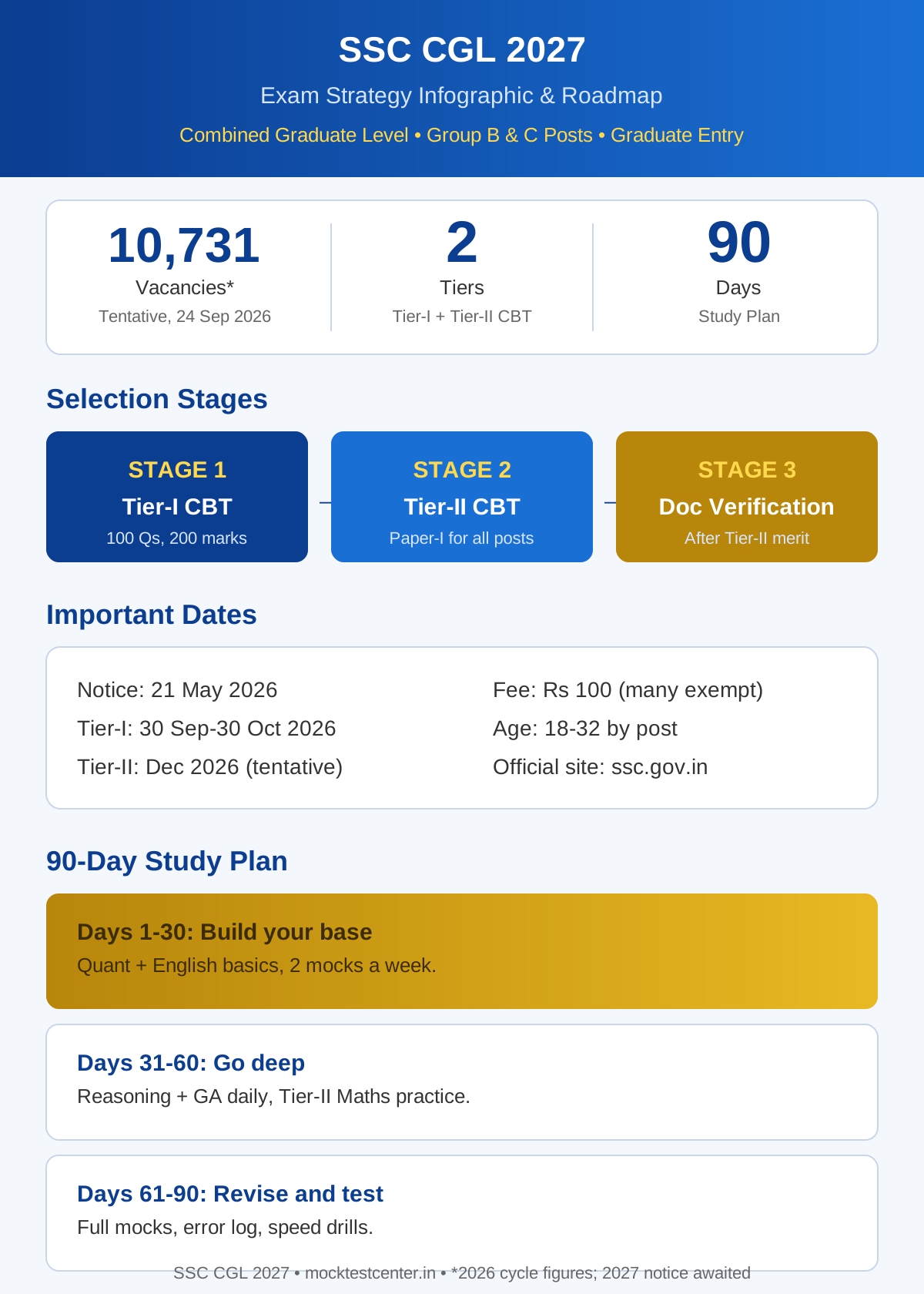
Vacancy means the number of empty posts. The notice of 21 May 2026 said there were about 12,256 tentative vacancies. Later, on 24 September 2026, SSC put out a tentative vacancy list that showed 10,731 vacancies across 59 post lines. SSC says the final number may change, because departments send their needs in stages.
The biggest post rows in the tentative list of 24 September 2026, as reported by secondary sources, are Inspector of Central Excise with 2,366 posts, Assistant Section Officer in the Central Secretariat Service with 668 posts, and Inspector of Income Tax with 595 posts. The posts sit in pay levels 4 to 8. Assistant Audit Officer is in Level 8 (basic pay Rs 47,600 to Rs 1,51,100). Assistant Section Officer, Inspector and Sub Inspector posts are in Level 7 (Rs 44,900 to Rs 1,42,400). Lower posts like Auditor, Accountant, Tax Assistant and Upper Division Clerk are in Levels 4 and 5. For 2027, no vacancy number has been published.
Exam pattern
CGL has two tiers, both computer based tests with objective questions, set in English and Hindi except the English sections.
Tier-I has 100 questions for 200 marks, in 60 minutes. There are four parts, with 25 questions and 50 marks each: General Intelligence and Reasoning, General Awareness, Quantitative Aptitude, and English Comprehension. Each part has its own 15-minute timer. Each wrong answer costs 0.50 marks. Tier-I only shortlists for Tier-II; its marks do not count in the final merit.
Tier-II Paper-I is compulsory for all candidates who clear Tier-I. Section I has Mathematical Abilities, 30 questions for 90 marks in 30 minutes, and Reasoning, 30 questions for 90 marks in 30 minutes. Section II has English, 45 questions for 135 marks in 40 minutes, and General Awareness, 25 questions for 75 marks in 20 minutes. Section III is the Computer Knowledge Test, 20 questions for 60 marks in 15 minutes, and it is qualifying. In Sections I, II and III, each wrong answer costs 1 mark. Paper-II (Statistics, JSO only) and Paper-III (Finance and Economics, AAO only) each have 100 questions for 200 marks, with 0.50 marks cut per wrong answer. The minimum qualifying marks are 30 percent for UR, 25 percent for OBC and EWS, and 20 percent for all other categories. Scores are normalised across shifts.
| Stage | Questions | Marks | Time |
|---|---|---|---|
| Tier-I (all four parts) | 100 | 200 | 60 minutes |
| Tier-II Paper-I, Section I (Maths + Reasoning) | 60 | 180 | 60 minutes |
| Tier-II Paper-I, Section II (English + GA) | 70 | 210 | 60 minutes |
| Tier-II Paper-I, Section III (Computer) | 20 | 60 | 15 minutes |
| Tier-II Paper-I, Section IV (DEST) | Typing test | Qualifying | 15 minutes |
| Tier-II Paper-II (Statistics, JSO only) | 100 | 200 | 2 hours |
| Tier-II Paper-III (Finance, AAO only) | 100 | 200 | 2 hours |
Syllabus
Syllabus means the list of topics you must study. In Tier-I, General Intelligence and Reasoning covers analogies, series, coding and decoding, puzzles, blood relations, direction sense, and non-verbal reasoning. General Awareness covers current events, history, geography, polity, economy, science, and static general knowledge about India. Quantitative Aptitude covers number systems, percentage, ratio, average, time and work, speed and distance, simple and compound interest, profit and loss, mensuration, algebra, geometry and trigonometry, and data interpretation. English Comprehension covers reading passages, vocabulary, grammar, synonyms and antonyms, idioms, one-word substitution, and spotting errors.
In Tier-II Paper-I, Mathematical Abilities goes deeper into the same Quant topics, with more hard questions on algebra, geometry, trigonometry and data interpretation. The Computer Knowledge Test covers computer basics, hardware and software, operating systems, MS Office, internet and email, and cyber security basics. Paper-II Statistics covers data, probability, sampling and index numbers. Paper-III covers finance, accounts and economics. Study the notice syllabus line by line.
Important dates
The 2026 cycle dates are as follows. The notice of examination was published on 21 May 2026. The online form was open from 21 May to 22 June 2026, and SSC reopened it from 23 to 25 June 2026. The last date to pay the fee was 26 June 2026. The Tier-I computer based test was held from 30 September to 30 October 2026, as fixed by the Important Notice of 12 September 2026. Some sources say the last Tier-I shift was on 28 October 2026, so the end date is given as 28 to 30 October 2026. The tentative answer key and response sheet came out on 4 November 2026. Tier-II is tentatively in December 2026, but SSC has not yet published a Tier-II date notice. For 2027, no dates have been published.
| Event | Date (2026 cycle) |
|---|---|
| Notice of examination | 21 May 2026 |
| Online form open | 21 May to 22 June 2026 |
| Fee payment last date | 26 June 2026 |
| Tier-I exam | 30 September to 30 October 2026 |
| Tier-I answer key / response sheet | 4 November 2026 |
| Tier-II exam | December 2026 (tentative, date not notified) |
| 2027 notice | Date awaited |
Cut-off
Cut-off means the lowest score that can pass a stage. There is no cut-off yet for the 2026 cycle, because the Tier-I result has not been declared. The best guide is the 2025 cycle, whose figures are from SSC result papers. In CGL 2025 Tier-I, for all posts other than Junior Statistical Officer and Statistical Investigator, the cut-off out of 200 normalised marks was UR 136.40, OBC 130.37, EWS 127.42, SC 115.03 and ST 106.39. These are the corrected figures from SSC's corrigendum of 14 January 2026 (the first printed UR figure, 136.83, was corrected).
The final cut-off is the Tier-II marks of the last candidate selected. In CGL 2025, the last UR candidate selected scored out of 390 marks in Tier-II Paper-I Sections I and II: 331 for ASO in the Central Secretariat Service, 348 for ASO in External Affairs, 350 for ASO in Railways, 319 for Inspector of Central Excise, and 362 for Assistant Enforcement Officer.
Best books
Books alone do not clear CGL. Practice and mock tests do. Still, a few standard books help. For Quantitative Aptitude, use the standard Quant books by R. S. Aggarwal and the previous year question papers of SSC. For Reasoning, solve puzzles daily from a standard book. For English, use a good grammar book, read the newspaper daily, and learn new words daily. For General Awareness, read NCERT books for history, geography and polity, and follow a monthly current affairs magazine. For Computer Knowledge, use a basic computer awareness book.
Solve the last 10 years of CGL papers in exam conditions, and keep one notebook each for Quant formulas, English words and current affairs.
90-day study plan
Days 1 to 30: Build your base. Study Quant for 3 hours, English for 2 hours, Reasoning for 1 hour and General Awareness for 1 hour every day. Finish the basic theory of all four subjects. Give 2 mock tests of Tier-I in this month, only to learn the pattern. Revise formulas nightly.
Days 31 to 60: Go deep. Move to Tier-II level Quant and English. Solve 50 Quant and 30 English questions daily from previous year papers. Give 2 Tier-I mocks every week and check every wrong answer. Start the Computer Knowledge Test topics, 30 minutes a day. Practise typing 15 minutes a day.
Days 61 to 90: Revise and test. Give 3 to 4 full Tier-I mocks every week, and 1 Tier-II Paper-I mock every week. Keep an error log and revise it daily. Do not start any new book now. Revise formulas, word lists and current affairs notes twice. In the last week, give one mock every day at the same time as the real exam.
How to use mock tests
Mock tests are practice tests that look like the real exam. They are the best tool for CGL, because each Tier-I part has its own 15-minute timer. Take the mock in one sitting. After the mock, spend an hour on analysis: check every wrong answer and revise that topic the same day.
Do not take 50 mocks and learn nothing. Take 20 to 25 mocks and learn from each one. Your Tier-I score should rise by 5 to 10 marks every 5 mocks. If it does not rise, change your plan. Spend more time on your weakest part, and less on your strongest part.
If you are also getting ready for another SSC exam, or for a state exam, the site has mock tests for those too. You can see SSC CHSL 2027, SSC MTS and Havaldar 2027, SSC GD Constable 2027, SSC CPO Sub Inspector 2027, SSC Stenographer 2027, SSC Junior Engineer 2027, SSC JHT 2027 and SSC Selection Post 2027 on this site. You can also see 72nd BPSC Prelims 2027, BPSC Assistant Section Officer 2027, BPSC Auditor 2027 and Indian Army NDA 2027 on this site. The official website for all SSC information is ssc.gov.in.
A last word
SSC CGL is a hard exam, but it is a fair one. There is no interview, so your marks alone decide your post. Every year, students from small towns and simple backgrounds clear it with steady study. The 2026 cycle has fewer vacancies than 2025, so the fight is tougher, but the posts are worth it: a stable central government job, good pay, and a clear path to grow.