
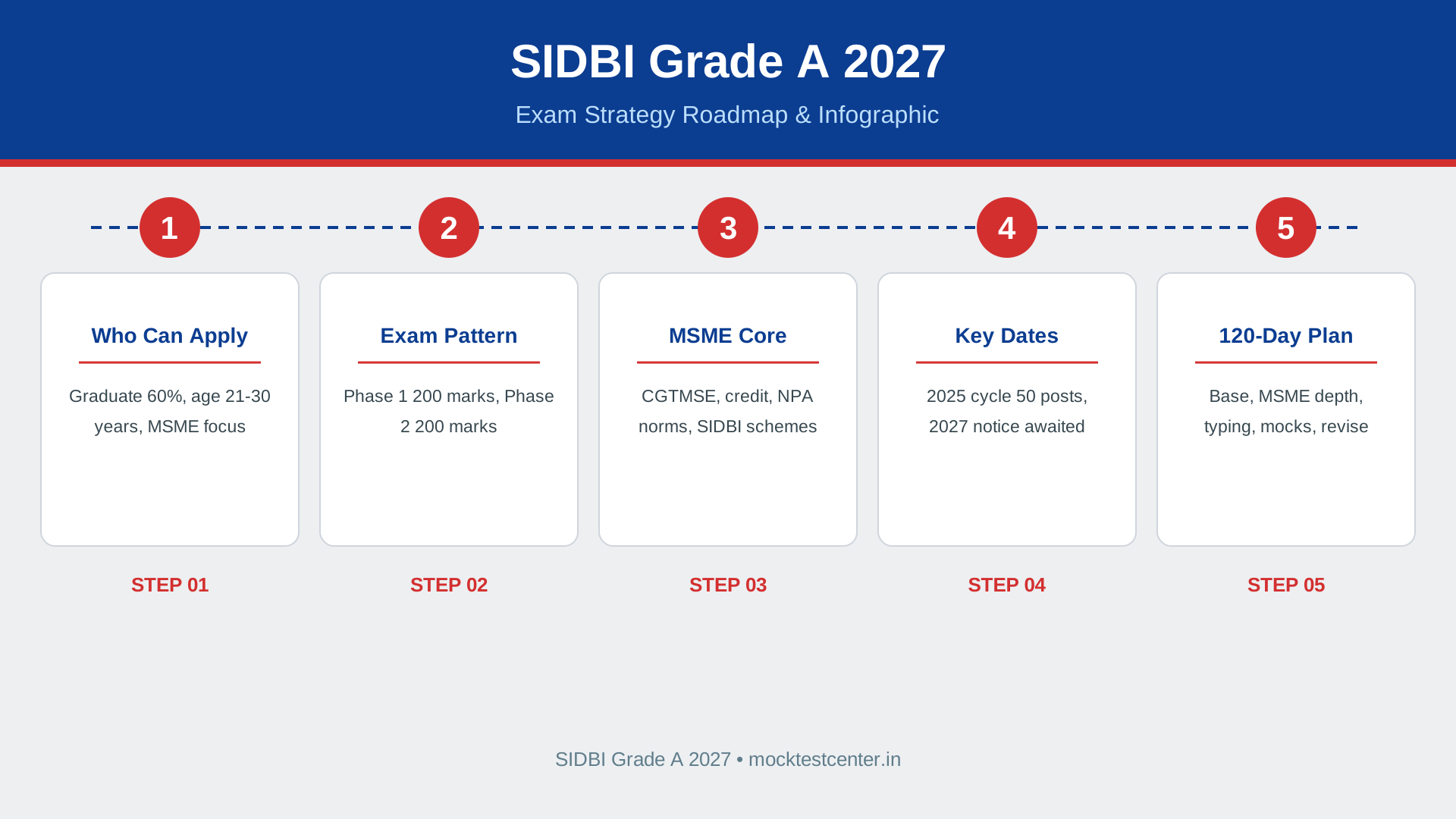
About SIDBI Grade A 2027 Exam Series
📖 Table of Contents
- Start with the last cycle, because it finished
- The 2025 cycle in full
- Who can apply for Grade A
- Fee, pay and probation
- How selection works: three stages
- Phase 1 in detail: seven sections, two kinds
- Phase 2 in detail: two papers, three parts
- What MSME knowledge really means
- Syllabus: the full map
- How to apply when the notice comes
- A 120 day plan that fits this exam
- Interview: what the panel wants
- Mistakes that cost marks here
- Cut offs: what no site can tell you yet
- Grade A or Grade B: a short comparison
- Other regulator exams on this site
- What to check first
SIDBI Grade A 2027
Start with the last cycle, because it finished
SIDBI Grade A is one of the few regulator exams where the last cycle is fully closed, with dates, vacancies and a final result all on record. The 2025 cycle ran under Advertisement 03/Grade A and B/2025-26. The notification came in July 2025, applications ran from 14 July to 11 August 2025, Phase 1 was held on 6 September 2025, Phase 2 on 4 October 2025, interviews in November 2025, and the final result was declared in January 2026. That is a complete cycle, and this page builds on it, since it is the best guide to what the 2027 cycle will look like.
No notification for the 2026 cycle had been released as of November 2026. SIDBI notified in July in 2023, 2024 and 2025, so a July pattern exists, but a pattern is not a promise, and the 2026 gap already broke the run. The 2027 cycle has no dates, no vacancy figure and no fee yet. Any site that prints a fixed 2027 date today is guessing, and this page will not join it.
SIDBI is the Small Industries Development Bank of India, the principal development financial institution for MSME promotion, financing and development in India. It was set up on 2 April 1990. Its Grade A post is Assistant Manager in the General Stream, and its Grade B post is Manager in the General and Specialist Streams. This page covers Grade A in full, and it covers Grade B only where the two recruitments share a notification, a paper or a date.
The 2025 cycle in full
The 2025 notification announced 76 vacancies in total: 50 for Assistant Manager Grade A in the General Stream, and 26 for Manager Grade B across the General and Specialist Streams. Grade B split into 11 General, 8 Legal and 7 Information Technology posts. Grade A split category wise into 20 unreserved, 5 EWS, 15 OBC, 7 SC and 3 ST posts, with five PwBD posts included inside the unreserved figure. That split matters, because the unreserved figure already contains the PwBD seats, and a candidate who reads 20 as 20 plus 5 will misjudge the queue.
One small conflict sits in the dates. Several trackers put the notification release on 13 July 2025, and one puts it on 14 July 2025, the same day applications opened. The application window itself is not in dispute: 14 July to 11 August 2025, with the fee paid inside that window. The exam dates are not in dispute either: Phase 1 on 6 September 2025 and Phase 2 on 4 October 2025. Where a date differs by a day between sources, this page gives the version with the wider support and flags the other one here.
| Event in 2025 | Date |
|---|---|
| Notification (Advt. 03/2025-26) | 13 July 2025 (one tracker says 14 July) |
| Applications open | 14 July 2025 |
| Applications close | 11 August 2025 |
| Phase 1 exam | 6 September 2025 |
| Phase 2 exam | 4 October 2025 |
| Interview | November 2025 |
| Final result | January 2026 |
That timetable is fast by regulator standards. About eight weeks separated the notification from Phase 1, and four weeks separated Phase 1 from Phase 2. A candidate who waits for the notification before starting preparation gets about two months for Phase 1 and one month for Phase 2, which is not enough for the MSME and descriptive parts of this exam. Start now, on the 2025 pattern, and let the notification catch up with you.
Who can apply for Grade A
Grade A General Stream asks for a graduation with at least 60 percent marks in Commerce, Economics, Mathematics, Statistics, Business Administration or Engineering, or a professional qualification such as CA, CS, CMA or CFA, or a full time MBA or PGDM of two years from a recognised university. SC, ST and PwBD candidates need 50 percent marks instead of 60. That 60 percent line is higher than many bank exams ask for, and it cuts the field before the exam begins, so check your final year percentage before you plan anything else.
Work experience is the one eligibility point where sources part ways, and you need to know about the split. One tracker says experience is not required for CA, CS, CMA and two year full time MBA or PGDM holders, and that other candidates need relevant experience in banking, NBFC or finance. Another reporting of the same notification lists two years of work experience in credit or MSME lending for non CA and non MBA candidates. The exact experience rule for each qualification route was not verified against the notification text in this pass, so this page will not state it as fact. Read the experience clause in the fresh notification with care, and do not assume your degree alone is enough until you have read it.
The age limit for Grade A in the 2025 cycle was 21 to 30 years as on 14 July 2025. Grade B asked for 25 to 33 years on the same date. Relaxation follows Government of India rules: five years for SC and ST, three years for OBC, ten years for PwBD, five years for ex servicemen. The result of your qualifying degree must be declared on or before the last date of application in the cycle you apply for. Indian citizenship is required.
Fee, pay and probation
The fee is another point where sources disagree, and the gap is wide enough to matter. One set of trackers reports the 2025 fee as 1,100 rupees for General, OBC and EWS candidates, and 175 rupees for SC, ST and PwBD candidates. Another tracker reports 1,000 rupees for General and OBC candidates, and 100 rupees for SC, ST and PwBD candidates. The 1,100 figure appears in the more detailed reports of the notification, and this page uses it as the working figure. The 1,000 figure may be a copy error from a different regulator exam, and it stays flagged here. Either way, the fee is paid online only, through debit card, credit card, net banking, IMPS or mobile wallet, and it does not come back.
Pay for Grade A starts at a basic of 44,500 rupees a month, in the scale 44,500 to 89,150 rupees over 17 years. Gross pay runs to about 1,00,000 rupees a month, and the annual CTC is reported at 19 to 21 lakh rupees. The package includes dearness allowance, house rent allowance, medical benefits, leave fare concession, vehicle and other loans at concessional rates, and leased accommodation. Probation runs for two years. Grade B starts higher, with gross pay reported at about 1,15,000 rupees a month, but this page is a Grade A page, and Grade B pay is given here only for comparison.
That pay, with a two year probation, sits near the top of the banking and regulator ladder for a fresh graduate. It is also the reason the exam draws candidates who already hold bank jobs. You will compete with people who have spent two years in a bank branch learning credit by doing it, and the MSME sections of this exam reward exactly that knowledge, so a fresh graduate needs a study plan that closes the experience gap on paper.
How selection works: three stages
Selection runs in three stages. Phase 1 is an online screening examination of one paper with seven sections, worth 200 marks in 120 minutes. Phase 2 is an online examination of two papers, worth 200 marks in total. Phase 3 is a personal interview of 100 marks, which includes marks for notable achievement in extracurricular activities at district, state or national level, and for awards or recognition in service, on documentary evidence.
The final selection and ranking rest on Phase 2 and the interview. Phase 1 marks play no part in the final merit. Phase 1 only decides who gets to sit for Phase 2. That shape is common across regulator exams, and it has the same consequence here as everywhere else. You need enough Phase 1 preparation to clear it safely, and you need the bulk of your time on Phase 2, because Phase 2 and the interview decide the list.
The interview deserves a note of its own. Most bank interviews test your personality and your general awareness. SIDBI adds a formal weight to achievements, which means a candidate with a district level sports certificate or a recognised award carries marks into the room that a candidate without them does not. Keep your certificates ready, and keep them in the format the notification asks for, since a claim without documentary evidence earns nothing.
Phase 1 in detail: seven sections, two kinds
Phase 1 has seven sections, and they split into two kinds. Four sections are qualifying only, and three sections decide the merit list for Phase 2. English Language, Reasoning Aptitude, Quantitative Aptitude and Computer Knowledge are qualifying, which means you must clear their cut offs, but their marks do not count toward shortlisting. General Awareness, MSME Knowledge, and the Stream Specific Test are merit sections, and their marks decide who moves to Phase 2.
| Phase 1 section | Questions | Marks | Nature |
|---|---|---|---|
| English Language | 30 | 30 | Qualifying |
| Reasoning Aptitude | 25 | 25 | Qualifying |
| Quantitative Aptitude | 25 | 25 | Qualifying |
| Computer Knowledge | 20 | 20 | Qualifying |
| General Awareness (banking, financial sector, ESI) | 20 | 20 | Merit |
| MSMEs: policy, regulatory and legal framework; finance and management | 30 | 30 | Merit |
| Stream Specific Test (MSME financing and credit assessment) | 50 | 50 | Merit |
| Total | 200 | 200 in 120 minutes |
One tracker page simplifies Phase 1 into four sections of 50 marks each: Reasoning, Quant, English and General Awareness. That version conflicts with the detailed seven section table above, which matches the notification text reproduced in the official pattern document. This page uses the seven section table, and it flags the four section version as a simplification that drops the MSME and stream specific sections entirely, which are the sections that decide the shortlist.
Read the table again and the strategy writes itself. The merit sections carry 100 of the 200 marks, and all 100 sit on MSME knowledge, banking awareness and credit assessment. A candidate who aces English, Reasoning and Quant but neglects MSME will clear the qualifying sections and still miss the shortlist, because the qualifying marks do not count. Give your best hours to the merit sections, and give the qualifying sections enough to clear their cut offs with comfort.
Negative marking is a quarter mark per wrong answer in the objective tests. All sections are bilingual except English. The paper is online, and the total time is 120 minutes for 200 questions, which gives you about 36 seconds a question. That is a fast paper, and the only way to hold the pace is timed mock practice.
Phase 2 in detail: two papers, three parts
Phase 2 has two papers. Paper 1 is English Language, a descriptive paper of essay, precis writing, comprehension and business or office correspondence, worth 75 marks in 75 minutes, with answers typed on the keyboard. Paper 2 splits into an objective part and a descriptive part. The objective part covers MSMEs, KYC, due diligence, financial ratios, credit assessment, NPA and IRAC norms, NBFC financing, investment banking, alternative investment funds, asset reconstruction companies and MSME development, with 50 questions worth 75 marks in 60 minutes. The descriptive part asks for long form answers on MSME, finance and credit topics, with four questions to attempt out of ten, worth 50 marks in 75 minutes.
That adds to 200 marks across the two papers. One tracker page reports a simpler split of 100 marks per paper, and this page flags that as a conflicting summary. The detailed split above, 75 plus 75 plus 50, comes from the more detailed pattern reporting, and it matches the structure of the official pattern document. If the fresh notification changes the split, the notification wins, and this page will need a correction.
The descriptive parts of Phase 2 are where this exam is won or lost. Paper 1 tests whether you can write a clear essay, shrink a passage into a precis, and draft a business letter in 75 minutes. The descriptive part of Paper 2 tests whether you can write a reasoned answer about a credit case, an NPA norm or a SIDBI scheme. Both need typing practice, since the answers are typed on screen, and typing speed under a clock is a skill of its own. Practise on a keyboard, not on paper, for this phase.
What MSME knowledge really means
MSME is the heart of this exam, and it is the part that most general banking aspirants get wrong. MSME means micro, small and medium enterprises, and SIDBI exists to finance and develop them. The exam tests the policy frame around them, the legal frame, the finance frame and the management frame, and it tests them as one subject, not four.
Start with the definitions: investment and turnover limits for micro, small and medium units, and how the Udyam registration system works. Then learn the schemes: CGTMSE, the credit guarantee fund, PM SVANidhi for street vendors, the SIDBI schemes for refinance and direct lending, and the funds SIDBI runs for venture capital and microfinance. Then learn the credit side: working capital assessment, term loan appraisal, financial ratios, due diligence, KYC, NPA and IRAC norms, and the difference between a standard asset and a substandard one.
Two schemes deserve a closer look, since they appear in the papers year after year. CGTMSE is the Credit Guarantee Fund Trust for Micro and Small Enterprises, and it gives a guarantee cover to banks that lend to small units without collateral, which is why a banker can approve a loan that has no security behind it. PM SVANidhi gives working capital loans to street vendors, and it rewards digital repayment with a cashback, which is why it appears in questions about financial inclusion. Learn what each scheme covers, who can use it, and what the loan limit is, and you will answer the scheme questions that other candidates leave blank.
Then read about the institutions around SIDBI: the role of the Reserve Bank, the role of the Ministry of MSME, the role of state financial corporations, and the role of NBFCs in MSME lending. The Phase 1 stream specific test and the Phase 2 Paper 2 both draw from this ground, so every hour you spend here counts twice. A candidate who reads only general banking awareness will find half the merit marks out of reach.
Syllabus: the full map
Phase 1 English covers comprehension, grammar, vocabulary and error spotting. Reasoning covers puzzles, seating, coding, blood relations, direction, series and syllogisms. Quant covers arithmetic, number systems, percentage, ratio, average, profit and loss, interest and data interpretation. Computer Knowledge covers basics of hardware, software, networks, the internet and common applications.
General Awareness in this exam leans hard toward the banking and financial sector and economic and social issues, with current affairs of the last six months carrying the most weight. The MSME section covers the policy, regulatory and legal framework for MSMEs, and the finance and management of MSMEs. The stream specific test for the General Stream covers MSME financing, due diligence, KYC, financial ratios, working capital and term loan assessment, NPA and IRAC norms, NBFC financing, and credit risk assessment.
Phase 2 Paper 1 is descriptive English, and Paper 2 is professional knowledge, as set out above. The syllabus note in the notification says the syllabus is only indicative and not exhaustive, which is the notification's way of telling you that the examiner can ask anything inside the subject. Do not study to a fixed list. Study the subject, and read the SIDBI website for the institution's own words on its schemes. The official site is sidbi.in, and the careers page is where every notice appears.
How to apply when the notice comes
Applications go online through the SIDBI website, at sidbi.in, on the careers page. You register with a valid email and mobile number, fill personal details, pick the post and stream, upload a photo, signature, left thumb impression and handwritten declaration, and pay the fee online. The application window in 2025 ran for about four weeks, from 14 July to 11 August, which is generous, but the portal slows in the last days, so apply in the first week if you can.
Keep your degree certificate, mark sheets, experience certificate if your route asks for one, caste or EWS certificate, PwBD certificate and photo ID ready in scanned form before the window opens. The photo and signature have fixed size limits, and a rejected upload on the last day has ended many applications. Keep a printout of the submitted form, since the registration number and password are your keys to the admit card.
Apply for one stream only if you are eligible for one, and read the notification before you choose between Grade A and Grade B, since the two posts have different age limits, different experience rules and different papers. A candidate who applies for both without reading the rules risks a rejected form on a technical point.
A 120 day plan that fits this exam
Days 1 to 30 belong to the base and to MSME. Give one hour a day to Quant and Reasoning, one hour to English, and two hours to MSME basics: definitions, Udyam, CGTMSE, PM SVANidhi, SIDBI schemes and credit appraisal. Read the newspaper daily, and keep a notebook for MSME news, RBI circulars and SIDBI announcements. Start typing practice early, since Phase 2 is typed.
Days 31 to 60 add the professional depth. Keep the Phase 1 practice going, but give two hours a day to credit assessment, financial ratios, NPA and IRAC norms, and NBFC financing. Read one SIDBI scheme document a week, and write a short note on it in your own words. Take one full Phase 1 mock test every week, under the 120 minute clock, and spend an hour after each test on the questions you got wrong. Write one essay and one precis every week.
Days 61 to 90 shift the weight toward Phase 2. Take a Phase 1 mock every three days, and write descriptive answers daily. Practise the Paper 2 descriptive format, four questions out of ten in 75 minutes, which means about 18 minutes a question, including thinking time. Revise your MSME notes twice. Read the SIDBI annual report in small pieces, one chapter a week.
Days 91 to 120 are for revision and testing. Take a mock test every two days, and in the last week take one every day. Revise your short notes daily. Stop reading new books in the last ten days, and solve only past papers and your error notes. The night before Phase 1, sleep. A tired mind answers 200 questions slower than a rested one, and the clock does not forgive it.
Interview: what the panel wants
The interview carries 100 marks, and it includes marks for notable achievements, so bring your certificates and your story with you. Expect questions on SIDBI, on MSME, on the economy, and on your own degree and work. A commerce graduate should expect questions on balance sheets and ratios. An engineer should expect questions on why a technical graduate wants a credit job. A candidate with work experience should expect questions on the work itself, since the panel will test what the experience certificate claims.
Read the SIDBI website before the interview, and read it like a person who will work there. Know the schemes by name, know the difference between refinance and direct lending, and know one or two recent SIDBI announcements well enough to discuss them. Keep your answers short and plain, and say plainly when you do not know an answer, since a confident guess in an interview costs more than an honest gap.
Mistakes that cost marks here
The first mistake is treating this like a bank PO exam. The qualifying sections look like a PO paper, but the merit sections are MSME and credit, and a PO preparation plan that ignores them will clear the qualifying cut offs and miss the shortlist. It is a different exam, and it rewards different reading.
The second mistake is leaving descriptive practice for the last month. Phase 2 is half the final merit, and its descriptive parts need typing speed, structure and subject depth together. A candidate who writes well by hand but types slowly will run out of time in Paper 1. Practise typing from the first month, and practise it on a keyboard with a clock.
The third mistake is guessing too much in Phase 1. A quarter mark penalty on every wrong answer adds up across 200 questions, and random guesses on 20 questions will cost you about five marks. In a 50 post exam, five marks is often the gap between the shortlist and the waiting room. Guess only when you can remove two options with confidence.
The fourth mistake is ignoring the experience clause. If your qualification route asks for two years of experience and you apply without it, your form can fail at document verification, after you have cleared the written phases. Read the clause, and if your route needs experience, keep the certificate ready in the format the notification asks for.
Cut offs: what no site can tell you yet
No verified cut off marks for the 2025 cycle were found in this pass, and this page gives no cut off figures. One tracker page prints memory based Phase 1 cut offs for 2022, 2023 and 2024, with General category figures near 160 to 168 out of 200, and those figures are labelled memory based on that page itself. This page will not repeat them as fact, since memory based numbers from a coaching page are not a source. Cut offs move with the number of posts, the number of candidates and the difficulty of the paper, and a 50 post exam will set cut offs that look nothing like a bank exam with 5,000 posts.
What you can do instead is aim high in the merit sections, since only the merit sections decide the shortlist, and aim safe in the qualifying sections, since they only ask you to clear their cut offs. A merit score that would top a mock test list is the right ambition. Everything else is noise.
Grade A or Grade B: a short comparison
Grade A and Grade B share a notification, and many candidates wonder which to pick. Grade A is Assistant Manager in the General Stream, with 50 posts in 2025, an age window of 21 to 30, and a basic pay of 44,500 rupees. Grade B is Manager in the General and Specialist Streams, with 26 posts in 2025, an age window of 25 to 33, and a higher pay. Grade B asks for more experience and more depth, and its applicant pool is smaller and older.
If you are 21 to 24 with a fresh degree, Grade A is your post, and Grade B is not open to you yet. If you are 25 to 30 with experience, you may qualify for both, and you should read both sets of rules before you choose. If you hold a law degree or an IT degree, the Grade B specialist streams may suit you better than the Grade A general pool. The right choice is the one where your age, degree and experience put you in the smallest crowd with the strongest papers.
Other regulator exams on this site
SIDBI is one of several regulator exams, and many candidates prepare for two or three of them together, since the syllabuses overlap on economics, finance and descriptive English. See RBI Grade B 2027, RBI Grade B DEPR 2027, NABARD Grade A 2027, NABARD Grade B 2027, SEBI Grade A 2027, PFRDA Grade A 2027, IRDAI Assistant Manager 2027, IFSCA Grade A 2027, FSSAI Technical Officer 2027 and FSSAI Assistant 2027 on this site.
What to check first
Open sidbi.in and look at the careers page once a week until the notice appears. Start MSME reading this week, start typing practice this week, and check your graduation percentage and your experience route against the 2025 rules before you plan anything else. The 2025 cycle is your map, the July pattern is your rough clock, and the next notification is the only date that counts.







