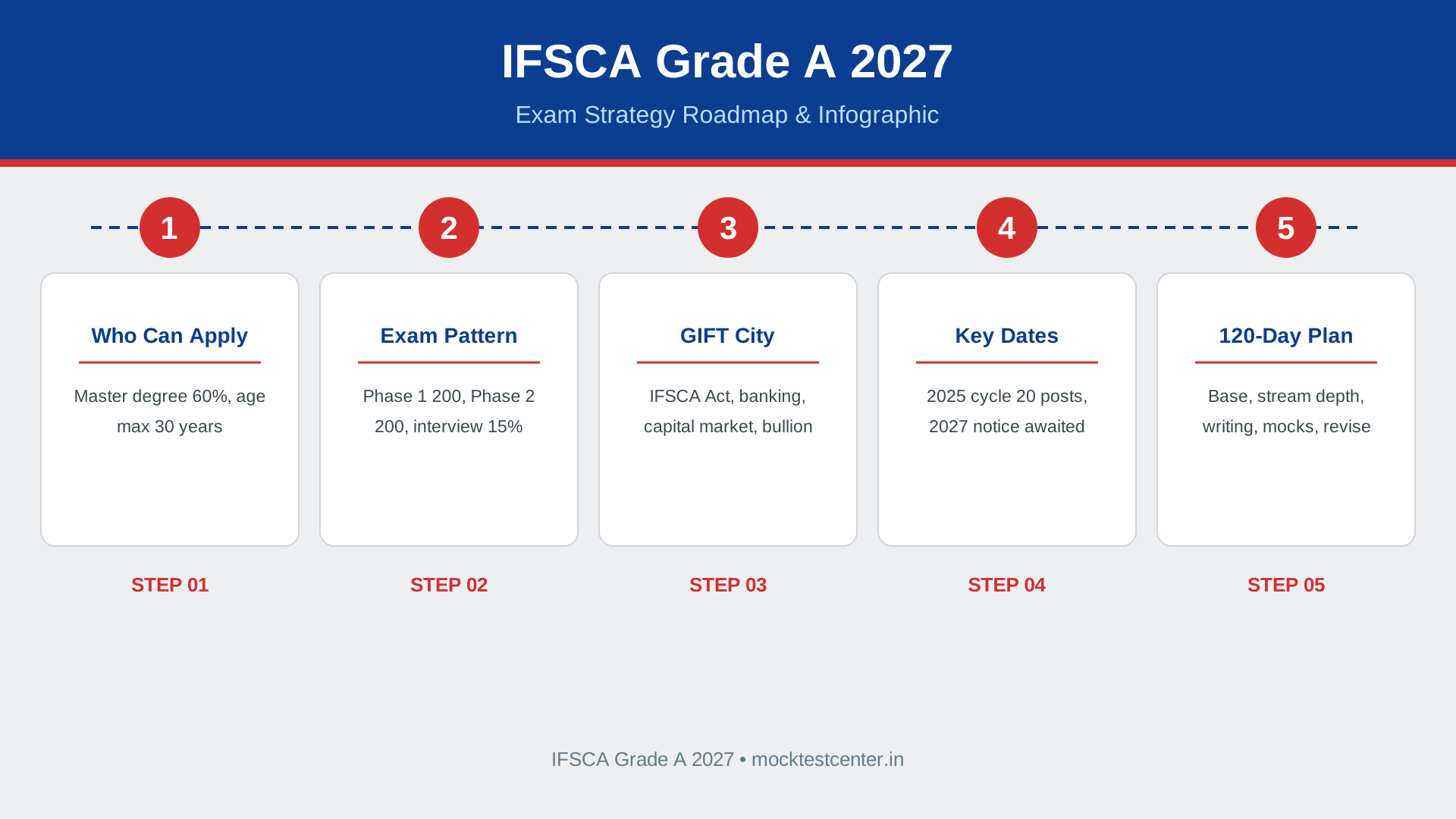
About IFSCA Grade A 2027 Exam Series
📖 Table of Contents
- The newest regulator exam in India
- The 2025 cycle in full
- Who can apply: three streams
- Fee, pay and probation
- How selection works: three phases
- Phase 1 in detail: two papers, 200 marks
- Phase 2 in detail: English writing and stream depth
- What GIFT City is, and why the exam tests it
- Syllabus: the full map
- How to apply when the notice comes
- A 120 day plan that fits this exam
- Interview: what the panel wants
- Mistakes that cost marks here
- Cut offs: what no site can tell you yet
- Is this exam annual, or a one off
- Other regulator exams on this site
- What to check first
IFSCA Grade A 2027
The newest regulator exam in India
IFSCA Grade A is the newest regulator exam in India, and that fact shapes everything about it. The International Financial Services Centres Authority held its first Assistant Manager recruitment in 2025, with 20 posts, and the whole cycle, from advance notice to final merit list, ran inside five months. There is no ten year paper trail to study, no old cut off trend to lean on, and no second cycle to confirm the pattern. What you get instead is a clean, well documented first cycle, and this page builds on it.
The 2025 cycle began with an advance intimation notice on 4 September 2025, and the detailed notification followed days later. Applications ran from 11 to 25 September 2025. Phase 1 was held on 11 October 2025, Phase 2 on 15 November 2025, interviews from 19 to 23 January 2026, and the final merit list came out on 23 January 2026. That is a complete cycle, and it is the only solid ground this page stands on. No 2026 notification had been released as of November 2026, and the 2027 cycle has no dates, no vacancy figure and no fee yet.
IFSCA is a statutory body set up by an Act of Parliament, the IFSCA Act of 2019, on 27 April 2020. It sits at GIFT City in Gandhinagar, Gujarat. It exercises the powers of the Reserve Bank, SEBI, IRDAI and PFRDA for financial products, services and institutions inside International Financial Services Centres. That is a wide mandate for a young body, and it is why the exam tests four regulators worth of knowledge in one paper.
The 2025 cycle in full
The 2025 recruitment offered 20 Assistant Manager posts in the Officer Grade A rank, across three streams. The General Stream took 12 posts, the Legal Stream took 4, and the Information Technology Stream took 4. The vacancies were indicative, and IFSCA kept the right to increase or decrease them, or to fill none of them, at any stage. Twenty posts is a small number, and the General Stream, with 12 posts, will carry the largest crowd.
One small conflict sits in the dates. One tracker page puts the detailed notification on 10 September 2025, and two others put it on 11 September 2025, the same day applications opened. The application window itself is not in dispute: 11 to 25 September 2025, closing at 11.59 pm on the last day. The exam dates are not in dispute either: Phase 1 on 11 October 2025, a Saturday, and Phase 2 on 15 November 2025, also a Saturday. Where a date differs by a day between sources, this page gives the version with the wider support and flags the other one here.
| Event in 2025 | Date |
|---|---|
| Advance intimation notice | 4 September 2025 |
| Detailed notification | 11 September 2025 (one tracker says 10 September) |
| Applications open | 11 September 2025 |
| Applications close | 25 September 2025 |
| Phase 1 exam | 11 October 2025 |
| Phase 2 exam | 15 November 2025 |
| Interviews | 19 to 23 January 2026 |
| Final merit list | 23 January 2026 |
That timetable is fast, and the application window is short. Fourteen days separated the opening of applications from the closing, which is one of the shortest windows in any regulator exam. A candidate who learns about the notice in its second week gets a few days to arrange documents, pay the fee and apply. Keep your documents ready now, so a short window never catches you out.
Who can apply: three streams
The General Stream asks for a master degree in Statistics, Economics, Commerce, Business Administration in Finance, or Econometrics, or an equivalent qualification, with at least 60 percent marks. That is a postgraduate bar, and it is higher than most regulator exams ask for. A bachelor degree alone does not qualify for the General Stream here, however strong the marks. If you hold only a bachelor degree, this stream is closed to you, and you should not waste the fee on it.
The Legal Stream asks for a bachelor degree in Law with at least 60 percent marks. The IT Stream asks for a bachelor degree in Information Technology or Computer Science, or an MCA, or a degree in Information Technology, with at least 60 percent marks. The IT Stream also faces a coding test after Phase 2, which is a qualifying test, and this page covers it below.
The age limit in the 2025 cycle was a maximum of 30 years as on 25 September 2025. One tracker reports the age window as 21 to 30 years, and this page notes that the minimum of 21 years comes from a single tracker, not from the notification summary, so treat the minimum as reported rather than confirmed. Relaxation follows Government of India rules: five years for SC and ST, three years for OBC in the non creamy layer, ten years for PwBD, five years for ex servicemen. The EWS rule asks for a family gross annual income below 8 lakh rupees, with asset criteria as per Government of India guidelines, and a certificate valid for 2025-26.
Your qualifying result must be declared on or before 25 September 2025 in the 2025 cycle, and the percentage is counted to two decimal places, with CGPA or OGPA conversion as per university norms. Indian citizenship is required. If you are eligible for more than one stream, you must file a separate application for each stream, and you must pay the fee for each one.
Fee, pay and probation
The 2025 fee was 1,000 rupees for General, OBC and EWS candidates, as application fee plus intimation charges inclusive of GST, and 100 rupees for SC, ST and PwBD candidates, as intimation charges inclusive of GST. The fee is non refundable, and it is paid online through debit card, credit card, internet banking, IMPS, cash card or mobile wallet, inside the application window of 11 to 25 September 2025. No offline application was accepted.
Pay is where two sources disagree, and the gap is wide enough to matter. One set of 2025 cycle reports puts the post in Pay Level 12, at 62,500 to 1,26,100 rupees over 17 years under the Seventh Central Pay Commission, with gross pay of about 1,80,000 rupees a month, including the NPS contribution, grade allowance, special allowance, dearness allowance and housing allowance. Another tracker page lists a basic pay of 44,500 rupees in the scale 44,500 to 89,150 rupees, which is the standard regulator scale used by RBI, SEBI and IRDAI. The Level 12 figure appears in the more detailed 2025 cycle reporting, and this page uses it as the working figure. The 44,500 figure looks like a copy from another regulator exam, and it stays flagged here. If the Level 12 figure holds, this is the best paid entry grade post among the financial regulators.
Probation runs for two years. Benefits reported for the post include leave travel concession, medical benefits, personal accident insurance, education allowance, knowledge updation allowance, a briefcase allowance and conveyance. The posting is at GIFT City, Gandhinagar, Gujarat, where the Authority sits. That is a single location posting, unlike the all India posting of most regulator jobs, and it suits candidates who are happy to live and work in Gujarat.
How selection works: three phases
Selection runs in three phases. Phase 1 is an online screening examination of two papers of 100 marks each. Phase 2 is an online examination of two papers of 100 marks each. Phase 3 is an interview. The final selection rests on Phase 2 and the interview, with Phase 2 carrying 85 percent weight and the interview carrying 15 percent weight. Phase 1 marks play no part in the final merit. Phase 1 only decides who gets to sit for Phase 2.
That ratio is the single most important number in this exam, and every hour of preparation should bend toward it. A candidate who tops Phase 1 by a wide margin gains nothing from the extra marks. A candidate who scrapes through Phase 1 and writes strong descriptive English and strong stream answers in Phase 2 can still finish at the top of the final list. So Phase 1 deserves enough work to clear it safely, and Phase 2 deserves the bulk of your time.
The IT Stream has one extra step. After Phase 2, IT candidates face a coding test, which is qualifying in nature. The coding test carries no merit marks. A candidate who fails it still stops there. If you apply in the IT Stream, keep your coding practice going alongside the written preparation, since a qualifying test still blocks you if you fail it.
Phase 1 in detail: two papers, 200 marks
Phase 1 has two papers, each worth 100 marks and each given 60 minutes. Paper 1 is common to all streams, and it has four parts of 25 questions each: General Awareness of the financial sector, English Language, Quantitative Aptitude, and Test of Reasoning. Paper 2 is stream specific, with 50 questions of two marks each. For the General Stream, Paper 2 covers general knowledge, current events of national and international importance, economic and social development, commerce, accountancy, management, finance and costing, the Indian economy, the global economy, five year plans, and central government initiatives and schemes in the financial sector. For the Legal and IT Streams, Paper 2 covers the specialised subject of the stream.
| Phase 1 paper | Marks | Time | Cut off |
|---|---|---|---|
| Paper 1, common: GA financial 25, English 25, Quant 25, Reasoning 25 | 100 | 60 minutes | 30 percent |
| Paper 2, stream specific: 50 questions of 2 marks | 100 | 60 minutes | 40 percent |
| Total | 200 | 120 minutes |
Negative marking is a quarter of the marks assigned to the question, for both papers in Phase 1. There is no sectional cut off inside Paper 1, only the overall cut off of 30 percent for the paper, and a cut off of 40 percent for Paper 2. That is a kinder structure than exams with a cut off in every section, since a weak section inside Paper 1 can be carried by a strong one. But the Paper 2 cut off of 40 percent is a real bar, and the stream paper is where the exam separates the serious candidates from the rest.
Sixty minutes for 100 marks in each paper gives you about 36 seconds a mark, which is a fast pace. The General Stream Paper 2 is a knowledge paper, not a speed paper, and it rewards reading more than practice. The Paper 1 sections reward practice more than reading. Give each paper the kind of preparation it asks for, and do not prepare for both in the same way.
Phase 2 in detail: English writing and stream depth
Phase 2 also has two papers of 100 marks each, each given 60 minutes. Paper 1 is common to all streams, and it is an English descriptive test: precis writing for 35 marks, essay writing for 30 marks, and comprehension for 35 marks. Paper 2 is stream specific, with 50 questions of two marks each. For the General Stream, Paper 2 covers the IFSCA Act, the Union Budget, the Economic Survey, banking, capital markets, insurance, pension funds, bullion, GIFT City, GIFT IFSC, IFSCA itself, and global financial centres.
Negative marking of a quarter mark per wrong answer applies to Paper 2 only in Phase 2, since Paper 1 is descriptive. The cut offs are 30 percent for Paper 1 and 40 percent for Paper 2. Paper 1 carries a weight of one third in the Phase 2 total, and Paper 2 carries a weight of two thirds, so the stream paper counts double the English paper in the final merit. That weight is worth remembering when you divide your study hours.
The descriptive English paper is where most candidates lose marks they should not lose. A precis keeps the passage to a third of its length, in your own words, with the facts kept and the decoration cut. An essay builds an argument with a beginning, a middle and an end, written in clean sentences. Practise both by hand on a clock, and get them read by someone who writes well, since you cannot grade your own writing with fresh eyes.
What GIFT City is, and why the exam tests it
GIFT City is the Gujarat International Finance Tec-City, near Gandhinagar, and it is India's first International Financial Services Centre. IFSCA regulates the financial institutions that work inside it: banks, insurers, capital market firms, fund managers and bullion exchanges. The exam tests GIFT City and the IFSCA Act because the job is about this centre, and the regulator wants officers who know what the centre is before they join it.
One more detail helps in both the papers and the interview. An IFSC banking unit is a branch of an Indian or foreign bank that works inside the IFSC, and it deals mainly in foreign currency business, which is why the exam asks about it alongside the domestic banking system. A fund manager in GIFT City runs schemes for investors who want India exposure without using the domestic market, and the regulator watches those schemes under a separate set of rules. Learn the names of the main entities in the centre, and learn what each one is allowed to do, since the Paper 2 questions often turn on exactly that distinction.
Read the IFSCA Act of 2019 in its main parts, and read the IFSCA website for the list of regulated entities and the recent circulars. The official site is ifsca.gov.in, and the careers page is where every notice appears. Learn the difference between an IFSC and a domestic financial centre, learn what an IFSC banking unit does, and learn what a bullion exchange does, since bullion is one of the subjects named in the Paper 2 syllabus, and it is the subject most candidates have never studied.
The global financial centres part of the syllabus asks you to know how London, New York, Singapore, Hong Kong, Dubai and Dublin run their markets, and what India can learn from them. You do not need deep knowledge of each centre. You need a clear paragraph on each one: what it trades, who regulates it, and what makes it work. That is enough for a two mark question, and it is the kind of reading that also helps in the interview.
Syllabus: the full map
Phase 1 Paper 1 covers General Awareness of the financial sector, English Language, Quantitative Aptitude and Test of Reasoning. The General Awareness here is financial, not general, so read the financial news with care, and keep notes on the Reserve Bank, the Union Budget, the Economic Survey and the markets. English covers comprehension, grammar and vocabulary. Quant covers arithmetic, number systems, percentage, ratio, average, profit and loss, interest and data interpretation. Reasoning covers puzzles, seating, coding, blood relations, direction, series and syllogisms.
Phase 1 Paper 2 for the General Stream covers general knowledge, current events of national and international importance, economic and social development, including sustainable development, poverty, inclusion and demographics, commerce, accountancy, management, finance and costing, the Indian economy, the global economy, five year plans, and central government initiatives and schemes in the financial sector. That is a broad list, and it is the list that makes this paper hard. No single book covers it, and you need to read across economics, commerce and current affairs together.
Phase 2 Paper 1 is descriptive English, and Paper 2 for the General Stream covers the IFSCA Act, the Union Budget, the Economic Survey, banking, capital markets, insurance, pension funds, bullion, GIFT City, GIFT IFSC, IFSCA and global financial centres. For the Legal Stream, Paper 2 covers the specialised subject in the annexure to the notification, and for the IT Stream it covers the IT specialisation. The notification carries the full syllabus for each stream, and this page does not reproduce it in full, because a wrong syllabus is worse than a short one.
How to apply when the notice comes
Applications go online through the IFSCA portal, on the link that IFSCA publishes with the notification. In 2025 the link ran on ibpsonline.ibps.in, and the careers page on ifsca.gov.in carried the notice. You register with a valid email and mobile number, fill personal details, pick your stream, upload a photo, signature, left thumb impression and handwritten declaration in English, and pay the fee online. If you are eligible for more than one stream, you must file a separate application for each stream.
Keep your degree certificate, mark sheets, caste or EWS certificate, PwBD certificate and photo ID ready in scanned form before the window opens. The 2025 window ran for only fourteen days, from 11 to 25 September, so a candidate who starts arranging documents after the notice appears will lose half the window to paperwork. Apply in the first days, not the last, because the portal slows when thousands of candidates log in at once. Keep a printout of the submitted form, since the registration number and password are your keys to the admit card.
A 120 day plan that fits this exam
Days 1 to 30 belong to the base and to the IFSCA Act. Give one hour a day to Quant and Reasoning, one hour to English, and two hours to economics and the financial sector. Read the newspaper daily, and keep a notebook for Budget and Economic Survey facts, RBI announcements and IFSCA circulars. Read the IFSCA Act in small pieces, one part a week, and make notes in your own words. Start writing one short essay a week from day one, because descriptive writing is a slow skill.
Days 31 to 60 add the stream depth. Keep the Phase 1 practice going, but give two hours a day to the Paper 2 subjects: banking, capital markets, insurance, pension funds and bullion. Read the Economic Survey in small pieces, and keep a page of numbers that matter: growth, inflation, fiscal deficit and the size of the financial sector. Take one full Phase 1 mock test every week, under the 120 minute clock, and spend an hour after each test on the questions you got wrong. Write one essay and one precis every week.
Days 61 to 90 shift the weight toward Phase 2. Take a Phase 1 mock every three days, and write descriptive answers daily. Practise precis writing, since it is the paper where candidates lose the most marks for the least reason, by writing too much or by copying the passage instead of shrinking it. Revise your GIFT City and IFSCA notes twice. If you are in the IT Stream, add coding practice to the routine, since the coding test after Phase 2 is qualifying and still blocks you if you fail it.
Days 91 to 120 are for revision and testing. Take a mock test every two days, and in the last week take one every day. Revise your short notes daily. Stop reading new books in the last ten days, and solve only past papers and your error notes. The night before Phase 1, sleep. A tired mind answers 200 marks of questions slower than a rested one, and the clock does not forgive it.
Interview: what the panel wants
The interview carries 15 percent of the final merit, and it is the last step before the list. Expect questions on IFSCA, on GIFT City, on the financial sector, and on your own degree. A commerce postgraduate should expect questions on accounting and finance. A law graduate should expect questions on the IFSCA Act and on financial regulation. An IT graduate should expect questions on systems and on the coding test. Read the IFSCA website before the interview, and read it like a person who will work there, not like a student revising a chapter.
Know one or two recent IFSCA announcements well enough to discuss them, and know why you want to work at GIFT City rather than in a bank in Mumbai. Keep your answers short and plain, and say plainly when you do not know an answer, since a confident guess in an interview costs more than an honest gap. The panel has read your Phase 2 papers, so it knows what you can write, and it will test what you can say.
Mistakes that cost marks here
The first mistake is treating this like a bank PO exam. The Paper 1 sections look like a PO paper, but Paper 2 in both phases is about the financial sector, the IFSCA Act and GIFT City, and a PO preparation plan that ignores them will clear Paper 1 and fail Paper 2. It is a different exam, and it rewards different reading.
The second mistake is applying in the General Stream with only a bachelor degree. The General Stream asks for a master degree, and a bachelor degree alone does not qualify, however strong the marks. Check the eligibility rule for your own degree before you pay the fee, since a rejected form costs the fee and the cycle.
The third mistake is leaving descriptive practice for the last month. Phase 2 is 85 percent of the final merit, and its Paper 1 is descriptive English. A candidate who writes well by hand but has never written a precis under a clock will lose marks that no amount of objective practice can win back. Start writing in the first month, and keep it going even while Phase 1 practice fills your days.
The fourth mistake is missing the window. Fourteen days is short, and the 2025 window closed at 11.59 pm on 25 September 2025. A candidate who learns about the notice in its second week gets a few days to arrange documents, pay the fee and apply. Keep your documents ready now, so a short window never catches you out.
Cut offs: what no site can tell you yet
No verified cut off marks for the 2025 cycle were found in this pass, and this page gives no cut off figures. Any site that prints an exact IFSCA cut off for the next cycle is inventing it, and you should treat that number as decoration. Cut offs move with the number of posts, the number of candidates and the difficulty of the paper, and a 20 post exam with a first ever paper will set cut offs that look nothing like a bank exam with 5,000 posts.
What you can do instead is aim high in Paper 2 of both phases, since Paper 2 carries the higher cut off and the higher weight, and aim safe in Paper 1, since Paper 1 only asks you to clear 30 percent. A Paper 2 score that would top a mock test list is the right ambition. Everything else is noise.
Is this exam annual, or a one off
Nobody knows yet. IFSCA held its first Grade A recruitment in 2025, and no 2026 notification had been released as of November 2026. That gap may mean the Authority recruits every two years, or it may mean the next notice is simply late. One cycle is not enough to call a pattern, and this page will not call one.
What you can do is prepare on the 2025 pattern and watch the careers page on ifsca.gov.in once a week. If the next notice comes in 2027, you will be ready. If it comes later, your preparation still counts toward RBI, SEBI, IRDAI and NABARD, since the syllabuses overlap on economics, finance and descriptive English. Preparation for this exam is never wasted, even if the notice takes its time.
Other regulator exams on this site
IFSCA is one of several regulator exams, and many candidates prepare for two or three of them together, since the syllabuses overlap on economics, finance and descriptive English. See RBI Grade B 2027, RBI Grade B DEPR 2027, NABARD Grade A 2027, NABARD Grade B 2027, SEBI Grade A 2027, PFRDA Grade A 2027, IRDAI Assistant Manager 2027, SIDBI Grade A 2027, FSSAI Technical Officer 2027 and FSSAI Assistant 2027 on this site.
What to check first
Open ifsca.gov.in and look at the careers page once a week until the notice appears. Check your degree against the 2025 eligibility rules before you plan anything else, since the master degree bar for the General Stream closes the door for bachelor degree holders. Start Phase 1 practice now, start descriptive writing this week, and keep your documents ready for a short window. The 2025 cycle is your map, GIFT City is your subject, and the next notification is the only date that counts.