About SSC MTS and Havaldar 2027 Exam Series
📖 Table of Contents
SSC MTS and Havaldar 2027
What is this exam
SSC means Staff Selection Commission. MTS means Multi-Tasking Staff (Non-Technical). Havaldar is a uniformed post in the Central Board of Indirect Taxes and Customs, or CBIC, and the Central Bureau of Narcotics, or CBN. This is the biggest central government exam for students who have passed Class 10. One common test can get you an MTS post in a central government office, or a Havaldar post.
MTS is a Group C, non-gazetted, non-ministerial post, with general office and field support work. Havaldar is also a Group C post, but it is uniformed, so Havaldar candidates must also pass a physical test. The selection is a single computer based examination in two sessions on the same day, and for Havaldar, a Physical Efficiency Test and Physical Standard Test after it.
The latest cycle with a published notice is the 2025 cycle. Its notice came on 26 June 2025, and its exam and physical tests ran in 2026. No notice for a fresh 2026 cycle had been published as of 18 November 2026. Some websites give 20 August 2026 as a 2026 notification date, but that is the PET and PST notice for the 2025 cycle, not a new notification.
Who can apply
Eligibility means who is fit to apply. The first rule is education. You must have passed Class 10 from a recognised Board by 1 August 2025 for the 2025 cycle.
The second rule is age. For MTS posts, the age limit is 18 to 25 years for most posts and 18 to 27 years for some posts. For Havaldar, it is 18 to 27 years. The age is counted as on 1 August 2025. SC and ST candidates get 5 more years, OBC candidates get 3 more years, and PwBD candidates get 10 more years. You must be a citizen of India, or a person of the categories allowed in the notice.
- Education: Class 10 (Matriculation) pass from a recognised Board
- Age as on 1 August 2025: MTS 18-25 years (most posts) or 18-27 years (some posts); Havaldar 18-27 years
- Relaxation: SC/ST +5 years, OBC +3 years, PwBD +10 years
- Fee: Rs 100; women, SC, ST, PwBD and ex-servicemen pay nothing
Posts and vacancies
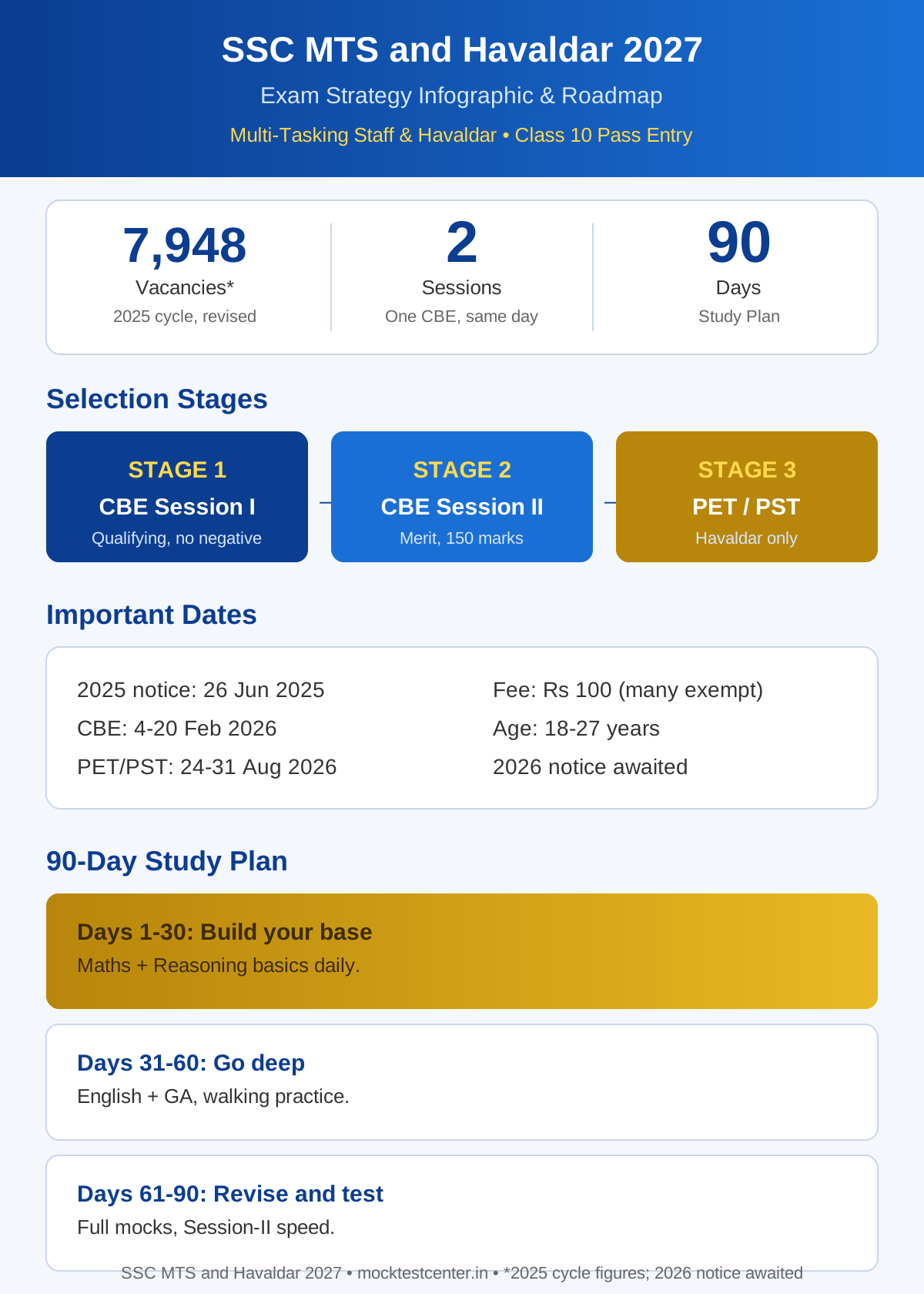
Vacancy means the number of empty posts. For the 2025 cycle, the revised total as on 27 November 2025 was 7,948 posts: 6,810 MTS posts and 1,138 Havaldar posts. Of these, 6,078 MTS posts are for the 18 to 25 age group and 732 for the 18 to 27 age group. The first notice of 26 June 2025 gave only 1,075 Havaldar posts and said MTS vacancies were still being collected. SSC revised the total to 4,375 MTS and 1,089 Havaldar posts on 28 July 2025, and to 7,948 on 27 November 2025.
Do not mix up the cycles. The figure of 9,583 posts that many websites show for 2026 is the total of the 2024 cycle, not a 2026 figure. No vacancy number for a fresh 2026 cycle has been published. MTS is in Pay Level 1 (Rs 18,000 to Rs 56,900) and Havaldar is in Pay Level 3 (Rs 21,700 to Rs 69,100), as per the 7th Pay Commission.
Exam pattern
The exam is one computer based examination in two sessions on the same day, and both sessions are compulsory.
Session I has Numerical and Mathematical Ability, 20 questions for 60 marks, and Reasoning, 20 questions for 60 marks — 40 questions for 120 marks, in 45 minutes. There is no negative marking in Session I, and Session I is qualifying only.
Session II has General Awareness, 25 questions for 75 marks, and English, 25 questions for 75 marks — 50 questions for 150 marks, in 45 minutes. In Session II, each wrong answer costs 1 mark. The total paper is 90 questions for 270 marks, in 90 minutes. The final merit for MTS posts is made only from your normalised Session II score, out of 150 marks. The minimum qualifying marks are 30 percent for UR, 25 percent for OBC and EWS, and 20 percent for all other categories, in both sessions. For Havaldar posts, candidates who clear the computer test must also pass the Physical Efficiency Test and Physical Standard Test, which are qualifying in nature.
| Session | Subject | Questions | Marks | Time |
|---|---|---|---|---|
| Session I (qualifying) | Numerical and Mathematical Ability | 20 | 60 | 45 minutes |
| Session I (qualifying) | Reasoning Ability and Problem Solving | 20 | 60 | 45 minutes |
| Session II (merit) | General Awareness | 25 | 75 | 45 minutes |
| Session II (merit) | English Language and Comprehension | 25 | 75 | 45 minutes |
| Total | All four parts | 90 | 270 | 90 minutes |
For Havaldar, the Physical Standard Test checks height, chest and weight. Male candidates need a height of 157.5 cm and a chest of 76 cm unexpanded, with a minimum expansion of 5 cm. Female candidates need a height of 152 cm and a weight of 48 kg. Height and weight relaxations apply for Garhwali, Assamese, Gorkha and Scheduled Tribe candidates. The Physical Efficiency Test is a walking test: male candidates must walk 1,600 metres in 15 minutes, and female candidates must walk 1 kilometre in 20 minutes. Some sources also list a cycling test, 8 km in 30 minutes for men and 3 km in 25 minutes for women, but one source citing the official 2025 notice says the test is walking only, so follow your PET call letter.
Syllabus
Syllabus means the list of topics you must study. Session I Numerical and Mathematical Ability covers number systems, percentage, ratio, average, time and work, speed and distance, interest, profit and loss, mensuration, algebra, geometry, and data interpretation, all at Class 10 level. Reasoning covers analogies, series, coding and decoding, puzzles, blood relations, direction sense, and non-verbal reasoning.
Session II General Awareness covers current events, history, geography, polity, economy, science, and static general knowledge. English covers reading passages, vocabulary, grammar, synonyms and antonyms, idioms, and spotting errors. The level is Class 10.
Important dates
The notice was published on 26 June 2025. The computer based examination was held from 4 to 20 February 2026. Some sources say the last shift was on 19 February 2026. A total of 8,04,633 candidates appeared. The result came out on 3 August 2026, and 8,071 candidates were shortlisted for the Havaldar PET and PST. An additional Havaldar shortlist came out on 7 October 2026. The PET and PST notice came on 20 August 2026, and the tests ran from 24 to 31 August 2026. The final result has not been declared yet.
For the next cycle, no notice has been published as of 18 November 2026. The SSC calendar had planned a notice on 30 June 2026, but that date passed with no notice. The notice will give the new application dates, vacancy number, and exam date.
| Event | Date |
|---|---|
| Notice (2025 cycle) | 26 June 2025 |
| Vacancy revised | 27 November 2025 (7,948 posts) |
| CBE | 4 to 20 February 2026 |
| CBE result | 3 August 2026 |
| PET / PST notice | 20 August 2026 |
| PET / PST (Havaldar only) | 24 to 31 August 2026 |
| Final result | Not yet declared |
| Next cycle notice | Not yet published (as of 18 Nov 2026) |
Cut-off
Cut-off means the lowest score that can pass a stage. There is no single all-India cut-off for MTS. SSC fixes separate cut-offs for every state and union territory, every category, and each age group.
The best guide is the last final result, for the 2024 cycle, declared on 12 March 2025. In that result, the UR cut-off for the 18 to 25 age group in Session II normalised marks ranged from about 120.79 in Tamil Nadu to 138.91 in Haryana. For the 2025 cycle, the final MTS cut-off has not been released yet. The Havaldar PET and PST shortlist cut-offs are given CCA-wise, by Chief Commissioner's Area. For example, Delhi CGST had a UR cut-off of 142.36 in Session II, while Mumbai Customs had a UR cut-off of 107.98. Aim for 135 or more out of 150 in Session II.
Best books
Books alone do not clear MTS. Practice and mock tests do. Still, a few standard books help. For Maths, use a standard Class 10 level Quant book and previous year papers. For Reasoning, solve puzzles daily. For English, use a good grammar book and read the newspaper daily. For General Awareness, read NCERT books and follow a monthly current affairs magazine.
Solve the last 5 years of MTS papers in exam conditions. If you have applied for Havaldar, walk fast every day, because the physical test is a walking test. Do not buy 20 books; buy 4 or 5 good ones and finish them twice.
90-day study plan
Days 1 to 30: Build your base. Study Maths 2 hours, Reasoning 1 hour, English 1 hour and General Awareness 1 hour every day. Finish the basic theory of all four subjects. Give 2 mocks this month, only to learn the pattern. If you want Havaldar, start fast walking daily.
Days 31 to 60: Go deep. Solve 50 Maths and 30 English questions daily from previous year papers. Give 2 mocks every week and check every wrong answer. For Havaldar, walk 1,600 metres daily and time yourself.
Days 61 to 90: Revise and test. Give 3 to 4 full mocks every week. Keep an error log and revise it daily. Do not start any new book now. In the last week, give one mock every day at the same time as the real exam.
How to use mock tests
Mock tests are practice tests that look like the real exam. They are the best tool for MTS, because the two sessions run back to back, and Session I closes on its own after 45 minutes. Take the mock in one sitting, with Session I first and Session II right after it. After the mock, spend an hour on analysis: check every wrong answer and revise that topic the same day. Keep an error log.
Take 20 to 25 mocks and learn from each one. Your Session II score should rise by 5 to 10 marks every 5 mocks, because Session II alone decides your merit. If it does not rise, change your plan. In the last 15 days, take only full mocks and revise notes.
The site also has mock tests for other exams. You can see SSC CHSL 2027, SSC GD 2027, SSC CPO Sub Inspector 2027, SSC Stenographer 2027, SSC Junior Engineer 2027, SSC JHT 2027, SSC Selection Post 2027 and SSC Delhi Police Constable 2027 on this site. You can also see 72nd BPSC Prelims 2027, BPSC District Statistical Officer 2027, BPSC Motor Vehicle Inspector 2027 and Indian Army Agniveer General Duty 2027 on this site. The official website for all SSC information is ssc.gov.in.
A last word
SSC MTS is the simplest way for a Class 10 pass student to get a central government job. The paper is of Class 10 level, there is no interview, and the merit comes from one session of 150 marks. Havaldar adds a uniform and a physical test, so keep your body fit if you want that post.
Start today. Finish your basics in 30 days and give mocks every week. Do not wait for the next notice to start studying. The pattern does not change much from year to year.