
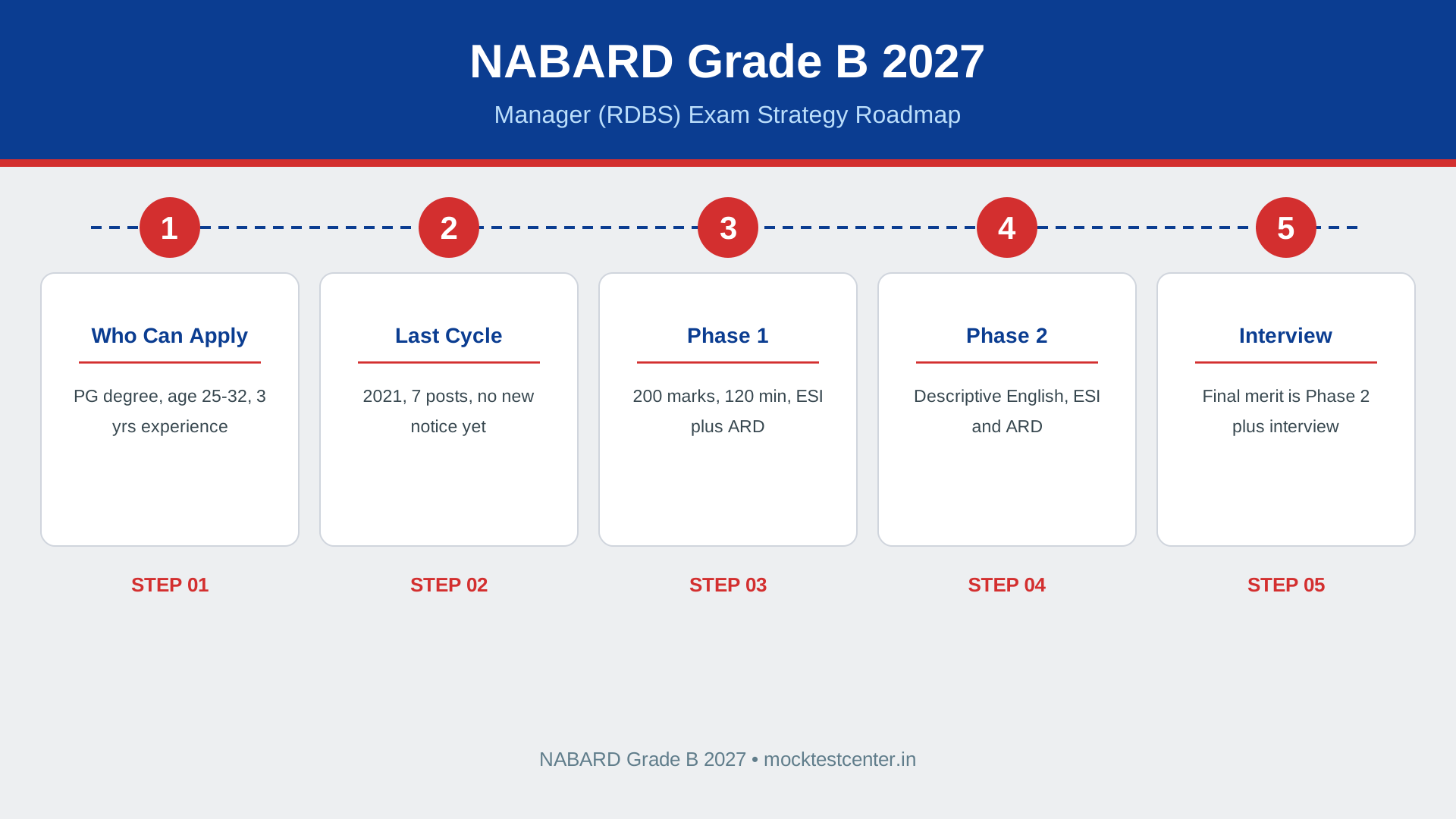
About NABARD Grade B 2027 Exam Series
📖 Table of Contents
- What this exam is
- The honest status of the 2027 cycle
- Who can apply
- Posts and vacancies
- What a Grade B Manager actually does
- Salary and perks
- Phase 1: the screening test
- Phase 2: the mains
- Interview
- Syllabus: Economic and Social Issues
- Syllabus: Agriculture and Rural Development
- How to apply
- Important dates
- A preparation plan that fits this exam
- Mistakes that cost candidates this exam
- Grade B and Grade A, side by side
- Other regulatory exams on this site
- Where to start this week
NABARD Grade B 2027
What this exam is
NABARD Grade B is the direct recruitment exam for the post of Manager in Grade B in the Rural Development Banking Service, or RDBS. NABARD runs it. NABARD is the National Bank for Agriculture and Rural Development, the apex bank for agriculture and rural credit in India. It came into existence on 12 July 1982 under the NABARD Act 1981, and it is fully owned by the Government of India.
A Grade B Manager holds a middle management post, not an entry level clerk or trainee role. You join as a Manager, you handle rural credit, supervision of cooperative banks and regional rural banks, and development work in districts. The post carries real responsibility from the first year, and that is why the bar for entry sits higher than the Grade A exam. You need a post graduate degree and work experience, not just a graduation degree.
Read the next paragraph before you plan anything else. There has been no fresh NABARD Grade B notification since 2021. The last direct recruitment was Advertisement No. 3/Grade B/2021-22, which invited applications from 17 July to 7 August 2021 for 7 posts. NABARD has run Grade A recruitments every year since then, including 91 Grade A posts in 2025, but its career notice list shows no Grade B advertisement after 2021. So everything on this page about pattern, eligibility, fee and salary comes from that 2021 cycle, and the 2027 cycle does not exist yet. Anyone who gives you fixed 2027 dates today is guessing.
That does not make this page useless. The 2021 advertisement is the best guide to what a future cycle will look like, because NABARD has kept the same shape for Grade B across 2017, 2019 and 2021. The age band, the post graduate rule, the three year experience rule and the three stage selection have stayed put. Prepare on that base, and check nabard.org for the next notice.
The honest status of the 2027 cycle
As of November 2026, NABARD has not released a Grade B notification for 2026, and no 2027 notification exists either. Two separate trackers that read the official career notice list confirm this, and both point to the same fact. The Grade B entries on that list stop at 2021. The officer notices after that are for Grade A and for contract posts.
This gap surprises many candidates, because the brief for this page assumed a 2025 cycle with single digit vacancies. There was no Grade B notification in 2025. The 7 vacancies people quote come from 2021, not 2025. The 91 posts announced in 2025 were Grade A, across RDBS, Legal and Protocol and Security Service. Mixing the two grades up is the most common error on this exam, and coaching sites do it all the time.
So what should you do while you wait? Two things. First, keep your preparation tied to the 2021 pattern, which this page sets out in full. Second, watch the NABARD careers page once a week. Grade B has come in 2017, 2019 and 2021, which is roughly a two year gap, but the gap since 2021 is already five years, so the old rhythm has broken. NABARD fills many Manager posts by promoting Grade A officers, and that may explain the silence. A new direct recruitment can still come, and when it does, the window will be short. The 2021 window lasted 22 days. You do not want to start preparing after the notice appears.
One more honest point. Some sites carry a 2026 registration window of 21 January to 12 February 2026 for Grade B. That window does not match any official notice, and the same pages also say the notification is yet to come out. Treat it as a placeholder that a site generated, not as a date. The official career list is the only source that counts.
Who can apply
Grade B asks for more than Grade A, and the extra asks are the whole point of the post. The 2021 advertisement set four conditions, and you had to meet all four on the cut off date in the notice.
First, age. You had to be between 25 and 32 years old. Not 21 to 32, as many sites claim. The lower limit of 25 is the single biggest filter in this exam, and it catches graduates who apply too early. Age relaxation applied as per government rules for SC, ST, OBC, PwBD and ex-servicemen. The 2021 sources do not agree on every relaxation figure, so read the new notice for the exact table when it comes.
Second, education. You needed a post graduate degree in any subject from a recognised university, with at least 60 percent marks in aggregate. For SC, ST and PwBD candidates the bar was 55 percent. Some trackers add a further condition, that you also needed 60 percent at the 10th, 12th, graduation and post graduation levels. That stricter reading appears in more than one tracker, but it was not confirmed against the official PDF in this pass, so treat it as likely but not certain. Check it in the new notice before you apply, because it decides eligibility for many candidates.
Third, experience. You needed at least three years of work experience in banking, finance, agriculture and allied sectors, or rural development. For SC and PwBD candidates the requirement was two years. This is what makes Grade B different from every other regulatory exam on this site. A fresh post graduate cannot apply, however good the marks. The experience has to be in a related sector, so a job in an unrelated field does not count.
Fourth, nationality. Only Indian citizens could apply. That rule is standard across NABARD recruitments.
If you are 23 with a fresh post graduation, Grade B is not your exam yet. Apply for NABARD Grade A 2027 instead, build three years of relevant experience, and come back to Grade B. If you are 29 with a post graduation and three years in a bank, you are the exact candidate this exam was built for.
Posts and vacancies
The 2021 cycle had 7 posts of Manager in Grade B (RDBS). That is the whole vacancy list. There were no separate streams, no legal or IT split, and no Rajbhasha posts. One post, one discipline, seven seats.
The category split of those 7 posts was 3 for Unreserved, 2 for OBC, 1 for SC, 1 for EWS, and 0 for ST. One of the 7 posts was earmarked for PwBD. Read that split with care, because it shows how thin the margin is. With 3 unreserved seats, a general category candidate is fighting for a handful of chairs, and the interview list runs at roughly five candidates per vacancy.
Compare that with Grade A, which had 91 posts in 2025, and you see why Grade B feels like a different world. Grade A is a volume recruitment. Grade B is a small, senior intake. The contest runs into a few thousand experienced post graduates chasing seven seats, which makes the effective competition just as sharp as Grade A, even though the applicant count is far smaller.
There is no vacancy figure for 2027, and there will not be one until the advertisement appears. If a future cycle follows the 2017 to 2021 pattern, expect single digits again, somewhere between 5 and 10 posts. That is an expectation, not a fact, and this page will not dress it up as one.
| Item | Grade B 2021 (last cycle) | What it means for 2027 |
|---|---|---|
| Post | Manager in Grade B (RDBS) | Same post expected, if notified |
| Total vacancies | 7 | Not announced; expect single digits |
| Unreserved | 3 | Not announced |
| OBC | 2 | Not announced |
| SC | 1 | Not announced |
| ST | 0 | Not announced |
| EWS | 1 | Not announced |
| Advertisement | 3/Grade B/2021-22 | No 2027 advertisement yet |
What a Grade B Manager actually does
NABARD supervises state cooperative banks, district central cooperative banks and regional rural banks. It refinances them, inspects them, and pushes credit into agriculture and rural projects. A Grade B Manager sits inside that work. You will not spend your days clearing cheques or selling loans at a branch counter. You will appraise refinance proposals, inspect a cooperative bank, follow up on a watershed project, or write a note on why credit flow to a district has slowed.
The posting can be at the head office in Mumbai or at one of the 31 regional offices across the states. NABARD also has 336 district offices staffed by District Development Managers, and six training establishments. Transfers happen, and a Manager should expect to move between regions over a career. That is normal in an all India institution, and candidates who want a single city posting should think twice.
The work also carries a development side that other regulators do not have. NABARD runs the SHG Bank Linkage Programme, the Rural Infrastructure Development Fund, watershed and tribal development programmes, and farm innovation funds. A Manager may handle a file on a self help group federation in the morning and a refinance inspection in the afternoon. If you like field work and rural economics, this is the most hands on regulatory job in the country. If you want a desk that never changes, look at the other exams on this site.
Probation lasts two years, and NABARD can extend it by one more year. The promotion path runs from Manager to Assistant General Manager and beyond, and many senior NABARD officers joined through Grade A and moved up. Direct Grade B entry skips the first few rungs, which is the reward for the post graduation and the three years of experience.
Salary and perks
The 2021 advertisement fixed the starting basic pay at 35,150 rupees a month. The pay scale ran from 35,150 to 62,400 over 16 years, with increments of 1,750 rupees in the early years and 2,000 rupees later, and an efficiency bar in the middle. That basic is now five years old, and any new advertisement will revise it, so do not plan your finances on 35,150.
The gross monthly pay is where the sources disagree, and the disagreement is worth stating plainly. One tracker puts the initial gross at 73,600 rupees a month. Another puts it at about 78,000 rupees a month. A third puts it at about 66,800 rupees a month. All three claim to quote the 2021 position, and they cannot all be right. The differences probably come from different allowance assumptions, different cities, and different dates, but no source in this pass showed its working. This page gives the basic pay as the solid figure and treats the gross as a range of roughly 67,000 to 78,000 rupees a month in 2021 terms. A new notice will carry a new figure, and it will be higher.
On top of basic pay, a Manager gets Dearness Allowance, Local Compensatory Allowance, House Rent Allowance and Grade Allowance, plus the usual benefits of a public sector bank job, such as leave fare concession, medical benefits, and pension under the National Pension System. Accommodation depends on availability at the posting, as in other regulators.
Do not pick Grade B for the salary alone. The Grade A starting basic in the 2025 cycle was also in the same band, and SEBI and PFRDA now pay far more at entry. Pick Grade B if you want NABARD itself, the rural credit mandate, and a Manager post without waiting years for promotion. The salary is good. It is not the highest on this site.
Phase 1: the screening test
Phase 1 was an online preliminary examination of 200 marks in 120 minutes. It was qualifying in nature. The marks did not count in the final merit list. Its job was to cut the field down to a manageable size for the mains, at a calling ratio of 1 to 25. So for 7 vacancies, about 175 candidates went through to Phase 2.
The paper had two parts. Part 1 tested general ability, and Part 2 tested the two subjects that define NABARD. Part 1 carried 120 marks. Reasoning carried 20, English Language carried 40, Computer Knowledge carried 20, General Awareness carried 20, and Quantitative Aptitude carried 20. Part 2 carried 80 marks, split evenly between Economic and Social Issues at 40 marks and Agriculture and Rural Development at 40 marks.
Every wrong answer cost one fourth of the marks assigned to that question. That rule applied in Phase 1 and Phase 2. With 200 questions in 120 minutes, you had about 36 seconds per question on average, so speed mattered as much as knowledge. The English section carried the most weight in Part 1 at 40 marks, which surprises candidates who expect reasoning or quant to lead. Do not neglect it.
The qualifying nature of Phase 1 changes how you should prepare for it. You do not need a top score. You need a score above the cut off, with enough margin to be safe. Candidates who chase a perfect Phase 1 score waste energy that Phase 2 needs. Clear it cleanly, then move on.
| Phase 1 section | Marks | Time |
|---|---|---|
| Reasoning | 20 | 120 minutes total, composite time |
| English Language | 40 | |
| Computer Knowledge | 20 | |
| General Awareness | 20 | |
| Quantitative Aptitude | 20 | |
| Economic and Social Issues | 40 | |
| Agriculture and Rural Development | 40 | |
| Total | 200 | 120 minutes |
Phase 2: the mains
Phase 2 was the real exam. Its marks counted in the final merit, together with the interview. The sources disagree on the exact shape of Phase 2, and this page will not hide that. One set of trackers describes two papers, each of 100 marks and 90 minutes. Paper 1 was General English, descriptive, written online through the keyboard. Paper 2 was Economic and Social Issues and Agriculture and Rural Development, in MCQ form. Another tracker describes three papers, adding a paper on Development Economics, Statistics, Finance and Management. Both versions agree on the core, that descriptive English plus ESI and ARD decided the merit, but they differ on whether a third paper existed.
Until the official 2021 PDF is read directly, treat the two paper version as the working shape and the third paper as a point to confirm. The difference matters for preparation, because a third paper on finance and management would need a separate study block. This page flags it here and in the notes, instead of picking one version and pretending the other does not exist.
What is certain is that descriptive English carried 100 marks. You had to write an essay, a precis, and comprehension answers on a keyboard in 90 minutes. Many candidates with strong MCQ skills lose the exam here, because they never practise typing long answers under time pressure. If you prepare for Grade B, type your English practice. Handwriting it in a notebook does not build the same skill.
Phase 2 also carried negative marking of one fourth of a mark per wrong answer in the MCQ paper. The descriptive paper had no negative marking, because there is nothing to guess in an essay.
Interview
The interview was the third and last stage. Candidates who scored high enough in Phase 2 were called for it, at a ratio of about 1 to 5 against the vacancies. For 7 posts, that meant roughly 35 candidates reached the interview room.
Here too the sources disagree, and the gap is large. Some trackers put the interview at 40 marks. Others put it at 75 marks. A 75 mark interview changes the final merit far more than a 40 mark one, so this is not a small detail. One tracker that read the advertisement closely states 75 marks, and says the final ranking rests on Phase 2 plus the interview, with ties broken first by Phase 2 marks, then by higher qualification, then by graduation marks, then by age. The 40 mark figure appears in older trackers that may carry the pattern from an earlier cycle. This page uses 75 marks as the working figure and flags the 40 mark figure as a conflict to confirm from the official notice.
The interview tests what the written papers cannot. The panel will ask about your three years of experience, about the bank or institution you worked in, about rural credit, and about current issues in agriculture. A candidate who worked in a rural branch and can talk about crop loans, self help groups and recovery will do better than a candidate who memorised definitions. Prepare your own work history as carefully as you prepare ESI. The panel has your application form in front of it, and it will start there.
The final merit list came from Phase 2 marks plus interview marks. Phase 1 marks played no part in it. That is the same structure SEBI and PFRDA use, and it means a candidate who just scrapes through Phase 1 can still top the final list with a strong Phase 2 and interview.
Syllabus: Economic and Social Issues
Economic and Social Issues, or ESI, is the subject that separates NABARD from a generic banking exam. It covers the Indian economy in its real shape, not just textbook definitions. You need to know growth, inflation, fiscal policy, banking and financial inclusion, and the structure of the rural economy. You also need to know the social side, poverty, employment, education, health, and the schemes that target them.
The government schemes matter more here than in any other regulatory exam, because NABARD implements and funds many of them. Read about the rural employment guarantee, food security, rural housing, and the schemes for farmers and self help groups. Know the budget numbers for the current year, and know which ministry runs which scheme. The panel and the paper both test whether you follow the news or only the book.
Read the Economic Survey and the Union Budget summary every year. They are free, they are official, and they give you the language the paper uses. A candidate who reads the Survey can answer questions that a candidate who only reads a guidebook cannot, because the paper often lifts its framing from the Survey itself.
One habit helps more than any book. Keep a notebook of one page per scheme, with the launch year, the ministry, the target group, and the current status. Revise it weekly. By the exam, you will have fifty pages that cover most of the ESI paper.
Syllabus: Agriculture and Rural Development
Agriculture and Rural Development, or ARD, is the second defining subject, and it carries the same 40 marks as ESI in Phase 1. It covers agronomy, soil, water, crops, animal husbandry, fisheries, and farm management. It also covers rural development, cooperatives, rural credit, and the institutions that deliver it.
Many candidates come to ARD with no agriculture background, and they treat it as a memorisation subject. That is a mistake. ARD rewards understanding. Know why a crop needs a certain soil, why drip irrigation saves water, why a cooperative bank differs from a commercial bank, and why farm credit fails in some districts. The paper asks about causes and effects, not just names and dates.
NABARD publishes annual reports and a yearly report on the state of agriculture and rural development. Those reports are long, but their summary chapters are the best single source for ARD. Read the latest one. It tells you what NABARD itself thinks matters, and the paper follows that lead more often than candidates expect.
Pay attention to the institutions. Know the difference between a state cooperative bank, a district central cooperative bank, a regional rural bank, and a small finance bank. Know who supervises each one. NABARD supervises the cooperative banks and the regional rural banks, and that supervision work is what a Grade B Manager does. The paper will test whether you know your future employer.
How to apply
In 2021, applications ran online only, through the careers page on nabard.org. The window ran from 17 July to 7 August 2021. Candidates filled the form, uploaded a photograph and signature, paid the fee online, and took a printout. There was no offline form and no form at a bank branch.
The fee in 2021 was 900 rupees for General, OBC and EWS candidates. That figure was made of a 750 rupee application fee plus 150 rupees of intimation charges. SC, ST and PwBD candidates paid no application fee, only 150 rupees of intimation charges. Staff candidates paid nothing. The fee was non refundable, and it had to be paid online. Some older trackers quote 600 rupees or 150 rupees for SC and ST, which looks like the fee from an earlier cycle, so the 900 and 150 figures are the ones tied to 2021. A new notice will set a new fee, so check it before you pay.
Keep your documents ready before the window opens. You will need your post graduation mark sheets, your experience certificates from each employer, your caste or PwBD certificate if you claim relaxation, and a photo and signature in the sizes the notice asks for. Experience certificates cause the most rejections in this exam, because candidates submit appointment letters instead of experience certificates, or certificates that do not state the dates and the nature of work. Ask your employer for a proper certificate now, while you have time.
Apply early in the window, not on the last day. The 2021 window was 22 days, and the site slows down on the last two days every year. A failed payment on the last day is a common and avoidable way to lose an exam.
Important dates
These are the 2021 dates, the only real dates this page can give. The notification and the advertisement came in July 2021, applications ran from 17 July to 7 August 2021, Phase 1 was held on 17 September 2021, and Phase 2 was held on 17 November 2021. The mains result came on 31 December 2021, according to one tracker. The interview followed after that.
Notice the gaps. The notice came in July, Phase 1 came two months later, and Phase 2 came two months after that. A future cycle will probably follow a similar rhythm, with about two months between each stage. That gives you a rough planning horizon, but it is not a promise. NABARD has not published any date for a new cycle.
Do not trust any site that lists 2027 dates today. There is no 2027 notification, no 2027 application window, and no 2027 exam date. Any date you see for 2027 is either a guess or a copy of the 2021 dates with the year changed. Check nabard.org and nothing else for dates.
| Event | 2021 cycle | 2027 cycle |
|---|---|---|
| Advertisement | 3/Grade B/2021-22, July 2021 | Not released |
| Applications | 17 July to 7 August 2021 | Not announced |
| Phase 1 exam | 17 September 2021 | Not announced |
| Phase 2 exam | 17 November 2021 | Not announced |
| Interview | After Phase 2, date not verified | Not announced |
A preparation plan that fits this exam
Grade B preparation is different from Grade A preparation in one way. You are not starting from zero. You have a post graduation and three years of work. Use them. Your experience counts as knowledge the paper and the interview will test, beyond a mere eligibility tick. A candidate who spent three years in a rural bank branch already knows more about farm credit than a candidate who read about it in a book. The plan below assumes you will study for six months, for two to three hours a day, alongside your job.
Months one and two are for the base. Read a standard book on the Indian economy, and a standard book on agriculture and rural development. Cover ESI and ARD first, because they carry 80 of the 200 Phase 1 marks and the whole of one Phase 2 paper. Alongside them, revise reasoning, quant and English for 30 minutes a day. Do not start with mock tests. You have nothing to test yet.
Months three and four are for depth and for English. Start writing one essay a week, typed, in 45 minutes, on a rural or economic topic. Start your scheme notebook, one page per scheme. Read the Economic Survey summary and the Budget summary when they come out. Take one Phase 1 mock test every two weeks, and spend a full hour analysing each one. Note every question you got wrong and why.
Months five and six are for tests and revision. Take one full mock test every week, then two a week in the last month. Practise descriptive English under time pressure, because the keyboard and the clock are the real enemies in Phase 2. Revise your scheme notebook and your error notes daily in the last two weeks. Stop learning new topics in the last week. New topics in the last week only create doubt.
One more point about English. The descriptive paper asks for an essay, a precis and comprehension. Many candidates write well but type slowly, and they leave the essay half finished. Type at least 30 words a minute before the exam. If you type slower than that, practise typing for 15 minutes a day. It is the cheapest score gain in this exam.
Mistakes that cost candidates this exam
The first mistake is applying before checking the age and experience rules. Every cycle, candidates below 25 apply, and candidates with less than three years of experience apply, and their applications get rejected. The fee is not refunded. Read the eligibility table in the notice twice before you pay.
The second mistake is treating Grade B like Grade A. The syllabus overlaps, but the depth does not. Grade B expects a post graduate level of understanding in ESI and ARD, and it expects you to write about them, not just tick boxes. Candidates who reuse Grade A notes without going deeper fail Phase 2.
The third mistake is ignoring descriptive English. It carries 100 marks in Phase 2, the same as the whole MCQ paper, and it is the paper most candidates never practise. An essay written once a week for six months is worth more than a month of reading about essay writing.
The fourth mistake is guessing wildly. Negative marking is one fourth of a mark, and in a 200 mark paper with a 1 to 25 shortlist, a handful of wild guesses can push you below the cut off. Guess only when you can eliminate two options. Leave the rest.
The fifth mistake is waiting for the notification to start. The gap since 2021 is five years, and the notice, when it comes, will give you about two months to Phase 1. Two months is not enough to build ESI and ARD from scratch. Start now, while the notice is still absent. If the notice never comes, you have still built knowledge that helps in Grade A, in RBI Grade B, and in every other regulatory exam.
Grade B and Grade A, side by side
Candidates ask which one to target, and the answer depends on where you stand today. Grade A is the entry post, Assistant Manager, and it takes fresh graduates with a graduation degree and an age of 21 to 30. Grade B is the Manager post, and it takes post graduates aged 25 to 32 with three years of experience. Grade A recruits in volume. Grade B recruits a handful. Grade A runs every year. Grade B has not run since 2021.
If you are under 25, or fresh out of college, Grade A is your exam. If you are over 25 with a post graduation and relevant experience, Grade B is the better target, because it puts you straight into middle management. Many officers do both. They join through Grade A, work for a few years, and then appear for Grade B from inside the system, or they rise through promotion instead.
The syllabus overlaps heavily in ESI and ARD, so preparation for one helps the other. The difference is depth and the descriptive paper. Prepare for both with the same base, and add the descriptive English practice for Grade B. That is the efficient way to cover two exams with one study plan.
Other regulatory exams on this site
NABARD Grade B is one of eleven regulatory exams covered on this site. If the age or experience rule shuts you out here, another regulator may fit you better. See RBI Grade B 2027, RBI Grade B DEPR 2027, NABARD Grade A 2027, SEBI Grade A 2027, PFRDA Grade A 2027, IRDAI Assistant Manager 2027, SIDBI Grade A 2027, IFSCA Grade A 2027, FSSAI Technical Officer 2027 and FSSAI Assistant 2027 on this site. RBI Grade B is the closest cousin to this exam, with the same ESI and ARD weight, and SEBI Grade A pays the most at entry.
Where to start this week
Start with three small steps. First, check your age and your experience against the 2021 rules, and write down whether you qualify today or when you will qualify. Second, open nabard.org, go to the careers page, and confirm for yourself that no Grade B notice is live. Third, buy or borrow one book on the Indian economy and read its first two chapters this week. That is enough to begin. The exam rewards candidates who start early and stay steady, and with seven seats on offer, steady is the only way in.







