
About NABARD Grade A 2027 Exam Series
📖 Table of Contents
- What this job actually is
- The 2025 cycle, step by step
- Who can apply
- The RDBS disciplines, and where General sits
- How the four stages work
- Phase 1: the merit section decides everything
- Phase 1: the qualifying section still needs a pass
- Phase 2: two papers, 200 marks
- Psychometric test and interview
- Pay, allowances and postings
- ARD: the subject that makes this exam different
- ESI: the other half of the merit score
- A six-month plan for a graduate
- Mistakes that cost good candidates a year
- How to use mock tests
- What to check on the day the notice comes out
NABARD Grade A 2027
What this job actually is
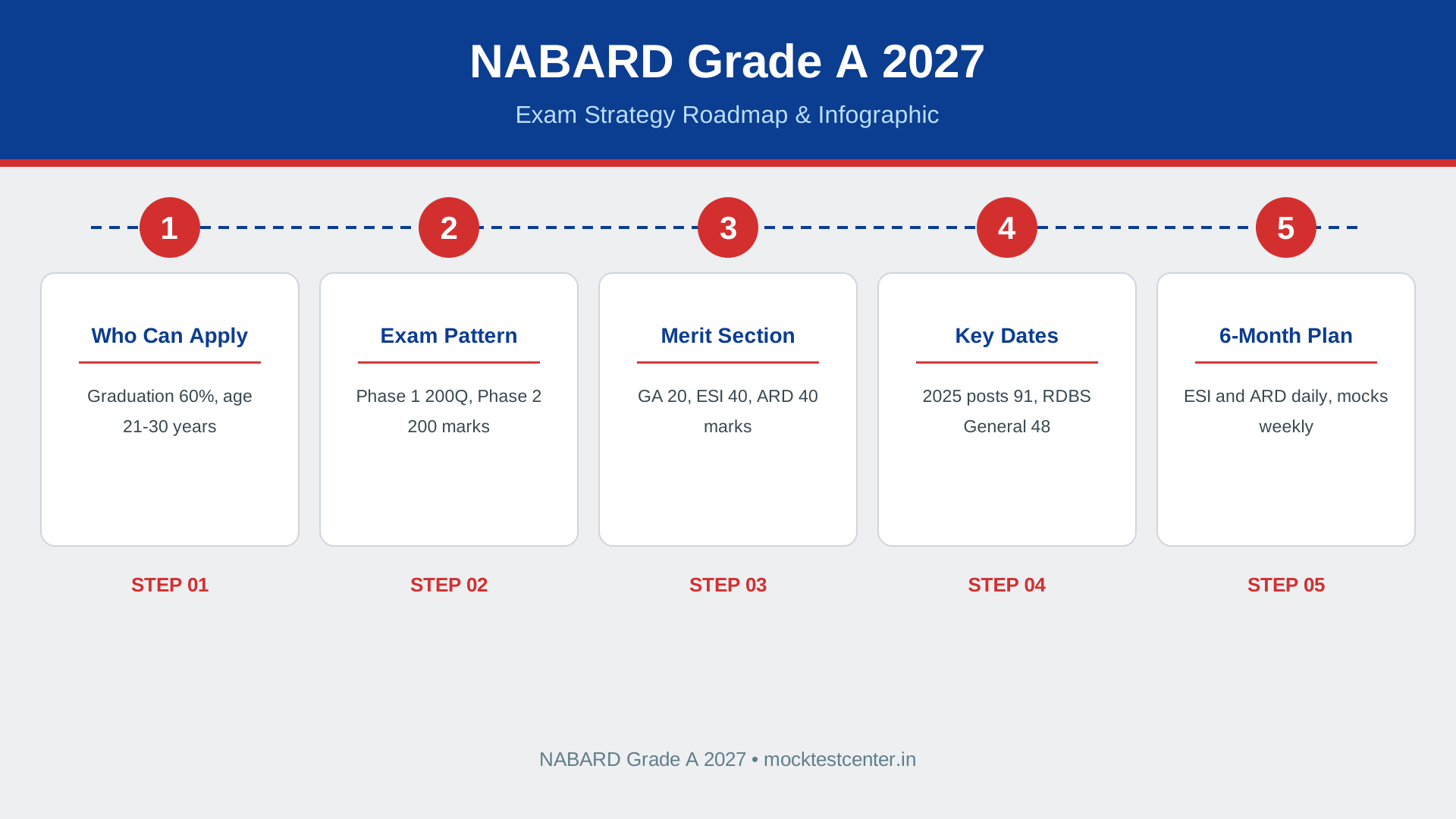
NABARD Grade A is the Assistant Manager post at the National Bank for Agriculture and Rural Development. The 2025-26 cycle, advertisement 05/Grade A/2025-26 dated 8 November 2025, offered 91 posts. Most of them sat in the Rural Development Banking Service, or RDBS, which had 85 posts. Legal Service had 2 posts and Protocol and Security Service had 4. The General discipline inside RDBS had 48 posts, which made it the largest single pool by far.
NABARD is the apex development finance institution for agriculture and rural development in India. It was set up on 12 July 1982 under the NABARD Act 1981. It is fully owned by the Government of India and works under the Department of Financial Services in the Ministry of Finance. Its work covers refinance to banks, supervision of cooperative banks and regional rural banks, rural infrastructure funds, watershed work, financial inclusion and development schemes for farmers and rural enterprises.
An Assistant Manager in RDBS works on that agenda. The posting can be in a regional office or the head office in Mumbai, and the work ranges from credit appraisal to field visits, scheme monitoring, inspections and policy notes. A candidate who likes agriculture and rural work will find the job itself interesting. A candidate who only wants a bank job and has no interest in rural India will find the work less so, and the interview panel will notice.
No notification for the next cycle has been released as of 19 November 2026. The 2025-26 cycle finished with its final result in May 2026, as per secondary reporting. This page gives no dates for the next cycle, because none have been announced. Everything dated below comes from the 2025-26 cycle.
The 2025 cycle, step by step
The short advertisement for the 2025-26 cycle came on 4 November 2025. The detailed notification followed on 8 November 2025. Applications ran from 8 to 30 November 2025 on the NABARD website. Phase 1 was held on 20 December 2025. Phase 2 was held on 25 January 2026. The whole cycle, from notification to Phase 2, took under three months, which is fast for a government recruitment.
The exam is conducted by the Institute of Banking Personnel Selection, or IBPS, on behalf of NABARD. That matters for a candidate, because the online test interface and the admit card process follow the IBPS pattern. A candidate who has taken an IBPS exam will find the NABARD test familiar.
Vacancies have shrunk over the recent cycles. One tracker notes that the intake almost halved between 2022 and 2025. The 2025-26 cycle offered 91 posts in all, and 48 of those were in the RDBS General discipline. A smaller intake means a higher cutoff for the same number of applicants, so plan for a tight cycle, not a generous one.
| Item | 2025-26 cycle |
|---|---|
| Advertisement | 05/Grade A/2025-26 |
| Short advertisement | 4 Nov 2025 |
| Detailed notification | 8 Nov 2025 |
| Applications | 8 to 30 Nov 2025 |
| Total posts | 91 |
| RDBS posts | 85 (General 48) |
| Legal posts | 2 |
| Protocol and Security posts | 4 |
| Phase 1 | 20 Dec 2025 |
| Phase 2 | 25 Jan 2026 |
| Final result | May 2026 [S] |
Applications go in online only, through the Career Notices page on nabard.org. Check that page when the next notice comes out, because the detailed advertisement, the information handout and the call letters all appear there first.
Who can apply
Age is 21 to 30 years on the cutoff date fixed in the advertisement. Two secondary sources disagree on the 2025-26 cutoff date. One puts it at 1 July 2025. Another gives the birth window as 2 September 1995 to 1 September 2004, which points to a 1 September 2025 cutoff. The two cannot both be right, so check the advertisement itself when you apply. The cutoff date moves with each cycle, and a wrong guess here can end an application.
Relaxation follows the usual pattern. OBC candidates get three years, which takes the upper limit to 33. SC and ST candidates get five years, which takes it to 35. Persons with benchmark disabilities get ten years, which takes it to 40. Read the advertisement for the full list, because the exact relaxations and the combinations are fixed there.
Education for the RDBS General discipline is a Bachelor degree in any subject with at least 60 percent marks in aggregate, or a post-graduate degree, MBA, CA, CS or ICWA with at least 55 percent. SC, ST and PwBD candidates need 55 percent in graduation or 50 percent in post-graduation. A Bachelor degree in agriculture qualifies directly for the General discipline, which is why agriculture graduates compete in large numbers here.
The specialist disciplines inside RDBS have their own qualifications. Agriculture, agriculture engineering, food processing, forestry, horticulture, animal husbandry, fisheries, information technology, finance, and other disciplines each ask for a degree in that subject, with the percentage bar set in the advertisement. A candidate should apply for one post and one discipline only, so pick the discipline where your degree fits best and your preparation is strongest.
Final year students are not eligible, as per secondary reporting of the 2025-26 advertisement. The graduation result must be declared before the notification date. Check the advertisement for your cycle, because this rule is fixed there.
The RDBS disciplines, and where General sits
RDBS had 85 of the 91 posts in the 2025-26 cycle. Inside RDBS, the General discipline had 48 posts. That is more than half the whole recruitment. The remaining RDBS posts sat across 13 specialist disciplines, which cover agriculture and allied subjects, engineering, information technology, finance and other fields. A candidate with a specialist degree should compare the General discipline with their own discipline before applying, because the competition and the syllabus differ.
The General discipline is open to graduates of any subject. That makes it the biggest pool and also the most competitive one in raw numbers. The specialist disciplines have fewer applicants, but they also have fewer posts, and the Phase 2 paper for a specialist discipline tests that subject. A candidate with a strong agriculture degree may find the specialist route easier, because the subject paper rewards depth in one field rather than breadth across many.
Legal Service had 2 posts and Protocol and Security Service had 4 posts in the 2025-26 cycle. Both are small, and both have their own eligibility rules. Legal asks for a law degree. Protocol and Security asks for a degree with the service background set in the advertisement. Do not apply for these on a guess. Read the eligibility line for the exact post.
One application covers one post and one discipline only. A candidate cannot apply for General and a specialist discipline in the same cycle. The choice is made at the application stage, and it cannot be changed later. Pick the discipline where your degree and your preparation line up, not the one with the most posts.
How the four stages work
Selection runs in four stages. Phase 1 is the preliminary online test. Phase 2 is the main online test, with objective and descriptive papers. Phase 3 is a psychometric test. Phase 4 is the interview. The final merit is the total of Phase 2 marks and interview marks. Phase 1 marks never enter the final list.
Phase 1 is a filter. It shortlists candidates for Phase 2 on the merit section only, discipline wise, up to 25 per vacancy. That ratio matters. With 48 General posts, up to 1,200 candidates go through to Phase 2 from the General discipline. The rest go home, whatever their qualifying section score was.
Phase 2 is where the rank is made. It carries 200 marks across two papers. The interview carries 50 marks. The final merit is out of 250 marks. A strong Phase 2 can carry a weak interview, and a strong interview can lift a middling Phase 2, but neither stage can rescue a failure in the other, because each stage has its own cutoff.
Every stage has sectional cutoffs as well as an overall cutoff. A candidate who scores high overall but falls below the cutoff in one test stays out. This is the rule that ends the most campaigns. It is also the reason a balanced score across sections beats a lopsided one.
Phase 1: the merit section decides everything
Phase 1 is one online objective test of 200 questions for 200 marks in 120 minutes, with a composite time for all tests together. The paper splits into a qualifying section of 100 marks and a merit section of 100 marks. Only the merit section counts toward shortlisting for Phase 2. The qualifying section needs a pass in each test and nothing more.
The merit section has three tests. General Awareness carries 20 marks. Economic and Social Issues carries 40 marks. Agriculture and Rural Development carries 40 marks. The three together make 100 marks, and the shortlist for Phase 2 is drawn on this total alone, discipline wise, up to 25 candidates per vacancy.
That structure tells you where to spend your time. ESI and ARD together carry 80 of the 100 merit marks. General Awareness carries 20. A candidate who masters ESI and ARD and treats General Awareness as a secondary subject will score higher than a candidate who splits time evenly across all three. The qualifying section needs a pass, so it should not eat the hours that ESI and ARD need.
Negative marking is one fourth of the marks assigned to the question, which is 0.25 marks per wrong answer in the objective tests of Phase 1 and Phase 2. Unanswered questions carry no penalty. The cutoff in each test and in the merit total is fixed by NABARD after the exam, and it changes every year with the paper and the pool.
Phase 1: the qualifying section still needs a pass
The qualifying section has five tests for 100 marks. Test of Reasoning carries 20 marks. English Language carries 30 marks. Computer Knowledge carries 20 marks. Quantitative Aptitude carries 20 marks. Decision Making carries 10 marks. Each test has its own cutoff, and a candidate must clear each one. A zero in any test ends the attempt, whatever the merit section score is.
Reasoning follows the standard bank exam pattern: puzzles, seating, syllogisms, coding, series and data sufficiency. English covers reading comprehension, cloze, error spotting and vocabulary. Computer Knowledge covers basics: hardware, software, networks, internet, MS Office and security. Quant covers arithmetic, data interpretation and number series. Decision Making presents situations and asks for the best course of action, and it carries only 10 marks, so do not let it eat a week of preparation.
The qualifying section is 100 marks that stay out of the shortlist, yet the pass bar is real. Candidates fail it every year, usually in one test they ignored. Give each test a weekly slot from the start. A pass in all five is the floor, and the floor must be built before the merit section gets the extra hours.
There is no sectional timing in Phase 1. The 120 minutes are composite across all eight tests. That gives a candidate control over time, and it also gives a candidate rope. Decide your time split before the exam and stick to it. A candidate who spends 60 minutes on the qualifying section will have 60 minutes left for 100 merit marks, and that is not enough.
Phase 2: two papers, 200 marks
Phase 2 has two papers. Paper 1 is General English, descriptive, 100 marks in 90 minutes. The answers are typed on a keyboard. The paper has three parts: an essay, a precis of 120 to 180 words, and a letter or a comprehension of 200 to 220 words. The essay carries the most weight, so practice writing essays on rural and economic topics. Typing speed matters here, because a slow typist will leave marks on the table even with good ideas.
Paper 2 covers Economic and Social Issues and Agriculture and Rural Development, and it is the paper that decides the rank for most candidates. The objective part has 30 questions for 50 marks in 30 minutes. The descriptive part has six questions, of which you attempt four, for 50 marks in 90 minutes. Two descriptive questions carry 15 marks each and two carry 10 marks each. The total for Paper 2 is 100 marks in 120 minutes across both parts.
For the General discipline, Paper 2 tests ESI and ARD. For specialist disciplines, Paper 2 tests the specialist subject instead, as per the advertisement. Check the information handout for your discipline, because the Paper 2 syllabus changes with the discipline.
Cutoffs apply to each test and to the total in Phase 2. Objective questions carry negative marking of one fourth of a mark. Descriptive answers carry no negative marking. The descriptive answers are typed on a keyboard, so practice typing full answers, not only reading about them.
Psychometric test and interview
Phase 3 is a psychometric test. It is mandatory, it runs for 90 minutes, and it carries no marks. It gives the interview panel a view of the candidate, and it informs the interview rather than adding to the total. Do not skip it and do not treat it as a formality. Answer it plainly and consistently, because inconsistent answers stand out.
The interview carries 50 marks. Candidates are shortlisted for it at up to three per vacancy, on the basis of Phase 2 marks. The panel asks about your background, your degree, agriculture and rural development, NABARD itself, the economy and current affairs. An agriculture graduate should expect subject questions. A general graduate should expect questions on why they want this job and what they know about rural India.
The final merit adds Phase 2 marks out of 200 and interview marks out of 50, which makes 250 marks in all. Phase 1 marks play no part. A candidate who scraped through Phase 1 can still top the final list with a strong Phase 2 and interview. A candidate who topped Phase 1 and relaxes in Phase 2 will not.
Pay, allowances and postings
The starting basic pay is 44,500 rupees a month. The pay scale reads 44500-2500(4)-54500-2850(7)-74450-EB-2850(4)-85850-3300(1)-89150, which means increments of 2,500 rupees for four years, then 2,850 rupees for seven years, then an efficiency bar, then four more increments of 2,850 rupees, then one increment of 3,300 rupees, reaching 89,150 rupees in 17 years. Promotions move the officer beyond that scale in time.
On top of basic pay, officers get dearness allowance, local compensatory allowance, house rent allowance, grade allowance and other admissible perks. The gross monthly salary is about 1,00,000 rupees, as per the 2025-26 cycle reporting. That figure moves with dearness allowance, so treat it as a snapshot. Some pages quote a range of 95,000 to 1,05,000 rupees. The basic pay figure is the one that stays fixed.
Perks include official accommodation where available, medical benefits, leave fare concession, loans at concessional rates, fuel reimbursement and the National Pension System. The full list sits in the advertisement under service conditions, and it is worth reading once, because the perks are part of why this post draws so many applications for 91 seats.
Postings can be in regional offices across India or the head office in Mumbai. Field work is part of the job in many postings, and a candidate who dislikes travel should know that before applying. Transfers are a normal part of the service.
ARD: the subject that makes this exam different
Agriculture and Rural Development carries 40 marks in the Phase 1 merit section and half of Phase 2 Paper 2. No other officer exam gives agriculture this much weight. That is the whole point of this exam, and it is also where most general graduates lose marks. A candidate who studies ESI well and treats ARD as an afterthought will score in the middle. A candidate who studies ARD properly will pull ahead.
ARD starts with agriculture itself: crops, cropping patterns, seasons, soil, irrigation, seeds, fertilisers, farm mechanisation and agricultural marketing. Then animal husbandry, fisheries, horticulture and forestry. Then rural development: rural credit, cooperatives, self help groups, microfinance, rural infrastructure, watershed development, rural employment schemes and poverty alleviation programmes.
Then comes NABARD itself: its history, its role, its funds, its schemes, its supervision of cooperative banks and regional rural banks, and its development work. Questions on NABARD appear every year, and they reward a candidate who has read the NABARD website and its annual report. The nabard.org site carries the annual report, the schemes and the press releases, and those are primary sources.
Government schemes fill the rest: PM Kisan, PM Fasal Bima, agriculture infrastructure fund, rural housing, rural roads, rural employment guarantee, food security, and the schemes for dairy, fisheries and horticulture. For each scheme, learn the launch year, the target group, the benefit and the implementing agency. A scheme question usually tests one of those four facts.
ESI: the other half of the merit score
Economic and Social Issues carries 40 marks in the Phase 1 merit section and half of Phase 2 Paper 2. It starts with growth and development: measurement of growth, the difference between growth and development, human development, poverty and inequality, employment and unemployment, and sustainable development goals. Then the Indian economy: national income, inflation, fiscal policy, monetary policy, banking, financial inclusion, agriculture, industry, services, the external sector and the budget.
Social issues follow: education, health, social security, gender, urbanisation and migration. Current economic events tie it together, and the paper rewards candidates who can connect a news item to a concept. The Union Budget and the Economic Survey are the two documents that matter most here. Read the Survey chapters on growth, fiscal policy, monetary policy, banking, agriculture, industry and the external sector.
For Phase 2, ESI needs writing, not only recall. The descriptive questions ask for analysis, and a good answer states the concept, applies it to the question, uses one fact or number, and closes with a line that answers the question asked. An answer that only lists facts scores in the middle. Practice one descriptive answer a week from the start, on a real past question, under time pressure.
A six-month plan for a graduate
Month one and two build the base. Give two hours a day to ESI and ARD and one hour to the qualifying section subjects. Finish the standard books for reasoning, quant and English. Start ARD reading with one chapter a day from a standard agriculture book. Read the newspaper daily and make short notes on agriculture, rural and economic news. Do not touch mock tests yet, except one diagnostic test to see where you stand.
Month three and four add Phase 2. Keep one hour a day on Phase 1 revision and add two hours on ESI and ARD in depth. Start writing one descriptive answer a week. Start writing one English essay a week, typed. Take one full Phase 1 mock test every week and analyse every wrong answer the same day. The analysis matters more than the score, because the same error repeated ten times is ten lost marks.
Month five is for mock tests and revision. Take two full Phase 1 mocks a week and one Phase 2 paper a week. Revise your short notes daily. Cut out any new book in this month. A new source in month five only adds confusion, and confusion costs marks.
Month six is for the final push. Take a mock every three days, then one every two days in the last two weeks. Revise your error notes and your short notes only. In the last week, solve past papers and read the last six months of agriculture and economic news from your own notes. Sleep properly in the last three days. A tired candidate makes errors that a fresh one does not, and the margin in this exam is thin.
Mistakes that cost good candidates a year
The first mistake is ignoring ARD. It carries 40 marks in Phase 1 and half of Phase 2 Paper 2. A candidate who studies only ESI and general awareness will score in the middle and wonder why. Give ARD the same hours as ESI from day one.
The second mistake is ignoring the qualifying section. The five tests need a pass each, and a zero in any one ends the attempt. Give each test a weekly slot from the start. Decision Making is only 10 marks, so keep its share of time small, yet never leave it at zero.
The third mistake is reading current affairs without notes. Current affairs feel easy to read and hard to recall, and the gap between reading and recalling is where marks go missing. Make short notes, revise them weekly, and test yourself from them. A notebook that you never revise is the same as a book you never read.
The fourth mistake is applying for the wrong discipline. One application covers one post and one discipline only, and the choice cannot be changed later. A specialist degree holder should compare the General discipline with their own discipline before applying, because the Phase 2 paper and the competition differ.
The fifth mistake is trusting a date for the next cycle from a random website. No dates for the next cycle have been announced. Any site that gives a fixed date today is guessing. The only dates that matter are the ones on nabard.org, on the Career Notices page.
How to use mock tests
A mock test works only if you take it like the real exam. Sit for the full 120 minutes for Phase 1 with no pauses and no phone. Mark answers the way you will in the exam. After the test, spend at least an hour on analysis. Note the questions you got wrong, the questions you guessed right, and the questions you left. The guessed right answers are as dangerous as the wrong ones, because a guess that works once will be repeated.
Track your score section by section, and split the merit section from the qualifying section. If ESI is low, your economics reading needs work. If ARD is low, your agriculture reading needs work. If General Awareness is low, your newspaper habit needs work. If a qualifying test is low, your pass is at risk, and that test needs a daily slot. Two good tests a week with full analysis beat ten tests taken in a rush.
For Phase 2, mock tests mean writing full papers, not just solving objective questions. Write one full Paper 2 every two weeks in the second half of your preparation. Write the descriptive answers typed, the way the real paper is typed. Get them checked. A mock that nobody checks is only half a mock.
Many NABARD candidates also prepare for other regulator exams, and the overlap is real. The ESI base helps across them, and the ARD base is unique to NABARD. See RBI Grade B 2027, RBI Grade B DEPR 2027, NABARD Grade B 2027, SEBI Grade A 2027, PFRDA Grade A 2027, IRDAI Assistant Manager 2027, SIDBI Grade A 2027, IFSCA Grade A 2027, FSSAI Technical Officer 2027 and FSSAI Assistant 2027 on this site.
What to check on the day the notice comes out
Read the advertisement the day it comes out, and check four things before you pay. First, the cutoff date for age and the percentage rule for your degree and discipline. Second, the number of posts in your discipline and your category. Third, the fee for your category. Fourth, the exam dates and the last date to apply. The 2025-26 fee was 800 rupees for General, OBC and EWS candidates, which was 650 rupees application fee plus 150 rupees intimation charges, and 150 rupees for SC, ST and PwBD candidates. One secondary source prints 850 rupees plus GST for the General category, which conflicts with the majority reporting. Check the new advertisement before you pay.
Keep your documents ready before the window opens. A graduation certificate, mark sheets, a photo, a signature scan and a valid identity proof cover most of it. The application window in the 2025-26 cycle was 22 days. That is enough time if your documents are ready, and it is short if they are not.
Start preparation now, even though the next notice is not out. The syllabus is stable, the pattern is stable, and the books are the same. A candidate who starts on the day of the notice is months behind a candidate who started today. The notice will come when it comes. Your preparation should not wait for it.







