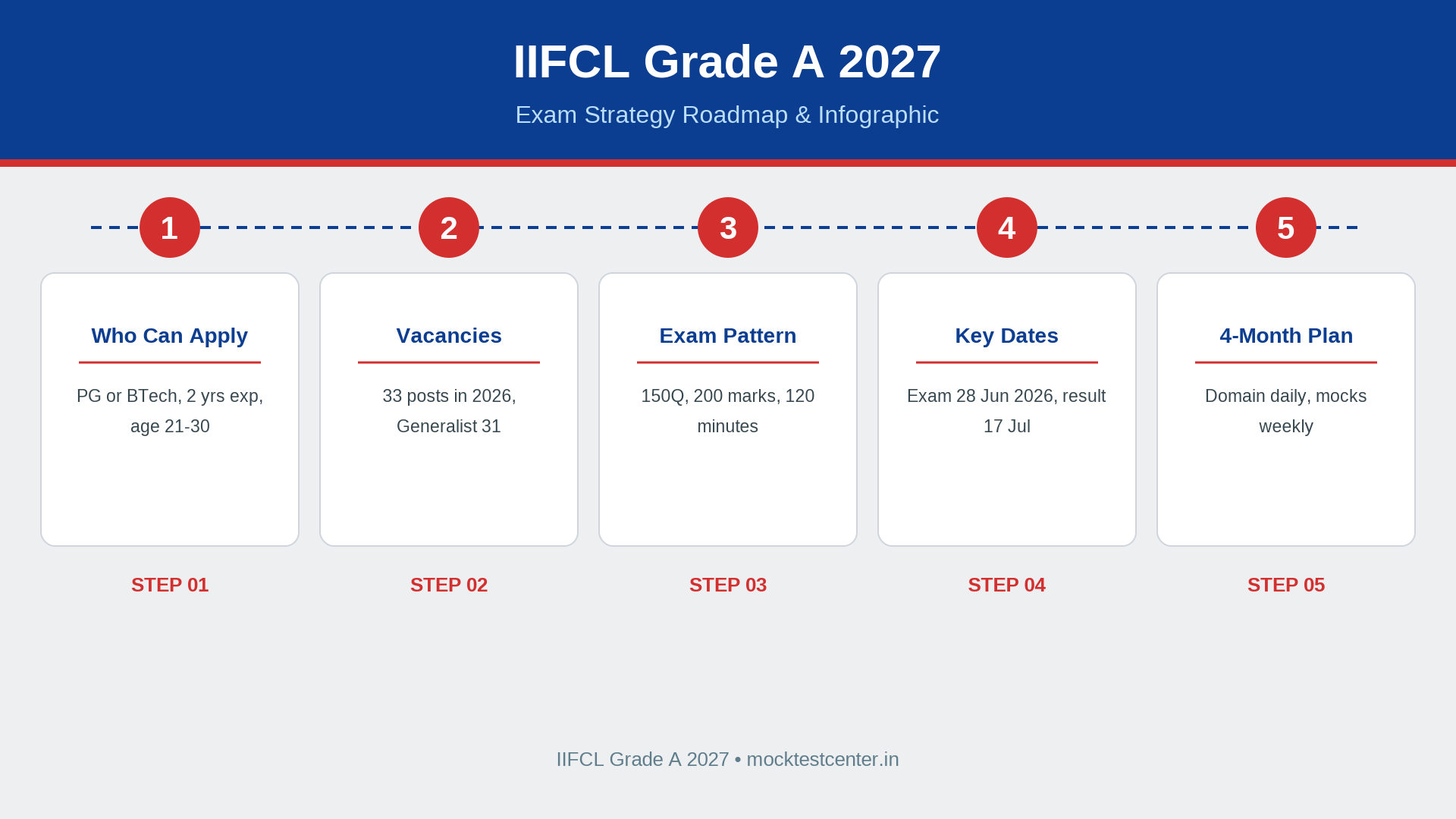
About IIFCL Grade A 2027 Exam Series
📖 Table of Contents
- What this job actually is
- The 2026 cycle, step by step
- The two streams, and why the choice matters
- Who can apply: the two year experience rule
- Age limit and relaxations
- How the written exam works
- Test 1, subject by subject
- Test 2, the domain paper that decides the rank
- The interview, and the 40 to 60 weight
- Pay, allowances and the 19 lakh figure
- Probation, postings and the service conditions
- What project finance really means here
- A four month plan for a working professional
- Mistakes that cost good candidates a year
- How to use mock tests for IIFCL Grade A 2027
- What to check on the day the 2027 notice comes out
- Sources
IIFCL Grade A 2027
What this job actually is
IIFCL Grade A is the Assistant Manager post at India Infrastructure Finance Company Limited. The 2026 cycle, advertisement IIFCL/HCM/2026/04 dated 18 March 2026, offered 33 posts. Thirty one of those posts sat in the Generalist stream and two sat in the Environment and Social Safeguard stream.
The written exam was held on 28 June 2026 and the Phase 1 result came out on 17 July 2026. IIFCL has released no notification for a 2027 cycle as of 23 November 2026, so this page gives no dates for 2027. Everything dated below comes from the 2026 cycle, and the 2026 cycle is the one to study, because the next advertisement will almost certainly follow the same shape.
IIFCL is a wholly owned Government of India company set up in 2006 to give long term finance to viable infrastructure projects. Its registered office sits at Plate A and B, 5th Floor, Office Block 2, NBCC Towers, East Kidwai Nagar, New Delhi. The company lends to green field and brown field projects across the sub sectors in the Harmonised Master List of Infrastructure Subsectors, which covers transport, energy, water, sanitation, communication, social infrastructure and commercial infrastructure.
The advertisement calls IIFCL one of the most diversified public sector infrastructure lenders in terms of eligible sub sectors and product offerings. That line matters for the exam, because the domain paper tests project finance, and project finance is the daily work of this company.
An IIFCL Assistant Manager does not sit in a retail branch. The work is appraisal of infrastructure projects, credit analysis, monitoring of loans, risk work, treasury work and policy notes. A candidate who has worked in a bank credit department will recognise the work at once.
A candidate who has only prepared for exams and never seen a loan file will need to learn the vocabulary of project finance from scratch, and the interview panel will test exactly that vocabulary. The post carries a starting basic pay of 44,500 rupees a month and the company puts the approximate cost to company at about 19 lakh rupees a year. Those two numbers explain why 33 posts drew serious competition from experienced bankers.
One fact sets this exam apart from every other regulator exam on this site. A fresh graduate cannot apply. The advertisement asks for at least two years of post qualification experience in officer cadre in a bank, a financial institution, a central or state government office, a public sector unit or an organisation of repute.
Candidates still waiting for their results cannot apply. If you are in your final year, or you finished your degree last month, this exam is closed to you for now. That single rule cuts the applicant pool to working professionals, and it changes the whole preparation game, because your competition is already employed and already knows the banking system from inside.
The 2026 cycle, step by step
The advertisement came out on 18 March 2026. The online registration gateway opened the same day, 18 March 2026, and closed on 10 April 2026. The cutoff date for age, education and post qualification experience was 28 February 2026. The advertisement gave a tentative schedule for the online exam in May or June 2026, the interview in June or July 2026, and the final result in July or August 2026.
The real dates landed inside those windows. IIFCL held the online exam on 28 June 2026 and released the Phase 1 result on 17 July 2026. Secondary reports put the interview on 7 August 2026 and the final result on 8 August 2026.
Secondary reporting gives the interview and final result dates, and the package notes flag them as such, because the official advertisement only gave tentative windows. The whole cycle, from notification to final result, took under five months, which is fast for a government recruitment, and it shows in the dates: apply in March, write the exam in June, sit the interview in August.
Applications went in online only, through the IIFCL website at iifcl.in. The fee was 600 rupees for most candidates and 100 rupees for SC, ST and PwBD candidates, with GST extra, borne by the candidate. The fee was not refundable in any circumstance, and the advertisement said so in plain words.
A candidate could apply for only one post, and only the latest valid application was kept if a candidate submitted more than one. The application form asked for the percentage of marks in graduation, and the degree certificate had to be in hand on the day of registration.
| Item | 2026 cycle |
|---|---|
| Advertisement | IIFCL/HCM/2026/04, 18 Mar 2026 |
| Applications | 18 Mar to 10 Apr 2026 |
| Cutoff date | 28 Feb 2026 |
| Total posts | 33 (Generalist 31, E and S Safeguard 2) |
| Written exam | 28 Jun 2026 |
| Phase 1 result | 17 Jul 2026 |
| Interview | 7 Aug 2026, as per secondary reporting |
| Final result | 8 Aug 2026, as per secondary reporting |
| Fee | 600 rupees, 100 rupees for SC, ST and PwBD |
Two other recruitments get mixed up with this one, and the mix up costs candidates real money. The first is the Grade B Manager recruitment of 2026, advertisement IIFCL/HCM/2026/03, which ran alongside Grade A and added 4 posts. Some trackers add 33 and 4 and report 37 Assistant Manager vacancies. That number is wrong.
Grade A had 33 posts and Grade B had 4, and they are different posts with different advertisements. The second is the IIFCL Projects Limited recruitment of 2025, advertisement 2025/02, which offered 8 officer posts, 4 in Grade A and 4 in Grade B, with applications from 16 April to 14 May 2025. IIFCL Projects Limited is a subsidiary, not the parent company, and its Grade A post is a different job. Check the advertisement number before you apply, because the two recruitments have different websites, different fees and different cutoffs.
The two streams, and why the choice matters
Generalist took 31 of the 33 posts. Environment and Social Safeguard took 2. A candidate could apply for only one stream, and the choice was made at the application stage. With 31 posts against 2, the Generalist stream looks like the obvious pick, and for most candidates it is.
But the raw post count is not the whole story. The Generalist stream draws every banker, every CA, every MBA and every engineer with two years of experience. The Safeguard stream draws a far smaller pool, and its eligibility is narrow, so the competition per post can be thinner even with only 2 posts on offer.
The Safeguard stream asks for engineering or a post graduate degree or diploma in environmental management, environmental sciences, an MSc, or post graduation in social work, sociology, anthropology, economics or development services. The experience bar is the same, two years in officer cadre. If your degree fits that list and you have worked on environmental or social compliance, resettlement, or impact assessment, the Safeguard stream plays to your strength.
The written exam stays the same for both streams. The stream choice changes the interview, where the panel will test the stream subject, and it changes the posting, because safeguard work sits in project appraisal and monitoring teams.
For the Generalist stream, the eligible qualifications are broad. A post graduate degree or diploma in any discipline, a Bachelor degree in law, a five year BA plus LLB, a Chartered Accountant, a Company Secretary, a Certified Management Accountant, or a BTech or BE all qualify. The post graduate course must be at least two years long.
The degree must come from a university or institution recognised by UGC, AICTE, the government, or a government regulatory body. If the degree certificate does not state the field of specialisation, the candidate must produce a certificate from the university or college that states it. That detail catches people at document verification, so get the certificate early if your degree paper is silent on the subject.
Who can apply: the two year experience rule
The experience rule is the heart of this exam, and it deserves a full section, because it is the rule most candidates get wrong. The advertisement asks for at least two years of post qualification experience in officer cadre in banks, financial institutions, central or state government, public sector units, or any other organisation of repute. Post qualification means the clock starts after the qualifying degree, not after school, and not from a part time job held during the degree. The experience must be in officer cadre, which means a clerk level job does not count, even if it ran for five years in a bank.
Work in a bank credit department counts directly. Work in a financial institution counts. Work in a government office in officer cadre counts. Work in a public sector unit counts.
Work in a private company counts if the organisation is one of repute and the role was in officer cadre, and the advertisement leaves that judgement to IIFCL. A candidate with two years in a small private firm should carry an experience certificate that states the designation, the dates, and the nature of work in clear words, because the interview panel will read that certificate before the interview begins. A vague certificate that only gives dates will invite questions, and questions about a vague certificate rarely go well.
Final year students are out, and so are candidates still waiting for results. The advertisement says the candidate must possess a valid mark sheet or degree certificate on the day of registration, and must enter the graduation percentage in the online form. There is no relaxation on this point.
A candidate who finished the degree in February 2026 and joined a bank in March 2026 will still be short of two years of experience on the cutoff date of 28 February 2026, so that candidate waits for the next cycle. Plan around the cutoff date, not around the exam date. The cutoff date is the date that decides eligibility, and it sits months before the exam.
There is one more trap in the experience rule. The advertisement says IIFCL reserves the right to raise or modify the eligibility criteria in minimum educational qualification and work experience. That means the two year bar is a floor, not a promise.
In a cycle with many applicants, the bar can move. A candidate with exactly two years of experience should not assume the application will sail through. Apply, but keep the documents ready, and keep an eye on the website for a corrigendum, because IIFCL publishes any corrigendum only on its website.
Age limit and relaxations
Age is 21 to 30 years on 28 February 2026. The candidate must have attained 21 years and must not have attained 30 years on that date. The relaxation table follows the government pattern. SC and ST candidates get five years, which takes the upper limit to 35.
OBC candidates in the non creamy layer get three years, which takes it to 33. PwBD candidates get ten years if they are unreserved or EWS, thirteen years if they are OBC, and fifteen years if they are SC or ST. Ex servicemen get five years under the ex servicemen reemployment rules. Children and family members of those who died in the 1984 riots get five years.
Two points in the fine print deserve attention. First, there is no reservation for ex servicemen in the officers cadre, so the ex servicemen relaxation is an age relaxation, not a reserved post. Second, an ex serviceman who has already joined a government job on the civil side after availing ex servicemen benefits loses ex servicemen status for reemployment.
Government guidelines allow the relaxation in upper age on a cumulative basis, which means a candidate who qualifies under two heads can add them, subject to the government rules in force. Certificates for every relaxation must be in the prescribed format and in hand at the interview, because the application locks the category after registration.
The age window, combined with the two year experience rule, fixes the real applicant pool. A candidate who finished a post graduate degree at 23 and worked two years applies at 25. A candidate who finished a BTech at 22 and worked in a bank applies at 24 or 25. The pool is young professionals, not fresh graduates and not late career switchers.
That is why the interview carries so much weight in this exam. The panel tests more than book knowledge. It tests what two years of work taught you, and whether you can talk about your own work with clarity.
How the written exam works
Selection runs in two phases. Phase 1 is a single online objective paper for 200 marks. Phase 2 is a technical and behavioural interview for 100 marks. There is no separate preliminary and main exam, and there is no descriptive paper.
The whole written test happens in one sitting of 120 minutes, split into two tests of 60 minutes each, with separate time allotted for each test. The paper may be held in multiple shifts and on more than one day if the number of candidates calls for it, but a candidate appears in only one shift on the given day. The admission letter carries the date, time and venue, and the candidate downloads it from the IIFCL website.
Test 1 carries 100 marks across 100 questions, one mark each. Reasoning carries 25 marks, quantitative aptitude carries 25, English language carries 25, and current affairs related to the financial sector carries 25. Test 2 carries 100 marks across 50 questions, two marks each, and it tests domain knowledge. The grand total is 150 questions for 200 marks in 120 minutes.
That split is the first thing to understand about this exam. Half the marks sit in a domain paper where each question is worth two marks, and half sit in a general paper where each question is worth one mark. A wrong answer in Test 2 costs twice as much as a wrong answer in Test 1, once you count negative marking.
Negative marking is one fourth of the marks assigned to the question. A wrong answer in Test 1 loses 0.25 marks. A wrong answer in Test 2 loses 0.5 marks. The official advertisement states this in plain words, and it matters, because one popular tracker page says there is no negative marking in this exam.
That page is wrong, and a candidate who follows it will guess freely in Test 2 and lose a full mark for every two wrong guesses. The advertisement is the only source that counts here, and it is unambiguous. Candidates have to secure minimum marks in aggregate, as prescribed by IIFCL, and IIFCL reserves the right to waive or modify the minimum qualifying marks without prior intimation.
| Test | Section | Questions | Marks | Time |
|---|---|---|---|---|
| Test 1 | Reasoning | 25 | 25 | 60 min |
| Test 1 | Quantitative Aptitude | 25 | 25 | 60 min |
| Test 1 | English Language | 25 | 25 | 60 min |
| Test 1 | Current Affairs, finance sector | 25 | 25 | 60 min |
| Test 1 total | 100 | 100 | ||
| Test 2 | Domain Knowledge | 50 | 100 | 60 min |
| Grand total | 150 | 200 | 120 min |
The syllabus in the advertisement is indicative and not exhaustive. The advertisement says so in a note, and the note is worth reading twice. It says candidates should treat the syllabus as a starting point, not as the only source of information, and that questions can be asked on all relevant matters under the subject.
Candidates should also prepare for current and latest developments and Acts under the subject, even if those topics are not listed in the syllabus. In plain words, the paper can go beyond the listed topics, and a candidate who only studies the listed topics will meet questions from outside the list. The information handout, which comes with the admission letter, carries the detailed instructions for the exam, and it is the last document to read before the test.
Test 1, subject by subject
Reasoning follows the standard bank exam pattern. The syllabus lists direction sense, alpha numeric symbol series, logical reasoning with passage inference, statement, assumption and conclusion, data sufficiency, blood relation, coding decoding, order and ranking, syllogism, machine input output, puzzles, seating arrangements and inequalities. Puzzles and seating arrangements carry the most weight in practice, because they take time and they reward a candidate who has solved hundreds of them.
The 25 questions in this section sit inside a 60 minute block shared with three other sections, so speed matters as much as accuracy. A candidate who spends 20 minutes on one puzzle has spent a third of the Test 1 time on 5 marks.
Quantitative aptitude covers number system, percentages, ratio and proportion, speed, time and distance, work and time, algebra, mensuration with areas and volumes, triangles, quadrilaterals, circles, trigonometry with ratios, heights and distances, coordinate geometry, probability, mixtures and allegations, lines and angles, data interpretation with tables, bar graphs, line graphs and pie charts, and set theory. Data interpretation is the section inside the section. A candidate who is fast at data interpretation will clear this part with time to spare. A candidate who is slow at it will lose marks in two places, because the time lost here is time taken from English and current affairs in the same 60 minute block.
English language covers reading comprehension, sentence improvement, vocabulary based questions, jumbled paragraphs, paragraph based questions, cloze test, fillers and sentence errors. The paper is in English only for this section, while the other Test 1 sections are bilingual. A candidate who reads slowly will find this section hard, because the comprehension passage and the cloze test both reward reading speed.
The fix is reading, not grammar drills. Read one financial newspaper editorial a day for two months and the comprehension questions start to feel familiar.
Current affairs related to the financial sector is the section that separates this exam from a general bank exam. The topics include RBI interest rate changes, banking reforms and NPAs, government financial policies, fintech developments, SEBI updates and stock market trends, mergers and acquisitions in banking, digital transaction initiatives, tax changes that affect finance, recent trends in the banking sector, new financial schemes and services, India in the global financial market, recent developments in insurance, the performance of the Indian economy, initiatives for digital and cashless transactions, banking restructuring, important financial regulatory bodies, and recent government policies for the financial sector. This is financial current affairs, and it rewards a candidate who follows RBI, SEBI and the finance ministry week by week. Six months of financial news, revised twice, is the right depth for these 25 marks.
Test 2, the domain paper that decides the rank
Test 2 is 50 questions for 100 marks in 60 minutes, and it is the paper that decides the rank. Every candidate in the Generalist stream faces the same Test 1, and the scores there bunch together, because reasoning, quant and English are the same subjects every bank exam tests. Test 2 is where the gap opens. A candidate who knows project finance will score far above a candidate who only knows general banking, and the gap doubles, because each question is worth two marks and each wrong answer costs half a mark.
The domain syllabus lists nine heads. Project finance comes first, and it should come first in your preparation too. Corporate banking and treasury comes next, then general management, risk management, corporate governance in the banking sector, accounting and taxation, Indian economy, the financial and banking system in India with its structure, concerns and financial institutions, and the latest RBI and SEBI circulars, guidelines on NBFCs, project finance and NPA, plus the annual reports of RBI, SEBI and IIFCL.
The advertisement lists the annual reports as a source, which is a direct hint. Read the IIFCL annual report, the RBI annual report, and the SEBI annual report before the exam, because questions come from them.
Project finance is a subject with its own language, and the interview panel will use that language too. A special purpose vehicle finances a project. It is a company set up only for that project. The lender looks at the cash flows of the project, not at the balance sheet of the promoter, and that is what non recourse financing means.
The debt service coverage ratio measures whether the project cash flow covers the loan repayment, and a ratio below one means the project cannot service its debt. The loan life coverage ratio does the same job over the whole life of the loan. A completion guarantee covers the risk that the project is not finished on time.
A take or pay contract means the buyer pays even if it does not take the goods. Learn them as the working words of the job, not as definitions for one question. A candidate who cannot use them in a sentence will struggle in the interview as well as in the paper.
Risk management splits into credit risk, market risk and operational risk, and each one has its own tools. Credit risk is the risk that the borrower does not pay. Appraisal, rating, covenants and security keep it in check. Market risk is the risk from interest rate and currency movement.
Hedging and asset liability management keep it in check. Operational risk is the risk from failed processes, people and systems. Controls and audit keep it in check.
Corporate governance in banking covers the board, the audit committee, the risk committee, independent directors, disclosure norms and the fit and proper criteria for directors. Accounting and taxation covers the matching principle, depreciation, provisioning, deferred tax, and the treatment of NPAs, including provisioning norms and the asset classification of standard, substandard, doubtful and loss assets.
The Indian economy head covers growth, inflation, fiscal policy, monetary policy, banking, financial inclusion, agriculture, industry, services, the external sector and the budget. The financial system head covers the structure of the banking system, the role of RBI, the role of SEBI, the role of financial institutions such as SIDBI, EXIM Bank, NABARD and NHB, and the place of IIFCL itself in that system. A candidate who has prepared for RBI Grade B 2027 will find the economy and finance heads familiar, and a candidate who has prepared for SEBI Grade A 2027 will find the circulars and governance heads familiar.
The overlap is real, and it is one reason many candidates prepare for two or three regulator exams together. The IIFCL paper is the one that adds project finance on top, and that is where the extra hours should go.
The interview, and the 40 to 60 weight
IIFCL shortlists candidates for the interview on the basis of marks in Phase 1. IIFCL decides the minimum aggregate cutoff for the shortlist in relation to the number of vacancies, and it also decides the number of candidates called for interview. IIFCL publishes the roll numbers of shortlisted candidates on its website.
The interview is technical and behavioural, it carries 100 marks, and the candidate may opt for Hindi or English. The panel tests domain knowledge, professional experience, banking and financial sector awareness, problem solving ability, communication skills, and behavioural and managerial capabilities.
The final selection rests on the written exam and the interview together, and here the advertisement needs careful reading. One line says IIFCL will prepare the final merit list by adding the marks secured in the written examination and the interview. Another line says the weightage of the online examination and the interview will be 40 to 60 respectively. Those two lines do not sit together neatly, because the raw marks are 200 for the written exam and 100 for the interview, which would be a 67 to 33 split if added raw.
A 40 to 60 weight means the marks are normalised before they are combined, so the interview counts for more than the written exam in the final list. The article flags this, because a candidate who reads only the first line will think the written exam decides the result, and a candidate who reads the second line will know the interview decides it. Treat the interview as the heavier stage, and prepare for it as the stage that makes the list.
IIFCL may also conduct a group discussion or a psychometric test as an additional tool to assess suitability. The advertisement says so, and the word additional matters. The 2026 advertisement lists a group discussion or a psychometric test as an optional extra, and IIFCL can add either one. A candidate should be ready for it.
The interview itself will go deep into your own work. The panel will ask a banker about the loans he appraised, the NPAs he handled, and the credit decisions he took. A CA will face questions on accounting standards and tax.
An engineer will face questions on the projects he worked on. Prepare five stories from your own work, each with a problem, an action and a result, and practise telling them in two minutes each. That is the preparation that shows in the interview room.
Pay, allowances and the 19 lakh figure
The IIFCL Assistant Manager starting basic pay is 44,500 rupees a month, in the scale 44500-2500(4)-54500-2850(7)-74450-EB-2850(4)-85850-3300(1)-89150 over 17 years. The scale reads as increments of 2,500 rupees for four years, then 2,850 rupees for seven years, then an efficiency bar, then four more increments of 2,850 rupees, then one increment of 3,300 rupees, reaching 89,150 rupees in 17 years. On top of basic pay, officers get dearness allowance, grade allowance, local allowance, house rent allowance at 15 percent of basic pay if the lease facility is not availed, family allowance and special allowance, as per the rules in force from time to time. Officers join the defined contribution New Pension Scheme, or such other scheme as the Government of India notifies.
The allowances and perks list is long, and it is worth reading in full, because it is part of the reason this post draws experienced bankers. The post carries a leased accommodation facility in lieu of HRA, gratuity, leave fare concession, leave encashment, reimbursement of medical expenses, a meal card, mobile, residential telephone, newspaper, eye refraction, household expenses, mobile handset charges, children education, book grant, briefcase, allowance for furnishing the residence, an interest free festival advance of up to one month gross emoluments, and loans and advances at concessional rates for car, housing, travel and personal computer or tablet. The advertisement puts the approximate cost to company for an Assistant Manager at about 19 lakh rupees a year. Some tracker pages quote a gross monthly salary of about 1,00,000 rupees, which sits in the same range, but the 19 lakh figure is the one from the official advertisement, and it is the one to quote.
There is also an increment rule that rewards professional qualifications. Candidates who possess JAIIB, CAIIB or a professional qualification may earn one or two additional increments in the pay scale, as per company policy. The management may also consider granting a further maximum of two increments in the scale of pay for deserving candidates.
That means a CA or a JAIIB holder can start higher than 44,500 rupees basic pay, and the difference compounds over a career. A candidate who holds JAIIB or CAIIB should mention it in the application and carry the certificate to the interview, because the increment is granted on the basis of the qualification, not on the basis of a claim.
Probation, postings and the service conditions
Selected candidates serve a probation of two years, which is extendable up to a maximum of four years at the discretion of IIFCL. That is a long probation, and it is longer than the one year probation in many bank officer posts. The posting clause is equally direct. IIFCL can post or transfer selected candidates at its discretion to any office, vertical or subsidiary anywhere in India, as per its requirement from time to time.
The advertisement adds a line that only candidates willing to serve anywhere in India should apply. That line is not decoration. IIFCL has offices and subsidiaries across the country, and a posting outside Delhi is a real possibility from the first year.
The service conditions also say that the decision of IIFCL on shortlisting, selection, and all other matters will be final and binding, and no correspondence or personal enquiry will be entertained. That is standard language, but it has a practical meaning for a candidate. If a document is missing at verification, or a certificate is in the wrong format, there is no appeal window.
The verification happens at the interview and at joining, and the candidate must produce the original documents with a photocopy. Category certificates must be in the prescribed format, and an OBC certificate must carry the non creamy layer clause. A candidate who waits until the interview call to arrange these papers will be too late.
What project finance really means here
Most candidates prepare for Test 2 by reading a list of topics. That is the wrong way to prepare for a paper about a company that finances infrastructure. The right way is to understand what IIFCL actually does, and then the topics fall into place. IIFCL gives long term finance to infrastructure projects.
A road, a power plant, a port, an airport, a water supply scheme, or a telecom network needs money for years before it earns a rupee. The promoter puts in equity, and the lender puts in debt, and the debt is repaid from the cash the project earns once it starts running. That is the whole business, and every topic in Test 2 hangs off it.
Project appraisal is the first step, and it is the step the interview panel cares about most. The appraiser checks the project cost, the means of finance, the demand forecast, the tariff, the construction schedule, the clearances, the promoter strength, and the risks. A road project fails if the traffic forecast is wrong. A power project fails if the fuel supply is uncertain.
A water project fails if the municipality cannot pay. The appraiser has to find the weak point before the money goes out, because after the money goes out, the lender stays tied to the project for fifteen or twenty years. That is why the paper tests risk management alongside project finance, and that is why the interview asks about real projects.
Credit enhancement is the second idea to grasp. IIFCL can give a guarantee or a takeout finance arrangement that lifts the credit rating of a project bond, so that pension funds and insurance companies can invest in it. Takeout finance means IIFCL takes over a loan from a bank after the project is built, so the bank gets its money back and can lend to a new project.
These are the products IIFCL sells, and a candidate who can explain takeout finance in two sentences will stand out in the interview. The company annual report carries the numbers for sanctions, disbursements and takeout finance, and reading it once before the exam is worth more than reading three tracker pages about the syllabus.
Non performing assets are the third idea, and the paper tests them from two sides. From the banking side, an NPA is a loan where interest or principal is overdue for 90 days, and the asset classification runs from standard to substandard to doubtful to loss, with provisioning at each stage. From the project side, an NPA is a project that went wrong, and the reasons are usually the same: a clearance that never came, a tariff that never rose, a promoter who walked away, or a demand forecast that never materialised.
A candidate who has handled an NPA in a bank should prepare one case in detail, with the numbers, the action taken, and the result. That case will answer half the interview questions on its own.
A four month plan for a working professional
People who already have a job write this exam, so the plan has to fit around work. Four months is enough for IIFCL Grade A 2027, if the hours are steady. Month one builds the base. Give one hour a day to Test 1 and one hour a day to Test 2.
In Test 1, finish the reasoning and quant basics and start English reading. In Test 2, read one chapter a day on project finance, starting with the special purpose vehicle, non recourse financing, the debt service coverage ratio and the loan life coverage ratio. Read the IIFCL annual report in this month, one section a night, and make notes on what the company actually finances.
Month two goes deep on the domain paper. Keep one hour a day on Test 1 revision and give two hours to Test 2. Cover corporate banking and treasury, risk management, corporate governance, accounting and taxation, and the Indian economy.
Read the RBI annual report chapters on banking and the SEBI annual report chapters on the securities market. Start financial current affairs notes in this month, with one line per news item and the date, and revise the notes every Sunday. A note that is never revised is the same as a page that was never read.
Month three is for mock tests and for the interview. Take one full mock test every week, 150 questions in 120 minutes, with the same time split as the real paper. Analyse every wrong answer the same day, and keep a list of the errors by subject.
Start interview preparation in this month. Write down five stories from your own work, practise them out loud, and get a colleague to ask you questions about them. Read the last six months of RBI circulars and the last budget speech, because the interview panel will ask about both.
Month four is for the final push. Take two mocks a week in the first two weeks, then one mock every two days in the last two weeks. Revise your error notes and your current affairs notes only. Cut out any new book in this month.
A new source in month four only adds confusion, and confusion costs marks. In the last week, solve the previous cycle paper pattern from your mocks, read your own notes on project finance, and sleep properly in the last three days. A tired candidate makes errors that a fresh one does not, and the margin in a 33 post exam is thin.
Mistakes that cost good candidates a year
The first mistake is applying without two years of experience. The advertisement is clear, and the verification is strict. IIFCL will reject a candidate who applies with 20 months of experience at document verification, after clearing the written exam, and that is the worst way to lose a year.
Count your experience from the date after your qualifying degree to the cutoff date, and count only officer cadre work. If you are short, wait for the next cycle and use the year to build the domain knowledge instead.
The second mistake is trusting a tracker page over the advertisement. One popular page says there is no negative marking in this exam. The advertisement says there is negative marking of one fourth of the marks assigned to the question. One page says 37 Assistant Manager vacancies.
The advertisement says 33, with 4 Grade B posts in a separate advertisement. One page says 40 vacancies. The advertisement says 33.
Every wrong number on a tracker page is a trap, and the trap is set for candidates who do not read the advertisement. Read the advertisement first, and read it twice, because it is the only document that decides anything.
The third mistake is treating Test 2 as a general knowledge paper. It is a domain paper, and it rewards a candidate who knows project finance, risk, governance, accounting and the financial system. A candidate who spends equal time on Test 1 and Test 2 will score well in Test 1 and average in Test 2, and the average in Test 2 will decide the rank, because Test 2 carries half the marks. Give Test 2 the bigger share of hours from the first week.
The fourth mistake is ignoring the interview weight. The advertisement gives the interview a 40 to 60 weight against the written exam, which means the interview counts for more than the written paper in the final list. A candidate who tops the written exam and walks into the interview unprepared will lose the post to a candidate who scored lower in the written exam and prepared for the interview. Start interview preparation in month three, not after the result.
The fifth mistake is applying to the wrong organisation. IIFCL Projects Limited is a subsidiary, and its 2025 recruitment is a different exam with a different advertisement number. The parent company exam is the one on iifcl.in, advertisement IIFCL/HCM/2026/04. Check the advertisement number, the website, and the fee before you pay, because the fee is not refunded in any circumstance.
How to use mock tests for IIFCL Grade A 2027
A mock test works only if you take it like the real exam. Sit for the full 120 minutes with no pauses and no phone. Keep the 60 minute split between Test 1 and Test 2, because the real paper enforces separate time for each test.
Mark answers the way you will in the exam, and count the negative marking in full. A mock score that ignores negative marking is a false score, and a false score builds false confidence.
After the test, spend at least an hour on analysis. Note the questions you got wrong, the questions you guessed right, and the questions you left. The guessed right answers are as dangerous as the wrong ones, because a candidate repeats a guess that works once. Track your score section by section, and split Test 1 from Test 2.
If Test 2 is low, your domain reading needs work. If current affairs is low, your newspaper habit needs work. If reasoning is low, your puzzle practice needs work. Two good tests a week with full analysis beat ten tests taken in a rush.
Many IIFCL candidates also prepare for other regulator exams, and the overlap is real. The economy and finance base helps across them, and the project finance base is unique to IIFCL. See RBI Grade B 2027, RBI Grade B DEPR 2027, NABARD Grade A 2027, NABARD Grade B 2027, SEBI Grade A 2027, PFRDA Grade A 2027, IRDAI Assistant Manager 2027, SIDBI Grade A 2027, IFSCA Grade A 2027, FSSAI Technical Officer 2027 and FSSAI Assistant 2027 on this site.
What to check on the day the 2027 notice comes out
Open the careers page on iifcl.in and read the advertisement itself, not a tracker summary. Check five things in order. First, the advertisement number and the post count, and whether the streams are still Generalist and Environment and Social Safeguard. Second, the cutoff date for age, education and experience, and whether your experience on that date clears two years.
Third, the fee and the last date, and pay early, because the gateway slows down on the last day. Fourth, the exam pattern, and whether Test 1 and Test 2 still carry 100 marks each with the same negative marking. Fifth, the interview weight, and whether the 40 to 60 split still stands.
If any of those five has changed, the preparation changes with it, and this page will need an update. Until the notice comes out, the 2026 cycle is the best guide you have for IIFCL Grade A 2027, and it is a good guide, because it is the most recent full cycle with a real paper, a real result, and a real final list.
Sources
Official advertisement IIFCL/HCM/2026/04 dated 18 March 2026, India Infrastructure Finance Company Limited, retrieved from the official website iifcl.in. IIFCL Grade A syllabus and mock test pages on Oliveboard at oliveboard.in. IIFCL Assistant Manager syllabus and exam pattern on Adda247. IIFCL Grade A result 2026 report on PracticeMock, which gives the exam date of 28 June 2026 and the result date of 17 July 2026.
IIFCL Grade A and B final result 2026 report on BankersAdda, which gives the interview date of 7 August 2026 and the final result date of 8 August 2026. IIFCL Projects Limited officers recruitment 2025, advertisement 2025/02, reported on IndGovtJobs.