
About FSSAI Assistant 2027 Exam Series
📖 Table of Contents
- 33 posts last time, one paper, and a degree of any kind
- What an Assistant does in FSSAI
- Who can apply
- The 2021 cycle, date by date
- Vacancies and the category split
- Pay, level and the first salary
- The exam pattern, in full
- Why one paper changes everything
- The syllabus, subject by subject
- The FSSAI block, and how to learn it
- What has happened since 2021
- Assistant, Junior Assistant and Personal Assistant, side by side
- Cut off, and why no number is printed here
- Books and sources that match this paper
- A 90 day plan that fits one paper
- How to use mock tests for this exam
- Mistakes that cost Assistant candidates
- Documents and the application, as it ran in 2021
- Other regulatory exams on this site
- What to check first when the next notice comes
FSSAI Assistant 2027
33 posts last time, one paper, and a degree of any kind
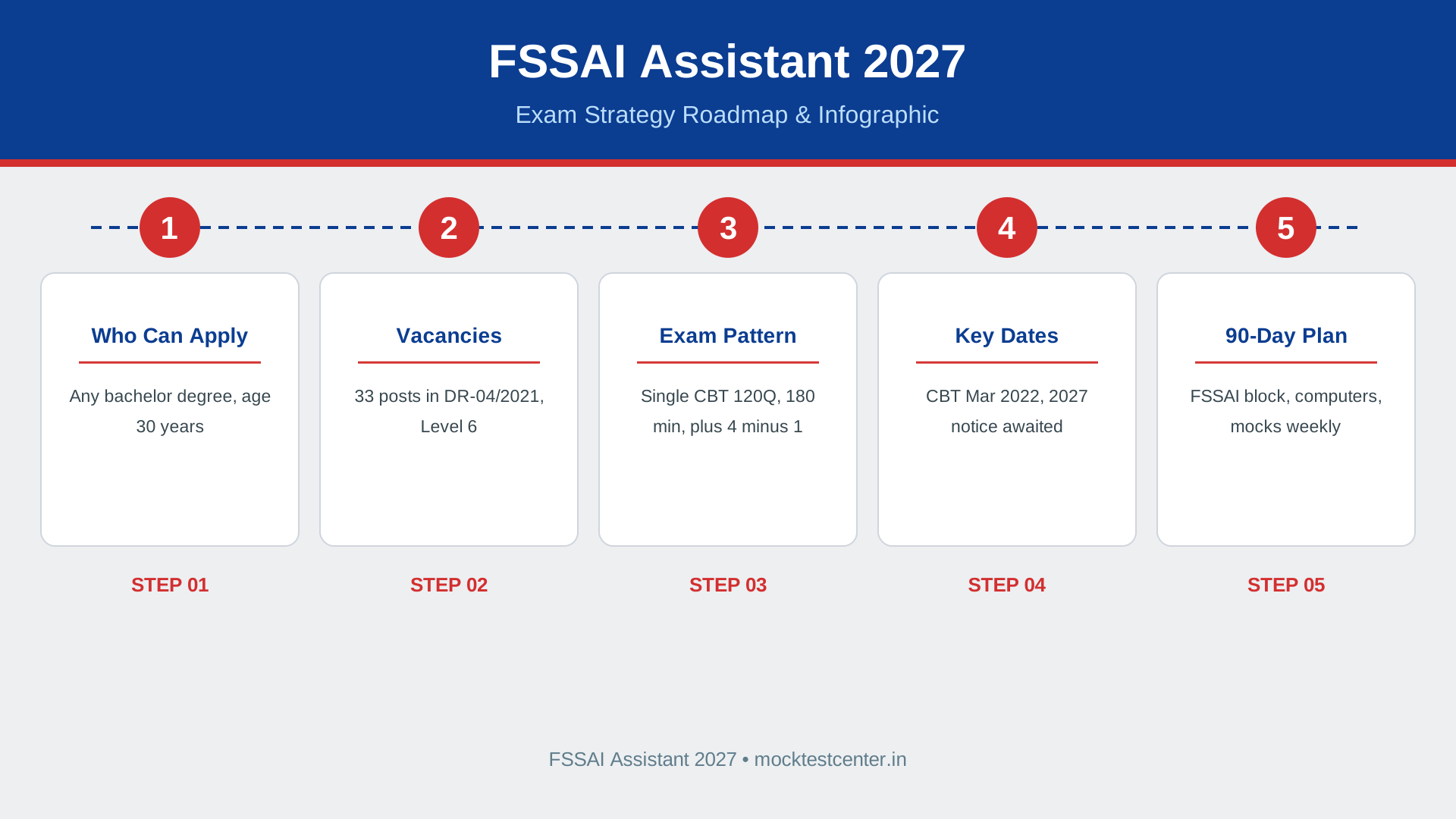
FSSAI Assistant had 33 posts in the last direct recruitment, Advertisement DR-04/2021, dated 30 September 2021. Any bachelor degree qualified a candidate, the age limit was 30 years, and selection rested on a single computer based test of 120 questions in 180 minutes. No second test, no interview, no skill test. That single paper carried 100 percent of the weight, so every mark in it counted in full.
This page is a preparation page for the next cycle, tagged 2027. No 2027 notice for FSSAI Assistant has been announced, and no 2027 vacancy number, date or fee exists yet. The facts below come from the 2021 notice and the test that followed it. Where a claim online goes beyond that record, this page says so, because a candidate who plans on an invented number plans on air.
Assistant is the entry point most graduates can actually reach in FSSAI. Technical Officer needs a science degree or a food diploma, Central Food Safety Officer needs a food or science degree, Food Analyst needs a master degree plus experience. Assistant needs a degree, full stop. That open door is why it draws a crowd far larger than its 33 posts, and why the paper, though shorter in stages, is sharp on competition.
What an Assistant does in FSSAI
An Assistant in FSSAI does the office work that keeps a regulator running. Files move, notes are put up, data is compiled, letters go out to state food authorities and labs, and records are kept for standards, enforcement, imports and training work. The post sits in the administration of the Authority, not in a lab, and not in field inspection. A candidate who joins as Assistant learns how a central regulator works from the inside, file by file.
That sounds plain next to a Technical Officer post, and it is plain, in the good sense. The work is steady, the posting is at headquarters in New Delhi or at a regional office, and the hours follow central government office hours. The exam reflects the job. It tests general intelligence, maths, English, general awareness, computer literacy and knowledge of FSSAI itself. It does not test food chemistry or microbiology in depth, because the job does not need them in depth.
One habit helps from the start. Learn the FSSAI block as a system, not as a list of scheme names. Eat Right India, food fortification, RUCO, Clean Street Food Hub, third party audit, lab ecosystem, imports, state food authorities: each of these is a part of one machine, and the paper asks how the parts fit. A candidate who can explain RUCO in one line and also say where it sits in the FSSAI system will answer more questions than a candidate who only memorised the expansion.
Who can apply
The 2021 notice asked for a bachelor degree from a recognised university or institution. No subject was named, no stream was named, and no minimum percentage was given in the material this pass could verify. A BA, a BSc, a BCom, a BTech or any other recognised bachelor degree met the education rule. Final year candidates needed to read the notice with care, because eligibility was counted as on the closing date of application, and a degree completed after that date did not count.
The age limit on the closing date of application was 30 years. Age relaxation followed central government rules for SC, ST, OBC Non Creamy Layer, persons with benchmark disability, ex-servicemen and other groups named in the notice. Only Indian citizens could apply. Candidates who applied for more than one post in the same advertisement had to state a priority for joining, and the priority given in the form was final.
There was no experience requirement for Assistant. That is the point of the post for a fresh graduate. A candidate who has just finished a degree and a candidate who has worked for five years in a private office stand on the same line at the application stage, and the paper decides between them.
The 2021 cycle, date by date
Advertisement DR-04/2021 came on 30 September 2021. The online link opened on 13 October 2021, after an earlier plan to open on 8 October, and the last date for online application was 12 November 2021, extended from 7 November 2021. The cut off date for eligibility and qualification was also 12 November 2021. Admit cards for the first computer based test were made available on 28 December 2021.
The computer based test for the DR-04/2021 posts ran on 28, 29, 30 and 31 March 2022, on revised dates. Assistant candidates sat for a single test in that window, and the result and document verification followed. The scheme of examination for Assistant listed a single CBT with 100 percent weight, and no interview or skill test stage.
The fee in 2021 was 1,500 rupees for General and OBC candidates, made of a 1,000 rupee application fee and 500 rupees of intimation charges. SC, ST, EWS, women, ex-servicemen and persons with benchmark disability paid 500 rupees, as intimation charges only, with no application fee. Bank and transaction charges, if any, were extra, and the fee once paid was not refunded. A candidate paid separately for each post applied for, so a candidate who applied for Assistant and for Junior Assistant paid twice.
| Event | DR-04/2021, Assistant |
|---|---|
| Advertisement date | 30 September 2021 |
| Online applications open | 13 October 2021 |
| Last date to apply | 12 November 2021 |
| Assistant posts | 33 |
| Total posts in DR-04/2021 | 233 |
| CBT, single stage | 28 to 31 March 2022 |
| Fee, General and OBC | 1500 rupees |
| Fee, SC, ST, EWS, women, ex-servicemen, PwBD | 500 rupees |
Vacancies and the category split
Assistant had 33 posts in DR-04/2021. The split was 13 for Unreserved, 9 for OBC Non Creamy Layer, 6 for SC, 2 for ST and 3 for EWS. That split is small, and small splits make the paper harder in practice, because one or two marks can move a candidate across the line in a category with only 2 or 3 posts.
Put the 33 next to the rest of the advertisement. Technical Officer had 125 posts, Central Food Safety Officer had 37, Personal Assistant had 19, Food Analyst had 4, Assistant Manager IT had 4, Assistant Manager in two other streams had 2 each, Hindi Translator had 1, IT Assistant had 3 and Junior Assistant Grade 1 had 3, for a total of 233 posts in DR-04/2021. Assistant was the third largest post, and it was also the most open on education, which is why its applicant count per post was high.
There is no vacancy number for a 2027 cycle, because no 2027 notice exists. Any site that gives a 2027 vacancy figure for Assistant today is inventing it. The 33 figure is a guide to scale. FSSAI recruits Assistants in the tens, not in the hundreds, and a candidate should plan for a tight contest, not a wide one.
Pay, level and the first salary
Assistant sits in Pay Level 6 of the pay matrix, with a basic pay range of 35,400 rupees to 1,12,400 rupees under the 7th Central Pay Commission. Allowances under central government rules sit on top of basic pay, and the amount varies with the place of posting. That is the salary fact that can be stated from the pay matrix. Gross and in hand figures on coaching sites differ by thousands of rupees, because dearness allowance changes and house rent allowance depends on the city. Treat any single in hand number as an estimate, not a promise.
Level 6 puts Assistant one level below Technical Officer and Central Food Safety Officer, both in Level 7, and above Junior Assistant Grade 1, which sat in a lower level in the same advertisement. For a fresh graduate, Level 6 at a central regulator is a solid start, with central government service conditions, leave, medical benefits and a pension system under the National Pension System for new joiners.
Promotion follows FSSAI service rules, and this page gives no promotion timeline, because no verified timeline was found in this pass. Do not plan a career on a coaching site claim that an Assistant becomes an Administrative Officer in a fixed number of years. The notice gives the entry level, and the service rules give the path, and both should be read from the official source when the next notice comes.
The exam pattern, in full
The Assistant paper was a single computer based test of 180 minutes, with 120 multiple choice questions. Each right answer gave 4 marks, each wrong answer took away 1 mark, and the total was 480 marks. The paper had two parts in the scheme, but in practice it read as six subjects in one sitting.
The six subjects were General Intelligence with 20 questions, Quantitative Aptitude with 20 questions, English Language with 10 questions, General Awareness with 20 questions, Computer Literacy with 25 questions, and FSSAI Role, Functions and Initiatives with 25 questions. Computer Literacy and the FSSAI block together made 50 of the 120 questions, which is the shape of the paper. A candidate who is strong in maths and reasoning but weak in computers and FSSAI loses the largest block.
That shape is the whole strategy. Most graduate exams give the largest weight to maths or reasoning. This one gives it to computers and to knowledge of the regulator itself. A candidate who can use MS Office, who knows Google Docs and email, and who has read the FSSAI system, starts with an edge that no amount of extra maths practice can replace.
| Subject | Questions | Marks |
|---|---|---|
| General Intelligence | 20 | 80 |
| Quantitative Aptitude | 20 | 80 |
| English Language | 10 | 40 |
| General Awareness | 20 | 80 |
| Computer Literacy | 25 | 100 |
| FSSAI Role, Functions, Initiatives | 25 | 100 |
| Total | 120 | 480 |
Why one paper changes everything
A single stage exam has no safety net. In a two stage exam, a weak first paper can be repaired in the second, and the merit list takes half from each stage. In the Assistant exam, the one paper is the merit list. There is no second chance inside the same cycle, and there is no interview to lift a borderline candidate.
That changes how you should take the paper. Guessing has a real cost, at minus 1 per wrong answer, and a guess on a 4 mark question swings the score by 5 marks against a right answer, because you lose the 4 you could have had and you lose 1 more. With only 33 posts, a swing of 5 marks can move a candidate by a visible rank. Leave a question blank when you have no ground to pick an option, and answer only when you can rule out at least two options or when you know the fact.
Time also works differently in a single paper. You get 180 minutes for 120 questions, which is 90 seconds per question on average. The FSSAI block and the computer block are fast if you know them, and slow if you do not, because you cannot work them out from first principles in the hall. The maths block is the opposite: it is slow even when you know it, because each question needs working. Plan the order to match that. Do the fast blocks first, bank the marks, and then give maths the time it needs without panic.
The syllabus, subject by subject
General Intelligence covered verbal and non verbal reasoning: semantic analogy, space orientation, Venn diagrams, classifications, pattern, number series, critical thinking, problem solving, word building, coding and decoding, emotional intelligence, and social intelligence. It is the standard reasoning set, and it rewards daily practice more than theory. Do 20 reasoning questions a day, and check the method for each wrong answer, not just the right option.
Quantitative Aptitude covered the usual graduate level maths: number systems, percentage, ratio and proportion, average, profit and loss, simple and compound interest, time and work, time speed and distance, and data work at a basic level. The paper pitched the level at a bachelor degree, which means the questions test method and speed, not advanced maths. Learn the short method for each chapter, and practise it until it is automatic.
English Language covered vocabulary, grammar and comprehension, with one word substitution, synonyms and antonyms, spelling errors, spotting errors, nouns, pronouns, adjectives, verbs, prepositions, conjunctions, use of a, an and the, idioms and phrases, and parts of speech. Ten questions only, but they are the cheapest marks in the paper for a candidate who reads English daily, and the dearest for a candidate who ignores the subject until the last week.
General Awareness tested the environment around the candidate and its application to society, with current events and matters of everyday observation, and questions on India and neighbouring countries, with history, culture, geography, economic scene, general polity including the Indian Constitution, sports and scientific research. The questions were pitched so that they did not need a special study of any one discipline. A daily newspaper and a monthly current affairs note cover most of it.
Computer Literacy is the subject most graduates get wrong in their planning. They assume it means basic computer knowledge, and then they meet 25 questions on MS Office, Google Docs, email, digital signature, common social media handles, and the regular office work a computer is used for. Practise in Word, Excel and PowerPoint, not in a theory book. Make a table in Word, build a sheet in Excel with a formula, and send an email with an attachment, and you will have covered the habits the paper tests.
The FSSAI block, 25 questions, is the largest single block with computers, and it is the block that decides the paper. It covered the genesis and evolution of FSSAI, the structure and functions of the Food Authority, food safety systems and processes, standards and enforcement, laboratory ecosystems, imports, third party audit, promoting safe and wholesome food through Eat Right India, food fortification, Clean Street Food Hub, RUCO, training and capacity building, and the role of State Food Authorities. Read this block from FSSAI material first, because coaching notes compress it into slogans and the exam asks for the system behind the slogan.
The FSSAI block, and how to learn it
Start with the Act. The Food Safety and Standards Act, 2006, created the Authority, and the paper expects a candidate to know why it was created and what it does. Read the genesis and evolution of FSSAI as a short history: food law before 2006 was spread across many Acts, and the 2006 Act brought them under one Authority. That one fact explains the structure that follows.
Next, learn the structure. The Food Authority sets standards, the enforcement sits with the Food Safety Commissioners in the states and with the central licensing system, the labs test samples, imports are checked at ports, and third party audit adds a layer of checking by private auditors. Each part has a job, and the paper asks which part does what. Draw the chain on one page, and revise it weekly.
Then learn the initiatives as work, not as names. Eat Right India promotes safe and wholesome food. Food fortification adds missing nutrients to staple foods. RUCO collects used cooking oil and turns it into biodiesel, so that used oil does not return to the food chain. Clean Street Food Hub raises hygiene in street food clusters. Each initiative answers a real problem, and the paper asks for the problem and the answer together, not just the name.
Keep a separate notebook for this block, with one page per topic, and write the facts in short lines. Revise it every Sunday. Twenty five questions is a large block, and a candidate who revises it weekly will hold the marks, while a candidate who reads it once will lose half of it by test day.
What has happened since 2021
Since the 2021 cycle, FSSAI has not run a fresh direct recruitment for Assistant that this pass could verify. That silence is itself a fact a candidate should know, because it explains why so many pages online carry invented 2024, 2025 and 2026 dates for this post. Some of those pages recycle the 2021 pattern under a new year label. Others mix the deputation circulars with direct recruitment and present the mix as a fresh notice.
The one real 2025 development was a deputation circular, DEP-01/2025, for Group A and B posts. It covered 33 posts in all, including Director, Joint Director, Manager and Assistant, with applications online from 15 April to 30 April 2025 and hard copy by 15 May 2025, later extended in some reports to 7 May 2025 for online submission. The Assistant posts in that circular were 6 in one count and 8 in another, and the maximum age was 56 years, which is the giveaway that it was deputation for serving officers, not direct recruitment for fresh graduates. It is not an Assistant direct recruitment notice, and it should not be quoted as one.
Another set of pages claims a 2025 Assistant recruitment of 15,000 plus posts, with applications from 23 January to 23 February 2025, and a salary in Pay Level 6. No official FSSAI notice supports that number, and the 2025 deputation circular above, with 33 posts in all, is the only 2025 FSSAI recruitment this pass could verify from credible reports. The 15,000 figure is treated in the package notes as not verified, and this article does not use it as a fact. If a 2027 direct recruitment notice appears, it will appear on fssai.gov.in under Jobs at FSSAI, and that page is the only place to trust for dates, posts and fee.
Assistant, Junior Assistant and Personal Assistant, side by side
Three posts in the same advertisement get mixed up, and the mix costs candidates marks, because each post has a different paper and a different job. Assistant needed any bachelor degree, had 33 posts, and sat for a single paper with 100 percent weight. Junior Assistant Grade 1 needed 12th pass, had 3 posts, and also sat for a single paper, with the same six subjects and the same 120 question pattern. The age limit for Junior Assistant was 25 years, not 30, which is the sharpest difference between the two.
Personal Assistant needed any bachelor degree, had 19 posts, and sat for a single paper plus a proficiency test in shorthand and typing. The paper counted 100 percent, and the shorthand and typing test was qualifying, with marks not added to the final result. Shortlisting for that test ran at 1 to 10. A candidate who can type and take shorthand has a real edge there, and a candidate who cannot should not waste a form on it.
Technical Officer, by contrast, needed a science degree or a food diploma, had 125 posts, and sat for two computer based tests with 50 percent weight each. Its paper tested food law, food chemistry, microbiology and processing in depth, which the Assistant paper does not. A graduate with a science degree can apply for both Assistant and Technical Officer, and the shared FSSAI block can be prepared once and used twice, but the rest of the preparation is different, and it should be planned as two papers, not one.
Cut off, and why no number is printed here
No cut off figure is printed in this article, because no cut off figure for Assistant in DR-04/2021 was verified from an official source in this pass. Trackers publish category wise tables, and some of those tables disagree with each other by wide margins, and none of them was checked against an official PDF in this pass.
The honest guidance is structural, not numerical. With 33 posts and a single paper of 480 marks, the cut off sat at the score of the 33rd candidate in each category merit list, after document verification, and that score moves with the paper. A paper with easy maths pushes the cut off up, because every candidate scores in maths. A paper with a hard FSSAI block pushes the cut off down, because the block separates the candidates who read the system from those who only read a summary.
Do not trust any site that gives a 2027 cut off today. A cut off is a result, not a forecast. It can only be known after a test is held, and it depends on the paper, the posts and the candidates who sat for it. Aim for 75 percent in mock tests, with no weak subject, and you will be in the range where a real cut off falls, whatever the paper does.
Books and sources that match this paper
Start with FSSAI material for the largest block. The FSSAI site carries the genesis and structure of the Authority, its systems and processes, and its initiatives, and that material is the source the paper draws from. Read it in full, and make notes in your own words. Then read the Act, at least the provisions and definitions, so the FSSAI block has a legal base under it.
For maths, use a standard quantitative aptitude book at graduate level, and practise one chapter a day with a timer. For reasoning, use a standard reasoning book, and solve 20 questions a day. For English, use a basic grammar book and read a daily newspaper, which also covers current affairs. For computers, practise in Word, Excel and PowerPoint, and use Google Docs and email in real work, because the paper tests habits, not definitions.
One good book per subject, read fully, beats a shelf of guides read in part. Past papers matter, because the 2021 paper shows the exact mix of subjects and the exact level of the FSSAI block. Solve the March 2022 paper under time, and check every wrong answer against the source, not just against the answer key.
A 90 day plan that fits one paper
Days 1 to 30 are for the base. Give one hour a day to maths, one hour to reasoning and English, one hour to computers with hands on practice, and one hour to the FSSAI block. Read the FSSAI system in small parts, one topic a day, and write one line per topic in your own words. Read the newspaper daily, and make short notes on current affairs. Solve 30 questions a day across maths and reasoning.
Days 31 to 60 are for depth and testing. Take one full mock test every week, in 180 minutes, with no pauses, and score it at plus 4 and minus 1. Spend an hour after each test on analysis, and note every wrong answer with the correct rule or fact. Revise the FSSAI block twice in this block, because it is the largest block and the one most candidates forget first. Practise computer questions from a real keyboard, in Word and Excel, not from a book alone.
Days 61 to 90 are for revision and more testing. Take a full mock test every three days, and in the last two weeks take one every two days. Revise short notes daily, and in the last week solve only past papers and your error notes. Keep one day a week for current affairs, because General Awareness rewards a steady habit, not a last week rush. In the last three days, revise the FSSAI notebook and the computer notes, because those two blocks are worth 100 marks each, and they are the fastest marks to lose and to keep.
How to use mock tests for this exam
A mock test for Assistant has to copy the real paper in subject mix, not just in question count. A mock with 120 maths questions is useless for this post, because the real paper has only 20 maths questions. Check the mix before you buy or join a test series: 20 reasoning, 20 maths, 10 English, 20 general awareness, 25 computers and 25 FSSAI. If the mix is wrong, the score is wrong, and the practice teaches the wrong habits.
After each test, spend an hour on analysis. Note the questions you got wrong, and note the questions you guessed. Track your score in each subject separately. If your computer score is low, go back to Word and Excel, not to more mocks. If your FSSAI score is low, go back to the FSSAI material. Two or three good tests a week, with full analysis, beat ten tests taken in a rush.
Time the paper in parts. Give the FSSAI block and the computer block 45 minutes together, because they are fast when you know them. Give reasoning and English 45 minutes together. Give maths 60 minutes, because it needs working. Give general awareness 30 minutes, and keep it last if you like, because it is the block where you either know the fact or you do not, and extra time does not create knowledge. That split adds to 180 minutes, and it stops maths from eating the time that the fast blocks need.
Mistakes that cost Assistant candidates
The first mistake is to prepare for a general graduate exam and skip the FSSAI block. That block is 25 questions, and the computer block is 25 more, so half the paper is FSSAI plus computers. A candidate who scores well in maths and reasoning and blanks on those two blocks starts from behind, and there is no second stage to repair it.
The second mistake is to guess freely. At minus 1 per wrong answer, a guess costs 5 marks against a right answer, and with only 33 posts, a few guesses can move a candidate out of the list. The third mistake is to trust a 2027 date or vacancy number from a tracker and plan around it. The fourth mistake is to pay a fee or fill a form on any site other than the official FSSAI site, because the notice, the link and the fee all come from there.
The fifth mistake is to confuse this post with the deputation circular of 2025. That circular asked for serving officers, with a maximum age of 56 years, and it covered 33 posts in all, with only a handful for Assistant. A fresh graduate who reads that circular as a direct recruitment notice will waste weeks waiting for a form that was never meant for them.
The sixth mistake is about the degree rule. Assistant needs any bachelor degree, and that open rule tempts candidates to assume the paper is easy. It is open on education, and it is tight on posts, which makes the paper harder, not easier. Plan for a tight contest, with a high cut off, and prepare the two largest blocks first.
Documents and the application, as it ran in 2021
Applications in 2021 were online only, through the FSSAI site, under Jobs at FSSAI. No other mode of submission was accepted. Candidates needed a degree certificate or provisional certificate, marksheets, a category certificate if claiming reservation, a disability certificate if applicable, a photo and a signature in the sizes the form asked for, and a payment method for the fee. The fee was paid online, and the form asked for a priority order if the candidate applied for more than one post.
Keep the same list ready for the next cycle, and add one item: a printout or saved copy of the submitted form and the fee receipt. FSSAI notices have changed dates mid cycle before, with the last date moving from 7 November to 12 November 2021, and the test dates moving twice. A saved copy of your own form is the one record that does not move.
Age and qualification were counted as on the closing date of application, 12 November 2021 in that cycle. That rule matters, because a degree completed after the closing date did not count, even if it was completed before the test. Check the closing date rule in the next notice with the same care, because it decides eligibility, not the test date.
Other regulatory exams on this site
FSSAI is one regulator among many, and a candidate who prepares for it often prepares for a second regulator at the same time. The general aptitude part overlaps, and the habit of reading a regulator's own law and annual work carries across. See RBI Grade B 2027, RBI Grade B DEPR 2027, NABARD Grade A 2027, NABARD Grade B 2027, SEBI Grade A 2027, PFRDA Grade A 2027, IRDAI Assistant Manager 2027, SIDBI Grade A 2027, IFSCA Grade A 2027 and FSSAI Technical Officer 2027 on this site. Each page gives that exam's own pattern, so do not carry the FSSAI pattern across to a banking or insurance regulator, because the papers differ in marks, in stages and in subject weight.
The Technical Officer page is the closest sibling, and it is worth a read even if you only want Assistant. It shows what a two stage FSSAI paper looks like, and it shows how much of the FSSAI block the two posts share. A science graduate who is eligible for both posts can prepare the shared block once and use it twice, which is the one genuine saving in this set.
What to check first when the next notice comes
When a new notice appears, check five things before you fill the form. First, the advertisement number and the date, so you know you are reading the right notice. Second, the post list and the vacancy split, so you know the scale. Third, the education rule, because Assistant has taken any bachelor degree so far, and a change there would change who can apply. Fourth, the scheme of examination, because a single stage paper can become a two stage paper, and the subject mix can move. Fifth, the fee, the last date and the closing date rule for age and qualification.
Check all five on fssai.gov.in, not on a tracker. Trackers copy the notice, and a copy can carry an old date, an old fee or an old pattern. The official PDF is the only version that counts, and it is the version this page used for the 2021 facts above.
Start now, with the FSSAI system, computers in real use, and one maths book, and take a full mock test every week from the second month. If the next notice keeps the 2021 pattern, you will be ready for the one paper that decides everything. If it changes the pattern, you will still hold the subject base that any new pattern must test, and that base is the part no notice can take away.







