
About Kerala Forest Guard 2027 Exam Series
📖 Table of Contents
- Kerala Forest Guard 2027 at a glance
- The notification calls the post Beat Forest Officer
- Where the live cycle stands now
- How many posts, and why no single number exists
- The Kerala Forest Guard exam pattern, in full
- The physical tests decide more than the paper
- Who can apply
- Pay and what the job actually involves
- The forest block is where this paper is won
- A preparation plan that fits the real paper
- Mistakes that cost candidates this post
- What to watch next
- Mock tests for Kerala Forest Guard 2027: Full Tests, PYQ, Chapter Tests, Sectional Tests, NCERT-based Tests, Current Affairs and PYQ PDF Downloads
- Sources
Kerala Forest Guard 2027: Complete Exam Guide
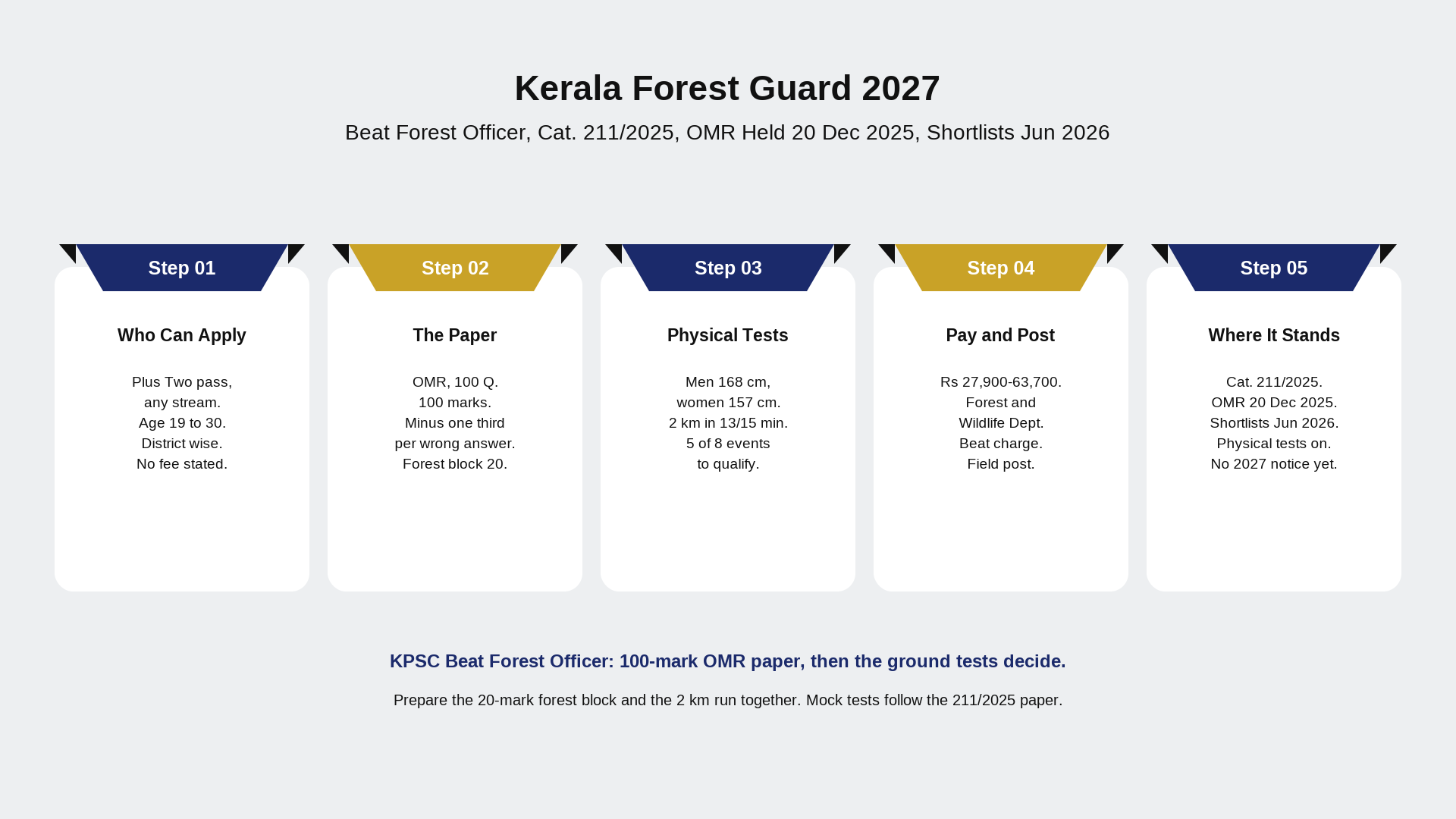
Kerala Forest Guard 2027 on this page follows the live recruitment for the post the Kerala Public Service Commission calls Beat Forest Officer. The Kerala Forest Guard exam pattern for the live cycle is a single OMR paper of 100 questions and 100 marks, followed by physical measurement, physical efficiency tests and an endurance run. KPSC held that OMR paper on 20 December 2025 for Category Number 211/2025, and district shortlists reached the physical test stage in June 2026. No separate 2027 notification has been published as of 23 November 2026, so this guide anchors on the 211/2025 cycle and on the Non Creamy Layer and community notifications that followed it, and says so wherever a 2027 figure would otherwise be guessed.
One fact about this examination surprises first time candidates, and it shapes everything else in this guide. The post is called Beat Forest Officer in every KPSC notification, and the Forest and Wildlife Department fills it district by district. The name Forest Guard describes the work. The notification name decides the application.
A candidate who searches only for Forest Guard misses the official notification, because keralapsc.gov.in lists it under Beat Forest Officer.
The second surprise is the weight of the physical tests. The written paper screens candidates. The physical standards, the efficiency events and the 2 km endurance run remove candidates who pass the paper. A candidate can score well in the OMR test and still go home from the ground.
This guide gives the physical standards the same space as the syllabus, because the recruitment gives them the same weight.
The third surprise is the vacancy picture. KPSC fills Beat Forest Officer posts district wise, and the general notification lists anticipated vacancies for each district instead of one state total. Community notifications fill the backlog for specific communities in specific districts. The numbers in this guide come from those notifications, district by district, and no state total is invented.
Kerala Forest Guard 2027 at a glance
| Detail | Kerala Forest Guard 2027, as run in the 211/2025 cycle |
|---|---|
| Conducting body | Kerala Public Service Commission (KPSC), Thiruvananthapuram, website keralapsc.gov.in |
| Department | Forest and Wildlife Department, Government of Kerala |
| Post name on the notification | Beat Forest Officer, Part I Direct Recruitment, district wise |
| Live cycle | Category Number 211/2025, gazette 31 July 2025, last date 3 September 2025 |
| Written test | Common OMR test held 20 December 2025, 1.30 pm to 3.20 pm, question paper code 172-2025, 100 questions, 100 marks |
| Final answer key | Published 19 January 2026 on keralapsc.gov.in |
| Endurance test | Held May 2026, 2 km in 13 minutes for men and 15 minutes for women |
| Shortlists | District shortlists published June 2026 for physical measurement and physical efficiency test |
| Pay scale | Rs 27,900 to Rs 63,700 per month |
| Qualification | Pass in Plus Two or an equivalent examination |
| Age, general direct recruitment | 19 to 30 years, candidates born between 2 January 1995 and 1 January 2006 |
| Method of appointment | Direct recruitment, district wise, 70 percent quota for direct recruitment |
| Application route | One time registration on keralapsc.gov.in, online application against the category number |
| 2027 notification | No separate 2027 notification published as of 23 November 2026 |
The notification calls the post Beat Forest Officer
KPSC published Category Number 211/2025 for Beat Forest Officer in the Forest and Wildlife Department. The notification names the department as Forest and Wildlife, the post as Beat Forest Officer, and the method of appointment as direct recruitment, district wise. The scale of pay printed in the notification is Rs 27,900 to Rs 63,700. The age limit printed for the general direct recruitment is 19 to 30 years, with candidates born between 2 January 1995 and 1 January 2006 eligible to apply.
The same notification fixes the rules that govern the post. The name, age limit and qualifications follow Government Order (P) Number 60/2010/F and WLD dated 30 August 2010 and Government Order (P) Number 84/2014/F and WLD dated 20 September 2014. The quota reserved for direct recruitment is 70 percent. The appointing authority assesses the number of vacancies and advice goes against the vacancies reported.
That last line matters. Advice follows reported vacancies, and the ranked list stays alive while vacancies keep coming in.
Beat Forest Officer is the entry post in the Kerala forest service. A Beat Forest Officer holds charge of a beat, which is the smallest unit of forest administration, and works under a Section Forest Officer. The beat work is field work. Patrolling, watching for fire and illicit felling, checking timber movement, protecting wildlife, recording offences and working with people who live near the forest fill the day.
The Western Ghats run along the eastern side of Kerala, and the state forest includes protected areas and plantations where the beat officer is the first official a visitor or a villager meets.
Candidates sometimes ask whether Forest Guard and Beat Forest Officer are two different posts in Kerala. In the KPSC system they are one post under the notification name. Other states use the name Forest Guard for their own entry post, and that is where the confusion starts. In Kerala the application form, the hall ticket, the answer key and the ranked list all carry the name Beat Forest Officer.
Search for that name on keralapsc.gov.in, and the Kerala Forest Guard 2027 mock test on this site follows the same paper.
Where the live cycle stands now
The 211/2025 cycle moved fast by KPSC standards. The gazette notification came out on 31 July 2025. Applications closed on 3 September 2025. KPSC held the common OMR test on 20 December 2025 from 1.30 pm to 3.20 pm, with question paper code 172-2025 in Malayalam, Tamil and Kannada mediums.
The final answer key went up on 19 January 2026. Candidates who sat that paper have already crossed the written stage.
The endurance test followed in May 2026. The Idukki district office held its endurance test from 19 to 22 May 2026, and the Kasaragod district office held its test on 20 and 21 May 2026. District shortlists followed in June 2026. The Kasaragod shortlist came out on 17 June 2026 and the Idukki shortlist on 29 June 2026.
Those shortlists name the register numbers provisionally eligible for physical measurement, physical efficiency test and verification of original documents. The physical tests run on schedules the district offices publish, with admission tickets downloaded from the KPSC website and dates sent by SMS and profile message.
The same OMR paper covered more than one category number. The KPSC answer key page lists the 20 December 2025 test against category codes 211/2025, 212/2025, 213/2025, 214/2025, 250/2025, 251/2025, 252/2025 and 253/2025. The 250/2025 to 257/2025 series is the community notification set from the same gazette date, 31 July 2025, with 21 vacancies across districts and communities. The 211/2025 notification is the general direct recruitment.
The community notifications fill reserved turns that stayed vacant, and they run on the same paper and the same physical standards.
Two more notification sets followed after the general cycle closed. Category Numbers 431/2025 to 434/2025 came out in the gazette dated 30 October 2025, with the last date for applications on 3 December 2025. Category Numbers 146/2026 to 150/2026 came out in the gazette dated 31 August 2026, with the last date on 7 October 2026. Both sets are First NCA notifications, which means they invite applications only from the named reservation communities for the named districts.
The 146/2026 set carries six vacancies: one LC/AI vacancy in Wayanad, one Muslim vacancy in Idukki, two Scheduled Caste vacancies in Idukki, one SIUC Nadar vacancy in Idukki and one SCCC vacancy in Idukki.
The pattern is clear. KPSC keeps the Beat Forest Officer pipeline moving through a general notification and then community notifications for the turns that remain. A candidate from a general category waits for the next general notification. A candidate from a notified community watches the NCA sets, because those are the notifications that carry their name.
How many posts, and why no single number exists
The 211/2025 general notification lists vacancies as district wise anticipated vacancies. It names the districts, Thiruvananthapuram, Kollam, Pathanamthitta, Kottayam, Idukki, Ernakulam, Thrissur, Palakkad, Malappuram, Kozhikode, Wayanad, Kannur and Kasaragod, and marks the numbers as anticipated. The notification does not print one state total. Tracker pages that print a firm state total for 211/2025 are adding up numbers that the notification itself calls anticipated.
The community sets do print exact numbers, because each one fills named turns. The 250/2025 to 257/2025 set carries 21 vacancies in total: one Scheduled Caste vacancy each in Kottayam and Pathanamthitta, Viswakarma vacancies in Kollam and Kozhikode, Muslim vacancies in Kozhikode and Kollam, LC/AI vacancies in Thiruvananthapuram, Thrissur, Ernakulam and Pathanamthitta, Ezhava Thiyya Billava vacancies in Malappuram and Pathanamthitta, one Hindu Nadar vacancy in Kollam and one Scheduled Tribe vacancy in Thrissur. The 431/2025 to 434/2025 set and the 146/2026 to 150/2026 set add their own small numbers for their own districts and communities.
That is how KPSC works for this post. The general notification opens the district wise list. The community notifications fill the gaps. The ranked list then supplies candidates as vacancies are reported, and the 70 percent direct recruitment quota decides how many of the reported vacancies go to this list.
A candidate who asks for one vacancy number for Kerala Forest Guard 2027 is asking a question the notification does not answer. The useful question is different: which district did you apply for, and which category number covers it.
District choice matters more here than in a state wide examination. The application goes to one district. The ranked list is district wise. A candidate applies where they are willing to serve, and the list for that district decides their turn.
The notification lists the districts in the application, and the candidate picks one. That choice stays with the candidate through the whole cycle.
The Kerala Forest Guard exam pattern, in full
The Kerala Forest Guard exam pattern for the live cycle is one OMR paper. The paper carries 100 questions and 100 marks. Each correct answer carries 1 mark. Each wrong answer loses one third of a mark.
Unanswered questions carry no penalty. The paper runs in Malayalam, Tamil or Kannada medium, with a separate English part, and the question paper code for the 20 December 2025 test was 172-2025.
One point about the duration needs care, because tracker pages print three different figures. The test on 20 December 2025 ran from 1.30 pm to 3.20 pm, which is 110 minutes on the clock. Some tracker pages print 75 minutes and others print 90 minutes for the same paper. The 1.30 pm to 3.20 pm timing comes from the KPSC answer key page for the test, and this guide uses it.
A candidate preparing for the next cycle should check the duration printed in the admission ticket and in the next notification, because KPSC can change the timing when it changes the paper.
The paper divides into six parts. General Knowledge carries the largest share, and the forest topics carry the next largest share. That split is the whole strategy of the paper in one line: a Plus Two level general paper with a forest paper inside it.
| Part | Marks | What it covers |
|---|---|---|
| General Knowledge | 40 | History 5, Geography 5, Economics 5, Constitution of India 8, Kerala administration 3, Biology and Public Health 4, Physical Science 3, Chemistry 3, Arts Sports Literature and Culture 4 |
| Current Affairs | 10 | Recent events in India and Kerala, national and international developments |
| Simple Arithmetic and Mental Ability and Observation Skills | 10 | Arithmetic, series, relationships, classification, arrangement of words, age problems, position determination |
| General English | 10 | Grammar, vocabulary and comprehension at Plus Two level |
| Regional Languages, Malayalam Tamil Kannada | 10 | Language paper in the medium the candidate chose |
| Special Topics, Forest Wildlife and Related Laws | 20 | Forests, forest types of India and Kerala, Western Ghats biodiversity, state of forests, forest laws, forest offences, protected areas, eco tourism, human wildlife conflict, forest dependent communities, forest products, climate change and forests |
| Total | 100 | 100 questions, 100 marks, one third negative marking |
The General Knowledge total deserves a note, because tracker pages disagree about it. Some pages print 35 marks for General Knowledge. The sub topic marks printed in the same pages add to 40: History 5, Geography 5, Economics 5, Constitution 8, Kerala administration 3, Biology and Public Health 4, Physical Science 3, Chemistry 3 and Arts Sports Literature and Culture 4. The six parts add to 100 only when General Knowledge counts 40.
This guide uses 40 and records the 35 figure as a tracker error.
Constitution of India carries 8 marks, the largest single block inside General Knowledge. History, Geography and Economics carry 5 marks each. Biology and Public Health carry 4, and Arts Sports Literature and Culture carry 4. Kerala administration carries 3, Physical Science carries 3 and Chemistry carries 3.
A candidate who studies the Constitution block and the Kerala history block first covers 13 marks before touching anything else.
The Special Topics block carries 20 marks, one fifth of the paper. It is the only block that a general KPSC candidate cannot prepare from a standard Plus Two guide. Forests, their definitions, their direct and indirect benefits, the forest types of India and Kerala, the biodiversity of the Western Ghats, the state of forests at global, Indian and Kerala level, important dates and events in forests and environment, national and international organisations in forestry, climate change mitigation and forests, forest dependent communities and forest products, forest laws and the punishment for forest offences, activities in the forest, human and wildlife conflict, protected areas and eco tourism all appear in the syllabus. Twenty marks on this block decide the rank more than any other block, because most candidates prepare it last or skip it.
The regional language part carries 10 marks and trips candidates who ignore it. The paper runs in Malayalam, Tamil or Kannada, and the candidate answers the language part in the medium chosen at application. A candidate who studied in Malayalam medium and answers the language part casually gives away marks that cost nothing to keep. The General English part carries another 10 marks at the same level.
Together the two language parts carry a fifth of the paper.
The arithmetic and mental ability part carries 10 marks and tests speed more than knowledge. Series, relationships, classification, arrangement of words in a meaningful order, age problems and position determination reward practice, and the questions are short. A candidate who practices 20 questions a day for a month finishes this block faster than a candidate who reads theory about it.
The physical tests decide more than the paper
The written paper is only the first gate. The shortlist from the OMR test goes to physical measurement, physical efficiency test and verification of original documents. The endurance test runs alongside. A candidate who clears the paper and fails the ground goes no further, and the notification prints the standards in full so that no candidate can claim surprise.
The physical standards are fixed numbers. Male candidates need a minimum height of 168 cm and a chest of 81 cm around the chest with an expansion of 5 cm on full inhalation. Scheduled Caste and Scheduled Tribe male candidates need a minimum height of 160 cm. Female candidates need a minimum height of 157 cm, and Scheduled Caste and Scheduled Tribe female candidates need a minimum height of 150 cm.
There is no chest measurement for female candidates.
The medical standards sit beside the physical standards. Hearing should be perfect. Vision without glasses should be 6/6 Snellen for distant vision in each eye and 0.5 Snellen for near vision in each eye. Colour vision should be normal.
Night blindness should be nil. A candidate who wears glasses and cannot meet the vision standard without them fails the medical standard, and this is the standard that removes candidates who never checked it before applying.
The endurance test is a 2 km run. Male candidates complete it within 13 minutes. Female candidates complete it within 15 minutes. The endurance test for the 211/2025 cycle ran in May 2026, before the physical measurement and efficiency tests, and the shortlists published in June 2026 name only the candidates who qualified in the endurance test.
That order matters for preparation. The run comes first in practice, and a candidate who cannot run 2 km in the qualifying time never reaches the other events.
| Physical efficiency event, male candidates | Standard |
|---|---|
| 100 metres run | 14 seconds |
| High jump | 132.2 cm |
| Long jump | 457.2 cm |
| Putting the shot, 7264 grams | 609.60 cm |
| Throwing the cricket ball | 6096 cm |
| Rope climbing, only with hands | 365.80 cm |
| Pull ups or chinning | 8 times |
| Endurance run, 2 km | 13 minutes |
Male candidates must qualify in five of the eight physical efficiency test events. Female candidates must qualify in five of nine events. The event lists for women follow the same pattern with standards set for women, and the notification prints them in full. A candidate needs five passes, so the smart preparation picks the five events that suit the candidate body and trains those hard, while keeping the other events at a passing level.
The shot put and the cricket ball throw reward technique as much as strength, and the rope climb rewards grip and practice more than height.
The physical standards also explain why the age window is young. The post needs a candidate who can patrol on foot, climb, run and work in rough ground in heat and rain. The Plus Two qualification and the 19 to 30 age window point at the same candidate: a young person with a school leaving qualification and a fit body. A candidate who treats this as a desk examination prepares for the wrong job.
Who can apply
The educational qualification is a pass in the Plus Two examination conducted by the Kerala Board of Higher Secondary Education, or an equivalent examination recognised by the Government of India or Kerala. No subject restriction applies. No minimum percentage applies. A candidate from any stream, science, commerce or humanities, can apply, and the paper tests general knowledge rather than the Plus Two subjects.
The age limit for the general direct recruitment is 19 to 30 years, with candidates born between 2 January 1995 and 1 January 2006 eligible under Category Number 211/2025. The community notifications carry their own age windows. The 250/2025 to 257/2025 set runs 19 to 33 years. The 146/2026 to 150/2026 set runs 19 to 39 years for Scheduled Caste candidates and 19 to 37 years for the other notified communities.
The general conditions of KPSC allow age relaxation for eligible categories, with the maximum age limit not exceeding 50 years in any case. A candidate should read the age window printed in the category number they apply under, because the window changes between the general notification and the community notifications.
The NCA notifications add one more condition. Differently abled candidates are not eligible for the posts under those notifications, because the post carries physical standards that the notification treats as essential. Separate ranked lists are prepared for each notified community and district under the NCA sets, and a candidate applies only against the category number that names their community and district.
Applications run through the KPSC one time registration system on keralapsc.gov.in. A candidate registers once, keeps the profile updated, and applies online against the category number while the notification is open. The notification extracts read for this guide state no application fee figure, and KPSC applications run through one time registration without a fee at the application stage. A candidate should still read the fee line in the next notification, because the notification is the authority.
Pay and what the job actually involves
The scale of pay printed in the 211/2025 notification is Rs 27,900 to Rs 63,700 per month. Government allowances sit on top of the scale, as they do for other Kerala Government posts. The starting pay puts the post in the lower middle of the state government scales, and the work puts it in the field rather than the office.
A Beat Forest Officer holds a beat and answers for it. The day starts with a patrol of the beat area, checking for fresh felling, fire, encroachment and signs of wildlife movement. The officer records offences, seizes timber or tools where the law allows, and reports to the Section Forest Officer. The officer also works with the people who live at the forest edge, on fire lines, on plantation work, on nursery work and on the protection of water sources inside the forest.
When human wildlife conflict flares, when an elephant enters a field or a leopard takes livestock, the beat officer is the first official on the spot.
The Western Ghats give the Kerala forest its character. The Ghats hold forests that change with altitude, from moist deciduous forest at the base to evergreen forest and shola grassland higher up. The biodiversity of the Western Ghats is the reason the Special Topics block of the paper carries 20 marks, and the reason a beat officer needs to know trees, animals and the laws that protect them. A candidate who learns the forest types of Kerala for the paper is also learning the ground they will patrol.
The job also carries risk that a desk post does not. Patrols run in remote ground, in rain, in heat, and sometimes at night. The physical standards exist because the work needs them, and the endurance run exists because a beat officer who cannot cover ground on foot cannot do the job. A candidate who applies for the pay alone and ignores the field work will find the job harder than the paper.
The forest block is where this paper is won
Twenty marks on forest, wildlife and related laws is the largest single block in the paper after General Knowledge, and it is the block where preparation pays best. General Knowledge rewards years of reading. The forest block rewards a month of focused study, because the syllabus names the topics and the questions stay close to them.
Start with the definitions. Forests, their direct and indirect benefits, and the forest types of India and Kerala. Learn the types by name and by where they grow in Kerala: evergreen, semi evergreen, moist deciduous, dry deciduous, shola and grassland, mangrove and plantation. Learn which districts hold which type, and which type holds which wildlife.
The paper asks about types more than any other forest topic.
Move to the Western Ghats. The Ghats run along the western edge of the Deccan plateau, and Kerala holds a long stretch of them. Learn why the Ghats matter for biodiversity, for rainfall and for the rivers that start in them. Learn the protected areas of Kerala by name and district, the national parks and the wildlife sanctuaries, and the animals each one protects.
Learn the difference between a national park, a wildlife sanctuary, a community reserve and a conservation reserve, because the paper tests the legal difference.
Move to the laws. The Indian Forest Act, the Wildlife Protection Act, the Forest Conservation Act and the Kerala Forest Act form the legal spine of the block. Learn what each law controls, what counts as a forest offence under each, and what punishment follows. Learn the rules on felling, on transport of timber, on hunting and on trade in wildlife parts.
The syllabus names forest offences and their punishment as a topic, and the questions follow the syllabus.
Finish with the living topics. Forest dependent communities and forest products, human and wildlife conflict, protected areas and eco tourism, climate change mitigation and forests, and the state of forests at global, Indian and Kerala level. These topics change every year, so read the latest India State of Forest Report summary and the Kerala forest department releases for the current figures. A candidate who reads the current report scores on questions that a candidate with an old book misses.
One more source helps more than any guide book. The question paper for the 20 December 2025 test, code 172-2025, is published on the KPSC website with the final answer key dated 19 January 2026. Read that paper before buying a new book. It shows the exact weight of each block, the exact style of the forest questions, and the exact level of the language parts.
No guide book describes the paper as well as the paper itself.
A preparation plan that fits the real paper
The plan below assumes three months and a candidate who works or studies alongside preparation. It spends time in proportion to marks, and it starts the physical training on day one, because the ground tests cannot be crammed.
Month one covers the base. General Knowledge from a standard KPSC Plus Two level guide, with the Constitution block first, then Kerala history, then Indian history, Geography and Economics. Current affairs from a daily Kerala newspaper, with notes on the forest and environment stories that feed the Special Topics block. Arithmetic practice of 20 questions a day.
The run starts in month one: 2 km three times a week, timed, with the target of 13 minutes for men and 15 minutes for women before the month ends.
Month two covers the forest block and the languages. The forest syllabus gets one hour a day, topic by topic, with the laws in the second half of the month. The regional language part gets 30 minutes a day from the Plus Two language textbooks. General English gets the same from a grammar workbook.
The physical training adds the efficiency events: high jump and long jump technique, shot put and cricket ball throw practice, rope climbing and pull ups, with two sessions a week on the ground.
Month three is the paper. The 172-2025 question paper under timed conditions, then the previous KPSC Beat Forest Officer papers, then mock tests in the same 100 question format with one third negative marking. Every mock test gets a review the same day: which block lost marks, which guesses cost marks, and which questions were left blank that should have been attempted. The physical training in month three is maintenance, not new effort, with the endurance run timed once a week.
The negative marking rule shapes the attempt strategy. Three wrong answers cancel one correct answer. A candidate who guesses on 30 questions and gets 10 right loses 20 marks on the other 20, and the net gain is zero. A candidate who attempts only the questions where two options can be eliminated scores higher with fewer attempts.
The rule for the mock tests is the rule for the real paper: attempt a question only when at least two options can be ruled out, and leave the rest blank.
Two hours a day, split between the paper and the ground, beats six hours of reading alone. The paper is 100 marks and the ground is a pass or fail gate, and a candidate who prepares only one of them prepares for half the recruitment.
Mistakes that cost candidates this post
The first mistake is preparing for the wrong post name. A candidate who searches for Forest Guard vacancies and never finds Category Number 211/2025 misses the application window, because the notification carries the name Beat Forest Officer. The fix is simple: search keralapsc.gov.in for Beat Forest Officer, and set the alert on that name.
The second mistake is leaving the physical preparation till after the written result. The endurance test for the 211/2025 cycle ran in May 2026, about five months after the OMR paper, and the shortlists followed in June. Five months sounds long. It is short for a candidate who cannot run 2 km, because running fitness builds over weeks and the rope climb and the jumps need technique that cannot be learned in a week.
Start the run in the first week of preparation.
The third mistake is ignoring the vision standard. The medical standard needs 6/6 distant vision without glasses in each eye, normal colour vision and no night blindness. A candidate who wears glasses should get the vision checked before applying, because the standard is checked at the physical stage and no preparation fixes it at that point.
The fourth mistake is skipping the forest block. Candidates with a general KPSC background score well in General Knowledge and Current Affairs and then lose the rank in the 20 mark forest block, because they treat it as general knowledge. The forest block is a separate syllabus with its own topics, and it needs its own month.
The fifth mistake is guessing in the OMR paper. One third negative marking punishes guessing hard, and the paper is designed for it. The candidates who top the list are usually the ones who attempted 75 to 85 questions with high accuracy, and the candidates who attempted all 100 with guesses fall behind them.
The sixth mistake is applying to the wrong district or the wrong category number. The recruitment is district wise, and the community notifications apply only to the named community and district. A candidate who applies under a category number that does not cover their district or community wastes the application. Read the district and community lines in the notification before clicking apply.
The seventh mistake is trusting tracker pages for the vacancy total. The general notification lists anticipated vacancies district wise and prints no state total. A page that prints a firm total is guessing, and a candidate who plans around a guessed number plans around nothing. The hard numbers are the 21 vacancies in the 250/2025 to 257/2025 community set and the 6 vacancies in the 146/2026 to 150/2026 set, and those numbers are small because community notifications fill backlog turns, not the whole recruitment.
What to watch next
The 211/2025 cycle is in the physical test stage as of 23 November 2026. District shortlists from June 2026 are moving through physical measurement, physical efficiency test and document verification, and the ranked lists follow. Candidates on those shortlists should watch the district office notices on keralapsc.gov.in for their physical test schedule and download the admission ticket when the SMS and profile message arrive.
The 146/2026 to 150/2026 community notifications closed on 7 October 2026, and their OMR test and physical stages follow the same sequence as the general cycle. Candidates under those category numbers should watch for the test date notice, which KPSC publishes on the website and in the profile message.
The next general notification is the question every new candidate asks, and no date exists for it as of 23 November 2026. KPSC opens a new general notification when the Forest and Wildlife Department reports fresh vacancies, and the community notifications in between show that the department keeps reporting. A candidate who wants the next general cycle should keep the Plus Two qualification ready, keep the one time registration profile updated, keep the running fitness at the qualifying standard, and prepare the forest block now, because the gap between a new notification and its OMR test is short.
Check keralapsc.gov.in for every date in this guide. The notification, the answer key, the shortlist and the ranked list all appear there first, and tracker pages copy them with errors. The Kerala Forest Guard 2027 mock test on this site follows the 211/2025 paper, so a candidate who practices here practices the real pattern.
Mock tests for other examinations on this site include Haryana Forest Guard 2027, Maharashtra Forest Guard 2027, Punjab Forest Guard 2027, Bihar Forest Guard 2027, Goa Forest Guard 2027, Gujarat Forest Guard 2027, JKSSB Forester 2027, JKSSB Wildlife Guard 2027, UPPSC ACF RFO 2027, West Bengal Forest Guard 2027.
Mock tests for Kerala Forest Guard 2027: Full Tests, PYQ, Chapter Tests, Sectional Tests, NCERT-based Tests, Current Affairs and PYQ PDF Downloads
The Full Tests tab follows the live paper. Each full test carries 100 questions and 100 marks, with 1 mark for a correct answer and minus one third for a wrong answer. Unanswered questions carry no penalty. It follows the six part shape and the official timing of 1.30 pm to 3.20 pm, which is 110 minutes on the clock.
The Previous Year Papers tab carries the paper KPSC actually published for this post. The only previous paper named in this guide is the 20 December 2025 test, question paper code 172-2025, with the final answer key published on 19 January 2026. The same paper covered category codes 211/2025, 212/2025, 213/2025, 214/2025, 250/2025, 251/2025, 252/2025 and 253/2025. No other previous year is named here, because no other paper appears in the sources read for this guide.
Chapter Tests break the syllabus into small units that a candidate can finish in one sitting. General Knowledge chapters follow the marks in the syllabus, with Constitution of India at 8 marks and History, Geography and Economics at 5 marks each. The forest chapters follow the Special Topics syllabus, with forest types of India and Kerala, the Western Ghats, forest laws, forest offences, protected areas and eco tourism. Arithmetic, General English and the regional language paper each get their own chapter tests, so a weak chapter shows up before the full test.
Sectional Tests follow the six parts of the paper. General Knowledge carries 40 marks, Current Affairs 10, Simple Arithmetic and Mental Ability 10, General English 10, Regional Languages 10, and Special Topics 20. A sectional test lets a candidate practise one part at full length and see the score for that part alone. The forest section deserves the most sectional practice, because it carries 20 marks and most candidates meet it for the first time in this examination.
NCERT-based Tests use the school books that sit behind the General Knowledge paper. History, Geography, Economics, Biology, Physical Science and Chemistry in Classes 6 to 12 feed the General Knowledge sub topics in this paper. A candidate who reads those books covers the base for the 40 mark General Knowledge part and for the science questions inside it. The forest block needs the forest syllabus and the current India State of Forest Report summary, because school books do not cover that block.
Current Affairs tests follow the 10 mark Current Affairs part of the paper. The scope is recent events in India and Kerala, with national and international developments, and forest and environment stories carry extra weight because they feed the Special Topics block as well. The PYQ PDF Downloads tab points to keralapsc.gov.in, where KPSC publishes the question paper and the final answer key. The 172-2025 paper and its answer key dated 19 January 2026 are the papers named in this guide, and the tab will add new papers as KPSC publishes them.
Use the tabs in order. Start with chapter tests to find weak topics, move to sectional tests to build speed, then sit full tests under timed conditions with the one third negative marking rule in force. Review every full test on the same day, and note which block lost marks and which guesses cost marks.
Sources
Kerala Public Service Commission, Category Number 211/2025, Beat Forest Officer in Forest and Wildlife Department, scale of pay Rs 27,900 to Rs 63,700, vacancies district wise anticipated across Thiruvananthapuram, Kollam, Pathanamthitta, Kottayam, Idukki, Ernakulam, Thrissur, Palakkad, Malappuram, Kozhikode, Wayanad, Kannur and Kasaragod, age 19 to 30, candidates born between 2 January 1995 and 1 January 2006, method of appointment by direct recruitment district wise, direct recruitment quota 70 percent, name age limit and qualifications as per GO (P) Number 60/2010/F and WLD dated 30 August 2010 and GO (P) Number 84/2014/F and WLD dated 20 September 2014, physical standards male height 168 cm and chest 81 cm with 5 cm expansion, SC/ST male height 160 cm, female height 157 cm, SC/ST female height 150 cm, medical standards hearing perfect, distant vision 6/6 Snellen each eye without glasses, near vision 0.5 Snellen each eye, colour vision normal, night blindness nil. Kerala Public Service Commission, OMR answer key page, Beat Forest Officer question paper code 172-2025, Malayalam Tamil and Kannada mediums, category codes 211/2025, 212/2025, 213/2025, 214/2025, 250/2025, 251/2025, 252/2025, 253/2025, date of test 20 December 2025, final answer key published 19 January 2026. Kerala Public Service Commission, District Office Idukki, shortlist notification dated 29 June 2026, Category Number 211/2025, shortlist for physical measurement and physical efficiency test on the basis of the common OMR test held on 20 December 2025 and the endurance test held from 19 to 22 May 2026. Kerala Public Service Commission, District Office Kasaragod, shortlist notification dated 17 June 2026, Category Number 211/2025, shortlist on the basis of the common OMR examination held on 20 December 2025 and the endurance test held on 20 and 21 May 2026.
PSCNet, Category Numbers 146/2026 to 150/2026, Beat Forest Officer in Forest and Wildlife, gazette date 31 August 2026, last date 7 October 2026, scale of pay Rs 27,900 to Rs 63,700, vacancies 6 in total, Wayanad LC/AI 1, Idukki Muslim 1, Idukki Scheduled Caste 2, Idukki SIUC Nadar 1, Idukki SCCC 1, age Scheduled Caste 19 to 39, other notified communities 19 to 37, qualification Plus Two, male physical standards height 168 cm and chest 81 cm with 5 cm expansion, SC/ST minimum height 160 cm, male candidates must qualify in five of eight physical efficiency test events and run 2 km within 13 minutes, female physical standards height 157 cm, SC/ST minimum height 150 cm, female candidates must qualify in five of nine events and run 2 km within 15 minutes, First NCA district wise notification, differently abled candidates not eligible. Testbook, Kerala Beat Forest Officer Recruitment 2025, 21 vacancies, Category Numbers 250/2025 to 257/2025, application start 31 July 2025, last date 3 September 2025, age 19 to 33 years, physical efficiency events male 100 metres run 14 seconds, high jump 132.2 cm, long jump 457.2 cm, shot put 7264 grams 609.60 cm, cricket ball throw 6096 cm, rope climbing 365.80 cm, pull ups 8 times. Entri, Kerala PSC Beat Forest Officer Vacancy 2025, Category Number 211/2025, applications 31 July 2025 to 3 September 2025, age 19 to 30 years with relaxations, physical standards male height 168 cm, chest 81 cm plus 5 cm expansion, female height 157 cm, SC/ST height relaxations 160 cm male and 150 cm female, salary Rs 27,900 to Rs 63,700. Kerala Job Point, Beat Forest Officer NCA notification, Category Numbers 431/2025 to 434/2025, gazette date 30 October 2025, last date 3 December 2025, scale of pay Rs 27,900 to Rs 63,700, age 19 to 33 years, candidates born between 2 January 1992 and 1 January 2006.
Government Job Online, Kerala PSC Beat Forest Officer Syllabus 2025, exam mode OMR or online, objective MCQ, total questions 100, total marks 100, duration 1 hour 30 minutes, negative marking one third mark per wrong answer, selection written exam plus physical efficiency test plus document verification, syllabus General Knowledge 35, Current Affairs 10, Simple Arithmetic and Mental Ability 10, General English 10, Regional Languages Malayalam Tamil Kannada 10, Special Topics Forest Wildlife and Related Laws 20, sub topic marks History 5, Geography 5, Economics 5, Constitution 8, Kerala Administration 3, Biology and Public Health 4, Physical Science 3, Chemistry 3, Arts Sports Literature and Culture 4. Testbook, Kerala Beat Forest Officer Syllabus and Exam Pattern 2025, three levels written test, physical standards and efficiency test and document verification, syllabus General Knowledge, Mental Ability and Observation Skills, Forests and Forest Management, forest definitions, forest types of India and Kerala, Western Ghats natural history and significance, state of forests global Indian and Kerala scenario, forest laws and punishment for forest offences, human and wildlife conflicts, protected areas and eco tourism. Toppers Exam, Kerala PSC Beat Forest Officer Vacancy 2026, post Beat Forest Officer, department Forest Department, organisation Kerala Public Service Commission, official website keralapsc.gov.in, syllabus History 5 marks, Geography 5 marks, Economics 5 marks, Constitution 8 marks, Kerala Administration 3 marks, Biology and Public Health 4 marks, Physical Science 3 marks, Chemistry 3 marks, Arts Sports Literature and Culture 4 marks, exam duration 75 minutes. ExamCare, Kerala PSC Beat Forest Officer Examination 2026, Plus Two level preliminary examination 100 questions 100 marks 75 minutes, Mains examination 100 questions 100 marks 75 minutes with one third negative marking, endurance test 2 km in 13 minutes for men and 15 minutes for women, physical measurement test and document verification.
Entri, Kerala PSC Beat Forest Officer Answer Key 2025, examination held on 20 December 2025 Saturday from 1.30 pm to 3.20 pm, OMR based test 100 marks covering Part I II III V and VI Malayalam Tamil Kannada and Part IV English, question paper code 172-2025. Competitive Cracker, Kerala PSC Beat Forest Officer Shortlist 2026, shortlist for recruitment in Kerala Forest and Wildlife Department, OMR exam held 20 February 2025 in one place and 20 December 2025 in another, shortlist includes register numbers qualified for dictation test.







