About JKSSB Forester 2027 Exam Series
📖 Table of Contents
- JKSSB Forester 2027 and the live cycle in numbers
- The written exam pattern
- Who can apply for JKSSB Forester
- Physical standards and the walk test
- Fee, salary and what the job pays
- What a Forester does, day to day
- Where Foresters are posted
- The 2008 recruitment and the Supreme Court judgment
- The 772 post forest group, explained
- Numerical ability and science, the two 32 mark sections
- How the selection runs from form to final list
- A 90 day plan that fits this paper
- The forests of Jammu and Kashmir
- Mistakes that cost candidates this exam
- Sources
JKSSB Forester 2027: Complete Exam Guide
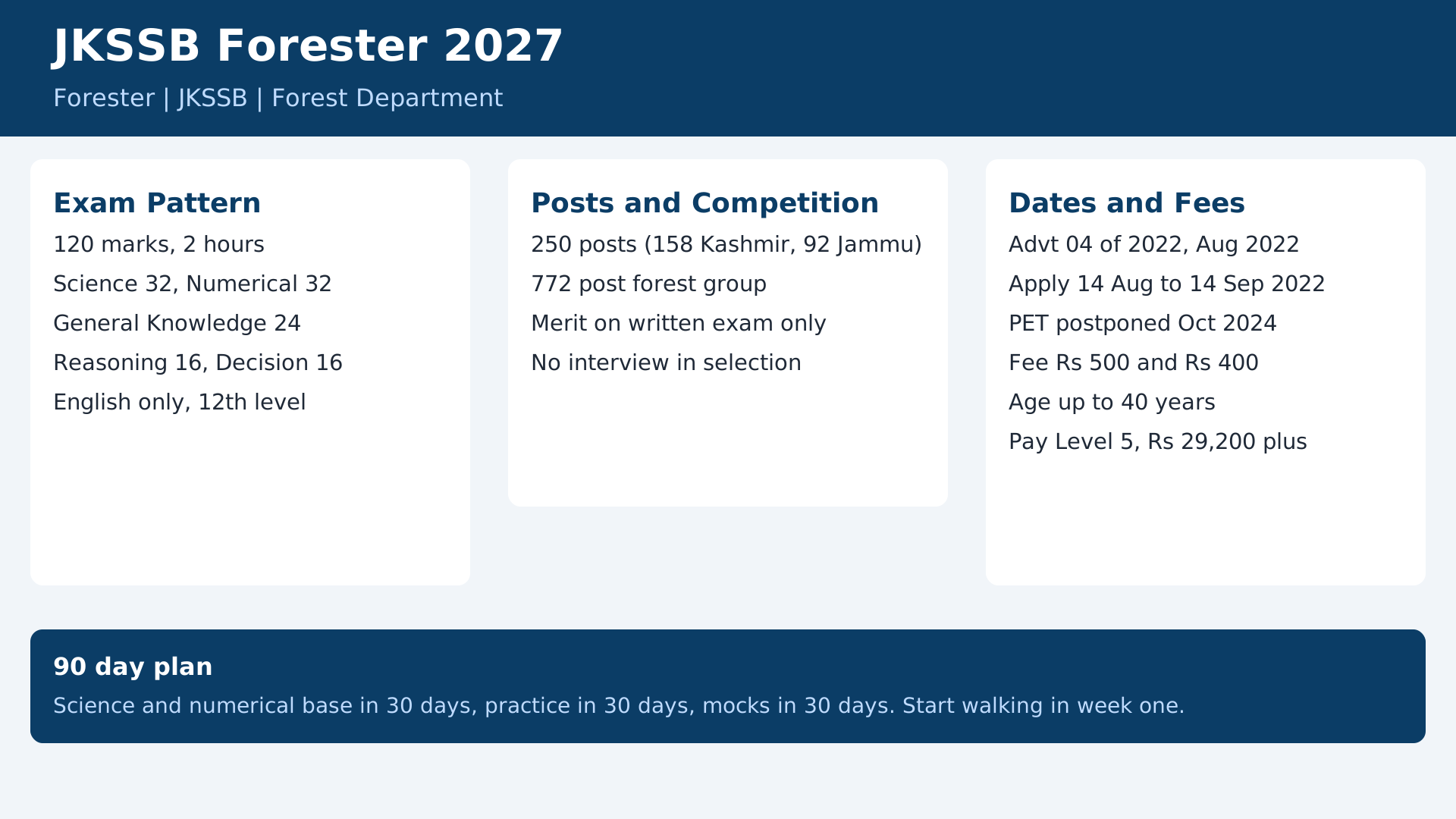
The Jammu and Kashmir Services Selection Board, JKSSB, advertised 250 Forester posts in the Forest, Ecology and Environment Department, and that cycle is still running, with no written exam held yet for Forester and the Physical Endurance Test postponed since October 2024. JKSSB Forester 2027 has no notification yet as of 20 November 2026, so every fact in this guide comes from the live cycle, Advertisement Number 04 of 2022, and the JKSSB notices that followed it. If you plan to sit for the 2027 cycle, that cycle is the closest picture you have of the posts, the pattern, the age limits, the physical tests and the fees. The Jammu and Kashmir Services Selection Board conducts the exam, and the Forest Department is the department you join.
A Forester is the first supervisory rank in the forest field staff. A Forester supervises a group of guards, maintains forest records, plans plantations, prepares offence reports for illicit felling and poaching, and assists the Range Officer in the management of a forest range. The post needs 10 plus 2 with science, it carries a walk test of 25 km for men and 16 km for women, and it pays Level 5, Rs 29,200 to Rs 92,300 a month, which makes it the best paid post in the JKSSB forest group. The science weight in the written paper follows the job: basic science and basic numerical ability carry 32 marks each of the 120, with general knowledge at 24 and reasoning and decision making at 16 each.
JKSSB Forester 2027 and the live cycle in numbers
| Item | Detail |
|---|---|
| Conducting body | Jammu and Kashmir Services Selection Board (JKSSB) |
| Department | Forest, Ecology and Environment Department |
| Notification | Advertisement Number 04 of 2022 |
| Posts | 250 Forester posts |
| Application window | 14 August 2022 to 14 September 2022 |
| Written exam | OMR based, not held yet for Forester as of 20 Nov 2026 |
| Physical tests | PST and PET postponed 21 Oct 2024, no new date |
| Age limit | Open Merit 40 years, reserved categories 43 years, PwD 42 years |
| Qualification | 10 plus 2 with science from a recognised board |
| Pay | Level 5, Rs 29,200 to Rs 92,300 per month |
| Application fee | Rs 500 General, Rs 400 SC, ST, PwD and EWS |
| 2027 notification | Not issued as of 20 November 2026 |
The 250 posts came in the large forest group advertisement of 2022, which covered 772 posts across the Forest, Ecology and Environment Department, including Forester, Wildlife Guard, Social Forestry Worker, FPF Guard, Inspector, Field Assistant, Driver, Computer Assistant, Junior Assistant, and others. The Forester posts split as 158 in Kashmir Division and 92 in Jammu Division, as listed in Annexure A of the advertisement. Forester was the largest single post in that group after the guard posts. The notification invited applications from domiciles of the Union Territory of Jammu and Kashmir for District, Divisional and Union Territory cadre posts, and the Forester posts were spread across the Jammu and Kashmir divisions.
The timeline of this cycle is slow, and for Forester it has barely moved. The notification came in August 2022, and the Physical Standard Test and Physical Endurance Test, first scheduled for the first fortnight of October 2024, were postponed by JKSSB on 21 October 2024 until further notice, with no new date announced since. The board then decided to hold the written examination first. OMR based written exams were then held for five other forest posts, Wildlife Guard, Social Forestry Worker, Inspector (FPF), FPF Guard and Field Assistant, with their results notified on 28 April 2026 and 11 June 2026, and no written exam notice or result for Forester has appeared on jkssb.nic.in as of 20 November 2026. Those five posts went on to their physical tests on 7 to 8 September 2026 at Srinagar and 11 to 13 September 2026 at Jammu, with the result on 21 October 2026 and a document verification shortlist on 29 October 2026, while Forester waited. If you are preparing for the next cycle, do not plan around a fast process. Plan around a slow one, keep your documents valid, and keep your fitness through the whole wait.
The written exam pattern
The written exam is an OMR based objective paper of 120 marks with a duration of 2 hours, set in English only at 12th standard level, under the syllabus JKSSB notified on 30 October 2023. The paper has five sections: basic science at 32 marks, basic numerical ability at 32 marks, general knowledge at 24 marks, logical reasoning and analytical ability at 16 marks, and decision making and problem solving at 16 marks. Basic science covers Physics, Chemistry and Biology with equal weightage, and basic numerical ability covers data interpretation, profit and loss, compounding, discounting, mensuration, geometry including coordinate geometry, trigonometry, and fundamentals of statistics including probability. The two 32 mark sections together carry more than half the paper, so the paper is a science and numbers paper first and a general paper second. The official syllabus does not state the number of questions, and it does not state a negative marking rule, so this guide does not claim either as official fact.
| Section | Marks |
|---|---|
| Basic science (Physics, Chemistry, Biology, equal weightage) | 32 |
| Basic numerical ability | 32 |
| General Knowledge | 24 |
| Logical reasoning and analytical ability | 16 |
| Decision making and problem solving | 16 |
| Total | 120 |
Merit is decided by the written examination alone. The Physical Standard Test, the Physical Endurance Test, and the walking test are qualifying only, and they add no marks. Your job in the written paper is to score as high as you can, and then to pass the physical tests. A candidate who scores 70 in the written exam and completes the walk test beats a candidate who scores 69 and walks faster, because the walk carries no marks.
The section split above is the official syllabus, notified by JKSSB on 30 October 2023 in Annexure A of its syllabus notice for Forester vide Advertisement Number 04 of 2022, and it replaces the 100 mark split with Mathematics 32 and separate Physics, Chemistry and Biology sections that tracker pages used to report. The official syllabus states the marks, the duration, the medium and the level, but it does not state the number of questions and it does not state a negative marking rule. Tracker pages report 0.25 marks per wrong answer, and this guide uses that figure only as a tracker reported rule, not as an official one. What is certain is the shape and the two 32 mark sections, because they come from the official notice, and the Supreme Court judgment of 26 November 2025 on the old Forester recruitment confirms that the post has always been science based, with 10 plus 2 with science as the qualification and the walk test as the physical core.
Who can apply for JKSSB Forester
You must have passed 10 plus 2 or an equivalent qualification with science from a recognised board. The science requirement is strict: 10 plus 2 without science does not qualify. If you hold a degree, you can still apply, because the rule is a minimum qualification, not a maximum, which is the opposite of the Wildlife Guard rule. A BSc in Forestry or a BSc with science subjects fits this post well, and the Supreme Court case on the 2008 Forester recruitment shows that the department once gave weightage points to BSc Forestry candidates, 25 points out of 100, which tells you how much the department values forestry education.
The age limit is counted as on 1 January 2022 for the live cycle. Open Merit candidates must be not more than 40 years. SC, ST, RBA, ALC and IB, EWS and PSP candidates run to 43 years, physically challenged candidates to 42 years, and Ex-Servicemen to 48 years, under the Jammu and Kashmir reservation rules. Candidates who had applied for Forester in the earlier Advertisement Number 08 of 2010 also get a one time age relaxation under the 2022 notification, and they need not pay the fee afresh. You must hold a domicile certificate of the Union Territory of Jammu and Kashmir. Only domiciles of Jammu and Kashmir can apply, and the posts are District, Divisional and Union Territory cadre, so the merit list follows the cadre of the post you apply for.
Physical standards and the walk test
The physical standards for Forester are height and chest, and they are the same standard used across the forest subordinate services in India. Male candidates need a minimum height of 163 cm, with a chest of 84 cm normal and 5 cm expansion. Female candidates need a minimum height of 150 cm, with a chest of 79 cm normal and 5 cm expansion. The chest standard is the point that separates Forester from Wildlife Guard, which carries no chest figure in the reported standard.
| Standard | Male | Female |
|---|---|---|
| Height | 163 cm minimum | 150 cm minimum |
| Chest normal | 84 cm | 79 cm |
| Chest expansion | 5 cm | 5 cm |
The Physical Endurance Test for Forester is the walk test, and it is the stage that decides the selection after the written exam. Male candidates must complete a 25 km walk in 4 hours on foot, and female candidates must complete a 16 km walk in 4 hours on foot. You need a physical fitness certificate from the Chief Medical Officer to take the walk test. The walk is qualifying, it carries no marks, and there is no running allowed, so pace and endurance matter more than speed. Train by walking, on uneven ground, in the shoes you will wear on the test day, building from 10 km to 25 km over eight weeks. A 25 km walk in 4 hours needs a steady pace of 6.25 km an hour, which is a brisk walk held for four hours without stopping.
Fee, salary and what the job pays
The application fee for the live cycle was Rs 500 for General candidates and Rs 400 for SC, ST, PwD and EWS candidates. Pay online only, through net banking, credit card or debit card, on the JKSSB portal. The fee is non refundable, and an application without the fee is rejected without consideration.
The pay is Level 5 in the pay matrix, Rs 29,200 to Rs 92,300 per month, as stated in Annexure A of Advertisement Number 04 of 2022 for both the Kashmir and Jammu Division Forester items, plus the allowances that apply to Forest, Ecology and Environment Department personnel. Level 5 is the first supervisory grade in the forest field staff, above the guard grades. During the probation period the Jammu and Kashmir Probationer Rules 2020 apply to pay and allowances.
The career path from Forester runs upward to Deputy Range Officer and Range Officer, through promotion and departmental examination, and Foresters who hold a forestry degree often move faster. The post is also a route into the Indian Forest Service for candidates who qualify in the civil services examination, because the field experience is exactly what the service looks for. Do not pick this exam for the salary alone. Pick it because you want to manage forests, supervise guards, and work outdoors in the Pir Panjal and the Kashmir valley.
What a Forester does, day to day
A Forester supervises a forest beat, which is a group of guards covering a defined area of forest, and is responsible for the protection, management and records of that beat. The daily work includes checking the guards on their patrols, inspecting plantation and nursery work, preparing offence reports for illicit felling, encroachment and poaching, maintaining the beat register, and reporting to the Range Officer. Foresters assist in wildlife census work, fire management, and the preparation of working plans for the range. In the Pir Panjal and the Kashmir valley the work also involves human animal conflict, because leopards and bears enter villages around the forests, and the Forester is the officer who responds.
The posting is usually a range office in a forest division, with field work across the beat. The work is physical and seasonal. Summer brings plantation, nursery and patrol. Winter brings snow, closed tracks, and animals moving to lower ground. The walk test exists because the job is walking, and a Forester who cannot walk 25 km cannot inspect a beat. The department trains Foresters at the Forest Training Institute, and the training covers silviculture, forest mensuration, survey, forest law, and wildlife management, so a science background is not just a qualification, it is the base the training builds on.
Where Foresters are posted
Foresters are posted to range offices across the forest divisions of Jammu and Kashmir, from the Jammu plains and the Shivalik hills to the Pir Panjal and the Kashmir valley. A range office is the base, and the beat is the ground, so a Forester spends most of the week in the field, walking the beat, checking the guards, and inspecting plantation and nursery work. The posting is usually in a forest division far from a town, with a range office and a forest rest house as the base, and the work is physical, solitary, and seasonal. A Forester who likes the outdoors, can live with basic facilities, and can walk all day will suit the post, and a Forester who wants a desk will not.
The 2008 recruitment and the Supreme Court judgment
The Forester post in Jammu and Kashmir has a long history, and the Supreme Court judgment of 26 November 2025 on the 2008 recruitment is worth knowing, because it shows how seriously the courts treat the selection rules for this post. The 2008 recruitment was for 38 Forester posts in Jammu Division, for candidates with 10 plus 2 with science, with a 25 km walk test, and the notification gave weightage points to candidates with a BSc in Forestry, 25 points out of 100. The department later changed the weightage rule, the affected candidates went to court, and the case travelled from the Central Administrative Tribunal to the High Court and finally to the Supreme Court, in Civil Appeal Number 10932 of 2025, decided on 26 November 2025.
The judgment dealt with whether the department could change the weightage rule after the selection process had begun, and with how the 25 km walk test and the BSc Forestry weightage were applied. The lesson for you is simple: the rules in the notification are the rules, and the department cannot change them midway, and the court will hold it to them. Read the notification when it comes, keep a copy, and check that every stage follows it. The judgment also confirms that the Forester post has carried the 10 plus 2 with science qualification and the 25 km walk test for at least 18 years, so those two facts are the most stable facts in this guide.
The 772 post forest group, explained
Advertisement Number 04 of 2022 was the largest forest recruitment in Jammu and Kashmir in a decade, and it is worth understanding because the Forester posts came inside it. The advertisement covered 772 posts across the Forest, Ecology and Environment Department, including 250 Forester posts, 108 Wildlife Guard posts, and a long list of other posts: Social Forestry Worker, FPF Guard, Inspector, Field Assistant, Driver, Computer Assistant, Junior Assistant, Junior Stenographer, Junior Scale Stenographer, and others. The posts were spread across District, Divisional and Union Territory cadre, and the advertisement was the first large forest recruitment after the reorganisation of the state into two union territories.
The size of the advertisement matters for two reasons. First, it means the Forest Department was hiring at scale, and a candidate who missed Forester could apply for several other forest posts in the same advertisement. Second, it means the selection process ran as a group, with the written exams, the physical tests and the document verification running across the posts together, which is why the process took four years for the five posts that reached those stages. Forester itself has not reached a single stage yet, which is the slowest outcome of all. If the next advertisement follows the same pattern, expect a large group advertisement rather than a standalone Forester notification, and expect the same slow timeline. Apply for every forest post you are eligible for in that advertisement, because the written paper is similar across the group and the physical tests are the same.
Numerical ability and science, the two 32 mark sections
Basic numerical ability carries 32 of the 120 marks, and basic science carries another 32, so the two sections together decide the merit list more than anything else. Numerical ability covers data interpretation, profit and loss, compounding, discounting, mensuration, geometry including coordinate geometry, trigonometry, and fundamentals of statistics including probability, all at 12th standard level. The questions are straightforward, but they are set for speed, and a candidate who has not practised arithmetic for years will be slow. Do 20 sums a day from the second week, with a timer, and keep a formula sheet that you revise every Sunday.
The 32 marks of numerical ability are the most predictable marks in the paper, because the topics never change and the level never rises above 12th standard. A candidate who scores 25 out of 32 in numerical ability starts the paper with more than a fifth of the total marks in hand, and that is often the difference between selection and rejection. The science section is harder to raise quickly, because it needs revision across three subjects, Physics, Chemistry and Biology, at equal weightage. Numerical ability is the one section you can raise by practice alone, and it is the section to prioritise in the first month, with science close behind.
How the selection runs from form to final list
The selection has four stages, and they run in a fixed order for this group of forest posts. First comes the online application on the JKSSB portal, with the fee paid online and the documents uploaded in the prescribed format. Then comes the OMR based written examination, which is the only stage that carries marks. Candidates who clear the written exam are shortlisted for the Physical Standard Test and the Physical Endurance Test, with the height and chest check first and the walk test after it. Those who pass move to document verification, where JKSSB checks your 10 plus 2 with science certificate, your domicile certificate, your date of birth, and your category certificate against the cut off dates in the notification. Medical examination follows selection under the department rules. There is no interview in this recruitment. For Forester, none of these stages has been held yet as of 20 November 2026, so this order is the plan on paper, not a record of what has happened.
One point in the sequence deserves care. The notification text for the 2022 forest group says candidates must qualify the Physical Standard Test and the walk test to be eligible to appear for the written examination, which suggests the physical stage comes first. In the actual cycle, the board reversed that order for the five forest posts that reached the written exam in 2026: the written exam came first, and the physical tests followed in September 2026. This guide follows the actual sequence, and flags the difference, because the order affects when you should train for the walk. Train for the walk from the start either way. If the physical stage comes first in the next cycle, you will be ready. If it comes after the written exam, you will still be ready.
A 90 day plan that fits this paper
Days 1 to 30 are for the base. Basic numerical ability carries 32 marks, so give it two hours a day, covering data interpretation, profit and loss, compounding, discounting, mensuration, geometry, trigonometry, and statistics with probability, at 12th standard level. Give one and a half hours a day to basic science, split across Physics, Chemistry and Biology at equal weightage, one hour a day to general knowledge, with current events, history, geography, polity, the Constitution, and forests, wildlife, environment, biodiversity and climate change, and half an hour a day to logical reasoning and decision making. Start walking in the first week. Three walks a week, building from 5 km to 15 km, in the shoes you will wear on the test day, on uneven ground where you can find it.
Days 31 to 60 are for practice. The paper is 120 marks in 120 minutes, so speed is a skill of its own. Do 50 questions a day under a timer, and keep an error log of every question you get wrong. Revise the error log every Sunday. Take your first full mock test at the end of week six, under exam conditions, a 120 mark paper in 2 hours, with the tracker reported 0.25 negative marking applied. Score it and count every mark lost to a guess, then find your weak subject before the last month. Build the walks to 20 km in this block, and get the Chief Medical Officer fitness certificate process understood early, so it does not become a last minute problem.
Days 61 to 90 are for mocks and revision. Take two mocks a week, and spend the day after each mock only on the questions you got wrong. Revise the science chapters, the numerical ability formulae, and the general knowledge facts in the final two weeks. Do one full 25 km walk for male candidates, or 16 km for female candidates, in the eighth week, to prove to yourself that the distance is possible. In the last three days, stop learning new topics. Sleep properly, keep the walking light, and revise your error log. The candidates who fail this exam usually fail on the walk test or on time management, not on knowledge, and both are fixed in the 90 days before the exam, not in the exam hall.
The forests of Jammu and Kashmir
Jammu and Kashmir holds some of the most important forest and wildlife habitat in India, and a Forester works in the middle of it. The Pir Panjal forests hold deodar, chir pine, blue pine, and fir, and the Kashmir valley holds the chinar, the walnut, and the willow. Dachigam National Park, outside Srinagar, is the last stronghold of the Hangul, the Kashmir stag, a species found nowhere else in the world. Hemis National Park in Ladakh is the largest national park in India and the best place in the world to see a snow leopard in the wild. The Gulmarg Wildlife Sanctuary, Overa Aru, and the Limber and Lachipora sanctuaries protect the Pir Panjal forests, while the Changthang cold desert holds the Tibetan wild ass, the black necked crane, and the Ladakhi urial.
A Forester needs to know this ground. The written paper tests school science, but the job tests field knowledge: which tree species grows where, how a plantation is raised, how a fire line is cut, which animal made a track, and how to keep people and animals apart without harming either. The department runs training for Foresters at the Forest Training Institute, and the best preparation for the job is time in the field, not time in a coaching centre. If you live near a forest division, visit it, learn its beats, and talk to the Foresters who work there. That knowledge will not appear in the written exam, but it will decide whether you last in the job.
Mistakes that cost candidates this exam
The first mistake is applying without 10 plus 2 with science. The notification is strict on the science requirement, and the verification stage rejects candidates who hold 10 plus 2 without science after they have cleared the written exam. The second mistake is training by running instead of walking. The test is a 25 km walk for men and a 16 km walk for women, on foot, in four hours, and running fitness does not transfer to walking endurance. The third mistake is ignoring numerical ability. It carries 32 of the 120 marks, and basic science carries another 32, so a candidate who revises only general knowledge is preparing for a different exam. The fourth mistake is applying without a domicile certificate in hand, or with a category certificate issued after the last date. JKSSB is strict on cut off dates, and no representation after the fact has ever helped.
JKSSB Forester aspirants often prepare for other JKSSB and uniformed exams alongside this one. The SSC GD 2027, UPPSC ACF RFO 2027, UPPSC Assistant Engineer 2027, IBPS SO 2027, UGC NET Paper 1 2027, FSSAI Technical Officer 2027, UP Police Fireman 2027, UP Police Jail Warder 2027, Bihar Police Constable 2027 and SBI Clerk 2027 pages on this site carry the same style of mock test guide, and the pattern habit you build here transfers directly to them.
Sources
JKSSB Advertisement Number 04 of 2022, dated 27 July 2022, read in full on jkssb.nic.in, for the 250 Forester posts, 158 in Kashmir Division and 92 in Jammu Division, the application window of 14 August to 14 September 2022, the fee of Rs 500 and Rs 400, the age limits of 40, 43, 42 and 48 years, the Level 5 pay of Rs 29,200 to Rs 92,300, the 10 plus 2 with science qualification, the physical standards and the walk test, and the 772 post forest group. The JKSSB syllabus notice dated 30 October 2023, Annexure A, read in full on jkssb.nic.in, for the written examination pattern of 120 marks in 2 hours, English medium, 12th standard level, with basic science 32, basic numerical ability 32, general knowledge 24, logical reasoning 16, and decision making 16. The JKSSB postponement notice dated 21 October 2024, for the postponement of the forest PST and PET. The JKSSB result notification dated 21 October 2026 and the document verification shortlist dated 29 October 2026, for the five forest posts whose written exams and physical tests were held in 2026, with no Forester stage among them. The negative marking of 0.25 marks per wrong answer is tracker reported, from Harshya and Testbook, because the official syllabus does not state a negative marking rule. The Supreme Court judgment in Civil Appeal Number 10932 of 2025, decided 26 November 2025, on the 2008 Forester recruitment, from the judgment summary.