
About West Bengal Forest Guard 2027 Exam Series
📖 Table of Contents
- West Bengal Forest Guard 2027 at a glance
- The 259 posts of 2017, and the 2,000 that were not Forest Guard posts
- The written test: 90 questions in 60 minutes
- The walk that ends attempts: 25 km in 4 hours
- Physical standards, and the relaxations that trackers get wrong
- Who can apply
- Pay, and the scale that changed since 2017
- The personality test and the final merit
- The 2020 Bana Sahayak story, and why it still matters
- The 2025 and 2026 claims that do not check out
- A preparation plan built around the walk and the clock
- The mistakes that cost candidates a year
- Sources
West Bengal Forest Guard 2027: Complete Exam Guide
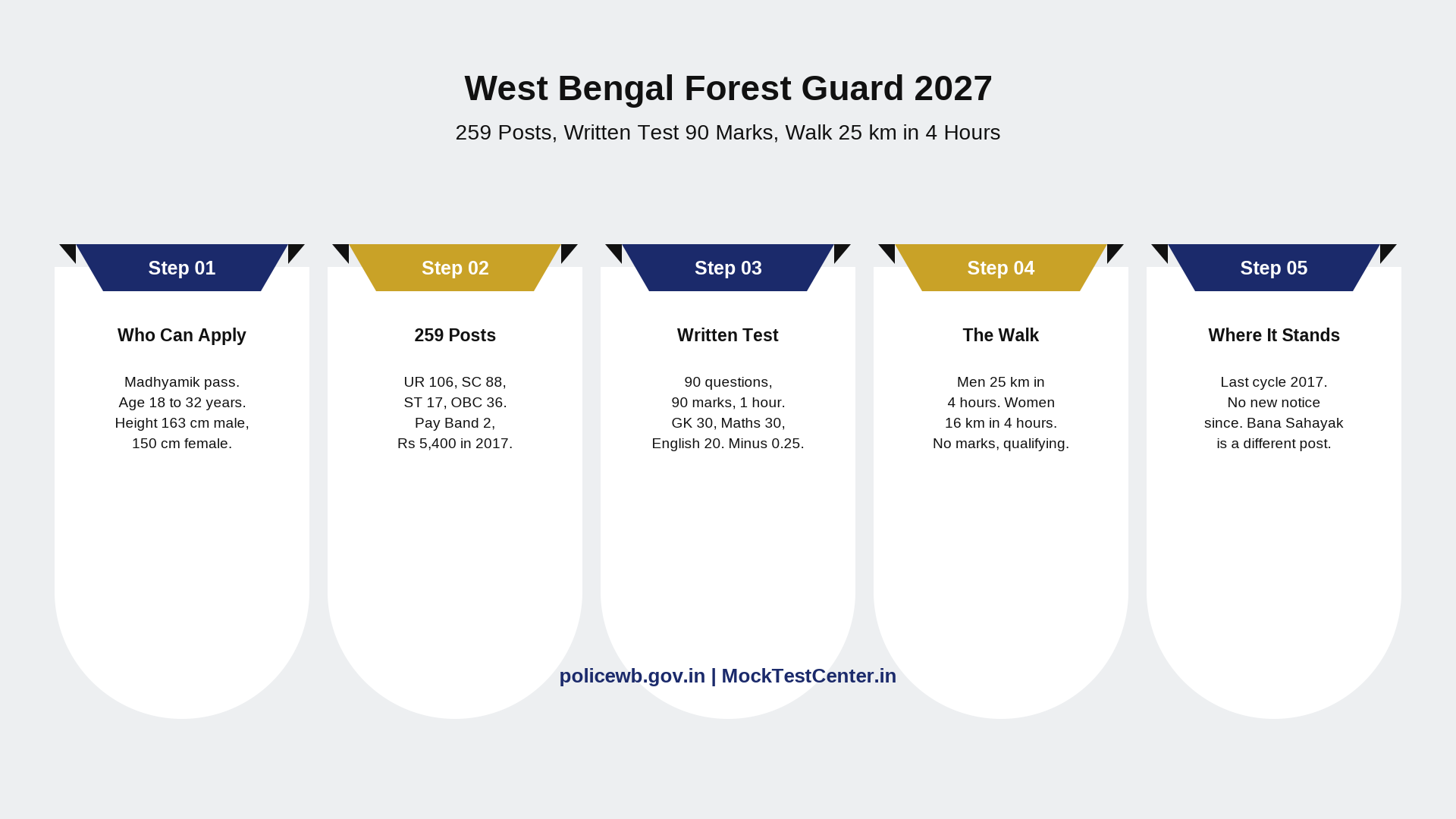
The West Bengal Forest Guard 2027 page on this site follows the last verified cycle of the West Bengal Forest Guard recruitment, and that cycle is the 2017 cycle run by the West Bengal Police Recruitment Board. The Board advertised 259 Forest Guard posts under the Directorate of Forests, Government of West Bengal, with applications closing on 19 May 2017. The written test carried 90 questions for 90 marks in one hour, with negative marking of one fourth of a mark for each wrong answer. No new Forest Guard notification has come out since 2017 as of 23 November 2026, and no 2027 notification exists, so this guide anchors on the 2017 cycle and on the recruitment rules of 2015 that still govern the post, and says so wherever a 2027 figure would otherwise be guessed.
That anchoring needs a correction first, because the number most search results show for this recruitment belongs to a different post. Several pages describe a West Bengal Forest Guard recruitment of 2,000 posts, or of 1,612 posts, or of 1,240 posts. The 2,000 post figure belongs to the Bana Sahayak recruitment of 2020, a contractual post that asked for an 8th standard pass and an age of 18 to 40 years. Bana Sahayak is not Forest Guard. Forest Guard is a permanent post that asks for a Madhyamik pass and an age of 18 to 32 years, and its last advertised cycle carried 259 posts. The 1,612 and 1,240 figures have no advertisement behind them at all. This guide uses the verified 259 post cycle only, and it flags every number that trackers report without an official text behind it.
The recruitment has four stages, and the order matters more than the syllabus. A written test comes first, then a physical measurement test, then a walking test of 25 km for men and 16 km for women in four hours, then a personality test. The final merit adds the written test marks to the personality test marks. The walk carries no marks and ends attempts without mercy, which is why this guide spends as many words on the walk as on the written paper.
West Bengal Forest Guard 2027 at a glance
| Detail | West Bengal Forest Guard 2027, as run in the 2017 cycle |
|---|---|
| Conducting body | West Bengal Police Recruitment Board (WBPRB), for the Directorate of Forests |
| Exam | Forest Guard under the Directorate of Forests, Government of West Bengal |
| Live cycle | 2017, WBPRB notification, applications closed 19 May 2017 |
| Posts in live cycle | 259 in all, split by category in the table below |
| Applications | Closed 19 May 2017, online through policewb.gov.in |
| Fee | Not stated in the sources read for this guide; the next notification will state it |
| Education | Madhyamik (10th standard) pass from a recognised board |
| Age limit | 18 to 32 years as on 1 January 2017, with relaxation under West Bengal rules |
| Pay scale in 2017 | Pay Band 2, Rs 5,400 to Rs 25,200, plus Grade Pay Rs 1,900 |
| Written test | 90 questions, 90 marks, 1 hour, OMR, negative marking 0.25 per wrong answer |
| Physical tests | Height and chest check, then a walk of 25 km for men and 16 km for women in 4 hours |
| Personality test | After the physical tests; final merit adds written test marks and personality test marks |
| 2027 notification | Not published as of 23 November 2026 |
The 259 posts of 2017, and the 2,000 that were not Forest Guard posts
The West Bengal Police Recruitment Board advertised 259 Forest Guard posts in 2017 under the Directorate of Forests, and the category split in the notification adds to 259 exactly. Unreserved carries 106 posts, with 9 more for unreserved ex servicemen. Scheduled Caste carries 88 posts, with 3 more for Scheduled Caste ex servicemen. Scheduled Tribe carries 17 posts. Other Backward Classes A carries 22 posts, and Other Backward Classes B carries 14 posts. The six rows add to 259: 106 plus 9 plus 88 plus 3 plus 17 plus 22 plus 14. A candidate should check the row that matches the exact category, because the Scheduled Caste share is large at 91 posts including ex servicemen, and the unreserved share is 115 posts including ex servicemen.
The notification set the age at 18 to 32 years as on 1 January 2017, and it asked for a Madhyamik pass from the West Bengal Board of Secondary Education or an equivalent examination from a recognised institution. The candidate had to hold Indian citizenship. Applications closed on 19 May 2017, and the Board took applications online through policewb.gov.in. The pay in the notification was Pay Band 2, Rs 5,400 to Rs 25,200, plus Grade Pay of Rs 1,900 per month. That pay belongs to the pre revision scale of 2017, and the current scale under the West Bengal Revision of Pay and Allowances Rules of 2019 will appear in the next notification. This guide states the 2017 figure as the notification figure and does not guess the revised figure.
The 2,000 post figure that dominates search results belongs to the Bana Sahayak recruitment of 2020, and Bana Sahayak is a different post in every respect. The Forest Department advertised 2,000 Bana Sahayak posts on 31 July 2020 on a contractual basis, asked for an 8th standard pass, set the age at 18 to 40 years, and took applications for seven working days from the date of advertisement. Around 6.7 lakh people applied for those contractual posts, according to the Times of India report of the later court case. A Bana Sahayak is a contractual forest worker who assists in forest patrol, tree plantation, and wildlife protection. A Forest Guard is a permanent government post recruited through a competitive examination under the 2015 rules. The two posts share a department and little else, and a candidate who prepares for Forest Guard from Bana Sahayak pages prepares for the wrong examination.
The Bana Sahayak recruitment then went to court, and the court story is the reason the 2,000 figure still fills search results years later. Two petitions filed in the Calcutta High Court in May 2023 alleged irregularities in the appointment process, and a single judge bench cancelled the entire panel of 2,000 successful candidates. A division bench stayed that order and restrained the Forest Department from starting a fresh process for forest assistants till further orders. In December 2023 the Calcutta High Court held that the recruitment of the 2,000 Bana Sahayaks did not suffer from any illegality and was valid and legal. The legal fight kept the 2,000 figure in the news for three years, and tracker pages copied the figure into Forest Guard pages without checking which post it belonged to.
The other figures in circulation have even less behind them. The 1,612 figure that the task brief asked this guide to verify appears in no notification, no court order, and no reputable report read for this guide. The 1,240 figure comes from an AI generated spam page that also promises 8 lakh applications and a salary of Rs 39,500 a month, with no source for any of it. The 185 figure comes from a single tracker page that claims a WBPSC Forest Guard advertisement of 2026 with 185 vacancies, and no second source carries it. This guide treats all three figures as unverified and uses none of them.
The written test: 90 questions in 60 minutes
The West Bengal Forest Guard exam pattern for the written test is short, sharp, and easy to underestimate. The test carries 90 questions for 90 marks, each question carrying one mark, to be answered in one hour on an OMR sheet. The subjects are General Awareness and General Knowledge with 30 questions, Elementary Mathematics at Madhyamik standard with 30 questions, English with 20 questions, and Reasoning with 10 questions. The four subject counts add to 90: 30 plus 30 plus 20 plus 10. The Board fixes the qualifying marks for the written test at its discretion, and the notification does not publish a qualifying line in advance, so this guide does not state one.
The negative marking is one fourth of a mark for each wrong answer, which is 0.25 marks. Four wrong answers cancel one correct answer. A candidate who guesses on 12 questions and gets 3 right and 9 wrong loses 2.25 marks on those 12 questions, which is a net loss of 0.75 marks against leaving them blank. The negative marking is gentler than the Calcutta High Court screening test, where a wrong answer costs a full mark, but it still punishes blind guessing. A blank answer costs nothing, and a candidate should leave a question blank when the choice is a pure guess.
Sixty minutes for 90 questions gives 40 seconds per question, and that clock is the real difficulty of the paper. The Mathematics questions at Madhyamik standard are not hard, but they need working, and a candidate who spends two minutes on a single sum loses the time for three easy questions. The General Knowledge questions are quick if the candidate knows them and slow if the candidate does not, because no amount of thinking retrieves a fact the candidate never learned. The sensible approach is to answer the certain questions first in a single pass, mark the doubtful ones, and return to them only if time remains. The paper rewards a candidate who finishes all 90 questions over a candidate who answers 60 questions perfectly and leaves 30 blank.
The written test is the first stage, and the Board calls a limited number of candidates from the written test result for the physical standard test and the physical efficiency test. The notification does not state the call ratio in the text read for this guide, so this guide does not state one. The written test marks also carry into the final merit, added to the personality test marks, so the paper matters twice: once to reach the physical tests, and once more in the final list. A candidate who treats the written test as a mere qualifying gate loses marks that count at the end.
The walk that ends attempts: 25 km in 4 hours
The Physical Efficiency Test of the West Bengal Forest Guard exam pattern is a walk, and it is the stage that ends the most attempts. Male candidates must walk 25 km in 4 hours, and female candidates must walk 16 km in 4 hours. The walk carries no marks. A candidate either finishes inside the time or fails the stage. The rules state the point plainly: there is no mark in the walking test, but the candidate should qualify in the walking test. The walk is a pass or fail gate, and it sits between the written test and the personality test, so a candidate who passes the paper and fails the walk loses the attempt after clearing the hardest academic stage.
Twenty five kilometres in four hours means an average speed of 6.25 km per hour, sustained without a break that the clock forgives. Sixteen kilometres in four hours means 4 km per hour. The male pace is a brisk walk bordering on a slow jog for most people, and it has to hold for four hours over forest paths, not a flat track. A candidate who has never walked more than 5 km in a day will not finish 25 km in four hours on the day, however strong the written test score. The walk needs training, and the training needs weeks, not days.
The training is simple and it has to start early. Walk 5 km a day in the first week, 10 km a day by the third week, and 15 km and then 20 km in single sessions before the test, all in the shoes the candidate will wear on the day. Practise on uneven ground, because a forest path is not a road, and practise with water, because four hours without water ends a walk faster than tired legs do. Time every long walk, because the test measures time, not distance alone. A candidate who can walk 25 km in 3 hours 30 minutes in practice has a margin for a bad day. A candidate who walks 25 km in 3 hours 55 minutes in practice has no margin at all.
The physical measurement test comes before the walk, and it checks height and chest against the standards in the rules. The Board measures height with electronic machines, according to the 2017 notification, and candidates who clear the measurement test go on to the walk. The order matters: a candidate who fails the height check never gets to the walk, and a candidate who passes the height check and fails the walk never gets to the personality test. The physical stages are qualifying only, and they carry no marks, but they end attempts just as finally as a failed paper.
Physical standards, and the relaxations that trackers get wrong
The physical standards for the West Bengal Forest Guard come from the West Bengal Services (Recruitment of Forest Guard and Head Forest Guard) Rules, 2015, notified as Number 522-For dated 1 March 2016, and the 2017 notification repeats them. Male candidates of all categories except Gorkhas, Garhwalies, Rajbanshis, and Scheduled Tribes need a height of 163 cm and a chest girth of 84 to 89 cm fully expanded, with a chest expansion of 5 cm. Male candidates from the Gorkha, Garhwali, Rajbanshi, and Scheduled Tribe categories need a height of 152.5 cm and a chest girth of 79 to 84 cm fully expanded, with the same 5 cm expansion. Female candidates of all categories except those four need a height of 150 cm and a chest girth of 79 to 84 cm fully expanded, with a 5 cm expansion. Female candidates from the four categories need a height of 145 cm and a chest girth of 74 to 79 cm fully expanded, with a 5 cm expansion.
The relaxations matter, because the tracker pages get them wrong in both directions. One tracker page gives the male chest as 79 cm unexpanded expanding to 84 cm, which mixes the relaxed category standard with the general standard and produces a figure that appears in neither. Another page gives the female height as 155 cm or 157 cm, which appears in no official text read for this guide. The rules give 150 cm for most female candidates and 145 cm for the four relaxed categories, and this guide uses those figures. A candidate should measure height and chest before applying, because a candidate who misses the height by a centimetre fails the measurement test and never reaches the walk.
The rules also set a fitness standard that goes beyond height and chest. A candidate must have sound hearing, eyesight, and general fitness for arduous outdoor work in the Forest Directorate. Defective vision must correct to at least 6/9 in the better eye and 6/12 in the other eye, and the candidate must not suffer from colour blindness or congenital or other diseases of the eye. The recommended candidate then faces a medical check by the Chief Medical Officer of Health or the Presidency Surgeon. A candidate with uncorrected poor vision or colour blindness should check the standard before applying, because the medical check comes at the end and can still end the attempt.
The age relaxation follows the existing orders of the Government of West Bengal for Scheduled Castes, Scheduled Tribes, Backward Classes, ex servicemen, and other specified categories. The notification sets the base age at 18 to 32 years as on 1 January of the year of advertisement, and the relaxations sit on top of that base. One tracker page, Testbook, states the age as 18 to 27 years in its main text and 18 to 32 years in its own FAQ on the same page. The 18 to 32 figure matches the 2015 rules and the 2017 notification, and this guide uses it. The 18 to 27 figure has no official text behind it, and a candidate who believes it may wrongly decide that the recruitment has closed for a 30 year old.
Who can apply
The West Bengal Forest Guard eligibility has three conditions, and the notification states all three in plain words. The candidate must hold Indian citizenship. The candidate must have passed the Madhyamik Examination or its equivalent from the West Bengal Board of Secondary Education or any institution recognised by the state government or the central government. The candidate must be between 18 and 32 years of age on 1 January of the year of advertisement, with relaxation for the reserved categories under the existing orders of the Government of West Bengal. The physical standards and the fitness standard sit alongside those three conditions, and the medical check closes the process.
The Madhyamik requirement is a 10th standard pass, and it is the lowest education bar among the permanent uniformed posts of West Bengal. A candidate who stopped after the 10th standard can apply, and so can a graduate. The trade is that the competition includes graduates and older candidates, so the paper is not easy for a fresh Madhyamik pass candidate. The age window of 18 to 32 years is wide by the standards of police recruitments, and it draws candidates who have aged out of constable posts. The walk then sorts the field, because a 30 year old who trains for the walk beats a 20 year old who does not.
The rules add a detail that matters for serving government staff. Two thirds of the sanctioned Forest Guard posts go to direct recruitment through the competitive examination, and one third goes to promotion from confirmed Group D employees of the Directorate of Forests who hold a Madhyamik pass and have completed at least eight years of continuous service as Group D employees. A candidate already working in the Forest Directorate as a Group D employee has a second route into the post, and that route has its own physical criteria and its own service condition. This guide covers the direct recruitment route, because that is the route open to a fresh candidate.
The fee for the 2017 cycle does not appear in the sources read for this guide, and this guide does not state one. The 2017 notification text available through the 9curry mirror of the WBPRB document carries the vacancy table, the eligibility, the written test scheme, and the physical standards, and the fee table sits outside the portion read. A candidate should expect a fee in the next notification and should read the fee table in that notification before paying, because the fee differs by category and the payment is non refundable in most West Bengal recruitments.
Pay, and the scale that changed since 2017
The 2017 notification placed the Forest Guard in Pay Band 2, Rs 5,400 to Rs 25,200, plus Grade Pay of Rs 1,900 per month. That scale belongs to the pay structure before the West Bengal Revision of Pay and Allowances Rules of 2019, and it no longer describes the salary a Forest Guard draws today. Tracker pages quote figures from Rs 18,000 a month to Rs 39,500 a month for the same post, and none of them cites an official pay notification. This guide states the 2017 notification figure as the notification figure, and it does not guess the revised figure, because a wrong salary in a guide misleads a candidate about the post itself.
The work justifies a careful look at the pay, because the post is not a desk post. A Forest Guard patrols the forests of West Bengal, from the Sundarbans mangroves to the Terai and Dooars forests to the Himalayan foothill forests of Darjeeling. The duties cover forest patrol, protection of wildlife, prevention of illegal felling and poaching, assistance in tree plantation, and fire watch during the dry season. The post demands outdoor work in all weather, long walks on forest paths, and postings in remote ranges far from towns. A candidate who wants a desk job should not apply for Forest Guard, and a candidate who loves the outdoors will find no better post at Madhyamik level in West Bengal.
The career path runs upward through the forest service. Head Forest Guard comes by promotion from the gradation list of permanent Forest Guards, Wildlife Guards, Game Guards, Installation Guards, and Forest Workers who have put in at least eight years of service in their posts. The 2015 rules state that route in Part B, and they give no direct recruitment route to Head Forest Guard at all. A Forest Guard who serves well can also move toward the Forester and Deputy Ranger posts through departmental channels and the examinations the state holds for those posts. The post is a career, not a stopgap, and the walk that opens the door is also the daily work of the job.
The personality test and the final merit
The personality test is the last stage of the West Bengal Forest Guard selection, and it follows the physical tests. The 2015 rules state the order: the written examination first, then a shortlist for the physical standard test followed by the physical efficiency test, and then the personality test for the candidates who clear the physical stages. The final selection rests on the marks obtained in the written examination and the personality test together. The physical stages carry no marks and decide nothing in the merit list, but they decide who reaches the personality test at all.
The marks for the personality test need a flag, because the sources disagree and the official text read for this guide does not settle it. Tracker pages put the personality test at 10 marks, and that figure appears on more than one tracker page. The 2017 notification text available for this guide states that the Board will conduct the personality test and that the final merit adds the written test marks to the personality test marks, and it does not state the figure in the portion read. This guide records 10 marks as the tracker reported figure and marks it as unverified, and a candidate should read the next notification for the figure the Board actually uses. If the personality test carries 10 marks against a written test of 90, it is worth a tenth of the final total, and a strong interview can move a candidate past a rival who scored a few marks higher on the paper.
The personality test checks general awareness and suitability for public service, and the panel will look for the things a Forest Guard does every day: knowledge of the forests of West Bengal, the ability to answer in clear language about patrol work and wildlife protection, and a steady manner under questioning. The notification does not publish a syllabus for the personality test, and this guide does not invent one. The honest preparation is to know the forests of the state, the work of the Forest Department, and the current affairs of West Bengal, and to practise answering aloud rather than rehearsing speeches. A candidate who can walk 25 km in four hours and cannot explain why the Sundarbans matter will lose marks at the last stage.
The 2020 Bana Sahayak story, and why it still matters
The Bana Sahayak recruitment of 2020 deserves its own section, because it is the story that confuses every search for Forest Guard, and because it may decide how the next Forest Guard recruitment runs. The Forest Department advertised 2,000 Bana Sahayak posts on 31 July 2020, asked for an 8th standard pass, set the age at 18 to 40 years, and took applications for seven working days from the date of advertisement. Around 6.7 lakh people applied. The posts were contractual, and the workers assist in forest patrol, tree plantation, and wildlife protection. The recruitment had no written test scheme of the kind the Forest Guard rules prescribe, and it followed a different process entirely.
The petitions came in May 2023, when two separate petitions in the Calcutta High Court alleged irregularities in the appointment process. A single judge bench cancelled the entire panel of 2,000 successful candidates. A division bench then stayed that order and restrained the Forest Department from starting a fresh process for forest assistants till further orders. In December 2023 the Calcutta High Court held that the recruitment did not suffer from any illegality and was valid and legal. The Times of India reported that finding, and the Telegraph reported the division bench stay. The panel survived, and the 2,000 Bana Sahayaks stayed in place.
The story matters for Forest Guard candidates for two reasons. The first is that the court fight froze fresh forest hiring for years, and the Forest Department has not advertised Forest Guard posts since 2017. The second is that the department now faces a choice about how to run the next Forest Guard recruitment, and the choice will decide the pattern a candidate prepares for. The 2017 cycle ran through the West Bengal Police Recruitment Board, even though the 2015 rules name the West Bengal Staff Selection Commission as the conducting body. The next cycle may run through the Police Recruitment Board again, or through the Staff Selection Commission, or through the Public Service Commission. The conducting body decides the application portal, the fee, and the exact pattern, and a candidate should check the advertisement itself rather than preparing from the 2017 pattern alone.
The 2025 and 2026 claims that do not check out
Tracker pages carry several claims of a new Forest Guard cycle in 2025 or 2026, and none of them checks out. One tracker page claims that applications for a 2026 cycle opened on 22 April 2025 and closed on 19 May 2026, with a written test on 27 May 2026, and it repeats the 2017 vacancy split of 259 posts row by row. The dates and the split are the 2017 figures with the year changed, and no WBPRB notice with those dates exists on policewb.gov.in. Another tracker page claims a 2025 admit card for the same 259 posts, with the exam date listed as to be notified later on the same page. A third page claims a WBPSC Forest Guard advertisement of 2026 with 185 vacancies and an advertisement number of 15/2026, and no second source carries that number or that figure.
The strongest evidence against those claims is the Testbook page for the recruitment, last updated on 17 November 2026, which still says the notification is awaited and the vacancy details will come with the detailed notification. Testbook is a tracker page, not an official source, but a tracker page that says a notification is awaited is strong evidence that no notification exists, because tracker pages gain traffic by announcing notifications, not by denying them. The West Bengal Forest Department website, westbengalforest.gov.in, carries no Forest Guard notification in the sources read, and the WBPRB site, policewb.gov.in, carries no Forest Guard notice either.
A wire report from July 2026 claims that the state government has decided to run fresh forest hiring through the Police Recruitment Board, and two news sites carry it. The report names the wrong Chief Minister and the wrong Forest Minister, and it reads like generated text rather than reporting, so this guide does not use it as a source for any fact. The decision it describes may still happen, because the Forest Department does need staff and the Police Recruitment Board did run the 2017 cycle, but a candidate should wait for a notice on policewb.gov.in or westbengalforest.gov.in before treating any 2026 claim as real. The rule for a candidate is simple. A notification exists when the Board publishes it, and a tracker page that relabels 2017 as 2026 is not a notification.
A preparation plan built around the walk and the clock
The pattern decides the plan, and the pattern of the West Bengal Forest Guard exam pattern has two features that most plans ignore. The first is that the written test gives 40 seconds per question, which makes speed worth more than depth. The second is that the walk is a pass or fail gate with no marks, which makes physical training worth as much as academic preparation. A plan that drills only the written subjects will pass the paper and fail the walk. A plan that trains only the walk will fail the paper and never reach it. The plan below gives both halves their share.
Start with the walk, because it takes the longest to build. Walk 5 km a day in the first week, 10 km a day by the third week, and build to single sessions of 15 km and then 20 km before the test, all in the shoes the candidate will wear on the day. Time every long walk, because the test measures time, and a candidate who walks 25 km in 3 hours 30 minutes in practice has a margin for a bad day. Practise on uneven ground, because a forest path is not a road, and carry water, because four hours without water ends a walk faster than tired legs do. Add a weekly session of brisk walking uphill, because the Dooars and Darjeeling ranges are not flat.
Mathematics needs daily practice at Madhyamik standard, and it carries 30 marks, the joint largest share of the paper. The topics are number systems, percentages, profit and loss, simple and compound interest, ratio and proportion, time and work, time speed and distance, averages, and mensuration. Practise 20 sums a day under a timer, and mark every wrong answer with the reason it went wrong, because the negative marking of 0.25 makes a careless error cost a quarter mark. Speed matters, and a candidate who solves 30 sums in 20 minutes with 28 right is better placed than a candidate who solves 30 in 35 minutes with 30 right, because the paper gives 40 seconds per question.
General Knowledge needs two streams, and it also carries 30 marks. The first is static: the Constitution of India, the structure of government, West Bengal geography and history, the forests of West Bengal and their wildlife, and the major national parks and sanctuaries of the state. The second is current: the last twelve months of national and West Bengal news, with attention to environment, forest, and wildlife stories. Read one newspaper daily and keep a notebook of 10 facts a day, because the General Knowledge questions are quick if the candidate knows the fact and slow if the candidate does not.
English carries 20 marks, and Reasoning carries 10, and both reward daily practice in small doses. English at this level covers grammar, vocabulary, synonyms and antonyms, error spotting, and comprehension, and a candidate who reads daily will find most of it familiar. Reasoning covers analogies, series, coding and decoding, blood relations, direction sense, and non verbal reasoning, and 10 questions a day beats a weekend of cramming. Give English and Reasoning one short session a day each, and do not let them eat the time that Mathematics and the walk need.
Mock tests should follow the real pattern, not a generic one. Take a 90 question mock in 60 minutes with minus 0.25 for a wrong answer, and score it the way the Board scores it. Take the mock at the same pace the real test demands, 40 seconds a question, and learn to leave a question blank rather than guess. The mock tests on this site follow the pattern of 90 questions in 60 minutes, and they are the closest practice to the real first stage. A mock test that gives 90 minutes for 90 questions will flatter a candidate into a false sense of readiness.
The mistakes that cost candidates a year
The first mistake is preparing from the 2,000 figure. A candidate who believes in 2,000 Forest Guard posts will expect a low cut off, a large call list, and an easy paper, and will prepare lightly. The real cycle has 259 posts, and the written test has negative marking, which makes the cut off higher than a candidate expects. The number of posts changes the whole preparation, and a candidate who prepares from a false number prepares for the wrong examination.
The second mistake is confusing Bana Sahayak with Forest Guard. Bana Sahayak asked for an 8th standard pass and an age of 18 to 40 years, and it was a contractual post with a different process. Forest Guard asks for a Madhyamik pass and an age of 18 to 32 years, and it is a permanent post with a written test, physical tests, and a personality test. A candidate who prepares from Bana Sahayak pages will study the wrong eligibility, the wrong age, and the wrong pattern, and will arrive at the Forest Guard test unready.
The third mistake is ignoring the walk until the admit card arrives. The walk needs weeks of training, and the gap between the physical test notice and the test itself may be short. A candidate who starts walking when the admit card comes will not finish 25 km in four hours. A candidate who starts walking when the application is filed will finish with time to spare. The walk is the stage that ends the most attempts, and it is the stage that needs the earliest start.
The fourth mistake is guessing in the written test. A wrong answer costs 0.25 marks, so four wrong answers cancel one correct answer. A candidate who guesses on 12 questions and gets 3 right loses marks against leaving them blank. The blank answer is the right answer when the candidate does not know, and the paper rewards the candidate who knows when to stop.
The fifth mistake is trusting the 2025 and 2026 tracker claims. The pages that promise a 2026 Forest Guard notification with applications from 22 April 2025 repeat the 2017 vacancy split with the year changed, and no WBPRB notice backs them. A candidate who waits for a 2026 admit card that does not exist will miss the real notification when it comes, and a candidate who pays a fee on a fake portal will lose money. Check policewb.gov.in and westbengalforest.gov.in, and treat every other claim as a rumour until the Board publishes it.
The sixth mistake is preparing from the wrong physical standards. Tracker pages give the male chest as 79 cm unexpanded, the female height as 155 cm or 157 cm, and the female walk as 14 km, and none of those figures matches the 2015 rules. The rules give a male chest of 84 to 89 cm expanded, a female height of 150 cm, and a female walk of 16 km. A candidate who trains for a 14 km walk and faces a 16 km walk will fail by 2 km. A candidate who measures height against a wrong standard will apply for a post the measurement test will refuse. Read the rules, not the tracker pages.
Check policewb.gov.in and westbengalforest.gov.in for the next Forest Guard notification before you change anything in this plan, and read the advertisement line by line when it appears. The pattern, the post count, and the dates in the next notification will be the ones that decide your attempt, not the figures in any guide.
Sources
West Bengal Police Recruitment Board, Information to Applicants for recruitment to the posts of Forest Guard under Directorate of Forests, Government of West Bengal, 2017, pay scale Pay Band 2 Rs 5,400 to Rs 25,200 plus Grade Pay Rs 1,900, vacancies 259, Unreserved 106, Unreserved ex serviceman 9, Scheduled Caste 88, Scheduled Caste ex serviceman 3, Scheduled Tribe 17, Other Backward Classes A 22, Other Backward Classes B 14, age 18 to 32 years as on 1 January 2017, Madhyamik pass, written examination 90 marks, 90 questions of 1 mark each, 1 hour, General Awareness and General Knowledge 30, English 20, Elementary Mathematics Madhyamik standard 30, Reasoning 10, negative marking one fourth of the allotted marks per wrong answer, physical standard and physical efficiency test after the written test, height measured with electronic machines, as mirrored at media.9curry.com. Government of West Bengal, Department of Forests, West Bengal Services (Recruitment of Forest Guard and Head Forest Guard) Rules 2015, Notification Number 522-For dated 1 March 2016, direct recruitment to two thirds of sanctioned posts by written examination followed by personality test, promotion to one third from confirmed Group D employees with Madhyamik pass and eight years service, physical standards male height 163 cm and chest 84 to 89 cm expanded with 5 cm expansion, Gorkhas, Garhwalies, Rajbanshis and Scheduled Tribes 152.5 cm and 79 to 84 cm, female height 150 cm and chest 79 to 84 cm, relaxed categories 145 cm and 74 to 79 cm, walk men 25 km in 4 hours and women 16 km in 4 hours, no marks in the walking test, education Madhyamik pass, age 18 to 32 years on 1 January of the year of advertisement, vision 6/9 better eye and 6/12 other eye, no colour blindness, final selection on written examination and personality test marks, Head Forest Guard by promotion after eight years service, as published at wbxpress.com. Careers360, WB Forest Guard Recruitment 2020, notification 31 July 2020, 2,000 Bana Sahayak posts, 8th standard pass, age 18 to 40 years, last date seven working days from advertisement, applications at westbengalforest.gov.in. Times of India, No Illegality In Bana Sahayak Recruitment, Calcutta High Court held the recruitment of 2,000 Bana Sahayaks on a contractual basis in 2020 valid and legal, around 6.7 lakh people applied. DT Next, HC dismisses plea for fast track hearing on forest guards recruitment, 25 May 2023, single judge bench cancelled the entire panel of 2,000 forest guards, vacation bench rejected fast track hearing, recruitment done in 2020, petitions alleged irregularities. Telegraph India, Calcutta High Court halts state forest department from initiating fresh process for recruitment of forest assistants, division bench stayed the single bench order cancelling the panel of 2,000 successful candidates, 2,000 vacant posts decided in 2020, petitions filed May 2023. Testbook, WB Forest Guard Recruitment 2023, last updated 16 May 2023, notification awaited, previous notification 2017 with 259 vacancies, written test 90 questions and 90 marks, General Awareness 30, English 20, Elementary Mathematics 30, Reasoning 10, age stated 18 to 27 years in main text and 18 to 32 years in FAQ, selection by written test and personality test, page updated 17 November 2026 still states notification awaited. JagranJosh, West Bengal Police Recruitment 2017, 259 vacancies for Forest Guard, physical standards male 163 cm and chest 84 to 89 cm with 5 cm expansion, selection by written examination, physical standard and physical efficiency test, personality test, medical test, written test 1 hour, General Awareness, English, Elementary Mathematics, Reasoning. ExamsLeague, WB Forest Guard Admit Card 2026 and WB Forest Guard Result 2026, claims exam 27 May 2026 and applications closed 19 May 2026 for 259 posts, personality test 10 marks, no WBPRB notice cited for any 2026 date, recorded here as unverified tracker claims. JobNoticeIndia, WBPSC Forest Guard Recruitment 2026, claims Advertisement Number 15/2026 and 185 vacancies, fee Rs 160, single source, no corroboration found, recorded here as unverified. DailyRecruitmentNews, Forest Department West Bengal Recruitment 2017, 259 Forest Guard vacancies, closing date for applications 19 May 2017, salary Rs 5,400 to Rs 25,200 plus Grade Pay Rs 1,900, official website policewb.gov.in.







