
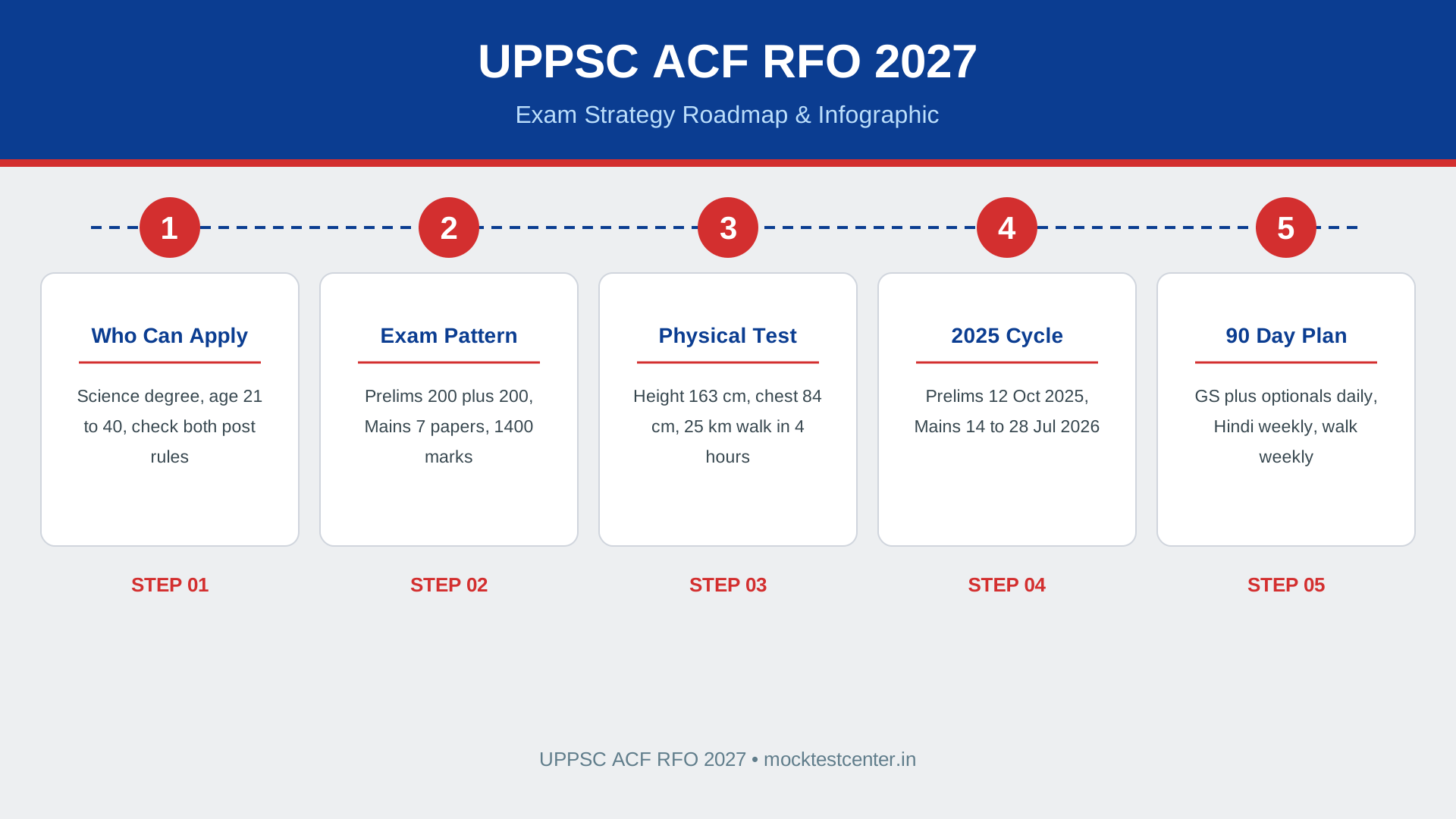
About UPPSC ACF RFO 2027 Exam Series
📖 Table of Contents
- What an ACF and an RFO actually do
- Where the 2027 cycle stands right now
- The selection stages in order
- Prelims: two papers, one counts
- Mains: seven papers and 1400 marks
- How to pick your two optional subjects
- Who can apply: the degree rule
- Age limit and relaxations
- The physical test: height, chest and the long walk
- The 2025 cycle, date by date
- Pay, posting and service
- Books that cover the syllabus
- A 90 day plan that fits real life
- Mock tests and the guessing question
- Mistakes that cost forest candidates a year
- What to check the day the 2027 notice arrives
- Sources
UPPSC ACF RFO 2027: Pattern, Eligibility, Physical Test and Preparation
UPPSC runs the Assistant Conservator of Forest and Range Forest Officer Services Examination together with its PCS examination. One application puts you in the race for two forest posts, and the same Prelims paper screens candidates for both. The 2027 notification has not come out yet, as of 19 November 2026, so every date and rule in this UPPSC ACF RFO 2027 guide comes from the 2025 cycle, which is still running. You will find the full pattern, the degree rules, the age limits, the physical standards, the 2025 cycle timeline, the pay, the books, a 90 day plan and the mistakes that cost forest candidates a year.
What an ACF and an RFO actually do
A Range Forest Officer runs a forest range, and a range is the working unit of the forest department. The RFO protects the trees in that range, stops illegal felling and poaching, manages nurseries and plantations, supervises forest guards, and keeps the records of timber, land and wildlife in that patch. An Assistant Conservator of Forest sits one level above, in charge of a division or a sub division, and supervises several ranges at once. The ACF plans working plans, approves felling and planting programmes, handles the budget of the division, and answers to the Divisional Forest Officer.
Both posts put you outdoors for much of the working day. A forest officer walks beats, inspects nurseries, checks fire lines before summer, and reaches remote compartments where no road runs. The job suits a candidate who likes field work and can live with that. It punishes a candidate who wants a desk and a fixed routine. The physical test exists for this reason, and it is not a formality. The commission tests whether your body can do the walking the job demands, every day, in heat and in rain.
The two posts differ in rank and in pay, and the degree rule differs too. The ACF post asks for a degree with at least one science subject, and the RFO post asks for a degree with two or more science subjects. Read the degree section of this guide before you apply, because the two rules trip up candidates every cycle. A degree that fits the ACF post can fail the RFO rule, and the form lets you apply for both only if your degree meets both lists.
The forest service also differs from the general PCS posts in one more way. A PCS officer can move across departments, from revenue to police to administration. A forest officer stays inside the forest department, and grows inside it, from RFO to ACF to Divisional Forest Officer and beyond. Choose this exam only if the forest itself interests you, because the department will be your home for your whole career.
Where the 2027 cycle stands right now
The 2027 notification has not come out yet. UPPSC releases the notice on its official portal, uppsc.up.nic.in, and the ACF RFO 2027 notice will appear there first. As of 19 November 2026, no 2027 date, no 2027 vacancy count and no 2027 fee exists in any official notice. Any website that gives you a fixed 2027 exam date today is guessing, and you should not plan around a guessed date.
The 2025 cycle is still running, and it sets the shape of the next cycle. UPPSC issued the 2025 advertisement as A-1/E-1/2025, dated 20 February 2025, combined with the PCS examination. The Prelims took place on 12 October 2025, and the Mains runs from 14 to 28 July 2026. The interview and the physical test follow the Mains, and the commission has not announced their dates yet. The 2027 cycle will follow the same shape, with new dates and a new vacancy count, and the notice will carry all three.
That leaves you with a clear choice. You can wait for the notice, or you can start now with the syllabus and the pattern from the 2025 cycle. The pattern has stayed the same across cycles, and the syllabus comes from the official plan of examination, so preparation that starts now will still count when the notice arrives. Only the dates, the fee and the vacancy count change with each cycle, and those three come from the notice itself.
The selection stages in order
Selection runs through four stages, and each stage cuts the field. Prelims screens. Mains ranks. The interview tests personality. The physical test checks the body. Fail any one stage and the cycle ends for you, so treat every stage as a gate, not as a formality.
| Stage | What happens | Marks | Counts for merit |
|---|---|---|---|
| Prelims | Two objective papers | 200 plus 200 | No, screening only |
| Mains | Seven papers, mixed types | 1400 | Yes |
| Interview | Personality test | 150 | Yes |
| Physical test | Standards plus walking test | Qualifying | No |
| Total for merit | Mains plus interview | 1550 | Yes |
Final merit rests on Mains plus interview, 1400 plus 150, a total of 1550 marks. Prelims marks never enter the merit list, and the physical test only qualifies. That split shapes your whole strategy. You need enough in Prelims to clear the cut off, and you need everything in Mains and the interview to rank. A candidate who tops Prelims and coasts in Mains loses to a candidate who scrapes through Prelims and fights in Mains.
One warning belongs here, early. The physical test comes after the written stages, and candidates who ignore it for a year discover too late that their body cannot finish the walk. Train for the walk from the first month of preparation, not from the week the physical test notice arrives. Twenty five kilometres in four hours sounds easy on paper, and it breaks candidates who never trained for it.
Prelims: two papers, one counts
Prelims has two objective papers, each worth 200 marks, each two hours long. Paper 1 tests General Studies, and Paper 2 tests General Studies and aptitude, with General Hindi up to Class 10 level in the syllabus. Paper 1 decides the merit for entry to Mains, and Paper 2 only qualifies. You must score at least 33 percent in Paper 2 to count, and Paper 2 marks never enter the merit list.
This structure differs from the PCS Prelims, and the difference confuses candidates every year. PCS Prelims carries Paper 1 for 150 marks and Paper 2 for 100 marks. ACF RFO Prelims carries 200 marks for each paper, as the official plan of examination states and as Testbook and other trackers confirm. Do not prepare from the PCS marks split. Prepare from the ACF RFO split, 200 and 200.
Paper 1 covers the usual General Studies ground: Indian history and culture, geography, Indian polity, the economy, science and technology, environment, and current events of national and international importance, with a focus on Uttar Pradesh. The syllabus also lists General Hindi up to Class 10 level. Keep a separate notebook for Uttar Pradesh facts, because the paper rewards a candidate who knows the state, its rivers, its districts, its schemes and its history, and not only the national picture.
One fact about Prelims stayed unverified in this pass, and this guide states it plainly. No source in this research confirmed the negative marking rule for ACF RFO Prelims, so this guide gives no number for it. Check the 2027 notice for the marking rule before you decide how to guess in Paper 1, and never trust a website that states a negative marking figure without quoting the notice.
Your Prelims target is simple. Clear Paper 2 with comfort, and score as high as you can in Paper 1. The cut off for Mains entry moves with the paper and the field, and no one can predict it. Aim for a Paper 1 score that would clear last cycle's cut off with room to spare, and measure yourself in mocks, not in hope.
Mains: seven papers and 1400 marks
Mains is the real examination, and it decides your rank. Seven papers, each worth 200 marks, add up to 1400. The papers mix conventional and objective types, and the mix matters for how you prepare. General Hindi and Essay and the four optional papers are conventional, which means you write answers by hand. The two General Studies papers are objective, which means you mark answers on an OMR sheet.
| Paper | Subject | Type | Time | Marks |
|---|---|---|---|---|
| Paper 1 | General Hindi and Essay | Conventional | 3 hours | 200 |
| Paper 2 | General Studies 1 | Objective | 2 hours | 200 |
| Paper 3 | General Studies 2 | Objective | 2 hours | 200 |
| Paper 4 | Optional Subject 1, first paper | Conventional | 3 hours | 200 |
| Paper 5 | Optional Subject 1, second paper | Conventional | 3 hours | 200 |
| Paper 6 | Optional Subject 2, first paper | Conventional | 3 hours | 200 |
| Paper 7 | Optional Subject 2, second paper | Conventional | 3 hours | 200 |
Three papers are compulsory, and four papers are optional. The compulsory papers are General Hindi and Essay, General Studies 1 and General Studies 2. The optional papers come from two subjects you choose at the time of application, with two papers for each subject. You cannot change your optional subjects after you apply, so choose them before you fill the form, not after.
General Hindi and Essay deserves more attention than most candidates give it. It carries 200 marks, the same as any other paper, and it tests two skills at once: your Hindi up to Class 10 level, and your ability to write an essay with a clear stand. Candidates with a science background often score low here, and a low score in this paper drags the whole total down. Practise one Hindi essay a week from the second month of preparation, and keep a list of Hindi words and usages you get wrong.
General Studies 1 and 2 cover history, geography, polity, economy, science, environment and current affairs in depth, and the questions ask for analysis, not only facts. The objective type saves you from handwriting, and it punishes shallow reading, because the options test fine distinctions. Read the standard books, then test yourself with previous year questions from the PCS Mains, because the General Studies ground overlaps heavily with the UPPSC PCS 2027 papers.
The interview carries 150 marks, and it follows Mains. The board tests personality, judgement, awareness of forest and environment issues, and your reasons for choosing the forest service. A candidate who can talk about a real forest issue in Uttar Pradesh, with facts and a view of his own, scores better than a candidate who recites book definitions. Read about the forests of Uttar Pradesh before the interview, the tiger reserves, the social forestry work, the human wildlife conflict, and the plantation drives, and form a view on each.
How to pick your two optional subjects
You choose any two subjects from a list of sixteen, and each subject gives two papers. The list comes from the official plan of examination, and it stays the same across recent cycles.
| Optional subjects, choose any two |
|---|
| Agriculture |
| Agricultural Engineering |
| Botany |
| Chemistry |
| Chemical Engineering |
| Civil Engineering |
| Forestry |
| Geology |
| Mathematics |
| Mechanical Engineering |
| Physics |
| Statistics |
| Zoology |
| Animal Husbandry and Veterinary Science |
| Horticulture |
| Environmental Science |
Pick your graduation subject first, if it sits on the list. You already know its base, its books and its language, and that head start matters across four papers worth 800 marks. A botany graduate who picks Botany and Forestry starts ahead of a botany graduate who picks Mathematics and Physics for fashion. The optional papers carry more than half the Mains total, so the choice decides your rank more than any other single decision.
Forestry deserves a special note. It is the only optional that matches the job itself, and it covers silviculture, forest management, wildlife, forest policy and forest law. A candidate who picks Forestry learns the job while preparing for the exam, and that knowledge pays again in the interview. But pick Forestry only if you can get its books and its previous year papers, because a subject without study material wastes the head start.
Two cautions belong here. First, older sources list different optional subjects, including History, Sociology and Hindi Literature, from the 2021 cycle. Those lists are out of date for this exam, and this guide uses the current sixteen from the official plan of examination. Second, some combinations may face restrictions in the notice, so read the combination rules in the 2027 notice before you lock your choice.
Who can apply: the degree rule
The degree rule is the gate that stops the most candidates, and it works differently for the two posts. Read both rules with your own degree in hand.
For the Assistant Conservator of Forest post, you need a Bachelor degree with at least one of these subjects: Botany, Zoology, Chemistry, Physics, Mathematics, Geology, Forestry or Statistics. A Bachelor degree in Agriculture also qualifies, and a Bachelor degree in Engineering also qualifies. One subject from the list is enough, so a chemistry graduate qualifies, and an engineering graduate qualifies.
For the Range Forest Officer post, the rule is stricter. You need a Bachelor degree with two or more of these subjects: Mathematics, Physics, Chemistry, Botany, Zoology, Forestry, Geology, Agriculture, Statistics or Horticulture. Two subjects from the list are the minimum, so a candidate with only Chemistry in the degree fails the RFO rule even while passing the ACF rule. Check your mark sheets subject by subject, because the commission counts the subjects you studied, not the name of your degree.
One part of the RFO subject list needs a check against the official notice. The full list above comes from trackers quoting the notification, and one tracker cut the list short mid sentence, so the exact RFO list in the 2027 notice deserves a fresh read before you apply. The ACF list is confirmed across several sources and matches the notification text quoted by trackers.
One old claim also needs care. Some older pages say that two years of service in the Territorial Army or an NCC B Certificate gives a preferential qualification. That claim comes from an older cycle, and this UPPSC ACF RFO 2027 guide does not treat it as a rule for 2027. Read the 2027 notice for any preferential qualification, and do not count on it until you see it there.
Age limit and relaxations
The age limit for the 2025 cycle runs from 21 to 40 years as on 1 July 2025. That means a candidate must have been born between 2 July 1985 and 1 July 2004. The same age band covers both posts, and the commission counts age as on 1 July of the exam year.
Relaxation follows the Uttar Pradesh government rules. SC, ST and OBC candidates of Uttar Pradesh get five years of relaxation. Physically handicapped candidates get fifteen years, with a maximum age of 55 years. Ex servicemen get three years plus their service period. Keep the certificate that proves your claim ready, because the commission checks it at document verification, and a missing certificate ends the claim.
One conflict needs a flag. A page that covers an older cycle states the age limit as 18 to 40 years. The 2025 notification and the trackers that quote it state 21 to 40 years, and this guide uses 21 to 40. The 18 year figure belongs to an older cycle, and you should not use it for 2027 until the notice says so.
The 2027 notice will set its own cut off date, and the birth date window will move with that date, so check it. If you turn 21 in mid 2027, check the notice date twice and carefully, because the notice cut off date would keep you out while a later cut off would let you in. Age is the one rule no appeal can fix, so read it first, before you spend a rupee on books.
The physical test: height, chest and the long walk
The physical test has two parts, and both are qualifying. The Physical Standards Test measures your body. The Physical Efficiency Test measures what your body can do. Pass both, or the cycle ends, however high your Mains score runs.
| Standard | Male, general | Male, ST and hill area | Female, general | Female, ST and hill area |
|---|---|---|---|---|
| Height | 163 cm | 152.5 cm | 150 cm | 145 cm |
| Chest, fully expanded | 84 cm | 84 cm | Not applicable | Not applicable |
| Chest expansion | 5 cm | 5 cm | Not applicable | Not applicable |
| Weight | Not stated | Not stated | 45 to 58 kg | 45 to 58 kg |
One conflict needs a flag here. A Testbook table lists the male height as 152.5 cm without marking it as the ST standard, and that figure matches the ST and hill area standard in other sources. The general male height of 163 cm comes from the older notification text quoted by trackers. This guide uses 163 cm for general male candidates and flags the 152.5 cm figure as the ST standard, but you must check the 2027 notice, because the notice is the only final word on physical standards.
The walking test is the part that ends candidatures. Male candidates must finish a 25 kilometre walk in four hours. Female candidates must finish a 14 kilometre walk in four hours. The walk is not a run, and the commission tests steady walking over a long distance, which is exactly what a forest officer does on a beat. Train for it the way you train for the written papers, with a weekly long walk that grows longer each month, and with shoes you have already broken in.
A medical examination follows selection, and the commission checks general fitness for forest service. Candidates with a medical condition that blocks field work should read the medical standards in the notice and take a doctor's view before they invest a year in preparation. The notice carries the medical rules, and no tracker page replaces it.
The 2025 cycle, date by date
The 2025 cycle shows how long this examination takes, and the timeline is the best planning tool you have for 2027. UPPSC issued the advertisement as A-1/E-1/2025, dated 20 February 2025, combined with the PCS examination. The Prelims took place on 12 October 2025. The Mains runs from 14 to 28 July 2026, in two shifts, with separate timings for the General Studies papers. The interview and the physical test have no announced dates yet, and the commission will publish them after the Mains result.
Count the gap. Prelims in October 2025, Mains in July 2026, nine months later. The Mains itself runs for fifteen days. A candidate who starts serious Mains preparation only after the Prelims result has already lost the race, because the Mains syllabus is far too large for a short sprint. Prepare for Prelims and Mains together from the first month, and use the Prelims as a checkpoint inside a longer Mains plan.
The vacancy count for the 2025 cycle is the one fact this guide cannot state firmly, and the reason is honest. One tracker lists 10 ACF posts with the RFO count unconfirmed. Another tracker lists 5 ACF posts and 5 RFO posts. A page from an older cycle lists 15 RFO posts and 1 ACF post, which belongs to that older cycle and not to 2025. The combined PCS examination in the same advertisement carried 210 posts. This guide gives no firm ACF RFO vacancy total for 2025, and the 2027 notice will carry the real number. Small vacancy counts change the cut off sharply, so do not build a plan on a guessed number.
The UPPSC RO ARO 2027 examination follows a similar long timeline, and candidates who sit for both exams learn to manage two long cycles at once. Keep one calendar for every exam you sit for, with the notice date, the last date, the exam date and the result date in separate columns, and check the official portal every week.
Pay, posting and service
The pay figures quoted by trackers come from the old pay scales, and they need care. The ACF post carries a pay scale of 15600 to 39100 rupees with a grade pay of 5400 rupees. The RFO post carries a pay scale of 9300 to 34800 rupees with a grade pay of 4800 rupees. Those figures predate the 7th Pay Commission matrix, and no tracker in this pass confirmed the current pay matrix level for either post. Treat the old figures as a rough guide to the rank gap between the two posts, and check the 2027 notice for the current pay level.
The rank gap is real, and it matters. ACF is a gazetted officer post, and RFO is a gazetted post at a lower grade. The ACF supervises divisions, and the RFO runs ranges. Both posts carry government accommodation, allowances and a pension under the state rules, and both post you in districts across Uttar Pradesh, often in forest divisions far from big towns. A posting in a tiger reserve division, a terai division or a Bundelkhand division is normal in this service, and a candidate who wants a city posting should choose a different examination.
Promotion runs inside the forest department. An RFO can rise to ACF, and an ACF can rise to Divisional Forest Officer and beyond, through departmental promotion and the state forest service rules. The Indian Forest Service is a separate examination, run by UPSC, and UPPSC forest officers do not enter it directly. Do not confuse the two, because their examinations, their syllabi and their services differ completely.
Books that cover the syllabus
Forest candidates need two shelves of books, one for General Studies and one for their optional subjects. The General Studies shelf overlaps with the PCS shelf, so start there.
For Indian history, read the NCERT books for Classes 11 and 12, then Spectrum for the freedom movement. For polity, read Lakshmikanth, and keep the Constitution's forest and environment provisions marked. For geography, read the NCERT books and keep a map of Uttar Pradesh beside you. For the economy, read the NCERT books and the Economic Survey summary. For science and environment, read the NCERT books and follow the environment news every week.
For General Hindi, use a standard Hindi grammar book up to Class 10 level, and a Hindi essay book with model essays. Read one Hindi newspaper editorial a day, and write a short summary of it in Hindi, because the essay paper rewards a candidate who thinks in Hindi, not a candidate who translates from English in the examination hall.
For the optional subjects, pick the standard graduation textbooks of your subject, and add the previous year papers of the ACF RFO Mains for that subject. Forestry candidates should read the standard forestry textbooks on silviculture and forest management, and the Indian Forest Act and the Wildlife Protection Act in simple summaries. Botany and Zoology candidates should use their graduation textbooks, and Chemistry and Physics candidates should use theirs. No single book covers an optional subject fully, so use two books per subject, one for the base and one for the questions.
Buy the latest edition of each book, and check the edition year before you pay. A book from 2019 still teaches the syllabus, because the syllabus has stayed stable, but a newer edition carries better questions and cleaner answers. Keep one book open at a time, and finish one book before you buy the next. A shelf full of unread books helps no one, and a single book read twice beats three books read once.
A 90 day plan that fits real life
Ninety days divide into three parts, and each part has one job. Days 1 to 30 build the base. Read the syllabus paper by paper, two papers a week, and make short notes as you read. Give General Studies two hours a day, give your optional subjects three hours a day, and give Hindi one hour a day. End each week with a previous year paper, solved without a time limit, and mark the questions you got wrong.
Days 31 to 60 build speed. Start timed practice, one full General Studies set every third day, and one optional paper every week. Revise your notes every Sunday, and rewrite the notes that feel thin. This is the phase where weak papers show themselves, and the honest move is to give the weakest paper the most hours, even when the strongest paper feels better to study. A plan that only feeds your strengths leaves the weak paper to cost you marks on exam day.
Days 61 to 90 build examination fitness. Sit for a full mock every second day, in one sitting, with no break and no phone. Analyse each mock the same evening, and write down three things: the papers that cost marks, the question types that ate time, and the silly errors. Revise only from your notes and your error list in the last ten days, and stop learning new material five days before the examination. Sleep well in the last week, because a tired mind drops more marks than a thin syllabus does.
Working candidates can follow the same plan with smaller daily hours. Two hours a day for ninety days beats six hours a day for thirty days, because the syllabus needs repetition more than it needs long sittings. Add a weekly long walk to the plan from day one, and let the walk grow longer each week, so the physical test never catches you unprepared. Keep a simple daily log, date, hours, papers covered, questions solved, kilometres walked, and the log itself will keep you honest when motivation dips.
The UPPSC PCS J 2027 preparation uses the same 90 day shape, and the UPPSC Lecturer GIC 2027 examination rewards the same daily log habit. One log can serve every examination you prepare for.
Mock tests and the guessing question
A mock test measures, and the analysis after it teaches. Sit for the mock in examination conditions, with the real time limit, one sitting, no break, no phone, no notes. Forest mocks test General Studies recall and optional subject depth, so practise those two skills in every mock. A question that names a tree species, a forest law or a soil type rewards the candidate who can place it in one line.
Analyse the mock the same day, while the questions still feel fresh. Sort every wrong answer into three piles: concept gap, silly error, and time pressure. Concept gaps need a return to the book. Silly errors need a slower reading habit. Time pressure needs more timed sets. A mock without this sorting wastes hours, because the score alone teaches nothing.
The guessing question has no answer yet, and this guide will not invent one. The negative marking rule for Prelims stayed unverified in this pass, so you cannot build a guessing strategy on a number you do not have. In mocks, practise two ways: answer everything, and answer only what you know, and compare the two scores. When the 2027 notice publishes the marking rule, pick the way that wins, and use it in the real paper. A mock is the place to test this, so that the habit feels natural on examination day.
Take mocks from the full syllabus, and mix examinations only for General Studies. Your optional subject mocks should stay inside your own two subjects, because a mixed mock hides your weak paper. Keep a running table of your mock scores, Prelims and Mains separately, and watch the trend across weeks, because a rising trend tells you the plan works and a flat trend tells you to change the plan.
Mistakes that cost forest candidates a year
The first mistake is applying with the wrong degree reading. Candidates assume any science degree fits both posts, and the RFO two subject rule stops them at document verification, after a year of preparation. Check your mark sheets against both lists before you apply, and apply only for the posts your degree fits.
The second mistake is choosing optional subjects for fashion. Candidates pick subjects they hear toppers name, instead of the subjects they studied for three years. The optional papers carry 800 marks, and a fashionable subject you cannot finish beats no one. Pick your graduation subject, and pick a second subject you can actually cover.
The third mistake is ignoring Hindi. Science graduates treat General Hindi and Essay as a small paper, and it carries 200 marks, the same as any optional paper. One Hindi essay a week from the second month fixes this, and the fix costs little.
The fourth mistake is ignoring the walk. Candidates train their minds for a year and their legs for a week, and the 25 kilometre walk ends their cycle after Mains. Walk every week from day one, and the physical test becomes a formality instead of a fear.
The fifth mistake is trusting unofficial dates. Websites guess the 2027 dates every year, and candidates who plan around a guessed date lose weeks. Trust only the official portal, and plan around the syllabus until the notice arrives. Candidates who prepare for the UPPSC Staff Nurse 2027 examination and the UPPSC Assistant Engineer 2027 examination face the same guessing game, and the same rule applies to them: the notice is the only date that counts.
What to check the day the 2027 notice arrives
Read the notice on the official portal, uppsc.up.nic.in, and check eight things in order. First, the vacancy count for ACF and for RFO, separately. Second, the application window and the last date for fee payment. Third, the Prelims date and the Mains window. Fourth, the degree rules for both posts, read against your own mark sheets. Fifth, the optional subject list and the combination rules. Sixth, the physical standards and the walking test distances. Seventh, the negative marking rule for Prelims. Eighth, the fee for your category.
Apply early in the window, and keep a copy of the filled form, the fee receipt and the application number. Complete the One Time Registration on otr.pariksha.nic.in before you apply, because the form needs it, and registration takes time to activate. Check your photo, your signature, your category and your optional subjects before you submit, because the correction window fixes small errors and never fixes a wrong optional subject. Then return to your plan, and let the notice change your dates, not your study.
Your preparation starts before the notice, and the notice only sets the dates. A candidate who has covered the syllabus, solved the previous year papers, walked the kilometres and taken the mocks will meet the notice with calm, and a candidate who waits for the notice will meet it with panic. Start now, and let UPPSC ACF RFO 2027 find you ready. The same rule serves every UPPSC examination, from the UPPSC APO 2027 examination to the UPPSC Medical Officer 2027 examination, and from the UPPSC Assistant Professor 2027 examination to the UPPSC TGT 2027 examination.
Sources
Official portal of the Uttar Pradesh Public Service Commission, uppsc.up.nic.in. Official plan of examination and syllabus for the ACF RFO Mains, published as a PDF and quoted by Testbook. Testbook ACF RFO pages for the 2025 cycle dates, the Mains paper table and the interview marks. Government job trackers quoting advertisement A-1/E-1/2025 for the vacancy reports, the age limits and the physical standards. Where sources disagreed, this article names the disagreement instead of hiding it.







