
About JKSSB Wildlife Guard 2027 Exam Series
📖 Table of Contents
- JKSSB Wildlife Guard 2027 and the live cycle in numbers
- The written exam pattern
- Who can apply for JKSSB Wildlife Guard
- Physical standards and the walk test
- Fee, salary and what the job pays
- What a Wildlife Guard does, day to day
- The forests and animals you will protect
- The long wait, and what the 2021 cycle teaches
- How the selection runs from form to final list
- English and Mathematics, the two sections candidates neglect
- A 90 day plan that fits this paper
- Where the posts are: the two divisions
- Mistakes that cost candidates this exam
- Sources
JKSSB Wildlife Guard 2027: Complete Exam Guide
The Jammu and Kashmir Services Selection Board, JKSSB, advertised 108 Wildlife Guard posts in the Forest, Ecology and Environment Department, and that cycle is now in its final stages, with the written exam done, the physical tests held in September 2026, and document verification notices issued in October 2026. JKSSB Wildlife Guard 2027 has no notification yet as of 20 November 2026, so every fact in this guide comes from the live cycle, Advertisement Numbers 03 of 2021 and 04 of 2022, and the JKSSB notices that followed it. If you plan to sit for the 2027 cycle, that cycle is the closest picture you have of the posts, the pattern, the age limits, the physical tests and the fees. The Jammu and Kashmir Services Selection Board conducts the exam, and the Wildlife Protection Department, under the Chief Wildlife Warden, is the department you join.
A Wildlife Guard protects the forests, sanctuaries and national parks of Jammu and Kashmir. The work is patrol on foot through forest beats, anti poaching watch, animal monitoring, handling human animal conflict, maintaining sanctuary boundaries, and assisting the Wildlife Warden and the forest staff. Jammu and Kashmir has Dachigam National Park, Hemis National Park, the Gulmarg and Overa sanctuaries, and the high altitude wildlife of Ladakh on its doorstep, so the guard force works in terrain that ranges from the Jammu plains to the high Himalaya. The pay is Level 2, Rs 19,900 to Rs 63,200 a month. The qualification is unusual and it matters more than anything else in this guide: minimum Matric, maximum 10 plus 2. Candidates with a qualification above 10 plus 2 cannot apply.
JKSSB Wildlife Guard 2027 and the live cycle in numbers
| Item | Detail |
|---|---|
| Conducting body | Jammu and Kashmir Services Selection Board (JKSSB) |
| Department | Forest, Ecology and Environment, Wildlife Protection Department |
| Notifications | Advertisement Number 03 of 2021 dated 4 June 2021, and 04 of 2022 |
| Posts | 108 Wildlife Guard posts |
| Division split | Jammu Division 71, Kashmir Division 37 |
| Application window | 20 June 2021 to 3 August 2021 |
| Written exam | OMR based, result notified 28 April 2026 and 11 June 2026 |
| Physical tests | 7 to 13 September 2026, Srinagar and Jammu |
| Document verification | Notices issued 29 October 2026 |
| Age limit | Open Merit 40 years, reserved categories 43 years, PwD 42 years |
| Qualification | Minimum Matric, maximum 10 plus 2 |
| Pay | Level 2, Rs 19,900 to Rs 63,200 per month |
| Application fee | Rs 350 |
| 2027 notification | Not issued as of 20 November 2026 |
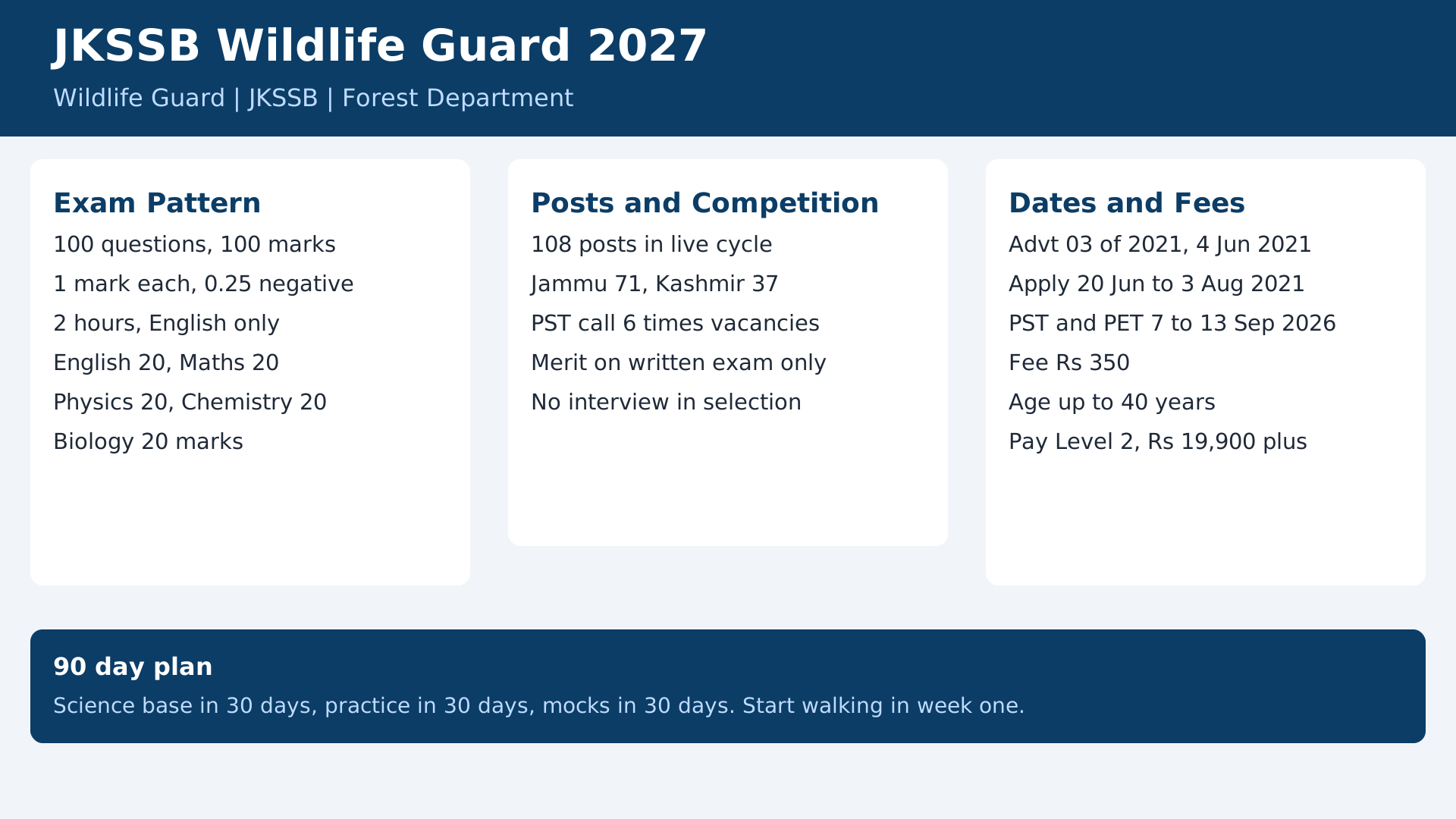
The 108 posts split across the two divisions and the categories. Jammu Division took 71 posts and Kashmir Division took 37. In Jammu the split was 35 Open Merit, 7 SC, 7 ST, 2 OSC, 3 ALC, 7 RBA, 3 PSP and 7 EWS. In Kashmir it was 19 Open Merit, 3 SC, 4 ST, 1 OSC, 1 ALC, 4 RBA, 2 PSP and 3 EWS. The Wildlife Guard posts were advertised under Item Numbers 189 and 190 in the 2021 notification and Item Numbers 605 and 606 in the 2022 notification, which is why you will see four item numbers quoted for the same 108 posts. The 2022 notification was a large forest group advertisement of 772 posts, covering Forester, Wildlife Guard, Social Forestry Worker, FPF Guard, Inspector, Field Assistant and others, and the Wildlife Guard posts in it were a second tranche of the same recruitment.
The timeline of this cycle is the first thing a new aspirant should understand, because it is very long. The notification came in June 2021. The written exam result was notified in April and June 2026, about five years later. The physical tests ran in September 2026, and document verification notices followed in October 2026. A candidate who applied at 35 in 2021 is 40 by the time the selection ends, which is exactly why the age limit for this post runs to 40 years for Open Merit. Do not plan your preparation around a fast cycle. Plan around a slow one, keep your documents valid, and keep your fitness through the whole wait.
The written exam pattern
The written exam is an OMR based objective paper of 100 questions for 100 marks, with each question carrying 1 mark and a duration of 2 hours. The questions are set in English only. Negative marking is 0.25 marks per wrong answer. The section split, as reported by Testbook, is General English 20 marks, Mathematics 20 marks, Physics 20 marks, Chemistry 20 marks, and Biology 20 marks. That split makes this paper different from every other JKSSB guard paper, because 80 of the 100 marks sit in English and the sciences, and there is no separate General Awareness section in the reported split. The science weight follows the job: a Wildlife Guard needs school level physics, chemistry and biology to understand habitat, animal behaviour, and the forest environment.
| Section | Marks |
|---|---|
| General English | 20 |
| Mathematics | 20 |
| Physics | 20 |
| Chemistry | 20 |
| Biology | 20 |
| Total | 100 |
Merit is decided by the written examination alone. The Physical Standard Test and the Physical Endurance Test are qualifying only, and they add no marks. JKSSB shortlisted candidates for the physical tests at six times the number of vacancies in each category, so about 648 candidates from the 108 post cycle reached the physical stage. That ratio is generous, and it means the written exam is a filter, not a final. Your job in the written paper is to land inside that six times band, and then to pass the physical tests. A candidate who scores 70 in the written exam and completes the walk test beats a candidate who scores 69 and walks faster, because the walk carries no marks.
The section split above rests on a single tracker source, and the upload check should confirm it against the syllabus notice for Advertisement 03 of 2021 before anyone builds a study plan on it. What is certain is the shape: 100 questions, 100 marks, 2 hours, 0.25 negative marking, English only, and a science heavy paper. If the split changes in the next notification, the shape will not.
Who can apply for JKSSB Wildlife Guard
The qualification rule is the most important line in this guide. You must have passed Matric, and your qualification must not exceed 10 plus 2 from a recognised institution. Candidates with a qualification above 10 plus 2 cannot apply. That rule catches graduates every cycle, because most government jobs reward a degree and this one excludes it. If you hold a degree, do not apply for Wildlife Guard. Apply for Forester, which needs 10 plus 2 with science, or for a graduate post in another JKSSB advertisement. If you hold only Matric or 10 plus 2, this post is open to you, and the competition is narrower than the graduate posts because the degree holders are kept out.
The age limit is counted as on 1 January 2021 for the live cycle. Open Merit candidates must be not more than 40 years, with a born before date of 1 January 1981 and a born after date of 1 January 2003 in the Testbook table. Reserved categories run to 43 years, and physically challenged candidates to 42 years, under the Jammu and Kashmir reservation rules. You must hold a domicile certificate of the Union Territory of Jammu and Kashmir. Only domiciles of Jammu and Kashmir can apply, and the posts are Divisional Cadre, so you apply against your own division, Jammu or Kashmir, and the merit list is drawn division wise.
Physical standards and the walk test
The physical standards for this post are height only, with no chest measurement in the reported standard. Male candidates need a minimum height of 163 cm, and female candidates need a minimum height of 150 cm. There is no weight condition in the notification. The forest physical standard is the same across the guard posts in this group, and it is lower than the police standard, because the job tests endurance on foot rather than height and chest.
| Standard | Male | Female |
|---|---|---|
| Height | 163 cm minimum | 150 cm minimum |
| Chest | Not stated for this post | Not stated for this post |
The Physical Endurance Test for the forest posts is the walk test, and it is the stage that decides the selection after the written exam. Male candidates must complete a 25 km walk in 4 hours on foot, and female candidates must complete a 16 km walk in 4 hours on foot. You need a physical fitness certificate from the Chief Medical Officer to take the walk test. The walk is qualifying, it carries no marks, and there is no running allowed. That last point matters for training. Candidates who train by running build the wrong fitness. Train by walking, on uneven ground, in the shoes you will wear on the test day, building from 10 km to 25 km over eight weeks. A 25 km walk in 4 hours needs a steady pace of 6.25 km an hour, which is a brisk walk held for four hours without stopping.
Fee, salary and what the job pays
The application fee for the live cycle was Rs 350 for all candidates, with certain exemptions under the rules. Pay online only, through net banking, credit card or debit card, on the JKSSB portal. The fee is non refundable, and an application without the fee is rejected without consideration. The fee for this post is lower than the JKSSB fees for the police and graduate posts, which run to Rs 500 or Rs 700, and it is one of the cheapest applications in the JKSSB system, so cost is never a reason to skip this exam.
The pay is Level 2 in the pay matrix, Rs 19,900 to Rs 63,200 per month, plus the allowances that apply to Forest, Ecology and Environment Department personnel. During the probation period the Jammu and Kashmir Probationer Rules 2020 apply to pay and allowances, so the first two years will not look like the full pay band. The guard career path runs upward through head guard and forester grades, through promotion and departmental examination, and the forest department also runs its own training for guards. Do not pick this exam for the starting salary alone. Pick it because you want forest work, because the job involves long foot patrols, remote postings, and duty in weather that no pay chart can soften.
What a Wildlife Guard does, day to day
A Wildlife Guard is the field staff of the Wildlife Protection Department. The daily work is patrol of a forest beat on foot, checking for poaching, illegal felling, grazing violations, and encroachment, and reporting what is found to the Wildlife Warden or the Range Officer. Guards monitor animal movement, maintain water holes and salt licks, assist in wildlife census work, and help with rescue and release of animals that stray into villages. In Jammu and Kashmir the human animal conflict work is real: leopards and bears enter villages around Dachigam, Gulmarg and the Pir Panjal, and the guard is the first person called.
The posting is usually a sanctuary or a national park beat, far from a town, with a guard hut or a forest rest house as the base. The work is physical, solitary, and seasonal. Summer brings patrol and fire watch. Winter brings snow, closed tracks, and animals moving to lower ground. The walk test exists because the job is walking. A guard who cannot walk 25 km in four hours cannot patrol a beat, and the department knows it. If you like the outdoors, can live with basic facilities, and can walk all day, this post will suit you. If you want a desk, it will not. Guards also help with plantation drives, nursery work, and the maintenance of fire lines, so the job mixes protection with the daily care of the forest itself.
The forests and animals you will protect
Jammu and Kashmir holds some of the most important wildlife habitat in India, and a Wildlife Guard works in the middle of it. Dachigam National Park, outside Srinagar, is the last stronghold of the Hangul, the Kashmir stag, a species found nowhere else in the world. The park also holds leopards, black bears, and musk deer. Hemis National Park in Ladakh is the largest national park in India and the best place in the world to see a snow leopard in the wild. The Gulmarg Wildlife Sanctuary, Overa Aru, and the Limber and Lachipora sanctuaries protect the Pir Panjal forests, while the Changthang cold desert holds the Tibetan wild ass, the black necked crane, and the Ladakhi urial.
A guard needs to know this ground. The written paper tests school science, but the job tests field knowledge: which animal made a track, which bird call belongs to which species, where a leopard is likely to cross a village path, and how to keep people and animals apart without harming either. The department runs training for guards, and the best preparation for the job is time in the field, not time in a coaching centre. If you live near a sanctuary, visit it, learn its beats, and talk to the guards who work there. That knowledge will not appear in the written exam, but it will decide whether you last in the job.
The human animal conflict work deserves a plain description, because it is the hardest part of the post. Leopards enter villages around Dachigam and the Pir Panjal looking for livestock, and bears enter orchards in autumn looking for fruit. The guard is the first person called, and the job is to keep the animal alive and the people safe at the same time. That takes patience, local knowledge, and the ability to stay calm when a crowd is frightened. The walk test measures your legs. The conflict work measures your head. Both are part of the same post.
The long wait, and what the 2021 cycle teaches
The 2021 cycle took five years from notification to document verification, and that fact should shape how you plan. A candidate who applied at 35 in 2021 was 40 by the time the physical tests ran in 2026, which is the Open Merit age limit. The lesson is to apply in every cycle where you are eligible, and never to sit out a cycle hoping for a better one. The next notification may come in a year or in three years, and the age limit will not wait for it.
The second lesson is about documents. Keep your Matric and 10 plus 2 certificates, your domicile certificate, and your category certificate in one file, and keep them valid. A certificate that expires, or a domicile certificate issued after the last date, ends a selection that took five years to reach. The third lesson is about fitness. Candidates who stopped walking after the written exam failed the walk test five years after they applied. Keep walking through the whole wait, three times a week, because the physical stage comes at the end and it is the easiest stage to lose.
How the selection runs from form to final list
The selection has four stages, and they run in a fixed order for this group of forest posts. First comes the online application on the JKSSB portal, with the fee paid online and the documents uploaded in the prescribed format. Then comes the OMR based written examination, which is the only stage that carries marks. Candidates who clear the written exam are shortlisted for the Physical Standard Test and the Physical Endurance Test at six times the number of vacancies in each category. Those who pass the height check and the walk test move to document verification, where JKSSB checks your Matric and 10 plus 2 certificates, your domicile certificate, your date of birth, and your category certificate against the cut off dates in the notification. Medical examination follows selection under the department rules. There is no interview in this recruitment.
One point in the sequence deserves care. The notification text for the 2022 forest group says candidates must qualify the Physical Standard Test and the walk test to be eligible to appear for the written examination, which suggests the physical stage comes first. In the actual 2021 and 2022 cycle, the written exam came first, with results in April and June 2026, and the physical tests followed in September 2026. This guide follows the actual sequence, and flags the difference, because the order affects when you should train for the walk. Train for the walk from the start either way. If the physical stage comes first in the next cycle, you will be ready. If it comes after the written exam, you will still be ready.
English and Mathematics, the two sections candidates neglect
English carries 20 marks and Mathematics carries 20 marks, and together they are 40 percent of the paper. Candidates who spend all their time on science lose both. English tests grammar, vocabulary, comprehension, synonyms and antonyms, error detection, and sentence correction at school level. The questions are straightforward, and the section rewards a candidate who reads English daily. Read one English newspaper a day, even for twenty minutes, and the comprehension and vocabulary questions will take care of themselves.
Mathematics tests number system, percentage, ratio and proportion, profit and loss, time and work, simple interest, averages, and mensuration at Class 10 level. The questions are not hard, but they are set for speed, and a candidate who has not practised arithmetic for years will be slow. Do 20 sums a day from the second week, with a timer, and keep a formula sheet that you revise every Sunday. The 20 marks in Mathematics are the most predictable marks in the paper, because the topics never change.
A 90 day plan that fits this paper
Days 1 to 30 are for the base. Cover school level Physics, Chemistry and Biology for two hours a day, because together they carry 60 marks, and give one hour each to General English and Mathematics. Revise Class 10 science from NCERT books, not from guidebooks, because the questions are set at school level and the NCERT text is the source. Start walking in the first week. Three walks a week, building from 5 km to 15 km, in the shoes you will wear on the test day, on uneven ground where you can find it.
Days 31 to 60 are for practice. The paper is 100 questions in 120 minutes, so speed is a skill of its own. Do 50 questions a day under a timer, and keep an error log of every question you get wrong. Revise the error log every Sunday. Take your first full mock test at the end of week six, under exam conditions, with negative marking applied. Score it and count every mark lost to a guess, then find your weak subject before the last month. Build the walks to 20 km in this block, and get the Chief Medical Officer fitness certificate process understood early, so it does not become a last minute problem.
Days 61 to 90 are for mocks and revision. Take two mocks a week, and spend the day after each mock only on the questions you got wrong. Revise the science chapters, the English grammar rules, and the mathematics formulae in the final two weeks. Do one full 25 km walk for male candidates, or 16 km for female candidates, in the eighth week, to prove to yourself that the distance is possible. In the last three days, stop learning new topics. Sleep properly, keep the walking light, and revise your error log. The candidates who fail this exam usually fail on the walk test or on time management, not on knowledge, and both are fixed in the 90 days before the exam, not in the exam hall.
Where the posts are: the two divisions
The 108 posts split into 71 in Jammu Division and 37 in Kashmir Division, and the merit list is drawn division wise. Jammu Division covers the Jammu plains, the Shivalik hills, and the Pir Panjal forests, with sanctuaries like Nandini, Sudhmahadev, and Jasrota, and the Tawi and Chenab river forests. Kashmir Division covers the valley forests, Dachigam, Gulmarg, Overa Aru, and the high altitude wildlife of the Zanskar and Ladakh ranges that fall under the Kashmir administrative umbrella for this recruitment.
The division split matters for your preparation in one practical way: the cut off marks differ between divisions, because the applicant counts differ. Jammu has nearly twice the posts of Kashmir, and it usually has more applicants too. You cannot choose your division, it follows your domicile, so the only useful response is to score as high as you can and ignore division wise speculation until the result comes. What you can do is learn the wildlife of your own division, because the department posting you will most likely be in your division, and local knowledge is what makes a guard useful from the first month.
Mistakes that cost candidates this exam
The first mistake is applying with a degree. The notification bars candidates with a qualification above 10 plus 2, and the verification stage rejects them after they have cleared the written exam. The second mistake is training by running instead of walking. The test is a 25 km walk for men and a 16 km walk for women, on foot, in four hours, and running fitness does not transfer to walking endurance. The third mistake is ignoring the science weight. Eighty of the 100 marks sit in English and the sciences, so a candidate who revises only General Awareness is preparing for a different exam. The fourth mistake is applying without a domicile certificate in hand, or with a category certificate issued after the last date. JKSSB is strict on cut off dates, and no representation after the fact has ever helped.
JKSSB Wildlife Guard aspirants often prepare for other JKSSB and uniformed exams alongside this one. The SSC GD 2027, UP Police Constable 2027, Bihar Police Constable 2027, UP Police Jail Warder 2027, UP Police Fireman 2027, FSSAI Assistant 2027, IBPS Clerk 2027, SBI Clerk 2027, UGC NET Paper 1 2027 and UPPSC PCS 2027 pages on this site carry the same style of mock test guide, and the pattern habit you build here transfers directly to them.
Sources
JKSSB Advertisement Notification Number 03 of 2021 dated 4 June 2021 and Advertisement Number 04 of 2022, for the 108 Wildlife Guard posts, the division split of 71 Jammu and 37 Kashmir, the item numbers 189, 190, 605 and 606, the qualification of minimum Matric and maximum 10 plus 2, the Level 2 pay of Rs 19,900 to Rs 63,200, and the fee of Rs 350, from Testbook, the JKSSB forest shortlist notice of 29 October 2026 on jkssb.nic.in, and the notification summary on JKSSB Posts. The written examination result notifications of 28 April 2026 and 11 June 2026, the shortlist for the Physical Standard Test and Physical Endurance Test at six times the vacancies, the physical test dates of 7, 8, 11, 12 and 13 September 2026 in Srinagar and Jammu, and the document verification notice of 29 October 2026, from the JKSSB notice on jkssb.nic.in and Mobile Pulse. The physical standards of 163 cm for men and 150 cm for women, and the walk test of 25 km for men and 16 km for women in 4 hours, from Testbook, Career Guide, and the forest group standard in the LAHD SSRB notice of 18 September 2023. The age limits of 40 years for Open Merit, 43 years for reserved categories and 42 years for PwD, from Testbook. The official JKSSB site at jkssb.nic.in, which could not be reached directly by curl during preparation on 20 November 2026, though its PDF notices were readable through search, so the facts above rest on the notification copies and tracker pages listed here and should be checked against the official notification before you apply.







