About Goa Forest Guard 2027 Exam Series
📖 Table of Contents
- Goa Forest Guard 2027 at a glance
- Nine posts inside a 722 post drive
- Who can apply
- The physical standards, and the 25 km walk
- CBT 1: 60 marks in 75 minutes
- CBT 2: General Geography of Goa carries 40 marks
- The Konkani test that ends candidacies
- Fee, pay, and the 12 month Valpoi training
- How the 2018 recruitment differs from 2026
- What a Forest Guard actually does in Goa
- A 90 day plan that trains feet and facts together
- Five mistakes that cost candidates the post
- How this guide was put together
- Sources
Goa Forest Guard 2027: Complete Exam Guide
Nine posts. That is the whole Goa Forest Guard 2027 recruitment: nine Forest Guard posts inside a 722 post Group C drive run by the Goa Staff Selection Commission. Forest Guard Goa candidates who miss that number will prepare for the wrong exam, because the written test, the physical standards and the walking test all belong to the big drive, and the Forest Guard share of it is tiny.
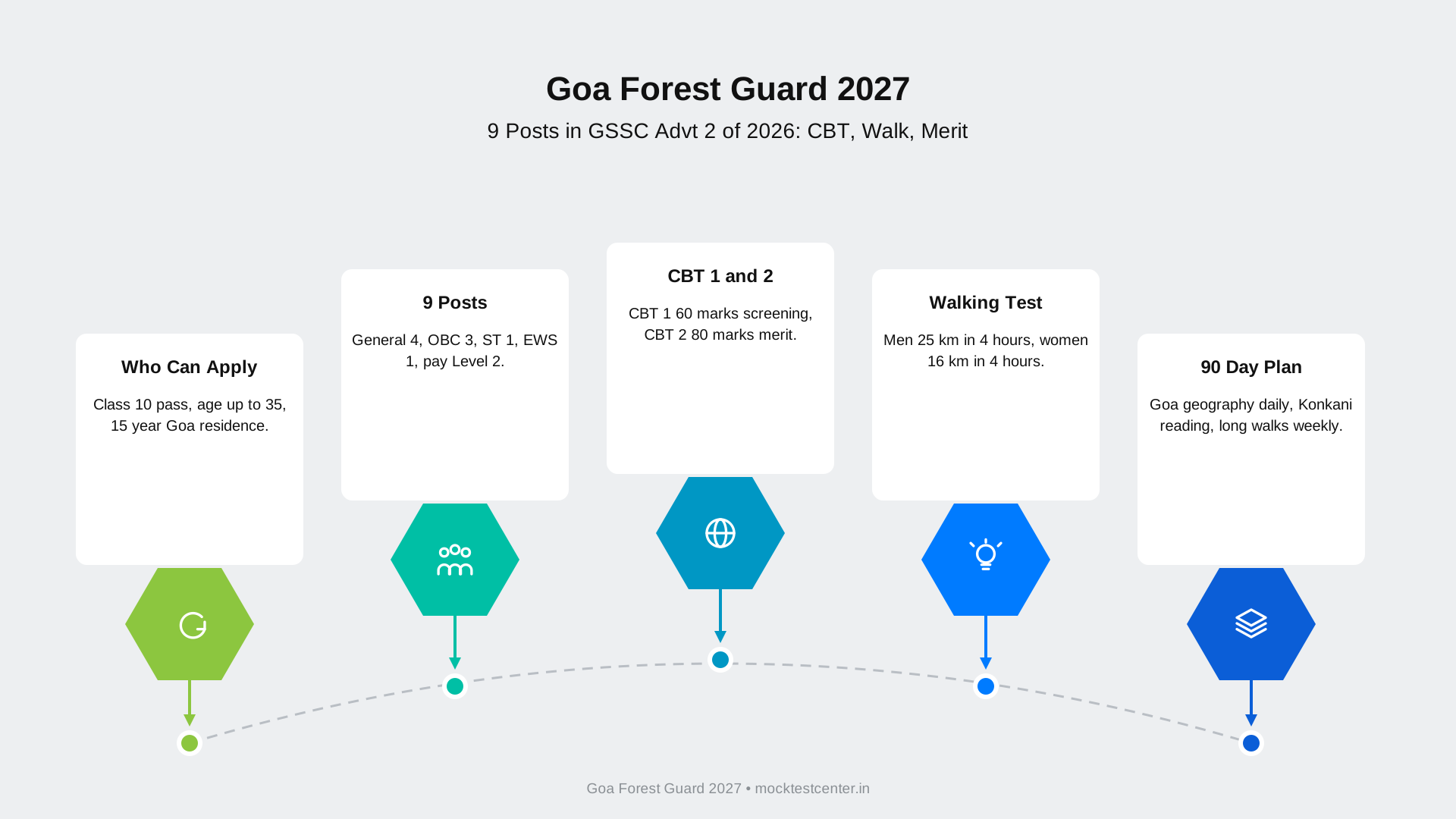
The Goa Staff Selection Commission advertised the drive as Advertisement 2 of 2026, and applications ran from 20 February to 13 March 2026 through the CBES Goa portal. A Forest Guard post needs only a Class 10 pass, and the age limit runs to 35 years. The pay sits at Level 2. The test runs in two computer based tiers, and the physical stage ends with a walk: 25 km in four hours for men, and 16 km in four hours for women.
This guide works from the official advertisement as published on the CBES Goa portal, and from tracker pages that reproduce the GSSC notification. The exam date for the computer based test had not been announced when the trackers last checked, so this guide says so plainly instead of guessing a date.
Goa Forest Guard 2027 at a glance
| Detail | Goa Forest Guard 2027 |
|---|---|
| Post | Forest Guard, Forest Department, Government of Goa |
| Recruiting body | Goa Staff Selection Commission (GSSC) |
| Advertisement | Advertisement 2 of 2026, 722 Group C posts |
| Forest Guard posts | 9 (General 4, OBC 3, ST 1, EWS 1) |
| Official website | gssc.goa.gov.in |
| Application portal | cbes.goa.gov.in |
| Applications | 20 February to 13 March 2026 |
| Education | Secondary School Certificate (Class 10) or equivalent |
| Age limit | Not exceeding 35 years as on 13 March 2026 |
| Pay | Level 2 of the 7th CPC pay matrix |
| Fee, Level 1 to 3 posts | Rs 200 UR, Rs 100 OBC and EWS, Rs 50 SC, ST and PwD |
| Selection | CBT 1 screening, physical test, CBT 2 merit, document verification |
| CBT 1 | 60 marks, 75 minutes, no negative marking reported |
| CBT 2 | 80 marks, 100 minutes, 40 marks General Geography of Goa |
| Walking test | Men 25 km in 4 hours, women 16 km in 4 hours |
| Training | 12 months at the Forest Training School, Valpoi |
| Residence | 15 year residence certificate in Goa, mandatory |
| Language | Knowledge of Konkani essential, Marathi desirable |
| Exam date | To be notified |
Nine posts inside a 722 post drive
The Goa Staff Selection Commission released Advertisement 2 of 2026 for 722 Group C posts across Goa government departments, and the Forest Guard posts sit inside it. Police Constable takes 360 posts, Armed Police Constable 119, Constable Driver 111, Warden 60, Round Forester 23, Range Forest Officer 13, Matron 10, and Forest Guard 9. The Forest Guard share is 9 out of 722, or about one in 80 posts.
That ratio shapes the competition. Nine posts draw applicants from across Goa, and the shortlist for the physical test runs to 20 times the vacancies, which means about 180 candidates reach the physical stage for Forest Guard. The written test has to cut thousands of applicants down to 180, so CBT 1 acts as a hard filter, and CBT 2 decides the final nine. A candidate who prepares for a 100 post drive will underprepare for this one.
The category split for the nine posts is General 4, OBC 3, ST 1 and EWS 1. No post is reserved for SC candidates in this cycle. The official CBES advertisement page lists the same split, and the tracker pages reproduce it exactly. A candidate should check the category against the split before applying, because the form offers no second chance after submission.
The drive groups the forest posts together. Range Forest Officer takes 13 posts at Level 6, and it needs a Bachelor degree in Science. Round Forester takes 23 posts at Level 3, and it needs a Class 12 pass. Forest Guard takes 9 posts at Level 2, and it needs a Class 10 pass. The three posts share the same CBT 1, the same Konkani condition, and the same walking test shape, and they split at CBT 2, where each post gets its own subject section. A candidate who qualifies for Round Forester as well as Forest Guard can apply for both, and the two applications run separately.
The notification date needs a note. Moneycontrol reported the notification on 14 February 2026, with the detailed advertisement and the application window opening on 20 February 2026. Tracker pages give 20 February 2026 as the notification date. Both reports agree on the window, 20 February to 13 March 2026, and on the 722 total. This guide uses 14 February for the announcement and 20 February for the detailed notification and the start of applications, and it flags the two dates so a reader can see the source of each.
Who can apply
The education bar is low, and the other conditions do the filtering. A candidate needs a Secondary School Certificate, the Class 10 pass, or an equivalent qualification from a recognised board. No higher qualification helps at the form stage, and no diploma or degree changes the eligibility. The post is built for Class 10 pass candidates, and the competition runs on the test, not on degrees.
The age limit runs to 35 years as on the last date of application, 13 March 2026. The official CBES advertisement page states the maximum age as 35 for Forest Guard, and the tracker pages agree. Relaxation follows the standard GSSC rules: SC and ST candidates get 5 years, OBC candidates get 3 years, PwD candidates get 10 years, and government servants get up to 5 years. The minimum age is 18 years, the standard floor for Group C posts in the drive.
Two conditions block more candidates than the age and education rules combined. The first is the 15 year residence certificate in Goa, issued by the competent authority. A candidate without it cannot apply, whatever the education or age. The second is knowledge of Konkani, which the advertisement lists as essential for the post. Marathi knowledge is desirable, not essential, and it helps at the interview and document stage, not at the form stage.
Employment Exchange registration also appears in the tracker guidance for the drive. Candidates should register with the Employment Exchange in Goa and keep the registration card ready, because the application asks for it and document verification checks it. A candidate who leaves registration to the last week of the window risks a missed deadline.
The fee for Level 1 to 3 posts is Rs 200 for UR candidates, Rs 100 for OBC and EWS candidates, and Rs 50 for SC, ST and PwD candidates, paid online through internet banking, debit card, credit card or UPI. One tracker page groups the fee differently, putting OBC and EWS with the general fee of Rs 200. This guide follows the IndiaJobCentral split of Rs 200, Rs 100 and Rs 50, and flags the other grouping as a conflict. The fee is small, and it is the cheapest part of the whole process.
The physical standards, and the 25 km walk
The physical stage decides more Forest Guard candidacies than the written test, and the reason is the walk. The official advertisement sets the standards in plain figures. Male candidates need a minimum height of 163 cm, and a chest of 79 cm unexpanded and 84 cm expanded. Female candidates need a minimum height of 150 cm. The walking test asks men to cover 25 km in four hours, and women to cover 16 km in four hours.
Those figures have not changed in years. The 2008 gazette notification for Forest Guard posts set the same height and chest figures, and the same 25 km and 16 km walks in four hours. The 2026 advertisement repeats them exactly. A candidate can trust the numbers, because two decades of notifications agree on them.
The walk is a pace test, not a speed test. Twenty five km in four hours means 6.25 km per hour, a brisk walk held for four hours without a break that matters. Sixteen km in four hours means 4 km per hour, a steady walk held for the same time. The test punishes the candidate who starts fast and fades, and it rewards the candidate who holds one pace from the first kilometre to the last. Training should copy the test: long walks at a fixed pace, on uneven ground, in the heat of the day, with the same shoes the candidate will wear on the day.
One conflict in the tracker pages needs a note. IndiaJobCentral describes a physical endurance test with a run, a long jump and a high jump for candidates shortlisted from CBT 1, up to 20 times the vacancies. MySarkariNaukri lists the same running and jumping events for Police Constable, and lists only the walking test for Forest Guard. The official CBES advertisement lists only the height, chest and walking test as the physical requirement for Forest Guard. This guide follows the official advertisement, and it flags the running and jumping description as a tracker account that may mix the Police Constable physical test into the Forest Guard stage. A candidate should train for the walk first, and treat the run and jump events as a possibility to check against the admit card instructions, not as a certainty.
The physical standards test comes after CBT 1 and before CBT 2. Candidates shortlisted from CBT 1, up to 20 times the vacancies, go to the physical stage, and only those who qualify in it sit CBT 2. The physical stage is qualifying, which means it adds no marks to the merit list. A candidate who walks 25 km in three hours and a candidate who walks it in three hours and 59 minutes stand equal at CBT 2. The walk only opens the door. CBT 2 decides who walks through it.
Selected candidates face one more physical demand after selection: a 12 month training course at the Forest Training School at Valpoi, or elsewhere as directed. The advertisement warns that candidates who fail subjects in the course will not get an annual increment or a promotion until they clear the failed subjects. The training is part of the job, not a formality after it, and a candidate who dislikes field life should think twice before applying.
CBT 1: 60 marks in 75 minutes
CBT 1 is the common screening test for Level 1 to Level 6 posts in the drive, and every Forest Guard candidate sits it. The paper carries 60 marks in 75 minutes, and it splits into four parts. Reasoning takes 10 marks. Numerical Ability takes 10 marks. Konkani Language takes 10 marks. English and Comprehension takes 30 marks.
English carries half the paper, so it carries half the result. Thirty marks of English and Comprehension in a 60 mark paper means a candidate who scores 25 in English and 20 elsewhere reaches 45, while a candidate who scores 15 in English needs near perfection in the other three parts to match it. The English section tests comprehension passages, grammar, vocabulary and error correction, and the SCERT English books for Classes 8 to 10 give the base. A candidate who reads English daily, even for 20 minutes, will hold an edge over a candidate who starts English a month before the test.
Ten marks each means ten questions each if each question carries one mark. The tracker pages leave the per question mark for CBT 1 unstated, so this guide gives only the section marks and flags the gap.
The Konkani section takes 10 marks, and it carries a gate. A candidate must score at least 4 out of 10 in the Konkani test in CBT 1, and the pass is mandatory for deciding merit. A candidate who scores 55 out of 60 but only 3 in Konkani fails the paper. A candidate who scores 40 out of 60 with 5 in Konkani passes the screen. The Konkani gate makes the smallest section the most dangerous one, and a candidate who cannot read Konkani should not apply at all.
Negative marking in CBT 1 is reported as absent. IndiaJobCentral states that no negative marking will apply for the computer based test, and it describes CBT 1 as a screening test excluding negative marking. MySarkariNaukri says the specific rule was not detailed in the notification it saw, and it adds that standard GSSC exams usually follow a 0.25 mark deduction for every wrong answer. The two accounts conflict, and the official advertisement text seen for this guide leaves the rule open. This guide follows the IndiaJobCentral account of no negative marking, and it flags the 0.25 claim as unverified. A candidate should read the admit card instructions on the day, because the admit card is the document that settles the rule.
CBT 1 screens, and it does not decide merit. The merit list comes from CBT 2, and CBT 1 only decides who reaches the physical stage. That shape changes the strategy. A candidate needs enough marks in CBT 1 to land inside the top 180, not the top nine. The safe target is a score that clears the cut comfortably, and the Konkani gate, not the total, is the line that ends candidacies.
CBT 2: General Geography of Goa carries 40 marks
CBT 2 is the merit exam, and it carries 80 marks in 100 minutes. Reasoning takes 10 marks. Numerical Ability takes 10 marks. English and Comprehension takes 20 marks. The subject specific test takes 40 marks. For Forest Guard and Round Forester, the subject specific test is General Geography of Goa.
Forty marks out of 80 means the subject section is half the merit paper. A candidate who scores 30 in General Geography of Goa and 25 in the other three parts reaches 55. A candidate who scores 15 in the subject section needs 40 from the other 40 marks to match it, which means a perfect score everywhere else. The subject section decides the merit list, and the other three sections protect it.
General Geography of Goa covers the state a Forest Guard will patrol. The physical geography runs through the Western Ghats in the east, the coastal plain in the west, and the rivers that cut between them: Mandovi, Zuari, Terekhol, Chapora, Sal and Talpona. The forest geography runs through the recorded forest area of 1,271 sq km, the forest cover of about 2,244 sq km, and the protected area network of one national park and six wildlife sanctuaries. The human geography runs through the two districts, North Goa and South Goa, the 12 talukas, and the towns of Panaji, Margao, Vasco da Gama, Mapusa and Ponda. The economic geography runs through mining, tourism, fishing and cashew, and the transport geography runs through the Konkan Railway, the national highways and the Mormugao port.
The subject section rewards a candidate who knows Goa as a place, not as a list. A question about the Mhadei river is a question about the Mhadei Wildlife Sanctuary, the water dispute with Karnataka, and the forests of Sattari taluka. A question about Cotigao is a question about Canacona taluka, the southernmost sanctuary, and the tall trees that define it. A candidate who reads the Goa geography chapters of the Class 9 and 10 SCERT books, and who follows Goa news for six months, will recognise the questions. A candidate who memorises a list of rivers will not.
The other three sections in CBT 2 follow the CBT 1 shape at a higher weight. Reasoning stays at 10, Numerical Ability stays at 10, and English and Comprehension drops from 30 to 20. The total time is 100 minutes for 80 marks, which gives 75 seconds per mark, a little more generous than CBT 1. A candidate should still move fast, because the subject section needs reading time, and the English passages need it too.
Document verification follows CBT 2. The commission checks the Class 10 certificate, the residence certificate, the caste certificate where claimed, the Employment Exchange registration, and the physical standards record. A candidate who clears CBT 2 and fails document verification loses the post, so the documents deserve the same care as the test.
The Konkani test that ends candidacies
Konkani is the quiet filter of the whole drive, and it ends more Forest Guard candidacies than any other single rule. The advertisement lists knowledge of Konkani as essential, and the CBT 1 Konkani section makes it a scored gate. A candidate needs 4 out of 10 in that section, and the pass is mandatory for merit. No other section carries a gate like it.
Konkani is the official language of Goa, and the state runs its schools in Konkani and Marathi mediums. A Forest Guard works in villages across both districts, and the guard speaks to farmers, fishermen, cashew growers and forest dwellers in Konkani. The test checks whether the guard can do the job in the language the public speaks, so it carries real weight.
The 10 marks test reading and comprehension, grammar and vocabulary. A candidate who speaks Konkani at home but never reads it will struggle, because the test is written. A candidate who reads Konkani newspapers, such as the Konkani dailies and the Konkani pages of the Goa press, will recognise the vocabulary. A candidate who studied in Marathi medium should still prepare Konkani reading, because spoken comfort does not transfer to the written paper.
Marathi helps too, and the advertisement lists it as desirable. A guard who knows Marathi can speak to the Marathi speaking villages of the border talukas, and the department values it. Marathi carries no marks and no gate, so it should never take study time from Konkani. Learn Konkani first, add Marathi later, and only if the Konkani gate is safe.
The residence rule and the Konkani rule work together to keep the drive local. A candidate from outside Goa needs a 15 year residence certificate, and a candidate from inside Goa still needs Konkani. Both rules say the same thing: the post belongs to a person who lives in Goa and speaks its language. A candidate who meets both rules has already cleared two filters that no amount of test preparation can replace.
Fee, pay, and the 12 month Valpoi training
The fee for a Forest Guard application is Rs 200 for UR candidates, Rs 100 for OBC and EWS candidates, and Rs 50 for SC, ST and PwD candidates. The post sits at Level 1 to 3 in the GSSC fee table, so the lower fee applies. Payment runs online through internet banking, debit card, credit card or UPI, and the application window ran from 20 February to 13 March 2026.
The pay sits at Level 2 of the 7th CPC pay matrix. The notification lists only the level, and the standard pay matrix puts Level 2 at Rs 19,900 to Rs 63,200 a month as basic pay, before allowances. Goa government posts add dearness allowance, house rent allowance and other allowances on top of the basic pay, so the take home pay runs higher than the basic figure. A new Forest Guard should expect the starting basic of Rs 19,900, and the annual increments that follow it.
The job is a Group C post in the Forest Department, and it carries the field life that the name promises. A Forest Guard patrols forest beats, watches for illegal felling and poaching, reports fires, helps in plantation work, and assists the Round Forester and the Range Forest Officer. The work runs outdoors, in the heat and the rain, in the Western Ghats and the coastal forests alike. The 12 month training at the Forest Training School at Valpoi prepares a recruit for exactly that life, with field craft, forest law, and the walking fitness the job needs.
The training rule carries a warning worth reading twice. Selected candidates must complete the 12 month course, and candidates who fail subjects in the course will not get an annual increment or a promotion until they clear the failed subjects. The training is a second exam, and it decides the first years of the career.
Nine posts, Level 2 pay, and a year of training make the post a modest prize. The value lies in the permanence: a government post in the home state, with a pension and a career path from Forest Guard to Forester and beyond. A candidate who wants a desk job should look elsewhere. A candidate who wants field work in the forests of Goa will find no better entry point.
How the 2018 recruitment differs from 2026
Goa last filled Forest Guard posts at scale in 2018, and the contrast with 2026 shows how much the process has changed. The Forest Department selected candidates for 157 Forest Guard posts in March 2018, and the list went up on the department website at forest.goa.gov.in. The selection ran on merit in the written test, with qualifying marks in Konkani, a physical examination and a walking test. One hundred and fifty seven posts against nine in 2026: the 2018 drive was 17 times bigger.
The 2018 process ran through the department itself, with paper applications and a departmental test. The 2026 process runs through the Goa Staff Selection Commission, with online applications on the CBES portal, a two tier computer based test, and a common screening paper shared with 722 posts. The physical standards did not change between the two drives, and the walking test did not change either. What changed is the gate: a computer based screening test with a Konkani gate now sits in front of the physical stage, and the subject test on General Geography of Goa now decides merit.
The 2008 recruitment shows the older shape even more clearly. The Chief Conservator of Forests advertised 37 Forest Guard posts in the Official Gazette of 18 December 2008, with a scale of Rs 4,440 to Rs 7,400 plus grade pay of Rs 1,400. The age limit ran to 40 years for general candidates, 45 for ST and SC, and 43 for OBC and ex servicemen. The sequence of tests ran in five stages: written test, physical fitness test, walking test, oral test, and medical test. The 2026 drive drops the oral test and the separate medical stage from the advertised sequence, and it adds the two tier computer test in their place.
The lesson from the history is simple. Forest Guard recruitment in Goa comes in waves, and the waves are far apart. A candidate who misses the 2026 window may wait years for the next one, and the next one may carry even fewer posts. Nine posts will not come again soon. Prepare for this cycle as if it is the only one, because the history says it nearly is.
What a Forest Guard actually does in Goa
Goa is a small state with a large forest. The India State of Forest Report 2021 puts the forest cover of Goa at 2,244 sq km, which is 60.62 percent of the geographical area of the state. The 2023 report puts the forest cover at 2,265.72 sq km, with tree cover of 257.82 sq km on top of it. The recorded forest area is 1,271 sq km, or 34.33 percent of the area. More than a third of Goa is recorded forest, and more than half of Goa is under forest or tree cover. A Forest Guard patrols that land.
The protected area network gives the guard a map. Mollem National Park covers 107 sq km in Sanguem taluka. Bhagwan Mahavir Wildlife Sanctuary covers 133 sq km in the same taluka. Cotigao Wildlife Sanctuary covers 86 sq km in Canacona. Bondla Wildlife Sanctuary covers 8 sq km in Ponda. Dr Salim Ali Bird Sanctuary covers 1.76 sq km on Chorao island in Tiswadi. Mhadei Wildlife Sanctuary covers 208.48 sq km in Sattari, and Netravali Wildlife Sanctuary covers 211.05 sq km in Sanguem. Together the network covers 755.31 sq km, about 20 percent of the state. A guard posted to Sanguem works in the largest sanctuaries. A guard posted to Canacona works in the southern forests. The posting decides the daily work.
The forests hold the state animal, the gaur, and the state bird, the ruby throated yellow bulbul, and the state tree, the asan. They also hold tigers that move through the Western Ghats between Karnataka and Maharashtra, and the guard is the first person who sees the signs of that movement. The work mixes patrol with protection: watching for illegal felling, for poaching, for encroachment, and for fire. The March 2023 fires showed the risk, when 74 fire incidents hit Goa in a fortnight, with 32 of them inside three wildlife sanctuaries, and the ground teams fought them with aerial support from the Indian Air Force. A guard who cannot walk 25 km in four hours cannot reach a fire in the far hills.
The department also runs eco tourism now, with facilities at Bondla, Surla and Dudhsagar, a jeep safari at Netravali, and cottages at Bondla. The guard meets tourists as well as poachers, and the job needs people skills as much as field skills. The Konkani test in CBT 1 starts to make sense here: the guard speaks to the public every day, in the language of the village the guard patrols.
A 90 day plan that trains feet and facts together
A Forest Guard plan has two halves, and most candidates train only one. The written test needs facts, and the walking test needs feet. Ninety days is enough for both, if the candidate trains them together from day one.
Days 1 to 30 build the base. Walk 5 km every morning at a fixed pace, and add 1 km each week, so the walk reaches 12 km by day 30. Study two hours a day: English comprehension and grammar for one hour, and General Geography of Goa for one hour. Read the SCERT geography books for Classes 9 and 10, and note the rivers, the sanctuaries, the talukas and the towns. Test reasoning and numerical ability with 20 questions each weekend.
Days 31 to 60 raise the load. Walk 15 km on weekends at the test pace of 6.25 km per hour for men, and 4 km per hour for women, on uneven ground. Study the subject section harder, because it carries 40 of the 80 marks in CBT 2. Read about the Western Ghats, the protected area network, and the forest cover figures, and link each fact to a place on the map. Sit a CBT 1 mock each weekend, 60 marks in 75 minutes, and check the Konkani score first. A Konkani score below 4 means the week after belongs to Konkani reading.
Days 61 to 75 sharpen the weak spots. Walk 20 km once, then 25 km once, at the test pace, with the shoes for the day. The walk is the only part of the exam that cannot be faked in the last week, so the long walks belong in this phase, not the last one. Study the logged wrong answers from the mocks, and redo the General Geography of Goa notes. Keep one CBT 2 mock each weekend, 80 marks in 100 minutes.
Days 76 to 90 run the exam routine. Walk 10 km on alternate days to hold fitness without tiring the legs. Revise the geography notes and the English rules, and sit a mock every third day. The day before the physical test, rest the legs and eat well. The day before the written test, read the admit card instructions and check the centre. The merit list comes from CBT 2, so the last fortnight belongs to the subject section above all.
Mock tests decide the written result, and the long walks decide the physical result. A candidate who scores 45 in CBT 1 mocks and walks 25 km inside four hours is ready. A candidate who scores 55 in mocks and cannot walk 15 km is not ready, whatever the mock score says.
Five mistakes that cost candidates the post
First, ignoring the Konkani gate. A candidate who scores well in English and reasoning but scores 3 out of 10 in Konkani fails CBT 1 outright. Konkani reading deserves daily time from day one, not a week before the test.
Second, preparing for the wrong subject. CBT 2 gives 40 marks to General Geography of Goa, not to general knowledge and not to forest science. A candidate who studies Indian geography in general and Goa geography not at all will lose the section that decides merit.
Third, training for a run instead of a walk. The official advertisement sets a walking test, 25 km in four hours for men and 16 km in four hours for women. Running fitness does not transfer to a four hour walk, and a candidate who trains only for speed will fade in the third hour.
Fourth, forgetting the residence certificate. The 15 year residence certificate is mandatory, and document verification checks it. A candidate who clears CBT 2 without it loses the post at the last stage.
Fifth, missing the scale of the competition. Nine posts mean the cut will run high, and a score that clears a 100 post drive will not clear this one. Aim for the top of the mock scores, not for the pass line, because there is no pass line in CBT 2, only a merit list of nine names.
How this guide was put together
This guide rests on the official advertisement as published on the CBES Goa portal, which gives the Forest Guard post count, the category split, the age limit, the pay level, the education rule, the physical standards, the walking test, the Konkani condition, and the 12 month training rule. It also rests on tracker pages that reproduce the GSSC Advertisement 2 of 2026, principally IndiaJobCentral and MySarkariNaukri, which give the CBT 1 and CBT 2 pattern, the fee split, and the selection sequence. Moneycontrol gives the notification date of 14 February 2026.
Three conflicts in the sources deserve a note. The fee split differs between tracker pages: IndiaJobCentral puts OBC and EWS at Rs 100, while MySarkariNaukri groups OBC and EWS with the general fee of Rs 200. This guide follows IndiaJobCentral and flags the other grouping. Negative marking differs too: IndiaJobCentral reports no negative marking in the computer based test, while MySarkariNaukri says the rule was not detailed and the usual GSSC deduction is 0.25 marks. This guide follows IndiaJobCentral and flags the 0.25 claim as unverified. The physical stage differs as well: the official advertisement lists only the walking test, while IndiaJobCentral describes a run, long jump and high jump stage. This guide follows the official advertisement and flags the tracker description as a possible mix with the Police Constable physical test.
Two facts could not be verified. The per question mark for CBT 1 and CBT 2 is not stated in any source seen for this guide, so this guide gives only the section marks and the durations. The exam date for the computer based test had not been announced when the trackers last checked, so this guide gives no exam date. The pay figure of Rs 19,900 to Rs 63,200 is the standard 7th CPC Level 2 matrix range, and the notification lists only the level, so the figure is flagged as the matrix range rather than a notification figure.
Sources
CBES Goa, Advertisement Details, Forest Guard, Goa Staff Selection Commission, cbes.goa.gov.in. IndiaJobCentral, Goa SSC Recruitment 2026, 722 Police, Forest and Prison Department Posts, indiajobcentral.in. MySarkariNaukri, Goa GSSC Group C Recruitment 2026, Notification, Eligibility, Exam Pattern, Salary, mysarkarinaukri.com. Moneycontrol, Goa Police Recruitment 2026, Notification released for 722 Constable, Forest Guard and Group C posts, moneycontrol.com. IndGovtJobs, Goa SSC Advt No 2 of 2026, 722 Group C Posts, indgovtjobs.in. Government of Goa, Recruitment of Forest Guards, March 2018, goa.gov.in. Official Gazette, Government of Goa, Series III No. 38, 18 December 2008, Forest Guard recruitment, archive.org. Press Information Bureau, India State of Forest Report 2021, forest cover of Goa, pib.gov.in. Herald Goa, Goa Forest Department Achieves Major Afforestation Milestones in 2024-25, heraldgoa.in. Wikipedia, Flora and fauna of Goa, en.wikipedia.org.