
About Punjab Forest Guard 2027 Exam Series
📖 Table of Contents
- Punjab Forest Guard 2027 at a glance
- Two rounds, one post: 2022 and 2025
- Who can apply for Punjab Forest Guard
- PSSSB Forest Guard exam pattern: what the paper looks like
- The syllabus, section by section
- The walk test and the measuring tape
- The money question
- What a Forest Guard actually does all day
- A 90 day plan that fits the real paper
- Mistakes that cost candidates marks
- Where to check next
- Sources
Punjab Forest Guard 2027: Complete Exam Guide
The Punjab Forest Guard 2027 cycle has no notification yet, and this guide says so in the first paragraph rather than burying it. The last full Forest Guard recruitment was Advertisement Number 07 of 2022, published by the Punjab Subordinate Services Selection Board, known as PSSSB, on 19 May 2022. It advertised 204 posts, of which 200 were Forest Guard. The written exam was held on 13 November 2022. A smaller round followed in 2025, with 29 Forest Guard posts inside a 500 post Forest Department drive, and its forms closed on 24 August 2025. As of 21 November 2026, no 2027 advertisement has been published, so this guide anchors on the 2022 cycle and marks every 2025 figure with its source.
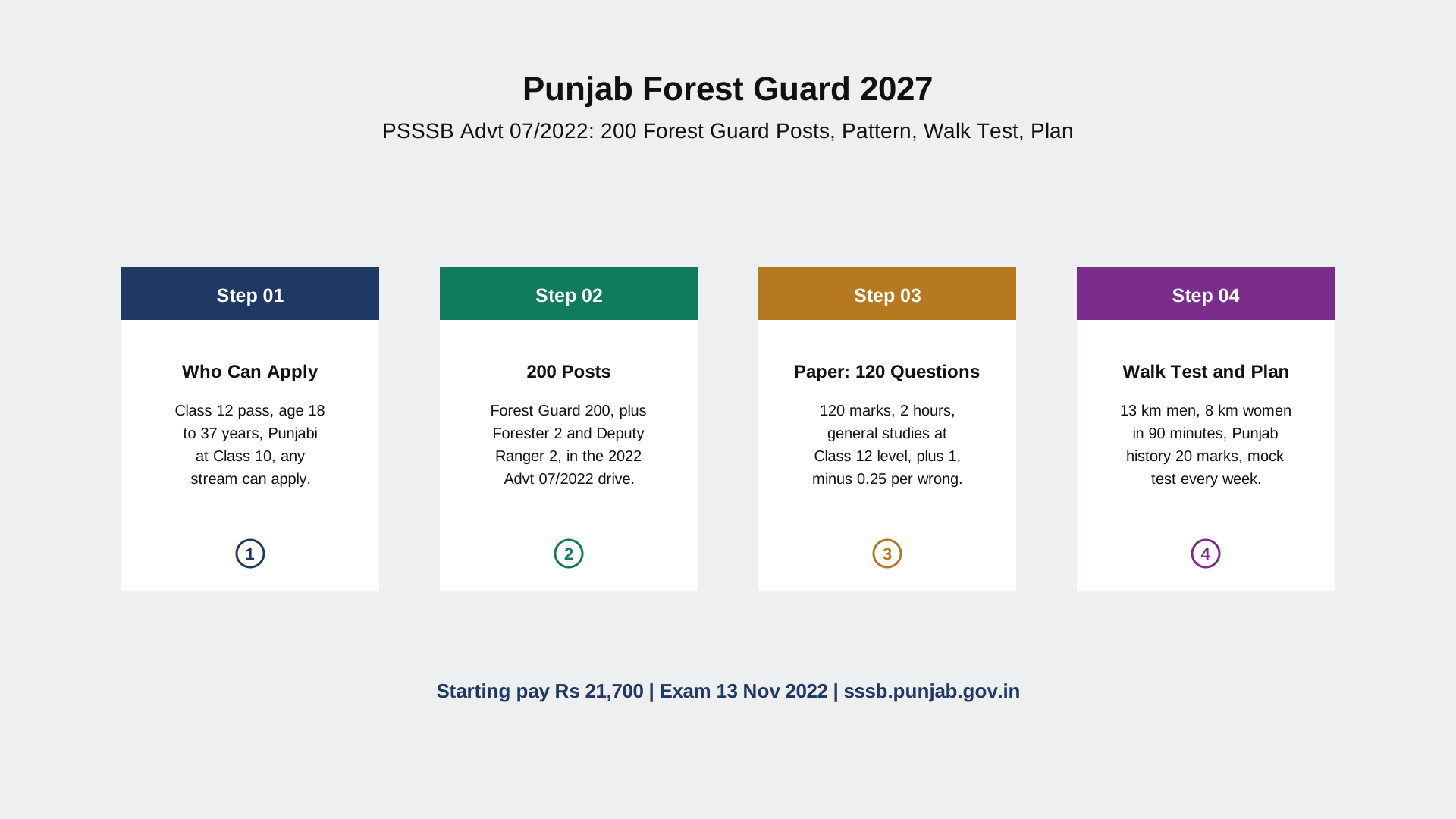
Forest Guard is one of the few Punjab government posts that asks for Class 12 only, and that is why the competition is wide. You need to have passed Senior Secondary Part II, which is Class 12, from a recognised board, and you need Punjabi at matriculation level. The age limit in the 2022 cycle was 18 to 37 years as on 1 January 2022. The written paper is a general studies paper of 120 multiple choice questions for 120 marks, to be finished in 2 hours, with 0.25 marks cut for a wrong answer. There is no technical subject in it. A candidate who prepares for police constable and clerk exams is already most of the way there.
The part that surprises first time candidates is the physical test. Forest Guard is a field post, and the selection includes physical measurement and a walk test after the written exam. The figures reported for the 2022 cycle are a height of 167 cm for men and 150 cm for women, a chest of 79 cm unexpanded and 84 cm expanded for men, and a walk of 13 km for men and 8 km for women to be finished in 90 minutes. Two trackers report a different set of figures, and this guide flags that conflict in the physical section rather than picking one set and hiding the other.
The starting pay reported for Forest Guard is Rs 21,700 a month, with the post placed in the lower pay levels of the Punjab government scale. That figure comes from House of Aspirants, which also reports Rs 25,500 for Forester and Rs 35,400 for Deputy Ranger in the same advertisement. One other tracker prints a scale of Rs 19,900 to Rs 63,200 for the post. This guide uses Rs 21,700 as the starting pay and flags the scale as a conflict, because the two numbers describe the same post in different ways and the notice will settle it.
Punjab Forest Guard 2027 at a glance
| Detail | Punjab Forest Guard 2027, as last advertised |
|---|---|
| Conducting body | Punjab Subordinate Services Selection Board (PSSSB), for the Department of Forests and Wildlife Preservation, Punjab |
| Post | Forest Guard |
| Advertisement | Advertisement Number 07 of 2022, notified 19 May 2022 |
| Total posts in 2022 | 204 in all, Forest Guard 200, Forester 2, Deputy Ranger 2 |
| Most recent round | 2025 Forest Department drive, 500 posts in all, Forest Guard 29, Clerk 451, Warden 20, forms 30 July to 24 August 2025 |
| Advertisement for 2027 cycle | Not published as of 21 November 2026; this guide anchors on Advertisement 07 of 2022 |
| Education | Senior Secondary Part II, Class 12 pass, plus Punjabi at matriculation level |
| Age limit in 2022 | 18 to 37 years as on 1 January 2022, with relaxation per Punjab government rules |
| Fee in 2022 | Not verified from a retrieved source; see the money section |
| Exam | Objective written paper, 120 questions, 120 marks, 2 hours |
| Marking | 1 mark for a right answer, 0.25 marks cut for a wrong answer |
| Physical test | Physical measurement and walk test after the written exam; figures in the physical section |
| Pay | Starting pay Rs 21,700 a month as reported for Forest Guard in the 2022 cycle |
| Selection | Written examination, physical efficiency and measurement test, document verification, medical examination |
| Official website | sssb.punjab.gov.in |
Two rounds, one post: 2022 and 2025
The 2022 round is the round this guide is built on, because it is the last round with a full public record. PSSSB published Advertisement 07 of 2022 on 19 May 2022 for 204 posts in the Forest Department. The split was 200 Forest Guard, 2 Forester and 2 Deputy Ranger, and the Forest Guard posts were divided into 134 for men and 66 for women. Applications ran from 19 May to 8 July 2022, after an extension from the first closing date of 28 June. The Forest Guard written exam was held on 13 November 2022, the Forester paper on 20 November 2022 and the Deputy Ranger paper on 26 November 2022. The written result came out on 2 January 2023, and the physical efficiency and measurement test was held from 29 April to 3 May 2023.
The 2025 round was smaller and it was bundled with other posts. PSSSB advertised 500 posts in the Department of Forests and Wildlife Preservation in July 2025, with 29 Forest Guard, 451 Clerk and 20 Warden posts. Applications ran from 30 July to 24 August 2025 on sssb.punjab.gov.in. The education for Forest Guard in that round was Class 12 or equivalent with Punjabi at matriculation level, and the age reported by Sarkari Jobs was 18 to 27 years as on 1 January 2025. That age is much narrower than the 18 to 37 years of the 2022 cycle, and the advertisement number for the 2025 round could not be verified from any retrieved source, so this guide reports the 2025 figures with those two flags attached and does not treat them as settled.
The gap between the two rounds tells its own story. Four years passed between the 2022 advertisement and the 2025 drive, and the 2025 drive offered only 29 Forest Guard posts against 200 in 2022. Retirements and new plantation and wildlife work keep creating vacancies in the Forest Department, so a fresh round in 2027 or 2028 is possible, and House of Aspirants says exactly that. Possible is the right word. Nothing has been announced, and a candidate who waits for the notice before starting preparation will be four months behind the candidate who starts now on the 2022 pattern.
One more distinction matters. Forester and Deputy Ranger are separate posts that usually appear inside a Forest Guard drive in small numbers, two each in 2022. Forester needs a bachelor degree in forestry or an equivalent qualification, and Deputy Ranger sits higher in the pay scale. This guide covers Forest Guard only. If you hold a forestry degree and want the Forester post, read the Forester eligibility in the next notice on its own terms, because the Class 12 rule for Forest Guard does not carry across to it.
Who can apply for Punjab Forest Guard
The education rule is Class 12. You must have passed the Senior Secondary Part II examination or an equivalent examination from a recognised board or university. There is no minimum percentage reported for Forest Guard in the 2022 cycle, and no subject requirement at Class 12. A candidate from any stream, science, commerce or arts, can apply. The second condition is Punjabi at matriculation level, which means Class 10. Candidates from other states can apply under the General category if they meet the Punjabi condition, and the condition has been part of PSSSB recruitments for years.
The age limit in the 2022 cycle was 18 to 37 years as on 1 January 2022, with relaxation under Punjab government rules for reserved categories. The relaxation rules that PSSSB applies across its recruitments give extra years to SC and BC candidates of Punjab, to Punjab government employees, to persons with disabilities and to ex-servicemen, with the exact years fixed in the advertisement. The 2025 round reported a much narrower age of 18 to 27 years as on 1 January 2025, and that figure comes from a tracker rather than the board notice. Until the next advertisement is published, treat 18 to 37 years as the working figure and check the age clause first when the notice lands, because it is the clause most likely to have changed.
Since October 2022, every PSSSB exam also carries a qualifying Punjabi paper at matriculation level, and a candidate needs 50 percent in it. House of Aspirants reports this rule for the Forest Guard paper, and it applies on top of the Class 10 Punjabi eligibility condition. The two are different things. The eligibility condition asks whether you passed Punjabi at Class 10. The qualifying paper tests your Punjabi again inside the exam, and 50 percent is the pass mark. A native Punjabi speaker who skips revision can still fall below 50 percent on grammar and idioms, so the paper deserves a week of its own in your plan.
Two documents decide whether your form survives verification. The first is the Class 12 certificate. The second is the Class 10 certificate showing Punjabi. Keep both ready as scanned copies in the size the portal asks for, and keep the originals ready for document verification. A candidate who clears the written exam and the physical test and then fails document verification loses the seat, and that happens every cycle in PSSSB recruitments.
PSSSB Forest Guard exam pattern: what the paper looks like
The PSSSB Forest Guard exam pattern is a single objective paper of 120 questions for 120 marks, to be finished in 2 hours. Each question carries 1 mark, and each wrong answer costs 0.25 marks. A question left blank costs nothing. The paper is set at Class 12 level, and it is a pure general studies paper with no technical subject. That is the single most useful fact about this exam, because it means the syllabus overlaps almost fully with the Punjab Police Constable paper and with the PSSSB Clerk paper, and preparation for one of those exams carries across to this one.
The section split reported by House of Aspirants, drawn from the official plan for Advertisement 07 of 2022, is 30 questions on general knowledge and current affairs, 30 on logical reasoning, mental ability and basic maths, 20 on Punjab history and culture, 15 on English, 15 on Punjabi and 10 on information and communication technology. The six sections add up to 120, and the split shows where the marks sit. Reasoning and maths together are worth as much as general knowledge, and Punjab history alone is worth more than English and computers combined.
One tracker prints a different split. IBT India lists English 10, general knowledge 25, maths 20, computers 10 and mental aptitude 15, which adds up to 80 rather than 120, so that table is incomplete or it describes a different paper. This guide uses the House of Aspirants split, because it adds up to 120 and it matches the 120 question paper, and it flags the IBT table as inconsistent. If the next advertisement prints a fresh split, the new split replaces this one, and your plan should change with it.
The negative marking shapes the whole strategy. With a 0.25 cut, four wrong answers wipe out one right answer. That is a mild penalty, and it means blind guessing is a losing habit while educated guessing pays. If you can remove two options with confidence, attempt the question. If you cannot remove even one option, leave it blank. The candidates who finish near the top usually attempt 105 to 115 questions with high accuracy, and the ones who attempt all 120 with guesses in the last twenty questions usually fall behind them.
| Section | Questions |
|---|---|
| General knowledge and current affairs | 30 |
| Logical reasoning, mental ability and basic maths | 30 |
| Punjab history and culture | 20 |
| English | 15 |
| Punjabi | 15 |
| Information and communication technology | 10 |
| Total | 120 |
There is one more rule that the section table does not show. Daily Job Alert reports that a candidate needed 40 percent in the written test to qualify for the physical test in the 2022 cycle. That is a tracker report rather than a board notice, and it is flagged as such here, but it fits the shape of the selection. The written exam is a screening stage, and only the candidates who clear it are called for measurement and the walk test. A score of 48 out of 120 is the 40 percent line, and a candidate aiming for selection should treat 70 or more as the real target, because the merit list is made from the written score and the physical test is qualifying in nature.
The syllabus, section by section
General knowledge and current affairs carry 30 questions, and they split into two kinds of preparation. Static general knowledge covers polity, the Constitution, the economy, science and technology, sports, cinema and literature, and the environment. Current affairs covers the last year of national and Punjab news, with schemes, appointments, awards and sports results. Keep a notebook with one line per event and revise it every week. A thick magazine read once and forgotten is worth less than a thin notebook revised four times.
Reasoning and maths carry 30 questions, and they reward practice more than reading. Reasoning covers coding and decoding, analogy, series, directions, blood relations and data interpretation. Maths covers percentage, ratio and proportion, average, profit and loss, simple and compound interest, time and work, time and distance, mensuration and data interpretation, all at Class 12 level. Solve twenty questions a day under a timer rather than reading a chapter a day without a timer, because the exam tests speed under pressure and the only way to build speed is to practise under pressure.
Punjab history and culture carry 20 questions, and they are the highest value section in the paper. Few general exams give one state this much weight, so it is the best place to pull ahead. The syllabus covers the physical features of Punjab, ancient history, the Bhakti and Sufi movements, the Sikh Gurus, the Adi Granth, the Sikh rulers, the Punjab freedom movement and folk culture. Start with the Gurus and the freedom movement, because those two areas recur every year, and then add the physical features and folk culture. Two weeks of steady work on this section can add ten marks to your score, and ten marks can move you fifty places in the merit list.
English carries 15 questions on grammar, synonyms and antonyms, idioms, voice and narration, and sentence correction. Punjabi carries 15 questions on grammar, spelling and idioms, including akhan and muhavare, and translation from English. Computers carry 10 questions on basics, networks and the internet, and Word, Excel and PowerPoint. None of these three sections is hard on its own, and together they are worth 40 marks, which is one third of the paper. A candidate who treats them as an afterthought gives away the margin that decides selection.
The walk test and the measuring tape
The physical test is the part of this recruitment that candidates prepare for last and regret first. Forest Guard is a field post, and the selection includes a physical efficiency and measurement test after the written exam. In the 2022 cycle the test was held from 29 April to 3 May 2023, about four months after the written exam, which gave successful candidates a full winter to train. A candidate who starts walking only after the written result has about two weeks of real training time, and that is rarely enough.
The figures reported for the 2022 cycle by IBT India and Testbook are a height of 167 cm for men and 150 cm for women, a chest of 79 cm unexpanded and 84 cm expanded for men, and 74 cm unexpanded and 79 cm expanded for women, and a walk of 13 km for men and 8 km for women to be finished in 90 minutes. The walk is the real test. Thirteen kilometres in ninety minutes is a fast walk, not a stroll, and it needs weeks of practice on a road rather than a treadmill. Start with 5 km and add a kilometre each week, and practise in the shoes you will wear on the day.
Two other trackers report a different set of figures, and the difference is large enough to matter. Adda247, in its Punjabi language page, and Daily Job Alert both report a height of 163 cm for men, a chest of 70 cm with 5 cm expansion, and a walk of 25 km for men and 14 km for women to be finished in 4 hours. Those figures match the older forest service rule used for Deputy Ranger and Assistant Conservator of Forests, where the walk really is 25 km in 4 hours, and they look like they were carried across to the Forest Guard page by mistake. This guide uses the 167 cm and 13 km set, because it is the set tied to the 2022 Forest Guard advertisement by two trackers, and it flags the 163 cm and 25 km set as a conflict. The next advertisement will settle it, and the height and chest figures in that advertisement are the only ones that count.
The medical examination comes after the physical test, and it covers eyesight and general fitness under the Punjab government rules. A candidate who wears glasses should check the eyesight standard in the notice, because it is the medical clause that most often needs a second look. The document verification stage runs alongside these stages, and the board checks the Class 12 certificate, the Class 10 Punjabi certificate and the category certificate at that point.
The money question
The starting pay reported for Forest Guard in the 2022 cycle is Rs 21,700 a month, from House of Aspirants. The same source reports Rs 25,500 for Forester and Rs 35,400 for Deputy Ranger in the same advertisement, which fits the hierarchy of the three posts. Adda247 prints a scale of Rs 19,900 to Rs 63,200 for Forest Guard, which is the pay scale rather than the starting pay, and the two numbers describe the same post in different ways. This guide uses Rs 21,700 as the starting pay and flags the Rs 19,900 figure as the bottom of the scale rather than a contradiction that needs resolving. Dearness allowance, house rent allowance and other allowances under Punjab government rules come on top of the basic pay, and the exact in hand figure depends on the place of posting.
The fee is the one figure this guide could not verify for the 2022 cycle from any retrieved source. The trackers that cover the 2022 advertisement list the fee as a detail to check in the notice, and none of them prints a number. The fee for the 2025 Forest Department drive is also unprinted in the retrieved sources. The standard PSSSB fee in sibling 2025 drives, such as the Jail Warder drive that ran in the same window, was Rs 1,000 for General, Rs 250 for SC, BC and EWS and Rs 200 for ex-servicemen, and the PSSSB Clerk 2026 fee follows a similar pattern. That standard fee is reported here as context, and it is flagged clearly as the fee from other PSSSB drives rather than the Forest Guard fee. Read the fee table in the next advertisement before you pay, because the fee is non refundable in PSSSB recruitments.
Forest Guard is a regular government post, not a contract post, and the service conditions follow the Punjab government rules for Group C posts. The posting can be anywhere in Punjab, in a territorial division, a wildlife division, a social forestry division or an urban forestry division, and transfers are a normal part of the service. A candidate who applies only for a posting near home should think again, because the department decides the posting and the first posting is rarely a choice.
What a Forest Guard actually does all day
A Forest Guard walks a beat. The beat is a stretch of forest, and the guard patrols it on foot, watching for illegal felling, encroachment, grazing and fire. The day starts early, because the forest is busiest at dawn, and the guard reports to the Forester with a diary of what was seen. The diary matters. A guard who cannot write a clear offence report will see the case fail, and a guard who writes it well will see the timber seized and the offender charged. Writing is a job skill here, and the written exam is the first test of it.
Fire season is the hardest part of the year. From March to June, the dry leaves and the hot wind turn a small spark into a fire that can run for kilometres, and the guard is the first person on the spot. The work is a fire line, a beat of the branches, a call to the range office and a watch through the night until the fire is out. A guard who is unfit cannot do this work, and that is why the walk test exists. The 13 km walk measures whether you can reach a fire and still work when you get there.
Plantation season is the other half of the job. The guard supervises nursery work, pits, planting and watering, and keeps count of the saplings that survive. The Forest Department plants lakhs of saplings a year across Punjab, and the survival count is the number the department is judged by. A guard who waters the plantation through the summer and protects it from grazing will show a survival rate that a guard who only patrols cannot match, and the range officer notices the difference.
Wildlife work comes with the beat too. Punjab has wildlife sanctuaries and wetlands, and the guard watches for poaching, rescues injured animals and reports sightings. The work needs patience and a quiet foot, and it needs a guard who can tell a protected species from a common one. The general knowledge section of the exam, with its questions on environment and wildlife, is the classroom version of this part of the job, and the candidates who study it with the field in mind remember it better than the ones who memorise it for the exam alone.
A 90 day plan that fits the real paper
Ninety days is enough if the plan respects the section split and the one minute per question pace. The plan below assumes you have already finished Class 12 and need revision and practice, not a first reading of the syllabus. It also assumes you start walking from day one, because the physical test is part of the selection and fitness cannot be built in the last fortnight.
Days 1 to 30 belong to Punjab history and reasoning. Give Punjab history one hour a day, reasoning and maths one hour a day, and general knowledge thirty minutes a day. Punjab history is the highest value section, and reasoning and maths together are worth 30 marks, so the first month buys the most marks per hour. Start the walk in this month too. Walk 5 km on alternate days, in the shoes you will wear on the test day, and add a kilometre each week.
Days 31 to 60 add English, Punjabi, computers and current affairs, and the first full mocks. Give the general section two hours a day and keep one hour a day for Punjab history revision. Take one full 120 question mock every Sunday, in 2 hours, with the same negative marking. Score it with the 0.25 cut applied, and write down the five questions you got wrong for the wrong reason rather than the five you got wrong for lack of knowledge. By the end of this month you should know your score in each section, and the weakest section should be getting an extra thirty minutes a day.
Days 61 to 90 are for mocks, revision and speed. Take two full mocks a week and spend the days between them on the weak sections the mocks expose. Revise the current affairs notebook every evening and the Punjab history notes every morning. In the last ten days, stop learning new topics. A new topic in the last ten days costs more marks than it earns, because it takes revision time away from topics you already know. The last mock should be three days before the exam, and the day before the exam should be light revision only, with the admit card, identity proof and directions to the centre checked in advance.
One habit ties the whole plan together. Solve every mock on paper first, then mark the answers. The paper gives you a minute per question, and the candidates who lose time are the ones who solve in their heads and then cannot check their work. A rough sheet with a clear working is faster than a clean head with a doubtful answer, and it is the difference between finishing the paper and guessing the last ten questions.
Mistakes that cost candidates marks
The first mistake is ignoring Punjab history. It is worth 20 marks, more than English and computers combined, and it is the section where a prepared candidate pulls ahead of the field. Candidates from outside Punjab skip it because it feels unfamiliar, and candidates from Punjab skip it because it feels familiar. Both groups lose the same marks. Two weeks of steady work on the Gurus, the freedom movement and folk culture buys marks that no other section offers as cheaply.
The second mistake is starting the walk too late. The physical test comes four months after the written exam in the 2022 cycle, which sounds like plenty of time, and candidates treat it as a problem for later. Later arrives with the result, and the walk needs weeks of practice on a road. Start walking in the first week of preparation, and the physical test becomes a formality rather than a fear.
The third mistake is trusting a single tracker site for dates and figures. The 2022 cycle had its result in January 2023 and its physical test in April 2023, and the trackers disagree on the physical standards to this day. Check sssb.punjab.gov.in once a week from the day you apply, and treat any figure you read elsewhere as unconfirmed until the board notice says the same thing. The advertisement number, the fee and the physical standards are the three figures most worth checking in the notice itself.
The fourth mistake is guessing on every question. The 0.25 cut is mild, but it adds up. Twenty blind guesses with a one in four hit rate give you five right and fifteen wrong, which is 5 marks gained and 3.75 marks lost, a net gain of 1.25 marks for twenty questions. The same twenty questions left blank cost nothing and save ten minutes for questions you can actually solve. Guess only when you can remove at least two options.
The fifth mistake is ignoring the previous cycle paper. The 2022 Forest Guard paper, with its revised answer keys for all four sets, is the closest thing to a blueprint for the next paper. House of Aspirants keeps the 2022 paper and keys in its archive, and solving that paper under timed conditions shows you the section split, the difficulty and the kind of questions the board asks. A candidate who has solved one real PSSSB paper walks into the hall knowing the shape of the questions, and that knowledge is worth more than another week of reading.
Where to check next
Everything in this guide comes from the sources listed below, and the PSSSB website is the only place that can confirm a date or a corrigendum. Check sssb.punjab.gov.in for the notice, the syllabus, the admit card and the answer key. The answer key matters more than most candidates think, because PSSSB has published revised keys for all four sets in past cycles, and a candidate who checks the key can sometimes gain a mark that changes the merit list.
Do not wait for a 2027 advertisement before you start. No 2027 notice has been published as of 21 November 2026, and the last full cycle is Advertisement 07 of 2022 with its exam held on 13 November 2022. If a fresh 2027 notice appears, it will almost certainly keep the same 120 question pattern, the same Class 12 eligibility and the same physical test, because PSSSB has used that shape for the 2022 cycle and the 2025 drive alike. Prepare for the pattern, watch the board site for the notice, and let the notice change your dates rather than your preparation.
Sources
House of Aspirants, PSSSB Forest Guard 2027, Syllabus, Exam Pattern and Papers, published 13 November 2026, official plan for Advertisement 07 of 2022, 120 questions in 2 hours, Class 12 syllabus, sections general knowledge 30, reasoning and maths 30, Punjab history 20, English 15, Punjabi 15, ICT 10, negative marking 0.25, qualifying matric level Punjabi paper at 50 percent since October 2022, written exam 13 November 2022, revised answer keys for sets A to D, no 2027 notification released yet.
House of Aspirants, PSSSB Forester 2027, Eligibility, Exam Pattern and Salary, Advertisement 07 of 2022, 204 posts in all, 200 Forest Guard, Forester 2, Deputy Ranger 2, starting pay Forester Rs 25,500, Forest Guard Rs 21,700, Deputy Ranger Rs 35,400, age 18 to 37 years as on 1 January 2022, Forester paper 20 November 2022.
Adda247, PSSSB Forest Guard Recruitment 2022 Notification, Exam Date, Advertisement Number 07 of 2022, 204 vacancies, Forest Guard, Forest Ranger and Forester, eligibility Class 12 pass, age 18 to 37 years, salary Rs 19,900 to Rs 63,200, selection written test, physical test, medical test and document verification, written exam 13 November 2022.
SSC Adda, PSSSB Forest Guard Recruitment 2022 Notification Out, Last Day To Apply Online, notification 19 May 2022, applications 19 May to 8 July 2022, 204 vacancies, Forest Guard 200, Forester 2, Forest Ranger 2, Class 12 pass.
IBT India, PSSSB Deputy Ranger, Forester and Forest Guard Recruitment 2022, 204 vacancies, applications 19 May to 8 July 2022, Forest Guard 200, physical standards height male 167 cm and female 150 cm, chest male 79 cm unexpanded and 84 cm expanded, female 74 cm and 79 cm, walk test 13 km male and 8 km female in 90 minutes, Deputy Ranger walk 25 km male and 14 km female in 4 hours.
Testbook, Punjab Forest Guard Recruitment 2024, Recommendation List Out, 204 vacancies, registration 19 May to 8 July 2022, Forest Guard exam 13 November 2022, Forester 20 November 2022, Deputy Ranger 26 November 2022, written result 2 January 2023, physical efficiency and measurement test 29 April to 3 May 2023, physical standards height male 167 cm and female 150 cm, chest male 79 cm and 84 cm, female 74 cm and 79 cm, walk male 13 km and female 8 km in 90 minutes.
Daily Job Alert, PSSSB Forest Guard Recruitment 2022, Apply Online for 204 Posts, Forest Guard 200, male 134 and female 66, last date 8 July 2022, written exam 40 percent marks compulsory for physical test, physical standards male height 163 cm, chest 70 cm plus 5 cm expansion, walk 25 km in 4 hours, female height 150 cm, walk 14 km in 4 hours.
Sarkari Jobs, SSSB Punjab Recruitment 2025 for 1360 plus Jail Warders, Forest Guards, Clerks, Wardens, Assistants and Other Vacancies, Forest Department drive 500 posts, Forest Guard 29, Clerk 451, Warden 20, applications 30 July to 24 August 2025, Forest Guard education Class 12 or equivalent with Punjabi at matriculation level, age 18 to 27 years as on 1 January 2025, official website sssb.punjab.gov.in.







