About APTET 2027 Exam Series
📖 Table of Contents
- APTET 2027 and the cycles that came before it
- What APTET is and what it is not
- The four papers, side by side
- Who can apply for APTET 2027
- The pass marks, and why the pass mark is not the target
- What each section actually tests
- The language of the paper
- Fee, application and the exam day
- What to study, and what to skip
- A 90 day plan that fits around a job
- Mistakes that cost marks
- Sources
APTET 2027: Andhra Pradesh Teacher Eligibility Test Guide
APTET 2027 has no notification yet as of 20 November 2026. The Andhra Pradesh Teacher Eligibility Test is a qualifying test. It gives you no job by itself. What it gives you is the eligibility certificate you must hold before you can apply for a teacher post in a government, aided or recognised private school in Andhra Pradesh, and a score that carries 20 percent weight in the state teacher recruitment test. Every fact in this guide comes from the real cycles that ran before 2027, mainly the two 2024 cycles, with the December 2025 cycle added where it confirms the same pattern. The pattern has stayed the same across those cycles, so the 2024 and 2025 facts are the best picture you have of the 2027 exam until the Department of School Education issues the next notification.
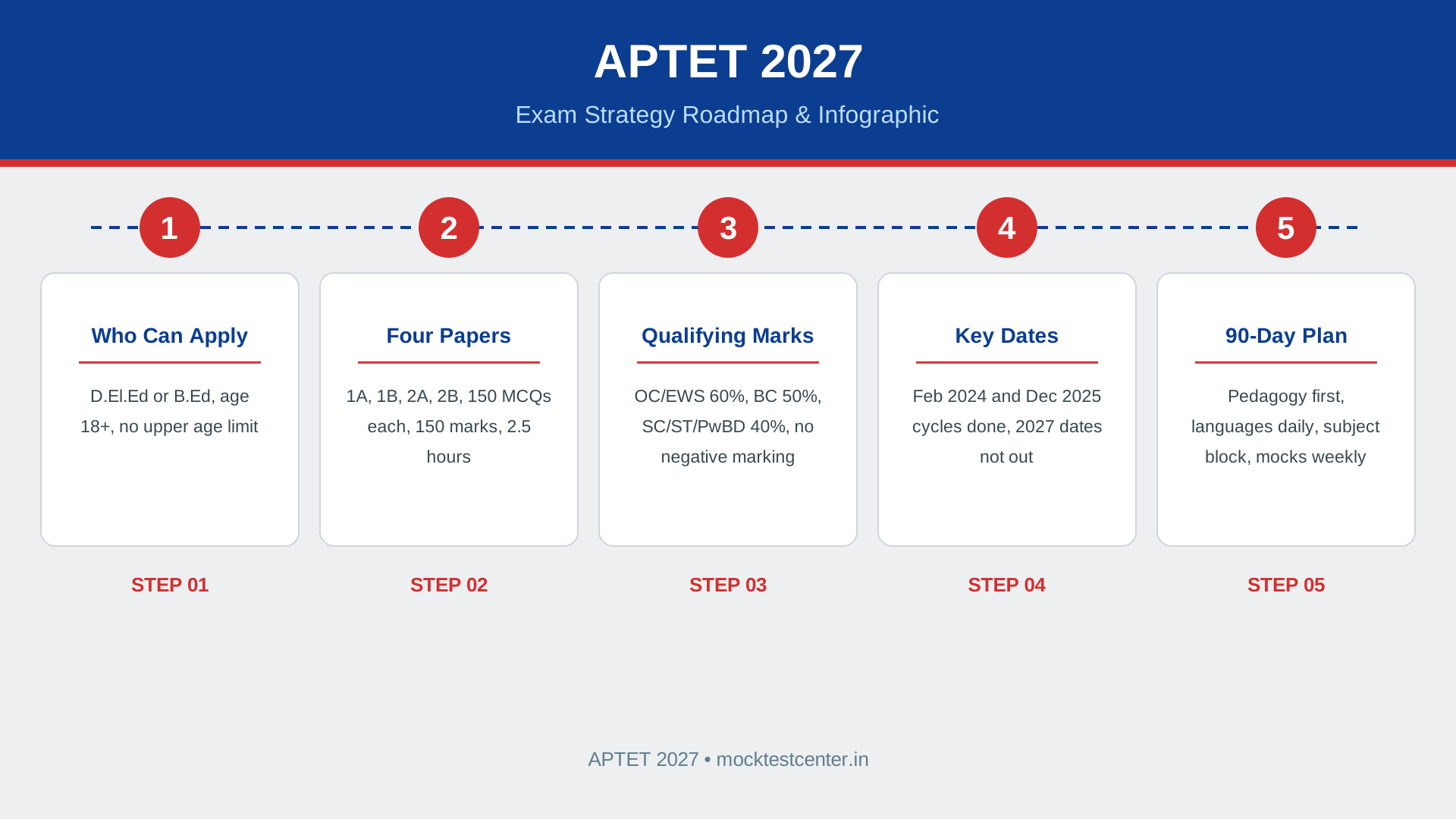
The Department of School Education, Government of Andhra Pradesh, runs the test through the Commissioner of School Education. It is a computer based test with four papers in one exam. Paper 1A is for Classes I to V in regular schools, Paper 1B is for Classes I to V in special schools, Paper 2A is for Classes VI to VIII in regular schools, and Paper 2B is for Classes VI to VIII in special schools. Each paper has 150 multiple choice questions for 150 marks, and each paper runs for 2 hours and 30 minutes. Every question carries 1 mark, and there is no negative marking, so a wrong answer costs you nothing beyond the mark you did not earn. You pay Rs 750 for each paper you sit for, and you can sit for more than one paper if you hold the qualifications for each. The certificate you earn is valid for life.
APTET 2027 and the cycles that came before it
| Cycle | Notification | Apply | Exam | Result |
|---|---|---|---|---|
| February 2024 | 8 February 2024 | 8 to 18 February 2024 | 27 February to 9 March 2024 | 14 March 2024 |
| July 2024 | 2 July 2024 | 4 to 17 July 2024 | 3 to 20 October 2024 | 2 November 2024 |
| December 2025 | 24 October 2025 | 24 October to 23 November 2025 | 10 to 21 December 2025 | 9 January 2026 |
| 2027 | Not issued as of 20 November 2026 | Not announced | Not announced | Not announced |
The February 2024 cycle ran exactly to its published schedule. The notification came on 8 February 2024, the fee window ran from 8 to 17 February, applications closed on 18 February, the exam ran from 27 February to 9 March in two shifts each day, and the final result came on 14 March. One tracker page gives the notification date as 7 February 2024, a day earlier than the bulletin schedule table, which records 8 February 2024 as the date the notification and information bulletin were issued. This guide uses 8 February, the date in the bulletin itself, and notes the 7 February figure as a tracker variant.
The July 2024 cycle is the one that teaches you not to trust a first schedule. The notification came on 2 July 2024, applications ran from 4 to 17 July, and the exam was first set for 5 to 20 August 2024 with the result promised for 30 August. That schedule did not hold. The department pushed the exam back, and it finally ran from 3 to 20 October 2024 in two shifts, with the final answer key on 27 October and the result on 2 November 2024. Several tracker pages still show the August dates and the 30 August result as if they happened, because they copied the first schedule and never updated it. If you read a page that says the July 2024 exam ran in August, that page is wrong. The October dates are the real ones, confirmed by the Business Standard report on the postponement and by the result coverage that followed.
The December 2025 cycle shows the same pattern holding a year later. The notification came on 24 October 2025, applications ran from 24 October to 23 November 2025, hall tickets came on 3 December 2025, the exam ran from 10 December 2025 in two shifts a day, the provisional answer key came on 2 January 2026, and the result was declared on 9 January 2026. A June 2026 cycle followed, with trackers reporting a notification on 5 June 2026 and an exam from 5 to 21 August 2026, but that cycle could not be checked against an official source during preparation, so this guide records it here and flags it as tracker only. The official portal for the later cycles moved to tet2dsc.apcfss.in, while the 2024 cycles ran on aptet.apcfss.in and the Commissioner of School Education site at cse.ap.gov.in. Both official sites could not be read directly during preparation, cse.ap.gov.in did not respond at all and aptet.apcfss.in returned a 403 error to a direct fetch, so the dates and rules in this guide rest on the information bulletin as quoted by the trackers listed in Sources, and the upload pre-check should open the live bulletin and confirm them before anyone applies.
What APTET is and what it is not
APTET is a test of eligibility. Passing it says you are fit to teach Classes I to VIII in Andhra Pradesh schools. It appoints you to no post, puts you on no merit list for a job, and carries no vacancy count, because there are no posts attached to it. The recruitment that follows is a separate process, the District Selection Committee recruitment, run as the Andhra Pradesh Teacher Recruitment Test. That is the exam with posts, and it is the exam this guide keeps separate from APTET throughout. Confusing the two is the most common error in APTET preparation, and it wastes months, because candidates who think APTET is a recruitment exam prepare for a selection test and ignore the eligibility test in front of them.
The link between the two exams is a number, and it is the number that makes your APTET score matter beyond a pass. In the teacher recruitment test, 20 percent weight goes to your APTET score and 80 percent goes to the written recruitment test. The rule comes from the APTET information bulletin itself, and it appears in the Mega DSC 2025 scheme of selection rules, G.O.Ms.No. 15 dated 19 April 2025, which says the total marks shall be 100, with 80 marks for the written test and the remaining 20 marks for APTET or CTET weightage. A candidate who scores 120 out of 150 in APTET carries 16 marks out of 20 into the recruitment list. A candidate who scores 90 out of 150, exactly the pass mark for the open category, carries 12 marks out of 20. That gap of 4 marks is often wider than the gap between two candidates in the recruitment test itself, so a bare pass in APTET is a weak hand in DSC even though it clears the eligibility bar.
The exception proves the rule. Physical Education posts carry no TET weightage at all. For School Assistant (Physical Education) and Physical Education Teacher posts, the Mega DSC 2025 rules say the total is 100 marks for the written test only, and no TET qualification is required for those posts. The same applies to Principals and Post Graduate Teachers under G.O.Ms.No. 16 dated 19 April 2025, where no TET is required. If you aim for a PET post, APTET does not help you. If you aim for a School Assistant or Secondary Grade Teacher post, APTET is both the gate and a fifth of your final score.
The Mega DSC 2025 itself covered 16,347 teaching posts, with more than 3 lakh candidates appearing for the recruitment test, and the merit list was drawn up on the 80 plus 20 formula. A brief notification for DSC 2026, for 2,721 posts, came on 13 October 2026, with the detailed notification following on 5 November 2026. That DSC 2026 figure comes from a tracker report, not from a government order seen during preparation, so treat the post count as reported rather than confirmed. The point stands either way: every DSC cycle since 2024 has used the same 80 plus 20 split, and every DSC cycle has required an APTET or CTET pass for the teaching posts it fills.
The certificate itself is valid for life. The rule follows the National Council for Teacher Education guidelines dated 9 June 2021, adopted in Andhra Pradesh by G.O.Ms.No. 69 dated 25 October 2021, and the bulletin states that the APTET certificate shall be valid for life time unless modified by future NCTE guidelines. Certificates earned before 9 June 2021 are also valid for life under the same rule. You do not need to renew it, and you do not need to sit for APTET again to keep it, unless you want a better score. There is no limit on the number of attempts, so a candidate who passed with 92 marks can sit again to push the score higher and carry a stronger 20 percent into the next DSC. That is a real option, and it is one of the few exams where retaking after a pass is a sound plan rather than a waste of a year.
One more distinction matters, and it is new. A Special TET ran in 2026 for in-service teachers who were appointed before 2011 and did not hold a valid TET certificate, after the Supreme Court order of 1 September 2025 in Civil Appeal No. 1385 of 2025 made TET a condition for continuing in service and for promotion. That Special TET exam ran from 11 to 21 October 2026, and its result came on 16 November 2026 with an overall pass percentage of 96.06 percent. A pass in the Special TET counts only for that service condition. It cannot be used for direct recruitment. For a DSC post, you need the regular APTET or CTET. Do not mix the two up when you read result news.
The four papers, side by side
| Paper | For classes | Schools | Questions | Marks | Time |
|---|---|---|---|---|---|
| Paper 1A | I to V | Regular | 150 | 150 | 2 hours 30 minutes |
| Paper 1B | I to V | Special | 150 | 150 | 2 hours 30 minutes |
| Paper 2A | VI to VIII | Regular | 150 | 150 | 2 hours 30 minutes |
| Paper 2B | VI to VIII | Special | 150 | 150 | 2 hours 30 minutes |
All four papers share the same shape. Every question is a multiple choice question with four options and one correct answer. Every correct answer earns 1 mark. There is no negative marking, so a wrong answer earns zero and costs nothing. The exam runs as a computer based test, in two shifts a day, from 9.30 am to 12 noon and from 2.30 pm to 5 pm. With 150 questions in 150 minutes, you have exactly one minute per question on average, and a candidate who knows the material can finish the paper inside that time. Speed matters less here than in exams with negative marking, because you can attempt every question, but the minute per question still sets the pace, and a candidate who spends four minutes on one hard question has taken time from four easy ones.
Paper 1A is the paper most candidates sit for. It is for a person who intends to be a teacher for Classes I to V in a regular school, which in DSC terms is the Secondary Grade Teacher post. Its five sections carry 30 questions each: Child Development and Pedagogy, Language I, Language II (English), Mathematics, and Environmental Studies. The split is flat, 30 marks in each section, so no single section decides the paper. A candidate who is strong in mathematics and weak in pedagogy loses the same 30 marks as a candidate with the opposite profile, and the pass mark is a total, not a section cut off, so a weak section can be carried by the other four if the total clears the bar.
Paper 1B mirrors Paper 1A for special schools. The five sections are the same size, 30 questions each, but the first section changes: Child Development and Pedagogy in Special Education replaces the general pedagogy section. Language I, Language II (English), Mathematics and Environmental Studies stay the same. Paper 1B is for Classes I to V in special schools, and it needs the special education qualifications set out in the eligibility section below, not the general D.El.Ed route alone.
Paper 2A is where the paper changes shape. It is for Classes VI to VIII in regular schools, which in DSC terms is the School Assistant post. The first three sections are the same as Paper 1A, Child Development and Pedagogy at 30, Language I at 30, and Language II (English) at 30. The fourth section carries 60 questions and 60 marks, and you choose one of three options inside it: Mathematics and Science, or Social Studies, or Languages. That 60 mark block is 40 percent of the paper, and it is the section that decides most Paper 2A results. Your choice of subject block must match the subject you intend to teach and the qualification you hold, because the DSC post you later apply for will follow the same subject line. The Languages option covers Telugu, Urdu, Hindi, English, Kannada, Odiya, Tamil and Sanskrit.
Paper 2B mirrors Paper 2A for special schools. Child Development and Pedagogy in Special Education carries 30, Language I carries 30, Language II (English) carries 30, and the fourth section is Category of Disability Specialization and Pedagogy at 60 questions and 60 marks. That last section is the heart of Paper 2B, and it tests the disability specialisation you trained in, so it cannot be prepared from general teaching books. It needs the special education material from your own training course.
Who can apply for APTET 2027
The minimum age is 18 years, and there is no upper age limit. That is the bulletin rule, confirmed by the eligibility pages that quote it, and it is one of the few age rules in Indian exams that has no ceiling at all. Two tracker pages give a maximum age instead, one says 18 to 40 years and another says 42 years for the general category with relaxations taking it higher, but those figures do not appear in the bulletin material quoted elsewhere, and this guide follows the no upper age limit rule. If the 2027 bulletin states a maximum age, that bulletin will govern, and you should read it before you apply rather than trusting any guide, including this one.
Nationality is simple: you must be a citizen of India. The educational qualifications differ by paper, and they are set by the National Council for Teacher Education norms as written into the bulletin. The table below gives the main route for each paper. The bulletin lists several equivalent routes for each paper, and the full list runs longer than a guide can fairly print, so the table shows the route most candidates use, and the text after it gives the main alternatives.
| Paper | Main qualification route |
|---|---|
| Paper 1A | Intermediate with at least 50 percent marks and a 2 year Diploma in Elementary Education, or a 4 year B.El.Ed, or graduation with B.Ed |
| Paper 1B | Intermediate with a Diploma in Education (Special Education) or equivalent RCI qualification |
| Paper 2A | Graduation with at least 50 percent marks and B.Ed, or a 4 year B.El.Ed or B.A.Ed or B.Sc.Ed |
| Paper 2B | Graduation or post graduation with B.Ed (Special Education), or B.Ed (General) with a Diploma in Special Education |
For Paper 1A, the bulletin routes are: Intermediate or Senior Secondary with at least 50 percent marks and a 2 year Diploma in Elementary Education, or Intermediate with at least 50 percent marks and a 4 year Bachelor of Elementary Education, or Intermediate with at least 50 percent marks and a 2 year Diploma in Education (Special Education), or graduation and a 2 year Diploma in Elementary Education, or graduation with at least 50 percent marks and a Bachelor of Education, or post graduation with at least 55 percent marks and a 3 year integrated B.Ed and M.Ed. For SC, ST, BC and PwBD candidates, the 50 percent mark in Intermediate drops to 45 percent. Candidates in the final semester of their D.El.Ed or B.Ed course can appear, provided they hold the requisite percentage of marks as given in the bulletin, so a final year student does not have to wait a year to sit for the test.
For Paper 2A, the routes are: graduation with at least 50 percent marks and B.Ed, or graduation with at least 45 percent marks and a 1 year B.Ed under the NCTE norms, or Intermediate with at least 50 percent marks and a 4 year B.El.Ed, or Intermediate with at least 50 percent marks and a 4 year B.A.Ed or B.Sc.Ed, or graduation with at least 50 percent marks and a 1 year B.Ed (Special Education), or post graduation with at least 55 percent marks and a 3 year integrated B.Ed and M.Ed. The 50 percent mark in graduation drops to 45 percent for SC, ST, BC and PwBD candidates. One detail in the bulletin helps older candidates: the minimum percentage in graduation does not apply to those who took admission to B.Ed or B.El.Ed before 29 July 2011.
For the special school papers, the qualifications follow the Rehabilitation Council of India norms. Paper 1B needs Intermediate with a 2 year D.Ed in Special Education in any disability category, or Intermediate with a 1 year Diploma in Special Education, or a Diploma in Community Based Rehabilitation with a 6 month certificate course in education of children with special needs, among other RCI approved routes. Paper 2B needs a degree or post graduation with B.Ed (Special Education), or B.Ed (General) with a 1 year or 2 year Diploma in Special Education, or B.Ed (General) with a Post Graduate Professional Certificate or PG Diploma in Special Education, or a BA B.Ed in Visual Impairment, or any other equivalent qualification approved by RCI. If your special education qualification is not on that list, check it against the bulletin before you pay the fee, because a wrong paper choice costs Rs 750 and a wasted attempt.
One more rule decides who can sit for both papers. A candidate who holds both D.El.Ed and B.Ed qualifications can appear for Paper 1 and Paper 2, and a candidate who holds only one of them can appear only for the paper that matches it. A B.Ed holder with no D.El.Ed cannot sit for Paper 1A, and a D.El.Ed holder with no B.Ed cannot sit for Paper 2A. Candidates who already hold an APTET pass and want a better score can apply again, and there is no bar on reappearing. The bulletin also notes that candidates who seek work in private unaided schools under a central or state syllabus can appear for CTET, run by the Central Government through CBSE, instead of APTET if they wish. For a government school post in Andhra Pradesh, APTET or CTET both count, and the DSC rules accept either.
The pass marks, and why the pass mark is not the target
| Category | Qualifying percentage | Marks out of 150 |
|---|---|---|
| OC and EWS | 60 percent and above | 90 |
| BC | 50 percent and above | 75 |
| SC, ST, PwBD and ex-servicemen | 40 percent and above | 60 |
The qualifying marks are the same in every cycle covered by this guide. Open category and EWS candidates need 60 percent, which is 90 marks out of 150. Backward Classes candidates need 50 percent, which is 75 marks. SC, ST, persons with benchmark disability and ex-servicemen need 40 percent, which is 60 marks. The EWS grouping with OC at 60 percent comes from the official table as quoted for the later cycles, while the 2024 bulletin material quoted by most trackers lists OC at 60 percent without naming EWS separately. Either way, the number is the same, 90 marks, and no candidate in the open category should plan around a lower figure.
Those numbers are the floor, not the target, and the 20 percent DSC weight is the reason. A pass at exactly 90 marks gives you 12 marks out of 20 in DSC. A score of 120 gives you 16. A score of 135 gives you 18. In the Mega DSC 2025, with more than 3 lakh candidates chasing 16,347 posts, the difference between 12 and 16 in the TET component was often the difference between a name on the list and a name below it. The candidates who treat APTET as a pass or fail test and stop studying the day they cross 90 are the ones who lose in DSC to candidates who treated APTET as a scoring test. If you are serious about a DSC post, your APTET target is 120 or above, not 90, and your preparation should aim at that number from the first week.
There is no sectional cut off. The bulletin sets the qualifying mark on the total only, so a weak section alone leaves you safe if the total clears the bar. That matters for planning, because it lets you play to your strengths. A Paper 2A candidate who is strong in Social Studies can afford a weaker Language II score if the 60 mark subject block carries the total past the bar. But the same rule cuts the other way in DSC, because the recruitment test has its own subject papers, and a weak subject in APTET usually means a weak subject in DSC too. Use the total rule to pass APTET, but do not use it as an excuse to leave a section unread.
Your score is also the only part of APTET that follows you. The certificate is valid for life, and the score on it is the score that carries into every DSC cycle until you improve it. A candidate who passed in February 2024 with 95 marks and never retook the test carried 12.6 marks out of 20 into the Mega DSC 2025. A candidate who retook it in December 2025 and scored 125 carried 16.6 marks. The retake cost Rs 750 and a morning. The gain was 4 marks in a list where the cut off moved by less than a mark between ranks. That is the arithmetic that should decide whether you retake, and it is the arithmetic most candidates never do.
What each section actually tests
Child Development and Pedagogy carries 30 marks in every paper, and it is the section that separates trained teachers from graduates who happen to know a subject. It covers how children grow and learn, the stages of development, the way learning happens in a classroom, the needs of children who learn differently, and the tools a teacher uses to check whether learning has happened. In the special school papers, the same section is reframed around special education: the nature of each disability category, the way teaching adapts to it, and the aids and methods that make a classroom work for a child with a disability. The syllabus for this section comes from the D.El.Ed and B.Ed course material, and a candidate who has just finished teacher training holds an edge here that fades with every year out of the classroom, so recent trainees should sit for APTET soon after training while the material is fresh.
Language I carries 30 marks, and it is the section most candidates choose badly. Language I is the first language, the medium of instruction in the schools under the state syllabus, and the options are Telugu, Urdu, Hindi, Kannada, Tamil, Odiya and Sanskrit. Most candidates pick Telugu, because it is the medium of most state schools and the language most of them studied. That is the right choice for most, but only if Telugu is your strongest language. The Language I syllabus tests proficiency in the language, the elements of the language, and communication and comprehension, at the level of Classes III to VIII with links up to Class X. A candidate who studied in Urdu medium or Tamil medium and picks Telugu because everyone else does has thrown away marks. Pick the language you read fastest in, because the comprehension passages reward speed as much as knowledge.
Language II is English for every candidate, and it carries 30 marks. The syllabus is the same shape as Language I: proficiency, elements of language, communication and comprehension, at the same class levels. English is the section where a small daily habit pays best. Fifteen minutes a day on a comprehension passage and a few grammar items, kept up for three months, moves this section more than a week of cramming before the exam. The passages come from the state syllabus level, not from a competitive English paper, so they reward a candidate who reads plain English steadily over one who memorises rules.
Mathematics in Paper 1 carries 30 marks, and Environmental Studies carries 30. The syllabus for both rests on the topics of Classes III to VIII, so the content is school level, but the questions test at a teacher level. Mathematics asks whether you can teach the concept, not only whether you can solve the sum, so a question may test the method, the common error a child makes, or the order in which a topic should be taught. Environmental Studies covers the world around the child, the family, the school, the community, plants and animals, water, air and soil, and the way people live and work, all at the level of the state textbooks for Classes III to V and the earlier syllabus for Classes VI to VIII.
Paper 2A replaces those two sections with a single 60 mark block, and the block you choose decides your preparation. Mathematics and Science covers the Class VI to X syllabus in both subjects, at the depth a teacher needs, and it suits candidates with a science degree. Social Studies covers history, geography, civics and economics at the same school levels, and it suits candidates with an arts degree. Languages covers the chosen language at a teacher level, with content and method, and it suits candidates who will teach that language. The 60 marks are double any other section, so a candidate who splits preparation evenly across all four sections has misread the paper. The subject block deserves about 40 percent of your study time, because it carries 40 percent of the marks.
The language of the paper
The question paper is bilingual. The medium of the exam is English and the chosen Language I, except for Sanskrit. That rule comes from the bulletin, and it means a Telugu medium candidate sees the questions in Telugu and English, an Urdu medium candidate sees them in Urdu and English, and a Sanskrit candidate sees them in English, because Sanskrit is not offered as a medium for the rest of the paper. Language I itself runs in that language, and Language II runs in English. The choice of Language I at the time of application therefore fixes the medium of your whole paper, and you cannot change it after the hall ticket comes out. Choose it with the same care you choose your subject block, because it shapes every question you read.
The bilingual rule also shapes how you should practise. Mock tests in English only will not prepare a Telugu medium candidate for the paper they will actually see, and the reverse is true. Practise with the previous year papers in your own medium, because the official question papers are released medium by medium, Telugu, Urdu, Hindi, Kannada, Tamil, Odiya and Sanskrit, shift by shift, and they show you exactly how a question reads in your language. The December 2025 papers are the most recent full set, and the February 2024 papers are the cleanest set for a first run, because that cycle ran to schedule and its papers were released in full.
Fee, application and the exam day
The fee is Rs 750 for each paper, paid separately for Paper 1A, Paper 1B, Paper 2A and Paper 2B. A candidate who sits for all four papers pays Rs 3,000. The fee is paid through the payment gateway on the official portal, and the payment gives you a journal number, which you then use to submit the online application. The fee window in the February 2024 cycle ran from 8 to 17 February, a day shorter than the application window, which closed on 18 February. The July 2024 fee window ran from 3 to 16 July, again a day shorter than the application window. Pay early. A candidate who leaves payment to the last day and hits a gateway failure has no second chance, because the application cannot be submitted without the journal number.
One tracker page lists the February 2024 fee as Rs 500 for all categories. That figure is wrong. The bulletin states Rs 750 for each paper, and the Times of India, News18 and the other trackers that quoted the bulletin directly all give Rs 750. The Rs 500 figure appears to come from an older cycle, and it has been copied into pages that were never corrected. Do not plan around Rs 500. Budget Rs 750 per paper, and check the fee in the 2027 bulletin when it appears, because the fee can change between cycles and the bulletin is the only figure that counts.
The application itself is online only, through the official portal. You fill the form, choose your paper or papers, choose your Language I, choose your examination district, upload the documents the form asks for, and submit. The February 2024 bulletin said the test would be held in all districts of the state except Manyam and ASR (Alluri Sitharama Raju) districts, with candidates from those districts accommodated in nearby districts. That district rule may change with the 2027 notification, and the number of districts in the state has changed since 2024, so check the district list in the new bulletin rather than assuming your district will have a centre.
On the exam day, the test runs in two shifts, 9.30 am to 12 noon and 2.30 pm to 5 pm, and each paper is a separate sitting. A candidate who applies for two papers will sit on different days or in different shifts, and the schedule for each paper comes with the hall ticket. The hall ticket in the December 2025 cycle came on 3 December 2025, a week before the exam began. The provisional answer key follows the exam, objections are invited on it, and the final key and result follow. In February 2024 the final key came on 13 March and the result on 14 March. In July 2024 the final key came on 27 October and the result on 2 November. The gap between the exam and the result is short, usually under two weeks, so there is little waiting time to use for DSC preparation. Start DSC preparation while you wait, because the DSC notification often follows within months.
What to study, and what to skip
The best books for APTET are the ones the bulletin itself points to. The detailed syllabus is designed by the State Council of Educational Research and Training, and the bulletin tells candidates to follow the present state syllabus and textbooks of Classes III to V and the previous state syllabus and textbooks of Classes VI to X, along with the present bilingual textbooks of Classes VI to IX. For the teacher training sections, the bulletin points to the 2016 and 2019 editions of the D.Ed and D.El.Ed textbooks from the Telugu Academy and SCERT. Those are the source books. A candidate who studies the state textbooks for the classes they will teach, and the D.El.Ed textbooks for pedagogy, has covered the syllabus as the examiners wrote it.
For Paper 1, that means the state textbooks for Classes III to V for mathematics and environmental studies, the language textbooks for your Language I and for English, and the D.El.Ed pedagogy books. For Paper 2, it means the state textbooks for Classes VI to X in your subject block, mathematics and science or social studies or your language, plus the B.Ed pedagogy material. The textbooks are not enough by themselves for the pedagogy section, because the section tests teaching method as well as content, and the D.El.Ed and B.Ed books cover that part. But a candidate who reads a commercial guide and never opens a state textbook will miss the exact phrasing and the exact examples the questions are drawn from.
Previous year papers are the second source, and they matter as much as the books. The official papers from February 2024, July 2024 and December 2025 are available paper by paper and shift by shift, and they show you the level of the questions, the way the pedagogy section is framed, and the weight each topic carries in practice. Solve the last two cycles in full, under time, with one minute per question, and score yourself. Then read the questions you got wrong and trace each one back to the textbook chapter it came from. That loop, paper to textbook and back to paper, is the whole preparation method in one sentence, and it beats reading a third guide book.
What should you skip. Skip any book that promises a cut off or a guaranteed selection, because APTET has no cut off beyond the qualifying marks in the table above, and no book can promise a DSC post. Skip the habit of collecting ten guides for one subject. One state textbook, one pedagogy book, and the previous papers will take you further than a shelf of guides. Skip the DSC syllabus until APTET is done, except for the overlap in your subject, because the DSC paper tests the same subject at a deeper level and the overlap will carry over. But do not start DSC preparation in full before APTET, because a candidate who fails APTET cannot sit for DSC at all, and the eligibility test comes first in every sense.
A 90 day plan that fits around a job
| Weeks | Focus | Daily time |
|---|---|---|
| 1 to 2 | Child Development and Pedagogy from your D.El.Ed or B.Ed books, plus one previous paper to set a baseline | 2 hours |
| 3 to 4 | Language I and Language II, one comprehension passage a day in each, plus grammar from the state textbooks | 2 hours |
| 5 to 6 | Paper 1 maths and environmental studies, or Paper 2 subject block, from Classes III to X textbooks | 2 to 3 hours |
| 7 to 8 | Paper 2 subject block in depth, 60 mark section first, with topic tests after each chapter | 2 to 3 hours |
| 9 to 10 | Full previous papers under time, one paper a week, with error review the same day | 2 to 3 hours |
| 11 | Weak sections only, from your error log, plus two full mocks | 3 hours |
| 12 | Revision of notes and short facts, one light mock, no new topics | 2 hours |
| Last 3 days | Formulae, pedagogy definitions, language rules, and rest | 1 hour |
The plan assumes two hours a day, which is realistic for a working candidate or a final year student, and it puts pedagogy first because pedagogy carries 30 marks in every paper and it is the section most candidates neglect. Weeks 1 to 2 build the pedagogy base and set a baseline score with a previous paper. Weeks 3 to 4 build the two language sections, which reward a daily habit more than any other part of the paper. Weeks 5 to 8 build the content sections, maths and environmental studies for Paper 1 and the 60 mark subject block for Paper 2, from the state textbooks. Weeks 9 to 10 test the whole plan under exam conditions. Week 11 fixes what the mocks exposed, and week 12 is revision only. New topics in the last week cost more marks than they gain, because they displace revision of material you already know.
Mock tests deserve a fixed slot, not leftover time. Take one full 150 question paper every Sunday from week 5 onward, in a single sitting of 2 hours and 30 minutes, without pausing, and review every wrong answer the same evening. Track your score by section, not just in total, because a total of 105 that hides a pedagogy score of 12 out of 30 is a warning that your weakest section needs work before the exam. Because there is no negative marking, attempt every question in the mock, and practise the art of moving on: a question you cannot solve in a minute is a question you should mark, answer with your best guess, and leave. The guess costs nothing, and the minute you save is worth a mark elsewhere.
If you are sitting for two papers, run the plan twice in parallel, not one after the other. Paper 1 and Paper 2 share the first three sections, pedagogy and the two languages, so the shared work covers 90 marks in each paper. The only part that differs is the last section: maths and environmental studies for Paper 1, and the 60 mark subject block for Paper 2. Study the shared sections once, then give each paper its own last section slot. A candidate who prepares Paper 1 fully and then starts Paper 2 from zero has wasted the shared 90 marks of work.
Mistakes that cost marks
The first mistake is treating APTET as a recruitment exam. Candidates who do that prepare for DSC, ignore pedagogy, and walk into APTET without the 30 marks that pedagogy carries. APTET is the gate. DSC is the race after the gate. Clear the gate first, and clear it with a score, not a bare pass.
The second mistake is picking the wrong paper. A B.Ed holder who applies for Paper 1A will have the application rejected or the result withheld, because the qualification does not match the paper. A D.El.Ed holder who applies for Paper 2A has the same problem in reverse. Read the eligibility table in this guide against your own certificates before you pay, and if your qualification sits on a boundary, check the bulletin. Rs 750 is a small fee, but a rejected application costs a whole cycle.
The third mistake is picking the wrong Language I. The language you studied in school is usually the right one, and the language everyone else picks is not a reason. A candidate who picks Telugu because it is common, when their schooling was in Urdu, has chosen a harder paper for no reason. The medium follows Language I, so the choice shapes every question, not only the 30 marks of the language section.
The fourth mistake is trusting the first schedule. The July 2024 cycle moved from August to October, and candidates who stopped studying in August because they thought the exam was over lost two months. Keep studying until the hall ticket is in your hand and the exam is done. A postponement is a gift of time, not a signal to stop.
The fifth mistake is trusting tracker dates and fees without checking the bulletin. The Rs 500 fee figure, the August 2024 exam dates, and the 30 August 2024 result date all still circulate on pages that were never updated. Each one is wrong, and each one has been copied from page to page until it looks true. The bulletin on the official portal is the only source that counts, and the Sources list at the end of this guide tells you which tracker pages quoted it faithfully and which ones did not.
The sixth mistake is leaving the subject block to the end. In Paper 2A and Paper 2B, the last section carries 60 marks, and candidates who study the three 30 mark sections first and run out of time for the subject block have left 40 percent of the paper unprepared. Start the subject block in week 5, not week 10, and give it the largest share of your time.
The seventh mistake is aiming at the pass mark. A score of 90 clears APTET for the open category, but it carries only 12 marks out of 20 into DSC. A score of 120 carries 16. In a recruitment list where the cut off moves by less than a mark between ranks, those 4 marks are the difference between a post and a near miss. Aim at 120 from the first week, and let the pass mark take care of itself.
Candidates who clear APTET usually prepare for DSC next, and the same style of guide helps there. The UGC NET Paper 1 2027, UGC NET Economics 2027, UGC NET Commerce 2027, UGC NET Law 2027, UGC NET Management 2027, UPPSC TGT 2027, UPPSC Lecturer GIC 2027, UPPSC Assistant Professor 2027, UPPSC PCS 2027 and SBI PO 2027 pages on this site carry the same style of mock test guide, and the study habits you build here, timed mocks, error logs and textbook first preparation, transfer directly to them.
Sources
The APTET information bulletin as quoted by GSR Maths and by the AP Teachers site, for the February 2024 schedule of notification on 8 February 2024, fee payment from 8 to 17 February, applications from 8 to 18 February, exam from 27 February to 9 March 2024 in two shifts, and final result on 14 March 2024, for the four paper structure, the fee of Rs 750 per paper, the no negative marking rule, the qualifying marks of 60 percent for OC, 50 percent for BC and 40 percent for SC, ST and PwBD, the 20 percent DSC weightage, the lifetime validity, and the eligibility routes for Papers 1A, 1B, 2A and 2B. The Jagran Josh report of 2 July 2024 and the Times of India report of 2 July 2024, for the July 2024 notification on 2 July 2024, applications from 4 to 17 July 2024, and the first exam schedule of 5 to 20 August 2024 with the result set for 30 August. The Business Standard report of July 2024, for the postponement of the July 2024 exam to 3 to 20 October 2024 and the result on 2 November 2024. The Careers360 and Shiksha pages on the December 2025 cycle, for the notification on 24 October 2025, applications from 24 October to 23 November 2025, hall tickets on 3 December 2025, exam from 10 December 2025, provisional key on 2 January 2026 and result on 9 January 2026. The Jagran Josh eligibility page and the Shiksha eligibility page, for the minimum age of 18 with no upper age limit, the 50 percent and 45 percent marks rules, and the Paper 1A and Paper 2A qualification routes. The Adda247 and Career Power syllabus pages, for the Paper 2B section of Category of Disability Specialization and Pedagogy at 60 marks, and the Paper 2A subject options. The Careers360 and Testbook pages on the Special TET 2026, for the exam from 11 to 21 October 2026, the result on 16 November 2026, and the 96.06 percent pass figure. The AP Teachers pages on the Mega DSC 2025 rules, G.O.Ms.No. 15 and G.O.Ms.No. 16 dated 19 April 2025, for the 80 percent written test and 20 percent APTET or CTET split, the exemption for Physical Education posts, Principals and Post Graduate Teachers, and the 16,347 post figure. The AglaSem result page, for the lifetime validity under the NCTE guidelines of 9 June 2021 and G.O.Ms.No. 69 dated 25 October 2021, and for the DSC 2026 brief notification of 13 October 2026 for 2,721 posts, which is tracker reported and not confirmed from a government order. The Commissioner of School Education site at cse.ap.gov.in and the APTET portal at aptet.apcfss.in, the official sources for the bulletin and the application, which could not be read directly during preparation on 20 November 2026, cse.ap.gov.in did not respond and aptet.apcfss.in returned a 403 error, so the facts above rest on the bulletin as quoted by the trackers listed here and should be checked against the official bulletin before you apply.