
About UGC NET Management 2027 Exam Series
📖 Table of Contents
- Where the June 2027 cycle stands
- What this exam gives you
- The paper pattern in plain numbers
- Who can apply
- The age rules
- How qualifying works
- Paper 1 in brief
- Paper 2 syllabus, unit by unit
- What the Management paper actually asks
- The June 2026 cycle, what happened
- The December 2026 cycle
- Cut offs, what the numbers mean
- Best books for Management
- A 90 day plan that fits around a job
- How to use mock tests
- Mistakes that cost marks
- What to check when the June 2027 notice arrives
UGC NET Management 2027
Where the June 2027 cycle stands
The June 2027 notification for UGC NET Management has not been released yet. As of 19 November 2026, the National Testing Agency, or NTA, has published no notice, no application dates and no exam dates for the June 2027 cycle. Any website that gives a fixed June 2027 date today is guessing. This page rests on the two cycles we can check, June 2026 and December 2026, and it says plainly where the facts come from.
UGC NET Management is subject code 17. It is one paper inside a national test that NTA holds twice a year, in June and in December, for the University Grants Commission. One test decides three things. It can give you a Junior Research Fellowship, it can make you eligible for Assistant Professor posts, and it can open PhD admission. The subject you pick for Paper 2 is the subject of your postgraduate degree in most cases, so choose the code that matches your degree and check the June 2027 notice when it arrives.
The December 2026 cycle is running while you read this. Its exam dates are 14, 15, 16, 17, 18 and 21 December 2026. That cycle tells you how NTA runs the test now, and the June 2026 cycle tells you what the last full result looked like. Both cycles are covered in detail further down this page, with the dates and fees that were actually announced.
Start with the pattern and the syllabus. Those two things change slowly. The syllabus for this subject has been the same since June 2019, and the pattern has been stable for years. If you wait for the June 2027 notification before you start, you lose months. The notification will change dates and fees. It will not change what you have to study. This page is your guide to UGC NET Management 2027, built from the June 2026 and December 2026 cycles.
What this exam gives you
UGC NET gives three separate results, and they are not the same prize. Category 1 is Junior Research Fellowship and Assistant Professor, with PhD admission as well. Category 2 is Assistant Professor and PhD admission, without the fellowship. Category 3 is PhD admission only. NTA publishes the result in these three categories, subject by subject and category by category.
The fellowship pays real money. A Junior Research Fellow gets 37,000 rupees a month for the first two years. After that, as a Senior Research Fellow, the amount rises to 42,000 rupees a month. House rent allowance is paid as per UGC rules on top of this. That is why the JRF cut off sits far above the Assistant Professor cut off in every subject.
PhD admission works on a score now. For Categories 2 and 3, universities give the NET score 70 percent weight and their own interview 30 percent weight when they admit PhD students. The NET score stays valid for PhD admission for one year from the result date. So a good score in June 2027 can still help you in PhD admissions through the next year, even if you miss the JRF line.
Assistant Professor eligibility has no expiry date in the same way. Once you qualify for Assistant Professor, that eligibility stays with you. Colleges and universities still run their own selection, and a NET qualification is the entry ticket, not the appointment itself. Keep that distinction in mind when you plan. The exam opens doors. It does not hand you a job.
The paper pattern in plain numbers
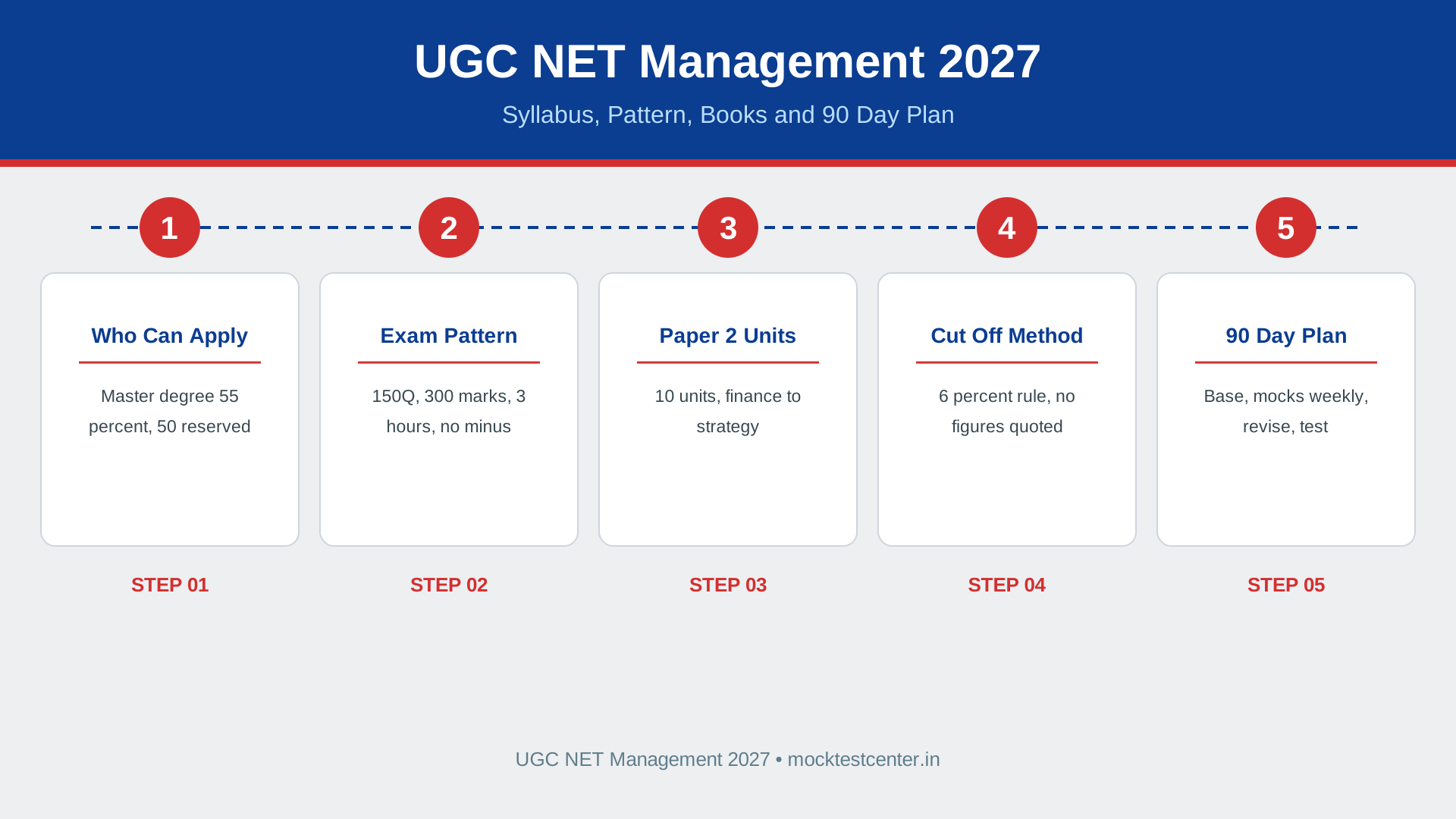
The whole test runs in one sitting of three hours. Paper 1 and Paper 2 come together, with no break between them. You sit for 180 minutes and answer 150 questions for 300 marks. Every question carries 2 marks. Every question is compulsory. There is no negative marking in either paper, so an unanswered question and a wrong answer cost you the same thing, which is the 2 marks you could have scored.
Paper 1 is the general paper on teaching and research aptitude. It has 50 questions for 100 marks and it is the same for every subject. Paper 2 is your subject paper. It has 100 questions for 200 marks, all on Management. Paper 2 carries twice the marks of Paper 1, so it decides your rank far more than Paper 1 does. A candidate who scores well in Paper 2 and merely passes Paper 1 will usually finish ahead of a candidate who does the opposite.
The test is a computer based test. You answer on screen at an exam centre. Roughly 5 questions come from each Paper 1 unit, and roughly 10 questions come from each Paper 2 unit, because most Paper 2 syllabuses have 10 units. Those are averages, not promises. NTA does not publish a fixed unit wise weight, and one unit can give 12 questions in one cycle and 7 in the next.
The no negative marking rule changes how you should attempt the paper. In the last 15 minutes, with no questions left unanswered, you should mark your best guess on every question you skipped. A guess has a one in four chance of adding 2 marks and no chance of taking marks away. That is a small gain per question, and across 10 guessed questions it can add up to the difference between two result categories.
| Paper | Questions | Marks | Time |
|---|---|---|---|
| Paper 1, general | 50 | 100 | 3 hours together |
| Paper 2, Management | 100 | 200 | |
| Total | 150 | 300 | No break |
Who can apply
You need a Master degree or an equivalent degree from a university recognised by UGC. General and General EWS candidates need at least 55 percent marks in the Master degree. OBC Non Creamy Layer, SC, ST, PwD and third gender candidates need at least 50 percent. The percentage is counted without rounding off, so 54.9 percent does not become 55 percent.
Final year Master students can apply provisionally. You can sit the exam while you are still finishing your degree, and your result stays provisional until you complete the degree with the required percentage. The bulletin gives a time limit for completing the degree after the result, and that limit differs by result category, so read it in the June 2027 notice. One source puts the limit at two years for Categories 1 and 2 and one year for Category 3, and that split rests on a single source, so treat it as a point to check rather than a settled fact.
Holders of a four year bachelor degree can also apply, but on different terms. You need 75 percent aggregate, or 70 percent if you belong to a reserved category, and you qualify for JRF and PhD admission only. Assistant Professor stays out of reach through NET for such candidates, and that rule matters for students who finished a four year honours degree and have not done a Master degree.
Your Master degree subject should match the subject you choose for Paper 2. NTA allows some closely related subjects, and the bulletin lists which combinations are allowed, so check that list before you apply. A mismatch at the application stage is a quiet disaster, because you can sit the exam and still find your result held back. Pick the code that matches your degree, not the code that looks easier.
The age rules
For the Junior Research Fellowship, the maximum age is 30 years as on the first day of the exam month. For the June 2026 cycle that date was 1 June 2026, and for the December 2026 cycle it is 1 December 2026. For June 2027 the exact date will appear in the new Information Bulletin, so check that notice with care before you apply.
Relaxation goes up to 5 years for OBC Non Creamy Layer, SC, ST, PwD, third gender and women candidates. Research experience, an LL.M. degree and armed forces service can also earn relaxation, and the total relaxation is capped at 5 years. You cannot stack relaxations to get 10 years. The cap is 5 years in total, whatever combination you claim.
For Assistant Professor and for PhD admission, there is no upper age limit at all. A candidate of 45 can qualify for Assistant Professor and teach. A candidate of 50 can use a NET score for PhD admission. The age rule bites only on the fellowship, which is why many older candidates aim for Category 2 and ignore the JRF line altogether.
Check your age on the first of the exam month, not on the application date and not on the result date. Candidates have lost a JRF because they counted from the wrong date. The bulletin states the reference date in one line. Read that line twice before you pay the fee.
How qualifying works
First you must appear in both papers. A candidate who sits only one paper is not considered at all, whatever the score in that paper. Then NTA applies a minimum aggregate across both papers together. General and General EWS candidates need 40 percent of 300 marks, which is 120 marks. SC, ST, OBC Non Creamy Layer, PwD and third gender candidates need 35 percent, which is 105 marks. Those are minimums to be considered. They are not the cut off.
The real cut off comes from a quota. NTA caps the number of candidates who qualify for Assistant Professor at 6 percent of the candidates who appeared in both papers. That 6 percent is split by reservation category and then by subject. Each subject and each category then gets its own cut off, set at the score of the last candidate inside that 6 percent slice. That is why the same total score can qualify in one subject and fail in another.
The three result categories are then drawn from the same qualified pool. The top slice gets JRF and Assistant Professor. The next slice gets Assistant Professor. The next slice gets PhD admission only. The gaps between the three lines are usually 20 to 30 marks in a subject like English, and they move every cycle with the difficulty of the paper and the number of candidates.
Two lessons follow from this. One, your target is not 120 marks. Your target is the cut off, which sits far above 120 in every popular subject. Two, your rank depends on the subject pool. A subject with fewer candidates can have a lower cut off even when the paper is hard, and a subject with a flood of candidates can have a high cut off even when the paper is easy. You cannot change the pool. You can only raise your own score.
Paper 1 in brief
Paper 1 has 10 units and it is the same for every candidate, whatever the subject. The units are Teaching Aptitude; Research Aptitude; Comprehension; Communication; Mathematical Reasoning and Aptitude; Logical Reasoning; Data Interpretation; Information and Communication Technology; People Development and Environment; and Higher Education System. The syllabus has not changed since June 2019.
Teaching Aptitude and Research Aptitude are the two units that reward a teacher. Teaching Aptitude asks about levels of teaching, learner characteristics, methods of teaching and evaluation systems. Research Aptitude asks about types of research, methods, steps, sampling, hypothesis testing and research ethics. Together they carry about 20 marks, and they are the most predictable part of the paper.
Comprehension gives you a passage and five questions on it. Communication asks about types of communication, barriers, classroom communication and mass media. Mathematical Reasoning asks about number series, ratio, percentage, profit and loss, interest and averages. Logical Reasoning asks about arguments, analogies, syllogisms and Venn diagrams. Data Interpretation gives you tables and graphs and asks you to read them fast and accurately.
Information and Communication Technology asks about computers, the internet, digital initiatives in education and basic terminology. People Development and Environment asks about sustainable development, pollution, natural resources and environmental issues. Higher Education System asks about the structure of Indian higher education, its institutions, policies and recent reforms. Each unit gives about 5 questions, so no single unit can be skipped safely, and no single unit deserves a month of study.
Paper 2 syllabus, unit by unit
Paper 2 has 10 units. The syllabus has been unchanged since June 2019, and NTA publishes it under the heading Updated Syllabi of UGC NET, applicable from June 2019 onwards. Each unit gives about 10 questions, so no unit can be abandoned and no unit deserves a month. Read the units in the order given below, and solve the previous year questions of each unit as you finish it.
Unit 1, Management and Managerial Economics covers the following ground. Management covers concept, process, theories and approaches, management roles and skills, and the functions of planning, organising, staffing, coordinating and controlling. Managerial Economics adds demand analysis, market structures, national income and inflation. Business Ethics and Corporate Social Responsibility sit in this unit too, with corporate governance and value based organisation. Learn Fayol, Taylor, Weber and the human relations school, and practise one numerical problem on elasticity every day.
Unit 2, Organisational Behaviour covers the following ground. Organisational Behaviour covers individual behaviour, group behaviour, leadership, organisational culture and climate, workforce diversity, emotions and stress, and organisational justice. Learn the classic motivation theories, Maslow, Herzberg, McGregor and Vroom, and learn the leadership theories, trait, behavioural, contingency and transformational. Questions often give a small workplace situation and ask which theory fits it, so learn to apply the theory, not just to name it.
Unit 3, Human Resource Management covers the following ground. Human Resource Management covers human resource planning, recruitment and selection, training and development, job analysis, job evaluation, compensation, performance management, organisation development, talent management, industrial relations, trade unions, collective bargaining, international HRM and green HRM. Learn the steps of selection and appraisal in order, and learn the main labour laws by name and purpose. This unit is large, so split it into hiring, pay, performance and relations, and finish one block per week.
Unit 4, Accounting and Financial Management covers the following ground. Accounting covers principles and standards, preparation of financial statements, ratio analysis, funds flow and cash flow analysis, cost sheets, marginal costing, cost volume profit analysis and standard costing with variance analysis. Financial Management adds capital structure, cost of capital, sources of finance, budgeting and leverages. Practise ratio problems until the formulas come without thinking, because this unit gives the most numerical questions in the paper.
Unit 5, Capital Budgeting and Investment covers the following ground. Capital Budgeting covers time value of money, valuation of bonds and shares, risk and return, investment appraisal methods, dividend theories, mergers and acquisitions, portfolio management, derivatives and working capital management. Learn NPV, IRR and payback properly, with one worked example each, and learn CAPM and the basic option payoffs. Questions here are numerical and conceptual in equal measure, so keep a formula sheet and revise it every Sunday.
Unit 6, Strategic Management and Marketing covers the following ground. Strategic Management covers concept, process, external analysis with PEST and Porter, internal analysis with the resource based view and the value chain, strategy formulation with SWOT, BCG, GE and Ansoff, and implementation with the McKinsey 7S framework. Marketing adds concept and orientation, segmentation, targeting and positioning, product and pricing decisions, place and promotion, and marketing channels. Learn the matrices by drawing them from memory, because the paper tests whether you know what goes in each box.
Unit 7, Consumer Behaviour and Marketing Types covers the following ground. Marketing continues here with consumer and industrial buying behaviour, brand management, brand equity models, logistics and supply chain management, service marketing, customer relationship marketing, retail marketing, e marketing, digital marketing, green marketing and international marketing. Learn the models of consumer behaviour and the stages of the buying process, and learn brand equity with one real brand as an example for each idea. Real examples make this unit stick.
Unit 8, Statistics and Operations Management covers the following ground. Statistics for Management covers measures of central tendency and dispersion, probability distributions, data collection, sampling, hypothesis testing with t, z, F and chi square tests, and correlation and regression. Operations Management adds facility location and layout, enterprise resource planning, scheduling, quality management with TQM, Six Sigma and ISO standards, and operations research with transportation, queuing and PERT and CPM. Keep the test statistics straight, because the paper asks which test fits which situation.
Unit 9, International Business and IT covers the following ground. International Business covers theories of international trade, balance of payments, foreign direct investment, the WTO and multilateral regulation of trade, EXIM procedures, and the IMF and World Bank. Information Technology adds computers in management, MIS, DSS, artificial intelligence, big data, data warehousing, data mining and knowledge management. Learn the trade theories in pairs, absolute advantage with comparative advantage, and learn the WTO agreements by name and purpose.
Unit 10, Entrepreneurship Development covers the following ground. Entrepreneurship covers concept, types, theories and process, entrepreneurial competencies, intrapreneurship, women entrepreneurship, rural entrepreneurship, innovation, business plans and feasibility analysis, small scale industries, sickness in small industries and institutional finance to small industries. Learn the schemes for MSMEs and the institutions that finance them, such as SIDBI and NABARD, and learn the stages of a business plan in order. This unit is the most factual of the ten, so short notes and weekly revision work well.
What the Management paper actually asks
The Management paper mixes theory with numbers. Accounting, finance, statistics and operations give numerical questions, and the rest of the paper gives conceptual questions. A candidate who avoids numbers loses about 30 marks before the paper starts. Practise one numerical problem a day from ratios, capital budgeting or hypothesis testing, and keep a formula sheet that you revise every week.
The paper also asks case based questions. A short business situation is given, and you must pick the concept that fits it. That is why learning a theory by name is not enough. Learn each theory with one example from a real company, and ask yourself which theory a manager would use in that situation. Candidates who study with examples score higher on these questions than candidates who study definitions alone.
Marketing and strategic management give the most questions after HRM and finance, and they are the units where frameworks matter. The paper asks what goes in each box of the BCG matrix, what the five forces are, and which strategy fits which situation. Draw each framework from memory once a week until you can do it without looking. A framework you cannot draw is a framework you do not know.
International business and entrepreneurship are smaller units, but they are factual and predictable. Trade theories, WTO agreements, MSME schemes and the institutions that finance small industry give direct questions every year. Short notes and weekly revision are enough for these units, and they are the cheapest marks in the paper.
The June 2026 cycle, what happened
The June 2026 notification came on 29 April 2026. One source says 28 April, and the majority of trackers say 29 April, so this page uses 29 April and flags the 28 April claim. Applications ran from 29 April to 20 May 2026 originally, and NTA extended the window to 23 May 2026, with fee payment till 11.50 pm on 23 May. One source says the window closed on 24 May. That claim is flagged here and not used.
The exam ran from 22 to 30 June 2026, on 22, 23, 24, 25, 29 and 30 June, in computer based mode. The fee was 1,150 rupees for General and Unreserved candidates, 600 rupees for General EWS and OBC Non Creamy Layer candidates, and 325 rupees for SC, ST, PwD and third gender candidates. The fee was paid online only and it was non refundable.
The number of subjects is itself a small conflict. Most trackers say 85 subjects. One tracker says 87, counting Statistics and Forestry as two newly added subjects. That claim has not been checked against the official bulletin in this pass, so it is flagged here. Do not quote 87 as a settled number.
The result for 84 subjects came on 28 August 2026, with the subject wise and category wise cut off lists released the same day. Certificates were released on 24 September 2026. Three subjects were held back from that result. English, Commerce and Sociology had their papers cancelled after a committee found many factual, typographical and translation errors in them, and those three papers were re conducted on 9 and 10 September 2026. The re exam result came on 17 September 2026, with the final answer key the same day.
The December 2026 cycle
The December 2026 notification came on 8 October 2026, and NTA issued a revised bulletin and corrigendum on 16 October 2026. Applications ran from 8 October to 31 October 2026, and the fee payment window was extended to 1 November 2026. The correction window opened on 2 November 2026.
The exam dates were revised too. NTA first announced 14 to 19 December 2026, and then revised the dates to 14, 15, 16, 17, 18 and 21 December 2026. If you are reading this page in December, that cycle is the live one. Its result will come after the exam, and its cut offs will be the freshest guide to what June 2027 will demand.
The December cycle uses the same pattern, the same syllabus and the same fee structure as the June cycle, unless the December bulletin changed something. The June 2027 notice will be a new bulletin, and it can change the fee or the dates. It rarely changes the syllabus. Read the December 2026 bulletin once, and read the June 2027 bulletin when it comes, and compare the two lines that matter most, which are the fee table and the eligibility rules.
Cut offs, what the numbers mean
No exact Management cut off figures are quoted on this page. NTA released the June 2026 subject wise and category wise cut off list on 28 August 2026, and that PDF was not opened directly in this pass, so no figures from it are reproduced here. Quoting a number from memory or from a random website would be worse than quoting nothing, because a wrong target misleads your whole preparation.
Read the mechanism instead, because the mechanism tells you how to set your target. The Assistant Professor qualifiers are capped at 6 percent of the candidates who appeared in both papers, split by category and by subject. Management is one of the largest subjects by number of candidates, so its cut off sits high. The minimum to be considered is 120 marks for General candidates and 105 for reserved candidates, and the real cut off sits far above those minimums in every cycle.
When the June 2026 cut off list is in front of you, read it in three lines, JRF, Assistant Professor and PhD only, for your own category. Note the gap between the three lines, which is usually 20 to 30 marks. Then set your mock test target 10 marks above the JRF line for your category. A target that sits exactly on last year line leaves you no margin for a harder paper or a larger pool of candidates.
The December 2026 result will give you a fresher number. When it comes, update your target from that list, not from this page. Cut offs are a guide for preparation, not a promise about the next cycle, and they move with the difficulty of the paper and the size of the pool.
Best books for Management
For management concepts and organisational behaviour, use Harold Koontz and Heinz Weihrich, Essentials of Management, and Stephen Robbins, Organisational Behaviour. Koontz gives you the functions and the classical theories in order, and Robbins gives you motivation, leadership, group behaviour and culture with examples you can remember.
For finance, use I.M. Pandey, Financial Management, and Prasanna Chandra, Financial Management. Pandey is the standard book for capital budgeting, capital structure and working capital, and Chandra is strong on valuation and risk. Keep a formula sheet from these two books and revise it every Sunday, because the numerical questions come straight from these formulas.
For marketing, use Philip Kotler, Marketing Management. It covers segmentation, targeting, positioning, the marketing mix, branding and services in one place. For strategic management, use a standard text on the subject and learn the frameworks by drawing them, BCG, GE, Ansoff and Porter, from memory. For statistics and operations, use a standard book on business statistics and one on production and operations management, and practise the numerical problems rather than just reading the theory.
Solve the previous year papers from June 2019 onwards, because those papers were set under the current syllabus. Keep a notebook of questions you got wrong, with the right answer and the unit it came from. That notebook becomes your revision book in the last month, and it is more useful than any new guide you could buy then.
A 90 day plan that fits around a job
Days 1 to 30 build the base. Give two hours a day to Paper 2 and one hour a day to Paper 1. In Paper 2, finish one unit a week and solve the previous year questions of that unit as you finish it. In Paper 1, finish Teaching Aptitude, Research Aptitude and Comprehension first, because those three units are the most predictable. Read a newspaper for 20 minutes a day and keep a small notebook for current affairs and environment facts, because Paper 1 rewards that habit.
Days 31 to 60 go deep and start testing. Take one full mock test every week, in one sitting of three hours, with no pauses. After each test, spend a full hour on analysis. Write down every wrong answer, the right answer, and the one line that explains why. Revise your weak units twice in this phase. Practise data interpretation daily, because it carries 10 marks in Paper 1 and it is the unit where speed matters most.
Days 61 to 90 are revision and testing. Take a full mock test every three days, and in the last two weeks take one every two days. Stop reading new books in the last 15 days. Revise your short notes daily, and solve only previous year papers and your error notes in the final week. Sleep properly in the last three days. A tired candidate loses more marks to silly errors than to hard questions, and no amount of last minute reading fixes that.
If you work full time, cut the daily hours to two and stretch the plan to 120 days. The structure stays the same. Base first, then testing, then revision. What does not work is reading theory for 80 days and taking the first mock test in the last week. The mock test is where you learn time management, and time management is half the exam.
How to use mock tests
A mock test is useful only if you take it like the real exam. Sit for three hours without a break. Keep your phone in another room. Mark answers on screen the way you will on exam day. Then spend at least one hour on analysis, which is more time than most candidates give it. Analysis is where the marks come from. The test itself only measures you.
Track your score unit by unit, not just as a total. If Paper 1 Data Interpretation is weak, practise tables and graphs for 15 minutes a day. If one Paper 2 unit is weak, go back to that unit for two days and solve its previous year questions again. A total score hides the problem. A unit wise score shows it.
Do not take ten mock tests in a week. Two or three good tests a week, each followed by full analysis, beat ten tests taken in a rush. And do not take a mock test the day before the exam. The day before is for your short notes, your admit card, your identity proof and an early night. These pages cover the other UGC NET 2027 subjects on this site.
Other pages on this site that help with this preparation are UGC NET Paper 1 2027, UGC NET Commerce 2027, UGC NET Economics 2027, UGC NET History 2027, UGC NET English 2027, UGC NET Political Science 2027, UGC NET Psychology 2027, UGC NET Computer Science 2027, UGC NET Geography 2027 and UPSC CSE Prelims 2027.
Mistakes that cost marks
The first mistake is preparing only Paper 2. Paper 1 carries 100 marks, which is one third of the total, and it is the paper where a prepared candidate can score 70 or more. Candidates who ignore Paper 1 give away that third and then wonder why their total falls short of the cut off.
The second mistake is reading too many books. One good book per unit, read fully, beats five books read in part. Pick your books in the first week and do not change them. New books in the last month create confusion, not knowledge.
The third mistake is skipping previous year papers. NTA repeats themes, and sometimes it repeats question types almost exactly. Solve the last five years of papers for your subject, and solve them unit by unit so you can see which topics return every year.
The fourth mistake is guessing without a method. With no negative marking, you should attempt every question, but a blind guess on a question you have never seen is still a one in four chance. A better method is to eliminate two wrong options first, which lifts the chance to one in two. Spend the last 15 minutes on elimination, not on panic.
The fifth mistake is trusting dates from random websites. The June 2027 dates are not out yet. Check the official NTA site for every notice, because only the official notice is final. A wrong date can cost you the whole cycle if you miss the application window.
What to check when the June 2027 notice arrives
First, check the notification date and the application window for UGC NET Management 2027, and apply in the first week. Do not wait for the last day. Websites slow down, payment gateways fail, and photo uploads get rejected for small reasons. Apply early and keep the confirmation page saved.
Second, check the fee for your category and the payment deadline. The June 2026 fee was 1,150 rupees for General, 600 for EWS and OBC Non Creamy Layer, and 325 for SC, ST, PwD and third gender candidates. The June 2027 fee may be the same or it may change. Pay only the amount in the new bulletin.
Third, check the subject code. Management is code 17. Confirm that the code is still 17 in the new bulletin, and confirm that your Master degree subject is listed as eligible for it. Then check the exam dates, the city list, and the correction window dates, and save the bulletin as a PDF on your phone.
Fourth, check the syllabus link in the bulletin. The syllabus has been unchanged since June 2019, but if NTA revises it for June 2027, that revision will appear in the bulletin first. Do not study from a syllabus PDF with a year in its title unless the bulletin points to it.
Check the official site ugcnet.nta.ac.in for every notice, and check ugc.gov.in for UGC rules on the fellowship and on PhD admission. Only the official notice is final, and this page will be out of date the day the new bulletin arrives.







