
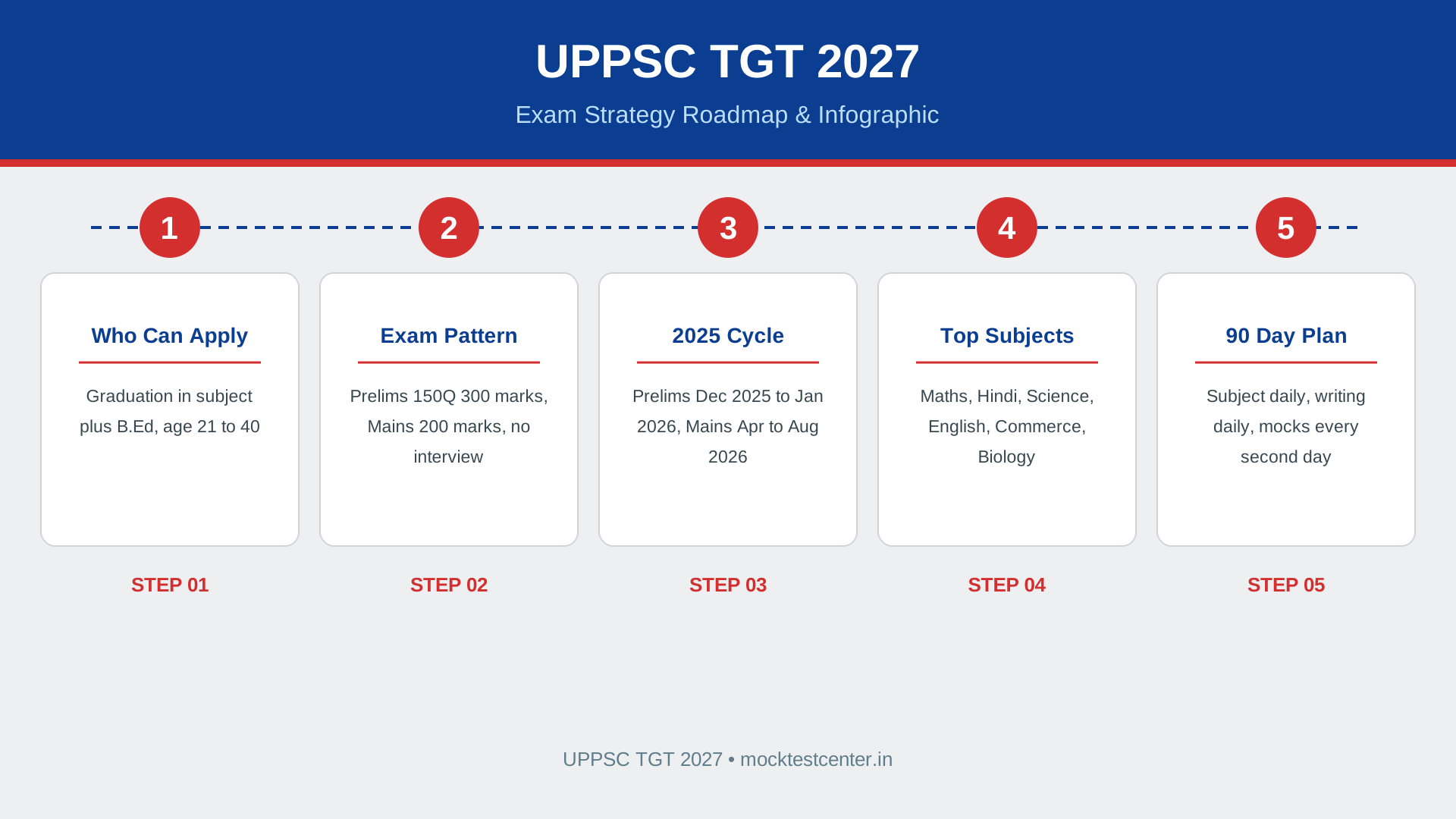
About UPPSC TGT 2027 Exam Series
📖 Table of Contents
- What the job is, and what TGT means here
- Where the 2027 cycle stands right now
- The selection stages in order
- Prelims: 150 questions, 300 marks, two hours
- Mains: one descriptive paper, 200 marks
- Who can apply: graduation plus B.Ed
- Age limit and relaxations
- The 2025 cycle, date by date
- Subjects and vacancies in the 2025 cycle
- Pay, posting and service
- Books that cover the syllabus
- A 90 day plan that fits real life
- Mock tests and the writing habit
- Mistakes that cost TGT candidates a year
- What to check the day the 2027 notice arrives
- Sources
UPPSC TGT 2027: Pattern, Eligibility, Subjects and Preparation
UPPSC recruits Assistant Teachers in the Trained Graduate Grade, known as LT Grade and widely called TGT, for Government Secondary Schools in Uttar Pradesh, and the 2025 cycle offered 7466 posts. The examination runs in two stages: an objective Prelims and a descriptive Mains, with no interview. The 2027 notification has not come out yet, as of 19 November 2026, so every date and rule in this guide comes from the 2025 cycle, which is still running. You will find the full pattern, the degree and B.Ed rules, the age limits, the subject wise schedule, the 2025 cycle timeline, the pay, the books, a 90 day plan and the mistakes that cost teaching candidates a year.
What the job is, and what TGT means here
An Assistant Teacher in the Trained Graduate Grade teaches students of Classes 6 to 10 in Government Secondary Schools, also called Inter Colleges, across Uttar Pradesh. The post is a Group C, non gazetted post, and it carries Pay Level 7, from 44900 to 142400 rupees a month, with a grade pay of 4600 rupees. You teach your subject, set and mark examinations, keep student records, and take part in the daily work of the school.
The name needs care, because three names point at the same post. The official advertisement calls it Assistant Teacher, Trained Graduate Grade, Male and Female Branch, Examination 2025. The short name is LT Grade, from the old Licentiate in Teaching grade. Candidates and coaching pages call it TGT, Trained Graduate Teacher. All three names mean this UPPSC examination, and this guide uses TGT as the short name, because that is the name candidates search for.
Do not confuse this examination with the aided school recruitment. UPPSC runs this examination for government secondary schools. A separate body, UPESSC, runs its own TGT and PGT recruitment for government aided institutions, with its own advertisement and its own portal. The two recruitments look alike, and their names confuse candidates every year. This guide covers the UPPSC examination only, and the official portal for it is uppsc.up.nic.in.
The post suits a graduate who likes classroom teaching and wants a government school job in his home state. It asks for graduation in the subject plus a B.Ed, and it asks for no postgraduate degree and no NET. That makes it the most open teaching examination UPPSC runs, and the 7466 posts in the 2025 cycle drew a very large field. The size of the field is the reason the examination runs in two stages, and the reason the Prelims cut off bites hard in popular subjects.
Where the 2027 cycle stands right now
The 2027 notification has not come out yet. UPPSC releases the notice on its official portal, uppsc.up.nic.in, and the TGT 2027 notice will appear there first. As of 19 November 2026, no 2027 date, no 2027 vacancy count and no 2027 fee exists in any official notice. Any website that gives you a fixed 2027 exam date today is guessing, and you should not plan around a guessed date.
The 2025 cycle is still running, and it sets the shape of the next cycle. UPPSC issued the advertisement as A-5/E-1/2025, dated 28 July 2025, for 7466 posts. Applications ran from 28 July to 28 August 2025, with corrections till 4 September 2025. The Prelims ran subject by subject from 6 December 2025 to 25 January 2026, with the Computer subject Prelims on 5 April 2026. The Mains ran subject by subject from 22 April 2026 to 16 August 2026. Results are still coming out subject by subject, and the final selection lists are not complete yet.
That leaves you with a clear choice. You can wait for the notice, or you can start now with the syllabus and the pattern from the 2025 cycle, and that head start is what UPPSC TGT 2027 rewards. The pattern has stayed the same across cycles, and the subject syllabus comes from the graduation level of your own subject, so preparation that starts now will still count when the notice arrives. Only the dates, the fee and the vacancy count change with each cycle, and those three come from the notice itself.
The selection stages in order
Selection runs through two written stages, and then document verification. Prelims screens. Mains ranks. There is no interview, and that fact shapes the whole examination. Your Mains score alone decides the merit list, so the descriptive paper is the examination, and everything else leads up to it.
| Stage | What happens | Marks | Counts for merit |
|---|---|---|---|
| Prelims | One objective paper, 150 questions | 300 | No, screening only |
| Mains | One descriptive paper, 20 questions | 200 | Yes, merit rests on this alone |
| Document verification | Certificates and medical check | Qualifying | No |
Final selection rests on Mains marks alone, followed by document verification and a medical examination. Prelims marks never enter the merit list. That split shapes your whole strategy. You need enough in Prelims to clear the shortlist, and you need everything in Mains to rank. A candidate who tops Prelims and coasts in Mains loses to a candidate who scrapes through Prelims and fights in Mains.
The shortlist rule matters here. UPPSC shortlists about 15 times the number of vacancies, subject wise and category wise, for the Mains, and only candidates who reach the minimum qualifying marks enter the shortlist. Fifteen times sounds generous, and it is, but the cut off still bites in popular subjects, because thousands of B.Ed graduates sit for a few hundred posts in a subject. Aim for a Prelims score that would clear the shortlist with room to spare, and measure yourself in mocks, not in hope.
Prelims: 150 questions, 300 marks, two hours
Prelims is a single objective paper, and it is a screening test. You get two hours, 150 questions, and 300 marks. Each question carries two marks, and each wrong answer loses one third of the marks of a question. The paper splits into two parts, and the split is fixed.
| Part | Questions | Marks |
|---|---|---|
| General Studies | 30 | 60 |
| Concerned subject, your own subject | 120 | 240 |
| Total | 150 | 300 |
General Studies covers the usual ground: Indian history, polity, geography, economy, science, environment, reasoning and current events, with a focus on Uttar Pradesh. Thirty questions cannot cover everything, so the paper rewards a candidate who knows the high yield areas, not a candidate who reads everything shallowly. Keep a separate notebook for Uttar Pradesh facts, because the paper rewards a candidate who knows the state, its schemes, its districts and its history.
Your own subject carries the weight. One hundred and twenty questions from your graduation subject decide most of your Prelims score, and they test the breadth of the subject, from the base concepts to the current debates. A candidate who revised the whole graduation syllabus scores far above a candidate who revised only the favourite chapters. Read the subject syllabus from the notification, tick each topic as you cover it, and let the syllabus set your reading list.
The qualifying marks rule also matters. Candidates who score less than 40 percent, or 35 percent for SC and ST candidates, do not qualify, however high the shortlist cut off runs. Treat 40 percent as the floor and the shortlist cut off as the real target, and aim well above both. One tracker page gives a different pattern for this paper, 125 questions for 500 marks with no negative marking. That pattern is wrong, and it looks like a copy from a different examination. This guide uses the 150 question, 300 mark pattern that the notification summaries agree on.
Negative marking changes how you should use the last minutes. One third of a question's marks goes for each wrong answer, so a blind guess costs you. But a question where you can remove two options is worth answering, because the odds turn in your favour. Practise this judgement in mocks, and keep a record of your guessing accuracy. A candidate who knows his own guessing record makes better decisions in the hall than a candidate who guesses by mood.
Mains: one descriptive paper, 200 marks
Mains is the real examination, and it decides your rank alone. One descriptive paper, 200 marks, three hours, twenty questions, all from your own subject. No General Studies, no second paper, no escape from depth. The paper tests whether you can write your subject, not only recognise it in options.
| Section | Questions | Marks each | Section total | Word limit |
|---|---|---|---|---|
| Section A, short answers | 10 | 8 | 80 | About 125 words |
| Section B, long answers | 10 | 12 | 120 | About 200 words |
| Total | 20 | NA | 200 | NA |
Section A asks ten short answer questions, eight marks each, with answers of about 125 words. Section B asks ten long answer questions, twelve marks each, with answers of about 200 words. The word limits are part of the test. A candidate who writes 400 words for an eight mark question runs out of time for the rest, and a candidate who writes 50 words for a twelve mark question leaves marks on the table. Practise with a timer and a word count, until the 125 word answer and the 200 word answer feel natural.
Handwriting and structure decide more marks than most candidates expect. The examiner reads twenty answers in a limited time, and a clear answer with a definition, an explanation and an example scores better than a long answer that wanders. Start each answer with the core idea in one line, build it in two or three short paragraphs, and close with a line that answers the question as asked. Keep your handwriting legible at speed, because an answer the examiner cannot read scores zero, however good the content is.
The Mains fee also deserves a note. One tracker states a Mains fee of 225 rupees for UR, OBC and EWS candidates, 105 rupees for SC, ST and ex servicemen, and 25 rupees for PH candidates. That figure comes from a single source, and this guide does not treat it as confirmed. Check the 2027 notice for the fee at each stage, and do not pay any fee through a link that does not sit on the official portal.
Who can apply: graduation plus B.Ed
Eligibility has two parts, and both must hold on the date the notice sets. Miss either part and the form fails.
First, the degree. You need a Bachelor degree in the relevant subject from a recognised university in India. The subject must match the post you apply for, and the notification lists the required graduation subjects for each teaching subject. A Hindi graduate applies for Hindi, a Mathematics graduate applies for Mathematics, and a candidate whose graduation subjects do not include the teaching subject cannot apply for it. Read the subject wise eligibility table in the notice before you apply, because a wrong subject choice wastes a whole cycle.
Second, the teaching qualification. You need a Bachelor of Education, B.Ed, or an equivalent qualification recognised by the National Council for Teacher Education, NCTE. The B.Ed must come from an NCTE recognised institution, and the notice sets the exact rule. Candidates with a special education qualification approved by the Rehabilitation Council of India can apply for the posts the notice marks for them. Keep your B.Ed certificate and your NCTE recognition proof ready, because the commission checks them at document verification.
One claim needs a flag. One tracker states that candidates must also have passed UPTET, the Uttar Pradesh Teacher Eligibility Test, to apply. No other tracker in this pass mentions UPTET for this examination, and the notification summaries list only graduation plus B.Ed. This UPPSC TGT 2027 guide does not treat UPTET as a requirement, and it flags the claim as unverified. Read the 2027 notice, and if it names UPTET, follow the notice.
The UPPSC Lecturer GIC 2027 examination asks for a postgraduate degree, and the UPPSC Assistant Professor 2027 examination asks for a postgraduate degree plus NET or a PhD. TGT asks for less, and that is its strength. A graduate with a B.Ed can sit for TGT in the year he finishes the degree, and the examination rewards classroom readiness more than research depth.
Age limit and relaxations
The age limit for the 2025 cycle runs from 21 to 40 years as on 1 July 2025. That means a candidate must have been born between 2 July 1985 and 1 July 2004. The same age band covers all subjects and both branches, male and female, and the commission counts age as on 1 July of the exam year.
Relaxation follows the Uttar Pradesh government rules. SC, ST and OBC candidates of Uttar Pradesh get five years of relaxation. Physically handicapped candidates of Uttar Pradesh get fifteen years. Ex servicemen get three years plus their service period. Keep the certificate that proves your claim ready, because the commission checks it at document verification, and a missing certificate ends the claim.
The 2027 notice will set its own cut off date, and the birth date window will move with that date, so check it. If you turn 21 in mid 2027, check the notice date twice and carefully, because the notice cut off date would keep you out while a later cut off would let you in. Age is the one rule no appeal can fix, so read it first, before you spend a rupee on books.
The 2025 cycle, date by date
The 2025 cycle shows how long this examination takes, and the timeline is the best planning tool you have for 2027. UPPSC issued the advertisement as A-5/E-1/2025, dated 28 July 2025, for 7466 posts: 4860 male branch, 2525 female branch, and 81 PwD and backlog posts. Applications ran from 28 July to 28 August 2025, with corrections till 4 September 2025.
The Prelims ran subject by subject, and the dates matter, because a wrong date in this section has already misled candidates. The main Prelims took place on 6, 7 and 21 December 2025 and on 17, 18, 24 and 25 January 2026. Mathematics and Hindi sat on 6 December 2025, Science and Sanskrit on 7 December, Home Science and Commerce on 21 December, Social Science and Biology on 17 January 2026, English and Physical Education on 18 January, Art and Agriculture with Horticulture on 24 January, and Urdu and Music on 25 January. The Computer subject Prelims took place separately, on 5 April 2026.
That last date needs emphasis. Some summaries of this cycle state the Prelims date as 5 April 2026, without saying that it covered only the Computer subject. A candidate who reads that date as the general Prelims date gets the cycle wrong by four months. This guide states the full schedule, and the brief for this package carried the same short date, which this package corrects here and in the package note.
Prelims results came out subject by subject from February 2026: Mathematics and Hindi on 5 February, Science, Sanskrit, Home Science and Commerce on 18 February, English and Biology on 24 February, Urdu, Music, Arts and Agriculture with Horticulture on 12 March, Physical Education on 19 March, and Social Science on 1 April. The Computer subject Prelims result came on 17 May 2026.
The Mains ran subject by subject too. Commerce sat on 22 April 2026, Sanskrit on 23 April, Mathematics, Science, Home Science and Agriculture with Horticulture on 16 and 17 May, Biology, Urdu and Arts on 13 June, Sociology, Physical Education, Music and Hindi on 11 July, and Computer Science on 16 August 2026. Mains results have come out for several subjects since 1 September 2026, with provisionally selected lists for Science and Sanskrit among the first, and results for the remaining subjects are still awaited. The UPPSC PCS 2027 examination and the UPPSC RO ARO 2027 examination also run long subject wise cycles, and candidates who sit for several UPPSC examinations should keep one calendar for all of them.
Subjects and vacancies in the 2025 cycle
The 7466 posts split across subjects and across the male and female branches, and the split decides where the real competition sits. The branch split was 4860 male, 2525 female, and 81 PwD and backlog posts. The subject list below names the subjects the Prelims and Mains schedules cover, and the full subject wise vacancy table sits in the official notification.
| Subjects in the 2025 cycle |
|---|
| Mathematics |
| Hindi |
| Science |
| Sanskrit |
| Home Science |
| Commerce |
| Social Science |
| Biology |
| English |
| Physical Education |
| Art |
| Agriculture and Horticulture |
| Urdu |
| Music |
| Computer Science |
| Sociology |
Two lessons follow from the split. First, a subject with many posts and many applicants is a different race from a subject with few posts and few applicants, and your own subject's numbers matter more than the total of 7466. Second, the branch split matters too, because male branch and female branch posts carry separate vacancy counts and separate cut offs. Check the vacancy count for your subject and your branch in the 2027 notice, and do not judge your chances from the total alone.
Pay, posting and service
The pay is straightforward, and the trackers agree on it. The post carries Pay Level 7, from 44900 to 142400 rupees a month, with a grade pay of 4600 rupees, under the 7th Central Pay Commission matrix. Dearness allowance, house rent allowance and other allowances sit on top of the basic pay. The post is Group C, non gazetted, and permanent.
The posting goes to a Government Secondary School somewhere in Uttar Pradesh, and the education department decides the school. You may get a school in a big town, and you may get a school in a small district town. A candidate who wants a posting in one city should think again, because the department posts where the vacancy sits, not where the candidate lives. Promotion runs through the departmental rules, from Assistant Teacher to senior grades, and further study can open the Lecturer and Assistant Professor examinations later.
Teaching Classes 6 to 10 differs from teaching degree classes. Your students are young, your subject is the base of their education, and your work includes keeping attendance, checking homework, setting school examinations, and talking to parents. A candidate who likes the classroom will find the work rewarding, and a candidate who chose the post only for the pay will find the classroom a hard place to hide.
Books that cover the syllabus
TGT candidates need two shelves of books, one for General Studies and one for their own subject. The General Studies shelf is small, because General Studies carries only 30 questions in Prelims and nothing in Mains. The subject shelf is large, because the subject carries 120 questions in Prelims and the whole of Mains.
For General Studies, read the NCERT books for history, geography, polity and economy, then Lakshmikanth for polity, and a current affairs monthly for the last year. Keep a notebook for Uttar Pradesh facts, because the paper rewards a candidate who knows the state. Do not buy a large General Studies library for this examination, because the return on those books is small, and the hours are better spent on your subject.
For your subject, start with the standard graduation textbooks, the books your university prescribed for your degree. Read them again, slowly, and make notes in your own words. Then add the standard reference books that TGT toppers recommend for your subject, and the NCERT books for Classes 9 to 12 in your subject, because the questions track the school level syllabus closely. A Hindi candidate should read the Hindi NCERT books and the standard Hindi grammar books. A Mathematics candidate should work through the NCERT books and a standard graduation level problem book.
Add a previous year papers book for your subject, from the earlier UPPSC LT Grade cycles and from the TGT examinations of other states, and solve it year by year. Check every answer against the syllabus topic it belongs to, and mark the topics that repeat. A topic that appears in three different years is a topic the examiner loves, and it deserves a full page of notes. Buy the latest edition of each book, and check the edition year before you pay. Keep one book open at a time, and finish one book before you buy the next.
One more shelf deserves a mention. Mains is a writing examination, and writing needs practice more than reading. Keep a notebook of model answers, ten short answers and ten long answers that you wrote yourself, revised twice, and marked against the word limit. That notebook is worth more than a new textbook in the last month, because it shows you your own standard, and it grows with every revision.
A 90 day plan that fits real life
Ninety days divide into three parts, and each part has one job. Days 1 to 30 build the base. Read the subject syllabus topic by topic, two topics a week, and make short notes as you read. Give your subject three hours a day, give General Studies one hour a day, and give writing practice one hour a day. End each week with a previous year paper, solved without a time limit, and mark the questions you got wrong.
Days 31 to 60 build speed. Start timed practice, one full Prelims set every third day, and one descriptive answer set every week. Revise your notes every Sunday, and rewrite the notes that feel thin. This is the phase where weak topics show themselves, and the honest move is to give the weakest topic the most hours, even when the strongest topic feels better to study. A plan that only feeds your strengths leaves the weak topic to cost you marks on examination day.
Days 61 to 90 build examination fitness. Sit for a full mock every second day, 150 questions in two hours for Prelims, and a full descriptive set in three hours for Mains, in one sitting, with no break and no phone. Analyse each mock the same evening, and write down three things: the topics that cost marks, the question types that ate time, and the silly errors. Revise only from your notes and your error list in the last ten days, and stop learning new material five days before the examination. Sleep well in the last week, because a tired mind drops more marks than a thin syllabus does.
Working candidates can follow the same plan with smaller daily hours. Two hours a day for ninety days beats six hours a day for thirty days, because the syllabus needs repetition more than it needs long sittings. Keep a simple daily log, date, hours, topics covered, questions solved, answers written, and the log itself will keep you honest when motivation dips. The UPPSC PCS J 2027 preparation uses the same 90 day shape, and the UPPSC Staff Nurse 2027 examination rewards the same daily log habit.
Mock tests and the writing habit
A mock test measures, and the analysis after it teaches. Sit for the mock in examination conditions, with the real time limit, one sitting, no break, no phone, no notes. Prelims mocks test recall and speed, so practise those two skills in every mock. A question that names a formula, a date or a rule rewards the candidate who can place it in one line.
Analyse the mock the same day, while the questions still feel fresh. Sort every wrong answer into three piles: concept gap, silly error, and time pressure. Concept gaps need a return to the book. Silly errors need a slower reading habit. Time pressure needs more timed sets. A mock without this sorting wastes hours, because the score alone teaches nothing.
Mains mocks need a different routine. Write the answers by hand, in the time limit, with the word limit in mind, and then read your own answers the next day, as an examiner would. Mark them for structure, for the definition, for the example, and for the closing line. A candidate who writes ten mock answers and revises each one twice learns more than a candidate who writes fifty answers and never reads any of them again. Keep a running table of your mock scores, Prelims and Mains separately, and watch the trend across weeks, because a rising trend tells you the plan works and a flat trend tells you to change the plan.
Use the negative marking rule in the last fifteen minutes of every Prelims paper. With one third of the marks going for a wrong answer, every question you leave blank costs nothing, and every blind guess costs you. Guess with sense, remove the options you know are wrong, and pick from what remains. A mock is the place to practise this, so that the habit feels natural on examination day.
Mistakes that cost TGT candidates a year
The first mistake is applying for the wrong subject. Candidates apply for a subject they like, instead of the subject their graduation degree covers, and the form fails at document verification, after a year of preparation. Read the subject wise eligibility table in the notice, and apply only for the subject your degree fits.
The second mistake is reading General Studies and ignoring the subject. General Studies carries 30 questions in Prelims and nothing in Mains, and the subject carries 120 questions in Prelims and the whole of Mains. Hours spent on General Studies beyond one hour a day are hours stolen from the subject, and the subject decides the result. Give General Studies its hour, and give the subject the rest.
The third mistake is reading without writing. Candidates read their subject for months, and then sit for a descriptive paper and discover that they cannot write a 200 word answer in the time allowed. Writing is a separate skill, and it needs practice from the first month. Write one short answer and one long answer every day, and the Mains paper will feel like a routine, not a shock. The UPPSC Assistant Engineer 2027 examination and the UPPSC APO 2027 examination carry their own descriptive papers too, and the same writing habit serves them.
The fourth mistake is collecting books instead of finishing them. A shelf full of unread books helps no one, and a single book read twice beats three books read once. Finish one book, solve its questions, and then buy the next.
The fifth mistake is trusting unofficial dates. Websites guess the 2027 dates every year, and candidates who plan around a guessed date lose weeks. Trust only the official portal, and plan around the syllabus until the notice arrives. The 5 April 2026 date shows how a true date can still mislead, when it covers only one subject and a summary drops that detail. Candidates who prepare for the UPPSC Medical Officer 2027 examination face the same guessing game, and the same rule applies to them: the notice is the only date that counts.
What to check the day the 2027 notice arrives
Read the notice on the official portal, uppsc.up.nic.in, and check eight things in order. First, the vacancy count for your subject and your branch, male or female. Second, the application window and the last date for fee payment. Third, the Prelims schedule, subject by subject. Fourth, the eligibility rules, your graduation subjects and your B.Ed, read against your own certificates. Fifth, the subject list, to confirm your subject and the permitted graduation combinations. Sixth, the Prelims pattern, to confirm the question count and the negative marking. Seventh, the Mains pattern and the word limits. Eighth, the fee for your category.
Apply early in the window, and keep a copy of the filled form, the fee receipt and the application number. Complete the One Time Registration on otr.pariksha.nic.in before you apply, because the form needs it, and registration takes time to activate. Check your photo, your signature, your category and your subject before you submit, because the correction window fixes small errors and never fixes a wrong subject. Then return to your plan, and let the notice change your dates, not your study.
Your preparation starts before the notice, and the notice only sets the dates. A candidate who has covered the subject syllabus, solved the previous year papers, written the answers and taken the mocks will meet the notice with calm, and a candidate who waits for the notice will meet it with panic. Start now, and let UPPSC TGT 2027 find you ready. The same rule serves the forest service too, and the UPPSC ACF RFO 2027 examination rewards the candidate who starts before the notice, just as this one does.
Sources
Official portal of the Uttar Pradesh Public Service Commission, uppsc.up.nic.in. Notification summaries quoting advertisement A-5/E-1/2025 for the vacancy count, the pattern, the eligibility rules and the subject wise 2025 cycle dates. National Council for Teacher Education, ncte.gov.in, for the B.Ed recognition rule. Where sources disagreed, this article names the disagreement instead of hiding it.







