
About UPPSC Assistant Professor 2027 Exam Series
📖 Table of Contents
- What the job is, and why it draws so many applicants
- Where the 2027 cycle stands right now
- The selection stages in order
- Prelims: one paper, 120 questions, 150 marks
- Mains: one descriptive paper, 200 marks
- Who can apply: the degree and NET rule
- Age limit and relaxations
- The 2025 cycle, date by date
- Subject wise vacancies in the 2025 cycle
- Pay, posting and service
- Books that cover the syllabus
- A 90 day plan that fits real life
- Mock tests and the writing habit
- Mistakes that cost teaching candidates a year
- What to check the day the 2027 notice arrives
- Sources
UPPSC Assistant Professor 2027: Pattern, Eligibility, NET Rule and Preparation
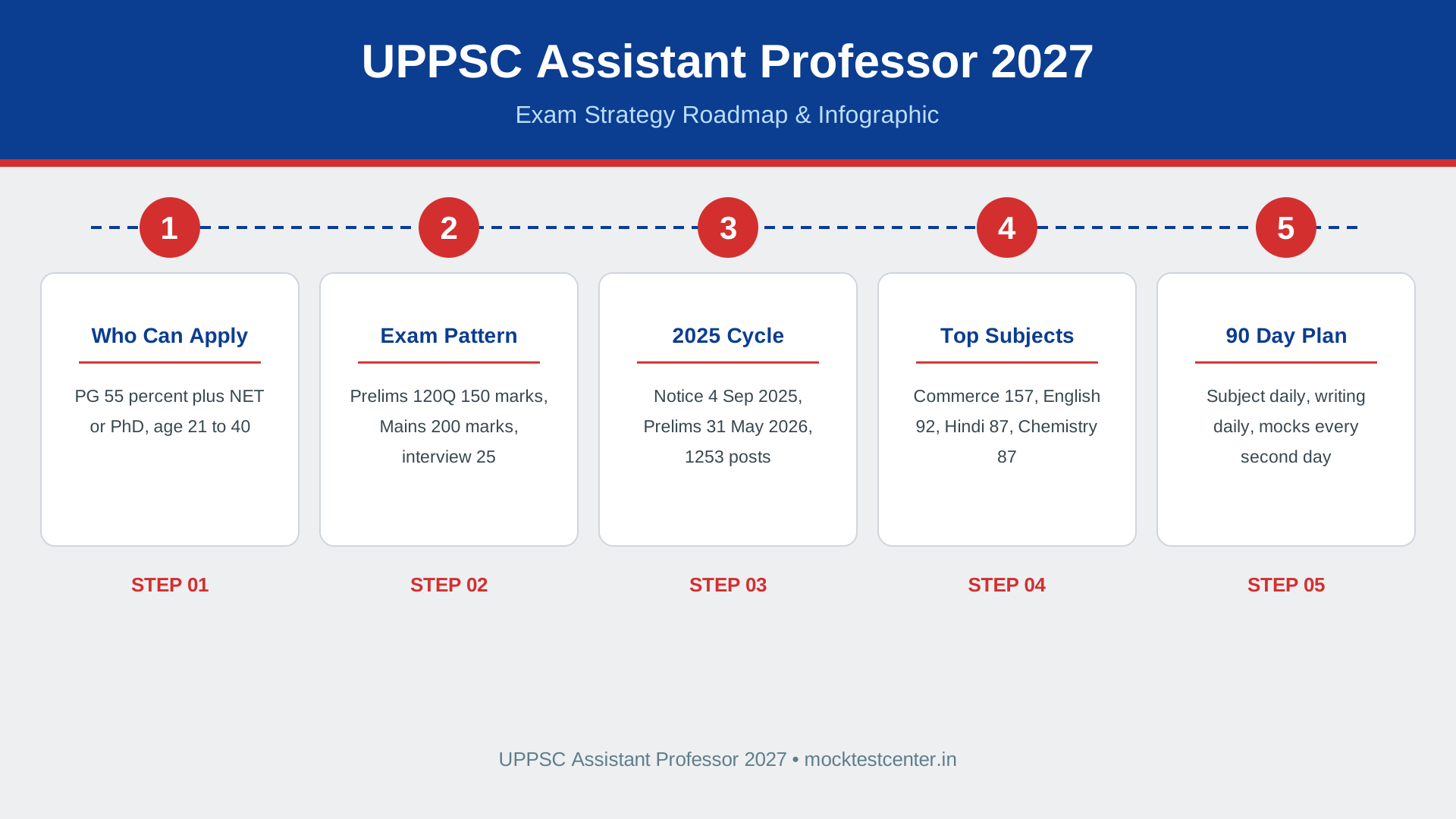
UPPSC recruits Assistant Professors for Government Degree Colleges in Uttar Pradesh, and the 2025 cycle offered 1253 posts across 28 subjects in 217 colleges. The examination runs in three stages: a screening Prelims, a descriptive Mains, and an interview. The 2027 notification has not come out yet, as of 19 November 2026, so every date and rule in this guide comes from the 2025 cycle, which is still running. You will find the full pattern, the NET and PhD rules, the age limits, the subject wise vacancies, the 2025 cycle timeline, the pay, the books, a 90 day plan and the mistakes that cost teaching candidates a year.
What the job is, and why it draws so many applicants
An Assistant Professor in a Government Degree College teaches undergraduate students, and in some colleges postgraduate students too. The post sits in the Higher Education Department of Uttar Pradesh, and the college is fully funded by the state government. You teach your subject, set and mark examinations, guide students, and take part in the academic life of the college. The post is a Group A gazetted post, and it carries Academic Pay Level 10, with a starting basic pay of 57700 rupees a month.
The 2025 cycle covered 217 Government Degree Colleges and 28 subjects, from Commerce and English to Botany and Military Science. Commerce alone carried 157 posts, the largest share. English carried 92, Hindi carried 87, Chemistry carried 87, Botany carried 79 and Mathematics carried 79. The spread means that a candidate in almost any postgraduate subject finds a door open, and the competition differs sharply by subject. A subject with 157 posts and a subject with a handful of posts are different races, and you should know your own subject's numbers before you judge your chances.
The job draws applicants for three reasons. It pays well for a teaching post, it carries the status of a gazetted officer, and it offers a stable academic career with promotion to Associate Professor and Professor through the career advancement scheme. It also asks for a rare combination: a postgraduate degree with 55 percent marks, plus NET or a PhD. That second condition cuts the field hard, and it is the reason this guide spends a full section on the NET rule. Many strong postgraduates discover at the form stage that they never cleared NET, and the cycle ends before it starts.
Do not confuse this examination with the aided college recruitment. UPPSC runs this examination for fully government funded colleges. A separate body, UPESSC, runs Assistant Professor recruitment for government aided colleges, with its own advertisement, 1936 posts in 2026, and its own portal at upessc.up.gov.in. The two recruitments look alike, and their names confuse candidates every year. This guide covers the UPPSC examination only, and the official portal for it is uppsc.up.nic.in.
Where the 2027 cycle stands right now
The 2027 notification has not come out yet. UPPSC releases the notice on its official portal, uppsc.up.nic.in, and the Assistant Professor 2027 notice will appear there first. As of 19 November 2026, no 2027 date, no 2027 vacancy count and no 2027 fee exists in any official notice. Any website that gives you a fixed 2027 exam date today is guessing, and you should not plan around a guessed date.
The 2025 cycle is still running, and it sets the shape of the next cycle. UPPSC issued a short notice on 3 September 2025, and the detailed notification followed on 4 September 2025, under advertisement A-7/E-1/2025. Applications ran from 4 September to 6 October 2025. The Prelims took place on 31 May 2026. Prelims results came out subject by subject from 7 August 2026, and the Mains form opened on 18 August 2026. The Mains date has not been announced yet.
That leaves you with a clear choice. You can wait for the notice, or you can start now with the syllabus and the pattern from the 2025 cycle, and that head start is what UPPSC Assistant Professor 2027 rewards. The pattern has stayed the same across cycles, and the subject syllabus comes from the postgraduate level of your own subject, so preparation that starts now will still count when the notice arrives. Only the dates, the fee and the vacancy count change with each cycle, and those three come from the notice itself.
The selection stages in order
Selection runs through three stages, and each stage cuts the field. Prelims screens. Mains ranks. The interview tests personality and teaching sense. Fail any one stage and the cycle ends for you, so treat every stage as a gate, not as a formality.
| Stage | What happens | Marks | Counts for merit |
|---|---|---|---|
| Prelims | One objective paper, 120 questions | 150 | No, screening only |
| Mains | One descriptive paper, 20 questions | 200 | Yes |
| Interview | Personality test | 25 | Yes |
| Total for merit | Mains plus interview | 225 | Yes |
Final merit rests on Mains plus interview, 200 plus 25, a total of 225 marks. Prelims marks never enter the merit list. That split shapes your whole strategy. You need enough in Prelims to clear the shortlist, and you need everything in Mains and the interview to rank. A candidate who tops Prelims and coasts in Mains loses to a candidate who scrapes through Prelims and fights in Mains.
The shortlist rule matters here. UPPSC calls candidates up to 15 times the number of vacancies for the Mains, on the basis of the Prelims result. Fifteen times sounds generous, and it is, but the cut off still bites in popular subjects, because thousands of NET qualified postgraduates sit for a few dozen posts. Aim for a Prelims score that would clear the shortlist with room to spare, and measure yourself in mocks, not in hope.
Prelims: one paper, 120 questions, 150 marks
Prelims is a single objective paper, and it is a screening test. You get two hours, 120 questions, and 150 marks. Each correct answer carries 1.25 marks, and each wrong answer loses one third of the marks assigned to the question. The paper splits into two parts, and the split differs for Mathematics.
| Part | Questions, most subjects | Questions, Mathematics |
|---|---|---|
| General Studies | 30 | 30 |
| Optional subject, your own subject | 90 | 70 |
| Total | 120 | 100 |
General Studies covers the usual ground: Indian history, polity, geography, economy, science, environment, reasoning and current events, with a focus on Uttar Pradesh. Thirty questions cannot cover everything, so the paper rewards a candidate who knows the high yield areas, not a candidate who reads everything shallowly. Keep a separate notebook for Uttar Pradesh facts, because the paper rewards a candidate who knows the state, its schemes, its districts and its history.
Your own subject carries the weight. Ninety questions from your postgraduate subject decide most of your Prelims score, and they test the breadth of the subject, from the base concepts to the current debates. A candidate who revised the whole postgraduate syllabus scores far above a candidate who revised only the favourite chapters. Read the subject syllabus from the notification, tick each topic as you cover it, and let the syllabus set your reading list.
Negative marking changes how you should use the last minutes. One third of a question's marks goes for each wrong answer, so a blind guess costs you. But a question where you can remove two options is worth answering, because the odds turn in your favour. Practise this judgement in mocks, and keep a record of your guessing accuracy. A candidate who knows his own guessing record makes better decisions in the hall than a candidate who guesses by mood.
Mains: one descriptive paper, 200 marks
Mains is the real examination, and it decides your rank. One descriptive paper, 200 marks, three hours, twenty questions, all from your own subject. No General Studies, no second paper, no escape from depth. The paper tests whether you can write your subject, not only recognise it in options.
| Section | Questions | Marks each | Section total | Word limit |
|---|---|---|---|---|
| Section A, short answers | 10 | 8 | 80 | About 125 words |
| Section B, long answers | 10 | 12 | 120 | About 200 words |
| Total | 20 | NA | 200 | NA |
Section A asks ten short answer questions, eight marks each, with answers of about 125 words. Section B asks ten long answer questions, twelve marks each, with answers of about 200 words. The word limits are part of the test. A candidate who writes 400 words for an eight mark question runs out of time for the rest, and a candidate who writes 50 words for a twelve mark question leaves marks on the table. Practise with a timer and a word count, until the 125 word answer and the 200 word answer feel natural.
Handwriting and structure decide more marks than most candidates expect. The examiner reads twenty answers in a limited time, and a clear answer with a definition, an explanation and an example scores better than a long answer that wanders. Start each answer with the core idea in one line, build it in two or three short paragraphs, and close with a line that answers the question as asked. Keep your handwriting legible at speed, because an answer the examiner cannot read scores zero, however good the content is.
The interview carries 25 marks, and it follows Mains. The board tests subject knowledge, teaching aptitude, communication and personality. A candidate who can explain a concept from his subject in simple words, the way a teacher explains it to a class, scores better than a candidate who recites a definition. Practise explaining your subject aloud, to a friend or to an empty room, and listen to whether a first year student would follow you. The UPPSC Lecturer GIC 2027 interview rewards the same skill, and candidates who prepare for both examinations can use one practice routine for both.
Who can apply: the degree and NET rule
Eligibility has two parts, and both must hold on the date the notice sets. Miss either part and the form fails.
First, the degree. You need a Master degree with at least 55 percent marks, or an equivalent grade, in the concerned, relevant or allied subject, from a recognised Indian university or an equivalent foreign university. One tracker states 50 percent for SC, ST, OBC and PwD candidates, and this guide flags that figure, because the main notification summaries state 55 percent without a separate reserved category figure. Read the 2027 notice for the exact percentage for your category, and count your marks without rounding off.
Second, the NET or PhD rule. You must hold a qualification in NET conducted by UGC or CSIR, or an equivalent UGC accredited SLET or SET examination, or an eligible PhD under the applicable UGC Regulations. The PhD route follows the UGC Regulations of 2009 and 2016, and the notice sets the exact conditions. One tracker states that candidates with a PhD awarded before 11 July 2009 are exempt from NET, and this guide flags that date, because it comes from a single source and needs a check against the notice.
Three more points need care. First, one coaching page states that SET and SLET certificates from other states are not valid in UPPSC recruitment. This guide flags that claim, because it comes from a single source and the notice is the final word. Second, fine arts and music disciplines allow traditional and professional artists with recognition as an alternative route, and the notice sets the exact conditions for those subjects. Third, your Master degree subject must match the subject you apply for, or a closely related or allied subject, and the notice lists the permitted combinations subject by subject. Read the subject list in the notice before you apply, because a wrong subject choice wastes a whole cycle.
The NET rule is the reason this examination rewards early planning. A postgraduate who starts NET preparation in the final year, clears NET, and then sits for the Assistant Professor examination moves in a straight line. A postgraduate who finishes the degree first and then discovers the NET rule loses a year. If you hold a Master degree and no NET, clear NET first, and treat the UPPSC Assistant Professor 2027 examination as the next step, not as a parallel attempt.
Age limit and relaxations
The age limit for the 2025 cycle runs from 21 to 40 years as on 1 July 2025. That means a candidate must have been born between 2 July 1985 and 1 July 2004. The same age band covers all subjects, and the commission counts age as on 1 July of the exam year.
Relaxation follows the Uttar Pradesh government rules. SC, ST and OBC candidates get five years of relaxation. Physically handicapped candidates get relaxation up to a maximum age of 55 years. Ex servicemen get three years plus their service period. Government servants get relaxation as per the rules the notice states. Keep the certificate that proves your claim ready, because the commission checks it at document verification, and a missing certificate ends the claim.
The 2027 notice will set its own cut off date, and the birth date window will move with that date, so check it. If you turn 21 in mid 2027, check the notice date twice and carefully, because the notice cut off date would keep you out while a later cut off would let you in. Age is the one rule no appeal can fix, so read it first, before you spend a rupee on books.
The 2025 cycle, date by date
The 2025 cycle shows how long this examination takes, and the timeline is the best planning tool you have for 2027. UPPSC issued a short notice on 3 September 2025, and the detailed notification followed on 4 September 2025, under advertisement A-7/E-1/2025. Applications ran from 4 September to 6 October 2025, with corrections allowed till 13 October 2025. The Prelims took place on 31 May 2026, almost eight months after the last date to apply.
Prelims results came out subject by subject from 7 August 2026, and the Mains form opened on 18 August 2026. The Mains date has not been announced yet. Count the gaps. Eight months from application to Prelims, two months from Prelims to the first results, and more waiting after that. A candidate who starts Mains preparation only after the Prelims result has already lost the race, because the descriptive paper needs months of writing practice. Prepare for Prelims and Mains together from the first month, and use the Prelims as a checkpoint inside a longer Mains plan.
One conflict needs a flag. A single tracker cites the advertisement as A-3/E-1/2025, dated 1 September 2025. Every other tracker, including the detailed notification summaries, cites A-7/E-1/2025, dated 4 September 2025, and this guide uses A-7/E-1/2025. The A-3 number looks like a copying error, and the 2027 notice will carry its own number in any case.
Another conflict needs a flag too. One tracker gives a different pattern for this examination, Prelims of 300 marks, Mains of 400 marks and an interview of 100 marks, with qualifying marks of 40 percent for General and 35 percent for SC and ST. That pattern does not match the notification summaries, which agree on Prelims 150, Mains 200 and interview 25. This guide uses the majority pattern and treats the other figures as wrong. The UPPSC PCS 2027 examination and the UPPSC RO ARO 2027 examination also run long cycles, and candidates who sit for several UPPSC examinations should keep one calendar for all of them.
Subject wise vacancies in the 2025 cycle
The 1253 posts split across 28 subjects, and the split decides where the real competition sits. The category split for the whole recruitment was 565 unreserved, 232 SC, 30 ST, 315 OBC and 111 EWS posts. The subject split below lists the largest subjects, and the rest of the posts spread across the remaining subjects in smaller numbers.
| Subject | Posts |
|---|---|
| Commerce | 157 |
| English | 92 |
| Hindi | 87 |
| Chemistry | 87 |
| Botany | 79 |
| Mathematics | 79 |
The remaining subjects include Economics, History, Geography, Political Science, Sociology, Psychology, Sanskrit, Urdu, Persian, Physics, Zoology, Statistics, Computer Science, Education, Philosophy, Home Science, Physical Education, Military Science, Law, Fine Arts and Music, among others. The full subject list and the full category wise split sit in Appendix 4 of the official notification, and the 2027 notice will carry its own Appendix 4 with new numbers.
Two lessons follow from the split. First, a large subject gives you more posts, and also more applicants, so a large number alone does not mean an easy race. Second, a small subject gives you fewer posts, and a single strong candidate can change the cut off, so a small subject rewards a candidate who prepares early and thoroughly. Either way, your own subject's numbers matter more than the total of 1253, and the total is the number that newspapers quote, not the number that decides your result.
Pay, posting and service
The pay is straightforward, and the trackers agree on it. The post carries Academic Pay Level 10, from 57700 to 182400 rupees a month, with a starting basic pay of 57700 rupees. Dearness allowance, house rent allowance and other allowances sit on top of the basic pay, and the post carries pension benefits under the state rules. One tracker quotes an in hand salary of around 80000 rupees a month, and another quotes 70000 to 75000, and a third quotes 95000 to 108000 gross. Those figures disagree because they count different allowances and different cities, so this guide gives no in hand figure, and the basic pay is the number you can trust.
The posting goes to a Government Degree College somewhere in Uttar Pradesh, and the Higher Education Department decides the college. You may get a college in a big town, and you may get a college in a small district town. A candidate who wants a posting in one city should think again, because the department posts where the vacancy sits, not where the candidate lives. The service is permanent, and promotion runs through the career advancement scheme, from Assistant Professor to Associate Professor and then to Professor, on the basis of service, qualifications and academic work.
Teaching in a degree college differs from teaching in a school. Your students are adults, your subject is deep, and your work includes setting question papers, evaluating answer scripts, guiding students for NET and other examinations, and taking part in seminars and academic programmes. A candidate who loves his subject will find the work rewarding, and a candidate who chose the post only for the pay will find the classroom a hard place to hide.
Books that cover the syllabus
Assistant Professor candidates need two shelves of books, one for General Studies and one for their own subject. The General Studies shelf is small, because General Studies carries only 30 questions in Prelims and nothing in Mains. The subject shelf is large, because the subject carries 90 questions in Prelims and the whole of Mains.
For General Studies, read the NCERT books for history, geography, polity and economy, then Lakshmikanth for polity, and a current affairs monthly for the last year. Keep a notebook for Uttar Pradesh facts, because the paper rewards a candidate who knows the state. Do not buy a large General Studies library for this examination, because the return on those books is small, and the hours are better spent on your subject.
For your subject, start with the standard postgraduate textbooks, the books your university prescribed for your Master degree. Read them again, slowly, and make notes in your own words. Then add the standard reference books that NET toppers recommend for your subject, because the Prelims subject questions track the NET syllabus closely. A Sociology candidate can use the same base as a UGC NET Sociology candidate, and a History candidate can use the same base as a NET History candidate. The overlap is large, and it saves you from buying a second library.
Add a previous year papers book for your subject, from the NET examination and from the earlier UPPSC Assistant Professor cycles, and solve it year by year. Check every answer against the syllabus topic it belongs to, and mark the topics that repeat. A topic that appears in three different years is a topic the examiner loves, and it deserves a full page of notes. Buy the latest edition of each book, and check the edition year before you pay. Keep one book open at a time, and finish one book before you buy the next.
One more shelf deserves a mention. Mains is a writing examination, and writing needs practice more than reading. Keep a notebook of model answers, ten short answers and ten long answers that you wrote yourself, revised twice, and marked against the word limit. That notebook is worth more than a new textbook in the last month, because it shows you your own standard, and it grows with every revision.
A 90 day plan that fits real life
Ninety days divide into three parts, and each part has one job. Days 1 to 30 build the base. Read the subject syllabus topic by topic, two topics a week, and make short notes as you read. Give your subject three hours a day, give General Studies one hour a day, and give writing practice one hour a day. End each week with a previous year paper, solved without a time limit, and mark the questions you got wrong.
Days 31 to 60 build speed. Start timed practice, one full Prelims set every third day, and one descriptive answer set every week. Revise your notes every Sunday, and rewrite the notes that feel thin. This is the phase where weak topics show themselves, and the honest move is to give the weakest topic the most hours, even when the strongest topic feels better to study. A plan that only feeds your strengths leaves the weak topic to cost you marks on examination day.
Days 61 to 90 build examination fitness. Sit for a full mock every second day, 120 questions in two hours for Prelims, and a full descriptive set in three hours for Mains, in one sitting, with no break and no phone. Analyse each mock the same evening, and write down three things: the topics that cost marks, the question types that ate time, and the silly errors. Revise only from your notes and your error list in the last ten days, and stop learning new material five days before the examination. Sleep well in the last week, because a tired mind drops more marks than a thin syllabus does.
Working candidates can follow the same plan with smaller daily hours. Two hours a day for ninety days beats six hours a day for thirty days, because the syllabus needs repetition more than it needs long sittings. Keep a simple daily log, date, hours, topics covered, questions solved, answers written, and the log itself will keep you honest when motivation dips. The UPPSC PCS J 2027 preparation uses the same 90 day shape, and the UPPSC Staff Nurse 2027 examination rewards the same daily log habit.
Mock tests and the writing habit
A mock test measures, and the analysis after it teaches. Sit for the mock in examination conditions, with the real time limit, one sitting, no break, no phone, no notes. Prelims mocks test recall and speed, so practise those two skills in every mock. A question that names a thinker, a theory or a date rewards the candidate who can place it in one line.
Analyse the mock the same day, while the questions still feel fresh. Sort every wrong answer into three piles: concept gap, silly error, and time pressure. Concept gaps need a return to the book. Silly errors need a slower reading habit. Time pressure needs more timed sets. A mock without this sorting wastes hours, because the score alone teaches nothing.
Mains mocks need a different routine. Write the answers by hand, in the time limit, with the word limit in mind, and then read your own answers the next day, as an examiner would. Mark them for structure, for the definition, for the example, and for the closing line. A candidate who writes ten mock answers and revises each one twice learns more than a candidate who writes fifty answers and never reads any of them again. Keep a running table of your mock scores, Prelims and Mains separately, and watch the trend across weeks, because a rising trend tells you the plan works and a flat trend tells you to change the plan.
Use the negative marking rule in the last fifteen minutes of every Prelims paper. With one third of the marks going for a wrong answer, every question you leave blank costs nothing, and every blind guess costs you. Guess with sense, remove the options you know are wrong, and pick from what remains. A mock is the place to practise this, so that the habit feels natural on examination day.
Mistakes that cost teaching candidates a year
The first mistake is applying without NET. Candidates finish a Master degree, see 1253 posts, and apply, and the form asks for the NET or PhD proof they do not hold. Clear NET first, and treat the Assistant Professor examination as the next step. The UPPSC Assistant Engineer 2027 examination and the UPPSC APO 2027 examination carry their own eligibility gates too, and the same rule applies: read the eligibility section before you read the vacancy count.
The second mistake is reading General Studies and ignoring the subject. General Studies carries 30 questions in Prelims and nothing in Mains, and the subject carries 90 questions in Prelims and the whole of Mains. Hours spent on General Studies beyond one hour a day are hours stolen from the subject, and the subject decides the result. Give General Studies its hour, and give the subject the rest.
The third mistake is reading without writing. Candidates read their subject for months, and then sit for a descriptive paper and discover that they cannot write a 200 word answer in the time allowed. Writing is a separate skill, and it needs practice from the first month. Write one short answer and one long answer every day, and the Mains paper will feel like a routine, not a shock.
The fourth mistake is collecting books instead of finishing them. A shelf full of unread books helps no one, and a single book read twice beats three books read once. Finish one book, solve its questions, and then buy the next.
The fifth mistake is trusting unofficial dates. Websites guess the 2027 dates every year, and candidates who plan around a guessed date lose weeks. Trust only the official portal, and plan around the syllabus until the notice arrives. Candidates who prepare for the UPPSC Medical Officer 2027 examination face the same guessing game, and the same rule applies to them: the notice is the only date that counts.
What to check the day the 2027 notice arrives
Read the notice on the official portal, uppsc.up.nic.in, and check eight things in order. First, the vacancy count for your subject, and the category split for it. Second, the application window and the last date for fee payment. Third, the Prelims date. Fourth, the eligibility rules, your Master degree percentage and your NET or PhD proof, read against your own certificates. Fifth, the subject list, to confirm your subject and the permitted degree combinations. Sixth, the Prelims pattern, to confirm the question count and the negative marking. Seventh, the Mains pattern and the word limits. Eighth, the fee for your category.
Apply early in the window, and keep a copy of the filled form, the fee receipt and the application number. Complete the One Time Registration on otr.pariksha.nic.in before you apply, because the form needs it, and registration takes time to activate. Check your photo, your signature, your category and your subject before you submit, because the correction window fixes small errors and never fixes a wrong subject. Then return to your plan, and let the notice change your dates, not your study.
Your preparation starts before the notice, and the notice only sets the dates. A candidate who has covered the subject syllabus, solved the previous year papers, written the answers and taken the mocks will meet the notice with calm, and a candidate who waits for the notice will meet it with panic. Start now, and let UPPSC Assistant Professor 2027 find you ready. The same rule serves the forest service too, and the UPPSC ACF RFO 2027 examination and the UPPSC TGT 2027 examination both reward the candidate who starts before the notice.
Sources
Official portal of the Uttar Pradesh Public Service Commission, uppsc.up.nic.in. Notification summaries quoting advertisement A-7/E-1/2025 for the vacancy count, the pattern, the eligibility rules and the 2025 cycle dates. UGC website, ugc.gov.in, for the NET and PhD regulations that the eligibility rule rests on. Where sources disagreed, this article names the disagreement instead of hiding it.







