
About UGC NET Commerce 2027 Exam Series
📖 Table of Contents
- What this exam gives you
- Who can apply
- Age limits and relaxations
- The exam pattern in one sitting
- Paper 1 in brief
- Paper 2 syllabus unit by unit
- Unit 1: Business Environment and International Business
- Unit 2: Accounting and Auditing
- Unit 3: Business Economics
- Unit 4: Business Finance
- Unit 5: Business Statistics and Research Methods
- Unit 6: Business Management and Human Resource Management
- Unit 7: Banking and Financial Institutions
- Unit 8: Marketing Management
- Unit 9: Legal Aspects of Business
- Unit 10: Income Tax and Corporate Tax Planning
- June 2026 cycle: what actually happened
- December 2026 cycle
- How the cut off works
- Best books for UGC NET Commerce 2027
- A 90 day plan that fits a working student
- How to use mock tests
- Mistakes that cost marks
- What to check when the June 2027 notice arrives
UGC NET Commerce 2027
UGC NET Commerce 2027 has no notification yet. NTA has published no dates for the June 2027 cycle as of 19 November 2026. That single fact shapes this whole page. You can still prepare with confidence because the pattern and the syllabus stay the same from cycle to cycle, and the June 2026 cycle gives you firm dates and fees to plan around.
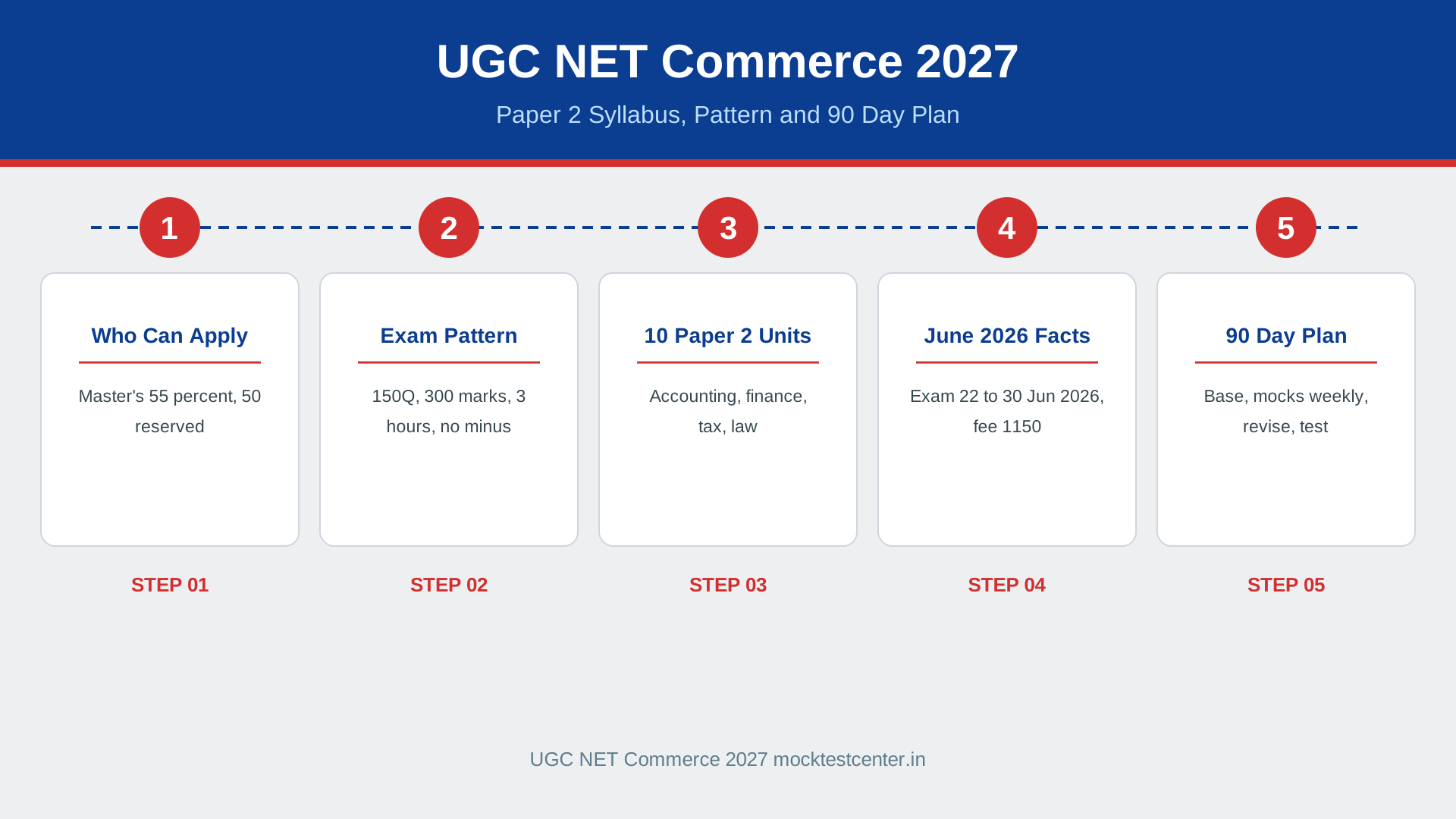
Here is the direct answer. UGC NET Commerce 2027 will test you in one sitting of 3 hours. Paper 1 carries 50 questions for 100 marks. Paper 2 carries 100 questions for 200 marks. Every question carries 2 marks. NTA gives no negative marking, so attempt every question. The paper comes in English and Hindi. Check the official site ugcnet.nta.ac.in for every notice, because only the official notice counts as final.
Commerce graduates form one of the largest groups in this exam, because an M.Com degree maps closely onto the Paper 2 syllabus. The ten units cover accounting, finance, economics, statistics, management, marketing, banking, law and tax, so the paper tests breadth as much as depth. This page walks through the pattern, the eligibility, the full syllabus unit by unit, the June and December 2026 cycles, the cut off method, the books, and a 90 day plan you can start today.
What this exam gives you
UGC NET opens three doors, and the result puts you in one of three categories. Category 1 covers Junior Research Fellowship and Assistant Professor, with PhD admission. Category 2 covers Assistant Professor and PhD admission. Category 3 covers PhD admission only. The category you land in depends on your score and the cut off for your subject and category, so read the cut off section below with care.
A Junior Research Fellowship pays 37000 rupees a month for the first two years, then 42000 rupees a month as Senior Research Fellow, plus house rent allowance as per UGC rules. That money lets you research full time in a university, and the fellowship carries weight when you apply for teaching posts later. An Assistant Professor post needs the NET qualification in most universities and colleges, so the exam works as a career licence for teaching.
For PhD admission, universities give the NET score 70 percent weight and their own interview 30 percent weight for candidates in Categories 2 and 3. The NET score stays valid for PhD admission for 1 year from the result date. So even a Category 3 result has real value if you plan a PhD within that year. Start your PhD applications in the same season as your result, because the 1 year window passes fast.
Who can apply
You need a Master degree or an equivalent degree with at least 55 percent marks if you belong to the General or General EWS category. Candidates from OBC Non Creamy Layer, SC, ST, PwD and third gender categories need at least 50 percent marks. NTA counts the percentage without rounding off, so 54.9 percent counts as below 55 percent. Your degree must come from a UGC recognised university.
Final year Master students can apply provisionally, but you must complete the degree within the window the bulletin sets. The bulletin sets 2 years from the result date for Categories 1 and 2, and 1 year for Category 3. Treat that Category 3 window with care, because it rests on a single source in our research and you must check it against the official bulletin when the June 2027 notice arrives.
Holders of a four year bachelor degree with 75 percent aggregate marks can also apply, with 70 percent for reserved categories. They qualify for Junior Research Fellowship and PhD admission only, and the Assistant Professor door stays closed for them. Check your own degree against these rules before you pay the fee, because the fee is non refundable and a wrong application wastes both money and a cycle.
Age limits and relaxations
The Junior Research Fellowship has a maximum age of 30 years as on the 1st of the exam month. For the June 2026 cycle that date was 1 June 2026, and for the December 2026 cycle it was 1 December 2026. The June 2027 cycle will use the 1st of the exam month as its reference date, but confirm that date in the new notice before you apply.
Relaxation goes up to 5 years for OBC Non Creamy Layer, SC, ST, PwD, third gender and women candidates. Research experience, an LL.M. degree and armed forces service also earn relaxation, with the total capped at 5 years. Add your relaxations together and check the cap, because the cap, rather than the sum, decides your final limit.
Assistant Professor posts and PhD admission carry no upper age limit. So a candidate of 45 can still sit for the exam and qualify for teaching, even when the fellowship age has passed. That rule keeps the exam open to working teachers and late starters, and it shapes the competition in every subject.
The exam pattern in one sitting
NTA holds both papers together in a single Computer Based Test session of 3 hours, with no break between papers. You manage the 180 minutes yourself, because the exam sets no sectional time limit. That freedom helps candidates who finish Paper 1 fast and want more time for Paper 2, and it punishes candidates who spend too long on the first paper. Practise with a timer from the first mock onward.
- Paper 1: 50 questions, 100 marks, 2 marks each
- Paper 2: 100 questions, 200 marks, 2 marks each
- Total: 150 questions, 300 marks, 3 hours
- Negative marking: none, attempt every question
- Mode: Computer Based Test, all questions compulsory
- Medium: English and Hindi
Paper 1 tests teaching and research aptitude, and Paper 2 tests your subject alone. The two papers together decide your aggregate, and the aggregate decides whether you clear the qualifying floor. Read the next two sections for the syllabus of each paper, then the cut off section for how NTA turns scores into results.
Paper 1 in brief
Paper 1 carries the code 00 and stays common for every subject. It has 10 units, with about 5 questions and 10 marks from each unit. The syllabus has stayed unchanged since June 2019, so old papers and old notes still work for this paper. The units cover teaching aptitude; research aptitude; comprehension; communication; mathematical reasoning and aptitude; logical reasoning; data interpretation; information and communication technology; people, development and environment; and the higher education system.
Many subject specialists treat Paper 1 as a side task and lose 20 to 30 marks there, which often decides the result. Give Paper 1 one hour a day in your plan, with data interpretation and logical reasoning as daily practice. Solve the last five years of Paper 1 questions before you touch a new guide, because the question styles repeat and the old papers show you the exact level NTA expects.
Paper 2 syllabus unit by unit
Paper 2 for UGC NET Commerce 2027 carries subject code 08 and has 10 units. The 100 questions spread across these units, with about 10 questions from each unit on average, though the exact split shifts from shift to shift. NTA publishes no official per unit weight, so treat any weight table on the web as a rough guide built from past papers. The unit list below follows the official NTA syllabus, and the package notes flag any order difference we found while checking it.
Unit 1: Business Environment and International Business
This unit opens the paper with the world outside the firm. It covers the economic, political, legal, socio cultural and technological environment, plus economic systems and economic planning in India. The LPG reforms of 1991 sit at the centre of this unit, with liberalisation, privatisation and globalisation, and the way government policy shapes business. Monetary policy and fiscal policy appear here, with the roles of the Reserve Bank of India and the central government. International business covers theories of international trade, the balance of payments, the WTO and trade blocs, foreign direct investment and foreign portfolio investment, multinational corporations, India foreign trade policy, foreign exchange markets, and institutions like the IMF, the World Bank and the Asian Development Bank. Questions here mix direct facts with short case situations, so learn each concept with one Indian example attached to it.
Unit 2: Accounting and Auditing
This unit carries heavy weight in most shifts, so give it deep study time. It starts with basic accounting principles, concepts and postulates, then moves to partnership accounts covering admission, retirement, death and dissolution of partners. Corporate accounting covers issue, forfeiture and reissue of shares, redemption of preference shares and debentures, amalgamation and reconstruction, and holding company accounts. Cost and management accounting covers marginal costing, standard costing, budgetary control and cost volume profit analysis. Financial statement analysis covers ratio analysis, funds flow analysis and cash flow analysis, plus human resource accounting and inflation accounting. International Financial Reporting Standards and Ind AS appear regularly. Auditing covers the meaning, objectives and types of audit, internal control, audit of companies, and recent trends in auditing. Practise numerical questions here every week, because reading theory alone leaves the ratios and the cash flow formats half learned.
Unit 3: Business Economics
This unit tests how a manager uses economic ideas to take decisions. It starts with the meaning and scope of business economics and the objectives of business firms. Demand analysis covers the law of demand, elasticity of demand and demand forecasting, with numerical questions on elasticity that reward regular practice. Consumer behaviour covers the utility approach and the indifference curve approach. Production covers the production function, the law of variable proportions and returns to scale. Cost and revenue concepts and curves follow, then market structures with price and output determination under perfect competition, monopoly, monopolistic competition and oligopoly. Pricing strategies and practices close the unit. Keep a small formula sheet for this unit and revise it weekly, because the same elasticity and cost formulas return in paper after paper.
Unit 4: Business Finance
This unit rewards candidates who can compute, so keep a calculator habit in practice even though the real exam gives you an on screen calculator. It starts with the scope and sources of finance and the time value of money, then the use of debt covering operating, financial and combined effects. Cost of capital leads into capital budgeting with payback, net present value, internal rate of return and the profitability index. Capital structure theories cover the net income approach, the net operating income approach, the Modigliani Miller approach and the traditional approach. Dividend decisions cover the Walter model, the Gordon model and the Modigliani Miller model. Working capital management covers cash, receivables and inventory management. Learn each model with its assumptions and its formula, because NTA frames many questions around a missing assumption or a changed input value.
Unit 5: Business Statistics and Research Methods
This unit splits into two halves that feel different, so study them as two blocks. The statistics half covers measures of central tendency and dispersion, correlation and regression analysis, index numbers, time series analysis, and probability with the binomial, Poisson and normal distributions. Sampling and sampling distributions lead into hypothesis testing with Z, t, F and chi square tests, plus analysis of variance. The research half covers research design, data collection, scaling techniques, questionnaire design, report writing and interpretation of data. Many candidates fear this unit and leave it thin, which wastes easy marks because the questions follow fixed patterns. Solve ten numerical questions a week from this unit and the fear fades fast. Keep the test selection rules clear, because NTA loves to ask which test fits which data situation.
Unit 6: Business Management and Human Resource Management
This unit covers how organisations run and how people inside them work. It starts with the principles and functions of management covering planning, organising, staffing, directing and controlling. Management theories cover the classical, neo classical and modern approaches, with Taylor, Fayol, Elton Mayo, systems thinking and contingency thinking. Organisational behaviour covers motivation with Maslow, Herzberg and McGregor, leadership styles, group dynamics, organisational culture and change. Human resource management covers human resource planning, recruitment and selection, training and development, performance appraisal, compensation, industrial relations and trade unions. This unit gives many direct recall questions, so short notes with names, years and one line definitions pay off well. Link each theory to a workplace example and the recall sticks longer.
Unit 7: Banking and Financial Institutions
This unit maps the Indian financial system from the central bank down to the newest payment services. It starts with an overview of the Indian financial system, the money market and the capital market. The Reserve Bank of India section covers its functions and monetary policy tools, with repo rate, reverse repo rate, cash reserve ratio and statutory liquidity ratio as regular question material. Commercial banking covers functions, credit creation, banking sector reforms, non performing assets and Basel norms. Financial institutions cover development banks, non banking financial companies, mutual funds and insurance companies. Financial services cover leasing, factoring and venture capital. Reforms in banking and insurance close the unit, with digital banking, payment banks and financial inclusion as current themes. Read the Reserve Bank of India annual report summary and the Economic Survey banking chapter once, and the current questions in this unit become far easier.
Unit 8: Marketing Management
This unit starts with the concepts, nature and scope of marketing, the marketing environment and consumer behaviour. Market segmentation, targeting and positioning form the base for most questions, so learn them with one product example each. The marketing mix covers product, pricing, promotion and distribution, the four Ps that appear in almost every shift. Product life cycle, branding, packaging and labelling follow, with advertising, personal selling and sales promotion on the promotion side. Logistics and supply chain management cover the movement of goods from maker to buyer. Recent developments close the unit with digital marketing, green marketing, relationship marketing and service marketing. This unit reads light, which tempts candidates to skim it, yet the questions test fine distinctions between close concepts, so learn definitions word by word for the pairs that look alike.
Unit 9: Legal Aspects of Business
This unit tests business law through the Acts that shape daily commerce. The Indian Contract Act 1872 covers the essentials of a valid contract, performance and discharge, and it gives the most questions in this unit. The Sale of Goods Act 1930 and the Negotiable Instruments Act 1881 follow, with conditions, warranties and negotiable instruments as core topics. The Companies Act 2013 covers formation, management and winding up of companies. The Consumer Protection Act, the Competition Act and the Foreign Exchange Management Act add the regulatory layer. Intellectual property rights and cyber law basics appear, with the Limited Liability Partnership framework closing the unit. Learn each Act through its key sections and landmark ideas rather than through bare memory of dates, because NTA asks what a section means in a business situation.
Unit 10: Income Tax and Corporate Tax Planning
This unit closes the paper with tax law and tax planning. It starts with basic concepts of income tax, residential status and incidence of tax. The heads of income cover salaries, house property, profits and gains of business or profession, capital gains, and income from other sources. Deductions and exemptions follow, with computation of total income and tax liability of individuals and companies. Corporate tax planning covers tax avoidance versus tax evasion, tax planning for a new business and tax planning for financial decisions. Goods and Services Tax covers its concepts and structure, with customs duty basics at the end. Tax rates change with Budgets, so check the latest Finance Act rates from the official Budget documents before the exam and use the rates that the current syllabus year expects. Practise ten computation questions a week here, because speed in this unit frees time for Paper 1.
June 2026 cycle: what actually happened
The June 2026 notification came on 29 April 2026. One source in our research says 28 April 2026, and we flag that claim here because we could not settle it against the official bulletin. Applications ran from 29 April 2026 to 20 May 2026 originally, then NTA extended the window to 23 May 2026, with fee payment till 23 May 2026 at 11.50 PM. One source says the window closed on 24 May 2026, and we flag that claim too. Use the extended date of 23 May 2026 as your planning fact.
NTA held the exam from 22 to 30 June 2026, on 22, 23, 24, 25, 29 and 30 June, in Computer Based Test mode. The fee was 1150 rupees for General and Unreserved candidates, 600 rupees for General EWS and OBC Non Creamy Layer candidates, and 325 rupees for SC, ST, PwD and Third Gender candidates. The fee stayed online only and non refundable. Check the official NTA site nta.ac.in for the bulletin of that cycle if you want the primary source.
Trackers report 85 subjects for the June 2026 cycle, while one source reports 87 subjects including two newly added subjects, Statistics and Forestry. We flag that conflict here and use 85 as the working figure. NTA released the cut off lists on 28 August 2026. For English and Commerce, a re exam cut off list came on 17 September 2026, with the final answer key for the re exam on the same date. Certificates came on 24 September 2026.
December 2026 cycle
How the cut off works
You must appear in both papers, and your aggregate across both papers must cross the qualifying floor. The floor sits at 40 percent, or 120 of 300 marks, for General and General EWS candidates. It sits at 35 percent, or 105 of 300 marks, for SC, ST, OBC Non Creamy Layer, PwD and third gender candidates. Those floors only admit you for consideration. The real cut off sits far higher in most subjects.
NTA caps the number of candidates who qualify for Assistant Professor at 6 percent of the candidates who appeared in both papers. NTA splits that 6 percent by reservation category first, then by subject, and that split produces the subject wise and category wise cut off. A subject with more candidates gets a larger share of the 6 percent, and a subject with fewer candidates gets a smaller share, so the cut off moves with the crowd size in your subject.
This page gives no exact cut off numbers for UGC NET Commerce 2027, because we did not verify the figures against the NTA cut off PDF of 28 August 2026. The June 2026 cut off list came on 28 August 2026, and the re exam list for English and Commerce came on 17 September 2026, but a number copied from a coaching site can differ by a mark or two from the official list. Read the official PDF on the NTA site before you set a target score, and set your target 15 to 20 marks above the last official cut off for your category, because the cut off rises when the paper turns easy.
Best books for UGC NET Commerce 2027
Start with one standard guide for the whole syllabus, then add subject books for the weak units. Arihant Experts UGC NET Commerce gives unit wise theory with previous year questions, and Trueman UGC NET Commerce covers the same ground with more practice sets. Pick one of the two as your base book and finish it fully before you buy a second guide, because two half read guides help less than one fully solved guide.
For finance, read Financial Management by I. M. Pandey for concepts and solved numerical questions, and keep Indian Financial System by M. Y. Khan beside it for the banking and institutions unit. For marketing, read Marketing Management by Philip Kotler, with focus on the core concepts and the Indian examples. For tax, read the Taxmann Students Guide to Income Tax by Vinod Singhania, and check the current Finance Act rates from the official Budget documents, because rates change with each Budget.
For accounting, use your M.Com notes first, then add a standard advanced accountancy book for partnership and company accounts. For statistics, use Business Statistics by S. P. Gupta for formulas and solved examples. For the base, revise NCERT Class 11 and Class 12 Accountancy and Business Studies, because the NET paper tests the same base ideas in harder frames. Close every unit with previous year papers from the NTA site, because the paper pattern repeats its question styles even when the numbers change.
Buy books after you read the syllabus once, because a book that skips a unit wastes your money. Check the edition year on the cover, because tax rates, budget facts and current data change every year. Use the library for the expensive reference books and buy only the base guide and the previous year paper book, because the notes you write yourself matter more than the shelf you fill.
A 90 day plan that fits a working student
Days 1 to 30 build your base. Give two hours a day to Paper 2 and one hour a day to Paper 1. Finish two Paper 2 units in this phase with notes and 50 questions each, and cover teaching aptitude and research aptitude in Paper 1. Read one newspaper page a day for the people, development and environment unit. Solve 30 questions a day from the units you finish, and keep an error notebook from day one.
Days 31 to 60 go deep and test. Finish the remaining Paper 2 units, with the hardest unit first in this phase while your energy stays high. Take one full mock test every week, in a single 3 hour sitting, and spend two hours on analysis after each test. Revise your weak units twice in this phase, and practise the numerical units daily, because formulas fade fast without use. Add previous year papers here, one paper a week, with the same analysis routine.
Days 61 to 90 revise and test more. Take a full mock test every three days, and in the last two weeks take one every two days. Revise your short notes daily, with the error notebook as your main revision source. In the last week of your UGC NET 2027 plan, solve only past papers and your error notes, and stop new books completely. Sleep well in the last three days, because a tired mind loses more marks than a missed chapter. Keep your admit card, photo and identity proof ready in this phase, so the exam week stays calm.
How to use mock tests
A mock test works only when you treat it like the real exam. Take each UGC NET 2027 mock in one 3 hour stretch, with no pauses and no phone, and mark your answers with the same care you will use on exam day. Spend one hour on analysis after each test, and note every wrong answer with the correct method beside it. Track your score in Paper 1 and Paper 2 separately, because a strong subject paper can hide a weak Paper 1 score that costs you the result.
Two or three good tests a week, with full analysis, beat ten tests taken in a rush. Start with one mock a week, then raise the pace in the last month as the plan above sets out. Use the error notebook to pick your revision topics each week, because the notebook shows your real weak units rather than the units you fear most. Time yourself per section too, because the 180 minutes vanish fast when a hard unit eats your clock.
Other pages on this site help you compare your preparation across exams.
- UGC NET Economics 2027
- UGC NET Management 2027
- UGC NET Paper 1 2027
- UGC NET History 2027
- UGC NET English 2027
Mistakes that cost marks
The first mistake is to skip Paper 1. Candidates who score 140 in Paper 2 and 50 in Paper 1 lose to candidates who score 120 in Paper 2 and 75 in Paper 1, because the aggregate decides the result. Give Paper 1 its hour a day and its mock analysis every week.
The second mistake is to read ten books for one unit. One base guide, one subject book for the weak units and the previous year papers cover the syllabus. Extra books add pages without adding marks, and they steal revision time in the last month.
The third mistake is to leave the numerical units for the end. Statistics, finance and maths based units need daily practice, and a last week rush cannot build that skill. Start the numerical units in week one, even if they feel hard, and the comfort grows with each set you solve.
The fourth mistake is to trust a cut off number from a random site. Cut offs change with the paper and the crowd, and a wrong target makes you either complacent or panicked. Use only the official NTA cut off PDF, and set your target above the last official figure for your category.
The fifth mistake is to wait for the notification before you start. The syllabus stays stable across cycles, and the June 2026 dates show you the shape of the cycle. Start now, and use the notice only to confirm dates, fees and the subject code.
What to check when the June 2027 notice arrives
Read the notice the day it comes, and check ten things before you apply. First, the exam dates and the application window, with the last date and the fee payment deadline. Second, the fee for your category, because the June 2026 fee was 1150 rupees for General, 600 rupees for General EWS and OBC Non Creamy Layer, and 325 rupees for SC, ST, PwD and Third Gender, and the new fee may differ. Third, your subject code, which is 08 for UGC NET Commerce 2027. Fourth, the syllabus PDF, to catch any unit change. Fifth, the eligibility and age rules, with the reference date for the fellowship age.
Sixth, the exam cities and the city choice rules. Seventh, the correction window dates, because a wrong photo or signature can cost you the admit card. Eighth, the photo and signature specifications, with the file size and format. Ninth, the category certificate rules, with the format and the issuing authority. Tenth, the result categories and the PhD score validity, because the rules can change between cycles. Save the bulletin PDF on your phone and read it twice, once before you apply and once before the exam.
More pages on this site cover the exams that many NET candidates also prepare for.
- UPSSSC PET 2027
- UPSC CSE Prelims 2027
- RRB Group D Level 1 2027
- SSC MTS and Havaldar 2027
- Bihar Police Constable 2027
Start your UGC NET 2027 preparation today, with the syllabus in front of you and the June 2026 cycle as your guide. The notice will arrive when it arrives, and the candidates who started early will read it with calm minds. Check ugcnet.nta.ac.in every week from now on, keep your documents ready, and take your first full mock test this week. That first mock tells you the truth about where you stand, and the next 90 days tell you how far you can go.







