
About UPPSC Lecturer GIC 2027 Exam Series
📖 Table of Contents
- What a GIC Lecturer does every day
- Where the 2027 cycle stands right now
- The Prelims paper: a screening test with a sharp edge
- The Mains paper: where the rank gets decided
- Who can apply: the eligibility rule in full
- Age limit and relaxations
- Vacancies, pay and fee from the 2025 cycle
- The 2025 cycle: what happened, date by date
- The syllabus: General Studies, Hindi and the subject
- Books that cover the syllabus without waste
- A 90 day plan that fits real life
- Mock test method: how to use mocks without wasting them
- Mistakes that cost good candidates marks
- What to check the day the 2027 notice arrives
UPPSC Lecturer GIC 2027: Pattern, Eligibility, Salary and Preparation
UPPSC Lecturer GIC 2027 will open the door to a teaching post in a Government Inter College in Uttar Pradesh. The Uttar Pradesh Public Service Commission runs this exam for Lecturer posts in the male branch and the female branch of Government Inter Colleges, plus a small number of posts in special schools and the Jail Training School. A postgraduate degree in the subject and a B.Ed. degree form the core of the eligibility rule, and the selection runs through a screening Prelims paper and a descriptive Mains paper.
That two stage shape matters more than any single fact in this guide.
The 2027 notification has come out in no form as of 19 November 2026. No 2027 date, no 2027 vacancy count and no 2027 fee exists in any official notice, so this guide rests on the 2025 cycle, Advertisement Number A-6/E-1/2025, and says plainly where the facts end and the waiting begins. Candidates who start now can cover the syllabus and the pattern from the last cycle, because both stay broadly the same from one cycle to the next, and the notice only fixes the dates and the vacancy count.
This guide covers the job itself, the pattern of both stages, the eligibility rule subject by subject, the age limits and the relaxations, the pay and the fee, the full 2025 cycle with its dates and its conflicts, the syllabus, the books, a 90 day plan, a mock test method and the mistakes that cost good candidates a place on the merit list.
What a GIC Lecturer does every day
A GIC Lecturer teaches Classes 11 and 12 in a Government Inter College. The post carries the name Lecturer, and the older name Pravakta still appears in many notices and result lists, so candidates should treat the two names as one post. The college sits in a district town or a block headquarters, and the lecturer handles the subject classes, the practical work where the subject needs it, the internal assessment and the board exam preparation of the senior classes.
The work differs from a school teacher post in one clear way. A GIC Lecturer teaches only the senior classes, and the subject depth runs far beyond a middle school timetable. A Physics lecturer explains mechanics and optics to students who will sit a board exam and then an entrance exam, and a Hindi lecturer works through grammar and literature with students who write long answers. The post suits a candidate who likes the subject itself, because the day fills with the subject from the first period to the last.
Government Inter Colleges run across all districts of Uttar Pradesh, so a posting can land in a big city or a small town. The transfer rules follow the state government service rules, and a lecturer builds seniority inside the education department over the years. Promotion moves a lecturer up the department ladder, and many lecturers later take charge of a college as a principal after years of service.
The post belongs to Group C, non gazetted service, under the state government. That label surprises some candidates, because the pay sits in Level 8 of the pay matrix, and the work carries real respect in a district. The gazetted label matters less on the ground than the pay, the security and the pension rules that come with a state government post.
A candidate who wants a college teaching post with a state government salary and a subject timetable should look hard at this exam. A candidate who wants a university post should look at the Assistant Professor exam instead, because the GIC post stays inside the school education system.
Where the 2027 cycle stands right now
UPPSC has released no 2027 notification for Lecturer GIC as of 19 November 2026. The official portal, uppsc.up.nic.in, carries the 2025 cycle notices, the 2025 Prelims result lists and the 2025 Mains form notice, and it carries no 2027 advertisement for this post. Any website that gives a fixed 2027 exam date today guesses, and a candidate who plans around a guessed date risks weeks of wasted effort.
The 2025 cycle gives the best guide to what 2027 will look like. UPPSC released the 2025 notification on 12 August 2025, and applications ran from 12 August to 12 September 2025. The fee last date matched the application last date, 12 September 2025, and the correction window opened on 19 September 2025. The calendar put the Prelims on 3 May 2026 and the Mains on 30 August 2026, and the later sections of this guide explain how those calendar dates moved in practice.
Three facts stay fixed while the dates move. First, the eligibility rule needs a postgraduate degree in the subject plus a B.Ed. degree. Second, the Prelims stays a 120 question objective paper for 300 marks. Third, the Mains stays a descriptive exam with General Hindi and Essay for 100 marks and the subject paper for 300 marks. A candidate who builds preparation on those three facts will find the 2027 notice easy to absorb when it arrives.
Check the official portal once a week, and check the advertisement number when a new notice appears. The 2027 advertisement will carry a fresh number, and the vacancy count, the subject list and the fee will sit inside that notice alone.
The Prelims paper: a screening test with a sharp edge
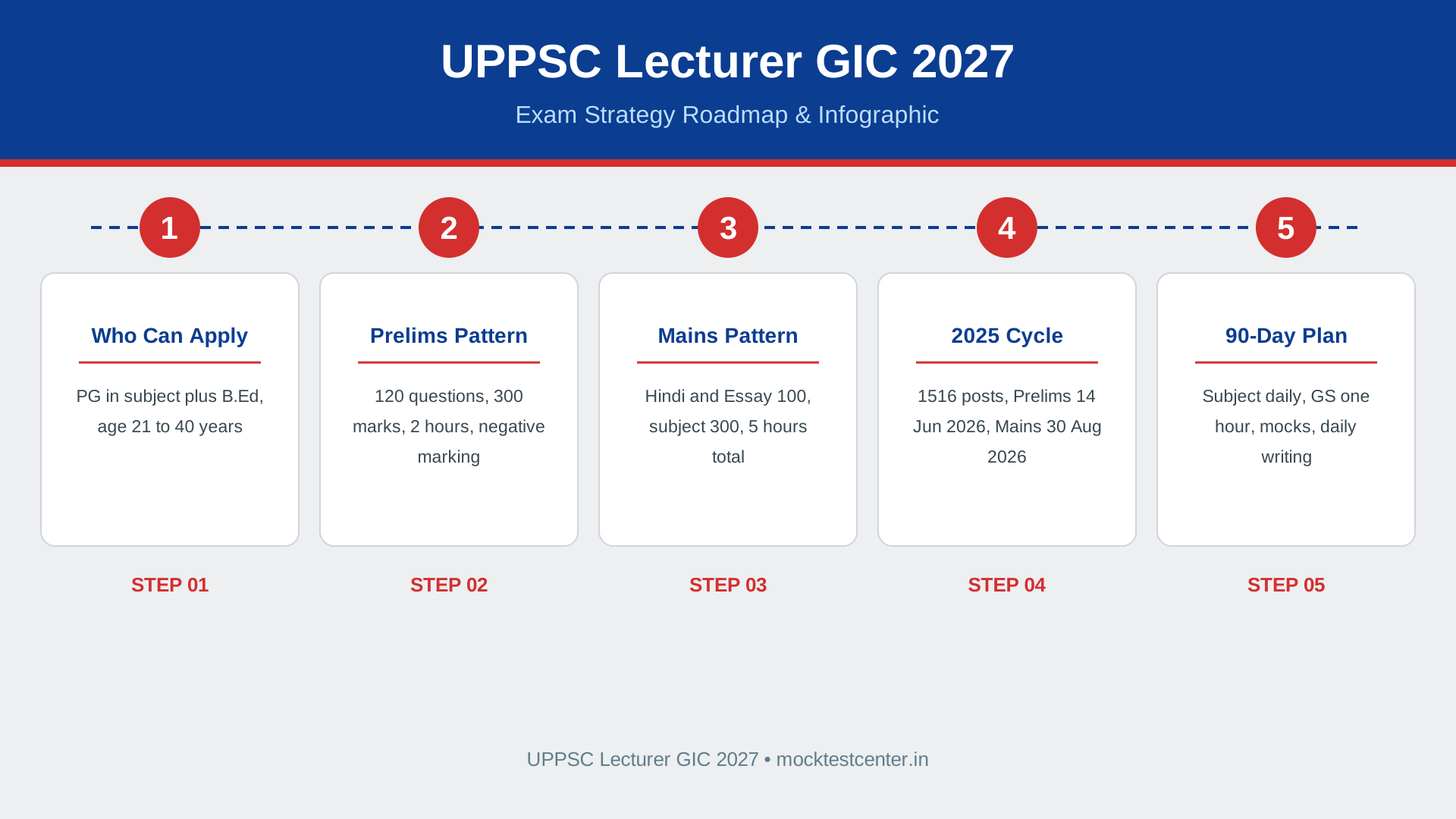
The Prelims paper screens candidates, and only the candidates who clear it sit for the Mains. UPPSC holds the Prelims as an objective paper with multiple choice questions, and the paper runs for two hours. The paper carries 120 questions for 300 marks, and the split gives the subject the larger share by design.
General Studies carries 40 questions, and the subject paper carries 80 questions. The marks follow a different split from the question count, because General Studies carries 100 marks and the subject carries 200 marks. A General Studies question carries 2.5 marks, and a subject question also carries 2.5 marks, so the arithmetic stays simple and the subject still decides two thirds of the score.
Negative marking applies in the Prelims, and it bites. UPPSC deducts one third of the marks of a question for every wrong answer, which works out to 0.83 marks lost on a 2.5 mark question. A guess with no basis costs marks, and a paper full of blind guesses can pull a decent score below the cut off line. The Mains carries no such penalty, because the Mains answers run in words, and the Prelims penalty shapes the whole strategy of the first stage.
Only Prelims qualified candidates move to the Mains, and the Prelims marks play no part in the final merit list. The Prelims works as a gate, and the Mains decides the rank. That split changes how a candidate should spend time, because a candidate needs enough Prelims score to pass the gate, and then needs Mains skill to win a rank.
| Prelims section | Questions | Marks | Time |
|---|---|---|---|
| General Studies | 40 | 100 | Shared 2 hours |
| Optional subject | 80 | 200 | Shared 2 hours |
| Total | 120 | 300 | 2 hours |
| Negative marking | One third of question marks | 0.83 marks per wrong answer | Applies to Prelims only |
| Mode | Offline OMR | Objective multiple choice | Single sitting |
General Studies covers a wide field, and the syllabus lists General Science, History of India, the Indian National Movement, Indian Polity, Economy and Culture, Indian Agriculture, Commerce and Trade, World and Indian Geography, Current Events, Logic and Reasoning, knowledge of Uttar Pradesh, Elementary Mathematics up to Class 8 level, and Ecology and Environment. The UP focus runs through the section, because the commission tests knowledge of the state where the candidate will teach.
The subject section tests the postgraduate syllabus of the chosen subject, and it carries twice the marks of General Studies. A candidate who knows the subject well can pass the gate even with an average General Studies score, and a candidate who knows only General Studies cannot pass the gate at all, because 80 of the 120 questions sit in the subject.
Speed matters in a two hour paper with 120 questions. A candidate gets one minute per question on average, and the paper leaves no room for long thought on a single question. The mock test section of this guide explains how to build that speed without losing accuracy.
The UPPSC PCS 2027 page follows a different Prelims shape, with two papers and a different mark split, so a candidate who prepares for both exams should keep the two patterns separate in the mind and never mix the mark counts.
The Mains paper: where the rank gets decided
The Mains paper decides the final merit, and it tests writing skill as much as subject knowledge. UPPSC holds the Mains as a descriptive exam with two papers, and the two papers run on the same day in the 2025 cycle plan. Paper 1 carries General Hindi and Essay for 100 marks in two hours, and Paper 2 carries the optional subject for 300 marks in three hours.
Paper 1 splits its 100 marks between General Hindi and an essay, and the Hindi part tests grammar, vocabulary and comprehension through unseen passages, synonyms, antonyms, sandhi, samas, sentence correction, idioms and phrases, and the major dialects of Uttar Pradesh. The essay part asks for a long piece of writing on a general topic, and it tests structure, clarity and the ability to build an argument in Hindi. A candidate who writes Hindi every day holds a clear edge here, because the paper rewards practice more than memory.
Paper 2 runs for three hours and carries 300 marks, and it tests the subject in descriptive form. The questions ask for long answers, and the candidate must explain concepts, work through problems, quote examples and build a full answer in the time allowed. A subject expert who cannot write fast loses marks here, and a good writer with thin subject knowledge also loses marks, because the paper needs both at once.
| Mains paper | Subject | Marks | Time |
|---|---|---|---|
| Paper 1 | General Hindi and Essay | 100 | 2 hours |
| Paper 2 | Optional subject descriptive | 300 | 3 hours |
| Total | Two papers | 400 | 5 hours |
| Negative marking | None in Mains | Descriptive answers | Writing skill counts |
Five hours of writing in one day tests stamina as much as knowledge. A candidate who has never written for five hours in a day will slow down in the second paper, and the handwriting will suffer, and the answers will shorten. The plan section of this guide builds that stamina week by week, because stamina grows only through practice.
The Mains result follows the descriptive papers, and the commission then calls qualified candidates for document verification. No interview stage appears in the 2025 selection process for this post, and the merit list rests on the Mains marks. Candidates should check the 2027 notice for any change to that rule, because UPPSC can add a stage in a fresh advertisement, and the notice alone settles the question.
Document verification checks the degree, the B.Ed. certificate, the age proof, the category certificate and the domicile proof, and a candidate with a wrong certificate loses the post at that stage even with a top rank. Keep every certificate ready before the Mains, and check the name spelling on each one against the application form.
The UPPSC RO ARO 2027 page shows a Mains with a different paper set, so a candidate who sits for both should read the two Mains patterns side by side and prepare the Hindi paper once for both exams where the syllabus overlaps.
Who can apply: the eligibility rule in full
The eligibility rule has two parts, and both parts must hold on the last date of the application window. First, the candidate needs a postgraduate degree in the subject applied for, from a university established by law in India or a deemed university or an institution established by law in India. Second, the candidate needs a B.Ed. degree in a course recognised by the National Council for Teacher Education, known as NCTE.
The subject list runs to 13 subjects for the main GIC posts, and the list reads Sociology, Geography, Economics, Civics, Physics, Chemistry, Mathematics, English, History, Biology, Hindi, Urdu and Sanskrit. History accepts a postgraduate degree in Ancient History, Medieval History or Modern History. Biology accepts a postgraduate degree in Botany or Zoology. Hindi needs a postgraduate degree in Hindi plus graduation in Arts with Sanskrit as a subject, a rule that trips candidates who hold a Hindi postgraduate degree without Sanskrit at graduation level.
The Sparsh Inter College posts for visually handicapped schools cover Sociology, Economics, Civics, English, History, Hindi and Sanskrit, and they need a B.Ed. with Special B.Ed. or M.Ed. in Visual Impairment or Hearing Impairment recognised by the Rehabilitation Council of India. The Jail Training School Lecturer post in Psychology needs a Master degree in Psychology with a paper in Criminal Psychology, and that post sits outside the main GIC subject list.
A candidate should match the postgraduate subject to the post subject exactly, because a near match fails the document check. A postgraduate degree in Commerce does not fit an Economics post, and a postgraduate degree in Political Science fits the Civics post, because the notice groups Civics with Political Science. Read the subject table in the notice line by line before applying, and apply only for the subject where the degree matches.
| Subject | Postgraduate degree needed | B.Ed. needed |
|---|---|---|
| Sociology | Postgraduate degree in Sociology | B.Ed. recognised by NCTE |
| Geography | Postgraduate degree in Geography | B.Ed. recognised by NCTE |
| Economics | Postgraduate degree in Economics | B.Ed. recognised by NCTE |
| Civics | Postgraduate degree in Civics or Political Science | B.Ed. recognised by NCTE |
| Physics | Postgraduate degree in Physics | B.Ed. recognised by NCTE |
| Chemistry | Postgraduate degree in Chemistry | B.Ed. recognised by NCTE |
| Mathematics | Postgraduate degree in Mathematics | B.Ed. recognised by NCTE |
| English | Postgraduate degree in English | B.Ed. recognised by NCTE |
| History | Postgraduate degree in Ancient, Medieval or Modern History | B.Ed. recognised by NCTE |
| Biology | Postgraduate degree in Botany or Zoology | B.Ed. recognised by NCTE |
| Hindi | Postgraduate degree in Hindi plus Arts graduation with Sanskrit | B.Ed. recognised by NCTE |
| Urdu | Postgraduate degree in Urdu | B.Ed. recognised by NCTE |
| Sanskrit | Postgraduate degree in Sanskrit | B.Ed. recognised by NCTE |
Preferential qualifications appear in the notice, and they help at the merit stage. Service in the Territorial Army for two years, or a B certificate of the National Cadet Corps, counts as a preferential qualification for the GIC Lecturer posts. A preferential qualification does not replace the degree rule, and it does not add marks by itself, but it can tip a close merit decision, so a candidate who holds it should claim it in the form.
Final year postgraduate students face a hard line. The notice needs the degree complete by the last date, and a candidate who waits for a result after that date fails the eligibility check. A B.Ed. student in the final semester faces the same line. Plan the application around the degree dates, and apply only when both degrees sit in hand or will complete before the last date the notice fixes.
UPPSC runs One Time Registration, known as OTR, and a candidate must complete OTR at least 72 hours before filling the application form. The OTR portal sits at otr.pariksha.nic.in, and the OTR number stays valid for later UPPSC exams. A candidate who leaves OTR to the last day can miss the window entirely, because the 72 hour gap blocks a same day application.
The UPPSC Assistant Professor 2027 page needs a postgraduate degree with a higher mark percentage and a different teaching qualification, so a candidate who holds a B.Ed. should not assume the same degree fits both posts without reading the Assistant Professor notice.
Age limit and relaxations
The age limit runs from 21 years to 40 years as on 1 July 2025 for the 2025 cycle. A candidate must have been born on or after 2 July 1985 and on or before 1 July 2004 to meet that window. The 2027 cycle will fix its own reference date, and the notice will state whether the reference date stays 1 July of the advertisement year or moves.
Relaxation adds years to the upper limit for reserved categories of Uttar Pradesh. SC, ST and OBC candidates of Uttar Pradesh get five extra years. Skilled sportspersons of Uttar Pradesh get five extra years. State government employees of Uttar Pradesh get five extra years. Teachers in aided institutions get five extra years. Physically handicapped candidates of Uttar Pradesh get fifteen extra years, which lifts the upper limit to 55 years for that group.
Ex servicemen get relaxation under the state rules, and the notice states the exact addition for that group. A candidate who claims relaxation must hold the certificate that proves the category, and the certificate must match the category claimed in the form, because a mismatch at document verification ends the candidature.
Age counts from the date of birth on the High School certificate, and UPPSC treats that certificate as the final proof. A candidate who finds a mismatch between the High School certificate and the other documents should fix it before applying, because the commission will not accept an affidavit as a substitute for the certificate.
Twenty one years as the lower limit means a candidate who finished a postgraduate degree early can still apply, and many toppers in this exam sit in their early twenties. Forty years as the upper limit gives a long window, and many candidates sit for this exam after years of teaching in a private school while they complete the B.Ed. degree.
The UPPSC PCS J 2027 page carries a different age window, so a law graduate who also holds a teaching degree should read the two age rules separately and never carry the GIC window into a PCS J form.
Vacancies, pay and fee from the 2025 cycle
The 2025 cycle announced 1,516 vacancies in the headline count, and the post wise break up reads 777 Lecturer posts in the male branch of Government Inter Colleges, 694 Lecturer posts in the female branch, 45 Lecturer posts in Sparsh schools for visually handicapped students, and 2 Lecturer posts in the Jail Training School. Those four numbers add to 1,518, and that arithmetic gap sits in the sources themselves.
Some trackers report 1,516 as the total, and some report 1,518, and the notice headline says 1,516 while the post wise table adds to 1,518. This guide uses 1,516 as the headline number and shows the four parts, because a candidate should see the gap rather than read a smoothed total. The 2027 notice will fix its own count, and the 2027 count will differ from both numbers.
Male branch subject counts show the spread. English carries 100 posts in the male branch, Hindi carries 82, Physics carries 86, Chemistry carries 85, Biology carries 73, Mathematics carries 94, Sanskrit carries 36 and Urdu carries 27. Female branch counts run in the same range, with Hindi at 80 posts and Physics at 104 posts. A candidate should read the subject wise table for the own subject, because the competition differs sharply between a subject with 100 posts and a subject with 27 posts.
| Post | Vacancies 2025 | Pay level | Pay range in rupees |
|---|---|---|---|
| Lecturer Male GIC | 777 | Level 8 | 47600 to 151100 |
| Lecturer Female GIC | 694 | Level 8 | 47600 to 151100 |
| Lecturer Sparsh schools | 45 | Level 8 | 47600 to 151100 |
| Lecturer Jail Training School | 2 | Level 7 | 44900 to 142400 |
| Headline total in notice | 1516 | See rows above | See rows above |
The pay for a GIC Lecturer sits in Pay Level 8 of the pay matrix, with a range from 47,600 rupees to 1,51,100 rupees and a grade pay of 4,800 rupees. The Jail Training School Lecturer sits in Pay Level 7, with a range from 44,900 rupees to 1,42,400 rupees. Dearness allowance, house rent allowance and other state allowances sit on top of the basic pay, and the in hand salary at entry runs well above the basic pay figure.
One source reports Level 10 pay of 56,100 rupees to 1,77,500 rupees for this post, and that figure belongs to a different post, because the 2025 notice and the majority of trackers put the GIC Lecturer in Level 8. This guide uses Level 8, and a candidate should trust the notice pay table over any single tracker page.
The application fee for 2025 reads 125 rupees in total for General, OBC and EWS candidates, made of a 100 rupee exam fee plus a 25 rupee online processing fee. SC and ST candidates pay 65 rupees in total, made of a 40 rupee exam fee plus a 25 rupee processing fee. PwD candidates pay 25 rupees, which covers the processing fee alone. Ex servicemen pay 65 rupees. The fee goes online only, and UPPSC refunds no fee once paid.
| Category | Exam fee in rupees | Processing fee in rupees | Total fee in rupees |
|---|---|---|---|
| General, OBC, EWS | 100 | 25 | 125 |
| SC, ST | 40 | 25 | 65 |
| PwD | 0 | 25 | 25 |
| Ex servicemen | 40 | 25 | 65 |
The UPPSC Staff Nurse 2027 page carries the same fee table, because UPPSC uses the same fee structure across many of its advertisements, and a candidate who applies for both exams pays the fee twice, once per application.
The 2025 cycle: what happened, date by date
UPPSC released the 2025 notification on 12 August 2025 under Advertisement Number A-6/E-1/2025. Applications ran from 12 August to 12 September 2025, and the fee last date matched the application last date. The correction window opened on 19 September 2025, and candidates could fix small errors in the form during that window.
The UPPSC exam calendar for 2026, released on 30 January 2026, put the GIC Lecturer Prelims on 3 May 2026 and the Mains on 30 August 2026. Those calendar dates were proposed dates, and the commission changed the Prelims date in practice. The Prelims actually ran on 14 June 2026 for 13 subjects, and on 17 June 2026 for Psychology, Criminology and Penology, which fall under the Jail Training School posts.
That shift matters, because a candidate who trusted the calendar date alone would have reached the exam hall six weeks early in the mind and then faced a different date in reality. The lesson stays simple. The calendar gives a plan, and the admit card gives the date. Check the admit card, and never treat a calendar date as final.
The 13 subjects in the 14 June Prelims read Sociology, Geography, Hindi, English, Physics, Chemistry, Mathematics, Economics, Civics, History, Biology, Urdu and Sanskrit. The result came in phases, with the first subject results on 20 July 2026 and further subject results on 24 July 2026. The qualified counts show the scale of the exam, with Chemistry sending 2,395 candidates to the Mains, English sending 2,571, History sending 1,586, Sociology sending 806, Geography sending 1,927, Economics sending 924, Civics sending 2,323 and Physics sending 1,575.
Hindi sent 4,314 candidates to the Mains from 17,393 candidates who appeared, out of 53,924 enrolled. Urdu sent 762 from 1,666 who appeared, out of 4,315 enrolled. Sanskrit sent 1,779 from 5,433 who appeared, out of 18,616 enrolled. Those three numbers show how many enrolled candidates never reach the hall, and how the Mains list still runs into thousands.
The Mains form opened on 29 July 2026, and qualified candidates could submit the Mains application till 12 August 2026. The hard copy of the application had to reach the UPPSC office by 19 August 2026 at 5 PM. The Mains exam stayed on 30 August 2026, the calendar date, so the Mains date held while the Prelims date moved.
The UPPSC Assistant Engineer 2027 page shows a calendar date that also moved in its own cycle, and the same lesson applies there, because UPPSC revises calendar dates through separate notices and the admit card always wins.
The syllabus: General Studies, Hindi and the subject
The Prelims General Studies syllabus covers a broad field, and a candidate should read it as a list of small topics rather than a single subject. General Science at High School level, History of India, the Indian National Movement, Indian Polity, Economy and Culture, Indian Agriculture, Commerce and Trade, World Geography and Indian Geography, Current Events, Logic and Reasoning, knowledge of Uttar Pradesh in education and culture, Elementary Mathematics up to Class 8 level, and Ecology and Environment form the list.
Current Events needs a daily habit, because the paper asks about events from the months before the exam, and a candidate who reads the news only in the last week will miss the questions. Uttar Pradesh knowledge needs a separate notebook, because the commission asks about the state schemes, the state geography, the state culture and the state education system, and a national level book covers none of that in depth.
Elementary Mathematics up to Class 8 level sounds easy, and it traps candidates who skip it. The questions test speed in arithmetic, percentages, ratios, averages and simple geometry, and a candidate who practises ten sums a day will answer them in seconds while a candidate who ignores them will lose easy marks.
The Mains General Hindi syllabus tests unseen passages, vocabulary through synonyms and antonyms, grammar through sandhi and samas, sentence correction, idioms and phrases, and the major dialects of Uttar Pradesh. The essay needs a structure that a candidate can repeat under pressure, with a clear opening, three or four points in the middle and a short close, and the essay topic can come from a social issue, an education issue or a current event.
The subject syllabus follows the postgraduate syllabus of the chosen subject, and the candidate should download it from the official portal and print it. A Physics candidate works through mechanics, thermodynamics, optics, electricity and modern physics. A Mathematics candidate works through algebra, calculus, geometry, probability, group theory and linear algebra. An English candidate works through British literature, Indian literature, world literature, literary movements, criticism, grammar and comprehension. A Chemistry candidate works through physical chemistry, inorganic chemistry, organic chemistry, biomolecules and polymers. A Sanskrit candidate works through Vedic texts, Upanishads, grammar, philosophy, poetics and drama. A Civics candidate works through political theories, the Indian Constitution, governance, public administration and foreign policy. A Geography candidate works through physical geography, human geography, economic geography, Indian geography, environment and resources.
The UPPSC TGT 2027 page covers a school teaching post with a different syllabus depth, and a candidate who prepares for both GIC and TGT should note that the GIC subject paper runs at postgraduate level while the TGT paper runs at graduate level.
Books that cover the syllabus without waste
Books should follow the syllabus, and a candidate should buy few books and finish them. Six sources cover the exam, and each one earns its place for a different reason. The NCERT books for Classes 11 and 12 in the subject give the base, and a candidate who has never taught the subject should start there. The standard postgraduate textbook in the subject gives the depth, and the candidate should read it chapter by chapter against the syllabus.
Lucent General Knowledge gives the General Studies base in one volume, and it suits the Prelims because the paper asks for facts across many topics. A UP general knowledge book gives the state part, and the candidate should keep it beside Lucent, because a national book will not cover the state schemes and the state geography in the depth the paper needs.
For General Hindi, a standard Hindi grammar book that covers sandhi, samas, synonyms, antonyms, idioms and sentence correction will serve the Mains Paper 1, and the candidate should solve its exercises rather than read it like a novel. An essay book helps only as a source of topics, because the essay skill grows through writing, and a candidate who reads essays without writing any will not improve.
Previous year papers give the best return on time. Solve the GIC Lecturer previous papers year by year, and mark each question against the syllabus topic it belongs to. The pattern of repeated topics will show itself within three years of papers, and the candidate can then give those topics extra hours.
Buy the latest edition of each book, and check the edition year before paying. A book from 2019 still teaches the syllabus, because the syllabus changes slowly, but a newer edition carries better questions and cleaner answers. Keep one book open at a time, and finish one book before buying the next, because a shelf full of unread books helps no one.
The UPPSC APO 2027 page lists a different book set for law, so a candidate who prepares for both exams should keep the two book lists on separate shelves and never mix the reading hours.
A 90 day plan that fits real life
Ninety days divide into three parts, and each part has one job. Days 1 to 30 build the base. Read the syllabus topic by topic, two topics a week in the subject, and make short notes as you read. Give General Studies one hour a day in this phase, and give the subject three hours a day. End each week with a previous year paper, solved without a time limit, and mark the questions you got wrong.
Days 31 to 60 build speed. Start timed practice, one full Prelims set every third day, and one Hindi essay every week. Revise the notes every Sunday, and rewrite the notes that feel thin. This phase shows the weak topics, and the wise move gives the weakest topic the most hours, even when the strongest topic feels better to study. A plan that only feeds strengths leaves the weak topic to cost marks on exam day.
Days 61 to 90 build exam fitness. Sit for a full mock every second day, 120 questions in two hours, in one sitting, with no phone and no notes. Analyse each mock the same evening, and write down three things, the topics that cost marks, the question types that ate time, and the silly errors. Revise only from the notes and the error list in the last ten days, and stop learning new material five days before the exam.
Working candidates can follow the same plan with smaller daily hours. Two hours a day for ninety days beats six hours a day for thirty days, because the syllabus needs repetition more than it needs long sittings. Keep a simple daily log with the date, the hours, the topics covered and the questions solved, and the log itself will keep you honest when motivation dips.
Mains writing needs its own slot from day 31 onward. Write one long subject answer every day, timed at 15 minutes, and write one Hindi essay every week, timed at 45 minutes. A candidate who starts Mains writing only after the Prelims result will find five hours of writing on exam day far harder than a candidate who has written every day for two months.
The UPPSC Medical Officer 2027 page uses a different plan shape, because a medical exam tests clinical knowledge in a different way, so a candidate who sits for both should keep two separate logs and two separate daily targets.
Mock test method: how to use mocks without wasting them
A mock test measures, and the analysis after it teaches. Sit for the mock in exam conditions, two hours, one sitting, no phone, no notes. The Prelims mock should mirror the real split, 40 General Studies questions and 80 subject questions, and the timer should run without a pause.
Analyse the mock the same day, while the questions still feel fresh. Sort every wrong answer into three piles, concept gap, silly error and time pressure. Concept gaps need a return to the book. Silly errors need a slower reading habit. Time pressure needs more timed sets. A mock without this sorting wastes two hours, because the score alone teaches nothing.
Use the negative marking rule in the last fifteen minutes of every paper. With a penalty of one third of the marks, a blind guess costs marks, so mark an answer only when you can remove at least one wrong option. Guess with sense, remove the options you know are wrong, and pick from what remains. A mock gives the place to practise this, so the habit feels natural on exam day.
Take mocks from the full syllabus, and mix subjects only for General Studies. The subject mocks should stay inside the chosen subject, because a mixed mock hides the weak topics. Keep a running table of the mock scores, General Studies and subject separately, and watch the trend across weeks, because a rising trend shows the plan works and a flat trend shows the plan needs a change.
For the Mains, a mock means writing. Write Paper 1 and Paper 2 on the same day once a fortnight, five hours in total, and check the answers against the syllabus the same evening. A candidate who writes only in the head will find the hand slow on exam day, and a candidate who writes on paper will find the speed already there.
The UPPSC ACF RFO 2027 page carries a mock method for a science heavy paper, and the same analysis habit applies there, because the sorting of errors works for every objective paper.
Mistakes that cost good candidates marks
The first mistake starts without the syllabus. Candidates read random books for months and then find the paper asking about topics they never opened. Print the syllabus, pin it on the wall, and tick each topic as you finish it.
The second mistake reads General Studies last. General Studies carries 100 marks, a third of the Prelims total, and candidates who leave it to the final month score far below their subject level. One hour a day from day one keeps General Studies level with the subject, and a level General Studies score saves many borderline results.
The third mistake collects books instead of finishing them. Many candidates memorise names and skip the concepts. The paper tests concepts through examples, so a candidate who knows the name and not the idea gives away marks.
The fourth mistake takes mocks and skips the analysis. A mock score without analysis gives a number without a lesson, and a candidate who repeats the same errors in ten mocks learns nothing from any of them. Analyse every mock, write the error list, and fix one error type before the next mock.
The fifth mistake trusts unofficial dates. Websites guess the 2027 dates every year, and candidates who plan around a guessed date lose weeks. Trust only the official portal, and plan around the syllabus until the notice arrives.
The sixth mistake applies for the wrong subject. A candidate with a postgraduate degree in one subject applies for another subject where the degree does not fit, and the form passes the online check but fails at document verification. Read the subject table in the notice before paying the fee, because the fee never comes back.
The UPPSC Polytechnic Lecturer 2027 page carries its own mistake list for a technical exam, and the same warning about the wrong subject applies there, because the branch must match the degree.
What to check the day the 2027 notice arrives
Read the notice on the official portal, uppsc.up.nic.in, and check seven things in order. First, the application window and the last date for fee payment. Second, the vacancy count by post and by subject. Third, the age reference date. Fourth, the eligibility table for the own subject, including the Hindi Sanskrit rule and the Sparsh rules. Fifth, the fee for the own category. Sixth, the Prelims date and the Mains date. Seventh, the correction window dates.
Apply early in the window, and keep a copy of the filled form, the fee receipt and the application number. Check the photo, the signature, the category and the subject before submitting, because the correction window fixes small errors and never fixes a wrong subject. Complete OTR first, and remember the 72 hour gap between OTR and the application.
Then return to the plan, and let the notice change the dates, not the study. A candidate who has covered the syllabus, solved the previous year papers and taken the mocks will meet the notice with calm, and a candidate who waits for the notice will meet it with panic. Start now, and let UPPSC Lecturer GIC 2027 find you ready.
Sources: UPPSC official portal uppsc.up.nic.in; UPPSC Exam Calendar 2026 released 30 January 2026; Advertisement Number A-6/E-1/2025; OTR portal otr.pariksha.nic.in.







