
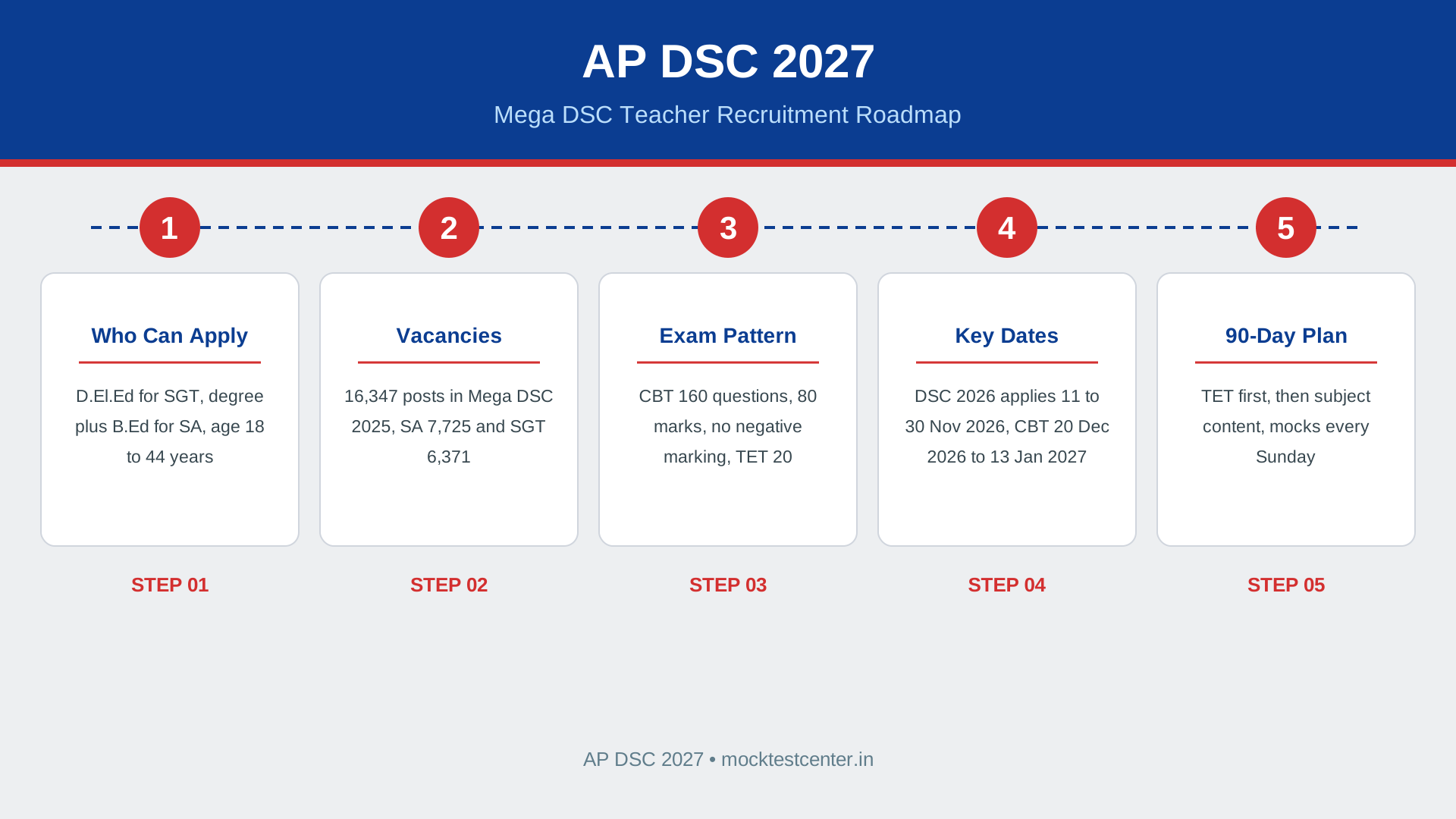
About AP DSC 2027 Exam Series
📖 Table of Contents
- AP DSC 2027 and the Mega DSC 2025 cycle in numbers
- The 16,347 posts, post by post
- DSC 2026 is open right now, and it changes your calendar
- Which post fits your qualification
- The exam pattern, post by post
- The 80-20 rule, and why your TET score is a fifth of your rank
- Who can apply: eligibility, age and the local quota
- What the syllabus actually covers
- Fee, pay and what the job is worth
- Cut offs: read them off the merit list
- A 90 day plan that fits the paper
- Books that match the syllabus
- Mistakes that cost candidates a post
- How to apply when the next notification lands
- Sources
AP DSC 2027: Mega DSC Teacher Recruitment Guide
Andhra Pradesh filled 15,941 teacher posts through the Mega DSC 2025 drive, out of 16,347 advertised, and 5,77,675 applications came in from 3,36,307 candidates. The final selection lists came out on 15 September 2025, and appointment orders followed on 25 September 2025. AP DSC 2027 has no notification yet as of 20 November 2026, so every fact in this guide comes from the Mega DSC 2025 cycle and the DSC 2026 cycle that is open right now. If you plan to sit for AP DSC 2027, those two cycles are the closest picture you have of the posts, the pattern, the age limits and the fees.
DSC stands for District Selection Committee, and the exam itself is the Andhra Pradesh Teacher Recruitment Test, or APTRT. The School Education Department runs it for teacher posts in government schools, Zilla Parishad schools, Mandal Parishad schools, municipal schools, Tribal Welfare Ashram schools, Juvenile Welfare schools, Differently Abled Welfare schools, and the residential school societies. One drive can cover primary teachers, high school assistants, postgraduate teachers and principals, so the first decision you make is which post fits your qualification. This guide works through that decision post by post, then the pattern, the 80-20 TET rule, the eligibility lines, the syllabus, the pay, the cut offs, and a 90 day plan.
AP DSC 2027 and the Mega DSC 2025 cycle in numbers
| Item | Detail |
|---|---|
| Conducting body | School Education Department, Government of Andhra Pradesh |
| Exam name | Andhra Pradesh Teacher Recruitment Test (APTRT), known as DSC |
| Latest big cycle | Mega DSC 2025, Notifications 01 and 02/Mega DSC-TRC-1/2025, dated 20 April 2025 |
| Rules behind it | G.O.Ms.No.15 and G.O.Ms.No.16, School Education (Services-I) Department, dated 19 April 2025 |
| Posts in Mega DSC 2025 | 16,347 |
| Application window | 20 April 2025 to 15 May 2025, online only |
| Fee, Mega DSC 2025 | Rs 750 per post, paid separately for each post |
| Computer Based Test | 6 June 2025 to 6 July 2025, with the last papers held on 1 and 2 July 2025 |
| Applications received | 5,77,675 applications from 3,36,307 candidates |
| Final selection lists | 15 September 2025, with 15,941 selected and 406 posts unfilled |
| Appointment orders | 25 September 2025 |
| 2027 notification | Not issued as of 20 November 2026 |
Those numbers tell you how the drive ran. The government moved from notification to final lists in about five months, and the Times of India put the whole process at 150 days from the first file to the final list. The department released the initial answer key on 5 July 2025, took objections till 12 July, published the final key on 1 August, and put out scorecards on 11 August. Merit lists came on 22 August, and the final selection lists on 15 September. About 1.4 lakh objections came in against the draft keys, and the department answered them before the final key. That pace matters for your planning. A DSC cycle does not drag on for two years. From the day the notification lands, you have about four weeks to apply and about seven weeks to the exam, so the preparation has to start before the notification, not after it.
Divide 5,77,675 applications by 16,347 posts and you get about 35 applications for each post. Use the 3,36,307 candidates instead and the figure drops to about 21 candidates per post. Both numbers are far kinder than the ratios in the big national exams, and they hide the real split. School Assistant posts drew the heaviest rush, and some district and subject combinations were far tighter than the state average. Women formed 49.9 percent of the selected candidates. The 406 unfilled posts stayed vacant because no eligible candidate was available in those categories, and the government said those posts will carry forward to the next DSC. That is the first useful fact for the 2027 cycle. The next notification will carry those 406 posts plus fresh vacancies.
The 16,347 posts, post by post
| Post | Posts | Where the post sits |
|---|---|---|
| School Assistant (SA) | 7,725 | Government, Zilla Parishad, Mandal Parishad, municipal and Tribal Welfare Ashram schools |
| Secondary Grade Teacher (SGT) | 6,371 | Primary and upper primary schools under the same managements |
| Trained Graduate Teacher (TGT) | 1,781 | Residential schools and special education schools |
| Post Graduate Teacher (PGT) | 286 | Model schools and residential societies |
| Physical Education Teacher (PET) | 132 | Residential schools, Juvenile Welfare and Differently Abled schools |
| Principal | 52 | Model schools and residential societies |
| Total | 16,347 | Across 26 districts and the residential societies |
The split above is the post-wise summary from the notification, and the six figures add up to 16,347. School Assistants alone took 7,725 posts, nearly half the drive, and Secondary Grade Teachers took 6,371. Those two posts are the heart of the exam. TGT posts, at 1,781, went mostly to the residential societies and to special education schools. PGT posts, at 286, and Principal posts, at 52, went to the Model Schools, the Andhra Pradesh Residential Educational Institutions Society, the Social Welfare Residential Society, the Tribal Welfare Residential Society, and the BC Welfare residential schools. PET posts, at 132, went to the same societies plus the Juvenile Welfare and Differently Abled schools.
The department-wise split shows the same picture from the other side. Government, Zilla Parishad, Mandal Parishad, municipal and municipal corporation schools took 13,192 posts. Tribal Welfare Gurukulam schools took 1,143, Tribal Welfare Ashram schools took 881, the Social Welfare Residential Society took 439, the Model Schools took 286, the Residential Educational Institutions Society took 190, the BC Welfare Residential Society took 170, the Differently Abled schools took 31, and the Juvenile Welfare schools took 15. Add those nine figures and you reach 16,347 again. Kurnool district held the largest single share, with 2,678 posts in the district-wise table.
Two notes belong here before you pick a post. First, the School Assistant figure covers language and non-language subjects together. Language subjects include Telugu, Hindi, English, Urdu, Tamil, Oriya, Kannada and Sanskrit, and the language teacher cadre in Andhra Pradesh is the Language Pandit. Pandit Training counts as an accepted training qualification for the Telugu School Assistant post under the 2025 rules, and Language Pandit posts sit inside the School Assistant language stream rather than as a separate head in the vacancy summary. No separate Language Pandit vacancy count was published in the headline split. Second, the special education posts sit under their own rules. Trained Graduate Teachers for special education, Secondary Grade Teachers for special education, and Physical Education Teachers in Differently Abled schools follow G.O.Ms.No.15, and their courses must carry Rehabilitation Council of India recognition alongside NCTE recognition.
DSC 2026 is open right now, and it changes your calendar
A new DSC cycle landed while this guide was being written, and you should know about it before you plan anything else. The School Education Department issued a brief notification on 13 October 2026, then three detailed notifications on 5 November 2026, numbered 01, 02 and 03/DSC-TRC-1/2026, for 2,721 teacher posts under the Andhra Pradesh Teacher Recruitment Test 2026. Applications run from 11 November to 30 November 2026 on the official portal tet2dsc.apcfss.in, and the Computer Based Test runs from 20 December 2026 to 13 January 2027. The fee is Rs 1,000 for each post, up from Rs 750 in the Mega DSC 2025 drive.
| Notification | Posts | Split |
|---|---|---|
| 01/DSC-TRC-1/2026, regular schools | 2,111 | School Assistant 906, Secondary Grade Teacher 1,205 |
| 02/DSC-TRC-1/2026, special education | 350 | School Assistant 150, Secondary Grade Teacher 200 |
| 03/DSC-TRC-1/2026, societies | 260 | Principal 30, PGT 81, TGT 113, Physical Director 2, PET 34 |
| Total | 2,721 | Three notifications, three different sets of rules |
The three notifications carry three separate Schemes of Selection Rules, G.O.Ms.No.52 for regular schools, G.O.Ms.No.51 for special education, and G.O.Ms.No.50 for the societies, all dated 4 November 2026. Do not treat the 2,721 posts as one pool. Each notification has its own vacancy list, its own eligibility clauses, and its own selection provisions. One point of naming causes confusion every cycle. APTRT is the name of the test and DSC is the name of the recruitment. They are not two exams. The 2025 notification itself invites applications through the Andhra Pradesh Teacher Recruitment Test under the District Selection Committee, and the 2026 cycle carries the same two names as APTRT 2026 and DSC 2026.
The age limit for the 2026 cycle is 18 to 44 years as on 1 July 2026, with 49 years for SC, ST, BC and EWS candidates and 54 years for persons with benchmark disabilities. If you are eligible for DSC 2026, apply in this window. The exam starts on 20 December 2026, which leaves about three weeks between the closing date and the first paper. That is the shape of every DSC cycle. The notification gives you weeks, not months.
Which post fits your qualification
Pick the post first and the books second, because the pattern, the TET rule and the syllabus all change with the post. A candidate with Intermediate and a Diploma in Elementary Education belongs in the SGT race. A graduate with a B.Ed belongs in the School Assistant race. A postgraduate with a B.Ed belongs in the PGT race, and a postgraduate with a B.Ed and teaching experience belongs in the Principal race. The table below gives the short version. The eligibility section later in this guide gives the full version with the marks percentages.
| Post | School level | Core qualification | TET needed |
|---|---|---|---|
| Secondary Grade Teacher | Classes 1 to 5, and upper primary | Intermediate plus D.El.Ed or B.El.Ed | Yes, Paper 1 |
| School Assistant | Classes 6 to 10 | Graduation in the subject plus B.Ed | Yes, Paper 2 |
| School Assistant, Physical Education | Classes 6 to 10 | Graduation plus B.P.Ed | No |
| Trained Graduate Teacher | Residential and special schools | Degree in the subject plus B.Ed | Yes, Paper 2 |
| Post Graduate Teacher | Intermediate, Classes 11 and 12 | Post graduation in the subject plus B.Ed | No |
| Physical Education Teacher | Residential and special schools | Graduation plus B.P.Ed | No |
| Principal | Model and residential schools | Post graduation plus B.Ed and teaching experience | No |
Two mistakes show up every cycle at this stage. The first is applying for a School Assistant post with a degree in one subject and a B.Ed methodology in another. The methodology subject in your B.Ed must match the post you apply for, and the rules list the accepted combinations subject by subject. A mathematics graduate with a social studies methodology cannot claim a mathematics School Assistant post. The second mistake is applying for an SGT post with a B.Ed but no D.El.Ed. A B.Ed alone does not qualify you for SGT. You need the elementary education diploma or the four-year B.El.Ed, plus Intermediate with the required percentage, plus a pass in TET Paper 1.
The exam pattern, post by post
Every DSC paper is a Computer Based Test with multiple choice questions, and every question carries 0.5 marks. There is no negative marking, so an attempted question can only add marks or add nothing. That single fact shapes the whole attempt strategy, and it is confirmed across the pattern tables for the 2025 and 2026 cycles. Scores are normalised across shifts, because the exam runs over many days and many shifts, and the 2026 rules publish the normalisation formula. Your raw score is not necessarily the score that enters the merit list. A hard shift is adjusted upward and an easy shift downward, and the calculation runs to five decimal places.
| Post | Questions | Marks | Duration | TET weightage |
|---|---|---|---|---|
| School Assistant | 160 | 80 | 2 hours 30 minutes | 20 marks |
| Secondary Grade Teacher | 160 | 80 | 2 hours 30 minutes | 20 marks |
| School Assistant, Physical Education | 200 | 100 | 3 hours | None |
| Physical Education Teacher | 200 | 100 | 3 hours | None |
| Trained Graduate Teacher, Paper 2 | 160 | 80 | 2 hours 30 minutes | 20 marks |
| Post Graduate Teacher, Paper 2 | 200 | 100 | 3 hours | None |
| Principal, Paper 2 | 200 | 100 | 3 hours | None |
The School Assistant paper splits into five parts. General Knowledge and Current Affairs carries 20 questions for 10 marks. Perspectives in Education carries 10 questions for 5 marks. Classroom Implications of Educational Psychology carries 10 questions for 5 marks. Content of the concerned subject carries 80 questions for 40 marks, and Methodology of the concerned subject carries 40 questions for 20 marks. Content plus methodology of your own subject is 120 of the 160 questions and 60 of the 80 marks. General Knowledge, perspectives and psychology together are worth 20 marks. Spend your time in that proportion.
The SGT paper splits into eight parts, and the balance is different. General Knowledge and Current Affairs carries 16 questions for 8 marks. Perspectives in Education carries 8 questions for 4 marks. Educational Psychology carries 16 questions for 8 marks. Then five subjects carry 24 questions and 12 marks each: Language 1, Language 2 English, Mathematics, Science, and Social Studies. Each of those five splits into 16 questions of content for 8 marks and 8 questions of methodology for 4 marks. No subject is weighted above another, so an SGT candidate cannot afford a weak subject the way a School Assistant candidate can. Language 1 offers Telugu, Urdu, Hindi, Tamil, Oriya, Kannada or Sanskrit, and you pick the one you studied.
The Physical Education paper is the longest single paper in the exam. School Assistant Physical Education and PET both sit for 200 questions and 100 marks in 3 hours. General Knowledge and Current Affairs carries 10 questions for 5 marks, Perspectives in Education carries 10 questions for 5 marks, physical education pedagogy and educational technology carries 40 questions for 20 marks, and Part 4 carries 140 questions for 70 marks. Part 4 covers content, organisation and administration, history, anatomy and physiology, kinesiology and biomechanics, health education and sports injuries, sports medicine and physiotherapy, yoga, recreation, sports training, wellness, sports management, research and statistics, officiating and coaching, sports psychology and sociology, the Olympic movement, and measurement and evaluation. That is a wide syllabus for one paper, and it rewards a candidate who studied physical education as a subject rather than as a hobby.
TGT, PGT and Principal candidates sit for two papers, and the first paper is a gate, not a scoring paper. Paper 1 is an English Language Proficiency Test of 100 questions for 100 marks in 1 hour 30 minutes, set up to Intermediate level. It applies to non-language TGT, non-language PGT, and Principal candidates. Language TGT and language PGT candidates do not sit for it. The marks from Paper 1 never enter the merit list, but the paper is qualifying in nature. If you do not clear it, your Paper 2 is not evaluated. Trackers put the Paper 1 qualifying marks at 60 for OC, BC and EWS candidates and 50 for SC, ST, PH and ex-servicemen, and you should confirm that figure in the bulletin for your cycle. Paper 2 for TGT carries 80 marks in 2 hours 30 minutes: General Knowledge and Current Affairs 10, Perspectives in Education 5, Educational Psychology 5, Content 40, Methodology 20. Paper 2 for PGT carries 100 marks in 3 hours: General Knowledge and Current Affairs 10, Perspectives in Education 10, Educational Psychology 10, Content 50, Methodology 20. Paper 2 for Principal carries 100 marks in 3 hours: General Knowledge and Current Affairs 15, Perspectives in Education 15, Educational Psychology 20, Part 4 worth 35 marks, and Teaching Methodology 15.
The 80-20 rule, and why your TET score is a fifth of your rank
The selection formula is the most misunderstood part of this exam, so read this section twice. For School Assistant, Secondary Grade Teacher, TGT, TGT Special Education and SGT Special Education posts, the total is 100 marks. The written test carries 80 marks and the TET score carries 20 marks. The rule comes straight from G.O.Ms.No.15 of 19 April 2025, and the 2026 rules repeat it in G.O.Ms.No.52. For School Assistant Physical Education, PET, PGT and Principal posts, the total is 100 marks from the written test alone, and no TET score enters the total. TET qualification is not required for those posts at all.
Your TET score counts only if you passed TET. The pass marks are 90 out of 150 for OC and EWS candidates, 75 for BC candidates, and 60 for SC, ST, persons with benchmark disabilities and ex-servicemen. In percentage terms, that is 60 percent, 50 percent and 40 percent. SGT candidates match against APTET Paper 1 or CTET Paper 1. School Assistant and TGT candidates match against APTET Paper 2 or CTET Paper 2. A TET pass in the wrong paper does not help you. An SGT candidate with only a Paper 2 pass, or a School Assistant candidate with only a Paper 1 pass, holds a certificate that the DSC rules will not count.
The conversion is simple arithmetic. Your TET score out of 150 is scaled down to 20 marks. A TET score of 120 out of 150 becomes 16 marks. A TET score of 90 out of 150 becomes 12 marks. Now put that next to the written test. Take two School Assistant candidates. The first scores 70 out of 80 in the written test and 120 out of 150 in TET. Her total is 70 plus 16, which is 86. The second scores 72 out of 80 in the written test and 90 out of 150 in TET. His total is 72 plus 12, which is 84. The second candidate beat the first by 2 marks in the written test and still lost by 2 marks in the final total, because the TET gap was 4 marks. That is the whole story of the 80-20 rule. A strong TET score is worth more than a small edge in the written test, and a weak TET score is a hole that the written test has to fill.
There is no interview and no demonstration in this recruitment. The Minister confirmed after the Mega DSC 2025 final lists that selection followed the 80-20 formula with no interview, and the stages are the written test, the TET weightage, and certificate verification. Selection runs on merit cum roster, which means your total score decides your place inside your category and district roster. Ninety-five percent of district cadre posts go to local candidates under the Presidential Order, and the remaining 5 percent is open competition on merit for local and non-local candidates alike. It is not a separate quota for non-local candidates. The 2026 rules state that plainly, and the 2025 rules rest on the same roster and local reservation framework.
Ties are rare because scores run to five decimal places after normalisation, but the 2026 rules still spell out a five-step tie-break, and it is worth knowing. The elder candidate ranks higher first. If the dates of birth match and the genders differ, the female candidate ranks higher. Then the community order applies: ST, SC Group 1, SC Group 2, SC Group 3, BC A, BC B, BC C, BC D, BC E, EWS, OC. Then the date of passing the professional or training qualification, and finally the date of passing Intermediate for SGT or graduation for School Assistant and Language Pandit posts.
Who can apply: eligibility, age and the local quota
Every candidate must hold all the required certificates on the last date fixed in the notification. The 2025 rules say this without any softening. No relaxation and no exemption is given for a certificate that arrives late. If your B.Ed result comes out a week after the closing date, you cannot apply in that cycle. Check the date on every certificate before you pay the fee, because the fee is charged per post and it does not come back.
| Category, Mega DSC 2025 | Age as on 1 July 2024 |
|---|---|
| Minimum age, all categories | 18 years |
| Maximum age, OC and EWS | 44 years |
| Maximum age, SC, ST, BC and EWS | 49 years |
| Maximum age, persons with benchmark disabilities | 54 years |
| Ex-servicemen | Length of service plus 3 years deducted from actual age |
The age limits above come from the Mega DSC 2025 notification, read with G.O.Ms.No.14 of 17 April 2025. The 2026 cycle uses the same limits, reckoned as on 1 July 2026 instead. Ex-servicemen get a subtractive relaxation rather than a flat ceiling: the length of service in the Armed Forces plus three years is deducted from the actual age before the maximum is applied. That relaxation does not apply to a candidate released by dismissal or discharge for misconduct or inefficiency.
For Secondary Grade Teacher, you need an Intermediate certificate with 50 percent marks, or 45 percent for SC, ST, BC and persons with benchmark disabilities, plus a two-year D.Ed. or D.El.Ed. or a four-year B.El.Ed., plus a pass in APTET or CTET Paper 1. An Intermediate Vocational Course with a bridge course certificate also counts, with the same diploma behind it. For School Assistant, you need graduation in the subject with 50 percent marks, or 45 percent for reserved categories, plus a B.Ed. with the subject as a methodology. A four-year integrated B.A.B.Ed. or B.Sc.B.Ed. with the subject also counts. A third route exists for postgraduates: post graduation in the subject with 55 percent marks, or 50 percent for reserved categories, plus a three-year integrated B.Ed.-M.Ed. with the subject methodology under NCTE regulations. For School Assistant Physical Education, you need a graduation degree plus a B.P.Ed. or M.P.Ed. recognised by NCTE.
For Trained Graduate Teacher in the residential schools, you need a degree in the relevant subject plus a B.Ed., plus a pass in APTET or CTET. For Post Graduate Teacher, you need a post graduate degree in the relevant subject with at least 50 percent marks plus a B.Ed. For Principal, you need a post graduate degree with at least 50 percent marks plus a B.Ed. plus the prescribed teaching experience in a recognised senior secondary school, higher secondary school or intermediate college. The exact years of experience are fixed in the recruitment rules for the post, so read them in the bulletin before you apply, because the figure is not the same as the TGT or PGT requirement. For special education posts, the D.Ed., D.El.Ed. or B.Ed. must be a special education course recognised by NCTE and the Rehabilitation Council of India.
Reservations follow the state rules. Vertical reservation covers SC groups 1, 2 and 3, ST, BC groups A to E, and EWS. Horizontal reservation covers persons with benchmark disabilities, ex-servicemen, women, and meritorious sportspersons. One exception is written into the 2026 rules and worth knowing in advance. No PwBD quota is extended to School Assistant Physical Education posts, because that quota is not applied to admission into physical education training courses. Sports quota candidates in the 2026 cycle also need a Sports Person Identification Number from the state sports portal before they apply, and the number on its own confers no claim. You still sit for the written test and clear the qualifying marks.
What the syllabus actually covers
The syllabus is published in the information bulletin for each cycle, and the structure follows the pattern tables above. General Knowledge and Current Affairs covers national and Andhra Pradesh events, state government programmes, and the state budget. Perspectives in Education covers the aims of education, the history of education in India, and the policy documents that shape schools. Educational Psychology covers child development, learning, motivation, individual differences, and the classroom implications of each. These three parts together are worth 20 marks in the School Assistant paper and 20 marks in the SGT paper, and they are the parts that every candidate can prepare from the same books.
Content is where the posts split. For SGT, content follows the school syllabus up to the upper primary level, across Language 1, English, Mathematics, Science and Social Studies, with methodology for each subject. For School Assistant, content is your own subject at the graduation level, with methodology for teaching that subject. For TGT, content is the subject at the degree level. For PGT, content is the subject at the post graduation level. For Principal, the paper adds the administration side of running a school. The SCERT Andhra Pradesh textbooks for Classes 3 to 10 are the base for the SGT and School Assistant content, because the content syllabus follows the school syllabus for those classes. Read the textbook first and the guidebook second. A guidebook tells you what to memorise. The textbook tells you what the question writer read.
Two habits separate the candidates who clear the paper from the ones who do not. The first is reading the state material as a separate subject. Andhra Pradesh schemes, the state budget, district facts, and the big welfare programmes appear in General Knowledge and again in the content of Social Studies, so the same hour of reading pays twice. The second is treating methodology as a scoring subject rather than a formality. Methodology carries 20 marks in the School Assistant paper and 20 marks across the five SGT subjects, and it is the most predictable part of the paper. The questions repeat the same ideas: lesson planning, teaching aids, evaluation, remedial teaching, and the use of the textbook. A candidate who prepares methodology properly banks those marks while others guess.
Fee, pay and what the job is worth
The Mega DSC 2025 fee was Rs 750 for each post, paid through the payment gateway between 20 April and 15 May 2025. Each post needed a separate payment, and the payment produced a journal number that let you submit the application. Candidates who had applied under the cancelled DSC 2024 notification, issued under G.O.Ms.No.11 of 12 February 2024, could reapply for the same posts without paying again, but a different post needed a fresh fee. The DSC 2026 fee is Rs 1,000 for each post. Fees change between cycles, so treat the last figure as the best guide and confirm it in the 2027 notification.
| Post | Ordinary pay scale, RPS 2022 | Entry basic quoted by trackers, older scale |
|---|---|---|
| Secondary Grade Teacher, Language Pandit, PET | Rs 32,670 to Rs 1,01,970 | Rs 21,230 |
| School Assistant, Trained Graduate Teacher | Rs 44,570 to Rs 1,27,480 | Rs 28,940 |
| Post Graduate Teacher | As per applicable pay rules | Rs 31,460 |
| Principal | As per applicable pay rules | Rs 37,100 |
Pay follows the Andhra Pradesh Revised Pay Scales of 2022, with dearness allowance, house rent allowance and other admissible allowances on top of basic pay. The ordinary scales in the table come from G.O.Ms.No.1 of 17 January 2022, which fixed the RPS 2022 scales. The entry basic figures in the third column are the ones trackers quote from the older scale, and they are shown here only so you can recognise them when you see them in other guides. The Automatic Advancement Scheme moves you up without a promotion: special grade after 6 years, SPP-1A after 12 years, SPP-1B after 18 years, and SPP-2 after 24 years. An SGT who stays in the same cadre reaches Rs 44,570 to Rs 1,27,480 at 12 years and Rs 54,060 to Rs 1,40,540 at 24 years. A School Assistant reaches Rs 54,060 to Rs 1,40,540 at 12 years and Rs 61,960 to Rs 1,51,370 at 24 years. The post is a permanent state government teaching job, and the pay progression is the reason so many candidates keep at this exam for years.
Cut offs: read them off the merit list
DSC publishes no separate state cut off list. The cut off for your post is the score of the last selected candidate in your district, your post, and your category, and you read it off the merit list itself. The department published the first merit lists on 22 August 2025 and the final selection lists on 15 September 2025, post-wise and district-wise, on the official portal. Open the list for your post and district, find the last name in your category, and that total out of 100 is the cut off you have to beat next time. A single state figure would mislead you, because the same post in Kurnool and in Vizianagaram can have very different last scores.
Two thresholds sit underneath the cut off, and candidates mix them up. The first is the TET pass mark, which decides whether your TET score counts at all: 60 percent for OC and EWS, 50 percent for BC, and 40 percent for SC, ST, persons with benchmark disabilities and ex-servicemen. The department confirmed those figures in its September 2026 briefing. The second is the written test qualifying mark for the 2025 cycle, which trackers quote as 60 percent for OC, 50 percent for BC, and 40 percent for SC, ST and PH candidates. Treat that second figure as tracker-reported, because the department briefing tied the same 60, 50 and 40 percent numbers to the TET pass marks, and the two thresholds are easy to confuse. The 2026 cycle changed the rule again: the aggregate qualifying mark is now 40 percent for OC and EWS, 35 percent for BC, and 30 percent for SC, ST and persons with benchmark disabilities, applied to the written test plus TET weightage together. Do not carry a 2025 qualifying figure into a 2026 or 2027 attempt.
One tracker claim deserves a warning. A results page states that the highest cut offs in Krishna, Chittoor and Guntur ran from 96 percent to 98 percent for OC candidates. That figure is not credible as a cut off on a 100-mark merit scale where the written paper is normalised and the TET weightage caps at 20, and no merit list extract supports it. Ignore it. Use the merit lists, use the qualifying marks above, and use the ratios: about 21 candidates per post in the Mega DSC 2025 drive, and 97.52 percent of posts filled.
A 90 day plan that fits the paper
| Weeks | Focus | Daily time |
|---|---|---|
| 1 to 2 | TET revision and General Knowledge, Andhra Pradesh schemes and the state budget | 3 hours |
| 3 to 4 | Your subject content from the SCERT textbooks, Classes 3 to 10 | 3 hours |
| 5 to 6 | Methodology and pedagogy, Perspectives in Education and Educational Psychology | 3 hours |
| 7 to 8 | SGT five subjects in turn, or SA content at graduation level, with one mock each Sunday | 3 to 4 hours |
| 9 to 10 | Paper 1 English for TGT, PGT and Principal candidates, plus full mocks under time | 3 to 4 hours |
| 11 | Two full mocks, error review, and revision of short notes | 4 hours |
| 12 | Revision only, certificates in order, no new topics | 2 hours |
| Last 3 days | Andhra Pradesh facts, dates and schemes, and one light mock test | 1 hour |
The plan assumes three hours a day, and it puts the TET first for a reason. Your TET score is already fixed if you passed TET in an earlier cycle, but if you still need to clear TET, the DSC plan cannot start until the TET plan does. Weeks 1 to 2 rebuild General Knowledge and the Andhra Pradesh material, because those parts pay in every paper. Weeks 3 to 4 build the subject content from the textbooks, not from a guidebook summary. Weeks 5 to 6 cover methodology and pedagogy, the most predictable marks in the paper. Weeks 7 to 8 go deep into the subject, with a full mock every Sunday from week 7 onward. Weeks 9 to 10 add the English proficiency paper for the candidates who face it, because a failed Paper 1 means an unevaluated Paper 2. Week 11 tests the whole plan under exam conditions. Week 12 is revision only. New topics in the last week cost more marks than they gain, because they displace revision of material you already know.
Mock tests deserve a fixed slot, not leftover time. Take one full mock every Sunday, 160 questions in 2 hours 30 minutes for SA and SGT, and review every wrong answer the same evening. Track your score by part, not just in total, because a total of 60 out of 80 that hides a methodology score of 8 out of 20 is a warning that your method preparation is thin. The department put an official online mock test on the portal from 20 May 2025 in the last cycle, so use the official mock when it appears for your cycle. It shows you the real interface, the real timer, and the real question style, and no third-party mock does that.
Books that match the syllabus
Start with the SCERT Andhra Pradesh textbooks for Classes 3 to 10. They are the base for the SGT and School Assistant content, because the content syllabus follows the school syllabus for those classes. Add the NCERT textbooks for science and social studies where the SCERT book is thin, and use a standard graduation level book for your own subject if you are a School Assistant candidate. For TGT and PGT, the subject content sits at degree and post graduation level, so your graduation and post graduation textbooks are the base, not a school book.
For Perspectives in Education and Educational Psychology, use the pedagogy sections of a good APTET preparation book. The DSC pedagogy parts and the TET syllabus overlap heavily, so the same reading serves both exams. For General Knowledge, keep one yearly current affairs compilation and read the Andhra Pradesh state budget speech and the state government releases for the state part. No national magazine covers Andhra Pradesh schemes in the depth that the DSC paper demands. For the English proficiency paper, practise comprehension, grammar and vocabulary at Intermediate level every week from the start, because it is a qualifying paper that can end the run, and it is the paper that candidates prepare for last.
Previous papers matter more than any book list. Solve the DSC previous papers and the APTET previous papers under time, with the 0.5 mark per question and no negative marking applied to your score. The DSC repeats themes even when it never repeats a question. Child development, the state schemes, the textbook content of your subject, and the methodology ideas return year after year in new forms. A mock score that ignores the 80-20 split is a lie you tell yourself. Convert your TET score to its 20-mark weightage and add it to every mock total, so the number you track is the number that will decide your rank.
Mistakes that cost candidates a post
The first mistake is treating TET as a formality. Twenty marks out of 100 ride on a test you may have passed years ago, and a TET score of 90 against a rival score of 120 is a 4-mark gap that the written test has to close. The second mistake is a TET paper mismatch. SGT needs Paper 1 and School Assistant needs Paper 2, and a pass in the wrong paper does not count. The third mistake is ignoring Paper 1 English. TGT, PGT and Principal candidates who skip it find their Paper 2 unevaluated, however strong it was.
The fourth mistake is applying for more than one post without ranking the preferences with care. Selection runs strictly down the order you give, and the moment you are selected against your highest priority option, your name leaves every other list. The 2026 rules allow a one-time reorder in the seven days after the merit list is published, and that window is the only correction you get. The fifth mistake is paying the fee once and assuming it covers every post. The fee is charged per post, each post separately, and a second post needs a second payment. The sixth mistake is waiting for the notification to start preparing. The Mega DSC 2025 window ran for 25 days and the exam started 22 days after it closed. The DSC 2026 window runs for 20 days and the exam starts 20 days after it closes. The notification gives you weeks, not months.
The seventh mistake is confusing DSC with APTET. APTET is the eligibility test. DSC is the recruitment. Passing APTET earns you the 20 percent weightage and nothing more, and it does not appoint you to any post. The eighth mistake is trusting tracker totals and tracker cut offs. One tracker table totals 16,768 posts instead of 16,347, and one tracker page quotes cut offs of 96 to 98 percent that no merit list supports. Check every number against the notification, the government order, or the merit list, and treat anything else as a rumour until it matches one of those three.
AP DSC 2027 aspirants often prepare for other teaching exams alongside this one. The UPPSC TGT 2027, UPPSC Lecturer GIC 2027, UPPSC Assistant Professor 2027, UGC NET Paper 1 2027, UGC NET Commerce 2027, JKSSB FAA 2027, SBI PO 2027, IBPS PO 2027, SSC GD 2027 and KPSC KAS 2027 pages on this site carry the same style of mock test guide, and the pattern habit you build here transfers directly to them.
How to apply when the next notification lands
Keep your certificates ready before the notification appears. You need your Intermediate and graduation certificates with the marks memos, your D.El.Ed. or B.Ed. certificate with the methodology subject visible on it, your APTET or CTET scorecard for the right paper, your caste or EWS certificate, your local status certificate, and your disability, ex-serviceman or sports certificates if you claim those quotas. Sports quota candidates need a Sports Person Identification Number from the state sports portal before they apply. Every certificate must be in hand on the last date fixed in the notification, because the rules allow no relaxation for a late certificate.
When the notification lands, read the information bulletin for your post before you pay anything. Confirm the post code, the district or zone, the fee for that post, and the TET paper the post needs. Pay the fee for each post separately and keep the journal number. Fill the application, rank your preferences in the order you want them, upload the certificates, and submit before the closing time. Then check the portal for the hall ticket and the official mock test, and keep preparing. The DSC 2026 window closes on 30 November 2026, and its exam starts on 20 December 2026. If you are eligible, that is the next date on your calendar. The AP DSC 2027 notification has no date yet, and the 406 unfilled Mega DSC posts will be part of whatever comes next.
Sources
The Andhra Pradesh School Education Department notification pages reproduced on apteachers.in, for Notification 01/Mega DSC-TRC-1/2025 dated 20 April 2025, the department-wise and district-wise vacancy tables, the fee of Rs 750 per post, the age limits as on 1 July 2024, and the examination schedule from 6 June to 6 July 2025. G.O.Ms.No.15 dated 19 April 2025, reproduced on the same site, for the 80-20 selection rule, the TET requirement for School Assistant, SGT and special education posts, the exemption for Physical Education posts, and the post-wise qualifications with the 50 percent graduation mark and the 45 percent mark for reserved categories. G.O.Ms.No.16 dated 19 April 2025, reproduced on the same site, for the Principal, PGT, TGT and PET posts in the residential societies and the TET requirement for TGT. The department note on Mega DSC 2025 dated 30 May 2025, for the 5,77,675 applications and the post-wise vacancy position. The Times of India report of 15 September 2025 and the New Indian Express reports of 15 and 25 September 2025, for the final selection lists, the 15,941 selected and 406 unfilled posts, the 150-day timeline, and the absence of an interview. The FreeJobAlert, Testbook, srjobhut, yuvaresult, karmasandhan and boldvoices pages on DSC 2026, for the three detailed notifications of 5 November 2026, the 2,721 posts, the application window of 11 to 30 November 2026, the fee of Rs 1,000 per post, and the Computer Based Test from 20 December 2026 to 13 January 2027. The beinsarkari selection rules page of 16 November 2026, written from G.O.Ms.No.50, 51 and 52 dated 4 November 2026, for the post-wise marks split, the Paper 1 English qualifying rule, the aggregate qualifying marks of 40, 35 and 30 percent, the tie-break order, the 95 percent local reservation, and the seven-day preference reorder window. The schools360 syllabus page, for the post-wise part split of the SA, SGT, SA Physical Education, TGT, PGT and Principal papers and the Paper 1 qualifying marks of 60 and 50. The learnerhub and teluguvidya pages on the RPS 2022 pay scales, for the ordinary scales of Rs 32,670 to Rs 1,01,970 for SGT and Rs 44,570 to Rs 1,27,480 for School Assistant under G.O.Ms.No.1 of 17 January 2022. The Commissioner of School Education site at cse.ap.gov.in and the DSC portal at apdsc.apcfss.in, the official sources for the notifications and the bulletins, which could not be read directly during preparation on 20 November 2026, so the facts above rest on the reproduced government orders and the tracker pages listed here and should be checked against the official notification before you apply.







