About JKSSB FAA 2027 Exam Series
📖 Table of Contents
- The 2025 cycle in numbers
- The 2022 cycle and why it still matters
- What the post is and what the work looks like
- Who can apply for JKSSB FAA 2027
- The paper, section by section
- Accountancy and Book Keeping carries the paper
- General Knowledge with special reference to Jammu and Kashmir
- The other six sections
- Fee and how to apply
- Cut offs, competition and what a good score looks like
- What to study first
- A 90 day plan that fits around a job
- Other exams worth preparing alongside
- Sources
JKSSB FAA 2027: Finance Accounts Assistant Exam Guide
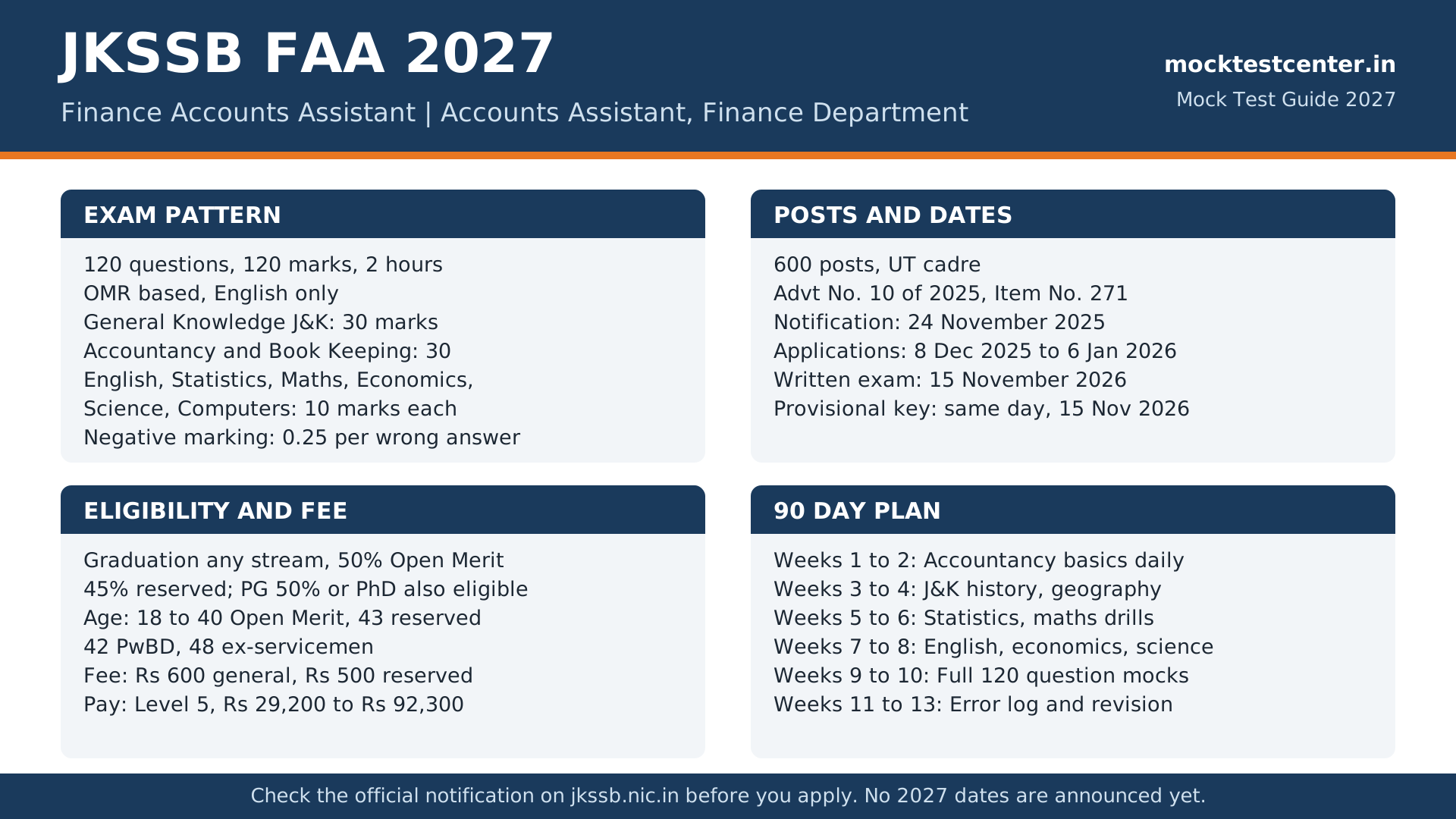
The most recent JKSSB FAA exam took place five days before this guide was written, on 15 November 2026. The Jammu and Kashmir Services Selection Board held an OMR based written test for 600 Accounts Assistant posts in the Finance Department that day, from 1 pm to 3 pm, across 495 centres in all 20 districts of Jammu and Kashmir. The provisional answer key came out the same evening. JKSSB FAA 2027 has no notification yet, so every fact in this guide comes from that 2025 cycle and the 2022 cycle before it. If you plan to sit for the next cycle, those two cycles are the closest picture you have of the posts, the paper, the age limits and the fees.
FAA stands for Finance Accounts Assistant, and the post carries the formal name Accounts Assistant in the Finance Department. The Board recruits for it under the Director General of Accounts and Treasuries. The work sits at the centre of how the Union Territory spends money: treasury offices, departmental accounts, bills, vouchers, ledgers and the monthly accounts that every government office must keep. A graduate in any stream can apply, provided the marks condition is met. The selection rests on one written paper only. There is no interview and no skill test. That single fact shapes the whole preparation. Your rank comes from 120 questions in 120 minutes, and nothing else can rescue a weak paper or sink a strong one.
The 2025 cycle in numbers
| Item | Detail |
|---|---|
| Conducting body | Jammu and Kashmir Services Selection Board (JKSSB) |
| Post | Accounts Assistant, Finance Department |
| Advertisement | Notification No. 10 of 2025, Item No. 271, dated 24 November 2025 |
| Posts | 600, UT cadre |
| Application window | 8 December 2025 to 6 January 2026, online only |
| Written exam | 15 November 2026, 1 pm to 3 pm, OMR based |
| Exam centres | 495 centres across all 20 districts, seating capacity 1,61,961 |
| Provisional answer key | 15 November 2026, objections for three working days from 16 November 2026 |
| Pay | Level 5, Rs 29,200 to Rs 92,300 |
| 2027 notification | Not issued as of 20 November 2026 |
The 600 posts split across categories in a way that tells you where the seats sit. Open Merit carries 240 posts, the largest single share. Scheduled Tribe 1 and Scheduled Tribe 2 carry 60 each, Other Backward Classes 60, Economically Weaker Sections 60, Scheduled Caste 48, Actual Line of Control or International Border 48, and Residents of Backward Areas 24. Add those figures and you reach 600. The split matters for one reason. A candidate who knows the category wise vacancy count can judge the real competition in the own category instead of staring at the headline figure of 600 and guessing.
The seating capacity of 1,61,961 deserves a careful reading. That figure is the combined capacity of the 495 centres, reported by the Board when it asked divisional administrations to suspend classwork at the centres on 14 November 2026. JKSSB has not published an applicant count for this cycle in the notices read during preparation, so treat 1,61,961 as capacity only. Do not quote 1,61,961 as the number of candidates. It shows only that the Board prepared for a very large turnout, with 82,489 seats in Jammu division and 79,472 in Kashmir division, and 47 centres in Srinagar district alone with 16,822 seats.
The answer key timetable also tells you how fast this Board moves once the exam is done. The provisional key for all four series, A, B, C and D, covering questions 1 to 120, came out on the exam day itself through Notice No. JKSSB-COE0EXAM(UT)/27/2026-03 dated 15 November 2026. Objections were accepted at the JKSSB offices in Jammu and Srinagar for three working days starting 16 November 2026, from 11 am to 5 pm. The final key and the result had not been published when this guide was written. A candidate who sat for the paper should watch jkssb.nic.in for the final key and the result, and a candidate preparing for the next cycle should note the speed. The gap between the exam and the key was hours, not weeks.
The 2022 cycle and why it still matters
The cycle before this one ran under Advertisement Notification No. 04 of 2020, Item No. 106, dated 16 December 2020, for 972 posts of Accounts Assistant in the Finance Department. The written exam took place on 6 March 2022, a Sunday, from 12 noon to 2 pm, and the result and score sheet followed in April 2022. The 972 posts split as Open Merit 486, Scheduled Caste 78, Scheduled Tribe 97, Other Social Caste 39, Actual Line of Control or International Border 39, Residents of Backward Areas 97, Pahari Speaking People 39, and Economically Weaker Sections 97. That split adds to 972, and it shows a different reservation map from the 2025 cycle. The 2022 list used Other Social Caste and Pahari Speaking People as categories, while the 2025 list uses Scheduled Tribe 1, Scheduled Tribe 2 and Other Backward Classes. The reservation categories in Jammu and Kashmir changed after the reorganisation, and the two lists record that change in plain numbers.
The 2022 cycle matters for a practical reason. It is the last completed cycle with a full public record: notification, admit card, exam, answer key and result. The 2025 cycle is still open at the result stage. The paper pattern, the syllabus weight and the negative marking come from the 2022 exam and the syllabus that governed it, and the 2025 notification kept the same post, the same department and the same selection rule of merit in the written examination only. When this guide describes the paper, it describes the paper that was actually set on 6 March 2022 and again on 15 November 2026, with 120 questions for 120 marks in 120 minutes.
One more detail from 2022 is worth keeping. The admit cards for the March 2022 exam were available from 24 February 2022, and the final answer key came out on 25 February 2022, before the exam. That order looks odd until you remember that JKSSB issues a provisional key, takes objections, and then issues a final key, and the dates in tracker reports sometimes mix the two. The 2026 timetable is cleaner in the record: exam on 15 November, provisional key the same day, objections for three working days after. Treat the 2022 admit card and key dates as background, not as a timetable to copy for the next cycle.
What the post is and what the work looks like
An Accounts Assistant in the Finance Department works in the accounts and treasuries organisation of the Union Territory. The appointing authority is the Director General of Accounts and Treasuries. The daily work is the bookkeeping of government: passing bills, keeping ledgers, preparing pay bills and pension papers, reconciling treasury figures with departmental figures, and keeping the records that auditors ask for at the end of the year. It is desk work with real responsibility. A wrong entry in a treasury account does not stay a small error. It travels up the chain until someone has to explain it, and that someone is often the assistant who made the entry.
The pay sits at Level 5 of the pay matrix, Rs 29,200 to Rs 92,300 per month under the 7th Central Pay Commission, plus the usual allowances. That figure appears in both the 2020 and the 2025 notifications, and it is the one pay figure in this guide that comes straight from the notification rather than from a tracker. The post is UT cadre, which means the posting can sit anywhere in the Union Territory, in Jammu division or in Kashmir division. A candidate who applies should accept that the first posting may not be in the home district. Transfers within the UT are part of the service, and the accounts and treasuries organisation has offices in every district.
Promotion runs through the accounts service. An Accounts Assistant who clears the departmental examinations and puts in the years moves to senior clerical and supervisory roles in the treasuries organisation, and the Accounts Service has its own gazetted cadre above. The exact promotion ladder depends on the departmental rules in force at the time, and this guide states no promotion timeline because no notification quoted one. The honest way to read the post is as a stable graduate level entry into the finance wing of the government, with a single written exam as the gate and no interview to clear after it.
Who can apply for JKSSB FAA 2027
Eligibility rests on four things: a degree with the marks condition, an age inside the limit, a Jammu and Kashmir domicile certificate, and the fee. The degree rule is the one that catches the most applicants out. Graduation in any stream from a recognised university qualifies, but the marks condition is strict. Open Merit candidates need a minimum of 50 percent marks in graduation. Reserved category candidates need a minimum of 45 percent. Candidates with a post graduation degree with 50 percent marks, or a PhD degree, are also eligible. That rule appeared in both the 2020 and the 2025 notifications in the same words, and trackers that quote the notification reproduce it exactly.
| Category | Maximum age, as on 1 January 2025 |
|---|---|
| Open Merit | 40 years |
| SC, ST 1, ST 2, RBA, ALC/IB, EWS, OBC | 43 years |
| Persons with Benchmark Disabilities | 42 years |
| Ex-servicemen | 48 years |
The minimum age is 18 years for every category. The maximum age figures above come from the 2025 notification, reckoned as on 1 January 2025, and they match the standard JKSSB age table used across the 2025 and 2026 notifications. Open Merit candidates must have been born between 1 January 1985 and 1 January 2007. Reserved category candidates must have been born between 1 January 1982 and 1 January 2007. Those date windows are the ones the notification carries, and they are the figures to check against your own date of birth before you pay the fee. Age is reckoned on 1 January of the cycle year, not on the date of application, and a candidate who misses the cut by a day is out.
Domicile is not optional. Only domiciles of the Union Territory of Jammu and Kashmir can apply, and the domicile certificate must have been issued on or before the cut off date in the notification. The 2020 notification stated the domicile condition in the same terms, and the Board has held it across cycles. A candidate who studied outside Jammu and Kashmir but holds a valid domicile certificate is eligible. A candidate who lives in Jammu and Kashmir without a domicile certificate is not. Keep the certificate ready before the application window opens, because the window in 2025 ran for about a month and the certificate cannot be arranged in a day.
The paper, section by section
| Section | Questions | Marks |
|---|---|---|
| General Knowledge with special reference to J and K UT | 30 | 30 |
| Accountancy and Book Keeping | 30 | 30 |
| General English | 10 | 10 |
| Statistics | 10 | 10 |
| Mathematics | 10 | 10 |
| General Economics | 10 | 10 |
| General Science | 10 | 10 |
| Knowledge of Computers | 10 | 10 |
| Total | 120 | 120 |
The paper runs for 2 hours, carries 120 objective questions for 120 marks, and gives 1 mark for each correct answer. A wrong answer costs 0.25 marks. A question left blank costs nothing. The questions are set in English only, and the exam is OMR based. That is the whole pattern, and it has stayed the same across the 2022 and 2025 cycles. Sixty seconds per question is the arithmetic, and it is tighter than it looks, because the Accountancy and Statistics questions need working, and the General Knowledge questions need recall rather than reasoning. A candidate who spends two minutes on one accountancy problem has already borrowed time from two other questions.
The negative marking rule deserves a full paragraph because it decides how many questions to attempt. A wrong answer costs 0.25 marks, which is one fourth of a mark. A guess between two options has a fair chance of paying for itself across a full paper, because a correct guess earns 1 mark and a wrong guess loses 0.25. A blind guess across four options does not pay, because the chance of a hit is one in four and the expected value turns negative once you count the penalty. The practical rule is simple. Attempt every question where you can remove at least one option with confidence, and leave the rest blank. A blank answer is worth zero, and zero beats minus 0.25 every time.
The two 30 mark sections carry half the paper between them. General Knowledge with special reference to Jammu and Kashmir and Accountancy and Book Keeping together make 60 of the 120 marks. No other section carries more than 10. That split is the single most useful fact in this guide for planning study time. Half your preparation time belongs to those two sections, and the other half is shared across the remaining six. A candidate who scores well in the two big sections and holds steady in the six small ones clears the paper. A candidate who spreads time evenly across all eight sections will find the two big ones underprepared on exam day.
Accountancy and Book Keeping carries the paper
Accountancy and Book Keeping is the section that separates commerce graduates from everyone else, and it is also the section where a non commerce graduate can close the gap fastest, because the syllabus is fixed and the question types repeat. The topics cover journal entries and ledger posting, trial balance, final accounts of a sole proprietor, depreciation and its methods, bills of exchange and promissory notes, bank reconciliation statements, partnership accounts including admission, retirement and death of a partner, company accounts in outline, and the basic concepts and conventions that sit under all of it. The questions test whether you can apply a rule, not whether you can recite it. A question gives a set of figures and asks for the closing balance, the depreciation charge, or the treatment of a bill, and the answer comes from working the figures rather than remembering a definition.
The way to prepare for this section is to solve problems by hand, with a timer, from a Class 11 and Class 12 accountancy textbook. TS Grewal and DK Goel are the standard books, and either one covers the syllabus with enough solved examples. Work through the journal and ledger chapters first, because every later topic assumes them. Then take final accounts and depreciation, because those two topics produce the most questions. Partnership accounts come next, and they are the longest chapter, so give them a full week rather than a weekend. A commerce graduate who revises the Class 12 book will finish this section in about 40 minutes in the exam and score high. A non commerce graduate who works through the same book from the start will need six weeks of daily practice to reach the same level, and that is time well spent, because 30 marks is a quarter of the paper.
One trap in this section is the treatment of theory questions. The paper sets a few questions on accounting concepts, conventions and principles, and those questions look easy. They are the ones where two options sound right and only one matches the textbook wording. Read the concepts chapter properly instead of skipping it as too basic. The distinction between a concept and a convention, and between the going concern assumption and the accrual concept, appears in the paper in some form in most cycles, and it costs a mark to everyone who guessed.
General Knowledge with special reference to Jammu and Kashmir
The General Knowledge section carries 30 marks and it is the section where local knowledge pays directly. The syllabus covers current events of national and international importance, and then turns to Jammu and Kashmir in detail: the history of the region, its geography, its economy, its culture and heritage, its important tourist destinations, its rivers and lakes, its climate and crops, and its demography including the census. A candidate from Jammu and Kashmir who has read the local news for a year will recognise a large share of these questions. A candidate who prepares only from a national general knowledge book will not, because the Jammu and Kashmir questions are specific in a way that no national book covers.
Start with the geography and history of the region, because those two topics anchor the section. Learn the districts of both divisions, the rivers that run through them, the passes that connect them, and the lakes that sit in the valley. Learn the sequence of the region's history from the early kingdoms through the Dogra period to the reorganisation of 2019, when the former state became two Union Territories. Then add the economy: horticulture and its main crops, handicrafts, tourism, hydroelectric power, and the major government schemes running in the UT. Current affairs from the twelve months before the exam carry a visible share of the questions, so keep a notebook of Jammu and Kashmir news from the application date onward, and update it weekly.
The national part of the section is smaller than the Jammu and Kashmir part, and it follows the usual pattern: major national events, appointments, awards, sports, and the Union Budget and Economic Survey. Read a monthly current affairs compilation for the national part and do not let it eat the time that belongs to the Jammu and Kashmir part. The 30 marks in this section are the most predictable marks in the paper for a candidate who lives in the region and reads its news. Treat them as marks to bank rather than marks to chase.
The other six sections
General English carries 10 marks and tests the standard set: narration, tenses, articles, modals, fill in the blanks with pronouns, homophones and homonyms, phrases, antonyms and synonyms, clauses, idioms and phrases, rearrangement of jumbled sentences, active and passive voice, uses of prepositions, pairs of words and their use in meaningful sentences, correction of sentences, correction of spellings, and error spotting. Ten questions cannot cover all of that, so the paper picks a spread. A graduate who reads English daily will answer most of these without special study, and a short daily drill on error spotting and synonyms will cover the rest.
Statistics carries 10 marks and covers measures of central tendency, dispersion, correlation, index numbers, and the reading of tables and graphs. The questions are numerical and short. A candidate who can compute a mean, a median, a standard deviation and a simple correlation from a small data set will answer them. Mathematics carries 10 marks and covers percentage, average, time, work and distance, ratios and proportions, problems of age, probability, LCM and HCF, and mensuration. These are Class 10 level topics, and they reward speed more than depth. Practise them as timed drills of 20 questions rather than as theory.
General Economics carries 10 marks and covers the basics: demand and supply, national income, inflation, banking and the Reserve Bank, the Union Budget, taxation in outline, and the economy of Jammu and Kashmir in brief. General Science carries 10 marks at Class 10 level: physics, chemistry and biology in the form of everyday facts rather than derivations. Knowledge of Computers carries 10 marks and covers computer fundamentals, the parts of a computer, operating systems in outline, the internet, email, and common applications. None of these six sections needs a separate book. A Class 10 science book, a basic economics text, and a computer fundamentals note set will cover them, and the marks in them are the marks that a steady candidate collects while the two big sections decide the rank.
Fee and how to apply
The application fee changed between cycles, and the change is large enough to state plainly. In the 2020 cycle the fee was Rs 350 for every candidate, payable online through net banking, debit card or credit card. In the 2025 cycle the fee rose to Rs 600 for Open Merit and other unreserved categories, and Rs 500 for SC, ST 1, ST 2, EWS and PwBD candidates, payable online only. The fee is non refundable, and the application is accepted only after the payment goes through. A candidate who applies in the next cycle should expect the 600 and 500 figures to hold or to rise, and should check the notification rather than assuming the 350 figure from 2020.
Applications go in online only, through jkssb.nic.in, in the window the notification fixes. The 2025 window ran from 8 December 2025 to 6 January 2026. The form asks for personal details, the domicile certificate, the graduation details with marks, the category certificate where applicable, a photograph and a signature, and the fee payment. Keep scanned copies ready before the window opens, and check the marks percentage against the 50 percent and 45 percent conditions before submitting, because a candidate who falls short of the marks condition and pays the fee loses both the fee and the application. The Board has run a correction window in recent cycles, and the 2025 cycle had an application correction window active in late 2026, but a correction window is not a promise. Fill the form right the first time.
Cut offs, competition and what a good score looks like
JKSSB publishes the result as a score sheet and a selection list, and the cut off for a cycle is visible only after the result. This guide states no cut off figure for the 2025 cycle, because the result had not been published when it was written, and it states no cut off figure for the 2022 cycle either, because no official cut off figure was retrieved during preparation. Tracker pages carry expected cut offs for both cycles, and those figures are estimates built from the paper difficulty and the vacancy count, not from the Board. A candidate who prepares to an expected cut off is preparing to a guess. Prepare to the paper instead: 120 marks, 0.25 negative marking, and a field where the two 30 mark sections decide the order.
One comparison gives a sense of the competition without inventing a number. The 2022 cycle offered 972 posts and the 2025 cycle offers 600, a drop of 372 posts, while the seating capacity prepared for the 2025 exam was 1,61,961. Even if only a fraction of that capacity was used, the applicants per post in 2025 were far higher than in 2022. The paper also stayed the same. That combination, fewer posts and the same paper, means the 2025 selection will sit at a higher score than 2022, and the next cycle will follow the same logic unless the vacancy count rises. The practical conclusion is that a score in the high 80s out of 120, which may have cleared in an easier cycle, is not a safe target. Aim for the mid 90s and above, with the two big sections carrying the score.
The Board normalises scores where the exam runs in more than one shift, and it has said so in the notifications for posts where the written test ran across shifts. The FAA exam in both cycles ran on a single day in one shift, so normalisation did not apply to it. That detail matters only if the next cycle splits the exam across shifts, in which case the notification will say so. Read the notification for the cycle you apply in, because the exam day arrangement is the one fact that can change without warning.
What to study first
Start with the two 30 mark sections, because they carry half the paper. For Accountancy, open a Class 11 and Class 12 textbook and work problems by hand. For General Knowledge, open a Jammu and Kashmir yearbook or a state general knowledge book and read the history and geography chapters first, then add the economy and current affairs. Those two sections take the first month of preparation, and they take it every day, not in a single weekend push. The six small sections come after, in the second month, as daily drills rather than as separate study blocks.
Books are simple to list. For accountancy, TS Grewal or DK Goel at Class 11 and Class 12 level. For Jammu and Kashmir general knowledge, a state yearbook and the Jammu and Kashmir sections of a standard general knowledge book, plus a notebook of local news from the last twelve months. For English, a standard grammar and comprehension book with error spotting practice. For mathematics and statistics, a Class 10 mathematics book and a short statistics note set. For economics, a basic Indian economy text at the level of the NCERT Class 11 and 12 books. For science, NCERT science from classes 6 to 10. For computers, a computer fundamentals book that covers hardware, software, the internet and common applications. No other book is needed for the written paper, and buying more books is the most common way to waste the first month.
Previous year papers are the second half of preparation. Solve the 6 March 2022 paper under time, 120 questions in 120 minutes, with the 0.25 negative marking applied to your score. A mock score without negative marking is a figure that flatters you and teaches you nothing. Solve it twice, once at the start of preparation to find the weak sections, and once in the last week to check whether the weak sections moved. The 15 November 2026 paper will reach the public record through the provisional answer key, and solving it under time is the best single mock available for the next cycle, because it is the paper the Board has just set.
A 90 day plan that fits around a job
| Weeks | Focus | Daily time |
|---|---|---|
| 1 to 2 | Accountancy basics: journal, ledger, trial balance, final accounts, with problems every day | 2 hours |
| 3 to 4 | Jammu and Kashmir history and geography, plus depreciation and partnership accounts | 2 hours |
| 5 to 6 | Jammu and Kashmir economy and current affairs, plus statistics and mathematics drills | 2 to 3 hours |
| 7 to 8 | English, economics, science and computers, plus the 2022 paper under time | 2 to 3 hours |
| 9 to 10 | Full mocks, 120 questions in 120 minutes, with negative marking applied and errors logged | 2 to 3 hours |
| 11 | Revision of the error log, the Jammu and Kashmir notebook, and the accountancy formulae | 3 hours |
| 12 | Two full mocks, light revision, and one rest day before the exam | 3 hours |
| 13 | Final revision of the two 30 mark sections and the formulae sheet | 2 hours |
The plan runs for 13 weeks because 90 days is 13 weeks near enough, and the last week is deliberately light. The first four weeks build the two big sections. The middle four weeks add the six small sections and the first full paper. The last five weeks are mocks and revision, with the error log doing the teaching. Keep the log in a notebook, one line per mistake, with the section, the topic, and the correct rule. A candidate who reviews the log every Sunday will not repeat the same mistake in the second mock, and that is the whole point of mock tests. A mock that you score and forget is a morning spent.
One habit matters more than the timetable. Write the accountancy formulae and the Jammu and Kashmir facts on a single sheet each, and revise those two sheets every night for ten minutes. The formulae sheet holds the depreciation methods, the partnership ratios, the bank reconciliation steps, and the final accounts format. The facts sheet holds the districts, the rivers, the lakes, the passes, the major schemes, and the census figures. Ten minutes a night across 90 days is 15 hours of revision, and it is the revision that turns a read chapter into a remembered answer.
Other exams worth preparing alongside
JKSSB FAA aspirants often prepare for other state and national exams alongside this one. The SBI PO 2027, IBPS PO 2027, IBPS Clerk 2027, RBI Assistant 2027, IBPS RRB PO 2027, IBPS RRB Clerk 2027, SEBI Grade A 2027, NABARD Grade A 2027, RBI Grade B 2027 and UGC NET Paper 1 2027 pages on this site carry the same style of mock test guide, and the pattern habit you build here transfers directly to them.
Sources
The Jammu and Kashmir Services Selection Board site at jkssb.nic.in, the official source for the notification, the syllabus, the admit card and the answer key, which could not be reached by direct fetch during preparation on 20 November 2026, so the facts below rest on the tracker pages and the official PDF listed here and should be checked against the official notification before you apply. The official provisional answer key PDF for the Accounts Assistant examination held on 15 November 2026, Notice No. JKSSB-COE0EXAM(UT)/27/2026-03 dated 15 November 2026, hosted on jkssb.nic.in, for the exam date, the advertisement number 10 of 2025, Item No. 271, the 120 questions across four series, and the objection window of three working days from 16 November 2026. Jagran Josh, for the 2022 cycle: Advertisement Notification No. 04 of 2020 dated 16 December 2020, Item No. 106, 972 posts, the exam held on 6 March 2022 from 12 noon to 2 pm, the 120 mark paper, and the section wise split of 30, 30, 10, 10, 10, 10, 10 and 10. Oliveboard, for the 2022 category wise split of 486, 78, 97, 39, 39, 97, 39 and 97, the fee of Rs 350 in that cycle, and the negative marking of 0.25. Testbook and Moneycontrol, for the 2025 cycle: Advertisement Notification No. 10 of 2025 dated 24 November 2025, 600 posts, applications from 8 December 2025 to 6 January 2026, graduation in any stream with 50 percent for Open Merit and 45 percent for reserved categories, post graduation with 50 percent or a PhD also eligible, age 40 for Open Merit and 43 for reserved categories as on 1 January 2025, fee Rs 600 and Rs 500, and pay Level 5 Rs 29,200 to Rs 92,300. The Notopedia reproduction of the 2025 notification, for the category wise split of 240, 48, 60, 60, 60, 48, 24 and 60. Straight Talk Communications, for the 15 November 2026 exam running from 1 pm to 3 pm at 495 centres with seating capacity 1,61,961, including 82,489 seats in Jammu division, 79,472 in Kashmir division, and 47 centres with 16,822 seats in Srinagar district. Harshya, for the section wise syllabus of the Accounts Assistant paper and the 0.25 negative marking rule.