About UP Police Sub Inspector 2027 Exam Series
📖 Table of Contents
- The last SI cycle ended four months ago
- UP Police Sub Inspector 2027: has the notification come out?
- The written exam in plain numbers
- General Hindi: 40 questions, and the easiest marks to drop
- Law, Constitution and General Knowledge: the section that makes this an officer exam
- Numerical and Mental Ability: a speed test dressed as a maths test
- Mental Aptitude, IQ and Reasoning: the section with the longest name
- Who can apply: a degree, 21 to 28, and one relaxation that may not come back
- What the physical tests measure
- After the written exam: verification, physical tests, medical, merit
- Pay: Level 6, and what lands in hand
- The 2021 cycle, for scale
- Two court developments worth knowing
- A 90 day plan that fits around a job or college
- Mistakes that cost candidates a full year
- What else to keep in sight while you prepare
- The day the notification drops, check these things first
- Sources
UP Police Sub Inspector 2027: Daroga Exam Guide, Pattern, 90 Day Plan
The UP Police Sub Inspector 2027 (UP Police SI) notification has not come out yet. As of 19 November 2026, the Uttar Pradesh Police Recruitment and Promotion Board, UPPRPB, has published no fresh advertisement for Sub Inspector Civil Police, and the last cycle is the one that finished only four months ago. That cycle, officially Direct Recruitment 2025, offered 4,543 posts, held its written exam on 14 and 15 March 2026, and declared its final result on 14 July 2026. So anyone preparing for UP Police SI 2027 is preparing on the last cycle pattern while waiting for the next notice, and that is a sound place to start because the pattern has held steady across cycles.
This guide covers the whole UP Police SI exam on that basis. You will find the last two cycles in full detail, plus the 160 question written exam with its marks and qualifying lines. The syllabus comes section by section, with who can apply, the physical tests, the pay, the court cases that still hang over the last result, and a 90 day plan that fits around a job or college. Every number here comes from the last notification as reported by the board and the result trackers, or from the 2021 cycle records. Where sources disagree, this guide says so instead of picking the neater number.
The last SI cycle ended four months ago
The cycle that ran through 2026 is the single most useful document for a 2027 aspirant, so it is worth setting out in full. UPPRPB called it Direct Recruitment 2025, under Advertisement Number PRPB-4(SI)-3/2025, because the board names a recruitment after the year its notification comes out. The notification was released on 12 August 2025, applications ran from 12 August to 11 September 2025, and the rest of the cycle played out in 2026. That naming habit is the reason so many pages call it the 2026 recruitment while the board calls it 2025, and it is also why a search for UP Police SI 2027 throws up pages about a recruitment that has already closed.
| Event | Date |
|---|---|
| Notification released | 12 August 2025 |
| Applications open | 12 August 2025 |
| Last date to apply | 11 September 2025 |
| Written exam | 14 and 15 March 2026 |
| Written result | 7 May 2026 |
| Document verification and physical standards | 15 to 17 June 2026 |
| Physical efficiency test | 29 June to 4 July 2026 |
| Final result | 14 July 2026 |
| Scorecards and marks released | 22 July 2026 |
The vacancy split shows where the posts actually sat. Out of 4,543 posts, 4,242 went to Sub Inspector Civil Police for men and women, 106 to Sub Inspector Civil Police (Women) for the women battalions at Bareilly, Gorakhpur, Lucknow, 135 to Platoon Commander PAC and Sub Inspector Armed Police for men only, and 60 to Platoon Commander and Sub Inspector Special Security Force for men only. The four figures add to 4,543. Category wise splits by UR, EWS, OBC, SC or ST were published with the notification, and the next notification will carry its own split, so there is no point memorising this one.
The written result tells you how sharp the contest was. A total of 12,333 candidates qualified the written exam on 7 May 2026, which means roughly three written qualified candidates for every post before the physical stages began. The document verification and physical standard test ran on 15 to 17 June 2026, with a reserve day on 17 June, and the running test ran from 29 June to 4 July 2026. The final result on 14 July 2026 selected 4,543 candidates, and the scorecards followed on 22 July 2026. The whole cycle, from notification to final result, took eleven months.
One more detail from that cycle matters for preparation. The written exam ran in shifts across two days, and the board later issued a notice on normalised marks, dated 21 July 2026, with an access link on 22 July 2026. Normalisation is the board method of adjusting scores when different shifts get papers of different difficulty, and it means your raw score and your final score can differ by a few marks. You cannot control it, and it is not worth worrying about, but you should know it exists so a scorecard that looks different from your own count does not come as a shock.
UP Police Sub Inspector 2027: has the notification come out?
No. A check of the UPPRPB website on 19 November 2026 found no new SI Civil Police notification, and the coaching trackers that follow the board daily say the same. Oliveboard states plainly that the exam date for 2027 has not been announced and that candidates should follow the official website. The result trackers say the next notification has not been announced as of their last checks in October and November 2026. Nothing in this guide gives 2027 dates or vacancy numbers, because none exist yet.
That silence is normal for this exam. The board runs SI recruitment in bursts with long gaps, not on a fixed yearly calendar. The 2021 cycle was notified in February 2021 and its final result came in June 2022. Then nothing for more than three years, until the August 2025 notification. A candidate who waits for the notification before starting to study gives away the whole gap, and the gap is where this exam is won.
Be careful with the dates you see on coaching sites. Several pages carry a 2027 label on top of the 2025 notification details, and some quote a figure of more than one lakh police vacancies across departments in 2026 without tying it to any SI notification. Treat any page that gives a 2027 SI exam date or a 2027 vacancy count as guesswork until the board notice board says otherwise. The only source that counts is the UPPRPB website at uppbpb.gov.in, and the only page inside it that matters is the notice board.
The written exam in plain numbers
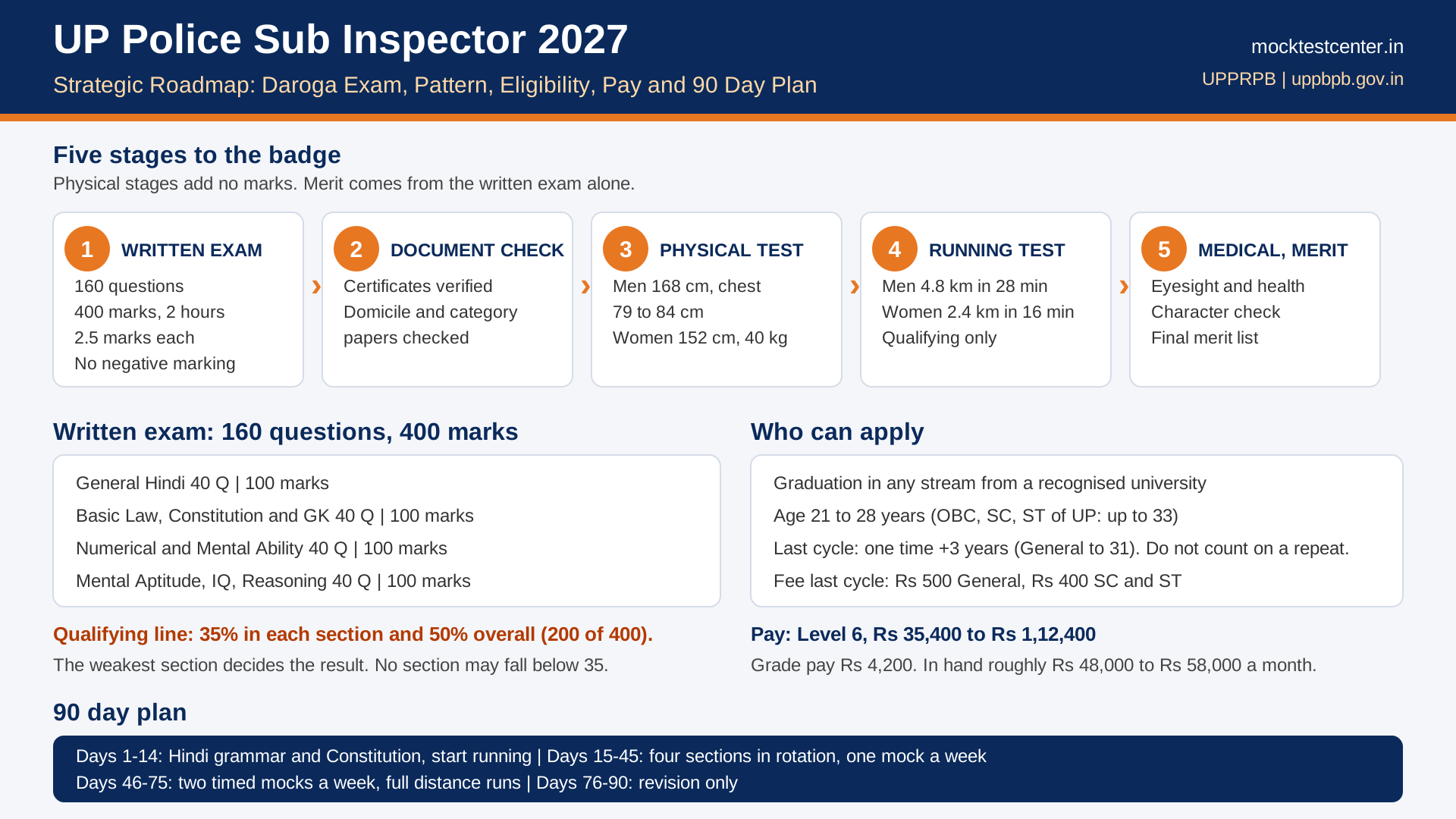
The written exam is one paper of 160 objective questions worth 400 marks, to be finished in two hours. Each question carries 2.5 marks. There is no negative marking, which is the single most candidate friendly feature of this exam, and it changes how you should attempt the paper. A question you are unsure about costs you nothing if you get it wrong, so there is no reason to leave any question blank.
| Section | Questions | Marks |
|---|---|---|
| General Hindi | 40 | 100 |
| Basic Law, Constitution and General Knowledge | 40 | 100 |
| Numerical and Mental Ability Test | 40 | 100 |
| Mental Aptitude, Intelligence Quotient and Reasoning | 40 | 100 |
| Total | 160 | 400 |
Two hours for 160 questions gives you 45 seconds per question, and that is the real shape of the exam. Slow, careful working through every question will not finish this paper. Candidates who move fast, skip a stuck question without a second thought, and come back only if time remains, do well. A mock test that you finish in two hours and forty minutes teaches you the syllabus. A mock test that you finish in two hours teaches you the exam.
The qualifying line is where many candidates trip. You need at least 35 percent in each subject and 50 percent overall to move to the next stage. In marks, that is 35 out of 100 in every section and 200 out of 400 in total. The per subject line is the dangerous one. A candidate who scores 280 overall but gets 32 in General Hindi does not qualify, while a candidate who scores 205 with no section below 35 does.
So the weakest section decides your result more than your strongest section does, and your preparation time should follow that fact.
One source, a coaching blog, puts the overall qualifying line at 40 percent instead of 50 percent. Every other tracker, including the syllabus pages that quote the notification, says 35 percent per subject and 50 percent overall, and the board notice for the last cycle says the same. This guide goes with 50 percent, and the next notification will settle it in black and white.
The paper is set in Hindi and English except for the General Hindi section, which is in Hindi only. That detail matters for candidates who studied in English medium. The law and reasoning sections can be attempted in English, but the Hindi section cannot be avoided, and it carries the same 100 marks as every other section.
General Hindi: 40 questions, and the easiest marks to drop
General Hindi looks like the soft section to a graduate from Uttar Pradesh, and that is exactly why it sinks people. The questions test school level Hindi grammar in a tight, factual way, and the difference between two similar options is often one matra or one rule. The syllabus covers Hindi grammar topics such as sandhi and samas, vilom and paryayvachi words, and the correction of shuddh and ashuddh sentences. It also covers muhavare and lokoktiyan, along with ras, chhand, alankar and unseen passage comprehension. None of it is hard.
All of it punishes a candidate who has not revised it since school.
The passage questions are the most reliable marks in the section, because the answers sit in the text in front of you. The grammar questions are the least reliable, because they depend on rules you either remember or do not. A practical split is to secure the passage and the vocabulary questions first, then work through the grammar, and never spend more than a minute on a single grammar question. If a sandhi question will not come to you in forty seconds, it will not come to you in four minutes either.
Two habits pay off here. First, read one Hindi newspaper editorial every day, not for current affairs but for sentence structure, because the paper tests the Hindi you can actually use. Second, keep a notebook of the words you get wrong in mocks, with the correct form written next to each one. Hindi mistakes repeat themselves. The same twenty words will come back in the next mock, and then in the exam.
Law, Constitution and General Knowledge: the section that makes this an officer exam
This is the section that separates the SI exam from a constable exam. A Sub Inspector investigates cases and writes reports. The statements taken must stand up in court, so the board tests whether you know the law you will work with. The syllabus covers the Indian Constitution with its fundamental rights and directive principles. It also covers general knowledge of India and Uttar Pradesh with current affairs, plus the basic law a police officer uses every day.
The law part covers the codes a police officer uses, and the Constitution part covers the rights a police officer must not violate.
One change makes the law syllabus trickier than it looks. The three new criminal laws, the Bharatiya Nyaya Sanhita, the Bharatiya Nagarik Suraksha Sanhita and the Bharatiya Sakshya Adhiniyam, came into force on 1 July 2024 and replaced the Indian Penal Code, the Code of Criminal Procedure and the Indian Evidence Act. The last SI notification was issued in August 2025, after that change, so candidates should study the new codes and their key sections rather than memorising the old IPC section numbers alone. The next notification will carry the exact syllabus wording, and that wording is what counts, but no serious preparation can ignore the new codes now.
For the Constitution, the questions cluster around a small set of topics. Fundamental rights and the writs come first, with the directive principles beside them. Then the structure of Parliament and state legislatures, the President and the Governor, and the judiciary. The amendments that changed something real matter too, such as the 42nd and the 73rd and 74th amendments.
A candidate who can state, for each fundamental right, which article it sits in and what it protects, has covered half the Constitution questions. The other half comes from current affairs, and here the questions lean towards Uttar Pradesh: state schemes, state geography and rivers, the state budget, and appointments in the state government.
General knowledge in this paper leans heavily on UP specific knowledge plus national current affairs from the last year, and the UP part is where an outsider loses marks. Learn the districts and their headquarters, the major rivers and dams, the wildlife sanctuaries and national parks, the folk arts and fairs, and the state welfare schemes with their launch years. A question about a scheme launched in Uttar Pradesh is worth the same 2.5 marks as a question about the Constitution, and it takes a tenth of the time to learn.
Numerical and Mental Ability: a speed test dressed as a maths test
The numerical section tests class ten maths at speed. The syllabus covers number system and simplification, with percentage, profit and loss, and simple and compound interest. It also covers ratio and proportion, average, time and work, time speed and distance, mensuration, and data interpretation from tables and graphs. Nothing here needs a degree in mathematics. Everything here needs practice under a timer, because the questions are easy and the clock is not.
The mental ability half of the section is different in kind. It covers number series and coding-decoding. Blood relations and direction sense come next, with analogy and classification after them. These questions test whether you can hold a pattern in your head and apply it, and they reward a candidate who has seen the pattern before.
A series question you have seen in a mock takes ten seconds. The same question seen for the first time takes two minutes. That gap is the whole section.
Work this section in two passes inside the paper. First pass, do the questions you can solve in under forty seconds: the straight percentage, the simple interest, the easy series. Second pass, come back to the longer ones: the data interpretation set, then the time and work problem with three workers. Candidates who work in order, question one to forty, run out of time on question thirty and never reach the easy questions at the end. Order is a tactic in this paper, and it is free.
One number to keep in mind: a candidate who scores 70 out of 100 in this section and 35 in Hindi has a worse result than a candidate who scores 55 in both. The qualifying line is per subject. Spread your preparation time so that no section falls below the line, and only then push your strong section higher.
Mental Aptitude, IQ and Reasoning: the section with the longest name
The fourth section is the longest named and the most predictable. It covers analogies and similarities, with differences, space visualisation, problem solving, analysis and judgement. Decision making, visual memory, discrimination, observation and relationship concepts follow, along with arithmetical reasoning, verbal and figure classification, and arithmetical number series. The syllabus summaries also list professional and social awareness, including topics such as gender sensitivity and awareness of social issues, which fits a police officer role and is easy to overlook while drilling puzzles.
This section is the best return on mock test time, because reasoning questions follow fixed patterns and the patterns repeat across years. Spend your first month learning the pattern types, one type at a time, and your second month doing them against the clock. A candidate who has done five hundred reasoning questions in mocks will finish this section with time to spare. A candidate who has only read about reasoning will still be working out the third question when the bell goes.
Watch one trap. The section mixes questions that take ten seconds with questions that take three minutes, and they look alike on the page. A long puzzle about seating arrangement is worth the same 2.5 marks as a one line analogy. Do the short ones first. Leave the long puzzle for the second pass, and if the second pass never comes, you have lost 2.5 marks, not twenty.
Who can apply: a degree, 21 to 28, and one relaxation that may not come back
The educational bar is simple. A bachelor degree from a university established by law in India, or an equivalent qualification recognised by the government, is required for all SI Civil Police posts. There is no minimum percentage in the degree for the main SI posts, and the degree can be in any stream. The board asks candidates to upload the graduation mark sheet or certificate, and the originals are checked at document verification, so a candidate in the final year of graduation should check the next notification carefully before applying, because the degree must be complete by the date the notification fixes.
The age limit in the last cycle was 21 to 28 years as on 1 July 2025. The limit is the same for men and women. Reserved categories of Uttar Pradesh get five years of relaxation on the upper limit, taking it to 33 years for OBC, SC or ST candidates of the state. Ex servicemen get relaxation under the state government rules. The age is counted on the fixed reference date, 1 July of the recruitment year, not on the date you apply, so a candidate who turns 29 a week after the reference date is still inside the limit, and a candidate who turns 21 a week after it is not.
Then came the relaxation that changed the last cycle. The state government gave a one time three year relaxation in the upper age limit for the 2025 recruitment, approved by the Chief Minister on 23 May 2025, which took the general limit to 31 years and the reserved limit to 36 years for that cycle alone. This was a one time decision, tied to the long gap since the previous SI recruitment. Candidates who are 29 or 30 should not plan on it being repeated. Prepare as if the limit is 28, and treat any fresh relaxation as a bonus, not a plan.
The application fee in the last cycle was Rs 500 for General, OBC or EWS candidates and Rs 400 for SC and ST candidates. One tracker also lists all women candidates at Rs 400, while the other trackers list the fee by category alone, so women candidates should check the fee table in the next notification rather than assuming either figure. The fee is paid online, and the application itself runs through one time registration on the UPPRPB portal, followed by the form and the upload of a photo and signature, and the confirmation page, which should be saved and printed.
One more point on eligibility. This is a state recruitment, and the reservation benefits and age relaxation for OBC, SC and ST apply to candidates of Uttar Pradesh. A candidate from another state is treated as general category for this exam. That is standard for state police recruitment, and it is worth knowing before you count your age relaxation.
What the physical tests measure
The physical tests come after the written exam, and they are pass or fail. No marks from the physical stages are added to the merit, but a candidate who fails any one of them is out, whatever the written score. The physical standard test checks height and chest against fixed numbers. Weight is measured too. The physical efficiency test is the run.
Both are qualifying in nature, and both are held for written qualified candidates only, which means you can train for them after the written exam, but you cannot start from zero then.
| Category | Height | Chest (men only) |
|---|---|---|
| General / OBC / SC men | 168 cm | 79 to 84 cm |
| ST men | 160 cm | 77 to 82 cm |
| General / OBC / SC women | 152 cm | Not applicable |
| ST women | 147 cm | Not applicable |
Two notes sit under that table. Men need a minimum chest expansion of 5 cm, which is the gap between the two chest figures, and women need a minimum weight of 40 kg. Height and chest are measured at the physical standard test, and there is no appeal against a short measurement, so check your own height with a tape before you apply. A candidate who is 166 cm tall cannot train his way to 168 cm.
| Category | Distance | Time allowed |
|---|---|---|
| Men | 4.8 km | 28 minutes |
| Women | 2.4 km | 16 minutes |
The run is the part candidates can actually control. A man needs to hold about 5 minutes 50 seconds per kilometre for 4.8 km, and a woman needs to hold about 6 minutes 40 seconds per kilometre for 2.4 km. That is a steady jog, not a sprint, and a candidate who runs three times a week for three months will finish it. The candidates who fail are usually the ones who never ran at all and tried to make it up in the last two weeks.
Start running in the first week of preparation, not after the written result. Three short runs a week, with distance built up slowly, is enough. It also helps the written preparation, because a candidate who sleeps better studies better.
One warning about the run standards. The SI run is not the same as the constable run, and the constable standards are often quoted on SI pages by mistake. The SI figures are 4.8 km in 28 minutes for men and 2.4 km in 16 minutes for women, as given in the last notification. Do not train to a constable standard and assume it will do.
After the written exam: verification, physical tests, medical, merit
The stages after the written exam run in a fixed order. Written qualified candidates are called for document verification and the physical standard test together, then for the physical efficiency test, then for medical examination and character verification, and the final merit is drawn from the written exam marks of candidates who clear every stage. The physical stages add no marks. The merit is the written score, among those who survive the rest.
Document verification and the physical standard test ran on 15 to 17 June 2026 in the last cycle, and the running test ran from 29 June to 4 July 2026. The gap between the written result on 7 May and the physical stages in June gave candidates about five weeks to prepare, which is enough to sharpen running fitness but not enough to build it from nothing. That is the practical reason to train through the written preparation instead of after it.
Document verification is the stage that ends candidatures over paperwork. Carry the originals and photocopies of your educational certificates. Add a caste or category certificate if one applies to you, plus a domicile certificate and identity proof, along with whatever the admit card for the stage lists. The most common failures are a category certificate in the wrong format, a name spelt differently across documents, and a graduation certificate that does not match the mark sheet. Check every document against the others in the first week of preparation, while there is still time to get a correction made.
The medical examination checks eyesight and hearing, along with general health, and character verification follows the police record check. Candidates who clear all of it appear in the final merit list, and the board publishes the list with cut off marks. In the last cycle, the final result came on 14 July 2026, eleven months after the notification, and the scorecards with marks came on 22 July 2026.
Pay: Level 6, and what lands in hand
A selected Sub Inspector is placed at Pay Level 6 of the 7th Pay Commission matrix, with a pay scale of Rs 35,400 to Rs 1,12,400. The older pay band figure quoted in the notification is Rs 9,300 to Rs 34,800 with a grade pay of Rs 4,200, and the 7th Pay Commission basic of Rs 35,400 is the figure that matters for a new joiner. On top of basic pay come dearness allowance and house rent allowance, with transport allowance and police specific allowances on top. The total varies with the place of posting and the allowance rates in force.
Guides that track this exam put the starting in hand salary of a new UP Police SI at roughly Rs 48,000 to Rs 58,000 a month after deductions, with the spread coming from different allowance rates and different posting cities. Treat that as a reported range, not a promise, because dearness allowance moves and house rent allowance depends on the city. What is certain is the structure: Level 6 basic pay with regular increments, plus allowances on top, with the National Pension System deduction applying as it does to all state government recruits.
The career path is the other half of the pay story. A Sub Inspector is an officer rank, the first rung of the officer ladder in the state police, and the normal line of promotion runs upward to Inspector and then to higher ranks with service and departmental examinations. The post carries charge of a police station in time, and that responsibility is why the selection includes a law paper and a physical test together. No other graduate level exam in the state combines the two in quite this way.
The 2021 cycle, for scale
The 2021 cycle is the reason this exam has such a large following. It was the biggest SI recruitment in the history of the state. The split was 9,027 for Sub Inspector Civil Police. Platoon Commander took 484, and Fire Service Second Officer took 23, making 9,534 in all. The category split inside the 9,027 SI posts was 3,613 unreserved, 902 EWS, 2,437 OBC, 1,895 SC and 180 ST, and the five figures add to 9,027.
The notification came on 25 February 2021, applications ran from 1 April to 15 June 2021 after the last date was extended, and the written exam ran from 12 November to 2 December 2021, in three phases over eighteen days, because the number of candidates was so large.
About twelve lakh candidates appeared for that written exam, according to the result reports, while one tracker puts the number who applied at more than fifteen lakh. The two figures describe different things, applications against appearances, and the gap between them is the candidates who applied and did not sit the exam. Either way, the scale was enormous, and the board needed eighteen days and multiple shifts to run a single written exam.
The answer key came out on 10 December 2021, with objections open till 16 December, and the written result was declared in mid April 2022. The physical efficiency test followed on 25 April 2022. Document verification and the physical standard test ran through May 2022, and the final result was declared on 12 June 2022, selecting 9,534 candidates. From notification to final result, the cycle took about sixteen months.
That cycle is not finished even now. On 14 November 2026, the board released a supplementary final result for the 2020-21 recruitment, selecting 203 more candidates, 200 as Sub Inspector Civil Police and 3 as Platoon Commander, under an Allahabad High Court order dated 1 September 2026. The candidates for that supplementary list went through document verification and physical standards on 2 November 2026, where 129 of 138 called candidates passed, and a running test on 5 November 2026, where 202 of 278 called candidates passed. Five years after the notification, the cycle is still producing selection lists, which tells you something about how long these recruitments can run.
The cycle before that, in 2016, offered 3,307 SI vacancies, which shows how much the numbers swing between cycles. A candidate who plans on 9,534 posts because that was the 2021 figure is planning on a number that may never come back. The 2025 cycle offered 4,543, less than half the 2021 figure, and the next cycle could be smaller still or larger. The only safe plan is to prepare for the pattern, not the vacancy count.
Two court developments worth knowing
The 2025 cycle has its own court story, and it is still open. On 1 October 2026, the Allahabad High Court passed an interim order staying the issue of appointment letters for the 4,543 selected candidates, while it hears petitions that challenge changes made to the answer key. The next hearing was listed for 5 October 2026, and the outcome after that date has not been verified in the sources used for this guide. Selected candidates should follow the board notice board and the court listing rather than coaching rumours, and aspirants for the next cycle should know that answer key disputes are a recurring feature of this exam.
The lesson from both court stories is the same. Keep every document from your application, save your admit card and your response sheet if the board provides one, and raise objections to the answer key inside the window the board gives, because that window is short and it does not reopen. The candidates who ended up in the November 2026 supplementary list got there because a court case ran its course, not because they shouted the loudest.
There is also a separate recruitment that candidates keep mixing up with this one. UPPRPB is running a distinct recruitment for Sub Inspector (Confidential) and Assistant Sub Inspector (Clerk and Accounts) posts under Advertisement Number UPRPB-B 13/2025, notified on 20 December 2025, for 537 vacancies. That is an administrative and clerical track, not the field Sub Inspector Civil Police post covered in this guide, and it has its own posts, its own vacancy count and its own timeline. The older figure of 1,329 posts that appears on some pages belongs to an earlier ASI and SI Confidential cycle, not to this one. Do not count its dates or its pattern as yours.
A 90 day plan that fits around a job or college
Ninety days is enough to cover this syllabus if you study five to six hours a day and run three times a week, and it is not enough if you spend the first month collecting books. The plan below assumes you have a basic graduation level hold on Hindi and maths, and it spends the most time on the two sections that carry the qualifying risk: Hindi and law.
Days 1 to 14 are for the base. Finish the Hindi grammar rules once, with a notebook, and cover the Constitution from fundamental rights through the judiciary. Start the running routine now: three runs a week, starting at 2 km and adding half a kilometre each week. Take one mock test at the end of day 14, not to score well but to find your weakest section, because the rest of the plan bends around that result.
Days 15 to 45 are for the four sections in rotation. Give Hindi and law two days each per week, numerical ability two days, and reasoning one day, with the seventh day for a mock test and its review. The review matters more than the mock. For every wrong answer, write down why you got it wrong: a rule you did not know, a calculation slip, a question you misread, or a guess that failed. The same reasons will repeat, and the list of reasons is your real syllabus for the last month.
Days 46 to 75 are for mocks and the run together. Two mock tests a week, each in the exact two hour window, with no phone and no breaks. Between mocks, revise only the topics your mock reviews flag, and keep the running at three days a week, now at full distance: 4.8 km for men and 2.4 km for women, timed. By day 75 you should know your score band in each section, and no section should sit below 40 out of 100 in mocks, because the qualifying line is 35 and a mock score below 40 leaves no margin for a hard paper.
Days 76 to 90 are for revision and nothing new. Rework your notebook, redo the mocks you scored lowest in, and revise the UP specific general knowledge and current affairs of the last six months. Cut the running back to two easy runs a week so you arrive fresh, not tired. In the last three days, stop studying new material entirely and sleep properly, because a candidate who has slept seven hours will answer more questions in two hours than a candidate who revised till 2 am and cannot think straight by question fifty.
Mistakes that cost candidates a full year
The first mistake is leaving Hindi for the last month. Graduates assume Hindi needs no study, then lose the section by two or three marks and fail the qualifying line while scoring well overall. Hindi needs a month of steady revision, not a week of panic.
The second mistake is studying law from the old codes only. The new criminal laws have been in force since July 2024, and a candidate who quotes IPC section numbers where the paper asks about the new code is answering a different exam. Study the new codes, and check the next notification for the exact syllabus wording.
The third mistake is never running until the written result comes out. Five weeks is not enough to build running fitness from nothing, and the physical test fails candidates who scored well in the written exam every cycle. Run from the first week.
The fourth mistake is taking mocks without a timer. A mock finished in three hours tells you nothing about a two hour paper, and it builds a false sense of readiness. Every mock from the second week onwards should run on the clock, in one sitting.
The fifth mistake is trusting a date or a vacancy count from a coaching page. The board has announced nothing for 2027, and any page that gives a date is guessing. Check the UPPRPB notice board once a week and ignore the rest, because a wrong date changes nothing about your preparation, while a wrong belief about the qualifying marks can change everything.
What else to keep in sight while you prepare
Most SI aspirants also keep one or two nearby exams in sight, and that is sensible as long as the SI paper stays the first priority. The UP Police Constable 2027 paper shares the physical test habit and some of the general knowledge, though it needs class twelve rather than a degree and its pattern is its own. Inside the UP Police family, the UP Police ASI 2027, UP Police Jail Warder 2027, UP Police Fireman 2027 and UP Police Computer Operator 2027 posts each have their own eligibility and their own pattern, so check each notification separately instead of assuming one preparation covers all of them. Outside the state, the Bihar Police Constable 2027, SSC Delhi Police Constable 2027, SSC Delhi Police Head Constable Ministerial 2027, SSC Delhi Police Head Constable AWO TPO 2027 and SSC GD 2027 papers all test reasoning and general knowledge in the same broad way, and a mock test for one of them is useful practice for the reasoning section of this paper, even though the syllabi are not the same.
The day the notification drops, check these things first
When the next SI notification appears, read five things before you do anything else. First, the exact post names and the vacancy split, because SI Civil Police, Platoon Commander and the women battalion posts have different eligibility and different physical standards. Second, the age reference date, because the limit is counted on 1 July of the recruitment year and a one time relaxation may or may not be repeated. Third, the fee, because the last cycle charged Rs 500 for general candidates and Rs 400 for SC and ST candidates, and the next cycle may differ. Fourth, the exam mode, because the 2021 cycle ran online and the 2026 cycle was reported as offline, and the mode changes how you practise. Fifth, the physical standards. Height and chest do not change with practice, so you should know at once whether you qualify.
After that, apply in the first week, not the last, and keep the confirmation page. Then go back to the plan, because the notification changes the date of the exam and nothing else about it. The paper will still be 160 questions, 400 marks, two hours, no negative marking, and a qualifying line of 35 percent in each section with 50 percent overall. The candidates who clear it will be the ones who were ready before the notification, not the ones who started after it.
Sources
UPPRPB official website, uppbpb.gov.in, notice board and result section, checked 19 November 2026. UP Police official website, uppolice.gov.in. The 2025-26 cycle dates and vacancy split are taken from the notification summaries published by UPTaiyari and VacancyWallah. ResultBharat and Testbook report the same details, as does Jagran Josh, all reporting the UPPRPB notification of 12 August 2025, Advertisement Number PRPB-4(SI)-3/2025. The selection stages come from the same summaries, as do the fee and age limit figures.
The 2021 cycle figures come from Jagran Josh, The Times of India, ABP News, The Indian Express and Times Now, reporting the UPPRPB notification of 25 February 2021 and the final result of 12 June 2022. The supplementary final result of 14 November 2026, selecting 203 candidates, is reported by Jagran Josh from the board notice PRPB-R-960/2026 under the Allahabad High Court order of 1 September 2026.
The one time three year age relaxation and the October 2026 stay on appointment letters are reported by TaiyarHo from the Chief Minister approval of 23 May 2025 and the High Court interim order of 1 October 2026. The 2016 cycle figure of 3,307 vacancies is reported by HenceProve. The new criminal laws coming into force on 1 July 2024 is a matter of public record.