
About UPPSC RO ARO 2027 Exam Series
📖 Table of Contents
- The one change that rewrites UPPSC RO ARO 2027
- The 2023 cycle took two and a half years
- Prelims in plain words
- Mains: four papers, 800 marks, all descriptive
- Hindi decides the rank
- Who can apply
- Fee, OTR and how to apply
- Pay and posting
- A 90 day plan that fits the new pattern
- Mocks and typing: how to use them without wasting them
- Mistakes that cost good candidates marks
- Check these six things before you apply
- Sources
UPPSC RO ARO 2027: New 800 Mark Mains, Pattern, Syllabus and Eligibility
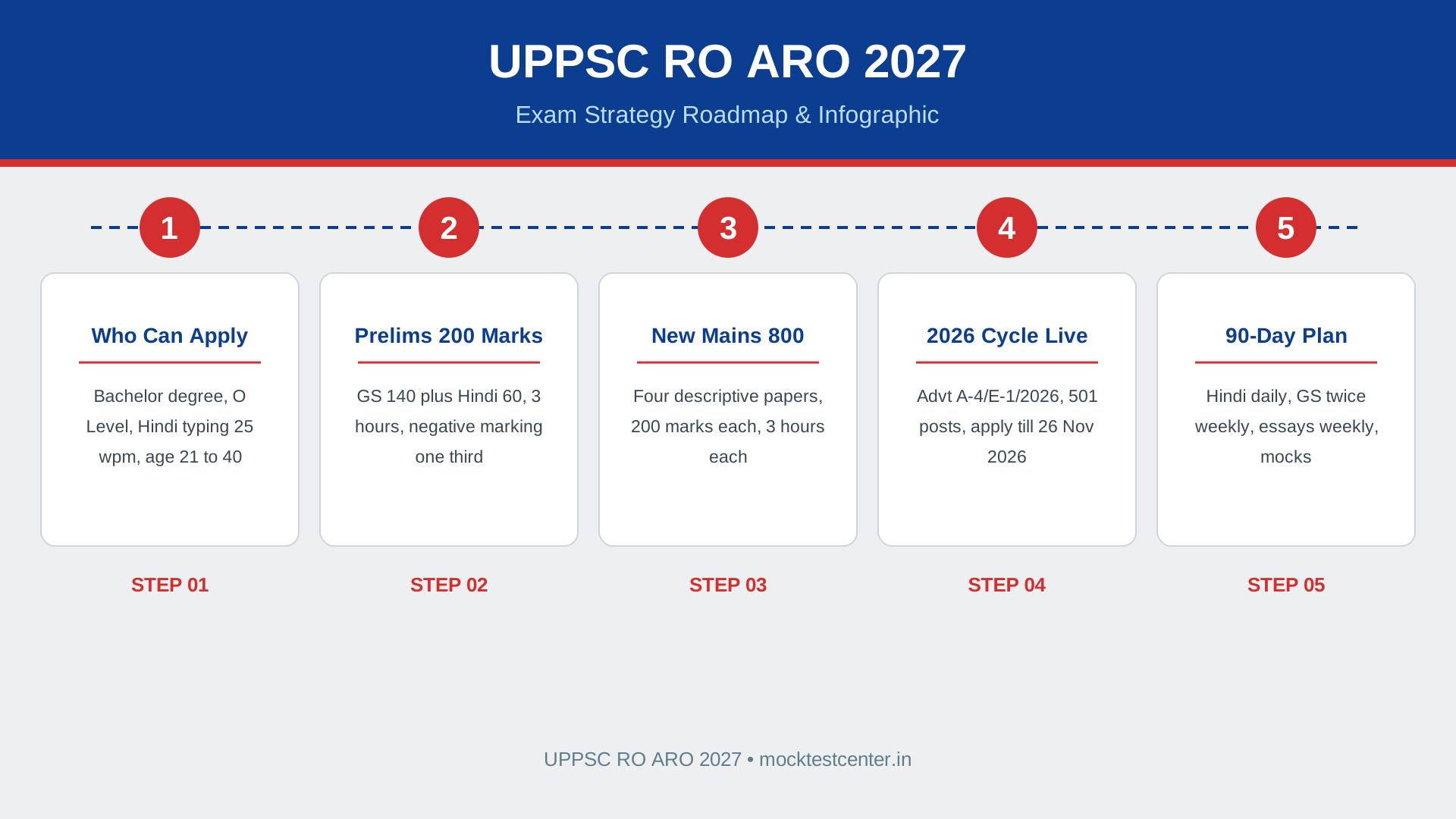
UPPSC RO ARO 2027 is the Review Officer and Assistant Review Officer exam of the Uttar Pradesh Public Service Commission, and the cycle now live is Advertisement A-4/E-1/2026, dated 26 October 2026, with 501 posts. Applications run from 26 October to 26 November 2026 on uppsc.up.nic.in. The Prelims stays a 200 mark objective paper.
The Mains has changed completely. It now carries four descriptive papers worth 800 marks, double the 400 marks of the last cycle. There is no interview. This page carries the 2027 label because the exam itself will run into 2027, but the live advertisement is the 2026 one, and no separate 2027 advertisement exists as of 19 November 2026.
That single fact decides how you should prepare. Many pages on the internet still show the old 400 mark Mains, because they copied the 2023 cycle. If you prepare from those pages, you will practise the wrong papers. This guide uses the 2026 advertisement as reported by several trackers, and it marks every place where sources disagree, so you can check the official notice yourself before you apply.
The one change that rewrites UPPSC RO ARO 2027
Under the 2023 cycle, the Mains had three papers worth 400 marks. General Studies was one objective paper of 120 marks. General Hindi and Drafting was 100 marks of descriptive writing plus 60 marks of objective vocabulary.
Hindi Essay was three essays worth 120 marks. That pattern is gone.
Under Advertisement A-4/E-1/2026, the Mains has four descriptive papers of 200 marks each, three hours each, for a total of 800 marks. Paper 1 is General Studies I. Paper 2 is General Studies II.
Paper 3 is General Hindi and Drafting. Paper 4 is Hindi Essay. Every paper is written by hand in the descriptive style, and the final merit list rests on the Mains total alone.
Two things vanish with the old pattern. The objective General Studies paper is gone, so a candidate can no longer bank 120 marks on multiple choice questions in the Mains. The objective vocabulary section of 60 marks is gone too.
In its place, General Studies becomes two full descriptive papers, and each one asks for 20 written answers in three hours. That works out to about nine minutes per answer, with word limits of 75 words for short answers and 125 words for long answers.
The essay paper changes as well. Three essays of 40 marks each become two essays, one of 80 marks with an 800 word limit and one of 120 marks with a 1200 word limit. A candidate who writes slow, long essays will run out of time in this paper. A candidate who writes short, sharp essays will finish with time to spare.
Why does this matter so much? Because the Prelims is only a screen. Its 200 marks do not count toward the final merit.
The Mains decides everything. A candidate who clears the Prelims by one mark and a candidate who tops the Prelims by 40 marks start the Mains on equal ground. The 800 mark Mains is the whole exam, in effect, and the 2026 advertisement has made it a writing exam from the first paper to the last.
The Prelims itself stays the same. One objective paper of 200 questions and 200 marks in three hours, with 140 questions of General Studies and 60 questions of General Hindi. One third of a mark goes for each wrong answer, so a wrong answer costs 0.33 marks and a blank answer costs nothing. Candidates equal to 15 times the vacancies qualify for the Mains, which means about 7,515 candidates will sit for the Mains from this cycle.
One more change sits inside the vacancy list. The 2026 advertisement covers more than RO and ARO. It also lists Review Officer (Accounts), Assistant Review Officer (Accounts), and four small posts at UPPSC itself, Manager, Care-Taker, Receptionist and Store Keeper.
The total is 501 posts, against 411 advertised in the last cycle. The biggest post is Assistant Review Officer with 329 vacancies, which is about two thirds of the total.
The 2023 cycle took two and a half years
The last cycle shows what this exam can cost in time. UPPSC issued Advertisement A-7/E-1/2023 on 9 October 2023 for 411 posts. The Prelims ran on 11 February 2024.
The Uttar Pradesh government cancelled that exam on 2 March 2024 after a paper leak. Candidates waited more than a year for the re-exam.
The re-exam ran on 27 July 2025 across 2,382 centres in all 75 districts of Uttar Pradesh. About 10.76 lakh candidates had applied. The Prelims result came on 16 September 2025, and 7,509 candidates qualified for the Mains.
The Mains ran on 2 and 3 February 2026. The typing test ran from 16 to 19 February 2026 at ITI Aliganj in Lucknow. A total of 5,930 candidates appeared for the Mains.
The final result came in April 2026, and 419 candidates were selected. Two trackers give the date as 5 April 2026 and two give it as 6 April 2026, so this guide uses 5 April and flags the other claim. The number 419 also needs a note.
The advertisement listed 411 posts, yet 419 candidates were selected, 338 for Review Officer and 81 for Assistant Review Officer, which means the vacancy count rose during the cycle. UPPSC has not yet published the official category wise cut off marks of the 2023 cycle, so this guide quotes no cut off numbers. Any site that gives you exact 2023 cut off marks today is guessing.
Anil Pandey topped the 2023 exam. His roll number was 1044839. Only 7.06 percent of the candidates who appeared for the Mains were finally selected, which tells you how steep the last stage is. The 2023 cycle ran from notification to final result in about two and a half years, and the paper leak in the middle caused most of that delay.
That history carries a plain lesson for the 2026 cycle. Apply early, keep your documents ready, and do not plan your preparation around a guessed exam date. The Prelims date for the 2026 cycle has not been announced as of 19 November 2026.
One tracker puts an expected Prelims date of 15 March 2027 on its page, but that is an estimate from the tracker, and no official date exists. Check uppsc.up.nic.in for the date, and plan around the syllabus until the date arrives.
Prelims in plain words
The Prelims is one objective paper, answered on an OMR sheet with a black ball point pen. It has two parts inside one sitting of three hours. The paper carries 200 questions for 200 marks, one mark per question, with four options for each question. Marking two answers for one question counts as a wrong answer.
| Paper | Questions | Marks | Time |
|---|---|---|---|
| General Studies | 140 | 140 | 3 hours |
| General Hindi | 60 | 60 | |
| Total | 200 | 200 | 3 hours |
The negative marking rule shapes every decision in this paper. Each wrong answer costs one third of a mark. A blank answer costs nothing.
That means a guess with no basis loses marks over a full paper, while a guess after removing two wrong options can pay. The minimum qualifying mark is 40 percent for most candidates and 35 percent for SC and ST candidates, and a candidate below that line does not reach the Mains even if seats stay vacant.
General Hindi is the part most candidates underrate. It carries 60 of the 200 marks, and it comes from only six vocabulary topics, ten questions each. Vilom, sentence correction, one word for several words, Tatsam and Tadbhav, Visheshya and Visheshan, and Paryayvachi.
A prepared candidate can score 52 to 56 out of 60 here, because the topics are fixed and the questions repeat in shape year after year. That score gives a cushion that the General Studies paper rarely gives.
The General Studies paper is wide. It covers general science, history of India and the national movement, Indian polity, economy and culture, Indian agriculture, commerce and trade, population, ecology and urbanisation in the Indian context, world geography and geography and natural resources of India, current national and international events, general intelligence, and special knowledge of Uttar Pradesh, its education, culture, agriculture, industry, trade, living and social traditions. The Uttar Pradesh part is where many candidates lose marks, because national level books cover it thinly.
Treat the Prelims as a gate, and nothing more. Its marks vanish after the screen. A candidate who spends six months chasing a top Prelims score and two weeks on answer writing has the plan backwards. Clear the gate with a safe margin, and put the real hours into the Mains.
Candidates who also follow the UPPSC PCS 2027 exam will see a different screen there, with two Prelims papers and an interview at the end, so do not mix the two patterns.
Mains: four papers, 800 marks, all descriptive
The Mains is where this exam is won. Four papers, each of 200 marks and three hours, all descriptive. The total is 800 marks.
The final merit list comes from this total alone, plus the typing test for the posts that need it, which is qualifying in nature. There is no interview for either RO or ARO, a point some guides get wrong. Two trackers describe a three stage process ending in a personal interview, and that is wrong. UPPSC holds no interview in this exam.
| Paper | Questions | Marks | Time |
|---|---|---|---|
| Paper 1 General Studies I | 20 | 200 | 3 hours |
| Paper 2 General Studies II | 20 | 200 | 3 hours |
| Paper 3 General Hindi and Drafting | 8 | 200 | 3 hours |
| Paper 4 Hindi Essay | 2 | 200 | 3 hours |
| Total | 50 | 800 | 12 hours |
Each General Studies paper has 20 questions. Ten are short answers worth 8 marks each with a 75 word limit. Ten are long answers worth 12 marks each with a 125 word limit.
Ten short answers give 80 marks and ten long answers give 120 marks, which adds to 200. Three hours for 20 answers leaves about nine minutes per answer, and that includes reading the question, thinking, and writing. A candidate who writes 200 words for a 75 word answer will not finish the paper. Word discipline is a scoring skill here, and it needs practice under a timer.
Paper 1, General Studies I, covers Indian history, art and culture, from ancient times to modern times, modern Indian history from 1757 to 1947, the freedom struggle, and consolidation after independence till 1965. It covers Indian society, its features and culture, women and women organisations, population, urbanisation, liberalisation, privatisation and globalisation, social empowerment, social justice and inclusive growth. It covers geography of India, physical, economic and human geography, and geography of Uttar Pradesh, physical, human, economic, planning and development.
It covers environment and disaster management, ecosystems, pollution, the Environment Protection Act, disasters like earthquake, tsunami, flood, drought and epidemic, the disaster management cycle, and NDMA, NDRF and SDRF. It closes with science and technology in everyday life, India science and technology policy, space, IT and telecom, missiles, UAVs, stealth, nanotechnology, robotics and artificial intelligence, nuclear energy policy, biotechnology, biopiracy and bioinformatics.
Paper 2, General Studies II, covers Indian polity and the Constitution, its evolution, features, amendments and basic structure, Union State relations and federal issues, the Finance Commission, Parliament and state legislatures. It covers governance, the executive and judiciary, pressure groups, public interest litigation, constitutional posts, statutory, regulatory and quasi judicial bodies including NITI Aayog, government policies and interventions, and information technology in governance. It covers economy and agriculture, sustainable development goals, manufacturing, energy, transport, budget and financial system, liberalisation, industrial policy, foreign trade, crops, fertilisers, irrigation, agri marketing, e-technology, farm subsidies, minimum support price, and problems of agriculture in Uttar Pradesh.
It covers ethics and integrity, foundations of ethics, Indian and Western ethical thought, attitude, aptitude, integrity, and emotional intelligence in public service. It closes with current affairs, regional, national and international, including games and sports, South Asia and SAARC, India, and Uttar Pradesh.
Notice how much of this syllabus overlaps with the UPPSC PCS Mains syllabus. A candidate who prepares for both exams can share notes across history, polity, economy and ethics, but the answer format differs, so shared notes still need separate writing practice.
The minimum qualifying mark applies in the Mains as well. SC and ST candidates must score at least 35 percent, and all other candidates at least 40 percent, in the Mains, or they do not enter the merit list. Research scholars of the Chief Minister Fellowship Programme get weightage marks in the Mains, 2 marks for one year, 4 marks for two years, and 6 marks for three or more years.
Hindi decides the rank
Paper 3 and Paper 4 together carry 400 of the 800 Mains marks, which is half the exam. Both papers are in Hindi. A candidate with strong Hindi can build a lead here that General Studies rarely gives, because Hindi answers reward practice more than memory. A candidate with weak Hindi can lose the exam here even with strong General Studies.
Paper 3, General Hindi and Drafting, has eight questions worth 200 marks. The break up, as reported from the 2026 advertisement, runs like this. An unseen passage gives 30 marks, a heading for 5 marks, explanation of three underlined parts for 15 marks, and a precis for 10 marks.
A summary of a government letter in tabular form gives 10 marks. Correspondence gives 20 marks, split into two parts of 10 marks each, covering official letters, demi official letters, office orders, circulars, reminders, office memos, notifications, notes and reports. Administrative and commercial terminology gives 20 marks, ten for English to Hindi and ten for Hindi to English.
Idioms and phrases give 30 marks, ten idioms at 3 marks each, with meaning and sentence use. Grammar gives 30 marks, 15 for parts of speech and cases and verbs, 5 for punctuation, and 10 for correction of errors in words and sentences. Varn vichar gives 10 marks, vowels and consonants and their classification.
Tatsam, Tadbhav, Deshaj and foreign words, prefixes, suffixes, Sandhi and Samas, synonyms, antonyms, words with many meanings, one word for a phrase, and words that sound alike but differ in meaning give 40 marks in three parts. General knowledge of computers gives 10 marks. The parts add to 200.
That paper tests the daily work of a Review Officer. A Review Officer reads files, writes notes, drafts letters, and turns long government letters into short summaries. The tabular summary question tests exactly that skill. Candidates who only memorise vocabulary will score in the grammar parts and lose marks in drafting, because drafting needs practice with real formats, not memory.
Paper 4, Hindi Essay, has two essays. The first carries 80 marks with an 800 word limit. The second carries 120 marks with a 1200 word limit.
One essay comes from each of two sections, and both essays are compulsory. The first section covers science, environment and technology, the economic field, agriculture, industry and trade, and natural calamities like landslides, earthquakes, floods and drought. The second section covers literature and culture, the social and political field, national and international events, and national development plans and projects.
Two essays in three hours sounds easy, and it is not. Two thousand words of clean Hindi in three hours needs a steady hand and a clear structure, and most candidates write their best essay first and rush the second. The 120 mark essay carries more weight than any single question in the whole exam, so it deserves the best hour, not the leftover hour. Practise both essays in one sitting, with a timer, and check the word count after each attempt.
The typing test follows the Mains for the posts that need Hindi typing. The speed needed is 25 words per minute in Hindi on a computer. In the 2023 cycle, UPPSC held the typing test on 16 to 19 February 2026 at ITI Aliganj in Lucknow, with a choice of Kruti Dev 010 or Mangal Inscript font. Start typing practice early, because 25 words per minute in Hindi with correct matras is harder than it sounds, and the test is qualifying, which means a fail here ends the attempt even with a high Mains score.
One point needs care. Sources disagree on which posts need the O Level certificate and the typing test. One tracker says only Assistant Review Officer posts need the O Level certificate and 25 words per minute Hindi typing, and Review Officer posts need only a bachelor degree.
Another tracker, reporting the 2026 advertisement post by post, says the O Level certificate and Hindi typing apply to RO and ARO posts in the Secretariat, the Board of Revenue and UPPSC, and it lists the Account posts and the small UPPSC posts separately. This guide follows the post by post reading and flags the other reading, because the advertisement itself is the final word. Check the post you apply for before you assume anything.
Who can apply
A bachelor degree from a recognised university is the base qualification for the general RO and ARO posts. On top of that, the 2026 advertisement asks for an O Level certificate from DOEACC or NIELIT, or an equivalent qualification, and a Hindi typing speed of at least 25 words per minute on a computer. Knowledge of English typing gives preference. For UPPSC posts, a Diploma in Computer Science is also accepted in place of the O Level certificate.
The Account posts ask for more. Review Officer (Accounts) and Assistant Review Officer (Accounts) need a B.Com with Accountancy, or an equivalent qualification including a CA or ICWA graduate level degree, plus an O Level certificate in Computer Application and knowledge of Hindi in Devanagari script. The Receptionist post, called Swagati, needs a bachelor degree with History, Geography, English Literature, Anthropology or Architecture as a subject, plus good Hindi. Manager, Care-Taker and Store Keeper need a bachelor degree, with preference for hotel management or catering, horticulture, accounts, administrative or store experience as listed in the advertisement.
Two conditions catch candidates out. First, candidates still appearing in the qualifying exam are not eligible, so a final year student cannot apply for this cycle. Second, preference goes to candidates with two years in the Territorial Army or an NCC B certificate, other things being equal, so mention it in the form if you hold it.
The age limit is 21 to 40 years as on 1 July 2026 for the general category. That means a general candidate must be born not earlier than 2 July 1986 and not later than 1 July 2005. Relaxation goes to five years for SC, ST and OBC candidates of Uttar Pradesh, skilled players of Uttar Pradesh, and Uttar Pradesh state government employees, including Basic Shiksha Parishad and aided Madhyamik teachers and staff, which takes the limit to 45 years.
Divyangjan candidates of Uttar Pradesh get 15 years of relaxation, which takes the limit to 55 years. Ex-servicemen of Uttar Pradesh get three years plus the period of army service. Research scholars of the Chief Minister Fellowship Programme get one to three years of relaxation, one year for each completed year.
Only one relaxation applies if you claim more than one, and UPPSC takes the most beneficial one. Candidates from other states can apply, but they count as unreserved candidates, with no reservation and no relaxation. Reservation and age relaxation for SC, ST, OBC, EWS, dependents of freedom fighters, ex-servicemen, sportspersons, Divyangjan and women apply only to permanent residents of Uttar Pradesh.
Domicile is not needed to apply, but it decides whether you get reservation. A candidate from outside Uttar Pradesh with a bachelor degree and the O Level certificate can sit for the exam as a general candidate. That rule surprises many applicants, so read it twice before you fill the form.
There is no limit on the number of attempts, as long as you stay inside the age limit. Graduates who go on to a master degree and clear NET may also look at the UPPSC Assistant Professor 2027 exam, which recruits teachers for government colleges. A candidate who misses the cut off in one cycle can sit again in the next cycle, and many selected candidates in the 2023 cycle had sat for the exam before.
Fee, OTR and how to apply
The Prelims fee is 125 rupees for Unreserved, EWS and OBC candidates, which is 100 rupees of exam fee plus 25 rupees of online processing fee. SC and ST candidates of Uttar Pradesh pay 65 rupees, and ex-servicemen of Uttar Pradesh pay 65 rupees. Divyangjan candidates of Uttar Pradesh pay 25 rupees, which is the processing fee only.
The Mains has a separate fee, paid only by candidates who qualify for the Mains, of 225 rupees for Unreserved, EWS and OBC candidates, 105 rupees for SC and ST candidates, and 25 rupees for Divyangjan candidates. Pay through SBI MOPS by net banking, card or other modes, and keep the payment slip.
One Time Registration, called OTR, is compulsory before you fill the form. Get your OTR number at otr.pariksha.nic.in at least 72 hours before you apply, because the OTR number takes time to activate. Your category, sub category, domicile, gender, date of birth, EWS status, creamy layer status, name and address are taken from your OTR as they stand on the last date, so fill the OTR with care. A change made in OTR must be synced with the Candidate Dashboard, or the form will carry the old details.
The application window for Advertisement A-4/E-1/2026 runs from 26 October to 26 November 2026, and the fee must also be paid by 26 November 2026. Corrections and fee reconciliation are allowed till 3 December 2026, and you can modify the qualification part of a submitted application only once, till that date. Apply on uppsc.up.nic.in, open All Notifications and Advertisements, open this advertisement, click Apply, and authenticate with your OTR number through OTP or OTR password. Fill the essential qualification, then on the Applicant Dashboard click Submit Details under Application Part 2 and answer Yes or No for each preferential qualification.
Do not send any hard copy at the Prelims stage. After the Prelims, or when UPPSC asks, send the hard copy of the online form with self attested copies of all marksheets and certificates. The High School certificate is the only proof of date of birth. Women candidates must note that caste certificates must come from the father side.
Print the final application form and the payment slip, and keep both safe. Keep your application number and password safe from the day you apply, because the admit card, the answer key and the result all need the same login.
Pay and posting
The posts in this exam sit in the pay scale of 29,200 rupees to 64,700 rupees at Level 5, up to 47,600 rupees to 1,51,100 rupees at Level 8, under the Seventh Pay Commission. Dearness allowance, house rent allowance and other allowances of the Uttar Pradesh government are paid on top. The exact level depends on the post, and the advertisement lists the level post by post.
The vacancy split by post is 131 Review Officer, 329 Assistant Review Officer, 31 Review Officer (Accounts), 6 Assistant Review Officer (Accounts) under special recruitment, and one post each of Manager, Care-Taker, Receptionist and Store Keeper at UPPSC. The total is 501. By category, the split is 246 Unreserved, 108 SC, 6 ST, 97 OBC and 44 EWS. The number may rise or fall before the Prelims result, because requisitions for other posts of the same nature and qualification can still reach UPPSC.
By department, the Uttar Pradesh Secretariat in Lucknow takes 420 of the 501 posts, which is more than four out of five. The Office of the Advocate General takes 45, all Assistant Review Officer posts. UPPSC in Prayagraj takes 28, and the Board of Revenue takes 8.
A Review Officer in the Secretariat reads files, puts up notes, drafts letters and government orders, and tracks files through the department. An Assistant Review Officer does the same work at a junior level, with more typing and more file movement. The work is desk work, in Hindi and English, inside government offices, and it suits a candidate who writes clean Hindi and keeps files in order.
The UPPSC APO 2027 exam leads to a prosecution post with a different pay scale and a law degree, so compare the two only on the work, not on the marks. The UPPSC Assistant Engineer 2027 exam is a technical post for engineering graduates, and the UPPSC Lecturer GIC 2027 exam leads to teaching in government inter colleges, so a graduate with a bachelor degree and an O Level certificate will find RO and ARO the natural fit among these.
A 90 day plan that fits the new pattern
Ninety days divide into three parts, and each part has one job. Days 1 to 30 build the base. Read the RO ARO syllabus topic by topic, and give General Hindi one hour every day from day one, because Hindi is the highest scoring part of the Prelims and half of the Mains.
Study Uttar Pradesh topics with the same care as national topics, because the Prelims paper asks about the state in detail. End each week with a previous year paper, solved without a time limit, and mark the questions you got wrong.
Days 31 to 60 build speed and writing. Start timed Prelims practice, one full 200 question paper every third day, in three hours, with the OMR habit and the negative marking rule in mind. Start answer writing in the same phase, two General Studies answers a day, one short and one long, inside the word limits.
Write one Hindi essay a week, and one drafting set a week, with real formats for letters, memos and circulars. This is the phase where weak areas show themselves, and the right move is to give the weakest area the most hours, even when the strongest area feels better to study.
Days 61 to 90 build exam fitness. Sit for a full Prelims mock every second day, 200 questions in three hours, in one sitting, with no phone and no notes. Sit for one Mains paper a week in full, three hours, twenty answers, with a timer.
Analyse each mock the same evening, and write down three things, the topics that cost marks, the question types that ate time, and the silly errors. Revise only from your notes and your error list in the last ten days, and stop learning new material five days before the exam.
Working candidates can follow the same plan with smaller daily hours. Two hours a day for ninety days beats six hours a day for thirty days, because the syllabus needs repetition more than it needs long sittings. Keep a simple daily log, date, hours, topics covered, questions solved, and the log itself will keep you honest when motivation dips. Hindi typing practice belongs in the daily log too, fifteen minutes a day on the computer, because typing speed grows slowly and cannot be built in a week.
The UPPSC PCS J 2027 exam needs a law degree and a different plan, with case law and judgment writing at the centre, so do not copy a PCS J timetable for RO and ARO. The UPPSC Staff Nurse 2027 exam is a nursing post with its own syllabus, and the UPPSC Medical Officer 2027 exam is a medical post, so each UPPSC exam needs its own plan even when the commission is the same.
Mocks and typing: how to use them without wasting them
A mock test measures, and the analysis after it teaches. Sit for the Prelims mock in exam conditions, three hours, one sitting, no break, no phone, no notes. Analyse the mock the same day, while the questions still feel fresh.
Sort every wrong answer into three piles, knowledge gap, silly error, and time pressure. Knowledge gaps need a return to the book. Silly errors need a slower reading habit.
Time pressure needs more timed sets. A mock without this sorting wastes three hours, because the score alone teaches nothing.
Use the negative marking rule in the last fifteen minutes of every Prelims paper. With one third of a mark lost for a wrong answer, every unanswered question is a choice, not a loss. Guess with sense, remove the options you know are wrong, and pick from what remains.
If you cannot remove even one option, leave the question blank. A mock is the place to practise this judgment, so that the habit feels natural on exam day.
Mains mocks need a different analysis. After each General Studies paper, count the answers you finished, the answers you left, and the answers that crossed the word limit. Most candidates lose marks not on knowledge but on unfinished papers.
If you finish only 15 of 20 answers, you have lost 60 to 100 marks before the examiner reads a word. The fix is speed, and speed comes from writing daily, not from reading more.
Typing practice needs its own routine. Practise Hindi typing on a computer every day, with the same font you will use in the test, Kruti Dev 010 or Mangal Inscript. Type passages from Hindi newspapers and government letters, because the test uses that kind of text.
Check your speed each week. Twenty five words per minute with correct matras and punctuation is the line, and a candidate who types fast with errors fails just as surely as a candidate who types slow.
Take mocks from the full syllabus, and keep Prelims mocks and Mains mocks separate. Your Prelims mocks should stay inside the RO and ARO pattern, because a mixed mock hides your weak topics. Keep a running table of your mock scores, Prelims and Mains separately, and watch the trend across weeks, because a rising trend tells you the plan works and a flat trend tells you to change the plan.
Mistakes that cost good candidates marks
The first mistake is preparing from the old pattern. Many guides still show the 400 mark Mains, and many video lectures still teach the objective General Studies paper. A candidate who follows those guides will walk into a descriptive exam with objective habits.
Check the advertisement number on any guide you use. If it does not say A-4/E-1/2026, treat its Mains pattern as out of date.
The second mistake is starting without the syllabus. Candidates read random books for months and then find the Mains asking about ethics, disaster management and Uttar Pradesh agriculture, topics they never opened. Print the RO ARO syllabus, pin it on the wall, and tick each topic as you finish it.
The third mistake is reading Hindi last. Hindi carries 60 marks in the Prelims and 400 marks in the Mains, and candidates who leave it to the final month score far below their General Studies level. One hour a day from day one keeps Hindi level with General Studies, and a level Hindi score saves many borderline results.
The fourth mistake is collecting books instead of finishing them. Many candidates buy five books for General Studies and finish none. One standard book per subject, read twice, beats three books read once. Buy the latest edition, check the edition year before you pay, and finish one book before you buy the next.
The fifth mistake is taking mocks and skipping the analysis. A mock score without analysis is a number without a lesson, and a candidate who repeats the same errors in ten mocks learns nothing from any of them. Analyse every mock, write the error list, and fix one error type before the next mock.
The sixth mistake is trusting unofficial dates. Websites guess the Prelims date every cycle, and candidates who plan around a guessed date lose weeks. Trust only the official portal, and plan around the syllabus until the notice arrives.
The seventh mistake is ignoring the O Level certificate and the typing test until the last month. The O Level certificate takes time to earn, and typing speed takes months to build. If your post needs the certificate, arrange it now. If your post needs typing, practise daily from the first week.
Check these six things before you apply
Read the advertisement on uppsc.up.nic.in, and check six things in order. First, the post list, and whether your qualification fits the post you want, general, Accounts, or the small UPPSC posts. Second, the age limit as on 1 July 2026, and whether your date of birth falls inside the window for your category.
Third, the O Level and typing rules for your post, because they differ by post. Fourth, the fee for your category, for the Prelims and for the Mains. Fifth, the application window, 26 October to 26 November 2026, and the correction window till 3 December 2026. Sixth, the OTR details, because the form copies your category, domicile and date of birth from OTR.
Apply early in the window, and keep a copy of the filled form, the fee receipt and the application number. Check your photo, your signature, your category and your post choices before you submit, because the correction window fixes small errors and never fixes a wrong post. Then return to your plan, and let the advertisement change your dates, not your study.
Your preparation starts before the exam date, and the date only sets the deadline. A candidate who has covered the syllabus, solved the previous year papers, written the essays and practised typing will meet the date with calm, and a candidate who waits for the date will meet it with panic. Start now, and let UPPSC RO ARO 2027 find you ready.
Candidates who want a forest post can read the UPPSC ACF RFO 2027 page, and candidates aiming for school teaching can read the UPPSC TGT 2027 page, because UPPSC runs many exams beside RO and ARO, and each one has its own pattern and its own dates.
Sources
UPPSC Advertisement A-4/E-1/2026, dated 26 October 2026, as reported by RealMocks, Notes Cafe, Drishti IAS and Kartavya PCS, all checked against each other in November 2026. UPPSC RO ARO 2023 cycle dates and figures as reported by Testbook, CareerPower, StudyIQ and Shishya, with the final result date flagged as 5 April 2026 against a 6 April claim. Pattern and syllabus detail for the 2026 cycle as reported by RealMocks and Improvam, checked on 27 October 2026. The official notice on uppsc.up.nic.in is the final word on every date, rule and figure in this guide.







