
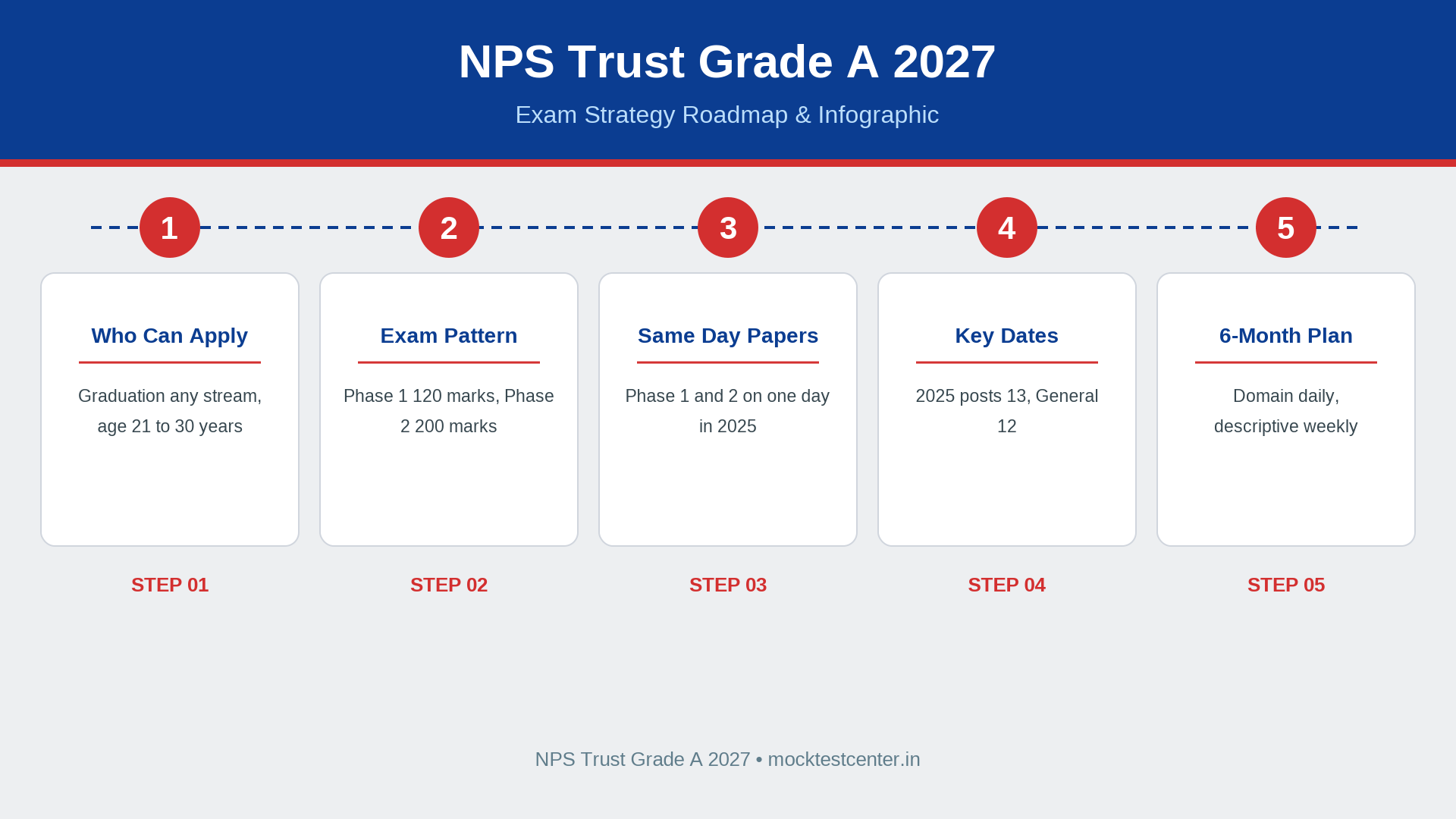
About NPS Trust Grade A 2027 Exam Series
📖 Table of Contents
- What this job actually is
- NPS Trust in one page
- The 2025 cycle, step by step
- Who can apply: age and education
- What the job pays
- How selection works: three phases, one day of exams
- Phase 1 in detail: 120 marks, 90 minutes
- Phase 2 in detail: two papers, 200 marks
- The interview and the final merit list
- Syllabus: the domain section that decides the shortlist
- What to study first: a plan that fits the real pattern
- NPS Trust Grade A 2027: fee, form and admit card
- The 2026 rumour and the 2027 wait
- Where this exam sits beside PFRDA, SEBI and RBI Grade B
- Sources
NPS Trust Grade A 2027
What this job actually is
NPS Trust Grade A 2027 is the Assistant Manager post at the National Pension System Trust, the body that holds pension money for more than 9 crore subscribers. The Trust recruits Grade A officers in small batches. The last full cycle ran in 2025 and offered 13 posts.
No new notification has been verified on the official site as of 23 November 2026. This page works from the 2025 cycle and says plainly where the facts stop.
That small intake shapes everything about this exam. Thirteen posts draw thousands of applicants, most of them already preparing for SEBI Grade A, PFRDA Grade A or RBI Grade B. The NPS Trust Grade A 2027 paper rewards people who know the pension sector cold. General aptitude alone will not carry a candidate through, because the domain section decides who moves to Phase 2.
An Assistant Manager at NPS Trust works in New Delhi. The work covers compliance checks on pension intermediaries, subscriber grievances, data reports, coordination with pension fund managers. It is office work with real responsibility, since the money under watch belongs to retired and retiring workers across India. The post carries a basic pay of 44,500 rupees a month, a one year probation and a promotion ladder that runs up to Chief Executive Officer.
NPS Trust in one page
The Pension Fund Regulatory and Development Authority, or PFRDA, set up NPS Trust on 27 February 2008 under the Indian Trusts Act 1882. PFRDA is the settlor of the Trust. The Trust is the registered owner of all assets under the National Pension System, and pension funds buy securities on its behalf.
Subscribers keep the beneficial ownership of those assets. In plain terms, the Trust holds the money, the fund managers invest it, and the Trust watches the fund managers.
The Trust monitors pension funds, the trustee bank, custodian, central recordkeeping agencies. It checks their work against PFRDA regulations and steps in on subscriber grievances and exits and withdrawals. A board of trustees runs the Trust, with a minimum of five trustees and a maximum of eleven, all appointed by PFRDA. Dinesh Kumar Khara chairs the board, and Suparna Tandon has served as Chief Executive Officer since 22 July 2024.
The National Pension System itself began on 1 January 2004 for central government employees. It opened to all citizens on 1 May 2009. Parliament passed the PFRDA Act in 2013 and the Act came into force on 1 February 2014.
The scale today is large. NPS Trust had assets under management of 16,20,276 crore rupees and 9,05,34,981 subscribers as on 31 October 2025. PFRDA also notified the Unified Pension Scheme regulations on 19 March 2025, which added fresh work to the Trust.
Two facts matter for a candidate. First, the posts advertised are for NPS Trust only and have no link with PFRDA, even though PFRDA set the Trust up. Second, the Trust recruits rarely.
Its advertisements so far include advertisement 3/2022 in August 2022 and advertisement 5/2025 in January 2025. A candidate who waits for a yearly cycle will wait a long time. The smart move is to prepare while the notification is still away, because the gap between notification and exam can be as short as five weeks.
The 2025 cycle, step by step
NPS Trust released advertisement 5/2025 on 16 January 2025 for Officer Grade A and Officer Grade B. Applications opened the same day and closed on 5 February 2025, a window of 21 days. The advertisement offered 19 posts in all across the two grades.
Grade A had 13 posts, with 12 in the General stream and 1 in Risk Management. Grade B had the rest.
Phase 1 and Phase 2 both took place on 25 February 2025, the same day. That is the single most unusual fact about this exam. Most regulator exams give candidates weeks between the preliminary test and the mains.
NPS Trust ran both papers back to back on one day and judged Phase 2 papers only for candidates who cleared the Phase 1 cutoffs. A candidate who treats Phase 1 as the only target and leaves Phase 2 for later will walk into the descriptive paper unprepared.
Results for Phase 1 and Phase 2 came out together on 28 April 2025. Interviews ran from 28 May to 13 June 2025. The final result came on 20 June 2025.
The whole cycle, from notification to final result, took about five months. That speed cuts both ways. It rewards candidates who are ready before the notification, and it punishes anyone who starts from zero on the day the advertisement appears.
| Event | 2025 cycle date |
|---|---|
| Notification, advertisement 5/2025 | 16 January 2025 |
| Online applications open | 16 January 2025 |
| Last date to apply | 5 February 2025 |
| Grade A posts | 13 (General 12, Risk Management 1) |
| Total posts across Grade A and Grade B | 19 |
| Phase 1 and Phase 2 exams | 25 February 2025, same day |
| Phase 1 and Phase 2 results | 28 April 2025 |
| Interviews | 28 May to 13 June 2025 |
| Final result | 20 June 2025 |
Who can apply: age and education
Age for Grade A runs from 21 to 30 years. The Trust calculated age as on 31 December 2024 for the 2025 cycle. Scheduled Caste and Scheduled Tribe candidates get five years of relaxation. The advertisement fixes the full relaxation table, and the next advertisement will fix a fresh cutoff date, so check the new notification before you count yourself in or out.
Education for the General stream is broad. A candidate needs a full time graduation or post graduation in any discipline from an Indian university or institute recognised by AICTE, UGC or the government. Professional qualifications count too: CA, CFA, CS, FRM or an equivalent, CMA, MBA, PGDBA, PGPM or PGDM.
No experience is needed for the General stream. The qualification must be in hand as on the cutoff date fixed in the advertisement.
Risk Management asks for more. A candidate needs a full time post graduate degree in Finance, Commerce, Economics, Statistics, Econometrics, Mathematics or Mathematical Statistics. CA, CFA, FRM or an equivalent, CMA, MBA, PGDBA, PGPM or PGDM also count.
On top of the degree, the stream needs a minimum of two years of post qualification experience in the pension or financial sector, with special knowledge or experience in investment management, treasury management or risk management. A diploma in data science, data analytics, data statistics or business analytics helps but stays desirable, not compulsory.
Final year students get a fair deal here. Candidates who have appeared for their final examinations and await results can appear in the selection process. They must produce the qualification documents at the time of joining.
That rule differs from some other regulator exams, so it is worth knowing early. One more limit applies to everyone: a candidate can apply for one stream only. Pick the stream before you pay the fee, because the choice stays fixed after submission.
| Stream | Age as on 31 Dec 2024 | Education | Experience |
|---|---|---|---|
| General | 21 to 30 years | Full time graduation or post graduation in any discipline, or CA, CFA, CS, FRM, CMA, MBA, PGDBA, PGPM, PGDM | None |
| Risk Management | 21 to 30 years | Full time post graduate degree in Finance, Commerce, Economics, Statistics, Econometrics, Mathematics or Mathematical Statistics, or CA, CFA, FRM, CMA, MBA, PGDBA, PGPM, PGDM | Minimum 2 years in pension or financial sector work |
What the job pays
The starting basic pay for a Grade A officer is 44,500 rupees a month. The Trust adds dearness allowance, house rent allowance, grade allowance, special allowance, local compensatory allowance, housing allowance, learning allowance on top of basic pay, plus its own contribution toward the National Pension System. The exact take home pay moves with the allowance rates in force at the time of joining, so any single number printed today will age fast.
Two secondary sources give different totals for the same post, and a candidate should know about the gap. One coaching portal puts the annual CTC of an Assistant Manager at around 30 lakh rupees. Another tracker puts the gross monthly pay at around 1,40,000 rupees, which works out to about 16.8 lakh rupees a year before the CTC extras.
Both numbers cannot be right in the same sense, and neither comes from the official advertisement text seen in this pass. The fixed figure is the basic pay of 44,500 rupees. Treat every larger number as a claim to check against the next notification, not as a promise.
Grade B pays more, with a basic pay of 55,200 rupees a month as per secondary reporting, and a gross of around 1,70,000 rupees a month. The promotion ladder runs from Grade A Assistant Manager to Grade B Manager, Grade C Assistant General Manager, Grade D Deputy General Manager, Grade E General Manager and Grade F Chief Executive Officer. The Trust keeps a probation of one year for new Grade A officers, and it can extend that period if performance falls short. Officers receive full salary during training.
How selection works: three phases, one day of exams
Selection runs in three phases. Phase 1 is an online objective test of 120 marks. Phase 2 is an online test of two papers worth 100 marks each.
Phase 3 is the interview. The notification sets the whole scheme, and the Trust can change dates or cancel the process at any stage.
The twist is the calendar. In 2025 the Trust held Phase 1 and Phase 2 on the same day, 25 February 2025. Candidates sat the 90 minute Phase 1 paper and then the two Phase 2 papers.
The Trust evaluated Phase 2 papers only for candidates who cleared the Phase 1 cutoffs. That single fact should shape the whole NPS Trust Grade A 2027 preparation plan. A candidate cannot afford to prepare for Phase 1 first and Phase 2 later, because later never comes.
Phase 1 is qualifying in nature. Its marks do not count in the final merit list. Phase 2 marks and interview marks decide the final selection, with equal weight of 50 percent each.
The Trust shortlists candidates for the interview on Phase 2 marks only. The interview carries no published mark figure in the notification, so a candidate should not assume a fixed total. The interview panel can ask in Hindi or English, as the candidate chooses.
Phase 1 in detail: 120 marks, 90 minutes
Phase 1 is one paper of 120 questions for 120 marks, to finish in 90 minutes. Each question carries one mark. There is no sectional timing, so a candidate can move between sections as time allows.
The paper is bilingual in Hindi and English, except for the English language test. Every wrong answer costs 0.25 marks.
The NPS Trust Grade A 2027 Phase 1 paper has five sections. English Language has 25 questions. Test of Reasoning and Analytical Skills has 25 questions. The domain section, covering Commerce, Accountancy, Management, Finance, Data Analytics, Statistics, Companies Act, Indian Trusts Act, Economics, Pension Sector, has 25 questions.
Quantitative Aptitude has 25 questions. General Awareness, including some questions on the financial sector, has 20 questions. The total comes to 120.
Risk Management candidates face the same shape with one change. Their 25 mark domain section tests the specialised subject of their stream instead of the General stream list. Human Resource candidates in Grade B follow the same pattern. The four aptitude sections stay common across streams.
Cutoffs work in two layers. A candidate must clear a separate cutoff in each test and an aggregate cutoff for the paper, both fixed by NPS Trust. The Trust does not publish these cutoffs in advance.
A strong total with one weak section can still end the attempt, so balanced preparation beats a lopsided score. The domain section deserves extra care, because it is the only section that tests the job itself, and it returns in Phase 2 as a full paper.
| Phase 1 section, General stream | Questions | Marks |
|---|---|---|
| English Language | 25 | 25 |
| Test of Reasoning and Analytical Skills | 25 | 25 |
| Commerce, Accountancy, Management, Finance, Data Analytics, Statistics, Companies Act, Indian Trusts Act, Economics, Pension Sector | 25 | 25 |
| Quantitative Aptitude | 25 | 25 |
| General Awareness, including financial sector questions | 20 | 20 |
| Total, 90 minutes, no sectional timing | 120 | 120 |
Phase 2 in detail: two papers, 200 marks
The NPS Trust Grade A 2027 Phase 2 has two papers of 100 marks each. Paper 1 is English and General Studies, a descriptive test of 100 marks in 60 minutes. Paper 2 is an objective test of 100 marks in 40 minutes on the stream subjects. The question papers are bilingual in Hindi and English, except for the English descriptive paper.
Paper 1 usually asks three questions: an essay, a precis, a reading comprehension. The essay tests whether a candidate can build an argument in clean English. The precis tests whether a candidate can shrink a passage without losing its point.
The comprehension tests whether a candidate reads carefully under time pressure. Sixty minutes for three written answers is tight, so hand speed and a fixed structure matter as much as knowledge.
Paper 2 returns to the domain list from Phase 1, in far greater depth. For the General stream, the paper covers Commerce, Accountancy, Management, Finance, Data Analytics, Statistics, Companies Act, Indian Trusts Act, Economics, Pension Sector. Risk Management and Human Resource candidates get questions on their own specialised subjects.
Paper 2 carries negative marking of 0.25 marks for each wrong answer. Paper 1 has no negative marking, since descriptive answers earn marks for quality rather than lose marks for a wrong tick.
The timing tells a candidate where the marks live. Phase 2 gives 100 minutes for 200 marks, against 90 minutes for 120 marks in Phase 1. The descriptive paper is the slowest part of the whole exam, and it is also the part most candidates neglect.
A candidate who writes one essay and one precis every week from the start of preparation will feel the difference on exam day. A candidate who first meets the descriptive paper in the exam hall will not.
| Phase 2 paper | Type | Marks | Time |
|---|---|---|---|
| Paper 1: English and General Studies | Descriptive, essay, precis, comprehension | 100 | 60 minutes |
| Paper 2: stream subjects, General stream | Objective MCQs on Commerce, Accountancy, Management, Finance, Data Analytics, Statistics, Companies Act, Indian Trusts Act, Economics, Pension Sector | 100 | 40 minutes |
The interview and the final merit list
Phase 3 is the interview. The Trust calls candidates for interview on the basis of Phase 2 marks only. Phase 1 marks play no part here, since Phase 1 only qualifies a candidate for the next stage. The interview panel can conduct the interview in Hindi or English, as the candidate opts.
The notification does not state the interview marks. What it does state is the weight. Phase 2 and the interview carry equal weight of 50 percent each in the final selection.
That weight makes the interview far more than a formality. A candidate with a middling Phase 2 score can still win a post with a strong interview, and a candidate with a strong Phase 2 score can lose one with a weak interview.
Interview questions usually test the same ground as the written papers, plus the candidate. Expect questions on the pension sector, the role of NPS Trust, current developments in NPS and the Unified Pension Scheme, and the candidate's own degree subject. A commerce graduate should expect accounting and finance questions.
An economics graduate should expect questions on inflation, fiscal policy, the pension system. Every candidate should be able to explain, in two minutes, what NPS Trust does and why it exists. That answer is the interview in miniature.
Syllabus: the domain section that decides the shortlist
The NPS Trust Grade A 2027 aptitude sections follow the usual banking exam pattern. Reasoning covers alphanumeric series; coding and decoding; syllogism; direction sense; inequality; ranking and order; blood relation; puzzles and sitting arrangement; input output; statement based questions; data sufficiency. Quant covers ratio and proportion; percentage; profit and loss; simple and compound interest; average and age; time and work; pipes and cistern; time and distance; mixture and alligation; series and quadratic equations; mathematical inequalities; number series; data interpretation; simplification and approximation; quantity comparisons. English covers reading comprehension; sentence rearrangement; cloze test; para jumbles; double fillers; error detection; sentence improvement; vocabulary.
General Awareness follows the official notification list. It covers economic and social development; the Indian economy with recent trends, fiscal and monetary policy, banking and infrastructure; the data and digital economy with cyber security and digital literacy; innovation and startups; technology including AI, space technology and biotechnology; sustainable development goals and global initiatives; emerging global challenges such as energy security, water scarcity and urbanisation; environment and climate change; ethical issues in governance and public administration; international relations; social justice with welfare schemes and inclusive development.
The domain syllabus is the part that sets this exam apart, and it comes from the official notification. Commerce and Accountancy covers accounting as a financial information system; accounting standards; cash flow statements; accounting for share capital transactions; employee stock options and buyback of securities; preparation of company final accounts. Management covers the role of a manager; leadership and leadership styles; human resource development; motivation; communication. Economics covers demand and supply; market structures; national income; balance of payments; foreign exchange markets; inflation; monetary policy; fiscal policy; non banking financial institutions.
Costing covers the overview of cost and management accounting; methods of costing; basics of cost control and analysis; lean systems and innovation. The Pension Sector covers the status of the pension sector in India; types of retirement schemes and their features; the National Pension System; the Atal Pension Yojana; annuity plans; basics of investment. Data Analytics and Statistics covers measures of central tendency and dispersion; the overview of data analytics; its importance; its types.
Finance covers the financial system and financial markets. Company law covers the Companies Act 2013. The Indian Trusts Act 1882 also appears in the Phase 1 domain list, which makes sense, since the Trust itself exists under that Act.
| Domain area | Core topics from the notification |
|---|---|
| Commerce and Accountancy | Accounting standards, cash flow, share capital, ESOP and buyback, final accounts |
| Management | Role of a manager, leadership, HRD, motivation, communication |
| Economics | Demand and supply, national income, balance of payments, inflation, monetary policy, fiscal policy |
| Costing | Cost and management accounting, methods of costing, cost control, lean systems |
| Pension Sector | Pension sector in India, retirement schemes, NPS, Atal Pension Yojana, annuity, investment basics |
| Data Analytics and Statistics | Central tendency, dispersion, overview and types of data analytics |
| Finance and Company Law | Financial system, financial markets, Companies Act 2013, Indian Trusts Act 1882 |
Note the shape of that table. Seven rows, and only one of them is the pension sector. A candidate who studies only NPS will miss most of the domain marks. The paper is a commerce and finance paper with a pension flavour, not a pension paper with a commerce flavour.
What to study first: a plan that fits the real pattern
Start with the domain section and the descriptive paper, because those two decide the result. Phase 1 aptitude can be built with daily practice, but domain knowledge and descriptive writing need months. A candidate who begins with quant and reasoning and leaves commerce for the end will find the end never arrives, since the NPS Trust Grade A 2027 exam can come five weeks after the notification.
Give the domain section two hours a day in the first three months. Work through one area at a time: accountancy first, then management, then economics, then finance, then the pension sector, then data analytics and statistics, then company law. Use Class 11 and 12 NCERT accountancy books for the base, a standard management text for leadership and motivation, and a standard Indian economy book for the economics half. Read the PFRDA site and the NPS Trust site every week for pension sector facts, because the paper asks about the real system, not a textbook version of it.
Give the descriptive paper one hour a week from the very first month. Write one essay and one precis each week, on a pension or economy topic, and time both. Sixty minutes is short for three answers, so practice with a clock from day one. Read one good English newspaper daily, and note the editorial arguments, since essay topics in regulator exams usually come from current economic debates.
Keep aptitude on a daily tick. Thirty minutes of quant, thirty minutes of reasoning and thirty minutes of English will hold those sections at a safe level. Spend the remaining study time on general awareness, with a monthly current affairs compilation and a weekly read of financial sector news from the Reserve Bank of India, SEBI, PFRDA and the Ministry of Finance.
Take a full mock test every week in the last two months, with Phase 1 and Phase 2 back to back on the same day, exactly as the Trust ran them in 2025. That single habit does more than any book. It teaches the body to write a descriptive paper after ninety minutes of objective questions, which is the real test on exam day.
One warning belongs here. Several coaching sites sell NPS Trust notes and courses for a 2027 cycle that has no notification yet. Buy material for the subjects, not for the cycle.
The syllabus has stayed stable across the 2022 and 2025 advertisements, so subject notes hold their value. A course that promises the 2027 paper pattern or the 2027 cutoffs is selling something it cannot know.
NPS Trust Grade A 2027: fee, form and admit card
The NPS Trust Grade A 2027 application fee follows the 2025 cycle for now. The 2025 fee was 1,000 rupees for Unreserved, EWS and OBC candidates. SC, ST, PwBD and women candidates paid nothing.
The fee is non refundable. The next notification will fix the fee again, so check the advertisement before paying, and pay only through the official portal.
Applications go in online only, through the Careers page on the NPS Trust website at npstrust.org.in. The 2025 process ran in clear steps: register with basic details, receive a provisional registration number and password on email, log in, fill the form, upload a photo, signature, thumb impression and handwritten declaration, preview the form, pay the fee by debit card, credit card, internet banking, IMPS, cash card or mobile wallet, and keep a printout of the form and the e receipt. Do not wait for the last day. The 2025 window lasted 21 days, and the portal load rises sharply near the close.
Admit cards come from the same Careers page. The Trust puts up a call letter link for Phase 1 and Phase 2, and candidates log in with the registration number, date of birth and captcha to download it. Phase 2 call letters follow the Phase 1 result in a normal two stage exam.
In 2025 both phases ran on the same day, so both call letters came together. Keep the registration number safe from the day you apply, because every later step needs it.
The 2026 rumour and the 2027 wait
One job tracker claims a fresh NPS Trust cycle for 2026, with 14 posts across Grade A and Grade B, a notification dated 16 October 2026, applications from 18 October to 18 November 2026, Phase 1 in December 2026 and Phase 2 in January 2027. That claim has no support from the official site or from other trackers. Other exam portals updated in the same week state that the 2026 notification has not been released yet, and that vacancies and dates will be notified later. The two versions cannot both be right.
This page does not treat the tracker claim as fact. As of 23 November 2026, no new NPS Trust Grade A notification has been verified on npstrust.org.in. A candidate who reads a fixed date on a tracker site should open the Careers page on the official site and look for the advertisement.
If the advertisement is there, the dates are real. If it is absent, the dates are a guess, however confidently they are printed.
The NPS Trust Grade A 2027 branding on this page follows the site rule for exam pages, not a notified cycle. NPS Trust recruits in irregular cycles, 2022 and then 2025, and the next advertisement may come in 2026 or 2027. The pattern, syllabus and eligibility on this page come from the last notified cycle, advertisement 5/2025, and they give a candidate the right preparation base whichever year the next notification lands in. When the new advertisement appears, check four things first: the post count, the cutoff date for age and education, the fee, and whether Phase 1 and Phase 2 still run on the same day.
Where this exam sits beside PFRDA, SEBI and RBI Grade B
NPS Trust Grade A 2027 is the smallest of the financial regulator exams, and that is its appeal. SEBI Grade A draws far more applicants for far more posts, and its syllabus runs wider. RBI Grade B is the hardest of the set, with a deeper economics paper and a longer preparation curve.
PFRDA Grade A is the closest cousin, since PFRDA regulates the pension sector that NPS Trust serves, and the two exams share much of the finance and economics syllabus. A candidate preparing for any one of these exams will find most of the work carries over to the others.
The differences are worth knowing. NPS Trust runs Phase 1 and Phase 2 on the same day, while SEBI and RBI give weeks between stages. NPS Trust gives the descriptive paper 60 minutes for 100 marks, which is faster than the RBI descriptive paper.
NPS Trust asks about the Indian Trusts Act 1882 and the pension sector in its domain paper, which no other regulator exam does in the same way. And NPS Trust recruits rarely, so the chance may come once in three years rather than once a year.
That rarity changes the strategy. A candidate cannot plan a year around NPS Trust alone. The sensible plan is to prepare for the regulator set as a whole, with SEBI Grade A or PFRDA Grade A as the main target and NPS Trust as the bonus paper when its notification appears.
The mock test pages on this site cover the whole set. The PFRDA Grade A 2027 mock test matches the pension sector half of this paper. The SEBI Grade A 2027 mock test matches the finance and securities half.
The RBI Grade B 2027 mock test stretches the economics half further than NPS Trust needs. The IRDAI Assistant Manager 2027 mock test covers another financial regulator with a similar pattern. The SIDBI Grade A 2027 mock test and the IFSCA Grade A 2027 mock test add two more regulator papers to the same preparation base.
The NABARD Grade A 2027 mock test helps with the agriculture and rural development half of general awareness. Practise the NPS Trust paper itself with the mock test on this page once the pattern is clear, and take the Phase 1 and Phase 2 mocks back to back, on the same day, as the Trust ran them in 2025.
Sources
National Pension System Trust, official website, Careers page, npstrust.org.in. Pension Fund Regulatory and Development Authority, NPS Trust page, pfrda.org.in, for the Trust deed date of 27 February 2008, the board, the Chief Executive Officer and the NPS start dates. NPS Trust request for proposal on the Government e Marketplace, November 2025, for assets under management of 16,20,276 crore rupees and 9,05,34,981 subscribers as on 31 October 2025. Advertisement 5/2025, January 2025, as reported by EduTap, Oliveboard, BankExamsToday and ixamBee, for the 2025 cycle dates, 13 Grade A posts, eligibility, pattern, syllabus, fee and result dates.
Oliveboard NPS Trust syllabus and exam pattern pages for the Phase 1 and Phase 2 tables. The 2026 cycle claim rests on a single job tracker and is contradicted by other exam portals, so this page flags it as unverified. Salary totals beyond the basic pay of 44,500 rupees come from secondary sources that disagree, so this page gives the basic pay as the fixed figure and flags the rest.







