About JAIIB RBWM 2027 Exam Series
📖 Table of Contents
- The JAIIB RBWM 2027 paper at a glance
- Who can sit for RBWM
- Module A: retail banking
- Module B: retail products and recovery
- Module C: support services and marketing
- Module D: wealth management
- How to handle the negative marking rule
- A 90 day plan that fits branch hours
- Mistakes that cost working bankers marks
- What a pass is worth
- Other exams worth a look
- Sources
JAIIB Retail Banking and Wealth Management 2027: RBWM Paper Guide
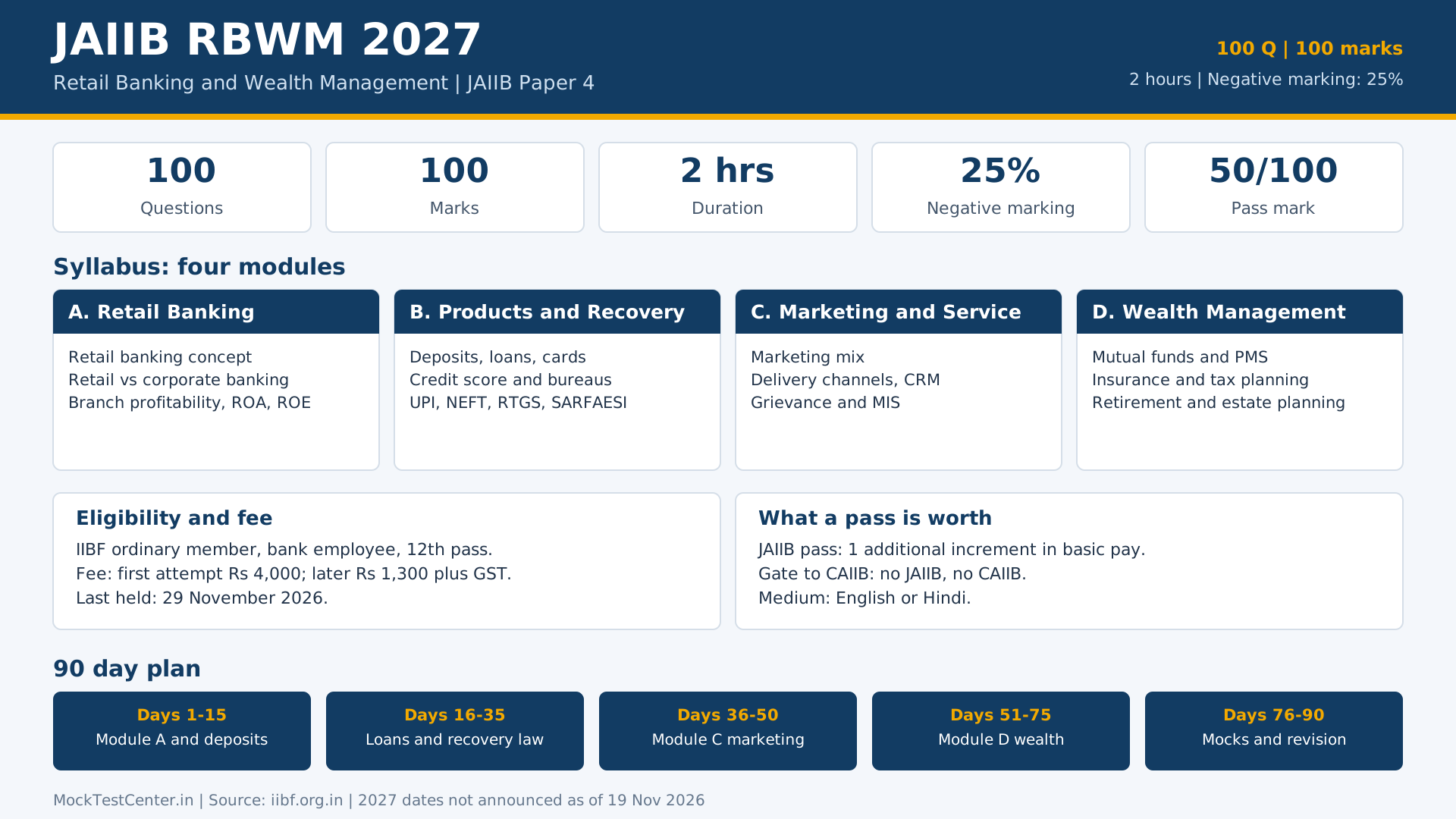
The JAIIB RBWM 2027 paper covers Retail Banking and Wealth Management, the fourth paper of JAIIB. It carries 100 questions for 100 marks, runs for 2 hours, and has negative marking of 25 percent of the marks of the question. You need 50 marks to pass it.
In the November 2026 cycle the RBWM paper was held on 29 November 2026. The 2027 schedule has not been announced yet, as of 19 November 2026, so treat any 2027 date you see online as a guess until the Indian Institute of Banking and Finance, IIBF, publishes it on the IIBF website.
This paper suits working bankers more than any other JAIIB paper. Most of it comes from work you already do at the branch. You open accounts, sell deposits, process home loans, handle card complaints, and answer questions about mutual funds and insurance.
The JAIIB RBWM 2027 paper tests whether you understand why each of those steps works the way it does. That is good news if you are short on study time. It also means rote reading will not carry you.
The questions ask you to apply a rule to a customer case, and a memorised definition will not help there.
This guide walks through the paper in full. It covers the pattern, the four syllabus modules, the products, the recovery law, the wealth management half, and a 90 day plan built around branch hours.
The JAIIB RBWM 2027 paper at a glance
Every JAIIB paper follows the same pattern. RBWM is no exception. The table below gives the facts in one place.
| Detail | RBWM paper |
|---|---|
| Paper number | Paper 4 of JAIIB |
| Questions | 100 multiple choice questions, including case based questions |
| Marks | 100 |
| Duration | 2 hours |
| Negative marking | 25 percent of the marks of the question |
| Mode | Online only |
| Medium | English or Hindi, chosen at registration, cannot be changed later |
| Pass mark | 50 out of 100 |
| Aggregate route | 45 in each paper with 50 percent aggregate in a single attempt |
| Last held | 29 November 2026 |
Two hours for 100 questions gives you about 72 seconds per question. That sounds tight, and negative marking of 25 percent means a wrong guess costs a quarter mark. Answer the questions you know first and keep time to return to the case studies.
The case based questions carry a short situation, then two or three questions on it. Read the situation once, answer all its questions together, and move on. Going back and forth between the case and the questions wastes the time you need for Module D.
The pass rule has two routes. The plain route is 50 marks in RBWM. The aggregate route helps when you sit for all four papers in one attempt.
If you score at least 45 in each paper and your total across the four papers reaches 50 percent, you clear JAIIB even if one paper stays below 50. Treat the aggregate route as a backup. It only works when you attempt all four papers together, and a weak paper can still drag your total down.
Aim for 50 in RBWM on its own. The aggregate rule is a safety net, and safety nets work best when you never need them.
IIBF also awards a class of pass on the first attempt only. First Class needs 60 percent or more in aggregate with a pass in every paper. First Class with Distinction needs 70 percent or more in aggregate and 60 or more in each paper.
These classes matter for your record, so if you are attempting all four papers for the first time, the aggregate route and the class rules both reward a balanced score across papers rather than a great score in one paper and a bare pass in the rest.
Who can sit for RBWM
RBWM is a JAIIB paper, so the JAIIB rules decide who can sit for it. JAIIB is open only to ordinary members of IIBF who work in the banking and finance industry. Your employer must be an institutional member of the Institute.
The general public cannot register for it, and that is the first fact many new bankers get wrong.
The education rule is simple. You must have passed the 12th standard in any stream, or an equal qualification. IIBF allows one exception.
Clerical or supervisory staff who have not passed the 12th standard may still sit for the exam on the recommendation of the manager or officer in charge of their bank. Subordinate staff of recognised banking or financial institutions can appear if they are IIBF members and have passed the 12th standard. There is no age limit, and there is no minimum service rule.
A clerk in the first year of service and an officer with twenty years behind the desk sit for the same paper under the same rules.
You must be an IIBF member before you apply. Membership is a separate step from exam registration, and new bankers often leave it too late. Apply for membership first, wait for it to come through, and then register for the exam cycle.
Registration for the November 2026 cycle ran from 1 August to 21 August 2026. The normal fee applied from 1 August to 7 August, an extra Rs 100 applied from 8 August to 14 August, and an extra Rs 200 applied from 15 August to 21 August. One tracker reported that registration stayed open till 6 September 2026, which conflicts with the dates above, so treat the August window as the notified one and check the IIBF website when the next cycle opens.
The fee follows the attempt. The first attempt costs Rs 4,000. Every later attempt costs Rs 1,300.
Goods and Services Tax and convenience charges sit on top of both figures. The fee is not refunded and cannot be adjusted to a later cycle, so register only when you are sure you will sit for the paper.
You get five attempts to clear JAIIB within three years from the date of registration for the first attempt, whichever ends earlier. That is the rule in the newer IIBF material and in the 2026 tracker pages. Older pages still print the earlier rule of four attempts within two years.
The change matters, because a candidate who plans on the old rule may give up a year early. Go by the five attempts in three years rule, and confirm it on the latest IIBF notification before you plan your attempts. Credits for papers you pass stay with you inside that window, so you reappear only in the papers you have not cleared.
JAIIB has four papers. Indian Economy and Indian Financial System (IE and IFS) is Paper 1. Principles and Practices of Banking, PPB, is Paper 2.
Accounting and Financial Management for Bankers, AFM, is Paper 3. RBWM is Paper 4. You can attempt them in any order across cycles, though most candidates sit for them in order.
In the November 2026 cycle the IE and IFS paper was held on 1 November, the PPB paper on 22 November, the AFM paper on 28 November, and RBWM on 29 November 2026. The May 2026 cycle ran from 3 May to 17 May 2026, with RBWM on 17 May 2026.
Module A: retail banking
Module A opens the paper with the idea of retail banking itself. It asks what retail banking means, how it grew, and why banks chase it. A retail bank serves a large number of small customers rather than a small number of large ones.
That single fact explains most of the module. Small accounts mean small risk per customer, steady fee income, and a huge service load. A branch that handles ten thousand savings accounts needs systems that a corporate branch never needs.
Start with the difference between retail and corporate banking. Corporate banking serves companies with large loans and trade finance, plus treasury products. Retail banking serves individuals and small firms with deposits and home loans, plus personal loans, cards, and payment services.
The ticket size is small, the volumes are huge, and the relationship is often with a person who walks into the branch. Questions here test whether you can sort a product into the right side. A cash credit limit for a factory belongs to corporate banking.
A home loan for a salaried customer belongs to retail banking. A working capital loan for a small shop sits in between, and the syllabus treats small business lending as part of the retail book in many banks.
Branch profitability gets its own weight in this module. You need the types of profit, gross profit and operating profit, then net profit, and you need to know how a branch earns and spends. Interest income comes from loans.
Fee income comes from charges and cards, plus cross selling. Interest expense goes to depositors. Operating expense covers staff and rent, plus systems.
Return on Assets and Return on Equity turn those figures into ratios that let a bank compare branches of different sizes. A question may give you a small branch profit table and ask which ratio rose and why. Learn the formulas by working two or three such tables by hand, because the numbers stick better when you have calculated them once.
The module also covers the business models banks use for retail banking and the conditions that make retail banking work. A bank needs a wide branch or digital reach, a low cost way to serve small accounts, a credit scoring system, and a recovery setup. Without those four, retail growth turns into bad loans and complaints.
The syllabus lists the advantages too. Retail deposits are stable, retail loans spread risk, and retail customers buy more than one product over time. The constraints are the mirror image.
Small loans cost more to process per rupee, recovery is harder, and service quality is hard to keep even across thousands of branches.
Give this module its time. It looks like theory, but it sets up the rest of the paper. Module B asks which product fits which customer need, Module C asks how the bank reaches the customer, and Module D asks how the bank helps the customer grow wealth.
All three rest on the Module A idea that retail banking is a high volume, low ticket, relationship business.
Module B: retail products and recovery
Module B is the longest and most scoring part of the paper. It covers what the bank sells and what the bank does when a borrower stops paying. Most of it will feel familiar from your daily work.
The exam turns that familiarity into questions about rules and limits, plus definitions, so study it with the product circulars in mind rather than with memory alone.
Deposits come first. Savings accounts and current accounts, fixed deposits and recurring deposits each serve a different need. A savings account pays interest on a balance the customer can withdraw at any time.
A current account suits businesses that need frequent transactions and pays little or no interest. A fixed deposit locks money for a fixed term at a fixed rate. A recurring deposit lets a customer save a fixed sum every month.
Questions ask about features and premature closure rules, plus nomination and the difference between a term deposit and a demand deposit. Know the products your own bank offers, then map each one to the syllabus term. Your bank may call it a salary account, but the syllabus calls it a savings account with payroll credits, and the exam uses the syllabus term.
Loans come next, and they carry the most questions in this module. Home loans and personal loans, education loans and vehicle loans, plus loans against deposits, each have their own purpose and security, plus a repayment shape. A home loan is secured by the house and runs for years.
A personal loan is unsecured and short. An education loan funds study and often has a moratorium period. A vehicle loan is secured by the vehicle.
The exam asks about margin and security, plus repayment and the documents a bank checks before sanction. Learn the difference between a term loan and an overdraft, and between a secured loan and an unsecured one, because those pairs appear again and again.
Credit scoring decides many loan outcomes before a human looks at the file. Credit bureaus collect repayment history from banks and turn it into a score. A low score means a past default or a thin record.
A high score means steady repayment. The bank uses the score to price the loan and to set the limit, and the syllabus expects you to know the role of bureaus and the factors that move a score. A customer who misses one EMI will see the effect, and a customer who closes a card after paying it off may see a different effect.
The exam likes such cause and effect questions, so learn the direction of each effect rather than a list of score bands.
Cards deserve a separate pass. Debit cards spend the customer money from the account. Credit cards spend the bank money and the customer repays later.
Prepaid cards carry a loaded balance. Each card type has its own risks, and the syllabus covers fraud and chargebacks, plus the duties of the bank when a card is lost. Know the difference between a debit card and a credit card in one line each, and know who bears the loss in a typical fraud case under the bank customer protection rules.
Digital payments run through this module as well. UPI, NEFT, RTGS, NACH, BBPS, plus AePS each move money in a different way. UPI moves money at once on a phone.
NEFT settles in batches. RTGS settles large amounts at once in real time. NACH handles bulk debits like EMIs and salary credits.
BBPS pays bills. AePS uses Aadhaar and a fingerprint at a banking point. Questions ask which system fits which need, so learn one line per system: what it moves and how fast, plus what limit it has.
Do not memorise limits that change often. Learn the purpose, because the purpose stays fixed while limits change.
Recovery closes the module, and it is where many candidates lose marks. When a loan turns bad, the bank has a set of tools. The SARFAESI Act lets a bank take and sell secured assets without going to court first, after following the notice steps in the Act.
Debt Recovery Tribunals hear bank claims above the threshold the law sets. Lok Adalats settle small cases by agreement. The exam asks about the steps and the authority, plus the order in which each tool applies.
Learn the sequence. A bank sends a demand notice, waits for the reply period, takes symbolic possession, then sells the asset. Skipping a step makes the action weak in law, and the exam tests exactly that point.
Also learn the terms for bad loans. A standard asset pays on time. A substandard asset has stayed unpaid past the norm.
A doubtful asset has stayed bad longer. A loss asset is one the bank treats as unrecoverable. The classification depends on time and on the security, and a question may give you a timeline and ask for the right class.
Module C: support services and marketing
Module C asks how a bank reaches its customers and keeps them. It is the softest module in the paper, and that makes it easy to underrate. It still carries a fair share of questions, and its topics repeat in case studies about complaints and service failures.
Marketing in banking starts with the marketing mix: product, price, place, plus promotion. The product is the deposit or loan. The price is the interest rate and the fee.
The place is the branch and the ATM, plus the phone and the website. Promotion is the campaign that tells customers the product exists. Questions here are simple if you can tie each of the four to a real product from your branch.
A home loan campaign is promotion. A lower processing fee is price. A new ATM is place.
The loan itself is the product.
Delivery channels are the heart of this module. Branches and ATMs, mobile banking and internet banking, plus phone banking and business correspondents each serve a different customer. A branch handles complex work like a loan discussion.
An ATM handles cash. Mobile banking handles quick transfers. A business correspondent takes banking to a village that has no branch.
The exam asks which channel fits which need, and which channel costs the bank the least per transaction. Digital channels cost less per transaction than a branch visit, and that single fact drives most bank strategy in this area.
Customer Relationship Management, CRM, is the system that turns one time transactions into a lasting relationship. A CRM record holds what the customer owns, what the customer asked for, and what the customer might need next. A bank uses it to cross sell a suitable product, to spot a customer who may leave, and to route a complaint to the right desk.
The exam treats CRM as a process, and the process runs from knowing the customer to serving the customer to keeping the customer. Learn the stages in order, because the order is the question.
Service standards and grievance handling close the module. The BCSBI codes set the standards banks promise on service, and the bank internal grievance system plus the Banking Ombudsman give the customer a path when the promise breaks. Learn the steps a customer follows.
First the branch, then the nodal officer, then the ombudsman. Questions often describe a complaint and ask what the correct next step is. The answer is almost always the next step in that ladder, and the ladder is the same for most complaints.
Management Information Systems, MIS, also sit in this module. An MIS report tells a branch manager what the branch did this week, which products sold, which loans slipped, and which complaints stayed open. The exam asks what an MIS is for, and the answer is decision making.
A report that no one reads is a cost, and a report that a manager acts on is a tool. Keep that distinction in mind when you read the MIS questions.
Module D: wealth management
Module D is the second half of the paper in spirit, even though it is one module out of four. It covers how a bank helps a customer build and protect wealth. Candidates who work in branches meet this module every day, because customers ask about fixed deposits versus mutual funds, about insurance for the family, and about saving tax.
The exam turns those counter questions into formal questions, so study each product with its purpose, its risk, and its tax treatment in mind.
Wealth management starts with financial planning. A plan looks at income and expenses, plus goals and risk appetite, then sets a path. A young salaried customer needs growth and a term cover.
A retired customer needs steady income and low risk. A business owner needs liquidity and succession planning. The plan is personal, and the exam tests whether you can match a product to a person.
A high risk product for a retired customer is a mismatch. A low return product for a young customer with a long horizon is a missed chance. Learn the match, because the case questions in this module are built on it.
Investment management follows. Portfolio management means holding a mix of assets so that one bad asset does not sink the whole plan. Portfolio Management Services, PMS, is a managed service for large investors, and it differs from a mutual fund in control and in minimum size.
A mutual fund pools money from many investors and invests it under a stated objective. Equity funds buy shares. Debt funds buy bonds.
Hybrid funds mix the two. The exam asks about fund types and net asset value, plus expense ratio and systematic investment plans. A systematic investment plan puts a fixed sum into a fund every month, and it smooths the purchase price over time.
Learn that one line well, because it appears in some form in most cycles.
Insurance is the protection side of wealth. Life insurance pays the family if the insured person dies. Term insurance gives a large cover for a low premium and pays nothing if the person survives the term.
Endowment plans mix cover with savings. Unit linked plans mix cover with market investment. Health insurance pays medical costs.
General insurance covers assets like a house or a car. The exam asks which policy fits which need, and it asks about the regulator, the Insurance Regulatory and Development Authority of India, and the role of the agent and the bank in selling insurance. A bank sells insurance as a corporate agent, and the exam expects you to know that the bank is a distributor, not the insurer.
Tax planning is the part candidates fear most, and it is simpler than it looks. The syllabus covers income tax basics and capital gains, plus the two tax regimes. Short term capital gains apply to assets sold quickly.
Long term capital gains apply to assets held longer, and the holding period differs by asset type. Deductions reduce taxable income. Exemptions remove an income from tax altogether.
A full tax return computation stays out of this paper. The questions test concepts and ask which income falls in which head. Learn the heads of income and the idea of a regime choice, and leave the rate tables for revision near the exam, because rates change with budgets.
Retirement planning and estate planning close the module. Retirement planning asks how much a person needs after work stops, and which products give a pension. Estate planning asks how assets pass to heirs, and the role of a will and a nominee.
A nominee receives the money, and a legal heir owns it, and the exam likes that distinction. Learn it in one sentence and move on. Housing finance also sits in this module.
A home loan needs valuation, a title check, and a margin from the buyer. A reverse mortgage lets a senior citizen borrow against a house while staying in it. The exam asks about the purpose of each, and the answers are short if you know the purpose.
Module D rewards a calm approach. Do not try to learn every fund or every tax section. Learn the purpose of each product and the risk it carries, plus the customer it suits.
That triangle of purpose and risk, plus fit, answers most Module D questions.
How to handle the negative marking rule
Negative marking of 25 percent changes how you should sit for this paper. A wrong answer costs a quarter mark. A blank answer scores nothing, so a question you can narrow to two options is worth an attempt, and a question you know nothing about is better left blank.
So a guess is not free. A wrong answer costs a quarter mark, so attempt a question only when you can rule out at least two options. A question you know nothing about is better left blank than answered blind.
Use the rule in two passes. In the first pass, answer every question you know and mark the rest. In the second pass, return to the marked ones and rule out options.
Even ruling out one option lifts your odds. A question with four options gives you a one in four chance by pure guess. Rule out one wrong option and the chance becomes one in three.
Rule out two and it becomes one in two. The exam has 100 questions, so a small lift on twenty uncertain questions can add three or four marks, and three or four marks can be the difference between 48 and 52.
Case based questions deserve a method of their own. Read the case once, slowly. Note the numbers and the dates.
Then answer all the questions on that case before moving on. The questions share the same facts, so answering them together saves re-reading. If a case confuses you, do not spend five minutes on it.
Mark it, move on, and return with fresh eyes after you have finished the easy questions. A stuck case can eat the time of ten easy questions, and easy questions pay the same one mark each.
Numerical questions in RBWM are few, and most are simple. A ratio, a simple interest figure, or a monthly instalment estimate. Do the rough math on paper, pick the closest option, and move on.
Do not chase exact decimals. The options are usually far enough apart that a rough figure picks the right one.
One caution about guessing. Guessing does not work as a plan for the whole paper. If you guess blind on sixty questions, you will get about fifteen right and lose about eleven marks to the quarter mark penalty, so you gain only about four marks, and that is far from fifty. Guess only on the questions you cannot solve, and solve the rest by study.
A 90 day plan that fits branch hours
Most JAIIB candidates work full days at the branch. A plan that needs four hours a day will fail in the first week. This plan needs ninety minutes on working days and three hours on Sundays.
It is built for the JAIIB RBWM 2027 paper, and it treats the branch as a study aid rather than an obstacle.
Days 1 to 15 cover Module A and the deposit half of Module B. Read one chapter a day, then write five lines on it in your own words. The five lines matter more than the reading.
A chapter you cannot summarise in five lines is a chapter you have not understood. Use your branch for this phase. Look at the deposit products on your own bank counter and match each one to the syllabus term.
A savings account you open every day becomes a revision point when you name its features in syllabus words.
Days 16 to 35 cover the loan half of Module B and the recovery law. This is the heaviest part, so give it twenty days. Read the loan products in the first ten days and the recovery law in the next ten.
For each loan type, write its purpose and its security, plus its repayment shape on one small card. Carry the cards for a week and read one at lunch. For recovery, learn the sequence of steps under the SARFAESI Act and the role of Debt Recovery Tribunals.
Draw the sequence as a short flow on paper. A flow you drew once stays in memory better than a paragraph you read three times.
Days 36 to 50 cover Module C. This module is lighter, so fifteen days is enough. Read marketing and channels, plus CRM and grievance handling in order.
Tie each topic to a real branch event. A complaint you handled last month is a grievance case. A campaign poster in your branch is a promotion example.
Candidates who link the module to their own week remember it without extra revision.
Days 51 to 75 cover Module D. Give it twenty five days, because it has the most new terms. Spend the first ten days on investment products and mutual funds.
Spend the next eight days on insurance and tax. Spend the last seven days on retirement and estate planning, plus housing finance. For each product, write its purpose and its risk, plus the customer it suits.
That three line card is the same triangle the exam tests, and a full set of cards becomes your last week revision kit.
Days 76 to 90 are for mocks and revision. Take one full JAIIB RBWM 2027 mock every Sunday, one hundred questions in two hours, under exam conditions. Score it the same day.
Spend Monday fixing the topics where you lost marks. In the last ten days, stop reading new material. Re-read your cards, rework the questions you got wrong, and take two more mocks.
A candidate who has taken five mocks walks into the exam knowing the pace, and pace is half the battle in a two hour paper.
A note on books. IIBF publishes course material for JAIIB, and it is the base text for the paper. Use it first.
Add a mock test series for practice and a short notes book for revision. Do not collect five books for one paper. Three sources are enough, and the third source should be mock tests rather than another textbook.
Mistakes that cost working bankers marks
The first mistake is trusting branch habit over the syllabus. You may have opened a thousand savings accounts, but the exam asks about the syllabus definition of a demand deposit, and a habit answer can be wrong. Study the term, then check it against your habit.
When the two differ, the syllabus wins in the exam hall.
The second mistake is skipping Module D. Many candidates finish Modules A to C and run out of time, so they read Module D once and hope. Module D carries a large share of the paper, and its questions are direct.
A week spent on Module D pays more marks than a week spent re-reading Module A for the third time. Give Module D its full twenty five days in the plan above.
The third mistake is ignoring the case based questions in practice. Candidates practise single line MCQs and then freeze when a case gives a paragraph first. Practise with case sets from the start.
Even two case sets a week will teach you to pull numbers out of a paragraph fast.
The fourth mistake is guessing blindly on questions you know nothing about. With negative marking of 25 percent, a wrong guess costs a quarter mark. Attempt a question only when you can rule out at least two options.
A guess has a chance. A blank has none.
The fifth mistake is poor time control. Some candidates spend ten minutes on one hard question and then rush the last thirty. Use the two pass method.
Answer the easy ones first, mark the hard ones, and return to them. Your score comes from the questions you can answer, and you must reach them all before time ends.
The sixth mistake is studying the wrong year rules. JAIIB rules changed over the years. The attempt limit and the fee moved, and so did the syllabus.
A note from 2021 can still teach you the concepts, but it cannot tell you the current fee or the current attempt limit. Check the date on every source you use, and confirm the rules on the IIBF website in the month you register.
What a pass is worth
JAIIB is a qualification with a direct pay effect. Clearing JAIIB earns one additional increment in basic pay for most bank staff. Clearing CAIIB after it earns two more increments.
That count, one for JAIIB and two for CAIIB, is the rule most banks follow. The rupee value of an increment depends on the pay scale and the settlement in force, so figures differ across sources. One guide quotes about Rs 1,340 a month for a clerk and about Rs 2,000 a month for an officer on JAIIB, with about Rs 2,680 and Rs 4,000 a month respectively on CAIIB.
Another guide quotes the higher pair for JAIIB itself, which looks like the same figures placed under the wrong heading. A third guide quotes much lower figures from an older pay scale. Treat the rupee figures as approximate, and treat the increment count as the firm fact.
Your own bank HR circular will give you the exact figure for your scale.
The pay is only half the value. JAIIB is also the gate to CAIIB. You cannot sit for CAIIB without clearing JAIIB first, or without passing Part I of the Associate Examination.
So RBWM carries weight beyond a single exam. It is the last paper many candidates clear before they can start CAIIB, and that makes it a career step rather than a single exam. Banks also weigh JAIIB in promotions and in postings to credit and retail roles.
A banker who understands retail products and recovery, plus wealth management, is a natural fit for branch head roles, and the certificate proves the knowledge in a form a promotion panel can read.
RBWM also pays back in daily work. A banker who understands why a loan needs a margin, how a credit score moves, and which insurance fits a retired customer serves better at the counter. Customers notice, and managers notice.
The certificate matters, but the knowledge matters every day after the exam.
Other exams worth a look
Many bankers prepare for more than one exam at a time, and RBWM knowledge overlaps with several of them. The SBI PO 2027 exam tests banking awareness that sits close to Module A. The SBI Clerk 2027 exam covers the same deposit and payment products as Module B.
The IBPS PO 2027 exam and the IBPS Clerk 2027 exam both test general banking knowledge that RBWM builds. The IBPS RRB PO 2027 exam adds a rural banking angle to the same retail base. The RBI Assistant 2027 exam tests the same customer service and product knowledge.
The LIC AAO 2027 exam goes deeper into insurance, which is Module D ground. The NABARD Grade A 2027 exam and the SEBI Grade A 2027 exam test regulation and markets that connect with the compliance side of banking. The UGC NET Paper 1 2027 exam is a different path, for those who want to teach, and its commerce and management papers share ground with Module A and Module C.
Pick one extra exam at most while you prepare for RBWM, because two exams at once need a shared plan, and three exams at once usually mean none of them gets enough time.
Sources
Indian Institute of Banking and Finance, iibf.org.in, official site for JAIIB and CAIIB rules, plus schedules, fees, and the syllabus. Oliveboard, JAIIB RBWM study material and syllabus pages. Guidely, JAIIB RBWM syllabus 2026 with module wise topics and the exam pattern.
Adda247, JAIIB syllabus 2026 and the JAIIB RBWM syllabus, with paper dates and passing criteria. Bankers Pioneer, JAIIB exam guide with the medium and aggregate pass rule. Bankers Adda, JAIIB 2026 guide with passing criteria and the attempt limit.
All sources retrieved on 19 November 2026. The 2027 schedule was not published on any of them as of that date.