
About CAIIB ABM 2027 Exam Series
📖 Table of Contents
- The CAIIB ABM 2027 paper at a glance
- JAIIB first, and no shortcut around it
- Module A: statistics
- Module B: human resource management
- Module C: credit management
- Module D: compliance in banks and corporate governance
- The other CAIIB papers in brief
- Typed answers and case questions
- A 90 day plan that fits branch hours
- Mistakes that cost working bankers marks
- What CAIIB adds to your pay and your career
- Other exams worth a look
- Sources
CAIIB Advanced Bank Management 2027: ABM Paper Guide
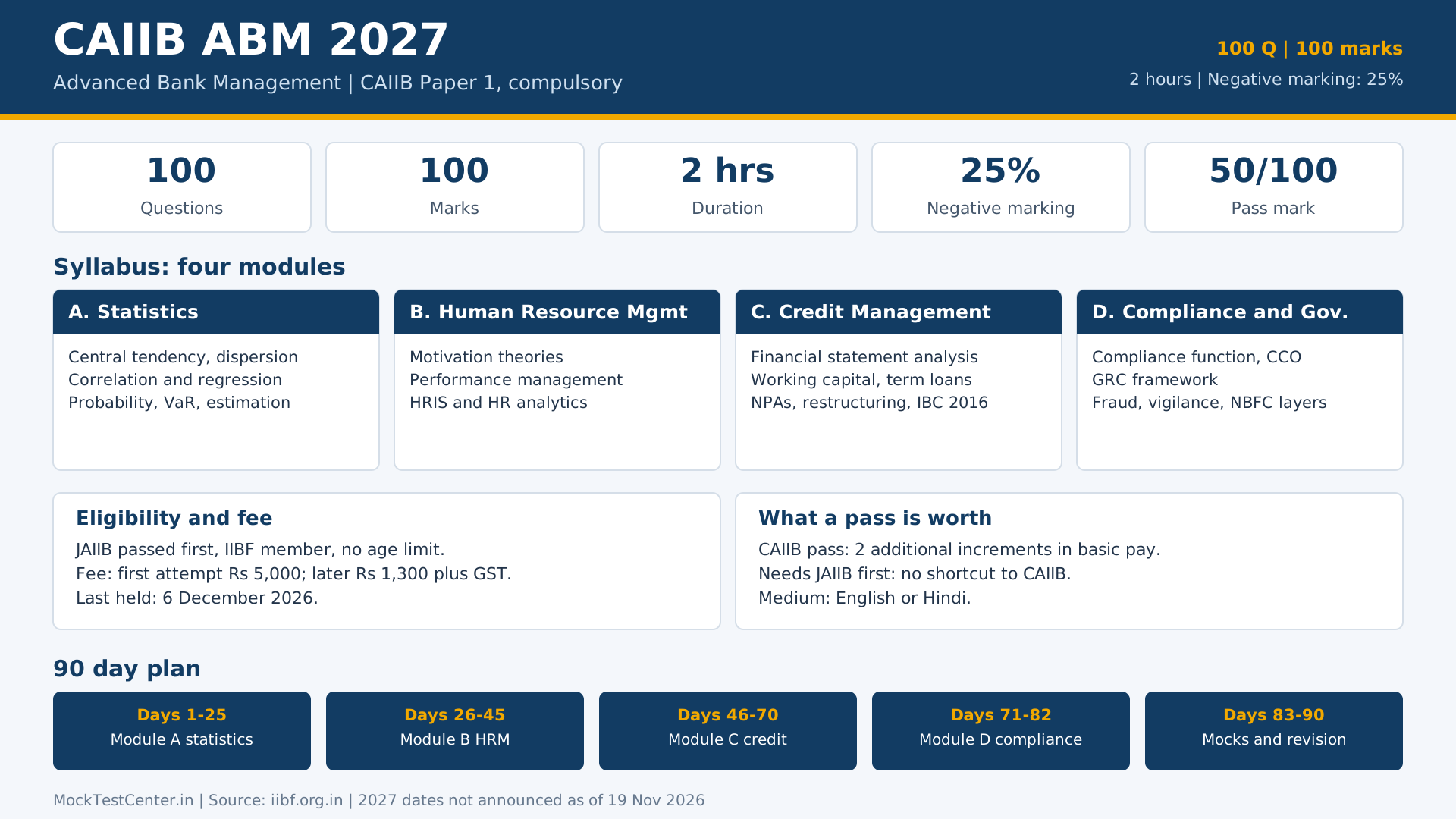
The CAIIB ABM 2027 paper covers Advanced Bank Management, the first compulsory paper of CAIIB. It carries 100 questions for 100 marks, runs for 2 hours, and has negative marking of 25 percent of the marks of the question. You need 50 marks to pass it.
In the December 2026 cycle the ABM paper was held on 6 December 2026. The 2027 schedule has not been announced yet, as of 19 November 2026, so treat any 2027 date you see online as a guess until the Indian Institute of Banking and Finance, IIBF, publishes it on the IIBF website.
One fact decides everything else about this paper. You cannot sit for CAIIB without clearing JAIIB first. CAIIB stands for Certified Associate of the Indian Institute of Bankers, and it is the advanced qualification that follows JAIIB.
The only alternative is passing Part I of the Associate Examination. There is no direct entry and no exemption. There is also no way to attempt ABM before JAIIB is done.
That gate shapes the whole paper. ABM assumes you already know basic banking from JAIIB. It builds on that base with statistics and people management, plus credit management and compliance.
Candidates who treat ABM as a fresh start struggle. Candidates who treat it as the next floor of a building they already own do well. Start from what you know.
This guide walks through the paper in full. It covers the pattern, the eligibility gate, the four syllabus modules, the other CAIIB papers, the typed numerical questions, and a 90 day plan built around branch hours.
The CAIIB ABM 2027 paper at a glance
Every CAIIB paper follows the same pattern. ABM is no exception. The table below gives the facts in one place.
| Detail | ABM paper |
|---|---|
| Paper number | Paper 1 of CAIIB, compulsory |
| Questions | 100 objective questions, including case based questions |
| Marks | 100 |
| Duration | 2 hours |
| Negative marking | 25 percent of the marks of the question |
| Mode | Online only |
| Medium | English or Hindi |
| Pass mark | 50 out of 100 |
| Aggregate route | 45 in each paper with an aggregate of 250 marks in a single attempt |
| Last held | 6 December 2026 |
Two hours for 100 questions gives you about 72 seconds per question. Some ABM questions need a calculation, so the real pace is uneven. A statistics question can take two minutes.
A compliance question can take twenty seconds. Plan for that uneven pace instead of dividing the time equally.
The pass rule has two routes. The plain route is 50 marks in ABM. The aggregate route helps when you sit for all the papers in one attempt.
If you score at least 45 in each paper and your total reaches 250 marks across the papers in that single attempt, you clear CAIIB. Tracker pages describe this route in slightly different words, so confirm the exact aggregate figure on the latest IIBF notification before you rely on it. Aim for 50 in ABM on its own.
The aggregate route is a safety net, and safety nets work best when you never need them.
Some ABM questions ask for a typed numerical answer. These have no options to pick from. You type the figure itself.
That detail changes how you practise statistics. A multiple choice question lets you work backwards from the options. A typed answer gives you nowhere to hide.
Practise statistics with a blank answer box in mind, and check your arithmetic twice before you move on.
JAIIB first, and no shortcut around it
CAIIB eligibility is short and strict. You must have passed JAIIB, the Junior Associate examination of IIBF, with no paper left pending. The alternative route is passing Part I of the Associate Examination.
Either route needs an active IIBF membership. There is no age limit for CAIIB.
This gate has a practical effect on your calendar. JAIIB runs in May and November. CAIIB runs in June and December, just after each JAIIB cycle.
A candidate who clears JAIIB in November can sit for CAIIB in December of the same year, provided registration is still open. A candidate who clears JAIIB in May can sit for CAIIB in June. The gap between the two exams is short, so start ABM reading while you wait for your JAIIB result.
The candidates who do that use the gap. The candidates who wait for the result lose it.
Registration for the December 2026 CAIIB cycle ran from 13 September to 8 October 2026. The last date was extended from 1 October to 8 October. The normal fee applied from 13 September to 19 September, an extra Rs 100 applied from 20 September to 26 September, and an extra Rs 200 applied from 27 September onwards.
Registration for the May to June 2026 cycle ran from 4 March to 24 March 2026, with the last date extended to 31 March 2026.
The fee follows the attempt. The first attempt costs Rs 5,000 plus Goods and Services Tax. Every later attempt costs Rs 1,300 plus Goods and Services Tax.
Convenience charges sit on top of both figures. The fee is not refunded and cannot be adjusted to a later cycle, so register only when you are sure you will sit for the paper.
You get five attempts to clear CAIIB within three years from the date of registration for the first attempt, whichever ends earlier. That is the rule in the newer IIBF material and in the 2026 tracker pages. Older pages still print the earlier rule of four attempts within two years.
The change matters, because a candidate who plans on the old rule may give up a year early. Go by the five attempts in three years rule, and confirm it on the latest IIBF notification before you plan your attempts. Credits for papers you pass stay with you inside that window, so you reappear only in the papers you have not cleared.
CAIIB has four compulsory papers and one elective paper. Advanced Bank Management, ABM, is Paper 1. Bank Financial Management, BFM, is Paper 2.
Advanced Business and Financial Management, ABFM, is Paper 3. Banking Regulations and Business Laws, BRBL, is Paper 4. The elective paper is the fifth paper, and you pick one subject from five choices.
In the December 2026 cycle, ABM was held on 6 December, BFM on 12 December, ABFM on 13 December, BRBL on 20 December, and the elective paper on 27 December 2026.
The June 2026 cycle ran from 31 May to 21 June 2026, with papers on 31 May and on 7, 13, 14, plus 21 June. Those dates come from a tracker summary of the IIBF schedule, so treat them as the reported dates for that cycle. The pattern is the same in both cycles.
Each paper sits on its own day, and the whole cycle spans about three weeks.
Module A: statistics
Module A is the module most candidates fear, and it is also the module where a working banker can score fastest. Statistics in ABM is applied statistics. Every concept ties to a banking decision, and the exam tests the tie rather than the theory alone. Learn the use first.
The module opens with the basics. What statistics is, what it does, and where it fails. Data collection comes next.
It covers classification and tabulation, plus frequency distribution. Learn the terms cleanly. A frequency distribution groups raw data into classes.
A tabulation lays it out for reading. The exam asks about the steps in order, so learn the order the way you would learn a process at the branch.
Sampling follows. Random sampling gives every unit an equal chance. Sampling distributions describe how a sample result varies.
The central limit theorem says that the average of large samples behaves like a normal distribution, even when the underlying data does not. The finite population correction factor adjusts the result when the sample is a large share of a small population. Questions here are short and direct.
Learn one line per concept, and you will answer most of them.
Measures of central tendency and dispersion carry the most numerical questions in this module. Mean and median, plus mode and quartiles, describe the centre of the data. Range and quartile deviation, plus standard deviation and coefficient of variation, describe the spread.
Skewness describes the tilt. Kurtosis describes the peak. The exam gives you a small data set and asks for a figure, or it describes a data set and asks which measure fits.
Practise with small sets by hand. A data set of five numbers is enough to learn a formula, and five such sets will fix all the common formulas in memory.
Correlation and regression come next. Correlation measures how two variables move together. Regression uses one variable to predict another.
A scatter diagram shows the pattern before any number is computed. The standard error of estimate tells you how far the predictions stray from the actual values. The exam likes questions that ask what a high correlation does and does not prove.
A high correlation shows a link. It never proves that one variable causes the other. That distinction appears in some form in most cycles.
Time series analysis studies data over time. Trend and cyclical variation, plus seasonal variation and irregular variation, are the four parts. A trend is the long direction.
A seasonal pattern repeats every year. A cyclical pattern follows the business cycle. An irregular movement has no pattern.
Banking data has all four. Deposits rise in a festival season, fall after it, and grow over the years. The exam asks you to name the part behind a described movement, so learn one banking example per part.
Probability closes the theory half of the module. Conditional probability and random variables, plus expectation and standard deviation, lead into the distributions. Binomial distribution fits yes or no outcomes.
Poisson distribution fits rare events. Normal distribution fits the bell curve that most banking data follows. Value at Risk, VaR, uses probability to state the most a bank may lose over a set period at a set confidence level.
Option valuation uses probability to price a contract. You do not need deep maths for these. You need the purpose of each distribution and the situation it fits.
Estimation and linear programming, plus simulation, finish the module. Point estimates give one figure. Interval estimates give a range with a confidence level.
Linear programming finds the best mix under limits, solved by the graphical method for small problems and the simplex method for larger ones. Simulation runs a model many times to see the range of outcomes. These three topics carry fewer questions than central tendency and probability, so give them less time.
Read them once, solve two or three problems each, and move on.
One warning about Module A. It tempts candidates to memorise formulas without understanding them. The exam sets numerical questions where the formula is the easy part and the reading of the question is the hard part.
Read each question twice. Note what it asks for. Then pick the formula.
A candidate who picks the formula first often solves the wrong problem with the right maths, and the mark goes to the candidate who read the question twice and picked the formula second.
Module B: human resource management
Module B is the most readable module in ABM. It covers how banks manage people, and every working banker has seen most of it happen. The exam turns that experience into questions about terms and models, plus sequences.
The module opens with the fundamentals of Human Resource Management (HRM) and its link to Human Resource Development (HRD). HRM covers the full people cycle, from hiring to exit. HRD covers the learning side, with its subsystems for training and appraisal, plus career growth.
Strategic HRM ties people decisions to the bank business plan. A bank that plans to grow retail lending needs lenders, so HRM hires and trains lenders. The exam asks about the link between the business plan and the people plan, so learn that link rather than a list of HRM functions.
Development of human resources follows. Career path planning maps the steps a banker can take. Self development is the part the individual owns.
Talent management spots and grows the people the bank cannot afford to lose. Succession planning names the next person for each key role before the role falls vacant. Attitude development sounds soft, and it is the part the exam tests with case questions about a demotivated team or a resistant branch.
Learn the tools, and learn which tool fits which situation.
Human behaviour and motivation carry the most questions in this module. Individual differences and workplace diversity, plus gender issues, shape how a team works. Motivation theories explain why people work hard, and each theory has a name and a core idea attached to it.
Maslow ranks needs from basic to self actualisation. Herzberg separates hygiene factors from motivators. McGregor contrasts Theory X and Theory Y views of workers.
The exam asks you to match a theory to a situation, so learn the core idea of each theory in one line. A manager who trusts staff to work without close watch is using Theory Y, whatever the question calls it.
Performance management follows. Appraisal systems rate work. Performance review and feedback tell the employee the result.
Counselling handles the gaps. Competency mapping lists the skills a role needs. Assessment centres test those skills through exercises.
Behavioural Event Interview, BEI, asks for real past examples rather than opinions. The exam asks about the order of these steps and the purpose of each. Learn the sequence from appraisal to feedback to counselling, because the sequence is the question.
Feedback and reward systems, plus conflict management and the IT side of HRM, close the module. A reward system must link pay to performance, or it stops motivating. Conflict has types and phases, plus causes, and negotiation resolves it.
HR Information Systems (HRIS) and Human Resource Management Systems (HRMS) store people data. e-HRM moves HR work online. HR analytics turns people data into decisions, like spotting which branches lose staff fastest.
These topics carry fewer questions than motivation and performance, so read them once and revise them from short notes.
Module C: credit management
Module C is the heart of ABM. It is also the module that overlaps most with daily branch work. A banker who has appraised a loan, monitored a limit, or chased a recovery will find this module familiar.
The exam tests the rules behind those familiar steps, so study it with your own loan files in mind. Your files are the textbook here.
Credit management opens with the basics. Why credit matters, how it grew in India, and the principles that guide it. The principles are simple to state and hard to follow under pressure.
Lend to a borrower who can repay. Take security that covers the risk. Price the loan for the risk.
Monitor the loan after sanction. The exam asks about the types of borrowers and the types of credit, plus the role of Reserve Bank of India guidelines in bank credit policy. Learn the borrower types first, because the appraisal method changes with the borrower.
A salaried borrower and a trader, plus a farmer and a company, need different checks.
Analysis of financial statements is the most technical part of this module. A banker reads a balance sheet and a profit and loss account, plus a cash flow statement and a funds flow statement, to judge a borrower. Rearranged statements put the figures in a form a banker can use.
Ratio analysis turns the figures into signals. Liquidity ratios show whether the firm can pay soon. Borrowing ratios show how much it owes.
Profitability ratios show whether it earns. The exam gives you a small set of figures and asks for a ratio, or it describes a ratio and asks what it signals. Practise with two or three real formats until the rearrangement feels routine.
Creative accounting and related party transactions are the traps in this chapter, and the exam asks how a banker spots them.
Working capital finance follows. Working capital is the money a firm needs for its daily cycle, from buying raw material to collecting cash from buyers. The working capital cycle measures how long cash stays locked in that loop.
Banks assess working capital by set methods, and the exam asks about the methods and the documents. Bills and receivables finance, plus the Trade Receivables Discounting System, TReDS, give firms cash against their sales. Non fund based limits like guarantees and letters of credit support a firm without an immediate cash outlay.
Learn the difference between a fund based limit and a non fund based limit, because that pair appears again and again.
Term loans fund long assets like plant and machinery. A term loan appraisal differs from a project appraisal in scope, and infrastructure projects need their own appraisal method. Deferred Payment Guarantees, DPGs, support a buyer who pays over time.
The exam asks about the checks before a term loan sanction, and about the repayment shape. A term loan repays in instalments over years. A working capital limit renews every year.
That difference in shape is the core of the chapter.
Credit delivery and monitoring decide whether a good sanction stays good. Documentation creates the legal base. Third party guarantees add a backstop.
Charge over securities gives the bank a claim on the asset. Disbursal follows the terms, and lending under consortium or multiple banking arrangements spreads a large loan across banks. Straight through processing, or a credit underwriting engine, automates the checks for small loans.
Loan Review Mechanism, LRM, is the tool that watches the loan after disbursal. The exam asks about the monitoring tools and the warning signs, so learn the signals that a loan is slipping before it turns bad.
Risk management and credit rating close the appraisal half. Credit risk is the risk that a borrower will not pay. Internal ratings come from the bank own system.
External ratings come from agencies. Credit derivatives shift risk, and the Reserve Bank of India guidelines set the frame for all of it. The exam asks about the factors that raise credit risk and the steps that cut it, so learn the factors as a short list you can recall under pressure.
Restructuring and rehabilitation, plus recovery, form the last part of the module. A stressed asset is a loan that has stopped paying on schedule. A wilful defaulter is a borrower who can pay and does not.
A non cooperative borrower is one who blocks the recovery process. The bank has options, from restructuring the loan to selling the asset. The Reserve Bank of India framework for resolution sets the steps and the timelines.
The Insolvency and Bankruptcy Code, IBC 2016, gives the legal route, with the Corporate Insolvency Resolution Process, the liquidation process, and the pre packed process for stressed MSMEs. The exam asks about the sequence under IBC and the role of each party. Learn the sequence as a flow, because a flow question is hard to answer from memory alone.
Module D: compliance in banks and corporate governance
Module D is the newest module in ABM. It entered the syllabus in the June 2023 revision, when IIBF rebuilt CAIIB. Two old modules went out.
Statistics and compliance came in. That history matters, because candidates who study from pre 2023 notes will find this module missing entirely. That is new. Learn it fresh.
The compliance function is the bank system for following the law and the regulator. A compliance policy states what the bank will do. Compliance principles and process, plus procedures, turn the policy into daily steps.
The compliance programme covers the whole bank, from the board to the branch. The Chief Compliance Officer, CCO, leads it. The exam asks about the role and duties of the CCO, so learn them as a short list: advise the board and watch for breaches, plus report gaps and build a compliance culture.
The CCO reports to the board, and that reporting line is the point. A CCO who reports to the business head cannot challenge the business.
Compliance audit checks whether the bank actually follows its own rules. Risk based internal audit focuses effort where the risk is highest. The reporting framework carries findings upward.
Disclosure requirements force the bank to publish what the rules require, including accounting standards and the listing rules of the Securities and Exchange Board of India for listed banks. The exam asks about the difference between an audit and an inspection, and about what a disclosure must contain. Learn the difference in one line each.
An audit tests the system. An inspection checks a specific area.
The governance structure puts the board at the top. The board owns compliance. Senior management runs it.
The corporate office sets the frame. Field offices apply it. Internal controls are the checks inside every process, and the exam asks why they matter.
A control that no one follows is decoration. A control that stops a bad payment is the system working. Learn the layers from board to branch, because the exam asks which layer owns which duty.
The framework for finding compliance issues and risks follows. Compliance risk is the risk of loss from breaking a rule. Inherent risk is the risk before controls.
Control risk is the risk that the controls fail. Independent testing checks the controls. The Loan Review Mechanism and credit audit watch the loan book.
A good compliance programme reports and monitors, plus it fixes, and the exam asks about that loop. Learn the loop as a cycle: find and report, then fix and test again.
Compliance culture and the GRC framework close the theory half. GRC joins governance with risk and compliance in one system instead of three separate teams. A whistle blower policy gives staff a safe way to report wrongdoing, and the exam asks about its parts.
Compliance failures have reasons, and most of them are human: pressure to meet targets, weak training, or a culture that rewards results over rules. The exam likes case questions on this point. A branch that hits its target by skipping a KYC check has a compliance failure, whatever its sales figure says.
Fraud and vigilance form the last part of the module. Fraud in banks takes many forms, from forged documents to cyber fraud. The fraud reporting and monitoring system carries each case upward with a timeline.
The vigilance function watches for misconduct by staff. Reserve Bank of India guidelines set the rules for private sector banks and foreign banks, and the exam asks about the reporting steps. Learn the steps in order: detect and report, then investigate and act.
A case that is detected and never reported is a second failure on top of the first.
Non Banking Financial Companies, NBFCs, get their own chapter. The scale based regulation framework sorts NBFCs into layers by size, and the compliance function and the CCO role differ by layer. Upper layer NBFCs face the tightest rules.
Middle layer NBFCs face the middle set. The exam asks about the layers and the transition path between them, so learn the layer names and the direction of movement. A growing NBFC moves up a layer, and the rules tighten with it.
The other CAIIB papers in brief
ABM is Paper 1, and four more papers stand behind it. Mastering them can wait until after ABM, but you need to know how they fit, because the aggregate pass rule and your study calendar span all five.
Bank Financial Management, BFM, is Paper 2. It covers treasury, balance sheet management, and the financial side of running a bank. Advanced Business and Financial Management, ABFM, is Paper 3.
It covers business strategy and advanced finance. Banking Regulations and Business Laws, BRBL, is Paper 4. It covers the laws that govern banking, from the Reserve Bank of India Act to the laws on negotiable instruments and contracts.
The elective paper is Paper 5, and you pick one subject from five choices. Rural Banking covers farm credit and rural finance. Human Resources Management covers people management in depth.
Information Technology and Digital Banking covers bank technology and digital channels. Risk Management covers the full risk frame of a bank. Central Banking covers the role of a central bank.
Pick the elective that matches your work. A rural branch officer gains most from Rural Banking. A credit officer gains most from Risk Management.
An IT officer gains most from Information Technology and Digital Banking. The elective is a full 100 mark paper, so pick it with the same care as a compulsory paper.
One more detail about the syllabus. IIBF sets a cut off for regulatory and banking developments in each cycle. For examinations held from September to February, developments up to 30 June count.
That rule comes from a tracker summary of the IIBF exam instructions, so confirm it on the latest notification. It means your current affairs reading for ABM should run to June for a December paper, and you can stop chasing later changes for exam purposes.
Typed answers and case questions
ABM has two question types that catch candidates out. The first is the typed numerical answer. Some statistics questions ask you to type the figure, with no options to pick from.
The second is the case based question. A short case gives a situation, then two or three questions test it.
For typed answers, practise without options. Take a statistics problem, solve it on paper, and write the answer in a blank box. Then check it.
A candidate who always practises with options learns to recognise the right answer. A candidate who practises without options learns to compute it. The exam needs the second skill. Blank boxes punish guesswork.
Watch the rounding. A typed answer may need a figure to two decimal places, or a whole number. Read the instruction on the screen before you type.
A right figure in the wrong format can still lose the mark. Keep your working neat on the rough sheet, because a neat working lets you spot an arithmetic slip before you type.
For case questions, read the case once, slowly. Note the numbers and the dates. Then answer all the questions on that case before moving on.
The questions share the same facts, so answering them together saves re-reading. If a case confuses you, mark it. Move on.
Return with fresh eyes after you have finished the easy questions. A stuck case can eat the time of ten easy questions, and easy questions pay the same one mark each.
Module C cases are the most common in ABM. A borrower case gives a balance sheet and asks for a ratio, or a loan case gives a repayment record and asks for the asset class. Module D cases give a compliance failure and ask for the right step.
Module B cases give a team problem and ask for the right management response. Practise two case sets a week from the start, and the case format will feel routine by exam day.
A 90 day plan that fits branch hours
Most CAIIB candidates work full days at the branch. A plan that needs four hours a day will fail in the first week. This plan needs ninety minutes on working days and three hours on Sundays.
It is built for the CAIIB ABM 2027 paper, and it treats the branch as a study aid rather than an obstacle.
Days 1 to 25 cover Module A, statistics. This module needs the longest stretch, because it has the most calculation. Read one chapter a day, then solve five problems on it.
The problems matter more than the reading. A formula you have used five times stays in memory. A formula you have only read fades in a week. Work the same five problems again on Sunday without looking at the answers, because a problem you can solve cold is a problem you own, while a problem you can only follow is a problem that will fail you under time pressure.
Use a simple notebook for the formulas, one page per chapter, and revise the notebook every Sunday.
Days 26 to 45 cover Module B, human resource management. This module is lighter, so twenty days is enough. Read the chapters in order, and write one line per motivation theory and one line per performance step.
Tie each topic to a real branch event. A appraisal discussion you sat through is a performance management case. A team conflict you watched is a conflict management case.
Candidates who link the module to their own week remember it without extra revision.
Days 46 to 70 cover Module C, credit management. Give it twenty five days, because it is the heart of the paper. Spend the first ten days on financial statement analysis and working capital.
Spend the next eight days on term loans and monitoring. Spend the last seven days on restructuring and the IBC process. For each topic, write the rule and one branch example on a small card.
Carry the cards for a week and read one at lunch. A card you wrote yourself beats a printed note you never read.
Days 71 to 82 cover Module D on compliance and governance. Twelve days is enough, because the module is new and compact. Read the compliance function and the CCO role first.
Then read audit and governance, plus the GRC framework. Then read fraud and the NBFC layers. Draw the governance layers on one page, from board to branch, and the compliance loop on another page, from finding to fixing.
Two drawings cover most of the module.
Days 83 to 90 are for mocks and revision. Take one full CAIIB ABM 2027 mock every Sunday, one hundred questions in two hours, under exam conditions. Score it the same day.
Spend Monday fixing the topics where you lost marks. In the last five days, stop reading new material. Re-read your cards and your formula notebook, rework the questions you got wrong, and take one more mock.
A candidate who has taken five mocks walks into the exam knowing the pace, and pace is half the battle in a two hour paper.
A note on books. IIBF publishes course material for CAIIB, and it is the base text for the paper. Use it first.
Add a mock test series for practice and a short notes book for revision. Do not collect five books for one paper. Three sources are enough, and the third source should be mock tests rather than another textbook.
Mistakes that cost working bankers marks
The first mistake is studying ABM from pre 2023 notes. CAIIB changed in June 2023. Two ABM modules went out, and statistics and compliance came in.
A note from 2021 can still teach you credit management, but it cannot teach you Module D, because Module D did not exist then. Check the date on every source you use.
The second mistake is skipping Module A. Many candidates fear statistics, so they read it last and run out of time. Module A carries a large share of the paper, and its numerical questions are direct.
A month spent on statistics pays more marks than a month spent re-reading Module B for the third time. Give Module A its full twenty five days in the plan above.
The third mistake is practising only with options. Typed numerical answers give you no options. A candidate who has never practised without options will freeze on the first typed question.
Practise statistics with a blank answer box from the second week onwards.
The fourth mistake is guessing blindly on questions you know nothing about. With negative marking of 25 percent, a wrong guess costs a quarter mark. Attempt a question only when you can rule out at least two options.
A guess has a chance. A blank has none.
The fifth mistake is poor time control. Some candidates spend ten minutes on one statistics question and then rush the last thirty. Use the two pass method.
Answer the easy ones first, mark the hard ones, and return to them. Your score comes from the questions you can answer, and you must reach them all before time ends.
The sixth mistake is memorising theory without a branch example. ABM tests application. A motivation theory without a team example is a definition you will forget.
A credit ratio without a borrower file is a formula you will misuse. Tie every topic to one real case from your own branch, and the exam questions will feel like work you have already done.
What CAIIB adds to your pay and your career
CAIIB is a qualification with a direct pay effect. Clearing JAIIB earns one additional increment in basic pay for most bank staff. Clearing CAIIB after it earns two more increments.
That count, one for JAIIB and two for CAIIB, is the rule most banks follow. The rupee value of an increment depends on the pay scale and the settlement in force, so figures differ across sources. One guide quotes about Rs 2,680 a month for a clerk and about Rs 4,000 a month for an officer on CAIIB, with about Rs 1,340 and Rs 2,000 a month respectively on JAIIB.
Another guide quotes the higher pair for JAIIB itself, which looks like the same figures placed under the wrong heading. A third guide quotes much lower figures from an older pay scale. Treat the rupee figures as approximate, and treat the increment count as the firm fact.
Your own bank HR circular will give you the exact figure for your scale.
The pay is only half the value. CAIIB marks a banker as ready for senior work. Credit appraisal and compliance, plus people management, are the skills a branch head and a regional manager use every day, and ABM teaches all three.
Banks weigh CAIIB in promotions and in postings to credit and inspection, plus compliance roles. A banker who understands credit risk and compliance is a natural fit for those posts, and the certificate proves the knowledge in a form a promotion panel can read.
ABM also pays back in daily work. A banker who can read a balance sheet, spot a slipping loan, and run a compliant branch serves better at the counter and in the back office. Customers notice, and managers notice.
The certificate matters, but the knowledge matters every day after the exam, in every credit file you read and every compliance check you clear, because ABM is the paper that turns a banker who follows rules into a banker who understands them.
Other exams worth a look
Many bankers prepare for more than one exam at a time, and ABM knowledge overlaps with several of them. The IBPS SO 2027 exam tests specialist knowledge that sits close to Module C. The IBPS RRB Clerk 2027 exam covers the same banking products and customer service base as JAIIB.
The RBI Grade B 2027 exam goes deeper into economics and regulation, which is Module D ground. The RBI Grade B DEPR 2027 exam goes deeper into statistics, which is Module A ground. The NABARD Grade B 2027 exam tests agriculture and rural credit that connect with the credit chapters.
The PFRDA Grade A 2027 exam and the IRDAI Assistant Manager 2027 exam test regulation that connects with the compliance side of banking. The SIDBI Grade A 2027 exam and the IFSCA Grade A 2027 exam test finance and markets that connect with the credit and treasury side. The UPPSC PCS 2027 exam is a different path, for those who want the state civil services, and its commerce and management papers share ground with Module B and Module C.
Pick one extra exam at most while you prepare for ABM, because two exams at once need a shared plan, and three exams at once usually mean none of them gets enough time.
Sources
Indian Institute of Banking and Finance, iibf.org.in, official site for JAIIB and CAIIB rules, plus schedules and fees, plus the syllabus. Oliveboard, CAIIB ABM syllabus 2026 with module wise chapters and the exam pattern, plus the CAIIB December 2026 cycle dates. Adda247, CAIIB syllabus 2026 and the CAIIB exam dates, with the fee and attempt limit.
CareerPower, CAIIB syllabus 2026 with the June and December cycle dates and the fee table. MyOnlinePrep, CAIIB syllabus 2026 with the exam pattern and the regulatory cut off rule. All sources retrieved on 19 November 2026.
The 2027 schedule was not published on any of them as of that date.