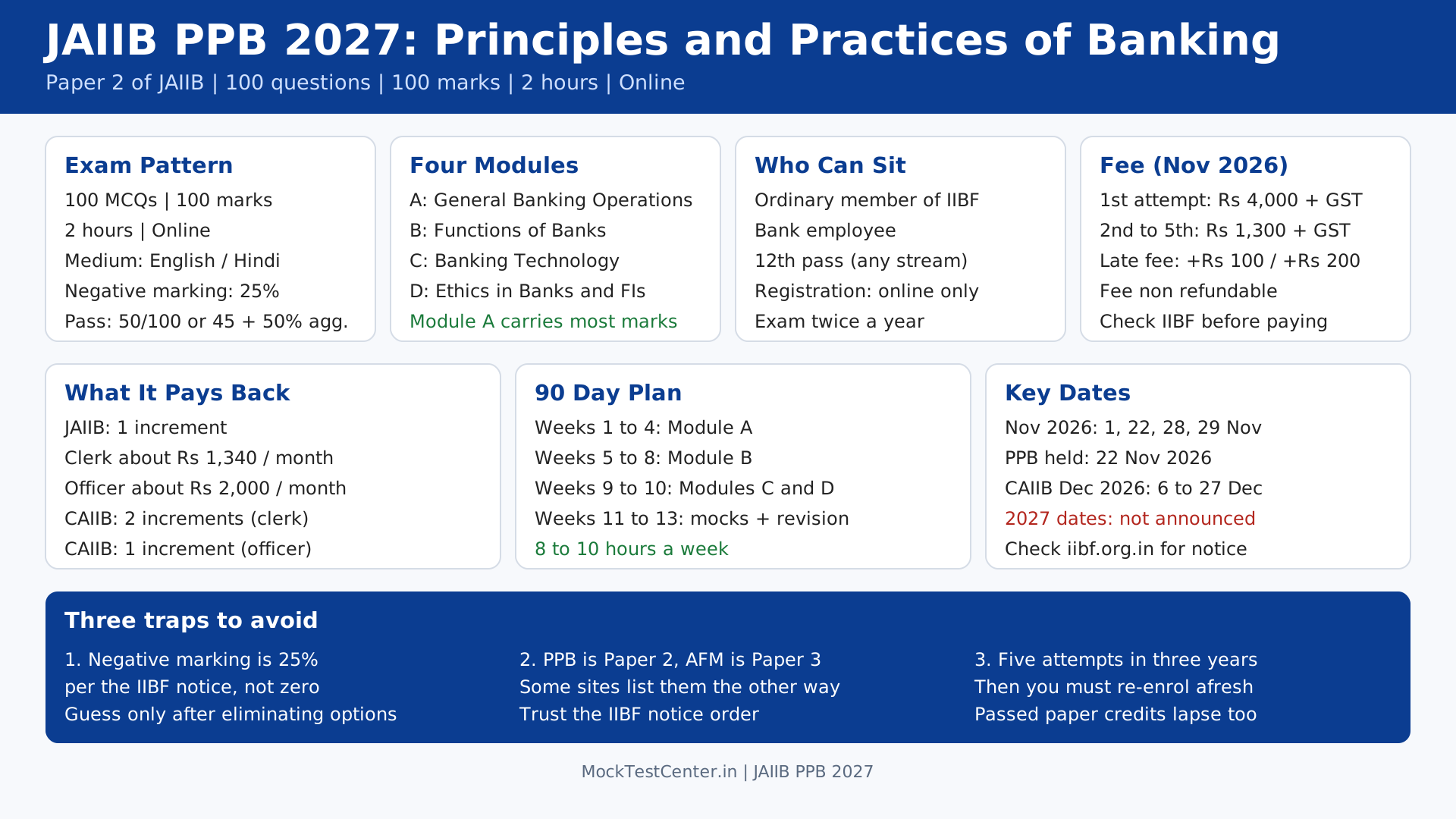
About JAIIB PPB 2027 Exam Series
📖 Table of Contents
- What the paper actually tests
- The JAIIB PPB 2027 pattern, the pass rule and the time limit
- Module A: General Banking Operations
- Module B: Functions of Banks
- Module C: Banking Technology
- Module D: Ethics in Banks and Financial Institutions
- Who can sit, what it costs, and what it pays back
- A 90 day plan for JAIIB PPB 2027 that fits a working banker
- Mistakes that cost marks in JAIIB PPB 2027
- Sources
JAIIB Principles and Practices of Banking 2027: PPB Paper Guide
The Principles and Practices of Banking paper, called PPB, is Paper 2 of the JAIIB exam. This guide covers the JAIIB PPB 2027 paper in full. IIBF sets 100 multiple choice questions for 100 marks, and you get 2 hours. The pass mark is 50 out of 100 in this paper.
There is a second route to pass. If you score at least 45 marks in each paper and your aggregate is 50 percent across all papers in a single attempt, IIBF treats that as a pass too. That rule comes straight from the IIBF revised syllabus notice, so it is the official word on the pass mark.
PPB is the paper that tests what you actually do at a branch. It covers how accounts open and how KYC works. It covers how loans are appraised and how cheques clear. It covers how digital banking runs and how a banker is expected to behave when no one is watching.
If you work at a bank counter, most of this syllabus will feel familiar. The exam still trips up working bankers, because familiar is not the same as exact. The paper asks for exact rules and exact limits and exact definitions across four modules that run from general banking operations to ethics.
The November 2026 cycle ran on four dates in November 2026. PPB was held on 22 November 2026, the second of the four dates. Indian Economy and Indian Financial System was held on 1 November. Accounting and Financial Management for Bankers was held on 28 November.
Retail Banking and Wealth Management was held on 29 November. The 2027 schedule is not out yet. IIBF had not announced the 2027 dates as of 19 November 2026, so this guide uses the 2026 cycle as the latest real cycle and says plainly where the 2027 dates are still unknown. Do not trust any site that prints 2027 JAIIB dates today, because no such dates exist yet.
One warning belongs right at the top. Several popular coaching sites print that JAIIB has no negative marking. The official IIBF revised syllabus notice says the opposite. It prescribes negative marking at 25 percent of the marks allotted to the question.
That means a wrong answer on a one mark question costs a quarter mark. The IIBF notice is the official document, so this guide treats 25 percent negative marking as the rule and tells you to check the current cycle notification before your exam. Guessing every question is a bad plan under that rule. Attempt a question only when you can rule out at least one option with confidence.
What the paper actually tests
PPB has four modules, and each one has a distinct job. Module A is General Banking Operations, and it is the biggest. It covers the banker customer relationship. It covers KYC and anti money laundering rules.
It covers opening accounts and deposit accounts. It covers clearing and cash handling. It covers negotiable instruments and foreign exchange remittances. It covers NRI business and cash management services.
It covers financial inclusion and customer service. It also covers grievance redressal. If you learn only one module well, make it this one, because it carries the most questions and the most marks.
Module B is Functions of Banks, and it is the lending module. It covers principles of lending and types of borrowers. It covers credit facilities and credit appraisal. It covers loan accounts and collaterals.
It covers modes of charging securities and documentation. It covers non performing assets and recovery laws. It covers letters of credit and bills finance. It covers retail loans and priority sector advances.
It covers agricultural finance and finance to NBFCs. It covers MSME finance and government sponsored schemes. It covers self help groups too. This is the module where bankers who only do deposits and clearing struggle, because it asks about appraisal methods and recovery law in detail.
Module C is Banking Technology. It covers bank computerisation and core banking systems. It covers alternate delivery channels and data communication networks. It covers electronic funds transfer systems and digital payment systems.
It also covers security. Module D; Ethics in Banks and Financial Institutions; covers values and business ethics; ethics at the individual level; ethics toward employees; work ethics; and the way technology changes ethical questions. Module D is short, and it still needs a full read. It asks about case studies like Enron and Satyam, and about concepts like whistleblowing and conflict of interest, and those questions need reading, not guessing.
Put together, the four modules add up to a paper that rewards steady reading over cramming. The IIBF study material for PPB runs long, and the questions come from all four modules, so skipping a module to save time usually costs more marks than it saves. The rest of this guide walks through each module in turn, with the topics that carry the most weight and the traps that catch the most candidates.
The JAIIB PPB 2027 pattern, the pass rule and the time limit
| Item | Detail for PPB |
|---|---|
| Paper number in JAIIB | Paper 2 of 4 |
| Questions | 100 multiple choice questions |
| Marks | 100 marks, 1 mark per question |
| Duration | 2 hours, 120 minutes |
| Mode | Online, computer based |
| Medium | English or Hindi |
| Negative marking | 25 percent of the marks allotted to the question, per the IIBF revised syllabus notice |
| Pass mark | 50 out of 100, or 45 in each paper with 50 percent aggregate in a single attempt |
| Modules | 4, named A to D |
A note on the paper number, because some coaching sites get it wrong. A few tracker sites list PPB as Paper 3 and AFM as Paper 2. The IIBF revised syllabus notice lists the papers in this order: Paper 1 Indian Economy and Indian Financial System, Paper 2 Principles and Practices of Banking, Paper 3 Accounting and Financial Management for Bankers, Paper 4 Retail Banking and Wealth Management. The November 2026 date order backs this up.
PPB was held on 22 November, the second date, and AFM was held on 28 November, the third date. This guide follows the IIBF order.
You get five attempts to clear JAIIB, and those five attempts must fall within three years from the date you register for your first attempt. Whichever comes first ends the window. The five attempts need not be consecutive, so you can skip a cycle. But the clock keeps running whether you appear or not.
An attempt counts when you apply, even if you stay away from the exam hall. If the five attempts or the three years run out, you must enrol afresh, and the credits for papers you already passed lapse. That is the current rule under the revised syllabus. The old rule, four attempts in two years, no longer applies, so ignore any site that still prints it.
Passed papers stay passed inside the window. If you clear PPB and one other paper in your first attempt, you carry those two credits forward and sit only for the papers that remain. That matters for planning. It means you can aim to clear PPB early and bank the credit, then attack the harder papers with your remaining attempts.
Class of pass is decided on the first physical attempt only, which is the attempt where you sit for a subject for the first time. First class needs 60 percent or more in aggregate with a pass in every subject. First class with distinction needs 70 percent or more in aggregate and 60 or more in each subject.
The exam runs twice a year, in a May and June cycle and a November cycle. Each paper sits on a separate date, usually a Sunday. A centre runs only where 20 or more candidates register, so pick your centre early. The November 2026 registration ran from 1 August to 21 August 2026, with late fee windows after that, and IIBF extended the last date into early September.
The exact extension dates differ between tracker reports, so this guide records only the announced window and the fact that an extension happened.
Module A: General Banking Operations
Module A is where the paper starts and where most of the marks sit. It opens with the banker customer relationship, and the first thing to learn is that a banker wears several legal hats with the same customer. The bank is a debtor when it takes a deposit; a trustee when it holds something in trust; a bailee when it holds an article in safe custody; an agent when it collects a cheque for you; a lessor when it lets out a locker; and an indemnifier in some guarantee situations. Questions love to test which hat applies in which situation, so learn the pairs, not just the words.
A locker is a lessor and lessee relationship. A deposit is a debtor and creditor relationship. Safe custody is a bailor and bailee relationship.
KYC and anti money laundering rules form the next large block, and this is the part of the syllabus that changes most often, so read it from the latest IIBF material. The chapter covers money laundering and the financing of terrorism; the anti money laundering framework in India; the KYC policy; the organisational setup for AML inside a bank; obligations under the Prevention of Money Laundering Act; risk management; international obligations; FATF identified jurisdictions; correspondent banking; reporting under FATCA and CRS; reporting obligations; and the cost of non compliance. The exam asks about the purpose of each piece, not just its name. Know why a bank files a suspicious transaction report, and know what the Central KYC Records Registry does.
CKYCR lets a customer complete KYC once and use it across financial institutions, and that single idea shows up in questions year after year.
Operational aspects of KYC follow, and here the questions get practical. KYC norms; wire transfers; other operational regulations; CKYCR; and monitoring of transactions all appear. Then the syllabus moves to opening accounts of various types of customers, and this chapter is a favourite of question setters because it is pure procedure. Personal accounts; accounts of other customers; norms for opening current accounts; photographs of account holders; and the Legal Entity Identifier all feature.
Learn which documents each type of customer needs, and learn the special cases, because the paper tests special cases more than routine ones. A minor; a blind person; a partnership firm; a trust; a company; and an unincorporated body each open accounts under different rules; and the differences are the questions.
Deposit accounts come next; with their salient features; interest rules; prohibitions and exemptions; inoperative accounts and unclaimed deposits; joint account operations; the nomination facility; attachment orders; and submission of records to statutory authorities. Nomination is a small topic with a big question count. Know who can nominate, who can be a nominee, and what happens when a nominee is a minor. Know the difference between a joint account operated by either or survivor and one operated jointly.
These are the kind of two line rules that turn into one mark questions.
Clearing; collection and cash handling covers the cheque truncation system; RBI guidelines on collection of instruments; and cash handling and custody; including security at branches and ATMs. The banker special relationship chapter covers mandate; power of attorney; the banker lien; the right of set off; and the right of appropriation. The lien and set off questions are easy marks if you learn the conditions. A banker lien applies to securities in the bank hands, and it does not apply to articles held in safe custody or to money kept for a specific purpose.
The right of set off lets a bank adjust a debit balance against a credit balance of the same customer in the same capacity, and the paper tests the same capacity condition again and again.
The next block covers foreign exchange remittance facilities for individuals. It covers NRI business. It covers foreign currency accounts. The syllabus traces the evolution of the Foreign Exchange Management Act; defines the terms; and covers inward and outward remittances; the Indo Nepal remittance scheme; accounts permitted for NRIs and persons of Indian origin; accounts of foreign nationals visiting India; special non resident rupee accounts; remittance of assets; property transactions by NRIs; investments by NRIs; types of foreign currency accounts; and the Foreign Contribution Regulation Act of 2010.
This block is heavy on names and limits, so make short notes with the account names and who can open each one. NRE, NRO, FCNR: the three account names sound alike in a question, and the paper knows it.
Cash management services and negotiable instruments close the operational core of Module A. So do the responsibilities of the paying bank and the collecting bank. Cash management services cover their development and their importance. They cover their types and the challenges they face.
The negotiable instruments chapter covers the Negotiable Instruments Act; payment of cheques; payment in due course; endorsement; crossing; forged instruments; dishonour of cheques; and the cheque truncation system. Payment in due course is a phrase to learn word for word, because the paper tests its conditions.
The paying bank chapter covers liability under the Negotiable Instruments Act; forged signatures; payment in good faith; payment under mistake; and cheque truncation. The collecting bank chapter covers statutory protection and the duties of the collecting bank. A collecting bank that acts in good faith and without negligence gets protection, and the paper asks what good faith and without negligence mean in practice.
Module A closes with ancillary services; financial inclusion; customer service; and grievance redressal. Ancillary services include demand drafts and banker cheques; mail transfer and telegraphic transfer; NEFT; RTGS; electronic benefit transfer; mobile and digital banking; safe deposit lockers; merchant banking; and government business. Financial inclusion covers extension of banking services, use of digital tools, financial literacy initiatives, and rural self employment training institutes. Customer service covers service in banks; branch management policies; ATM operations; security and risk mitigation; counter services; and special customer facilities.
Grievance redressal covers the model grievance redressal policy, the RBI Integrated Ombudsman Scheme of 2021, the Consumer Protection Act of 2019, and the Right to Information Act of 2005. The Ombudsman scheme is the single most asked topic in this closing block. Learn that it merged the three earlier ombudsman schemes into one, that it covers deficiency in service, and that a customer can approach it after first complaining to the bank.
Module B: Functions of Banks
Module B is the lending module, and it rewards bankers who have worked in credit, while it punishes those who have not. It starts with the principles of lending, types of borrowers, and types of credit facilities. Fund based working capital facilities; term loans; demand loans; and non fund based facilities all appear; and the paper tests the difference between fund based and non fund based limits. A fund based limit puts the bank money out.
A non fund based limit, like a letter of credit or a bank guarantee, puts the bank promise out, and money moves only if the promise is called. Learn that difference cold, because it runs through the whole module.
Credit appraisal and assessment come next. The syllabus covers credit appraisal; appraisal techniques; methods of loan assessment; assessment of working capital; and assessment of term loans. Working capital assessment is the heart of this chapter. Learn the methods by name and learn which method suits which size of borrower.
The paper asks which method applies to a given turnover, and it asks about the cash budget method and the turnover method in particular. Term loan appraisal is different from working capital appraisal, and the paper tests that difference too. A term loan is appraised on the project, its cash flows, and its debt service capacity, while a working capital limit is appraised on the operating cycle.
Operational aspects of loan accounts follow, and this chapter is long. It covers interest rates on loans; credit management and monitoring; common operational terms in loans; loan processing and sanction procedure; accounting aspects of loan products; operating instructions on loans and advances; recovery agent guidelines; and the fair practices code for lenders. The fair practices code is a favourite. Learn what a lender must disclose to a borrower before sanction, and what it must not do during recovery.
Recovery agent behaviour is a real world issue, and the paper treats it as one.
Types of collaterals and their characteristics, modes of charging securities, and documentation form the next block. Collaterals covered include land and buildings; goods and documents of title; advances against life insurance policies; advances against shares and debentures; loans against book debts and term deposits; gold loans; supply bills; and vehicle finance. For each one, learn what makes it a good security and what weakens it. A life insurance policy needs assignment.
Shares need a pledge and a check on the market value. Goods need hypothecation or pledge, and the paper tests the difference between those two charges. Hypothecation leaves the goods with the borrower. Pledge moves possession to the bank.
Modes of charging securities include mortgage; hypothecation; pledge; lien; and assignment; and the registration of charges matters for companies; so learn that too.
Non performing assets and stressed assets get a full chapter, and this is one of the most marked chapters in the module. It covers the definition of non performing assets; income recognition norms; gross and net advances; gross NPA and net NPA; asset classification; provisioning norms; writing off NPAs; resolution of stressed assets; and restructuring norms. Asset classification is the core. Learn the categories and the time periods that move an account from one category to the next.
Learn what provisioning means and why gross NPA and net NPA differ. The paper asks for definitions and for the sequence of events; so learn the order in which an account slips; gets classified; gets provided for; and gets resolved.
Laws relating to recovery of dues cover the Recovery of Debts and Bankruptcy Act of 1993; the SARFAESI Act; the Insolvency and Bankruptcy Code; the Legal Services Authorities Act; and the law of limitation. SARFAESI is the most asked law in this chapter. Learn what it lets a secured creditor do without going to court, and learn its limits. The Insolvency and Bankruptcy Code is the next most asked.
Learn the broad flow of the resolution process and who sits where in it. Section numbers stay out of the questions. The paper asks what the law does and who it protects.
Contracts of indemnity; contracts of guarantee and bank guarantees; letters of credit; deferred payment guarantees; and bills finance follow. Indemnity and guarantee sound alike, and the paper tests the difference. In indemnity, one party promises to save another from a loss. In guarantee, a surety promises to pay if the principal debtor fails.
Learn the rights of the surety; the liability of the surety; continuing guarantee; revocation of guarantee; and discharge of surety. Bank guarantees have their own rules. Learn the types of bank guarantees and the banker obligation to honour them. Letters of credit cover their meaning; the parties; the types; the documents; and the Uniform Customs and Practice for Documentary Credits; UCPDC 600.
Bills finance covers classes of bills, the laws that govern bills, types of bill finance, and the legal position of the banker in bill finance.
Retail loans and credit cards; priority sector advances; agricultural finance; finance to NBFCs and micro finance institutions; MSME finance; government sponsored schemes; and self help groups close Module B. Retail loans cover credit cards and home loans. They cover personal loans and consumer loans. Priority sector advances cover applicability; targets and sub targets; categories; non achievement of targets; and guidelines for priority sector loans.
Agricultural finance covers short term and long term loans; crop loans; the Kisan Credit Card scheme; financing of agricultural activities; the minimum support price scheme; and the Pradhan Mantri Fasal Bima Yojana.
Finance to NBFCs covers bank finance to NBFCs; on lending by NBFCs; the NBFC and micro finance institution model; co lending to priority sector; and the scale based regulation framework. MSME finance covers the MSME Development Act; credit support to MSMEs; delayed payment provisions; the Trade Receivables Discounting System; the credit guarantee fund scheme; and cluster based financing. Government sponsored schemes include the Deendayal Antyodaya Yojana rural and urban livelihoods missions. They include the Pradhan Mantri Jan Dhan Yojana and MUDRA loans.
They include the Khadi and Village Industries Commission too. Self help groups cover their definition, their formation, the self help group bank linkage programme, and their place in the two livelihoods missions.
This closing block is wide, so do not try to memorise every scheme. Learn what each scheme is for, who it serves, and which institution runs it.
Module C: Banking Technology
Module C is the shortest of the four in reading time, but it is not the easiest, because it asks about systems you use every day without thinking about how they work. It starts with essentials of bank computerisation: bank computerisation itself; networking technologies in banks; uninterrupted power systems; core banking systems; data warehousing; and data mining. Learn what a core banking system does before you learn its details. It lets a customer use any branch as the home branch, and it centralises the books of the bank.
That single idea explains most of the operational questions in this module.
Operational aspects of the core banking environment follow. The syllabus covers the functions performed by the system; the flow of transactions; accounting of transactions; begin of day operations; end of day operations; password control; parameter and master file maintenance; logical access control; security controls; and the role and responsibilities of banks under the system. Begin of day and end of day operations are easy marks. Learn the sequence of what opens the day and what closes it, and learn who can change a master file and who can only view it.
Logical access control is about who can do what inside the system, and the paper asks about maker checker controls and password discipline.
Alternate delivery channels and digital banking cover the channels themselves; automated teller machines; electromagnetic cards; electronic banking; customer protection in unauthorised electronic transactions; turn around time harmonisation; and customer compensation for failed transactions. The compensation rules are the most asked part of this chapter. Learn the turn around time for resolving a failed ATM transaction and the compensation a customer gets when the bank misses it. The paper asks for the rule, not for sympathy, so learn the number from the IIBF material and the RBI circular it cites.
Data communication networks and electronic funds transfer systems cover data communication networks; the network scenario in India; emerging trends in banking communication; the evolution of electronic funds transfer systems; SWIFT structured financial messaging; automated clearing systems; the two level funds transfer system; and the emergence of electronic payment systems in India. Digital payment systems cover electronic clearing systems in India, the National Payments Corporation of India, and digital payment initiatives by the Government of India. Learn what NPCI runs, because the paper asks. UPI; IMPS; RuPay; and the national automated clearing house all sit under NPCI; and the questions test which system does what.
The impact of technology adoption closes Module C. Security considerations and cyber crime close it too. Technology trends close it as well. The impact chapter covers trends in technology development, the role of technology upgradation, global trends in banking systems, and the impact of information technology on banks.
The security chapter covers risk concern areas in banks; types of cyber threats; control mechanisms; computer audit; information system audit; information system security; online fraud methods; cyber security awareness; IT resource evaluation; disaster recovery management; the Information Technology Act; the Gopalakrishnan Committee report; the cyber security framework in banks; and the RBI Integrated Ombudsman Scheme of 2021. The cyber crime chapter covers the difference between fraud and crime and the phases of an effective incident response plan.
The trends chapter covers e RUPI and FinTech. It covers RegTech and SupTech. The advanced concepts chapter covers social media banking and hashtag banking. It covers account aggregators and open banking.
Learn the four trend words by their definitions. FinTech is technology in finance.
RegTech is technology in regulation and compliance. SupTech is technology in supervision. e RUPI is a prepaid digital voucher for a specific purpose. Those four definitions alone are worth marks.
Module D: Ethics in Banks and Financial Institutions
Module D is the most different part of the paper, because it asks how you think, not what you remember. It opens with ethics; business ethics and banking as one picture: values and ethics; ethics and business values; the definition and practice of business ethics; the question whether business ethics is an oxymoron; the ethical foundation of banking; finance depending on trust; the ethical foundation of being a professional; banking ethics in a global context; Enron and its lesson; the global financial crisis; ethics in the Indian context; Satyam and its lessons; and an Indian bank case study. Enron and Satyam are the two cases to learn properly. Enron showed what happens when accounting hides the truth.
Satyam showed the same lesson in India. The paper asks what went wrong in each case and what it teaches a banker.
Ethics at the individual level covers values; norms and beliefs; core values; morality and personal values; value conflicts; personal ethics and business ethics; individual integrity and responsibility; the golden rule; understanding right and wrong; ethical reasoning; ethical dilemmas; and a framework for ethical decision making. The questions here are situational. They describe a banker facing a choice and ask which action fits the ethical framework. The way to answer them is to learn the framework from the book, not to guess from common sense.
Common sense gives the popular answer, and the paper often asks for the principled one.
Ethical dimensions for employees covers abuse of official position; insider trading; proprietary data; bribes; obligations to third parties; job discrimination; sexual harassment; managing conflict of interests; fair accounting practices; related party transactions; HRM ethics; principles of representation and work environment; and employees as ethics ambassadors with managers as ethical leaders. Work ethics and the workplace covers what work ethics means; ethical behaviour at the workplace and its benefits; recognising ethical workplaces; unethical behaviours and their causes and remedies; conducting personal business during office time; taking credit for other people work; ethical lapses and organisational culture; ethics of a banker; whistleblowing in banks; and whistleblowing law in India. Banking ethics and changing dynamics covers ethics and technology; data security and privacy; intellectual property rights; patents and proprietary rights; and ethics of information security. Whistleblowing is the most asked topic in this block.
Learn what protection a whistleblower gets and what the process is inside a bank.
Who can sit, what it costs, and what it pays back
JAIIB is not an open public exam. You must be an ordinary member of IIBF, and you must work in a bank or financial institution whose employer is an institutional member of IIBF. That covers public sector banks; private banks; regional rural banks; cooperative banks; foreign banks; and other financial institutions. The education bar is a pass in the 12th standard, in any discipline, or its equivalent.
You need your membership number to register, and registration is online through the IIBF portal. The fee is paid separately for every attempt, and it is not refunded or adjusted once paid.
The fee for the November 2026 cycle was Rs 4,000 plus GST for the first attempt; and Rs 1,300 plus GST for the second to fifth attempts; with convenience charges extra. At 18 percent GST, the first attempt works out to about Rs 4,720 in total before convenience charges. Late registration adds Rs 100 in the second week and Rs 200 in the third week. One tracker site still prints Rs 2,700 as the first attempt fee, and that figure is stale.
It matches an older fee, not the November 2026 cycle. Five separate tracker reports agree on Rs 4,000 for the 2026 cycle; so this guide uses Rs 4,000 and flags the Rs 2,700 figure as out of date. Fees change between cycles, so check the current IIBF notification before you pay.
Clearing JAIIB brings one extra increment in most banks, for clerical staff and for officers alike. The amount is about Rs 1,340 a month for a clerk and about Rs 2,000 a month for a probationary officer; though one tracker prints Rs 1,350 for clerks; and the exact amount depends on your bank and the settlement in force. Clearing CAIIB after JAIIB brings two increments for clerical staff and one increment for officers, worth about Rs 2,680 a month for a clerk and about Rs 4,000 a month for an officer. JAIIB and CAIIB together add about Rs 4,020 a month for a clerk and about Rs 6,000 a month for an officer.
Those are approximate figures from tracker reports, not IIBF figures, because IIBF does not fix your pay. Your bank does. The certificate also helps at promotion time, and CAIIB needs JAIIB passed first, so JAIIB is the gate to the whole ladder.
The same banking knowledge that PPB tests shows up in the big recruitment exams too. A candidate who has read PPB properly will find the banking awareness parts of SBI PO 2027; SBI Clerk 2027; IBPS PO 2027; IBPS Clerk 2027; RBI Assistant 2027; RBI Grade B 2027; NABARD Grade A 2027; SEBI Grade A 2027; IBPS RRB PO 2027 and LIC AAO 2027 easier to handle; because those exams ask about the same operations; the same lending rules; and the same digital banking systems. That is a side benefit, not the reason to sit for JAIIB, but it is a real one for a banker who also watches the recruitment calendar.
A 90 day plan for JAIIB PPB 2027 that fits a working banker
| Weeks | What to do | Hours a week |
|---|---|---|
| 1 to 2 | Read Module A chapters on the banker customer relationship and KYC. Read the AML chapter and the account opening chapter too. Make short notes with definitions in your own words. | 8 |
| 3 to 4 | Finish Module A: deposits and clearing. Cover negotiable instruments and foreign exchange. Cover grievance redressal too. Take one mock test on Module A. | 8 |
| 5 to 6 | Read Module B: principles of lending and appraisal. Read the loan accounts chapter and the collaterals chapter. Work the appraisal examples by hand. | 9 |
| 7 to 8 | Finish Module B: NPA and recovery laws. Cover guarantees and letters of credit. Cover priority sector and government schemes. Take one mock test on Module B. | 9 |
| 9 to 10 | Read Module C fully: core banking and digital channels. Cover NPCI systems and security. Read Module D fully: ethics cases and frameworks. | 8 |
| 11 | Full syllabus revision from your short notes. Two full mock tests, 100 questions each, timed at 2 hours. | 10 |
| 12 | Weak area repair only. One mock test every alternate day, with error review the same evening. | 10 |
| 13 | Final revision of definitions and limits. Revise the case names too. One last mock test three days before the exam, then rest. | 6 |
The plan assumes about eight to ten hours a week, which fits a branch job if you protect one hour a day and a longer sitting on a holiday. Read the IIBF study material first and use other books only to fill gaps. Macmillan publishes a PPB guide that many candidates use alongside the IIBF material. Take a mock test every week from week four onward, and always review the wrong answers the same day.
A mock test you never review is time spent, not learning done. Keep a small notebook of the rules you keep forgetting, and read that notebook in the last week. That notebook is your JAIIB PPB 2027 revision kit.
Mistakes that cost marks in JAIIB PPB 2027
The first mistake is reading Module D last and skipping it. It is short, and candidates treat it as light reading, then lose easy marks on case studies and frameworks they never read. Read it in week nine, as the plan says, and give it the same respect as the lending chapters. The second mistake is memorising definitions without learning the conditions.
The paper rarely asks what a lien is. It asks when a lien applies and when it does not. The third mistake is ignoring the negative marking rule. If you believe the coaching sites that print no negative marking, you will guess on every question you do not know, and each wrong guess will cost a quarter mark under the IIBF rule.
Guess only when you can eliminate at least one option.
The fourth mistake is studying from old material. KYC rules, digital payment systems, and the Ombudsman scheme all changed in recent years, and old books print old rules. Use the latest IIBF study material and check the current cycle notification for the pattern. The fifth mistake is treating PPB as a theory paper.
It is a procedure paper. The questions ask what a banker does next in a given situation, so practise with situational questions and previous year papers, not just with reading. The sixth mistake is leaving the paper number confusion unresolved. If you prepare from a site that calls PPB Paper 3, you may download the wrong syllabus.
PPB is Paper 2, AFM is Paper 3, and the IIBF notice is the authority.
Start with Module A, finish Module B before you touch the rest, and keep one hour a day protected for ninety days. That is the whole method. The paper rewards a banker who read the book, learned the conditions and sat the mock tests.
Sources
IIBF revised syllabus notice for JAIIB and the other courses (DB and F, SOB, CAIIB), dated 30 August 2022, on the official IIBF site: IIBF revised syllabus notice (PDF). This is the source for the four paper names and order; the module names; the 100 question and 120 minute pattern; the 25 percent negative marking rule; the 50 mark pass rule with the 45 mark aggregate route; the five attempts in three years rule; and the AFB to AFM rename. The IIBF home page is at iibf.org.in.
Other sources used for dates; fees; and syllabus detail; checked on 19 November 2026: Adda247 JAIIB PPB syllabus page; module wise topics for Modules A; B; C and D; and the November 2026 exam dates; Oliveboard JAIIB syllabus and credit retain pages; for the five attempts in three years rule and the increment figures; the November 2026 admit card notice reported on 28 October 2026; for the paper wise dates of 1; 22; 28 and 29 November 2026; the JAIIB November 2026 fee reports from five tracker sites; all printing Rs 4,000 plus GST for the first attempt and Rs 1,300 plus GST for later attempts; and the CAIIB December 2026 schedule reports; for the 6; 12; 13; 20 and 27 December 2026 dates. The Rs 2,700 first attempt fee printed by one tracker site was treated as stale and not used.