
About CAIIB ABFM 2027 Exam Series
📖 Table of Contents
- ABFM at a glance
- Who can sit for ABFM and what it costs
- Why ABFM feels different from BFM
- Module A: The Management Process
- How to study Module A
- Module B: Advanced Concepts of Financial Management
- How to study Module B
- Module C: Valuation, Mergers and Acquisitions
- How to study Module C
- Module D: Emerging Business Solutions
- How to study Module D
- How to read a case study in this paper
- A 90 day plan that fits a working banker
- Mistakes that cost marks every cycle
- What comes after ABFM
- Sources
CAIIB Advanced Business and Financial Management 2027: ABFM Paper Guide
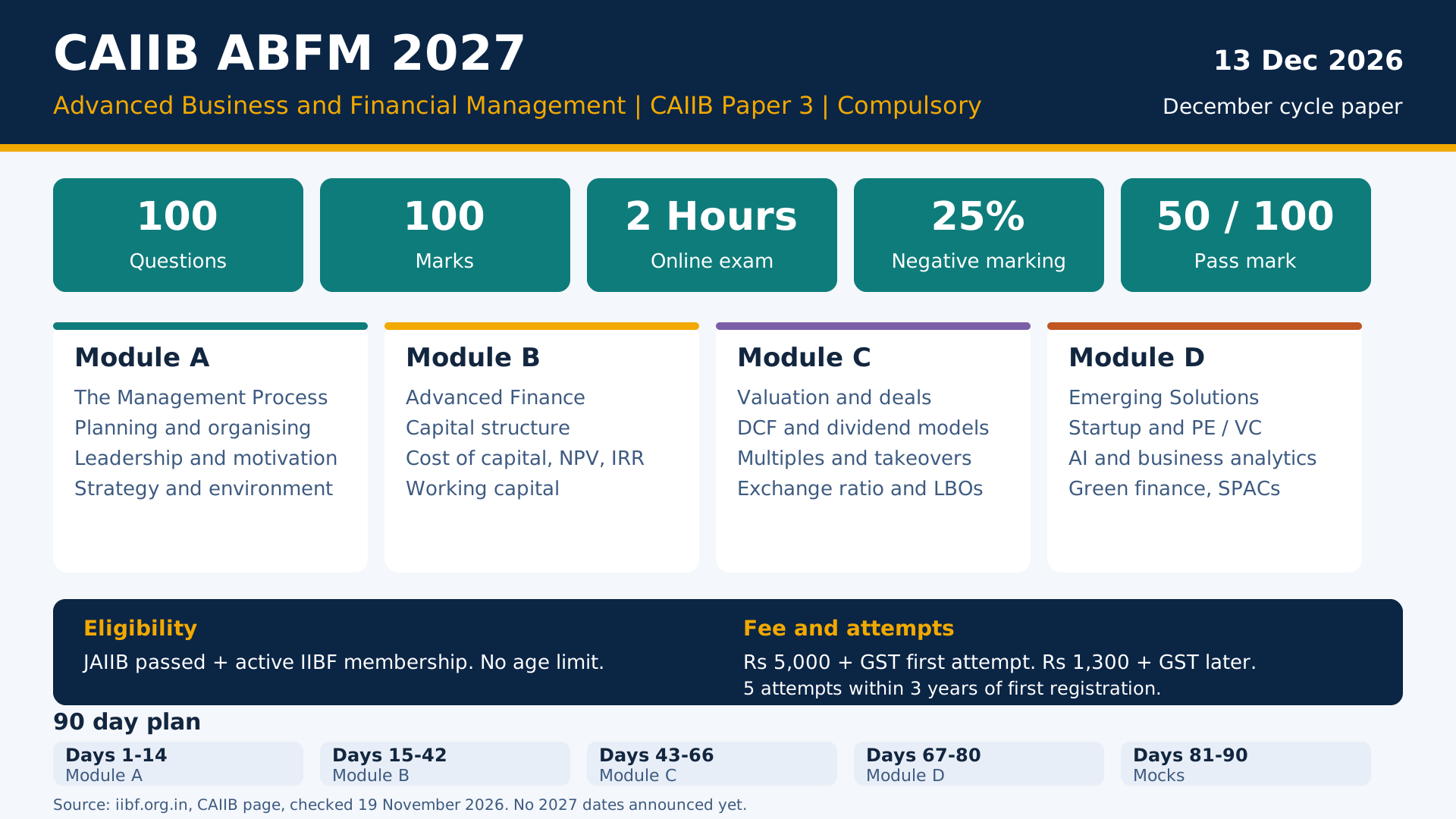
Advanced Business and Financial Management, known as ABFM, is Paper 3 of the CAIIB exam and it carries 100 questions for 100 marks in 2 hours. You need 50 marks to pass the CAIIB ABFM 2027 paper, and negative marking of 25 percent applies, so a wrong answer costs a quarter mark. The paper ran on 13 December 2026 in the December cycle, and the June cycle paper ran on 13 June 2026, both online, according to the official IIBF CAIIB page.
No 2027 dates exist yet. IIBF has not announced the 2027 schedule as of 19 November 2026, and any date you see for 2027 on a coaching site is a guess, so plan around the twice a year rhythm and check the IIBF page before you register. The CAIIB ABFM 2027 paper follows this same pattern.
Four modules make up the paper. The Management Process opens it, Advanced Concepts of Financial Management follows, then Valuation, Mergers and Acquisitions, then Emerging Business Solutions. The mix is unusual. Half the paper reads like a management textbook and half reads like a finance textbook, and the exam keeps crossing from one side to the other.
A question on leadership can sit next to a question on discounted cash flow, and a case study can ask you to use both in the same answer. That crossing is the whole character of ABFM, and it is also why the paper surprises candidates who prepared for it like a second BFM.
This guide walks through the paper the way a working banker should study it. It covers the pattern, the pass rule, the fee, the attempt limit, each module in depth, the case study method that carries so many marks, a 90 day plan, and the mistakes that cost marks every cycle.
ABFM at a glance
| Item | Detail |
|---|---|
| Paper | Advanced Business and Financial Management, CAIIB Paper 3, compulsory |
| Questions | 100 objective questions, including case studies and caselets |
| Marks | 100 marks, 1 mark per question |
| Time | 2 hours, online mode |
| Negative marking | 25 percent of the marks of the question |
| Pass mark | 50 out of 100, or 45 with 50 percent aggregate in one attempt |
| Medium | English and Hindi |
| December 2026 paper date | 13 December 2026 |
| June 2026 paper date | 13 June 2026 |
| First attempt fee | Rs 5,000 plus GST |
| Second to fifth attempt fee | Rs 1,300 plus GST per attempt |
The pass rule deserves a second look because many candidates read it wrong. The standard pass is 50 marks in the paper. The second route lets you pass a paper with 45 marks if your total across all five papers in one attempt reaches 50 percent, which is 250 marks out of 500.
Oliveboard states this rule as 50 per paper or 45 with 50 percent aggregate in one attempt, and the same 250 aggregate figure appears in other tracker guides. The 45 mark route only helps if you sit all five papers in one attempt and score well in the rest, so treat 50 as your real target and treat 45 as a safety net you hope you never need.
Case studies and caselets carry a large share of the marks in this paper. Oliveboard notes that the ABFM paper includes caselets and case studies among its 100 questions, and Myonlineprep says the same about CAIIB papers in general. A caselet gives you a short business situation and asks three or four questions on it, and a wrong reading of the situation can cost you the whole set.
That is why this guide spends a full section on the case study method. The candidate who practises cases weekly will finish this paper calmly, while the candidate who only reads theory will run out of time in the middle of a case he has never learned to read.
Who can sit for ABFM and what it costs
Only a banker who has already passed JAIIB can register for CAIIB, and you must hold an active IIBF membership with the subscription paid up. The IIBF CAIIB page states the exam is for members only. There is no age limit, and the exam runs twice a year, in the May June window and again in the November December window. JAIIB itself has four papers, Indian Economy and Indian Financial System, Principles and Practices of Banking, Accounting and Financial Management for Bankers, and Retail Banking and Wealth Management.
Its November 2026 papers ran on 1, 22, 28 and 29 November 2026. Its first attempt fee is Rs 4,000 plus GST, with Rs 1,300 plus GST for the second to fifth attempts.
The CAIIB fee is Rs 5,000 plus GST for the first attempt and Rs 1,300 plus GST for each of the second, third, fourth and fifth attempts. Those figures come from the official IIBF CAIIB page, checked on 19 November 2026. For the December 2026 cycle, registration with the normal fee ran from 13 to 19 September 2026, then with Rs 100 extra from 20 to 26 September, then with Rs 200 extra from 27 September to 8 October 2026. The June 2026 cycle followed the same shape, with normal fee registration from 4 to 10 March 2026 and the paper dates spread from 31 May to 21 June 2026.
The attempt rule is the one that catches people out. IIBF gives you 5 attempts to finish CAIIB, within a maximum of 3 years from the date of your first registration, whichever ends first. The attempts need not run back to back. An attempt counts the moment you apply, whether or not you turn up for the exam.
If the window lapses, you must enrol afresh and you lose credit for papers you already passed. That last point matters more than it sounds. A passed paper is a real asset, and a careless registration can throw it away, so never register for a cycle you know you cannot prepare for.
The money side explains why bankers take this exam seriously. A clerk who clears JAIIB gets 1 increment, and a clerk who clears CAIIB gets 2 more increments, which adds up to 3 increments across the two exams. An officer gets 1 increment for JAIIB and 1 for CAIIB, which adds up to 2 increments. Several trackers agree on those counts, including Anuj Jindal and the IIBF store guides, and they all add that the exact rupee value follows the bipartite settlement and your own bank circular.
Guidely, using the 12th Bipartite Settlement, puts a JAIIB increment at about Rs 1,340 a month for a clerk and about Rs 2,000 a month for a probationary officer, while Adda247 puts a CAIIB increment at about Rs 2,680 a month for a clerk and about Rs 4,000 a month for a probationary officer. Those rupee figures come from trackers, not from IIBF, and they change with each settlement, so confirm the current figure with your HR department before you quote it to anyone.
Why ABFM feels different from BFM
BFM asks how a bank manages money. ABFM asks how a business is run and how its finance is judged. The shift is bigger than it sounds. BFM stays inside the bank, with treasury, forex and the balance sheet.
ABFM steps outside the bank and looks at the companies the bank lends to, values, merges, and funds. A candidate who treats ABFM as BFM with new chapter names will study the wrong way, because the questions test business judgement as much as banking knowledge.
The management module is where this difference shows first. It asks about planning, organising, staffing, directing, controlling, leadership, motivation and communication, and none of those topics has a formula. You cannot solve your way through them. You have to know the idea well enough to pick the right answer from four close options, and the wrong options are often half right.
Candidates who love numericals find this module slow and slippery, and candidates who love theory find it easy. Both groups need the same fix, which is to read each concept, write it in one plain sentence, and test it against a real situation from their own branch.
The finance modules swing the other way. Valuation, capital budgeting and working capital are numerical, and the sums are long. A discounted cash flow question can take three minutes if you know the steps and six minutes if you do not, and the paper gives you 72 seconds per question on average. The gap between those two numbers is the whole exam.
The candidate who practised the sums finishes, and the candidate who only read about them runs out of time. That gap is the blunt truth of this paper, and the 90 day plan below is built around it.
One thing to respect is the marking rule. The official IIBF notice that introduced the revised syllabi prescribes negative marking at 25 percent of the marks allotted to the question, so a wrong answer on a one mark question costs a quarter mark. Many coaching sites still print no negative marking, but the IIBF notice is the official word. Guess only when you can rule out at least two options.
A wrong answer costs a quarter mark, so attempt a question only when you can rule out at least two options. The only questions that need care are the case based sets, where one wrong reading can cost you three or four marks at once, and the long numericals, where a careless slip wastes the time you spent.
Module A: The Management Process
The Management Process is the first module, and it is the one that candidates most often underrate. It covers the basics of management, planning, organising, staffing, directing, controlling, leadership, motivation, communication, strategic management, and the business environment. There are no sums here. The marks come from knowing ideas precisely and telling close options apart, and that takes a different kind of study from the rest of the paper.
Start with what management is. Management is the process of planning, organising, staffing, directing and controlling the work of people so that an organisation reaches its goals with the resources it has. Each of those five functions has its own job, and the exam will test whether you can tell them apart. Planning sets the goal and the path.
Organising arranges people and resources along that path. Staffing puts the right people in the right roles. Directing guides and motivates them while the work runs.
Controlling checks the result against the plan and corrects the course. A question will describe a manager doing one of these things and ask which function it is, and the answer is easy only if you learned the five functions as five jobs rather than five words.
Planning deserves extra time because the syllabus gives it real space. Planning covers the types of plans, the steps in the planning process, decision making, and the tools managers use to choose between options. A plan can be long term or short term, standing or single use, and the exam will ask you to sort a given plan into its type.
Decision making is the heart of planning, and the questions test the steps a manager follows, from finding the problem to choosing the option to checking the result. Keep a short note that lists the planning steps in order, because the exam loves to ask what comes first and what comes last.
Organising covers the structure of the organisation, the span of control, delegation, centralisation and decentralisation, and the difference between line and staff roles. The span of control is the number of people one manager can supervise well, and it changes with the work. Routine work allows a wide span, and complex work needs a narrow one.
Delegation is the manager handing authority down with the task, and the exam will test the point that a manager can delegate authority but keeps the responsibility. That single point answers a surprising number of questions, and it is worth more than a page of memorised definitions.
Staffing, directing and controlling follow in order. Staffing covers recruitment, selection, training and appraisal, and it connects to the human resource topics that return in the elective paper on Human Resources Management. Directing covers leadership, motivation and communication, and these three topics carry the most questions in this module. Leadership styles range from the manager who decides alone to the manager who decides with the team, and the exam will ask which style fits a given situation.
Motivation theories explain why people work hard, and you must know the main ones by name and by their central idea. Communication covers the flow of messages up, down and across the organisation, the barriers that block it, and the difference between formal and informal channels.
Strategic management closes the module, and it is the part that ties the rest together. Strategic management asks how an organisation reads its environment, sets its direction, and holds its edge against rivals. Business environment analysis covers the economic, political, social, technological and legal forces around a firm, and the exam will ask you to sort a given force into its type.
A change in interest rates is an economic force, a change in law is a legal force, and a change in customer taste is a social force, and the question will give you the change and ask for the type. Learn the five forces as five labels, and the questions become quick.
How to study Module A
Give this module two weeks. Read one function per day, write it in one plain sentence, and add one example from your own branch under it. A branch that moved to a new target, a team that got a new leader, a process that changed after an audit, all of these are management examples, and they make the theory stick. Test yourself with 20 questions a day from this module alone, because the questions here are won on precision, and precision comes from practice.
Module B: Advanced Concepts of Financial Management
Advanced Concepts of Financial Management is the biggest module in ABFM and it is the one that decides most results. It covers sources of finance, financial strategies, capital structure, financial and operating leverage, cost of capital, capital investment decisions, risk adjustment, working capital, and investment decisions. This is the numerical heart of the paper, and it rewards the candidate who practises sums and punishes the candidate who only reads.
Start with the goal of financial management. A firm manages its finance to raise money at a low cost, invest it where it earns more than that cost, and return value to its owners. Every topic in this module serves one of those three jobs, and the exam will test whether you can tell which job a given decision belongs to. Raising money is the financing decision.
Choosing a project is the investment decision. Paying a dividend is the distribution decision. A question will describe a decision and ask which type it is, and the answer is easy only if you learned the three decisions as three jobs.
Sources of finance come next, and you must know them as a menu with a cost attached to each item. Equity is the money owners put in, and it costs the return owners expect. Debt is the money lenders put in, and it costs interest, with a tax saving attached because interest is a deductible expense. Retained earnings are the profits a firm keeps, and they cost the return owners could have earned elsewhere.
Preference shares, debentures, term loans, trade credit, commercial paper and leasing all sit on the same menu, and the exam will ask which source fits a given need. A firm that needs money for ten years uses a different source from a firm that needs money for ten days, and the question will give you the need and ask for the source.
Capital structure is the mix of debt and equity a firm uses, and it is the most argued topic in this module. Debt is cheaper than equity because lenders take less risk and interest saves tax, so a firm that borrows more lowers its average cost of funds. Debt also raises risk, because interest must be paid even in a bad year, and a firm that borrows too much can fail from its interest bill alone.
The exam tests this trade off again and again, and the candidate who can state both sides in one sentence will do well. The optimal structure is the mix where the cost is lowest and the value is highest, and the exam will ask what moves a firm toward it or away from it.
Gearing, which the book calls leverage, measures how much a small change in sales moves profit, and the module covers both financial gearing and operating gearing. Operating gearing comes from fixed costs in the business, and it shows how a change in sales moves operating profit. Financial gearing comes from debt in the structure, and it shows how a change in operating profit moves the return to owners.
A firm with high fixed costs and high debt has high gearing on both sides, which means its profit swings widely with sales, and the exam will ask you to compute the two measures and to say what a high number means. Keep the two apart in your notes, because the exam loves to mix them.
Cost of capital is the rate a firm must earn on its projects to keep its funders happy, and it is the single most used number in this module. The cost of equity, the cost of debt after tax, and the cost of preference shares each have their own formula, and the weighted average cost of capital blends them by the share each source holds in the structure. A project that earns more than the weighted average creates value, and a project that earns less destroys it, and that one rule answers most of the questions on capital budgeting. Practise the weighted average until you can compute it without thinking, because it appears in this module, in Module C, and in the case studies.
Capital investment decisions, which the book also calls capital budgeting, are the methods a firm uses to judge a project. Net present value discounts all future cash flows at the cost of capital and accepts the project if the result is positive. Internal rate of return finds the discount rate that makes the net present value zero and accepts the project if that rate beats the cost of capital. Payback asks how fast the project returns its money, and it ignores what comes after.
Each method has a strength and a weakness, and the exam will ask you to pick the right method for a given situation or to spot the flaw in a given answer. Risk adjustment adds the last layer. A risky project must be judged at a higher rate than a safe one, and the methods for adjusting include the risk adjusted discount rate, the certainty equivalent, and sensitivity analysis, and you must know what each one changes.
Working capital is the money a firm needs to run its daily business, and it is the topic that most connects to banking, because banks fund working capital. The working capital cycle runs from buying raw material to making goods to selling them to collecting the cash, and the longer the cycle, the more money the firm needs. The exam tests the components of working capital, the ways to measure the cycle, and the ways to fund it, from bank cash credit to trade credit to commercial paper.
A firm that holds too much stock wastes money, and a firm that holds too little loses sales, and the questions test whether you can find the balance. Project finance closes the module, and it asks how a large project is funded as a separate venture, with its own cash flows, its own lenders, and its own risks, and the exam will test what makes it different from ordinary corporate borrowing.
How to study Module B
Give this module four weeks, which is more than any other module gets. Read one topic per week and solve sums on it the same day, before you move on. Keep a formula sheet with no more than 20 lines on it, and rewrite it from memory every Sunday. If you cannot rewrite it, the sheet still needs work.
That test is harsh and it works. Spend the last week of this block on working capital cases, because they link this module to the bank lending you already know.
Module C: Valuation, Mergers and Acquisitions
Valuation, Mergers and Acquisitions is the module that most candidates find the hardest to finish, and it is also the module that carries the most marks per hour of study once you learn its methods. It covers corporate valuation, discounted cash flow valuation, other valuation models, mergers, acquisitions, restructuring, and deal structuring. The module is numerical and it is long, so it rewards the candidate who practises sums and punishes the candidate who only reads.
Start with why valuation matters. A valuation puts a price on a business, and that price decides whether a buyer pays too much, a seller accepts too little, or a bank lends against the right value. The exam will test the three broad approaches and when each one fits. The asset approach values what the firm owns.
The market approach values what similar firms sell for. The income approach values what the firm will earn in the future, and that is the approach the exam tests most. Learn the three approaches as three answers to the same question, and the questions become easy to sort.
Discounted cash flow valuation is the central method, and you must learn it step by step. You forecast the free cash flow the firm will generate, you pick a discount rate, usually the weighted average cost of capital, you discount each year back to today, and you add a terminal value for the years beyond the forecast. The dividend discount model is the simpler cousin of the same idea, and it values a share by discounting the dividends it will pay.
Both methods rest on the same logic, which is that a rupee tomorrow is worth less than a rupee today, and the exam will test that logic with numbers. The inputs matter as much as the method, because a small change in the growth rate or the discount rate moves the answer a lot, and the exam will ask you to spot which input drives the result.
Other valuation models fill the next block. Relative valuation compares a firm with its peers using multiples like the price earnings ratio, the enterprise value to sales ratio, and the enterprise value to operating profit ratio. Book value looks at the net assets on the balance sheet, and the stock and debt approach values the firm by adding the market value of its equity to the market value of its debt.
Each method has a strength and a weakness, and the exam will ask you to pick the right method for a given firm. A young firm with no profits needs a different method from a mature firm with steady dividends, and a firm with heavy debt needs a different method from a firm with none.
Special cases appear in the syllabus, and they are the part of the module that candidates skip and then regret. Intangible assets, startups, distressed firms, service companies, holding companies, e commerce firms, warrants and convertibles each need a different touch, because the standard models assume steady cash flows and a normal capital structure. A startup has no history, a distressed firm has no sure future, and a service firm has few tangible assets, so the valuer must adapt. The exam asks about these cases because they test judgement, and a candidate who knows why the standard model fails will pick up marks that others leave behind.
Mergers and acquisitions are the second half of the module. A merger joins two firms, an acquisition buys one firm, a takeover buys control against the wishes of the target, and a leveraged buyout buys a firm with borrowed money. The reasons firms merge range from cost savings to market share to tax gains, and the exam will ask you to sort a given reason into its type. The mechanics matter too.
The exchange ratio decides how many shares of the buyer a shareholder of the target receives, and the exam will ask you to compute it from the share prices and the agreed values. The costs and benefits of a deal must be weighed together, because a merger that saves costs but pays too high a price can still destroy value.
Restructuring covers the deals that split firms apart rather than joining them. A demerger splits one firm into two, a divestiture sells a unit, and a spin off gives shareholders shares in the new firm. Each one answers a different problem, and the exam will ask which one fits a given situation.
A firm that wants to focus on its main business sells the side unit, and a firm that wants to release value in a hidden division demerges it, and the question will give you the problem and ask for the deal. Deal structuring closes the module, with negotiations, legal and tax aspects, reporting, financing, and cross border acquisitions, and it asks how a deal is put together so that it survives the board, the regulator, and the market.
How to study Module C
Give this module three and a half weeks, and spend half the time on sums. Practise discounted cash flow sums until the steps feel automatic, then practise exchange ratio sums the same way. Keep a one page note for each valuation method, with the formula in one line, the inputs in one line, and one worked example under it. That note becomes your revision sheet in the last week, and it is worth more than the whole book at that stage.
Module D: Emerging Business Solutions
Emerging Business Solutions is the newest module in the paper, and it is the one that most rewards a candidate who reads the news. It covers hybrid finance, startup finance, private equity and venture capital, artificial intelligence, business analytics, green and sustainable financing, and special purpose acquisition companies. The topics change fast, and the exam tests the ideas rather than the fine print, so a candidate who knows what each one is and why it matters will score well.
Hybrid finance sits between debt and equity, and the syllabus lists warrants, convertibles, foreign currency convertible bonds, mezzanine finance, and innovative hybrid instruments. A warrant gives its holder the right to buy shares at a set price, and a convertible bond starts as debt and turns into equity at the holder choice. Mezzanine finance sits below senior debt and above equity, and it carries a higher return for a higher risk.
The exam will ask you to sort an instrument into its type and to say who uses it and why. A firm that wants money without giving up control today uses a different instrument from a firm that wants the cheapest money it can get, and the question will give you the need and ask for the instrument.
Startup finance is the next block, and it covers how a new firm raises money when it has no history and no profits. The syllabus lists the benefits and challenges of startup finance, the policies that support it, pitching, funding stages, schemes, tax exemptions, and the investor view. A startup raises money in rounds, from friends and family to angel investors to venture capital to the public market, and each round buys a smaller share of a bigger firm.
The exam will ask about the stages and the risks at each stage, and it will ask about the schemes that support startups in India. Keep a short note that lists the funding stages in order, because the exam loves to ask what comes first and what comes last.
Private equity and venture capital follow, and they are the money behind startups and buyouts. Private equity buys into mature firms and improves them, venture capital buys into young firms and grows them, and both exit by selling the firm, listing it, or selling to another buyer. Due diligence is the checking a fund does before it invests, and the exam will ask what it covers.
The benefits of this money are the funds and the advice that come with it, and the drawbacks are the control the fund takes and the pressure to exit on time. Learn the two as two answers to the same question, which is who funds a firm that banks will not fund, and the questions become easy to sort.
Artificial intelligence is the topic that most candidates read last and remember least, and that is a mistake, because it carries easy marks. The syllabus covers the history of artificial intelligence, its applications in banking and financial services, neural networks, the tools used, rational agents, and the ethics of it. A bank uses artificial intelligence to score credit, spot fraud, answer customers, and manage risk, and the exam will ask which use fits a given situation. The ethics matter too, because a model that decides who gets a loan must be fair and open, and the exam will ask about the risks of a model that is not.
Business analytics is the companion topic, and it covers the essentials, the types, the elements, big data, web and mobile analytics, and the importance of it all. Descriptive analytics says what happened, predictive analytics says what may happen, and prescriptive analytics says what to do, and the exam will ask you to sort a given use into its type.
Green and sustainable financing closes the finance topics, and it covers the standards, the best practices, the policies in India, the challenges, and the RBI view. Green finance funds projects that help the environment, from solar power to clean transport, and the exam will ask what counts as green and who decides. The RBI view matters because the regulator sets the frame inside which banks lend for green projects, and the exam will test that frame. Special purpose acquisition companies, known as SPACs, close the module.
A SPAC is a firm listed with no business of its own, and it raises money to buy a real business later. The syllabus lists the advantages, the disadvantages, the structure, the process, and the risks, and the exam will ask whether a SPAC helps or hurts the investor in a given case.
How to study Module D
Give this module two weeks. Read one topic per day and write it in one plain sentence with one example under it. A startup you read about, a green bond in the news, a bank chatbot you used, all of these are examples, and they make the theory stick. Test yourself with 20 questions a day from this module alone, because the questions here are won on knowing the idea, and the idea is easy once you have an example for it.
How to read a case study in this paper
A case study in ABFM is a short business story with numbers in it, and it asks you to use the numbers to reach a decision. The story will give you a firm, its sales, its costs, its capital, and a choice it must make, and the questions will ask what the firm should do. The candidates who fail these questions usually fail in the same way. They read the questions first, then hunt through the story for numbers, and they run out of time in the middle of the hunt.
The fix is simple, and it feels slow the first time you try it. Read the story twice before you look at the questions.
The first read is for the story. Who is the firm, what does it sell, what choice does it face, and what numbers matter. The second read is for the numbers. Write down the sales, the costs, the capital, the rate, and the options, in a small table on your rough sheet.
Then look at the questions. Most of them will answer themselves once the numbers sit in front of you in order, because the exam tests whether you can find the right numbers and use the right method, and the table does the finding for you.
Three methods cover most of the case questions in this paper. Net present value answers whether a project is worth doing. The weighted average cost of capital answers what rate to judge it at. The working capital cycle answers how much money the firm needs to run.
A case that asks about a new project will use the first two, and a case that asks about funding will use the third, and a case that asks about a merger will use valuation. Learn to spot which method a case needs from its first paragraph, and you will save minutes on every set.
Practise at least two case sets a week from the second month onward, and time yourself on them. A case set of four questions should take you eight minutes at most, which is two minutes per question, and you should review every wrong answer the same day. A wrong answer you review becomes a mark you will not lose again, and a wrong answer you ignore will repeat itself on exam day. The CAIIB ABFM 2027 mock tests on this site include case based questions in the same shape as the real paper, so use them to rehearse the real day, not just to check your knowledge.
A 90 day plan that fits a working banker
Ninety days is enough for the CAIIB ABFM 2027 paper if you study two hours a day and keep every Sunday for revision and mock tests. The plan below splits the time by module weight, not by page count, because Module B and Module C carry the most marks and deserve the most days. Adjust the dates to your cycle, and keep the shape of the plan even if you start late. A late start with a good shape beats an early start with no shape.
| Days | Focus | Daily work |
|---|---|---|
| 1 to 14 | Module A The Management Process | Read one function per day and write it in one plain sentence with a branch example |
| 15 to 42 | Module B Advanced Financial Management | Read one topic per week and solve sums on it the same day |
| 43 to 66 | Module C Valuation, Mergers and Acquisitions | Practise discounted cash flow and exchange ratio sums daily |
| 67 to 80 | Module D Emerging Business Solutions | Read one topic per day and test with 20 questions |
| 81 to 90 | Full revision and mock tests | One mock test every second day with a same day review of every wrong answer |
Time matters as much as accuracy. The paper gives you 120 minutes for 100 questions, which is 72 seconds per question on average. The theory questions should take you 40 seconds each, which leaves you more than two minutes for each numerical and case based question. Work in three passes.
In the first pass, answer every question you know at once and mark the rest. In the second pass, solve the numericals you marked, with the calculator, slowly. In the third pass, read the case based questions again and answer them with a fresh eye. Do not solve a long valuation sum in the first pass, because it will eat the time of five easy questions, and those five easy questions are worth five marks while the long one is worth one.
Revision needs a system of its own. Keep three sheets of paper, one for formulas, one for management ideas, and one for the mistakes you made in mock tests. Read those three sheets every morning in the last two weeks, and add to them whenever a mock test shows you a gap. On the last day before the exam, read only those three sheets.
Do not open a new book on the last day. A new book on the last day adds worry, not marks.
Mistakes that cost marks every cycle
The first mistake is reading only the theory and skipping the sums. ABFM is a numerical paper in its heart, and a candidate who reads the book twice without solving a single sum will score lower than a candidate who reads it once and solves 200 sums. The second mistake is the opposite, which is solving sums without learning the concept behind them.
A formula without the idea behind it breaks the moment the question changes its shape, and the exam changes shapes often. Learn the idea first, then the formula, then the sums, in that order.
The third mistake is ignoring the case based questions until the last week. Case based questions carry several marks on one passage, and a candidate who never practised them will read slowly, panic, and lose the whole set. Practise two case sets a week from the second month onward. The fourth mistake is memorising the management module word for word.
The questions test whether you can tell close options apart, and a candidate who memorised the words without the idea will pick the wrong close option every time. Write each idea in your own words, and test it against a real situation from your branch.
The fifth mistake is studying the wrong edition of the book. IIBF lists the 2026 edition of Advanced Business and Financial Management from Macmillan Education India on its CAIIB page, and the syllabus has run under the revised structure since May 2023. An old book from the pre 2023 syllabus will teach you the wrong paper list and the wrong pass rule, and it will waste weeks of your time. Check the edition before you start, and check the IIBF page for the current rules before you register.
The sixth mistake is trusting a 2027 date from a coaching site. No 2027 dates exist as of 19 November 2026. The December 2026 cycle is the live one, with ABFM on 13 December 2026, and the next cycle dates will appear on the IIBF page first.
The seventh mistake is registering for a cycle you cannot prepare for, and burning one of your five attempts. The attempt counts the moment you apply, so register only when your plan is real and your dates are free. A passed paper is a real asset, and a careless registration can throw it away.
What comes after ABFM
ABFM is Paper 3, and it sits in the middle of the CAIIB set. The other compulsory papers are Advanced Bank Management, Bank Financial Management, and Banking Regulations and Business Laws, and you must also clear one elective from Rural Banking, Human Resources Management, Information Technology and Digital Banking, Risk Management, and Central Banking. A candidate who passes ABFM should move straight to the next paper while the study habit is still warm, because the hardest part of CAIIB is keeping the habit alive across five papers.
Many bankers preparing for CAIIB also track other banking exams for colleagues and family, and the same study discipline helps there too. SBI Clerk 2027, IBPS RRB PO 2027, IBPS SO 2027, RBI Assistant 2027, LIC AAO 2027, NABARD Grade B 2027, PFRDA Grade A 2027, IRDAI Assistant Manager 2027, UGC NET Commerce 2027, and AFCAT 2027 are the exams aspirants ask about most, and each one has its own pattern and syllabus on this site. The habit that clears ABFM, which is daily sums, weekly revision, and mock tests under time pressure, is the same habit that clears any of them.
Start with the formula sheet. Pick one module, read it today, and solve ten sums on it before you sleep. That is the whole secret of this paper, and it fits in one evening. The rest is repetition.
Sources
IIBF CAIIB page on iibf.org.in, which lists the December 2026 and June 2026 paper dates, the fee of Rs 5,000 plus GST for the first attempt and Rs 1,300 plus GST for later attempts, the five electives, and the 2026 Macmillan edition books, checked 19 November 2026. The IIBF revised syllabus circular for JAIIB, DBF, SOB and CAIIB, which sets the 5 attempts in 3 years rule and the 50 out of 100 pass mark, as reproduced on the Modelexam site. Oliveboard CAIIB ABFM syllabus page and Oliveboard CAIIB syllabus page for the four ABFM modules, the case based question pattern, the 50 per paper or 45 with 50 percent aggregate pass rule, and the 25 percent negative marking rule. PW CAIIB ABFM syllabus page for the module topics and the type the answer numerical questions.
Myonlineprep CAIIB syllabus page for the module breakdown, the online mode, and the 30 June cutoff for developments in September to February exams. Adda247 CAIIB exam page for the December 2026 dates, the registration windows, and the increment figures. Anuj Jindal JAIIB and CAIIB salary page and Guidely JAIIB salary increment page for the clerk and officer increment counts and the 12th Bipartite Settlement rupee figures. Careers360 CAIIB syllabus page for the ABFM module topic lists.