
About JAIIB AFM 2027 Exam Series
📖 Table of Contents
- What the paper actually tests
- The JAIIB AFM 2027 pattern, the pass rule and the time limit
- Module A: Accounting Principles and Processes
- Module B: Financial Statements and Core Banking Systems
- Module C: Financial Management
- Module D: Taxation and Fundamentals of Costing
- How to practise numericals without burning out
- Who can sit, what it costs, and what it pays back
- A 90 day plan for JAIIB AFM 2027 that fits a working banker
- Mistakes that cost marks in JAIIB AFM 2027
- Sources
JAIIB Accounting and Financial Management for Bankers 2027: AFM Paper Guide
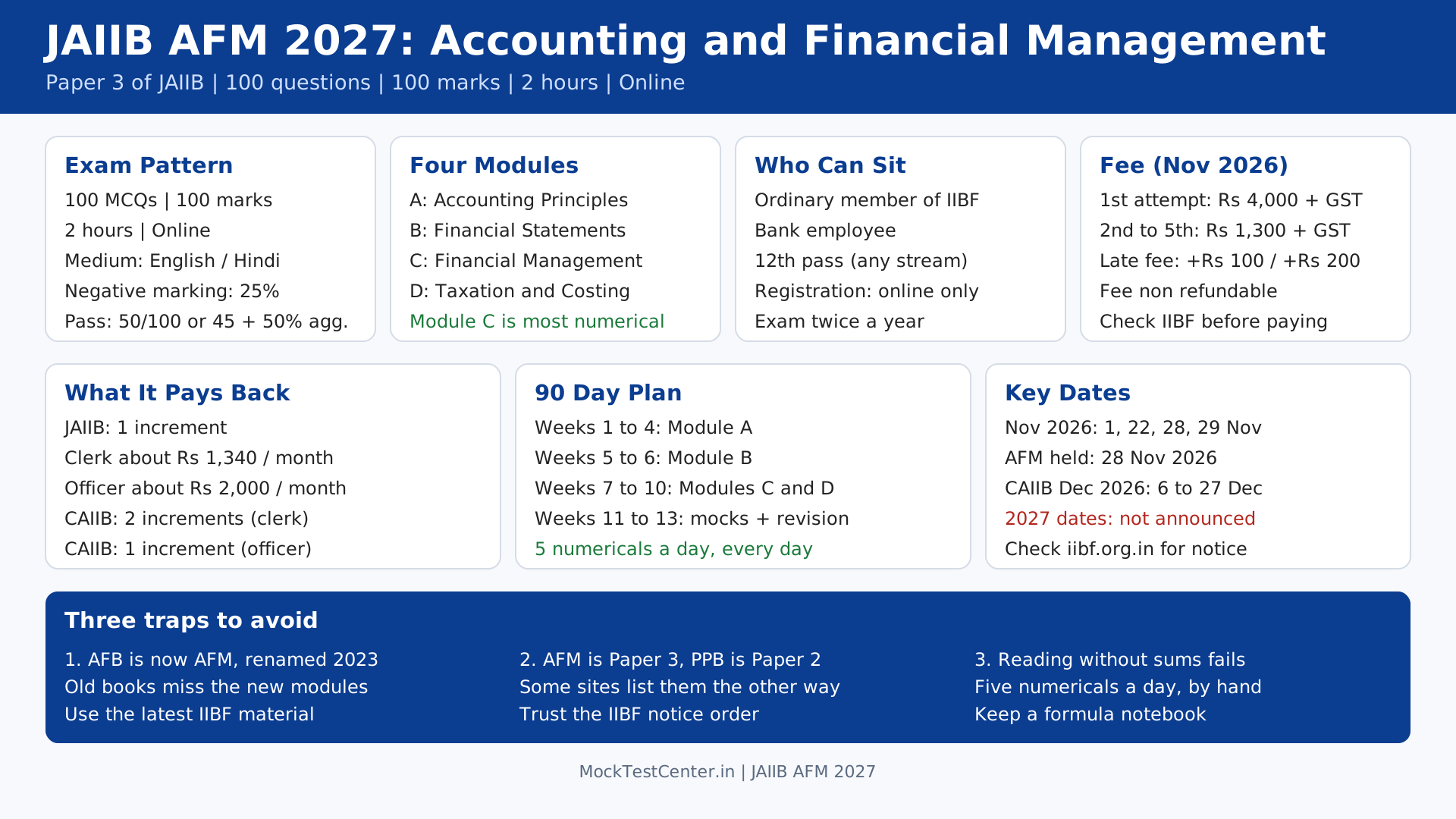
Accounting and Financial Management for Bankers, called AFM, is Paper 3 of the JAIIB exam. IIBF sets 100 multiple choice questions for 100 marks in the JAIIB AFM 2027 paper, and you get 2 hours. The pass mark is 50 out of 100 in this paper. There is a second route to pass.
If you score at least 45 marks in each paper and your aggregate is 50 percent across all papers in a single attempt, IIBF treats that as a pass too. That rule comes straight from the IIBF revised syllabus notice, so it is the official word on the pass mark. This guide covers the JAIIB AFM 2027 paper in full.
AFM is the numerical paper of JAIIB, and it is the paper that working bankers fear most. It asks you to prepare a bank reconciliation statement; work out depreciation two ways; read a balance sheet; compute ratios; find the yield to maturity of a bond; work out the cost of capital; and decide whether a project is worth the money. If you have not touched accounting since college, the syllabus looks long. It is long.
But the paper is fair. It tests the same set of calculations every cycle, and the calculations come from four modules that build on each other in order.
First, a correction that matters. The old name of this paper was Accounting and Finance for Bankers, shortened to AFB. The IIBF revised syllabus of 2023 renamed it Accounting and Financial Management for Bankers, shortened to AFM. The IIBF notice itself records the change: credits for AFB under the old syllabus carry over to AFM under the revised syllabus.
If you buy an old book or join an old course that says AFB, check that it teaches the revised syllabus, because the old AFB material misses the new modules. A second correction belongs here too. Some coaching sites list AFM as Paper 2 and PPB as Paper 3. The IIBF revised syllabus notice lists the papers in this order: Paper 1 Indian Economy and Indian Financial System, Paper 2 Principles and Practices of Banking, Paper 3 Accounting and Financial Management for Bankers, Paper 4 Retail Banking and Wealth Management.
The November 2026 date order backs this up. AFM was held on 28 November 2026, the third date, and PPB was held on 22 November, the second date.
The November 2026 cycle ran on four dates in November 2026. AFM was held on 28 November 2026, the third of the four dates. Indian Economy and Indian Financial System was held on 1 November. Principles and Practices of Banking was held on 22 November.
Retail Banking and Wealth Management was held on 29 November. The 2027 schedule is not out yet. IIBF had not announced the 2027 dates as of 19 November 2026, so this guide uses the 2026 cycle as the latest real cycle and says plainly where the 2027 dates are still unknown. Do not trust any site that prints 2027 JAIIB dates today, because no such dates exist yet.
One warning belongs right at the top. Several popular coaching sites print that JAIIB has no negative marking. The official IIBF revised syllabus notice says the opposite. It prescribes negative marking at 25 percent of the marks allotted to the question.
That means a wrong answer on a one mark question costs a quarter mark. The IIBF notice is the official document, so this guide treats 25 percent negative marking as the rule and tells you to check the current cycle notification before your exam. Guessing a numerical answer is a bad plan under that rule. Attempt a numerical only when your working gives you a clear answer, and attempt a theory question only when you can rule out at least one option.
What the paper actually tests
AFM has four modules, and each one has a distinct job. Module A is Accounting Principles and Processes. It covers accounting standards including Ind AS. It covers basic accountancy procedures.
It covers cash and subsidiary books. It covers bank reconciliation and trial balance. It covers rectification of errors and depreciation. It covers capital and revenue expenditure.
It covers bills of exchange and accounting entries in banks. It covers back office functions and bank audit. This module is the foundation. If you cannot do a bank reconciliation statement or a trial balance, the later modules will feel twice as hard.
Module B is Financial Statements and Core Banking Systems. It covers the balance sheet equation. It covers preparation of final accounts and company accounts. It covers cash flow and funds flow.
It covers final accounts of banking companies. It covers core banking systems and accounting in a computerised environment. This module is mostly theory, and it rewards reading over calculation. Learn how a bank final account differs from a company final account, and learn what each schedule in a bank balance sheet holds.
Module C is Financial Management. It covers an overview of financial management. It covers ratio analysis. It covers financial mathematics for interest and annuities.
It covers yield to maturity and forex arithmetic. It covers capital structure and cost of capital. It covers capital investment decisions and term loans. It covers equipment leasing and working capital management.
It covers derivatives too. This module is the most numerical of the four, and it is where the paper is won or lost. Ratios; interest; annuities; yield to maturity; and working capital carry the most questions.
Module D is Taxation and Fundamentals of Costing. It covers taxation on income tax. It covers tax deducted at source and deferred tax. It covers goods and services tax.
It covers an overview of cost and management accounting. It covers costing methods. It covers standard costing and marginal costing. It covers budgets and budgetary control.
This module mixes formulae with concepts. Learn the costing methods by their definitions first, then learn the variances and the budget types.
Put together, the four modules add up to a paper that rewards daily practice over reading. The IIBF study material for AFM runs long, and the questions come from all four modules, so skipping a module to save time usually costs more marks than it saves. The rest of this guide walks through each module in turn, with the topics that carry the most weight and the traps that catch the most candidates.
The JAIIB AFM 2027 pattern, the pass rule and the time limit
| Item | Detail for AFM |
|---|---|
| Paper number in JAIIB | Paper 3 of 4 |
| Questions | 100 multiple choice questions |
| Marks | 100 marks, 1 mark per question |
| Duration | 2 hours, 120 minutes |
| Mode | Online, computer based |
| Medium | English or Hindi |
| Negative marking | 25 percent of the marks allotted to the question, per the IIBF revised syllabus notice |
| Pass mark | 50 out of 100, or 45 in each paper with 50 percent aggregate in a single attempt |
| Modules | 4, named A to D |
You get five attempts to clear JAIIB, and those five attempts must fall within three years from the date you register for your first attempt. Whichever comes first ends the window. The five attempts need not be consecutive, so you can skip a cycle. But the clock keeps running whether you appear or not.
An attempt counts when you apply, even if you stay away from the exam hall. If the five attempts or the three years run out, you must enrol afresh, and the credits for papers you already passed lapse. That is the current rule under the revised syllabus. The old rule, four attempts in two years, no longer applies, so ignore any site that still prints it.
Passed papers stay passed inside the window. If you clear AFM and one other paper in your first attempt, you carry those two credits forward and sit only for the papers that remain. That matters for planning. It means you can aim to clear AFM early and bank the credit, then attack the other papers with your remaining attempts.
Class of pass is decided on the first physical attempt only, which is the attempt where you sit for a subject for the first time. First class needs 60 percent or more in aggregate with a pass in every subject. First class with distinction needs 70 percent or more in aggregate and 60 or more in each subject.
The exam runs twice a year, in a May and June cycle and a November cycle. Each paper sits on a separate date, usually a Sunday. A centre runs only where 20 or more candidates register, so pick your centre early. The November 2026 registration ran from 1 August to 21 August 2026, with late fee windows after that, and IIBF extended the last date into early September.
The exact extension dates differ between tracker reports, so this guide records only the announced window and the fact that an extension happened.
Module A: Accounting Principles and Processes
Module A starts with accounting itself. It covers its definition and its scope. It covers accounting standards including Ind AS. Learn what an accounting standard does before you learn any single standard by name.
A standard tells every preparer to treat the same transaction the same way, so that two balance sheets can be compared. The chapter covers the nature and purpose of accounting; historical perspectives; the new accounting system; origins of accounting principles; accounting standards in India and their definition and scope; generally accepted accounting principles of the USA; an overview of international financial reporting standards; the difference between GAAP and IFRS; and transfer pricing.
Ind AS is the Indian version of the international standards, and the paper asks what Ind AS changed for banks in particular. Learn that banks prepare their accounts under Ind AS in phases, and learn which items Ind AS treats differently from the old standards.
Basic accountancy procedures come next, and this chapter is the grammar of the whole paper. It covers concepts of accountancy; the going concern idea; the double entry system; the principle of conservatism; revenue recognition and realisation; and accrual and cash basis. The double entry system is the one idea you must learn cold. Every transaction has a debit and a credit of equal amount, and every question in Module A assumes you know that.
The going concern idea says the business will keep running, so assets are valued on that basis. Conservatism says you record a loss when you expect it, but you record a gain only when it is realised. Revenue recognition says you record income when it is earned, not when cash arrives. Accrual basis records income and expenses when they occur.
Cash basis records them when money moves. The paper tests the difference between accrual and cash basis again and again.
Maintenance of cash and subsidiary books and ledger follows; with record keeping basics; account categories; debit and credit concepts; accounting mechanics; and journalising. Then comes the bank reconciliation statement, and this is the most asked topic in Module A. The chapter covers recording transactions in the cash book; transactions contained in the pass book; whether the pass book is a mirror image of the cash book; causes for the pass book and the cash book being different; understanding reconciliation; preparing a reconciliation statement; the need for bank reconciliation; how to prepare the statement when extracts of the cash book and the pass book are given; adjusting the cash book balance; and the advantages of a reconciliation statement. Practise this chapter with numbers.
The paper gives you a cash book extract and a pass book extract and asks for the reconciled balance, and the only way to get it right is to have done twenty such sums before the exam. Learn the common causes of difference by heart: cheques issued but not presented; cheques deposited but not cleared; bank charges; direct deposits; interest credited by the bank; and errors in either book.
Trial balance, rectification of errors and adjusting and closing entries form the next block. Trial balance comes first in the block. It covers the meaning of a trial balance; its features and purpose; types of trial balance and preparation; disagreement of a trial balance; classification of errors; location of errors; rectification of errors; the suspense account; rectification when books are closed; and adjusting and closing entries. A trial balance is a list of all ledger balances, and its two sides must agree.
When they do not agree, the difference goes to a suspense account while you find the error.
Learn the types of errors that do not affect the trial balance, because the paper asks for them. An error of omission; an error of principle; a compensating error; and an error of commission in the wrong account all leave the trial balance agreeing; and that is exactly why they are hard to find.
Depreciation and its accounting is the next large block. It covers the meaning of depreciation; its causes; the need for depreciation; factors of depreciation; accounting entries; methods of depreciation; the straight line method; the diminishing balance or written down value method; advantages and disadvantages of each; the units of production method; the sum of the years digits method; replacement of a fixed asset and creation of a sinking fund; and amortisation of intangible assets. Practise the two main methods with numbers until the answers come without thinking. Under the straight line method, the same amount is charged every year.
Under the written down value method, the charge falls each year because it is a fixed percentage of a falling balance. The paper asks which method suits which asset, and it asks for the depreciation charge in a given year under each method. Learn the formulae, then do the sums.
Capital and revenue expenditure; bills of exchange; operational aspects of accounting entries; back office functions; and bank audit close Module A. Capital and revenue expenditure covers expenditure itself, the distinction between capital and revenue expenditure, and receipts. The distinction is simple to state and easy to get wrong in a question. Capital expenditure creates an asset or improves one.
Revenue expenditure keeps the business running day to day. Bills of exchange covers types of instruments of credit; term and due date of a bill; important terms; accounting entries; the accommodation bill; and bill books. Operational aspects of accounting entries covers the peculiar features of the accounting system in banks and the accounting systems of different banks. Back office functions covers the functions performed by the back office, the reconciliation function in banks, and reconciliation of inter branch and inter office entries.
Bank audit and inspection covers bank audit; risk based internal audit; concurrent audit; internal audit; statutory audit; and the role of audit and inspection. Learn the three audit types by who does them and when. Concurrent audit runs alongside the work. Internal audit is the bank own check.
Statutory audit is the external audit required by law.
Module B: Financial Statements and Core Banking Systems
Module B starts with the balance sheet equation, and this is the one equation that runs through the whole paper. Assets equal liabilities plus capital. Every transaction keeps that equation in balance, and every final account is a presentation of it. The chapter covers the balance sheet equation and computation of the balance sheet equation.
Learn to apply it to a short problem: if assets rise and liabilities stay still, capital must rise by the same amount. The paper asks that kind of question, and it is a free mark if you have practised it.
Preparation of final accounts follows. It starts with preparation of the trial balance. It continues with adjustment entries. It ends with preparation of financial statements from the trial balance.
Then company accounts in two parts. Company accounts one covers the definition and types of companies; the distinction between partnership and limited liability company; classes of share capital; issue of shares; general illustrations; and non voting shares. Company accounts two covers the form of the balance sheet and the impact of Ind AS on financial statements.
Learn the classes of share capital. Learn the difference between authorised capital and issued capital. Learn the difference between subscribed capital and paid up capital too. The paper asks for those definitions, and it asks what happens on issue of shares at a premium.
Cash flow and funds flow come next, and candidates mix these two up more than any other pair in the module. A funds flow statement shows the change in working capital between two dates. It answers where the funds came from and where they went. A cash flow statement shows the change in cash and cash equivalents, split into three heads: operating activities; investing activities; financing activities.
Learn the three cash flow heads and what goes in each. Operating activities cover the core business. Investing activities cover buying and selling assets. Financing activities cover raising and repaying capital and debt.
The paper asks you to classify a given item into one of the three heads, so learn the classification rules, not just the definitions.
Final accounts of banking companies is the most important chapter in Module B for a banker, because it describes the accounts of your own employer. It covers the definition and functions of a bank; requirements of banking companies as to accounts and audit; significant features of accounting systems of banks; principal books of account; preparation and presentation of financial statements of banks; accounting treatment of specific items; preparation of the profit and loss account; comments on profit and loss account items; important items of the balance sheet; disclosure requirements of banks to be added as notes to accounts; disclosures prescribed by RBI under Basel III; banks listed on a stock exchange; and implementation of Indian Accounting Standards. Learn how a bank profit and loss account is laid out, and learn the schedules of a bank balance sheet by name. The paper asks which item sits in which schedule, and the schedules are the answer key.
Learn the disclosure items too; because RBI requires banks to disclose their capital adequacy position; their asset quality; and their segment results; and the paper tests that.
Core banking systems and accounting in a computerised environment close Module B. It covers the meaning of computerised accounting; its features; terms used; the difference between computerised and manual accounting; its advantages and disadvantages; functions performed by computerised accounting; software available in the market; computerisation and its scope and experiences in banking; the core banking components; information security; and the influence of the internet and the world wide web on banking. This chapter is mostly theory, and it rewards reading. Learn the core banking components by name, and learn what changes when accounting moves from manual books to a computerised system.
The audit trail improves, the speed improves, and the control points move from the branch to the system.
Module C: Financial Management
Module C is the heart of the AFM paper, and it is where most candidates lose their marks. It opens with an overview of financial management: forms of business organisation; financial decision making in a firm; objectives of financial management; the fundamental principles of finance; building blocks of modern finance; the risk return trade off; the agency problem; business ethics and social responsibility; organisation of the finance function; the relationship of finance to economics and accounting; and the emerging role of the financial manager in India. The two ideas to learn cold are the objectives and the trade off. The objective of financial management is to maximise the value of the firm for its owners, not to maximise profit in a single year.
The risk return trade off says a higher expected return comes with higher risk, and no investment gives a high return with no risk. The agency problem is the conflict between the owners and the managers, and the paper asks how it is controlled.
Ratio analysis follows, and this is the most asked topic in Module C. It covers the meaning of accounting ratios; classification of ratios; uses of accounting ratios; limitations of accounting ratios; calculation and interpretation of various ratios; and the different users of ratios and their use. Ratios fall into four families, and you must learn all four. Liquidity ratios measure the ability to pay short term dues.
Solvency ratios measure the ability to pay long term dues. Activity ratios measure how well assets are used. Profitability ratios measure how much profit the business earns on its sales and its capital. For each ratio, learn the formula, learn what a high value means, and learn what a low value means.
A high current ratio means strong short term liquidity, but a very high one can mean idle assets. A high debt equity ratio means heavy borrowing, which lifts returns in good years and hurts in bad ones. The paper gives you a short set of figures and asks for the ratio, so practise with numbers until the formulae come without thinking. The limitations matter too.
Ratios compare the past, they depend on the accounting policies used, and they say nothing about the quality of management, so a ratio never tells the whole story on its own.
Financial mathematics comes in three parts, and each part needs its own practice. Calculation of interest and annuities covers simple interest; compound interest; fixed and floating interest rates; front end and back end interest rates; calculation of interest using products and balances; annuities; future value of an ordinary annuity; present value of an ordinary annuity; future value of an annuity due; present value of an annuity due; and repayment of a debt. Learn the difference between simple and compound interest first, then learn the annuity formulae. An ordinary annuity pays at the end of each period.
An annuity due pays at the start of each period. That one period shift changes the value, and the paper tests it. Calculation of yield to maturity covers the meaning of debt; introduction to bonds; terms associated with bonds; types of bonds; optionality in bonds; valuation of bonds; bond value with semi annual interest; current yield on a bond; yield to maturity of a bond; theorems for bond value; illustrations; duration of a bond; properties of duration; bond price volatility; and problems and solutions. Learn the bond price rule first: when the market rate rises above the coupon rate, the bond price falls below its face value, and when the market rate falls below the coupon rate, the bond price rises above its face value.
Duration measures how sensitive the bond price is to a change in rates, and the paper asks for that idea in words as often as in numbers. Forex arithmetic covers fundamentals of foreign exchange; the Indian forex market; direct and indirect quotes; basic exchange rate arithmetic; and forward exchange rates. Learn the direct quote and the indirect quote, and learn to convert one into the other, because the paper asks for the conversion.
Capital structure and cost of capital is the next large block. It covers the meaning of capital structuring; gearing; factors influencing the decision on capital structuring; theories and approaches on capital structuring; the net income approach; the net operating income approach; the traditional position; assumptions in the approaches; taxation and capital structure; cost of debt; preference and equity; determining the proportions; weighted average cost of capital; factors affecting the weighted average cost of capital; weighted marginal cost of capital; determining the optimal capital budget; divisional and project cost of capital; flotation cost and the cost of capital; and misconceptions surrounding the cost of capital. The weighted average cost of capital is the single most important calculation in this chapter. It blends the cost of each source of funds by its weight in the capital structure, and it is the rate a project must beat to be worth doing.
Learn the cost of each source separately first. Cost of debt is the interest rate after tax, because interest saves tax. Cost of preference shares is the dividend rate. Cost of equity is the return shareholders expect.
Then learn to blend them. The paper asks for the weighted average cost of capital from a short capital structure, and it asks what happens to it when the debt proportion changes.
Capital investment decisions and term loans, equipment leasing, working capital management, and derivatives close Module C. Capital investment decisions covers discounted and non discounted cash flow methods for investment appraisal; basic concepts of term loans; deferred payment guarantees; project financing; and the difference between term loan appraisal and project appraisal. Learn the two families of appraisal methods. Non discounted methods, like the payback period, ignore the time value of money.
Discounted methods, like net present value and internal rate of return, count it. Net present value is the value of all future cash flows at today rates minus the initial cost, and a project with a positive net present value adds value to the firm. Equipment leasing covers the meaning of a lease; features of a lease; types of leases; rationale for leasing; contents of a lease agreement; legal aspects of leasing; finance leases; operating leases; accounting of lease transactions in the books of lessor and lessee; and leasing as a financing decision. Learn the difference between a finance lease and an operating lease.
A finance lease transfers most of the risks and rewards of ownership. An operating lease does not. Working capital management covers the working capital cycle; cash and marketable securities; accruals; trade credit; working capital advance by commercial banks; the cash budget method of lending; regulation of bank finance; public deposits; inter corporate deposits; short term loans from financial institutions; rights debentures for working capital; commercial paper; and factoring and forfaiting. Learn the working capital cycle first: cash goes out to buy stock; stock is sold; the sale becomes a debtor; and the debtor pays; so cash comes back.
The length of that cycle decides how much working capital the business needs. Derivatives covers the characteristics and functions of derivatives; users of derivatives; futures; forward rate agreements; swaps; and options. Learn the four instruments by what they do. A future is a standardised contract to buy or sell later at a fixed price.
A forward is the same idea without standardisation. A swap exchanges one stream of payments for another. An option gives the right, but not the obligation, to buy or sell. The paper asks for those definitions, and it asks who uses each instrument and why.
Module D: Taxation and Fundamentals of Costing
Module D opens with taxation. It covers income tax. It covers tax deducted at source and deferred tax. It covers goods and services tax.
The income tax chapter covers an overview of the Income Tax Act; basic deductions in respect of certain incomes; and deduction sections 80QQB; 80RRB; 80TTA and 80U; tax deducted at source and tax collected at source; returns; refunds and recovery. Learn the idea of tax deducted at source first. It is tax collected at the point where income is paid, so the receiver gets the income after tax, and the payer deposits the tax with the government.
Deferred tax is the tax effect of timing differences between accounting income and taxable income, and the paper asks for that idea in words. The goods and services tax chapter covers the meaning of direct and indirect tax and an introduction to GST. Learn the direct and indirect distinction cold. A direct tax is paid by the person it is levied on.
An indirect tax is collected by one person and borne by another. GST is an indirect tax, and the paper asks for that classification.
An overview of cost and management accounting follows; with the evolution; meaning; objectives and scope of cost accounting; concepts of costs; classifications and elements of cost; cost centre and cost unit; methods and techniques of costing; cost accounting standards; and the same ground for management accounting; plus the tools and techniques of management accounting and the relationship between cost accounting; financial accounting; management accounting and financial management. Learn the three elements of cost first. They are material and labour and overhead. Every costing method in this module sorts costs into those three elements, so the elements are the key to the rest.
Learn the cost centre and cost unit too.
A cost centre is the place where a cost is collected. A cost unit is the unit in which the cost is measured.
Costing methods form the next block: unit and output costing; job costing with job cost cards; collecting direct costs; allocation of overheads; batch costing; contract costing with progress payments; retention money; escalation clause; contract accounts; accounting for material and plant used in a contract; contract profit and accounting entries; process costing with process loss; abnormal gains and losses; equivalent units; inter process profit; joint products; by products and accounting; service costing; unit costing and multiple costing; and identification of cost unit and cost determination and control. Learn each method by the industry it fits. Job costing fits one off jobs. Batch costing fits groups of identical items.
Process costing fits continuous production. Contract costing fits long projects. The paper asks which method fits a given business, and it asks for the treatment of process losses and abnormal gains, so learn those rules in particular. Equivalent units convert partly finished work into finished units for costing, and the paper tests that conversion.
Standard costing closes Module D. Marginal costing closes it too. Budgets and budgetary control close it as well. Standard costing covers its definition; significance and applications; types of standards; installation of a standard costing system for material; labour and overhead; variance analysis for materials; labour and overheads; accounting treatment of variances; benchmarking for setting standards; and variance reporting to management.
Learn the variance idea first. A variance is the difference between the standard cost and the actual cost, and it is favourable when the actual cost is lower than the standard.
The paper asks for variances on all three elements, so learn each one. Marginal costing covers its meaning; advantages; limitations and applications; breakeven analysis; cost volume profit analysis; the profit volume ratio and its significance; margin of safety; absorption costing; the difference between marginal costing and absorption costing; and income measurement under each. Learn the breakeven point first: it is the sales level where total revenue equals total cost, so profit is zero. Margin of safety is sales above the breakeven point, and the paper asks for both.
Budgets and budgetary control covers the budget concept; budget manual; fixed and flexible budgets; preparation and monitoring of various types of budgets; the budgetary control system with its advantages; limitations and installation; zero based budgeting; and programme and performance budgeting. Learn the fixed and flexible distinction. A fixed budget stays still whatever the output. A flexible budget changes with the output, and the paper asks which one to use when output changes.
How to practise numericals without burning out
AFM is won on the desk, not in the book. Read a chapter once, then close the book and do the sums. Keep a formula notebook with one page per topic: ratios on one page, annuities on one page, yield to maturity on one page, weighted average cost of capital on one page, variances on one page, breakeven on one page. Write the formula at the top of the page and three worked examples below it.
Read that notebook every morning for ten minutes, and the formulae will stay in your head through the exam. Do five numericals a day, every day, from the start of your preparation. Five a day for ninety days is 450 numericals, and that is enough to cover every type the paper asks. Do them by hand first, then check with a calculator.
The exam gives you an on screen calculator, but a hand worked answer teaches the method, and the method is what the paper tests.
Time yourself from the fourth week onward. A 100 question paper in 120 minutes gives you about 72 seconds per question, and a numerical takes longer than a theory question. Practise finishing a full mock test inside 2 hours, and practise leaving a hard numerical after two minutes instead of fighting it. A question you skip costs one mark.
A question you fight for ten minutes costs five other questions. That trade is the whole exam strategy for AFM. Review every wrong answer the same day, and write the correct method in your formula notebook. A mock test you never review is time spent, not learning done.
Who can sit, what it costs, and what it pays back
JAIIB is not an open public exam. You must be an ordinary member of IIBF, and you must work in a bank or financial institution whose employer is an institutional member of IIBF. That covers public sector banks; private banks; regional rural banks; cooperative banks; foreign banks; and other financial institutions. The education bar is a pass in the 12th standard, in any discipline, or its equivalent.
You need your membership number to register, and registration is online through the IIBF portal. The fee is paid separately for every attempt, and it is not refunded or adjusted once paid.
The fee for the November 2026 cycle was Rs 4,000 plus GST for the first attempt; and Rs 1,300 plus GST for the second to fifth attempts; with convenience charges extra. At 18 percent GST, the first attempt works out to about Rs 4,720 in total before convenience charges. Late registration adds Rs 100 in the second week and Rs 200 in the third week. One tracker site still prints Rs 2,700 as the first attempt fee, and that figure is stale.
It matches an older fee, not the November 2026 cycle. Five separate tracker reports agree on Rs 4,000 for the 2026 cycle; so this guide uses Rs 4,000 and flags the Rs 2,700 figure as out of date. Fees change between cycles, so check the current IIBF notification before you pay.
Clearing JAIIB brings one extra increment in most banks, for clerical staff and for officers alike. The amount is about Rs 1,340 a month for a clerk and about Rs 2,000 a month for a probationary officer; though one tracker prints Rs 1,350 for clerks; and the exact amount depends on your bank and the settlement in force. Clearing CAIIB after JAIIB brings two increments for clerical staff and one increment for officers, worth about Rs 2,680 a month for a clerk and about Rs 4,000 a month for an officer. JAIIB and CAIIB together add about Rs 4,020 a month for a clerk and about Rs 6,000 a month for an officer.
Those are approximate figures from tracker reports, not IIBF figures, because IIBF does not fix your pay. Your bank does. The certificate also helps at promotion time, and CAIIB needs JAIIB passed first, so JAIIB is the gate to the whole ladder.
The accounting and finance knowledge that AFM tests shows up in the specialist recruitment exams too. A candidate who has worked through AFM will find the accounting and finance parts of IBPS SO 2027; IBPS RRB Clerk 2027; IDBI JAM 2027; ECGC PO 2027; SIDBI Grade A 2027; PFRDA Grade A 2027; IRDAI Assistant Manager 2027; IFSCA Grade A 2027; FSSAI Technical Officer 2027 and UGC NET Commerce 2027 easier to handle; because those exams ask about the same balance sheets; the same ratios; and the same costing ideas. That is a side benefit, not the reason to sit for JAIIB, but it is a real one for a banker who also watches the recruitment calendar.
A 90 day plan for JAIIB AFM 2027 that fits a working banker
| Weeks | What to do | Hours a week |
|---|---|---|
| 1 to 2 | Read Module A: accounting standards and double entry. Read the bank reconciliation chapter too. Do 5 bank reconciliation sums and 5 trial balance sums. | 9 |
| 3 to 4 | Finish Module A: depreciation, bills of exchange, and bank audit. Start the formula notebook. Take one mock test on Module A. | 9 |
| 5 to 6 | Read Module B: balance sheet equation and final accounts. Read the cash flow and funds flow chapter too. Practise classifying cash flow items. | 8 |
| 7 to 8 | Read Module C: ratio analysis and interest and annuities. Do 5 ratio sums and 5 annuity sums a day. | 10 |
| 9 to 10 | Finish Module C: yield to maturity and cost of capital. Cover working capital and derivatives. Read Module D: taxation and costing. | 10 |
| 11 | Full syllabus revision from the formula notebook. Two full mock tests, 100 questions each, timed at 2 hours. | 10 |
| 12 | Weak area repair only. One mock test every alternate day, with error review the same evening. | 10 |
| 13 | Final revision of formulae and ratio definitions. Revise the variance rules too. One last mock test three days before the exam, then rest. | 6 |
The plan assumes about nine to ten hours a week, which fits a branch job if you protect one hour a day and a longer sitting on a holiday. Read the IIBF study material first and use other books only to fill gaps. Macmillan publishes an AFM guide that many candidates use alongside the IIBF material. Take a mock test every week from week four onward, and always review the wrong answers the same day.
Keep the formula notebook beside you during every mock test review, and add every method you got wrong to it. That notebook is your revision kit in the last week.
Mistakes that cost marks in JAIIB AFM 2027
The first mistake is reading without doing sums. AFM punishes readers who never pick up a pen. If you have read a chapter and done no numericals from it, you have not studied it. The second mistake is mixing up the two flow statements.
Funds flow shows the change in working capital. Cash flow shows the change in cash. Candidates who learn one definition and apply it to both lose marks in Module B every cycle. The third mistake is ignoring the negative marking rule.
If you believe the coaching sites that print no negative marking, you will guess on every numerical you cannot solve, and each wrong guess will cost a quarter mark under the IIBF rule. Guess a numerical only when your working gives you a clear answer.
The fourth mistake is studying from old AFB material. The paper was renamed and restructured in the 2023 revised syllabus, and old books miss the new modules and print the old pattern. Use the latest IIBF study material and check the current cycle notification. The fifth mistake is spending too long on one hard numerical in the exam.
A 100 question paper in 120 minutes gives you about 72 seconds per question, so leave a hard sum after two minutes and come back only if time remains. The sixth mistake is leaving the paper number confusion unresolved. If you prepare from a site that calls AFM Paper 2, you may download the wrong syllabus. AFM is Paper 3, PPB is Paper 2, and the IIBF notice is the authority.
Start with Module A, do five numericals a day, and keep one hour a day protected for ninety days. That is the whole method. The paper rewards a banker who did the sums, learned the formulae and sat the mock tests.
Sources
IIBF revised syllabus notice for JAIIB and the other courses (DB and F, SOB, CAIIB), dated 30 August 2022, on the official IIBF site: IIBF revised syllabus notice (PDF). This is the source for the four paper names and order; the module names; the 100 question and 120 minute pattern; the 25 percent negative marking rule; the 50 mark pass rule with the 45 mark aggregate route; the five attempts in three years rule; and the AFB to AFM rename. The IIBF home page is at iibf.org.in.
Other sources used for dates; fees; and syllabus detail; checked on 19 November 2026: Adda247 JAIIB AFM syllabus page; module wise topics for Modules A; B; C and D; and the November 2026 exam dates; Oliveboard JAIIB syllabus and credit retain pages; for the five attempts in three years rule and the increment figures; the November 2026 admit card notice reported on 28 October 2026; for the paper wise dates of 1; 22; 28 and 29 November 2026; the JAIIB November 2026 fee reports from five tracker sites; all printing Rs 4,000 plus GST for the first attempt and Rs 1,300 plus GST for later attempts; and the CAIIB December 2026 schedule reports; for the 6; 12; 13; 20 and 27 December 2026 dates. The Rs 2,700 first attempt fee printed by one tracker site was treated as stale and not used.